Showing posts with label Medical Negligence. Show all posts

Wednesday, November 14, 2012

‘Too ill to work’ yet Ex-SLCC Chief Eileen Masterman resurfaces in Scottish Public Services Ombudsman investigation into death of baby at NHS Forth Valley Hospital

MacAskill meets Masterman, yet months later the SLCC complaints chief left on ‘ill health’ grounds.IT has been pointed out to Scottish Law Reporter that Eileen Masterman, the ‘too ill to work’ former Chief Executive of the Scottish Legal Complaints Commission (SLCC) who was reported to have received a substantial, secret payoff personally signed off by Justice Secretary Kenny MacAskill, swiftly returned to her previous employers at the Scottish Public Services Ombudsman (SPSO) to investigate complaints made by members of the public against public bodies poorly regulated by the SPSO.

Scottish Law Reporter last featured a report on Eileen Masterman’s bitter exit from the Scottish Legal Complaints Commission, negotiated by lawyers and backed up by the Justice Secretary in a rather strange, secret deal involving a huge payout, the size of which appears to have been buried in either the SLCC’s annual accounts, or those of the Scottish Government.

The popular law blog, Diary of Injustice featured an investigation into a cruel case involving the death of a baby at an NHS Forth Valley hospital, which was investigated by Eileen Masterman in her position as a “Complaints Reviewer” at the SPSO. The Diary of Injustice report raises serious concerns as to how & why Mrs Masterman was able to return to work in the public sector so quickly after being accused by the Scottish Government’s Finance Secretary John Swinney of lying over secret meetings with corrupt US Insurance Giant Marsh :

Deputy First Minister to look into death of baby McKenzie Wallace after parents complain of ‘whitewash’ report by SPSO investigator Eileen Masterman

Death of baby McKenzie Wallace montageHealth Minister to look into NHS failures in case of death of baby in NHS Forth Valley hospital & SPSO report whitewash. SCOTLAND’S DEPUTY FIRST MINISTER Nicola Sturgeon has said she will look into the case of the death of little baby McKenzie Wallace at an NHS Forth Valley hospital after an exclusive report in the Sunday Mail newspaper revealed the baby’s grieving parents have fought a long & difficult battle to get answers over why little McKenzie died. The report in the Sunday Mail also revealed NHS Forth Valley FAILED to pick up on a rare heart defect in the couple’s baby which should have been detected during a 20 week scan but was missed after the scan, conducted by a trainee under the supervision of an experienced midwife was not properly interpreted. However, a senior consultant obstetrician who later studied the ultrasound pictures from the Stirlingshire hospital found a heart problem was visible and had been missed by both the midwife & the trainee.

On receipt of a further report into the tragedy, the family have accused the Scottish Public Services Ombudsman (SPSO) ‘Complaints Reviewer’, Eileen Masterman of producing a ‘whitewash’ report in the SPSO’s investigation of their complaints against NHS Forth Valley regarding the deadly failures in the provision of medical services which ultimately led to the death of McKenzie Wallace just five days after she was born.

While the death of baby McKenzie has been a terrible toll in itself for the family to bear, the nightmare continued when their complaints to NHS Forth Valley over the events which led to the death of their child were mishandled, leading to the family using Freedom of Information legislation to uncover more facts not disclosed by NHS Forth Valley during their investigations and ultimately, making a complaint to the Scottish Public Services Ombudsman who used an unnamed ‘expert’ to exonerate the hospital’s role in the death of the child.

The files accumulated by the family in their complaint to NHS Forth Valley can be read here : Complaint to NHS Forth Valley - Death of Baby McKenzie Wallace The responses received from NHS Forth Valley can be viewed here : NHS Forth Valley FOI - Death of Baby McKenzie Wallace and the report by the Scottish Public Services Ombudsman into the way the hospital handled the case, can be viewed here : SPSO Report - Death of Baby McKenzie Wallace

m2Former SLCC Chief Executive Eileen Masterman wrote SPSO report which exonerated negligent medical staff at NHS Forth Valley. In what may come as a surprise to many, the author of the SPSO report now branded a whitewash is none other than Eileen Masterman, former Chief Executive of the Scottish Legal Complaints Commission (SLCC), who took a six month sick leave from the SLCC and then employed teams of lawyers to negotiate a massive SECRET PAYOFF so large & subject to such a complex agreement, the secret deal was required to be signed off personally by Scotland’s Justice Secretary, Kenny MacAskill. Legal insiders commenting on the case said today they were shocked to see Eileen Masterman show up again at the Scottish Public Services Ombudsman so soon after resigning under a cloud from the Scottish Legal Complaints Commission, with an official explanation of “ill health”.

mkmc slcc openingFOI investigations by Diary of Injustice revealed Justice Secretary MacAskill personally signed off secret unpublished payment to Eileen Masterman. One Scottish Government insider who now claims he “did not agree with the terms of the settlement as put to Mr MacAskill” said the Justice Secretary was out on a limb over his involvement in the secret payoff to Masterman. The insider called for all details of the negotiations involving Ms Masterman, the SLCC & the Scottish Government along with the amount of the secret payoff to be made public.

The Scottish Government insider said : “Clearly there is a public confidence issue here were someone can resign from the highly controversial and underperforming Scottish Legal Complaints Commission claiming ill health and then go back to work at the highly questionable Scottish Public Services Ombudsman who have similar public confidence issues. There must be full transparency here otherwise there can be no confidence in the SPSO.”

One senior solicitor who does not wish to be named has already claimed the Scottish Legal Complaints Commission had been told during the “bitter negotiations” that “Eileen Masterman’s health was so bad that she may never work again”. It has also been alleged that involvement from Cabinet Secretary for Finance John Swinney, who accused Ms Masterman of lying over secret meetings she took part in with convicted US insurers Marsh who handle the Law Society of Scotland’s notoriously corrupt Master Policy protection for negligent solicitors also ‘contributed to Ms Masterman’s alleged ill health’, an issue reported earlier by Diary of Injustice here : SLCC’s Eileen Masterman resigns, questions remain on attempt to mislead Cabinet Finance Chief John Swinney over secret meetings with insurers Marsh

However it appears after only a few months of leaving the SLCC, Eileen Ms Masterman was re-employed by Jim Martin, the Scottish Public Services Ombudsman, whose organisation was savaged last year by Scottish Government Minister Alex Neil during his testimony to the Scottish Parliament’s Petitions Committee, which Diary of Injustice reported along with video footage of Minister Neil’s testimony, here : Holyrood considers nine petitions against Scottish Public Services Ombudsman as Housing Minister dubbed ‘out of touch’ over accusations

The Sunday Mail newspaper spoke to the parents about their views of Ms Masterman’s report on the death of their baby. The Sunday Mail reported : “The couple have also criticised a report issued last month by Eileen Masterman, of the Scottish Public Services Ombudsman. She rejected the view of the Forth Valley doctor. Instead, she agreed with an unnamed expert who said there was no need for a second scan due to the limited nature of what could be seen. She said: “The advice indicated that, even if the scan had been done again, it would have been likely the results would have been the same.”

Andrew said: “I have no faith in Masterman. The SPSO have refused to say who the expert is or hand over their report. “McKenzie’s death cannot be for nothing. Some sort of lesson has to be learnt.”

spso-logoSPSO refused to issue any comment on Eileen Masterman’s report. The Scottish Public Services Ombudsman was asked for media comment on Ms Masterman’s position at the SPSO and to explain how she was able to return to work so soon. One of it’s Press Officers said : “I am sorry but we are unable to comment on the employment status of individuals. This would be unfair to those individuals and in breach of data protection.” Later, the SPSO angrily REFUSED to disclose any material in response to Freedom of Information requests regarding Ms Masterman’s apparent speedy return to work at the SPSO, with SPSO officials blocking all further attempts to secure disclosures via Freedom of Information legislation.

Nicola SturgeonScottish Deputy First Minister & Health Secretary Nicola Sturgeon MSP. Deputy First Minister & Scotland’s Health Secretary, Nicola Sturgeon was asked by Diary of Injustice for a comment on the tragic events and the SPSO’s handling of baby McKenzie’s parents complaints against NHS Forth Valley. Questions put by Diary of Injustice journalists to Ms Sturgeon, which were accompanied by papers relating to the case asked : “Has the Health Minister any comment on how the complaint involving the death of the baby has been handled, the fact this family have received little support in spite of what appears to be a cover up by NHS Forth Valley, and why can one individual who travels between regulators show up again in an old post to carry on her work after claiming she could never work again.”

A spokesperson for the Scottish Government replied to the questions put to the Health Secretary, stating : “The circumstances surrounding this event are extremely tragic, and our thoughts are with the parents. Where recommendations are made in an Ombudsman’s report, we expect NHS Boards to fully implement all necessary steps to ensure that similar circumstances do not recur.”

The spokesperson continued : “The SPSO is an organisation independent of the Scottish Government and as such appoints its own personnel. The circumstances surrounding any appointment of any individual is a matter for the SPSO.”

The parents of baby McKenzie have since received a letter from the Scottish Government replying on behalf of Scottish Health Secretary Nicola Sturgeon. Andrew & Joanne have now been told Ms Sturgeon has agreed to look at the papers relating to the circumstances of baby McKenzie’s death, and how Andrew & Joanne were treated by NHS Forth Valley & the SPSO. Ms Sturgeon also offered her condolences in the letter to Andrew & Joanne over baby McKenzie’s death. The parents of baby McKenzie have also asked for a meeting with Ms Sturgeon over the case.

Clearly, the tragic case of the death of little baby McKenzie Wallace, just five days into her live is yet another clear demonstration of medical negligence in the NHS and the cover ups which kick in to prevent any justice for the bereaved family. The family deserve answers and the life of a child cannot be lost in an SPSO report or a promise of “lessons will be learned” which are, as we are all now sadly too aware, never learned.

The Sunday Mail reports :
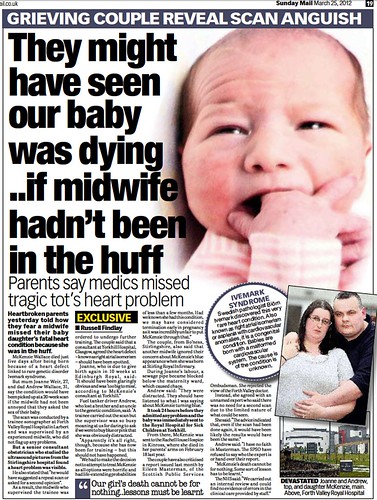
Grieving parents say medics missed tragic toddler's heart problem Sunday Mail March 25 2012Grieving parents say medics missed tragic toddler's heart problem

Mar 25 2012 Exclusive by Russell Findlay

HEARTBROKEN parents yesterday told how they fear a midwife missed their baby daughter’s fatal heart condition because she was in the huff. McKenzie Wallace died just five days after being born because of a heart defect linked to rare genetic disorder Ivemark syndrome.

But mum Joanne Weir, 27, and dad Andrew Wallace, 31, say the condition would have been picked up at a 20-week scan if the midwife had not been annoyed that they asked the sex of their baby. The scan was conducted by a trainee sonographer at Forth Valley Royal Hospital in Larbert and was supervised by an ­experienced midwife, who did not flag up any problems.

But a senior consultant obstetrician who studied the ultrasound pictures from the Stirlingshire hospital found a heart problem was visible. He also stated that “he would have suggested a repeat scan or asked for a second opinion”. As a result, the midwife who supervised the trainee was ordered to undergo further training. The couple said that a consultant at Yorkhill Hospital, Glasgow, agreed the heart defect – known as right atrial isomerism – should have been spotted.

Joanne, who is due to give birth again in 10 weeks at Edinburgh Royal, said: “It should have been glaringly obvious and was ‘too big to miss’, according to McKenzie’s consultant at Yorkhill.”

Fuel tanker driver Andrew, who lost a brother and an uncle to the genetic condition, said: “A trainee carried out the scan but the supervisor was so busy moaning at us for daring to ask if we were to buy blue or pink that she was obviously distracted.“Apparently it’s all right, though, because she has now been for training – but this should not have happened.

“We had to make the decision not to attempt to treat McKenzie as all options were horrific and had life-extending probabilities of less than a few months. Had we known she had this condition, we may have considered ­termination early in pregnancy as it was incredibly unfair to put McKenzie through that.”

The couple, from Bo’ness, Stirlingshire, also said that another midwife ignored their concern about McKenzie’s blue appearance when she was born at Stirling Royal Infirmary. During Joanne’s labour, a sewage pipe became blocked below the maternity ward, which caused chaos. Andrew said: “They were distracted. They should have listened to what I was saying about McKenzie turning blue.”

It took 24 hours before they admitted any problem and the baby was immediately sent to the Royal Hospital for Sick Children at Yorkhill. From there, McKenzie was sent to the Rachel House Hospice in Kinross, where she died in her parents’ arms on February 18 last year.

The couple have also criticised a report issued last month by Eileen Masterman, of the Scottish Public Services Ombudsman. She rejected the view of the Forth Valley doctor. Instead, she agreed with an unnamed expert who said there was no need for a second scan due to the limited nature of what could be seen. She said: “The advice indicated that, even if the scan had been done again, it would have been likely the results would have been the same.”

Andrew said: “I have no faith in Masterman. The SPSO have refused to say who the expert is or hand over their report. “McKenzie’s death cannot be for nothing. Some sort of lesson has to be learnt.”

The NHS said: “We carried out an internal review and could find no evidence of errors in the clinical care provided by staff.”

Monday, July 23, 2012

Master Policy favourites Brechin Tindal Oatts hire another partner for insurers representation team

LEGAL firm Brechin Tindal Oatts  (bto), with offices in Glasgow & Edinburgh have added another partner to their team representing insurers, professional defence unions such as the Medical Defence Union, & other vested interests.

Seonaid Busby, who joined the team on 23 July 2012 from Biggart Baillie, will work closely with Partner and Solicitor Advocate Stephen Bryceland dealing with motor, employers’ liability and public liability personal injury claims.  Along with Stephen, Seonaid will be responsible for supervising a large team who deal with higher volume, lower value claims.

Ms Busby has specialised in insurance litigation for the most part of her career focusing on defender reparation cases in both the Sheriff Court and Court of Session. She is vastly experienced in dealing with employers’ liability, public liability, road traffic accidents and occupational disease claims. 

Bill Speirs, head of bto’s Insurers’ Representation team, said: “Seonaid is a valuable addition to bto’s team of over 50 insurance professionals. She brings experience of both pursuer and defender work and exposure to a range of stakeholders in the insurance sector. Her in-depth knowledge of the insurance market and her supervisory skills will further enhance the offering provided by Stephen’s team focusing on economy for volume claims".

“Recognising the importance of economy and efficiency in dealing with such matters, our bespoke team provides a first rate service to insurers specifically targeted at early settlement and minimising costs in litigated claims.  Stephen Bryceland’s role as Solicitor Advocate is an essential and effective way of avoiding unnecessary cost in the increasing number of Court of Session actions raised for minor or low-value claims.”

The appointment takes bto's partner strength to 35. Its Glasgow and Edinburgh offices have a total of over 170 staff.

Brechin Tindal Oatts are also Master Policy Panel solicitors, providing defence to solicitors (you mean ‘crooked’ – Ed) accused of negligence and other wrongdoing covered by the Master Policy. The firm also receives instructions from professional defence unions such as the Medical Protection Society and the Medical and Dental Defence Union of Scotland in connection with legal actions against doctors & other medical services personnel.

Got a story to tell about BTO, anything we’ve missed out ? Don’t be shy, tell Scottish Law Reporter more..

Saturday, February 05, 2011

'Medics should be prosecuted' says father of teenage daughter who died of paracetamol overdose at Glasgow's Southern General Hospital

A grieving father has called for Doctors at the Southern General Hospital in Glasgow to be prosecuted after his daughter died from a massive overdose of paracetamol painkillers, details of which came to light in a Fatal Accident Inquiry undertaken by Sheriff Andrew Cubie who ruled her death in 2008 could have been avoided - but made no recommendations.

The report from the Daily Record newspaper follows :

Grieving dad plans court action after paracetamol overdose leads to daughter's death

Feb 5 2011 Craig McDonald

A HEARTBROKEN dad yesterday called for medics to be prosecuted after his daughter died from a massive overdose of painkillers.

Danielle Welsh, 19, was given almost double the recommended amount of paracetamol at Glasgow's Southern General Hospital.

Her father John blasted: "The hospital staff have killed Danielle - why is no one being prosecuted?"

Danielle, who was just 4ft tall because of a condition that affected her growth, died from liver failure because of the overdose.

A fatal accident inquiry yesterday ruled her death in 2008 could have been avoided - but made no recommendations.

John asked: "What's the point in having a 12-day inquiry for the sheriff to sit on the fence at the end of it?

"He should be condemning the medical staff for their actions but he's basically saying, 'Mistakes have been made and that's it'. We are devastated - and that's putting it mildly."

John, from Glasgow, added: "I am a driver with the council and if I was to knock someone down, I would expect to be prosecuted. Why are medical people treated differently?

"They don't seem to be accountable for their actions, even when they get it badly wrong. There has been no action taken against those responsible - no sacking, no suspension, nothing.

"Our lives have been ruined."

He said that he would "definitely" be looking at taking further legal action against those involved.

In a written ruling, sheriff Andrew Cubie said Dr Shamita Das and pharmacist Lesley Murray should have checked Danielle's dosage as intravenous paracetamol was not commonly used. And he said nursing staff should also have checked the appropriate dosage for her weight.

Last July, Dr Das told the inquiry at Glasgow Sheriff Court that she prescribed an adult dose of intravenous paracetamol for Danielle on June 18, 2008, not realising how light she was.

The teenager was seen by 11 nurses and 12 different doctors and received 20 doses ofparacetamol. Not one of the doctors noted the overdose.

Sheriff Cubie said medical staff had "misplaced assumed familiarity" with paracetamol because it was so common.

He added: "There was no shortage of information about the intravenous administration if the medical personnel had felt the need to check. The tragedy is that no one did."

Greater Glasgow Health Board have since changed their guidelines.

But John said her family - including mum Margaret and Danielle's sister and brother, Catherine, 24, and Martin, 18 - had been left with "no faith or trust" in hospitals or doctors.

Saturday, March 28, 2009

Medical negligence soars in Scotland as NHS pays out £5.25million for birth error case

Scotland has seen its biggest NHS payout for medical negligence which is on an increasing trend in Scotland.

While the NHS paid out £5.25m in this particular case, you can bet a substantial amount so far undisclosed went on legal teams attempting to defend against the action and defeat the family’s claim, who apparently spent years battling for compensation …

The Herald reports :

NHS pays record £5.25m for birth blunder

Exclusive by MARTIN WILLIAMS March 27 2009

The family of a boy left severely disabled at birth by a hospital blunder has received £5.25m in Scotland's biggest NHS compensation payout.

News of the award comes as new figures provided to The Herald show that clinical negligence payouts have reached epidemic levels in recent years, rising six-fold in just under 10 years.

The latest payout is at least £1.3m more than the total annual negligence bill for the whole of NHS Scotland for each year between 1997 and 2001.

Compensation claims in Scotland have totalled a staggering £37.5m in the last two financial years.

The boy's family had battled for years for compensation for their son, who is now aged nine, after they made a claim against the former Argyll and Clyde Acute Hospitals NHS Trust.

The record award was made by the two health boards, NHS Greater Glasgow and Clyde and NHS Highland, which took over the defunct board's responsibilities.

Details of the boy's case only came to light when his family made an application to the Court of Session for the release of £500,000 of the payout to buy a suitably adapted house.

It has led to new concerns about the number of negligence cases that are being dealt with out of court, ensuring there is no public explanation of what happened and what lessons could be learned from any mistakes made.

In 2007 the NHS in Scotland paid out a record £23m in compensation payments because of medical blunders. It amounted to two-and-a-half times the previous record paid out the year before, described then by the Scottish Government as "exceptional".

In 1997/98 the total paid out for clinical negligence by all health boards in Scotland was just £3.5m. It fell to just under £3m in 1999/2000, before rising to just under £4m the following year.

The sums paid out began to rise over the next few years, with annual payments totalling around £9m until 2004/05.

In 2007, some 9123 people were injured or killed by NHS staff error.

The burden of the £5.25m payout will be shared between NHS Greater Glasgow and Clyde and NHS Highland.

The sum eclipses the £3m handed over by NHS Tayside in what is now the second-biggest compensation payout for medical negligence.

NHS Greater Glasgow and Clyde would not provide full details of what happened or say whether an investigation was carried out.

The trust released a short and carefully prepared statement in response to The Herald's questions. It said: "I can confirm the NHS has made an out-of-court settlement to the family following the claim against the former Argyll and Clyde Health Board regarding the very sad circumstances that surrounded the birth of the family son in 1998."

No official from NHS Highland could be contacted.

Prominent legal experts say they are not surprised at the rising number of negligence payouts and believe there are more to come.

One lawyer, who asked not to be identified, said: "All the negligence claims I have dealt with involving a health board have all at some point ended up being dealt with out of court. It is all so predictable.

"Either the family involved gets cold feet because they feel there is too much risk and they cannot afford to take it all the way, or the health board settles before the case ever comes to court."

An interesting Editorial on Medical Negligence from the Herald also accompanies the above article :

Medical negligence

Money can never truly compensate for a catastrophic injury caused by avoidable medical negligence, but it can make a world of difference to the quality of that person's life. Today The Herald reveals that Scotland has witnessed its largest ever payout to a boy left severely disabled after a medical blunder during his birth: £5.25m.

However, while the total paid in medical negligence settlements has risen six-fold in recent years, Scotland still lags a long way behind England in the number and level of payments. The notion of Scotland as a "compensation culture", with "ambulance-chasing lawyers" bringing opportunistic actions is a myth. In fact, recently the number of claims north of the border has fallen and total expenditure is only rising because of a handful of very serious cases, predominantly children with cerebral palsy and requiring lifelong round-the-clock care.

Why is the level of compensation south of the border more than four times higher per capita than in Scotland? In England, the shrinking of the legal aid budget has led to the rise of the "no win, no fee" negligence case.

In Scotland, however, pursuers are reluctant to use this mechanism because the cost of insuring against losing such cases is not included as part of the settlement.

Not that no win, no fee offers any sort of panacea. Recent publicity has revealed that the fees charged by lawyers often account for more than half of the settlement and sometimes bear no relation to the work actually done. This is not merely distasteful. It is against the interests of taxpayers. The NHS budget should be paying for doctors and nurses, not lawyers. The more spent on lawyers' bills, the less there is for treating patients.

In its manifesto, the SNP promised to reform and simplify the payment of medical negligence but may now be baulking at the cost. The favoured model is the one operating in Denmark, which is more like British criminal injuries compensation than the present adversarial system for negligence cases.

It would certainly cost more than the current system, but patients who suffer avoidable injuries at the hands of doctors deserve to be compensated by society. At present, too many of them end up with nothing because of the paucity of legal aid and fear of losing.

Courts will continue to have a role to play in serious and complex claims such as cerebral palsy cases. Many of those who are compensated have to go through a long and arduous ordeal and almost invariably end up with an out-of-court settlement. This is in nobody's interests. It lacks transparency. It encourages a culture of denial and blame. And it is poorly aligned to learning lessons from systemic failures.

For all its faults, the English system involves the early sharing of relevant information between pursuer and health authorities. This results in more cases being dropped at an early stage and also more early settlements. There is no obvious reason why such pre-action protocols could not be employed in Scotland.

Wednesday, March 11, 2009

Scots legal firm Brodies & Dean of Faculty threaten Parliament over asbestos claims legislation

Legislation designed to allow sufferers of medical illness related to asbestos exposure is to be challenged by the insurers, who have taken on legal representation in the form of Edinburgh legal firm Brodies LLP, and Richard Keen QC, the Dean of the Faculty of Advocates

Peter Cherbi’s “A Diary of Injustice in Scotland” reports the insurers idea is a judicial review against Parliament’s law making powers on this legislation :

Insurance firms with links to Scottish Government threaten legal challenge against Holyrood on asbestos claims reforms


richard keen qcDean of Faculty Richard Keen QC to fight asbestos claims law. Insurance firms and lawyers who have strong financial relationships with the Government and the Scottish Parliament, have teamed up in an attempt to defeat through the courts, the Damages (Asbestos-Related Conditions) (Scotland) Bill, expected to be passed this week at Holyrood, which will allow victims of asbestos related illnesses to claim compensation from insurers for suffering such conditions as lung scars, which are an indication of exposure to asbestos.

The Edinburgh legal firm of Brodies has been called in by several insurance companies, identified in the Sunday Herald newspaper as AXA, Norwich Union, RSA and Zurich, to mount a judicial review legal challenge to the Damages (Asbestos-Related Conditions) (Scotland) Bill, which goes through Parliament this week. The insurers legal position is that the legislation proposed will allow people to claim compensation who suffer from ailments associated with asbestos exposure, which the insurers currently don't classify as harmful.

Richard Keen as you all know, appeared in the media only a few weeks ago demanding that class actions be allowed in Scotland against banks, however I take it that class actions for the victims of asbestos claims are not included in his thinking at the time.

I wrote a previous article on the Parliamentary hearings, which saw lawyers representing the legal profession attempt to argue that ‘pleural plaques’, a condition which indicates exposure to asbestos, was “good for you”, here : Insurance lawyers argue against laws to help asbestos victims asserting part of their suffering 'is a good thing'

Law Society of ScotlandLaw Society’s insurers threaten Parliament. It is of note that two of those Insurers - Royal Sun Alliance (RSA) and Norwich Union are backers of the Law Society of Scotland's infamously corrupt Master Insurance Policy, which insures every member of the Scots legal profession including the dean of faculty himself, all other advocates, and even the legal firm of Brodies, who themselves have been caught up in claims made by clients against their negligence cover.

You can read more about the Law Society’s Master Insurance Policy here : The Master Insurance Policy, Marsh UK & corrupt practices by insurers of the Scots legal profession

A legal insider who was approached for comment said "It is true that all advocates are part of the Master Policy, although it is generally left to individual advocates to arrange their own Indemnity Insurance cover, albeit through the same firm. It is fair to say the dean of faculty is probably insured by the same insurers now challenging the asbestos claims legislation".

On being asked for his thoughts on revelations the same insurers deal with Government, he said : "It is my understanding that Marsh also arrange insurance cover for many public institutions, including Government. This insurance cover will also be underwritten by many of the same insurance firms who are affected in the asbestos damages bill now before Holyrood."

ScottishGovernmentScots Govt pays millions to insurers now threatening legal action. The Master Policy, run by Marsh UK, a subsidiary of the US Insurance giant Marsh, which itself has been caught up in insurance fixing scandals, amazingly shares among its clients, the current SNP controlled Scottish Government, which pays out millions of pounds of public money in Professional Indemnity Insurance cover for all Government Departments, many public bodies & quangos, and also the Justice Department's 'goliath' Government Legal Service for Scotland, staffed by 175 seriously well paid lawyers who under Justice Secretary Kenny MacAskill, also get their huge insurance subscriptions paid as expenses perks by the taxpayer.

You can read more about the Government Legal Service for Scotland (GLSS) and exactly what contribution they make to us here : Scottish Government's £10m in-house lawyers make their mark against legal reforms & public access to justice

scotparliScottish Parliament also has links to insurers. Even the Scottish Parliament itself is not immune from associations with the insurers who are now challenging the legislation to help asbestos victims. The 13 lawyers assigned to the Scottish Parliament from the GLSS are also themselves insured by the same insurers who are threatening legal action against Holyrood, and several departments of the Scottish Parliament also allegedly rely on insurance services provided by Marsh UK and the RSA for their own indemnity insurance !

An official from a consumer organisation today who declined to be named said : "One could speculate a great deal on whether such involvement at all levels of government by a single insurance firm, or cartel of insurers, may give rise to the conclusion by some there is an inherent conflict of interest going on, which may lead to ineffective or badly worded legislation being passed, or a general lack of will on the part of politicians to do the right thing for consumers, on the basis they don't want to upset their services provided by the Insurance community."

So, we have a situation where the same insurers who are now threatening legal action against Parliament to prevent asbestos sufferers receiving compensation, are at the same time, receiving millions of pounds in taxpayers money from Government, the Parliament, and many public authorities in Scotland, to ensure protection against financial claims for wrongdoing or negligence in public office. Is that right ? Is this an acceptable state of affairs ?

Is it ethical to pay millions of pounds of taxpayers money to the same insurers who are fighting proposals of reforms in the legislative process which are designed to make life better for those who are suffering fatal illness ?

Let us remind ourselves of the arguments put forward by the insurance companies lawyers in Parliament against asbestos sufferers :

Scots lawyers argue ‘asbestos related illnesses are good for you’ :


From the Sunday Herald :

Insurance giants to challenge new asbestos legislation

Firms will fight move to allow Scottish workers to claim £50m in damages

By Tom Gordon, Scottish Political Editor

BRITAIN'S BIGGEST insurers are planning an unprecedented legal challenge to a new law which would allow Scots workers to sue for asbestos exposure.

Four firms are preparing to seek a judicial review of the legislation, which is expected to pass its final stage at Holyrood on Wednesday with over-whelming cross-party support.

The law is designed to give workers the right to seek compensation for scars on the lung known as pleural plaques, which indicate exposure to asbestos, but which are themselves harmless.

It is understood the Edinburgh law firm Brodies is co-ordinating the judicial review on behalf of AXA, Norwich Union, RSA and Zurich.

The lawyers have already engaged two of Scotland's most formidable advocates to attempt to overturn the law at the Court of Session. Leading will be Richard Keen QC, dean of the Faculty of Advocates, and he will be assisted by Jane Munro.

If successful, the challenge would humiliate the government and dash the hopes of thousands of people negligently exposed to asbestos.

While the average payout would be around £8000 per person, legal costs would be twice as much again, and ministers estimate the total cost to private companies will top £50 million.

Frank Maguire of Thompsons Solicitors, which represents many Scots asbestos victims, said the court would be loath to reverse the will of parliament, especially as it was a clarification of the existing law.

He said: "We have researched all the angles and we are pretty confident that this will be overcome. We believe this judicial review will be defeated."

A spokesman for justice secretary Kenny MacAskill said: "We are entirely confident that this bill is within the legislative powers of the Scottish parliament. There is a moral imperative here that the SNP government in Scotland is acting on, even if Westminster is not. The House of Lords judgment means that people diagnosed with pleural plaques would have to live with the worry of possible future ill health for the rest of their lives, with no recourse to claim damages."

The judicial review will not surprise the Scottish government. During a consultation last year, insurance firms warned the proposed legislation was "wholly wrong", would open the flood-gates to similar dubious damage claims, and ought to be dropped. Some warned of potential legal challenges.

One of the main complaints against the legislation was that it would allow people to sue for a condition that causes them no physical harm: pleural plaques are symptomless, and do not develop into fatal mesothelioma. Allowing people to claim damages for something that hasn't damaged them is perverse and up-ends centuries of case law, critics argued.

But advocates of compensation said people who discover they have plaques suffer psychological stress.

In October 2007, after more than 20 years of people being able to claim compensation for plaques, the House of Lords ruled plaques were too trivial to merit damages. The Westminster government has so far accepted the ruling, but in Scotland asbestos victims persuaded the Scottish government to legislate to restore the "status quo ante", and let workers pursue damages for the condition once more. Wednesday's third-stage vote will see the culmination of that two-year campaign.

Last week, ministers were forced to issue a revised financial memorandum to the Damages (Asbestos-Related Conditions) (Scotland) Bill, after realising it had underestimated the likely cost of compensation.

Settling the backlog against private firms is expected to cost £11.8m to £20m, followed by annual costs of £3.7m-£7m.

Councils also face bills of around £850,000 to settle existing cases, and annual bills of around £500,000.

The Ministry of Defence, which runs the Rosyth Naval Dockyard, and the UK Department for Business, which inherited liability for defunct shipyards, face total costs of around £7m, a bill the UK government could choose to hand back to Edinburgh.

Christine O'Neill, of Brodies, added: "We have been instructed by a number of insurers to look at a challenge."

Monday, February 11, 2008

Insurance firms seen to 'control' public access to courts as medical negligence claims in Scotland lag behind rest of the UK.

While some believe a growing "compensation culture" is draining vital health services in the country, others who have tried to make medical negligence claims against poor treatment in the NHS have discovered such cases fall directly to the control of the indemnity insurers rather than doctors, as is same case when trying to pursue a negligence claim against most professionals in the UK.

Difficulties in obtaining legal representation in medical negligence cases in Scotland can be put down to the fact that the same indemnity insurers of the legal profession insure large parts of the medical profession and indeed other departments of Government & public services.

Trying to get one professional insured by a group of insurers to sue another professional who is insured by the same insurers has to be one of the most difficult things to achieve in court today ... and thus is reflected in the poor levels of legal representation available to the public - a well known scandal which an opened legal services market may bring to an end.

The Sunday Herald reports :

Fear of ‘compensation culture’ as Scottish NHS payouts more than double

By Judith Duffy, Health Correspondent

THE NHS in Scotland was forced to pay out a record £23 million in compensation for medical errors last year - but campaigners have warned that patients north of the Border are being prevented from seeking justice when mistakes occur.

According to new figures, the bill for clinical negligence claims more than doubled in 2006-7 compared to the £9.8m paid out the previous year.

Concerns have been raised that a growing "compensation culture" is draining vital health service resources. Last month, a record payout of £5m, awarded to actress Leslie Ash after she contracted a superbug in a London hospital, provoked a storm of controversy.

But the "exceptional" increase in Scotland is said to be due to a larger number of high-value settlements, and is only a small fraction of the £600m paid out annually by the NHS in England for medical injury cases.

Campaigners say difficulties in accessing specialist solicitors and legal aid in Scotland are preventing many patients from seeking compensation when they have been victims of medical injury.

Peter Walsh, chief executive of charity Action Against Medical Accidents (Avma), claimed the notion of members of the public being highly litigious was a "common myth".

"There is only a tiny fraction of people who could claim for negligence who ever actually make a claim," he said. "In Scotland, even with this big leap in the amount that has been paid out, it only really reflects just a small number of high-value claims.

"It is still just the tip of the iceberg of people who really deserve and need compensation who aren't getting justice."

Leading compensation lawyer Cameron Fyfe also pointed out that the current system of claiming compensation for injury from the NHS was a difficult process.

"You have to prove that no ordinary doctor or consultant would ever have acted in this way, which in layman's terms means it was a very serious error which no-one else would make," he said.

Despite this, Fyfe said the number of NHS negligence cases he was dealing with had risen by around 30% over the past 18 months.

"I get the impression that individuals are more educated about their right to claim compensation, especially medical compensation," he said. "In the past, people thought I can't sue my doctor' - doctors were like gods, really - but now people realise they are just human like the rest of us."

Ten years ago, the NHS in Scotland paid out just £3.5m in compensation, but by 2006/7 that had risen to just more than £23.1m. The largest amount paid out last year was by Lothian health board, which had a total bill of £7.2m.

John Matheson, director of finance at NHS Lothian, said this was due to a number of long-running cases being settled, with four cases accounting for 93% of the total.

He added: "Most claims of medical negligence occur in a small number of specialities, and steps are always taken to learn from rare incidents of this nature so that the chances of their recurrence are minimised."

The SNP pledged in its election manifesto to provide an alternative system for compensation, which would introduce a right to redress without necessarily having to go through a legal battle, an idea which has been backed by Avma and the British Medical Association.

Liz Macdonald, policy manager at the Scottish Consumer Council, also welcomed the idea of the "no fault" compensation scheme.

"At the moment, if you bring a negligence action it is a particular clinician who is in the firing line," she said. "If you have no-fault compensation, in a way it is easier for doctors to hold up their hands and say something did go wrong.

"In most of these cases, it isn't because an individual doctor or member of staff is at fault, it is because of the way the system is working."

She added: "All the research shows the thing people want most is an apology and an assurance it is not going to happen to anyone else. Only about 10% of people actually want compensation.

"There are these worries about opening the floodgates and massive increases in compensation, but you have to keep that in perspective as that is not what everybody wants."

A spokeswoman for the Scottish government said the total number of claims for clinical negligence cases had remained steady, with around 150 reaching settlement every year, and the amount of money paid out accounted for around 0.1% of health board budgets.

She added: "The Scottish government intends to introduce a no-fault system for compensation, which we believe will help foster a more open and respectful relationship between patients and clinical staff. We will consult fully on our proposals."

Saturday, February 09, 2008

Court of Session ruling on Hep C may pave way for tainted blood products inquiry

The recent ruling by Lord MacKay which strikes down the Lord Advocate's decision not to hold an FAI into two victims of the contaminated blood products scandal, is being viewed as a message from the judicary it can and will make life difficult for any Government who may implement judicial reforms ...

Peter Cherbi reports on the Hep C ruling and what it may mean for victims of the contaminated blood products scandal in Scotland :

Court ruling on Hep C inquiry - time for Government to admit responsibility and do the right thing for victims.

For years, local Health Trusts, the NHS, civil servants, local authorities, and Government Ministers have done their utmost to prevent an inquiry into the use of contaminated blood products on the NHS which have caused suffering & death to patients who received blood transfusions of infected blood products - which someone knew about and did nothing about.

Rather than admit responsibility, successive administrations have played with people's lives, destroyed medical files & records, interfered in people's access to justice with willing help from the legal profession itself, and prevaricated victims attempts to get an inquiry and answers into what happened to them at the hands of the health service - all because the same Health Trusts, NHS staff, civil servants, local authorities, and Government Ministers wont admit they were at the very least, negligent, and at the most, knew of events as they occurred and did nothing about it.

However, after long campaigns by victims families, Lord Mackay has overturned a dictatorial 2006 ruling by the Lord Advocate denying Fatal Accident Inquiries into the deaths of two victims of the contaminated blood products scandal, declaring the Lord Advocate, Elish Angiolini's ruling breached the Human Rights of the victims.

However good the news is there will now be inquiries into the deaths, the fact remains that inquiries into events in Scotland have a less than honest record when it comes to getting to the facts - with remits being changed, argued over just in case some people or vested interests may be threatened with exposure .. etc ..

Isn't it time for a touch of honesty now for all the victims of the contaminated blood products scandal ?

A touch of honesty, in the form of an admission of guilt, negligence, and a fast track system to compensate the victims and provide the answers which people should have been given many years ago.

Such a move isn't impossible, as the Japanese Government have proved, with, after long campaigns also in Japan over similar cases where people have fell ill or died through the use of contaminated blood products, the Government of Prime Minister Fukuda has decided to recognise its responsibility in the Hepatitis C transmission due to the use of the blood products, and offer apologies & compensation to those affected.

So why is this not possible in Scotland ? Indeed, why is this attitude not possible in the UK ?

Why must victims be subject to delays, obstruction, prevarication, and be sent down the route of inquiry after inquiry, when we all know from experience, much of what will be revealed will be decided beforehand, just in case a few heads must role for the loss of life which could have been prevented ...

Such a policy should be applied to all areas of injustice, easy to do, cheaper, shouldn't involve the lawyers raking in gigantic feels like the miners compensation scandal - where the lawyers got more than the victims ... and well, it would add a touch of honesty to Government never seen before ...

Are we up for it in Scotland ? Does our Government have that 'touch of honesty' to go the extra mile and resolve these issues as they should be resolved ?

Here's how the Japanese have reacted to the situation - after campaigns from victims to secure inquiries and a resolution of their suffering, with a report from "Hepatitis Central.com" :

Japan Offers Aid to Recipients of HCV Tainted Blood

Lawmakers in Japan have publicly recognized the government's responsibility in Hepatitis C transmission from tainted blood products. While a recently passed bill will offer compensation to those affected, it will be interesting to see if other administrations follow suit.


Hepatitis C bill offering aid, apology clears Diet

Compiled from staff, Kyodo reports


The House of Councilors voted unanimously Friday to enact a law to give uniform relief to people who contracted hepatitis C from tainted blood products.

With the passage of the hepatitis C bill, about 1,000 people, including the 207 hepatitis C plaintiffs who sued the government and drugmakers, will receive an apology and compensation from the government.

In a statement issued following the law's enactment, Prime Minister Yasuo Fukuda said: "We must frankly admit the state's responsibility for causing huge harm to the victims and for failing to prevent the harm from spreading. I express my apologies from my heart."

With the enactment, the plaintiffs plan to conclude a basic agreement Tuesday with the government to pave the way for the pending lawsuits nationwide to be settled out of court.

Watching the Upper House approve the legislation in the chamber, plaintiffs smiled and some wiped away tears. Michiko Yamaguchi, who leads the plaintiffs' group, said, "I feel that the five years of fighting (since the lawsuit was filed in 2002) have at last paid off."

Fukuda plans to meet with the plaintiffs Tuesday.

Stalled negotiations on out-of-court settlements saw a breakthrough after Fukuda announced Dec. 23 his decision as president of the ruling Liberal Democratic Party to seek a lawmaker-sponsored bill to provide blanket relief to the sufferers.

The bill was submitted Monday to the Diet, was passed unanimously Tuesday by the Lower House and was sent to the Upper House for final legislative approval.

Under the law, people who contracted hepatitis C from contaminated blood products, including fibrinogen, will receive compensation ranging from ¥12 million to ¥40 million per person depending on the severity of the case.

The government will provide around ¥20 billion to set up a fund at the Pharmaceuticals and Medical Devices Agency to pay the relief. The drugmakers will also be required to offer contributions.
Gist of hepatitis C relief law


The following is the gist of a law enacted Friday to offer blanket relief for people with hepatitis C caused by tainted blood products:

* The government admits responsibility for causing huge harm to victims and failing to prevent the harm from spreading.

* The law will provide relief to those who contracted hepatitis C from contaminated blood products, such as fibrinogen.

* Victims entitled to relief are required to submit certification as hepatitis C sufferers, such as court rulings.

* Compensation ranging from ¥12 million to ¥40 million per person will be paid depending on the severity of the case and the balance will be paid if the condition worsens within 10 years.

* A fund will be set up to ensure payments, with the government providing the resources.

* The fund will call for drugmakers to provide contributions.

Here are further references from the Foreign Correspondences Club of Japan and The Japan Times respectively :

Fukuda, Kawada & Yamanishi, "Landmark Hepatitis C Settlement"

Fukuda meets, apologizes to hepatitis C victims

Now for the reports on the possibility of inquiries, which may or may not be as revealing as they should be .. we will just have to wait and see .. wait wait wait again for the victims of cover up and injustice ... a national sport for politicians whatever their political party may be ...

Families win long fight for hepatitis C deaths inquiry

By CRAIG BROWN

FOR the last eight years of her life, Eileen O'Hara was in constant pain – all because a blood transfusion that was meant to save her life went wrong.

The grandmother was one of many innocent victims fatally infected with the debilitating hepatitis C virus by contaminated NHS blood stocks during the 1970s and 1980s.

After a long campaign, her relatives yesterday celebrated a judge's landmark decision that will force Scottish ministers to launch an inquiry into the scandal.

Lord Mackay overturned a 2006 ruling by Scotland's most senior law officer, the Lord Advocate, Elish Angiolini, who ruled there should not be fatal accident inquiries into the deaths of Mrs O'Hara, 72, and the Rev David Black, 66, a haemophiliac who died of hepatitis C in 2003. Lord Mackay held that Ms Angiolini's decision had breached their human rights.

It is thought to be the first time a Scottish judge has quashed a decision of the Lord Advocate.

Mrs O'Hara's daughter, Roseleen Kennedy, said: "We knew we couldn't change what had happened. It's really been for us about finding out the truth, and always realising that there's hundreds of others out there that may still have this to go through. We didn't want anyone else to be in this position."

Another daughter, Annette O'Hara, 39, from Bishopbriggs, said: "I'm delighted that at last we get an opportunity to find answers to the questions we've had for many years.

"It's been a struggle. It has been very difficult at times, but luckily we are a close-knit family and we've been able to support each other. It would have been easy to give in, but we just felt that we had to do it for our mother."

Mrs Kennedy, 42, from Scotstoun, Glasgow, described how her mother's illness had gone undiagnosed until 1995, when she was diagnosed with cirrhosis of the liver and subsequently hepatitis C. She contracted it during one of two operations on her heart in 1986 and 1991.

"It wasn't just one part that hurt – it was her whole body," she said. "Her stomach became swollen, her liver and spleen enlarged. Later on, she needed a wheelchair whenever she wanted to go out.

"She had always been a very active person. In the final weeks, she was bedridden in hospital."

A summary of Lord Mackay's findings said any investigation "could include the Lord Advocate seeking a fatal accident inquiry before a sheriff or the setting up of a public inquiry by the Scottish ministers".

The previous Labour administration at Holyrood had resisted calls from victims and their families for a public inquiry, but the SNP government has said one will be held. Its remit has yet to be established.

Frank Maguire, of Thompsons Solicitors, has campaigned on the family's behalf for more than three years.

He said that while the inquiry would focus on the deaths of Mr Black and Mrs O'Hara, it would have implications for other sufferers. "There are still people out there who have had transfusions in the 1980s and early 1990s who don't know they have hepatitis C because nothing has really been done about tracing them and they may have never come back into contact with hospitals since then," he said.

Hepatitis C is spread mainly through contact with the blood of a person who is infected. It can lead to liver failure, but it can take years, or even decades, for symptoms to appear.


ANXIOUS WAIT OVER 'TAINTED BLOOD' TESTS

BRITISH soldiers could face months of anxious waiting for tests to establish whether they were exposed to contaminated blood in Iraq and Afghanistan, it emerged yesterday.

All of the 18 military casualties given transfusions with blood that had not been tested properly have now been informed of the risk. But Derek Twigg, the defence minister, said some had still not had their tests completed because blood samples could not be taken for "some months" after the transfusion. It was revealed last month that seriously injured British troops had been given blood from the US military that had not been properly screened, meaning it could contain infections.

Mr Twigg added: "The MoD fully recognises the distress this will have caused."

Now for the Herald's version - and please note the lack of comment from the Tories, who of course presided over much of the period of the contaminated blood products scandal ... I wonder if they will be trying to fiddle the remit of any inquiry so their members can escape blame - let's hope the SNP don't let them ...

Ruling adds to pressure for hepatitis C inquiry

WILLIAM TINNING February 06 2008


Pressure has mounted on Scottish ministers after a senior judge ruled that authorities acted unlawfully by refusing an official investigation into the deaths of two patients who died after being infected with hepatitis C through NHS blood transfusions.

In an unprecedented move Lord Mackay of Drumadoon yesterday quashed the Lord Advocate's decision not to hold fatal accident inquiries into the deaths of Eileen O'Hara, 72, and the Rev David Black, 66, who both died in 2003.

Lord Mackay's judicial review findings, issued by the Court of Session in Edinburgh, said ministers and Scotland's most senior law officer acted in a manner incompatible with their rights.

Last night the SNP administration was coming under pressure to honour a pre-election pledge to hold a public inquiry into people infected with hepatitis C and HIV from blood products in the 1970s and 1980s.

The former Labour-led Scottish Executive had resisted calls for a public inquiry in 2006 from victims and families of some 4000 people in Scotland who were given contaminated blood.

Mrs O'Hara received blood transfusions in 1985 and 1991 and was later diagnosed with hepatitis C.

Mr Black was a haemophiliac who had a liver transplant and received blood transfusions in the 1980s. He died of liver cancer due to hepatitis C.

Yesterday's ruling was welcomed by Mrs O'Hara's family and other campaigners. The judicial review was raised by Roseleen Kennedy, one of Mrs O'Hara's daughters, and Mr Black's widow Jean.

At a press conference in Glasgow, Mrs Kennedy, 42, a schoolteacher from Scotstoun, Glasgow, said: "I am just delighted that at last we got an opportunity to find answers to some of the questions that we have had for many years."

Solicitor-advocate Frank Maguire who campaigned on the families' behalf for more than three years, said the £100,000 cost of the families' legal action would be paid by the Scottish Government.

He said the families now wanted a full judicial inquiry by a Court of Session judge.

Philip Dolan, chairman of the Scottish Forum of the Haemophilia Society, which provided almost £50,000 for the legal fight, described the ruling as "great news".

In his findings, Lord Mackay said both the Lord Advocate and ministers had flouted Article 2 of the European Convention of Human Rights which states that "everyone's right to life shall be protected by law".

The law says that when a person dies after hospital treatment, ministers are obliged to have in place a system capable of providing an effective investigation into the death.

Lord Mackay further ruled that the only way such an investigation into the death of Mrs O'Hara or Mr Black could be achieved would be if the authorities were to initiate a public inquiry.

Lord Mackay continued the cases until a further hearing to allow the Lord Advocate and ministers to decide what action they will take after the ruling. No date has been set for the hearing.

Health Minister Nicola Sturgeon said yesterday: "We will now study the judgment in detail and in discussion with the Lord Advocate will consider its wider implications."

Dr Richard Simpson, Labour's spokesperson on public health, said: "Labour supports the right of individual families to know the exact circumstances that led to the death of their loved ones."

Ross Finnie, Liberal Democrats health spokesman, urged Ms Sturgeon to offer Lord Mackay the Scottish Government's "absolute commitment" to hold an inquiry.

Scottish Conservative Party justice spokesman Bill Aitken said he felt it was inappropriate to comment ahead of further legal and judicial process being completed.

A Crown Office spokesman said the opinion of the Court of Session and Lord Mackay, in particular, had been noted and would be "carefully considered" before any decision was taken.

Wednesday, January 16, 2008

Hospital sued over MRSA

A Grandmother who contracted MRSA while in hospital has launched a damages action at the Court of Session.

No doubt the Health Service's indemnity insurance scheme will kick into full swing and try to kill off the claim ... and use any means to do so ...

The Herald reports :

Grandmother sues hospital over MRSA

BRIAN HORNE January 16 2008

A grandmother yesterday launched an attempt to sue a hospital where she contracted the MRSA bug while recovering from an operation.

Elizabeth Miller, 71, is seeking £30,000 in damages at the Court of Session in Edinburgh.

The action is being seen as a test case. Mrs Miller's solicitor, Cameron Fyfe, said other cases waiting in the wings could end up costing the health service millions.

However, lawyers for Greater Glasgow Health Board asked judge Lady Clark to dismiss the action, because Mrs Miller's claims were not detailed enough to pin the blame on them.

Mrs Miller of 8 Maxwell Place, Kilsyth, was found to have contracted MRSA while recovering from a heart operation in Glasgow Royal Infirmary in October, 2001.

She claims that she probably picked up the potentially deadly organism in the hospital ward and blames staff for not washing their hands thoroughly.

Court papers lodged on her behalf claim: "If the hospital's hand hygiene policy had been implemented, enforced and adhered to, Mrs Miller would not have become infected with MRSA."

Greater Glasgow NHS Board, which is contesting the action, denies any breach of its "duty of care" towards its patient and says she could have been carrying the infection before being admitted to hospital.

As the six-day legal argument got under way yesterday, Mr Fyfe said: "People might think it is a shame the health service has to pay out money but many of those affected see legislation as a last option and a method of encouraging health boards to clean up hospitals."

Mrs Miller was admitted to the hospital on October 18, 2001, for an aortic valve replacement. The operation took place the following day.

On October 28 the consultant surgeon found the wound was infected and later tests revealed MRSA.

Mrs Miller says that after she returned from the operating theatre at least 13 members of the hospital staff were involved in "hands on" treatment.

She claims that an inspection the following month, after an MRSA outbreak had affected nine other patients, revealed a lack of soap and paper towels.

Dust levels on the ward were also noted to be high and some equipment was described as dirty. There had been previous complaints about the standard of cleaning there, claims Mrs Miller.

The health board claims the precise role of cleaning in the control of hospital bugs is unknown. It has also told the court that organising cleaning and hygiene and dealing with outbreaks of infections are matters of judgment, which was exercised properly.

After the MRSA was detected, Mrs Miller needed treatment with powerful anti-biotics and a further operation.

If Lady Clark allows the case to continue, the Court of Session could hear from Mrs Miller in person at a later date about the effects of her ordeal. She was not in court yesterday.

Friday, October 26, 2007

Borders General Hospital in 100K medical negligence award to MRSA victim

Borders General hospital - known to some in the Scottish Borders as a 'butchers shop with a one way ticket to death' and to others as a life saver, is to pay an award of more than £100,000 to a victim of a quad bike accident in August 1997, who then contracted the MRSA infection at the Hospital who failed to treat it in time, necessitating the amputation of the patient's leg.

Ten years on after being forced to take the case to Court - a terrible indictment of both the Hospitals conduct in this matter, and the legal system ....

BBC News reports :

Amputation man awarded £100,000

A Borders farmer who had his leg amputated below the knee after becoming infected with MRSA has been awarded more than £100,000 by a sheriff.

Michael McColm, from Fairnilee, Galashiels, was injured when his quad bike overturned in August 1997.

He took Borders General Hospital NHS Trust to court over his treatment.

A sheriff ruled that "on the balance of probabilities" he would not have had his leg amputated but for negligence in failing to treat his MRSA infection.

Mr McColm was admitted to Borders General Hospital on 18 August, 1997 and was diagnosed with a broken leg.

NHS Borders notes the court judgment and will consider the details contained in this lengthy and complex report - NHS Borders statement

It was manipulated under anaesthetic, put in plaster and, three days later, a metal rod was inserted.

However, by 6 October a bacteriology report found a heavy growth of MRSA from the wound.

A week later a decision was made not to admit Mr McColm for intravenous antibiotics as his wound appeared to be "healthy and improving".

After that he was seen on several occasions and given various treatments - including further operations - but he remained in considerable pain.

By April 1998 his GP, unhappy at his lack of progress, referred Mr McColm to the Royal Infirmary of Edinburgh for a second opinion.

Prof Charles Court-Brown was immediately pessimistic that his right leg could be saved.

A below the knee amputation was carried out on 18 August, 1998 - exactly a year after Mr McColm's accident.

The court heard evidence about possible MRSA treatments

In defence evidence, Sheriff James Gilmour was told that administering intravenous antibiotics was not automatic in the treatment of MRSA.

He also heard a detailed defence of the other treatments which were offered.

However, the sheriff found failings in the treatment at Borders General Hospital offered by surgeons William Dennyson, John Driver-Jowitt and Christopher Tiemessen.

He ruled that the amputation of Mr McColm's right leg below the knee was caused by the "fault and negligence" of the NHS Trust.

The sheriff awarded him a total of more than £102,000.

NHS Borders issued a short statement on the ruling.

"NHS Borders notes the court judgment and will consider the details contained in this lengthy and complex report," it said.

"It is too early to make any comments about individual parts of the judgment."