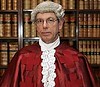
 Lord President Lord Hamilton in the dock over regulation of judiciary’s conduct. SERIOUS DOUBTS over the ability of Scotland’s top judge to carry out investigations into complaints made against fellow judges & sheriffs have surfaced after Scotland’s Lord President, Lord Hamilton appeared to shy away from carrying out an investigation into serious allegations made by a former lecturer at St Andrews University against currently serving Court of Session Judge Lady Smith & the controversial ex-Sheriff Mark Sischy, (now deceased) who were both involved in an Employment Tribunal case.
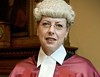 Court of Session Outer House Judge Lady Smith faces allegations over ‘buried evidence’ at Employment Tribunal. Among the allegations levelled at Lady Smith on the website of Dr Declan Quigley, former lecturer of Anthropology who resigned from St Andrews in 2002 and took the University to an Employment Tribunal, are claims that : “Lady Anne Smith, Scottish Supreme Court judge, ensured that evidence buried by the Scottish Employment Tribunals to protect the University of St Andrews remained covered up and that a judgment containing a tissue of misrepresentations went unchallenged.”
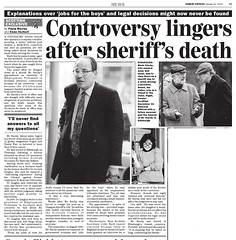 The late Mark Sischy who resigned from his position as a Sheriff in disgrace after being caught drink-driving, and amazingly returned to the Scottish judicial system as a £74,000-a-year chairman of employment tribunals, ended up presiding over the former University lecturer’s case against St Andrews University, is, according to Dr Quigley’s website alleged to “[have] perverted the course of justice. He signed a judgment containing a tissue of misrepresentations and buried large amounts of evidence to protect the University of St Andrews.”. Mr Sischy’s return to the judicial system in such a prominent role after his drink driving conviction provoked accusations of cronyism, and was questioned at the time by the SNP’s Tricia Marwick MSP. Tricia Marwick said : "The manner in which Mr Sischy was appointed raises concerns of cronyism within the Scottish judicial system.Mr Sischy has been promoted to a full-time chairman while still serving a ban for drink-driving. When you consider that some of the cases brought in front of employment tribunals may involve drink-related incidents during hearings for unfair dismissals, it seems ludicrous to appoint someone with a criminal conviction in this area."
Ms Marwick added : "The posts for part-time employment tribunal chairmen are not advertised while information regarding full-time positions are only circulated to part-time chairmen. This points to cronyism with a strong element of using a 'jobs for the boys' system. The SNP are calling for the procedures of appointments to be more open, transparent and accountable. All positions within the Scottish judicial system should operate best practice where all jobs are advertised and open to the public. These appointments of secrecy are sending out all the wrong messages about employment tribunals.”
Read all about it : Skorupski’s Law – University of St Andrews blew nearly £1/4 million on legal fees. Top judge & Tribunal Chief made ‘questionable decisions’ (click image below to view Dr Quigley’s website)
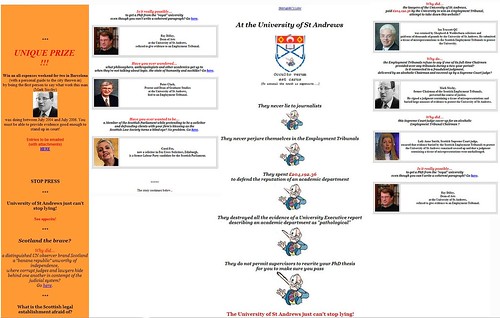
Among others identified by Dr Quigley’s website are Ian Truscott QC, who represented the University in the Employment Tribunal, and two lecturers at St Andrews University, one alleged to have lied to an Employment Tribunal while the other apparently refused to give evidence.
A Freedom of Information request reported in the Times Higher Education supplement revealed the staggering costs of the hearing, which saw the University of St Andrews spend at least £204,000 to defend the case, far more than Dr Quigley expected to win.
In recent weeks Dr Quigley has been attempting to have his complaints against Lady Smith and the actions of the now deceased Mr Sischy investigated by Scotland’s Lord President, Lord Hamilton, who is responsible for selection and the conduct of the judiciary. However, the Lord President has claimed in correspondence seen by our reporters that he is not responsible for Mr Sischy’s actions and alarmingly, the responses from the Lord President’s office to Dr Quigley’s requests for an investigation apparently ignore all references to complaints made against Lady Smith.
Speaking today to journalists for Scottish Law Reporter, Dr Quigley said : "Lord Hamilton is clearly protecting Lady Smith who corruptly hid from the parties to an employment appeal tribunal (and their barristers) that the Chairman of the original tribunal had been an alcoholic and had been off work for months immediately prior to signing the judgment.”
Dr Quigley continued : “I am examining ways of making Lady Smith legally accountable for her actions and the Lord President and the President of the Employment Tribunals (Mrs Shona Simon) will have to justify why there has been no examination of the circumstances surrounding the case when there have been repeated requests to do so. Obviously, if the claims on my website were not true, I would have been hauled up in front of Lady Smith by now for contempt of court or defamation. In fact, Lady Smith was in contempt of her own court - and of the very basis of the Employment Appeals Tribunals - and she needs to answer for that."
A legal insider this afternoon said it was fundamentally important that any complaint made against a member of the judiciary be thoroughly investigated and go through a formal process which gave a fair hearing to both sides.
However, despite serious allegations being made against a currently serving judge and an ex-sheriff no such investigation has taken place so far by Lord Hamilton, who appears determined to avoid an inquiry into the former University of St Andrews lecturer’s claims, even though there appears ample allegations in the media Mr Sischy gained his Tribunal position through the well known ‘jobs for the boys’ culture in Scotland’s legal establishment, as one report from the Herald newspaper at the time reveals :
Disgraced sheriff's £74,000K comeback Top post despite drink-driving
Iain Wilson Chief Reporter
9 Aug 1999
EXCLUSIVE. A SHERIFF who resigned in disgrace after being caught drink-driving is back in the Scottish judicial system as a £74,000-a-year chairman of employment tribunals.
Mr Mark Sischy's return would not be tolerated under the appointments system which operates in England and Wales. He would not even have been granted an interview because of his criminal conviction. His job was not advertised. The £74,464 salary is met by taxpayers.
Mr Sischy's appointment, via a part-time post in the first instance, will further fuel charges of cronyism and jobs for the boys under the Scottish system, which appears to be less open and transparent than south of the Border. All part-time chairmen's posts in England are advertised under a policy adopted by the Lord Chancellor to draw on ''best available recruitment practices,'' with emphasis placed on open competition.
In Scotland, the posts are not advertised, apparently on grounds it would not produce "a larger field of people with the necessary kind of experience". Instead, aspiring candidates make themselves known either to Mrs Doris Littlejohn, president of Employment Tribunals (Scotland) or to the nation's leading judge, Lord Rodger of Earlsferry, the Lord Justice-General and Lord President of the Court of Session.
Mr Sischy was banned for two-and-a-half years for being almost three times over the drink-drive limit. That timescale does not run out until November. The ban was imposed on May 15, 1997. But by the end of the year, he had re-emerged as a part-time chairman of employment tribunals, whose current pay rates are £332-a-day, plus expenses for travel and subsistence. Promotion has now followed, with Mr Sischy's full-time job, based in Dundee, confirmed last month by Lord Rodger. The vacancy was circulated only among the small pool of part-time chairmen in Scotland. Their caseloads can include drink-related incidents emerging as key factors during evidence at hearings into claims for unfair dismissal.
Mr Sischy, who sat as a sheriff in Glasgow, tendered his resignation from the £79,667-a-year post he had held since 1990 before appearing at Edinburgh Sheriff Court. He was fined £800 and banned from driving for two-and-a-half years. He had been caught with 100mg of alcohol in 100ml of breath by police while driving to a shop near his home. The legal limit is 35mg
Sheriff John Dean told him the fine and period of disqualification had to reflect the level of alcohol in his body. After sentence, Mr Sischy refused to be drawn on what his future plans were. Within months, he was a part-time tribunal chairman.
Now full-time, and with five months of the original drink- driving ban still to go, he is earning almost as much as before his fall from the Bench. Lord Rodger's counterpart in England, the Lord Chancellor, specifically expresses his disgust over drink-driving in a memorandum on conditions of service for tribunal members. His rules and regulations make clear that criminal behaviour, including drink-driving, is unacceptable.
A spokesman for the Lord Chancellor acknowledged that applicants with spent convictions would not necessarily be barred from becoming tribunal chairmen. But he added: "An applicant would not be considered for the period of his disqualification." In other words, anyone still serving a ban would not be interviewed. In his memorandum, the Lord Chancellor warns he would consider removing members if convicted of a grave offence. In particular, he regards "conviction for an offence of driving while under the influence of alcohol or drugs as so grave as to amount prima facie to misbehaviour".
His spokesman said there was no question of a chairman having to resign automatically if convicted after taking up the post. Each case would be considered on the individual circumstances. But the spokesman stressed: "No applicant would be considered for the job while still banned from driving ... he regards drink-driving as a very serious offence." Candidates were specifically warned of the Lord Chancellor's views on drink-driving, both verbally and in writing, during the initial application process, then at interview, and on appointment.
Mr Sischy's ban emerged during an investigation by The Herald into the Scottish appointments system. He offered no explanation for his appointment. When approached, he said: "I think I know what you want to talk to me about. You will understand that I cannot comment." Asked again to discuss issues, he said: "I cannot comment. It is a matter for Doris Littlejohn and the Lord President." Mrs Littlejohn has still to reply to questions lodged by The Herald, and Lord Rodger has refused to comment.
 Judge Lady Smith now head of Scottish Tribunals. COURT OF SESSION judge Lady Smith has been appointed as the first President of the Scottish Tribunals by Scotland’s current top judge – the Lord President & Lord Justice General Lord Brian Gill. The appointment was made under the Tribunals (Scotland) Act 2014, where the Lord President, Lord Gill, has overall leadership of the Scottish Tribunals. Lord Gill has now formally assigned Lady Smith to the Office of President, to whom he may delegate various functions.
