The merry go round of quango appointments is certainly alive & kicking under the SNP minority Scottish Government with the announcement today of the reappointment for a further three years of lucrative taxpayer funded jobs with expenses & jollies attached for a former Law Society President, Martin McAllister and the former Permanent Secretary for the Scottish Government (Chief of the civil service in Scotland), Sir Muir Russell to the Judicial Appointments Board.
For those of you having to face the massive public service cuts, reduced pensions, higher taxes or even unemployment, spare a thought for Mr McAllister & Sir Muir Russell who will both be on the nice little earner of £290 per day a for a time commitment of 20 to 30 days per year.(Yes, we are all in this together ! – Ed)
Sir Muir Russell chaired an inquiry into into allegations that leading academics at the University of East Anglia manipulated data on global warming. The ‘results’ of that ‘inquiry’ can be found HERE. (Guess what, the University did no wrong ! - Ed)
While Sir Muir Russell holds no other public appointments currently, Mr McAllister is also a part-time Convenor of the Mental Health Tribunal for Scotland with a remuneration of £430 per day.
Mr McAllister is however, more remembered for being caught in the scandal over former Law Society Chief Executive Douglas Mill’s secret claims fixing memos, as covered by one of our own reporters, Peter Cherbi, HERE
The Cabinet Secretary for Justice today announced the reappointments of Sir Muir Russell as the Chairing Member, and Mr Martin McAllister as a member to the Judicial Appointments Board for Scotland.
Sir Muir Russell was first appointed as Chairing Member of the Judicial Appointments Board for Scotland on October 1, 2008 for a three year period. His background is as a civil servant and he held a number of posts before being appointed Permanent Secretary at the Scottish Office in 1998. He was Principal of the University of Glasgow from 2003 until his retiral in 2009. He is a Vice Chair of Governors of the Glasgow School of Art, the Chairman of the Dunedin Concert Trust, a Member of the Board of the Moredun Research Institute, the Chairman of the Council of the Hannah Research Institute and a Fellow of the Royal Society of Edinburgh.
This reappointment will run for a further three years from October 1, 2011 to September 30, 2014.
He is an experienced chair who demonstrates particular strengths in building relationships both internally and with external partners.
This post is part-time and attracts a remuneration of £17,500 per annum for a time commitment of 20 to 30 days per year.
He has no other public appointments.
Mr McAllister was first appointed as a legal member on September 1, 2008 for a three year period. He is a partner with Taylor and Henderson Solicitors. He is a former President of the Law Society of Scotland and has convened several of its Committees including Legal Aid, Professional Practice and Professional Conduct. Mr McAllister is currently a part-time tutor at the University of Strathclyde and a part-time Convenor of the Mental Health Tribunal for Scotland.
As a practicing Solicitor and former President of the Law Society he brings valuable experience of the largest element of the legal profession in Scotland.
This reappointment will run for a further three years from September 1, 2011 to August 31, 2014.
This post is part-time and attracts a remuneration of £290 per day a for a time commitment of 20 to 30 days per year.
Mr McAllister is also a part-time Convenor of the Mental Health Tribunal for Scotland with a remuneration of £430 per day.
The Judicial Appointments Board for Scotland was established by Ministers in 2002, and it became an independent advisory non-departmental public body on June 1, 2009. The Board has statutory responsibilities under the Judiciary and Courts (Scotland) act 2008. The Board's role is to make recommendations to Ministers for appointment to the office of judge, sheriff principal, sheriff, and part-time sheriff as well as other judicial offices set out in the Act.
These Ministerial public appointments were made in accordance with the Commissioner for Public Appointments in Scotland's Code of Practice.
All appointments are made on merit and political activity plays no part in the selection process. However, in accordance with the original Nolan recommendations, there is a requirement for appointees' political activity within the last five years (if there is any to be declared) to be made public. There is no political activity to be declared.
More From A Diary of Injustice in Scotland as Kenny MacAskill pleads ignorance over those oh-so-famous claims fixing memos from dearly departed and happily-not-missed Chief Executive Douglas Mill.
The kink in the story is that Martin MacAllister, who was whisked to the Judicial Appointments Board quietly by the Justice Secretary, is of course identified on those fiddly, shady memos which targeted members of the public who were trying to complain against their solicitors ..... very shady indeed ..
When questioned today over why former Law Society President Martin McAllister was appointed to the Judicial Appointments Board, despite being identified by Cabinet Secretary John Swinney MSP in memos detailing a claims & complaints fixing scandal operted by the Law Society of Scotland, Justice Secretary Kenny MacAskill denied through his spokesman, any knowledge of the offending memos, which have been available at the Scottish Parliament, in the media, and even on the internet for some time now, and which continue to rock Scotland's legal establishment.
Kenny MacAskill denies existence itself ? : “Mr McAllister was appointed through fair and open competition by an independent panel. We are not aware of any formal complaint about Mr McAllister’s role in relation to claims and complaints during his time as President of the Law Society of Scotland, and no evidence has been presented to us which would raise any questions over the decision of the selection panel.”
The now well known memos to everyone except the Justice Secretary himself, were revealed by the Cabinet Secretary for Finance John Swinney MSP, who identified a particular memo from Law Society Chief Executive Douglas Mill to the then Law Society President Martin McAllister as being the key to a claims & complaints fixing scandal which saw clients claims against crooked lawyers ruined by a well practiced policy of delay & destruction of claims & complaints against multiple firms of crooked lawyers.
John Swinney reveals a memo : "I am interested in what the witnesses have just said about the Law Society having nothing to do with the arrangements for handling negligence claims. I have in front of me a memorandum in connection with the case of one of my constituents. It was issued by Mr Mill on 5 July 2001.”
"Mr Mill's memo was written to the then president of the Law Society, Mr McAllister. It refers to the broker of the master policy. Mr Mill suggests that it would be good if he and the others involved all got together and had a "summit meeting" to discuss how to dispose of my constituent's "several valid claims". Mr Mill and I have discussed the matter at length over the years, but I find that a rather strange memo if it is to sit comfortably with the statement that the president has just made.
The memo of 5 July encourages "a summit meeting on the up-to-date position"to be held to look at "both the complaints and the claims aspects." That rather suggests that the Law Society has been involved. The claim remains unresolved to date and yet the memo is dated 5 July 2001."
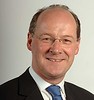
Cabinet Secretary for Finance John Swinney identifies Martin McAllister in memos which revealed the Law Society's claims & complaints fixing scandal to protect crooked lawyers
The claims fixing scandal, which involved senior members of staff at the Law Society of Scotland, apparently headed in an operation by Law Society Chief Executive Douglas Mill, saw a policy implemented by the Law Society and some of the UK's largest insurers, Royal Sun Alliance PLC, and Marsh UK to delay and destroy client claims and complaints against notorious Scots legal firms with poor regulatory records.
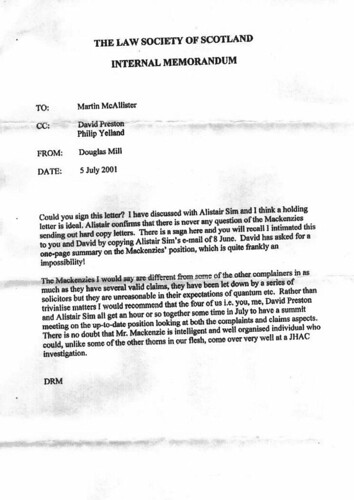
Law Society Chief Exec Douglas Mill's memo to Martin McAllister - ‘We have to stop the MacKenzie's claims dead and prevent their testimony to a Parliamentary investigation’
The Law Society of Scotland INTERNAL MEMORANDUM
To: Martin McAllister CC: David Preston, Philip Yelland FROM : Douglas Mill DATE : 5 July 2001
Could you sign this letter ? I have discussed with Alistair Sim and I think a holding letter is ideal. Alistair confirms that there is never any question of the Mackenzies sending out hard copy letters. There is a saga here and you will recall I intimated this to you and David by copying Alistair Sim's email of 8 June. David has asked for a one page summary on the Mackenzie's position, which is quite frankly an impossibility !.
The Mackenzies I would say are different from some of the other complainers in as much as they have several valid claims, they have been let down by a series of solicitors but they are unreasonably in their expectations of quantum etc. Rather than trivialise matters I would recommend that the four of us i.e. you, me, David Preston and Alistair Sim all get an hour or so together some time in July to have a summit meeting on the up-to-date position looking at both the complaints and claims aspects. there is no doubt that Mr Mackenzie is intelligent and well organised individual who would unlike some of the other thorns in our flesh, come over very well at a JHAC investigation.
DRM
Clearly the memos do indeed, identify the then Law Society President Martin McAllister as being part of the fray which prevented the MacKenzies claims & complaints against a number of solicitors from progressing to any reasonable conclusion.
Indeed, since the date of the memo (2001), none of the claims identified within the memo, or by John Swinney in his confrontation with Douglas Mill before the Scottish Parliament's Justice 2 Committee during 2006 have been settled. Not one. In fact, not one claim or complaint by those who submitted their cases to the Justice 2 Committee during 2006 have been settled. Not one.
So in conclusion, Douglas Mill’s memo to Martin McAllister has resulted in a very successful policy by the Law Society of Scotland of protection for several firms of corrupt solicitors while significant and long lasting financial harm has been caused to the damaged lives of clients.
Mr McAllister has now been appointed to the Judicial Appointments Board, where he will be in part responsible for the appointment of lawyers to the positions of Sheriffs and Judges.
Inevitably some of those lawyers who come before the Judicial Appointments Board will have not the best of regulatory records, where complaints have been poorly handled by the Law Society of Scotland, possibly to the point those complaints have been dealt with by the ‘Douglas Mill doctrine’ contained in the memo to Mr McAllister, which is clearly ‘destroy the client’s access to justice at all costs’.
Is it fair to have lawyers appointing lawyers to positions of Judges ?
During the 2001 Justice 1 Committee “regulation of the legal profession inquiry’ which was heavily restricted in content & remit by the then Convener, Christine Grahame MSP (SNP), Martin McAllister, the then President of the Law Society of Scotland made the following comments :
Martin McAllister : “We are open to change and want to make improvements. It is proper that Parliament is reviewing the checks and balances that operate, but it is a fundamental right of citizens in a democracy that the legal profession is independent. Such a profession is a guarantor of the rights of citizens—and in Scotland we deserve no less.”
Well, eight years on from the date of Douglas Mill’s memo to Mr McAllister, there have been no improvements in regulating the legal profession, and still, the Law Society of Scotland impedes and prevents clients access to justice when it sees fit.
Martin McAllister went onto say during the 2001 J1 inquiry : “The point is that the organisation is changing. We have made a number of changes in how we deal with complaints over the past 10 years. I do not think that the committee would find it useful to go through a list of those, but some key things are important in improving public perception, one of which is greater lay involvement. A second is the improvement in literature, so that the public have a much better idea of how we deal with complaints. We have brought with us our current, revised leaflets.”
What change ? The Law Society of Scotland hasn’t changed one bit over the past ten years, or the past twenty years for that. There is still a claims and complaints fixing policy to see that no claim or complaint goes to a fair & proper conclusion and clients who choose to complain are victimised almost to the point of death.
Christine Grahame’s Justice 1 Committee of 2001 forbade members of the public to appear before it to testify as to their experiences with the Law Society of Scotland, while lawyers, more Law Society officials, and just about anyone who could be dragged out to support the idea of self regulation (lawyers looking after complaints against lawyers) were allowed almost free reign to appear before the then Justice 1 Committee at the cost of excluding the Scots public.
It took a further five years until 2006 when members of the public, ordinary Scots like you and I, were able to appear at Holyrood during the 2006 LPLA Bill inquiry by the Justice 2 Committee and tell of how scandalous the Law Society of Scotland had treated them.
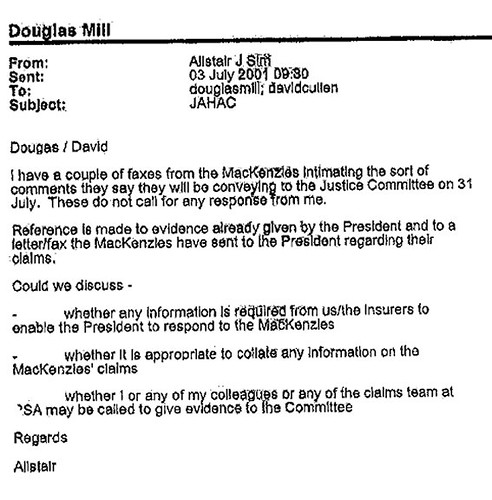
Marsh UK Director Alistair Sim to Law Society Chief Executive Douglas Mill - Collating information on the MacKenzies and throwing some red herrings at the Justice Committee ..
Email to Douglas Mill from Alistair J Sim
From: Alistair J Sim Sent 03 July 2001 09:30 To: douglasmill; davidcullen Subject JAHAC
Douglas / David
I have a couple of faxes from the MacKenzies intimating the sort of comments they say they will be conveying to the Justice Committee on 31 July. These do not call for any response from me.
Reference is made to evidence already given by the President and to a letter/fax the MacKenzies have sent to the President regarding their claims.
Could we discuss -
-whether any information is required from us/the insurers to enable the President to respond to the MacKenzies
-whether it will be appropriate to collate any information on the MacKenzies claims
-whether I or any of my colleagues or any of the claims team at RSA may be called to give evidence to the Committee.
Regards
Alistair.
Clearly Mr McAllister was privy to a great deal of information as Law Society President, information which could have ended the suffering of many clients who had been trying to pursue claims or complaints against their solicitors, but as the facts show, no action was taken by Mr McAllister to alleviate clients problems at the hands of his colleagues Douglas Mill, Philip Yelland & others at the Law Society of Scotland.
To a certain extent of course, Martin McAllister was but a tool of Douglas Mill, as the President of the Law Society of Scotland is more of an honorary position, the real power lying with the slightly dictatorial position of Chief Executive.
Clearly Mr McAllister could have done more, said more, and helped clients who were caught in the Douglas Mill doctrine much more than has happened, because as we hear from Mr Swinney himself, no client, no claim has been settled, not one.
Perhaps the memos identifying Mr McAllister in the claims & complaints fixing operation run by the Law Society of Scotland should have surfaced as a possible barrier to being appointed to the Judicial Appointments Board, which is a position itself responsible for the appointment of lawyers to positions on the judiciary.
Before I quote the Justice Secretary’s Press Release on the McAllister appointment, I feel a footnote is required on the second appointment contained in the Press Release, that of Lady Smith.
Lady Smith, appointed along with Martin McAllister, is the wife of David Smith, who was of course, appointed by Kenny MacAskill to the Scottish Legal Complaints Commission – to examine complaints against other lawyers.
You can read more about Mr MacAskill’s appointments to the Scottish Legal Complaints Commission in the following report I wrote earlier in the year :
You don’t have much imagination in public appointments, Mr MacAskill, do you ? and why did you try to use the Office of Public Appointments in Scotland to justify your selections because the OCPAS assessor apparently didn’t have sight of any of the information or memos your own Cabinet colleague Mr Swinney has within his files …
The Cabinet Secretary for Justice today announced the appointment of new legal members to the Judicial Appointments Board for Scotland.
Lady Smith has been appointed as the Senator member to replace Lord Wheatley whose term of office came to and end in June. Lady Smith's appointment is for three years from July 1, 2008.
Lady Smith is a graduate of the University of Edinburgh. She was admitted to the Faculty of Advocates in 1980, and appointed Queen's Counsel in 1993. She was appointed a judge of the Court of Session and High Court in 2001
Martin McAllister has been appointed as the solicitor member of the Board to replace Michael Scanlan whose term comes to an end later this year. Mr McAllister has been a solicitor since 1980. He was President of the Law Society of Scotland from 2001 to 2002 and is a partner of Taylor and Henderson, Solicitors in Saltcoats.
Mr McAllister has been appointed to the Board for a period of three years. He will take up his appointment in October.
These new appointees replace members who are retiring this year. The composition of the Board i.e. five legal and five lay persons remains unchanged.
Both appointments are part-time and carry a commitment of around 20 - 30 days a year. Mr McAllister will be entitled to a daily fee of £290. Lady Smith, being a serving judge, receives no fee for her attendance.
The appointments of the new solicitor member followed recommendations to Scottish Ministers by an independent selection panel chaired by the Rt Hon Lady Cosgrove, recently retired judge of the Court of Session.
The Judicial Appointments Board for Scotland was set up in 2002 with a remit to advise Ministers on the appointment of Judges, Sheriffs Principal and Sheriffs (both full-time and part-time). There are ten members, five legal members (a Judge, Sheriff Principal, Sheriff, an Advocate and a Solicitor) and five lay members including Sir Neil McIntosh as the lay Chairman.
The Judicial Appointments Board currently operates on an administrative basis and is therefore not subject to OCPAS regulations. However, the selection panel included an OCPAS assessor and followed good recruitment practice in making the recommendations for appointment.