Showing posts with label Douglas Connell. Show all posts

Saturday, March 21, 2009

Turcan Connell looks towards changes in Scots legal services market

Turcan Connell, that well known to many Edinburgh law firm which serves the interests of big landowners, and doesn’t do a terribly good job of clients wills, as we reported HERE & HERE , is preparing for a changed legal services market .. so they say.

Do some more speaking up against Drumsheugh Gardens, lads .. and then we will see some real changes for the better …. (In other words, get some bottle – Ed)

The Scotsman reports :

Turcan Connell prepares for multi-discipline future

Published Date: 20 March 2009
By PETER RANSCOMBE

LAW firm Turcan Connell yesterday said it was preparing for a "multi-national and multi- disciplinary future" with a string of new appointments.

Turcan Connell – which has its headquarters in Edinburgh and offices in London and Guernsey – has long been an advocate of alternative business structures, which would reform the law to allow non-lawyers to own legal firms for the first time.

As well as being a law firm, Turcan Connell provides financial and investment advice.

Haig Bathgate was yesterday promoted to the new role of investment director (principal), while Bob Hair became financial planning director (principal).

The firm said: "Haig and Bob's promotions mean that both will now be fully involved with, and work alongside, the partnership of Turcan Connell as professionals who are not lawyers, with a view to becoming full partners."

Meanwhile, Alison MacKrill, managing director of Turcan Connell's international trust services office in Guernsey, yesterday become a partner.

Douglas Connell, joint senior partner, said: "We strongly believe that it should be possible for client facing non-lawyers to be partners in Turcan Connell and we are actively supporting the progress now being made towards the alternative business structure that will allow this."

Turcan Connell – which has 18 partners and about 280 staff – was formed in 1997 as a spin out from the private client practice of Dundas & Wilson

Sunday, May 25, 2008

Edinburgh legal firm Turcan Connell caught up in Minto family inheritance scandal

It is reported today in Scotland on Sunday that Lady Caroline Minto, who is currently writing her memoirs as the Dowager Countess and former wife of the late 6th Earl of Minto, is to fight a court case against the late earl's executors – his son, the present 7th Earl, better known as businessman Timothy Melgund, and Edinburgh solicitor Douglas Connell.

The late Earl's estate has allegedly fallen on bad times, and Executor Douglas Connell, senior partner in the well known Edinburgh legal firm of Turcan Connell, claims there is no money left to pay the inheritance to Lady Minto, as the story goes.

Readers may well recall an earlier tale where Messrs Turcan Connell were embroiled in a story relating to a legal bill from Turcan Connell wiping out the net assets of an estate .. so no stranger to controversy then, and unsurprisingly, the Law Society of Scotland whitewashed rejected the complaint.

Why do people bother appointing lawyers as Executors to their estates when more often than not it causes these same problems ?

Some free advice for non-lawyer readers - never appoint a solicitor or legal agent as the executor of your will !

Scotland on Sunday reports :

Lady Minto lifts lid on bitter legacy

By Martin Hannan

ONE of Scotland's leading aristocratic families has been split by a bitter feud over the non-payment of a six-figure legacy to the Dowager Countess and former wife of the late 6th Earl of Minto.

The row threatens to explode as the Dowager Countess, Lady Caroline Minto, is currently writing "tell-all" memoirs in a bid to raise cash to fund a court case against the late earl's executors – his son, the present 7th Earl, better known as businessman Timothy Melgund, and Edinburgh solicitor Douglas Connell.

Melgund and Connell say they cannot honour the legacy as there is no money left from her former husband's estate to pay her. Under Scots law, executors do not have to make payments to beneficiaries if the deceased's estate cannot afford it.

Lady Minto says she will ask the courts to rule that more £200,000 worth of assets transferred by her husband to the family's Minto Trust should be returned to his estate in order to pay the legacy.

The row over the will has revealed deep divisions within the House of Minto. Melgund, the chief executive of Paperchase, has accused his stepmother of deserting his father when he became ill some years before his death in September, 2005, an accusation she denies.

Lady Minto, the former nurse and model Caroline Larlham, married the 6th Earl, Gilbert Edward George Lariston Elliot-Murray-Kynynmound, in 1991 when he was 63 and she was 39. The Old Etonian and former Scots Guards officer Gibbie Elliot, as he was known to his friends, was convener of Borders Regional Council from 1990 until 1996.

Lady Minto's memoirs are expected to tell an extraordinary story of how she rose from being adopted at birth to becoming a Countess. It was love at first sight when she met the widowed earl at an art exhibition – he dropped his spectacles, and she picked them up. They were married within months.

But Lord and Lady Minto divorced in 2004 after 14 years together, during which time Earl's condition deteriorated to the point where he needed permanent oxygen treatment.

Lady Minto, who now lives in a small flat in Italy, says her husband's health and wealth were ruined by the long battle over the family seat near Hawick.

Her book will also detail her acrimonious estrangement from some of the Minto family.

"None of them even phoned me to tell me he was dead," she said. "A butcher in Hawick phoned to offer his condolences, and I didn't even know he was dead."

The Dowager Countess was left £100,000 in the will but she has been paid only £10,000 after her solicitors tackled the executors. Lady Minto has now been told that the late Earl's estate was valued at £151,000 but that after deducting expenses, taxes and £40,000 legal fees, there is nothing left to pay the £90,000 balance of the legacy.

Lady Minto, 55, says that in 2001, her late husband signed over personal holdings worth £300,000 to the Minto Trust, in which the Elliot family's assets were invested. The trustees include Melgund and Connell.

She claims that after deductions for his care and £1,000 per month living expenses payments, the trust still has more than £200,000-worth of the late Earl's wealth which she says should go back into his personal estate.

"I believe the executors have at least a moral duty to recover and sell some of my late husband's assets and pay my legacy," said Lady Minto.

She claims those assets included two paintings attributed to French Old Master Jean-Antoine Watteau – another of his works is up for auction at Christie's in London next month for a minimum of £3m.

No paintings by Watteau are listed in the inventory of the estate, which does include numerous valuable artworks and Georgian silverware.

A spokeswoman for Douglas Connell and Turcan Connell said: "Client confidentiality is at the heart of the Turcan Connell ethos and as a total rule we never make comment on any aspect of client business.

"If Lady Minto wishes to take the matter further then she should instruct her lawyers to contact us."

Timothy Melgund, who lives in Wiltshire, said: "My ex-stepmother deserted my father when he became bedridden and ill. He was then supported by the local authority until I managed to have him moved into a home where he became very happy again and unfortunately died in 2005.

"I hadn't seen my ex-stepmother for many years before that and this sort of interference that she is now coming up with is not particularly pleasant.

"The perception that my family is a rich family is just a nonsense, I'm afraid. My father left a legacy in his will but he just did not have that amount of money."

Asked about his feelings about the Dowager Countess, Melgund said: "This is a rather sad tale of a man who was married to a lady for a pretty short period of his life and when he became frail to the point where he couldn't support himself, she deserted him."

He firmly denied there were paintings such as the two alleged Watteaus held by the trust.

"The idea that these Watteaus were worth £3m or indeed that they were Watteaus is just fantasy," said Melgund.

"They had Watteau written on the frame. But they weren't. If they had been genuine Watteaus they would have been sold many, many years ago."

Friends of Lady Minto say they are shocked at the accusation of desertion. "She was definitely with Gibbie when I visited them several times in 2002-2003," said Frances Anderson, "even though Gibbie was in very poor health. Caroline was devoted to Gibbie."

Jane Martin, Lord Minto's carer in his final months before entering a nursing home, added: "Lord and Lady Minto were devoted to each other."

and just for comparison here is an earlier story, from the Herald newspaper where Messrs Turcan Connell were caught in an earlier scandal involving a 'ruined' estate ...

Legal bill wipes out net assets

IAIN MORSE and SIMON BAIN January 02 2007

A leading Edinburgh law firm which charged fees of more than £16,000 to administer an estate with net assets of under £14,000 has had a complaint against it to the Law Society of Scotland rejected.

The complaint was made by widow Dr Kate Forrest, a lecturer in Russian in Edinburgh, against Turcan Connell, the multi-disciplinary firm which prides itself on its “family office”.

Forrest complained that the firm had told her only that it would charge £200 an hour, had entered into unnecessary work, and had failed to give her estimates, or issue itemised bills, despite repeated requests. She claims the firm then gave an undertaking to halt the charges, in a meeting with witnesses at the firm’s office, but this did not materialise.

When the Law Society examined the complaint, it ruled that the meeting could not be taken into account as the firm had no record of it, and it accepted an explanation by managing partner Douglas Connell that the complaint had been based entirely on a “misunderstanding”.

The £16,000 in charges had the effect of more than wiping out any assets in the estate, which had gross assets of £69,574 but debts of £55,731.

The Law Society reported that the firm had “apologised for the oversight” in billing, and that “simple oversight … should not be defined as inadequate professional service”.

In November, Jane Irvine, the Scottish Legal Services Ombudsman, issued a rare public rebuke to the Law Society over its handling of complaints, urging it to “recognise that the consumer age has dawned”.

The Scottish Executive is poised to scrap self-regulation by the profession, policed by the ombudsman, and introduce a Scottish Legal Complaints Commission, which the society is fiercely resisting.

The number of complaints received by the Law Society of Scotland has shot up from 2402 during 2002 to 4849 last year. The 12-page annual report of the society’s Client Relations Office records 1057 cases in which no action was taken at all last year, while in 108 cases a solicitor’s conduct was found unsatisfactory.

The current procedure starts with a reference to the law firm against which the complaint is made, and internal procedures to be followed by firms are laid down by the society. Only after these are exhausted can complainants proceed to the Law Society itself. And then, perhaps surprisingly, complainants can be charged by the law firm for their work in submitting the relevant evidence to the society.

The evidence regarded as acceptable by the society may be limited only to the files presented by the law firm, though it can order the production of “missing”documents - such as the record of a meeting. If a complaint is rejected by the society, the complainants have recourse to the courts. But this means finding a law firm prepared to act against another firm - which as The Herald has reported can be difficult in Edinburgh - at a minimum cost of several thousand pounds, a considerable disincentive to taking legal action.

Kate Forrest says she is left with no choice but to go to court if she wishes to challenge an outstanding fee in excess of £8000. She says: “For me this would be expensive and risky. I am not rich and they know this very well.”

The Law Society of Scotland said: “A complaint about a fee could be service or conduct as it could result from a breach of a rule if there was no letter of engagement, or IPS (inadequate professional service) if there was insufficient communication about a fee with a client.

“If a client feels a fee is too much then it can be referred to the Auditor of Court who can decide what a reasonable fee might be. Firms may also charge for providing a bill which itemises each letter, phone call, etc, especially if it is for a large volume of work.

“If someone takes a court action against a solicitor then the society is not involved in that process.”

Turcan Connell said: “We care deeply about ensuring that we give every client the best possible service. Our trust and tax experts are among the most proficient in Scotland, and we always strive to protect our clients’ interests and minimise their costs as far as possible.

“Dr Forrest is no longer a client. We resolutely protect the privacy of all current and former clients, and would not make any public comment on an individual’s personal circumstances or relationship with us.”

Monday, January 29, 2007

Law Society of Scotland rejects complaint over estate ruined by huge legal fees

It looks like the Edinburgh legal & financial investment firm of Turcan Connell, which has offices at 1 Earl Grey Street, Edinburgh and in Guernsey,the Channel Islands can be added to the long list of legal firms to stay away from, judging from today's Herald newspaper report on how they administered an estate.

Turcan Connell seem to like the money and publicity .. as long as they are getting it written for their benefit, that is ... noting their recent claim to fame of hitting £450m in their investments ... see here : Law firm Turcan Connell funds hit £450m ... but despite the £450m in their investment portfolio .. they still manage to ruin an estate ... much in the same way, it seems that crooked Borders solicitor Drew Penman - Scotland's Most Famous Crooked Lawyer of Stormonth Darling Solicitors, Kelso .. did to my family .. and a few other clients too.

I can sympathise with Dr Kate Forrest on this one .. making a complaint against a firm of solicitors who have raped an estate can be a tedious affair .. and the Law Society, it all it's crooked glory, are loathed to do anything on such cases, as they have done in the case of Dr Forrest's complaint against Turcan Connell .. well ..actually, the Law Society of Scotland have went one better, and thrown the complaint out.

Quotes from the Herald article today :

Forrest complained that the firm had told her only that it would charge £200 an hour, had entered into unnecessary work, and had failed to give her estimates, or issue itemised bills, despite repeated requests. She claims the firm then gave an undertaking to halt the charges, in a meeting with witnesses at the firm's office, but this did not materialise.

When the Law Society examined the complaint, it ruled that the meeting could not be taken into account as the firm had no record of it, and it accepted an explanation by managing partner Douglas Connell that the complaint had been based entirely on a "misunderstanding".

The £16,000 in charges had the effect of more than wiping out any assets in the estate, which had gross assets of £69,574 but debts of £55,731.

The Law Society reported that the firm had "apologised for the oversight" in billing, and that "simple oversight … should not be defined as inadequate professional service"

Well, when a lawyer tells you they will charge only a set fee .. believe me .. it's a LIE. You got that one, right ? in English. A LIE.

Ask a lawyer for estimates of work ? What you get, if anything, is a LIE. Got that ? A LIE. I've tried it myself. They didn't provide me with an estimate despite repeated requests, and the lawyer then denied I ever made such requests - removed the file notes which matched my email records, took a sickie to get out of the complaint (he got off the hook of course) and then became a Law Accountant.

Another client of a lawyer who contacted me, told me they got an estimate back for £1500 and the final bill ended up at £8000.

Lawyers fake up paperwork on a daily basis. There must be more faked paperwork in lawyers offices in Scotland than there is fake currency floating round the planet.

They don't always fake up the paperwork too well though .. When Drew Penman was faking up the paperwork on my complaint .. he got some of the dates wrong and some of the staff entries upside down .. managed to insert the wrong documents into the wrong order .. and cleverly, the Law Society Complaints Reporter found this one out for himself .. that's why he recommended Drew Penman be prosecuted before the SSDT and be struck off .. but, being represented by equally crooked James Ness, now the Director of Law Care ... Penman got off the hook with even more fiddled evidence at the Complaints Committee hearing.

So you see .. faking up the paperwork is common .. and fake estimates from a lawyer for work .. if you ever actually manage to get one .. aren't worth the ink it takes to type them out.

I liked the part in the article where the Law Society said it couldn't accept the information relating to the 'meeting' where fees were discussed .. "as the firm had no record of it" ... great cop-out there, if familiar .. which goes down to fiddled minutes of meetings - which usually exist .. but the lawyer can remove them at will, because the Law Society of Scotland says they can do that .. it's called "right of lien" which is also used to keep files from a client until they pay for their services .. and even then .. surprise, any file the lawyer deems shouldn't be released to the client, is held back.

Maybe the minutes of the meeting did actually exist in this case ... we shall perhaps, never know .. but I know the same happened in my complaint against Drew Penman ... minutes of meetings were denied to exist .. the mysteriously turned up .. some of them faked of course .. so Dr Forrest should perhaps pursue that one further.

More quotes from the Herald article :

"If a client feels a fee is too much then it can be referred to the Auditor of Court who can decide what a reasonable fee might be. Firms may also charge for providing a bill which itemises each letter, phone call, etc, especially if it is for a large volume of work.

"If someone takes a court action against a solicitor then the society is not involved in that process."

Well, the process involving the 'Auditor of the Court' is usually referred to as "Judicial Taxation" ... but it's certainly no cure for the whims of crooked legal firms to charge what they want for services which usually are poorly handled.

You will all remember the famous £45,000 bill for photocopying which Tods Murray hit one of their clients with .. which was I heard, reduced to around £7,000 or even less after 'Judicial Taxation' .. but it doesn't always go the way of the client .... as the Auditor of the Court can get things wrong a lot too .. and there have been a few challenges to the validity of the Auditor of the Court's position over the years .. one fine example being a Judicial Review of the Auditor's actions, which you can read about here : OUTER HOUSE, COURT OF SESSION [2006] CSOH 169 OPINION OF J GORDON REID Q.C., F.C.I.Arb (sitting as a Temporary Judge) in the Petition of DANIEL PATRICK COYLE Petitioner; for Judicial Review of a decision of the Auditor of the Court of Session .. some good info on the Auditor of the Court contained in that one ...

However, the Law Society's statement : "If someone takes a court action against a solicitor then the society is not involved in that process." is simply, a LIE.

Here's proof of otherwise : The Corrupt Link Revealed - How the Law Society of Scotland manages client complaints & settlements.

More proof here : Law Society of Scotland claims success in gagging the press over Herald newspaper revelations of secret case memos

The Law Society of Scotland have a well practiced policy of managing all claims against solicitors, to make sure claims get nowhere and clients lose everything.

Indeed, what is happening to the estate in terms of the legal charges which will wipe out the estate assets, is quite common. After all, that's exactly what Drew Penman did to me .. and that's exactly what lawyers up and down Scotland do to estates - wipe them out by using up all their assets, cash, opening up high interest overdraft accounts with favoured Banks and squandering all the money in cosy deals between themselves and the Banks. Simple stuff - it's policy on all estates.

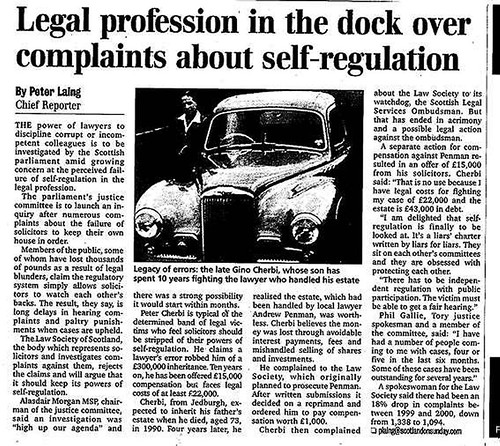
Here is a remarkably similar story Peter Laing from Scotland on Sunday wrote about my case involving crooked lawyer Andrew Penman from Kelso legal firm Stormonth Darling Solicitors :

Scotland on Sunday February 2001 - Legal Profession in the dock over complaints about self regulation

Take a will to a lawyer, and plenty of you will get the same. I get reports of this all the time, and I know it's true, because it happened to my family.

I doubt Dr Forrest will be able to get a lawyer to sue a lawyer .. many of us have tried it, and it doesn't work.....

Complaints such as Dr Forrest's should be referred to the new SLCC, as it's plain for all to see the Law Society of Scotland are not doing their job, and never really have. It's time for a full review of the treatment of complaints against lawyers by clients over the years which have been subject to the utmost prejudice in favour of solicitors, by the most corrupt self regulatory body in existence - the Law Society of Scotland.

Here's the link to the Herald article today, and prepare yourselves for an even more gruesome story of the lengths crooked lawyers will go to defeat complaints later this week. Gruesome, and perhaps even, evil.

http://www.theherald.co.uk/business/77839.html

Legal bill wipes out net assets
IAIN MORSE and SIMON BAIN January 02 2007

A leading Edinburgh law firm which charged fees of more than £16,000 to administer an estate with net assets of under £14,000 has had a complaint against it to the Law Society of Scotland rejected.

The complaint was made by widow Dr Kate Forrest, a lecturer in Russian in Edinburgh, against Turcan Connell, the multi-disciplinary firm which prides itself on its "family office".

Forrest complained that the firm had told her only that it would charge £200 an hour, had entered into unnecessary work, and had failed to give her estimates, or issue itemised bills, despite repeated requests. She claims the firm then gave an undertaking to halt the charges, in a meeting with witnesses at the firm's office, but this did not materialise.

When the Law Society examined the complaint, it ruled that the meeting could not be taken into account as the firm had no record of it, and it accepted an explanation by managing partner Douglas Connell that the complaint had been based entirely on a "misunderstanding".

The £16,000 in charges had the effect of more than wiping out any assets in the estate, which had gross assets of £69,574 but debts of £55,731.

The Law Society reported that the firm had "apologised for the oversight" in billing, and that "simple oversight … should not be defined as inadequate professional service".

In November, Jane Irvine, the Scottish Legal Services Ombudsman, issued a rare public rebuke to the Law Society over its handling of complaints, urging it to "recognise that the consumer age has dawned".

The Scottish Executive is poised to scrap self-regulation by the profession, policed by the ombudsman, and introduce a Scottish Legal Complaints Commission, which the society is fiercely resisting.

The number of complaints received by the Law Society of Scotland has shot up from 2402 during 2002 to 4849 last year. The 12-page annual report of the society's Client Relations Office records 1057 cases in which no action was taken at all last year, while in 108 cases a solicitor's conduct was found unsatisfactory.

The current procedure starts with a reference to the law firm against which the complaint is made, and internal procedures to be followed by firms are laid down by the society. Only after these are exhausted can complainants proceed to the Law Society itself. And then, perhaps surprisingly, complainants can be charged by the law firm for their work in submitting the relevant evidence to the society.

The evidence regarded as acceptable by the society may be limited only to the files presented by the law firm, though it can order the production of "missing"documents - such as the record of a meeting. If a complaint is rejected by the society, the complainants have recourse to the courts. But this means finding a law firm prepared to act against another firm - which as The Herald has reported can be difficult in Edinburgh - at a minimum cost of several thousand pounds, a considerable disincentive to taking legal action.

Kate Forrest says she is left with no choice but to go to court if she wishes to challenge an outstanding fee in excess of £8000. She says: "For me this would be expensive and risky. I am not rich and they know this very well."

The Law Society of Scotland said: "A complaint about a fee could be service or conduct as it could result from a breach of a rule if there was no letter of engagement, or IPS (inadequate professional service) if there was insufficient communication about a fee with a client.

"If a client feels a fee is too much then it can be referred to the Auditor of Court who can decide what a reasonable fee might be. Firms may also charge for providing a bill which itemises each letter, phone call, etc, especially if it is for a large volume of work.

"If someone takes a court action against a solicitor then the society is not involved in that process."

Turcan Connell said: "We care deeply about ensuring that we give every client the best possible service. Our trust and tax experts are among the most proficient in Scotland, and we always strive to protect our clients' interests and minimise their costs as far as possible.

"Dr Forrest is no longer a client. We resolutely protect the privacy of all current and former clients, and would not make any public comment on an individual's personal circumstances or relationship with us."