Showing posts with label BBC Scotland. Show all posts

Saturday, January 25, 2014

BBC Scotland’s Lawyers Behaving Badly reveals solicitors guilty of misconduct are still benefiting from MacAskill’s £151m a year legal aid pot

Self Regulation by the Law Society of Scotland has failed profession & clients. THE fact is, regulation of the legal profession by the Law Society of Scotland, the Scottish Legal Complaints Commission and the Scottish Solicitors Discipline Tribunal does not serve any purpose of protecting the profession from bad apples or giving the client a fair hearing enabling proper and full closure of complaints.

All self regulation of the legal profession has achieved in Scotland is to centre extraordinary power at the Law Society’s Drumsheugh Gardens HQ in Edinburgh. It is no use pretending the profession is clean, and it is no use trying to blame someone else for a problem of the profession’s own creation. Over then to BBC Scotland for their investigation of Lawyers Behaving Badly.

BBC Scotland investigates Lawyers Behaving Badly Part 1

BBC Scotland investigates Lawyers Behaving Badly Part 2

Lawyers Behaving Badly: Firms employing misconduct solicitors still get legal aid

By Samantha Poling Investigations correspondent, BBC Scotland

The BBC investigated lawyers who had been found guilty of professional misconduct

Law firms with solicitors who have been found guilty of professional misconduct are still receiving millions in legal aid, according to a BBC investigation.

It found that 33 solicitors guilty of misconduct such as dishonesty, are working for firms eligible to claim public funds through legal aid cases.

Four solicitors were found to have deliberately misled their clients.

The Law Society of Scotland, which regulates solicitors' conduct, said it was doing its job properly.

The programme - BBC Scotland Investigates: Lawyers Behaving Badly - found one solicitor was convicted of domestic abuse and assault and another who was on the Criminal Legal Aid register despite a conviction for embezzling court fines.

The investigation revealed that 22 solicitors had findings of professional misconduct but remained on the Criminal Legal Assistance Register.

For civil law cases, a total 22 firms which employed solicitors found guilty of professional misconduct remained on the legal aid register.

The list included the firm Robertson and Ross, which was banned from the Criminal Legal Assistance Register by the Scottish Legal Aid Board, for submitting fake travel claims totalling more than £220,000.

Robertson and Ross issued a statement saying it was an ex-employee who claimed fake travel expenses and the full amount was repaid.

They said "neither the firm or any current member/employee has any formal finding of dishonesty against them", and said the firm should remain on the Civil Legal Aid Register.
'Bad apples'

The BBC also discovered that three firms on the Civil Legal Aid Register employed solicitors who had been disciplined for the way they handled legal aid cases.

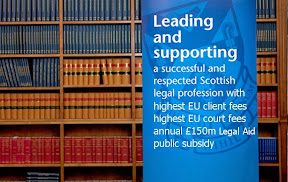
Combined, the firms received almost £7.5m last year from the £150m Scottish Legal Aid budget.

Professor Julian Webb, from Warwick School of Law, said: "One can always say, and I think the profession's defence on this one is, what we are dealing with is the bad apples, that the system at root is not necessarily a bad one.

"Most solicitors, certainly, I don't think, go into the profession with the intention of being dishonest or defrauding clients."

He added: "Whether the structures are sufficiently robust to capture or catch those bad apples and catch them early enough, I think certainly in the Scottish examples, is a really moot question."

The Scottish Legal Aid Board said they monitored solicitors and acted decisively where they could, such as when the Legal Aid fund was abused or when their code of practice was breached. But it was not their job, they said, to regulate the legal profession.

A spokesman said the cases that involved solicitors convicted of domestic abuse and of embezzling fines did not result in them being struck off the professional register.

He said the Scottish Legal Aid Board did not have the power at that time to remove the solicitors from the register.

"In the cases where a solicitor was convicted for assault and the clerk of court was convicted for embezzlement, the Scottish Solicitors' Disciplinary Tribunal determined in 2001 and 2004 respectively that neither offence was sufficiently serious for either solicitor to be struck off," the spokesman said.

"At that time, as well as the general regulatory powers and functions in relation to solicitors, the Law Society of Scotland alone exercised the statutory power through Section 31 of the Legal Aid (Scotland) Act to exclude a solicitor from undertaking legal aid and representing legal aid clients. They did not exercise this power."

He added: "Solicitors undertaking criminal legal aid must register with us, and we have powers to de-register a solicitor from criminal legal aid work where we have evidence of abuse of the legal aid fund or breaches in our criminal Code of Practice.

"Where appropriate, a report is sent to the procurator fiscal, who makes a determination on whether to prosecute or not. This is not a matter for the board."

The system of regulating solicitors in Scotland falls between the Scottish Legal Complaints Commission, which deals with service complaints, and the Regulation Committee of the Law Society of Scotland, which deals with complaints about conduct.

The Law Society of Scotland has a dual role of representing solicitors and regulating their conduct, which has led to accusations of a lack of robustness.

Carole Ford, the lay convener of the Law Society's regulation committee, said: "The Law Society looks only at conduct issues.

"It is not looking at any other aspect of complaints and the Law Society's system is overseen. The Scottish Legal Complaints Commission has oversight of what the Law Society does. There is absolutely no doubt that the Law Society is doing its job properly."

Andrew Hopper, who is both a solicitor and Queen's Counsel, has worked mostly on cases involving professional regulation and discipline in relation to solicitors for the past 25 years. He said it was "unsettling" to find cases where findings of dishonesty were made but no strike-off followed.

He said: "It's unsettling for the profession as well as the public. If you have a concept that you can have solicitors who have been found to be dishonest continuing in practice, that affects the reputation of the whole profession.

"It is disturbing, it creates a two-grade profession and it is dreadful to my mind for the reputation of the whole profession that this should have been able to occur."

The Scottish Solicitors Discipline Tribunal, which struck off nine solicitors last year, insisted the system was robust.

They told the BBC they were always concerned if a solicitor was found guilty of dishonesty. But they said they would have to assess the extent to which anyone had suffered as a result of that dishonesty before taking a decision to strike off.

Wednesday, January 15, 2014

LOVE US OR ELSE: Law Society of Scotland statement on BBC documentary "Lawyers Behaving Badly"

Law Society tells beeb how great it is before complaints secrets hit screen. IN response to the forthcoming BBC Scotland investigation – Lawyers Behaving Badly, the Law Society of Scotland has mounted a press offensive to portray the Scots legal sector as a collection of fluffy cuddly animals who are integral to the survival of mankind, society and the universe as we know it.

Solicitors as we all know (haha – Ed) play a crucial role in our society and our economy, helping thousands of people and businesses with the widest spectrum of legal issues. The evidence shows that the public have confidence in Scottish solicitors. In a major poll of Scottish public opinion by Ipsos MORI, 87% of people who had used a solicitor said they were happy with the service received. Over three quarters said they had trust in the profession as a whole recognising that they work hard to help people deal with difficult situations. We do not take this position for granted.

We recognise the interest which BBC Scotland has shown in the whole system of regulation and appreciate its focus in ensuring strong systems are in place to protect clients in the relatively few occasions when things go wrong.

That is why we sought to be as helpful as possible to the production team over the last three months as they prepared their documentary. We provided a host of background information and ensured the non-solicitor convener of our regulatory committee, Carole Ford was available for an interview which lasted well over one hour.

Individual cases and recent reforms

In highlighting some of the most difficult and complicated cases, we do not believe the BBC gave sufficient weight to the major reforms to legal regulation in Scotland over recent years. Indeed the specific cases raised by the BBC all predated these reforms.

Since the system was overhauled in 2008, we have a clear system of co-regulation in Scotland, with different organisations undertaking different roles. You now have an independent and separate Scottish Legal Complaints Commission (SLCC) which receives complaints from the public and decides which should be admitted for investigation. We are surprised the BBC decided not to carry any interview with the SLCC as part of its documentary, given the critical role it now plays in the regulation system.

There is also a separate and independent discipline tribunal, involving solicitors and non-solicitors, to decide in serious cases of wrongdoing. The Law Society is responsible for setting standards, providing training and support and setting clear and robust tests for those wishing to enter the profession. We also proactively inspect firms, investigate conduct complaints passed to us by the SLCC and intervene in firms when there is a critical need to do so.

There is also clear oversight and control of our own regulatory work as well as redress for consumers whenever they think we get it wrong. Within the Law Society, every single regulatory sub-committee is made up of solicitors and non-solicitors from outwith the legal profession altogether in order to ensure the public interest features in each and every decision.

The SLCC has oversight powers for our own complaints handling and our guarantee fund and people can make a handling complaint to the SLCC if they are unhappy with how we have dealt with their case. People can also take an appeal directly to the independent discipline tribunal and ultimately take action against us to the Court of Session

Legal aid

Part of the broadcast focused on the issue of the criminal and civil legal aid registers. The BBC has raised concerns over a number of solicitors who have had findings of professional misconduct against them and are on the legal aid register.

In each of the cases mentioned, the Society did act properly, investigating the complaints thoroughly and taking action to the independent Scottish Solicitors' Discipline Tribunal. It is only because of the actions of the Society and our evidence gathering that the findings of misconduct were made against the solicitors involved. However, it is always a matter for the independent tribunal to decide what action is taken against a solicitor found guilty of misconduct, whether that be a fine, censure, restriction, suspension or strike off. In these cases, the tribunal chose not to strike off the solicitor concerned.

It is the Scottish Legal Aid Board and not the Law Society of Scotland which maintains the legal aid registers. Whilst the Board has the ability to remove a solicitor from the register, the Society has no such power other than through the civil legal aid quality assurance scheme where a poor service has been provided by the firm directly to clients.

In cases involving the abuse of legal aid money, we are dependent on the Board in making a conduct complaint through the Scottish Legal Complaints Commission for us to investigate and, where necessary, take to the discipline tribunal.

Regulation in England and Wales

We think it would be wrong to look at the system of regulation in England and Wales as a model to follow here in Scotland. There is much evidence to suggest the system there is more complicated, bureaucratic and expensive. The chair of the Legal Services Board in England and Wales even described that system as "over engineered and exceptionally complex".

The Scottish Government looked at that model when it reviewed the whole regulatory system in 2009 and ultimately rejected it. Indeed, so many concerns have been raised that the UK Ministry of Justice ran a public consultation on how the system in England and Wales could be simplified. We were surprised that the BBC made no mention of these concerns or the recent calls for reform.

The Scottish regulatory system

The regulation of solicitors in Scotland is similar to that in Ireland, north and south, and in many states and provinces in the USA and Canada. Other professions in Scotland, including accountants with ICAS, chartered surveyors and RICS and teachers and the General Teaching Council, operate to a similar system of regulation.

That is not to say the current system here in Scotland is perfect. It isn't and we have been working with government, consumer groups and the SLCC to review a series of possible reforms which we believe could help make the system of regulation even stronger. That should not detract though from the core of the system which is built around the public interest and protecting clients.

The Law Society of Scotland has been in involved the regulation of solicitors and has worked in the public interest for almost 65 years. We take our responsibilities extremely seriously and will continue to work hard to maintain the highest possible standards of professionalism from Scottish solicitors and ensure they remain the respected and trusted advisors of choice.

If you are solicitor with any further questions on these matters, please contact the regulation team on 0131 476 8131.If you are a member of the press or public, please contact the Law Society's communications team on 0131 226 8884 or 0131 476 8115.

To learn more about the work of the Society, please visit the A to Z of what we do section of our website or follow us on Twitter (with all the other twits – Ed)