Showing posts with label Lord President. Show all posts

Friday, January 30, 2015

FRACKS AWAY: Scottish Government fracking ban hits problem as top judge promotes shale gas retrieval, says “resources should be served by the court system”

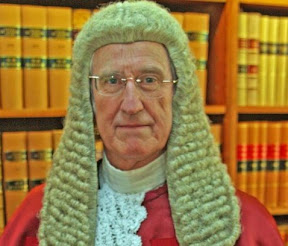
Slant drilling coming to a house near you – courtesy of courts. SCOTLAND’S top judge Lord Brian Gill has given his own view of fracking for shale gas on the same day the Scottish Government announced a moratorium on new fracking licenses. In what many view as an opposite opinion to the ban on fracking in Scotland, Lord Gill gave an optimistic appraisal of the retrieval of shale gas in his words, saying “if that should  be allowed” on the same day Energy Minister Fergus Ewing sought to quell protests by announcing a temporary ban on fracking – with the promise of a ‘public consultation’.

Ominously, Gill also indicated the courts should be there to serve opportunities presented by natural resources, and went on to chide the legal profession for not taking enough notice of the North Sea oil boom.

Speaking on the issue of fracking, Gill said: “Our resources of energy may be increased by the retrieval of shale gas, if that should be allowed. It seems to me therefore that the opportunity that our natural resources present should be served by the court system.”

However, Gill’s own views on the nation’s energy policy and how the legal sector should exploit it for their own ends was delivered the very same day the Scottish Government grudgingly announced a ban on new shale gas fracking schemes.

Making a statement announcing the ban on fracking for shale gas after it emerged Energy Minister Fergus Ewing had criticised MSP Joan McAlpine for assisting constituents against plans by the Duke of Buccleuch to mine coalbed methane at Canonbie in Dumfries and Galloway, Mr Ewing told the Parliament: "I want to ensure that the voices of the communities likely to be most affected are heard, and are heard in a more formal and structured way.I am therefore announcing today that in addition to the technical work I've referred to on planning, environmental regulation and upon assessing the impact on public health, Scottish ministers will also launch a full public consultation on unconventional oil and gas extraction."

Speech by Lord Gill on Digital Justice, Fracking & Big Oil. During the speech, Lord Gill also chastised his own judicial colleagues & lawyers for missing out on exploitation of Scotland’s oil boom.
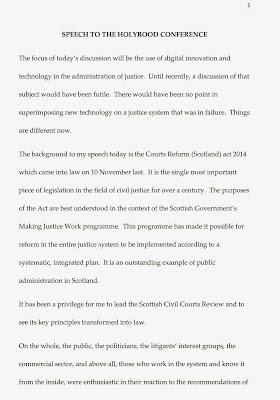
Lord Gill said: “In the 1960s and 1970s the economy of Scotland was transformed by the discovery of North Sea oil. The judges and lawyers of that time were not alert to the opportunity that Scotland could be an international forum for resolving disputes in the oil and gas industry. We paid a price for our complacency when the international oil and gas industry passed us by.”

Gill continued: “Half a century on we should look at Scotland's economic opportunities and see how the courts can best serve them. In recent years a commitment to renewable energy has brought wind power to the fore as an energy source. Other forms of renewable energy may follow.”

The full text of Lord Gill’s speech follows: The focus of today's discussion will be the use of digital innovation and technology in the administration of justice. Until recently, a discussion of that subject would have been futile. There would have been no point in superimposing new technology on a justice system that was in failure. Things are different now.

The background to my speech today is the Courts Reform (Scotland) act 2014 which came into law on 10 November last. It is the single most important piece of legislation in the field of civil justice for over a century. The purposes of the Act are best understood in the context of the Scottish Government's Making Justice Work programme. This programme has made it possible for reform in the entire justice system to be implemented according to a systematic, integrated plan. It is an outstanding example of public administration in Scotland.

It has been a privilege for me to lead the Scottish Civil Courts Review and to see its key principles transformed into law.

On the whole, the public, the politicians, the litigants' interest groups, the commercial sector, and above all, those who work in the system and know it from the inside, were enthusiastic in their reaction to the recommendations of

the Review and to the Courts Reform Bill through which the prospect of a modern civil justice system became a reality.

Future generations will be surprised to learn that in the early years of the 21st century there were sections of the legal profession who thought it right to conduct civil litigations of a value of £5000 in the highest civil court in the land; or that we tolerated a system in which the legal costs of the first day of an action could exceed the value of the claim.

It is my impression that those lawyers who opposed change assumed that the profession was living in a static legal world. Events have disproved that assumption. In the Scottish legal world change is all around. Solicitor firms of high repute have gone to the wall. Famous legal names have disappeared as a result of the entry of international law firms into Scotland.

Even without the civil justice reforms the profession would have faced the prospect of radical change. Consider the changes that have occurred in the profession since we reported in 2009. Would anyone now contend that, for example, the structure of the solicitor profession or the system of legal aid will be the same in ten years' time as it is now?

All of the controversy over civil justice reform must now be put behind us. The Scottish Parliament has passed the Act. What was the subject of debate is now the law of the land.

So, now that the tumult and the shouting has died, as Kipling put it, it is time to look ahead in a positive way. I am pleased to announce that the timetable for commencement of the provisions of the Act has now been finalised.

By July next the lengthy process of appointment of the first summary sheriffs will be put in hand. In time, those summary sheriffs will deal with the new simple procedure, which will come into force in the Spring of 2016.

In September, at the start of the new legal year, a number of the key reforms will take effect, namely:

• the establishment in Edinburgh of a sheriff court with a Scotland-wide jurisdiction for personal injury cases;

• the extension of the exclusive jurisdiction of the sheriff court to actions with a value of up to £100,000;

• the establishment of the Sheriff Appeal Court, at first with jurisdiction for criminal cases and after January 2016 with jurisdiction also in civil cases;

• and finally, the introduction of the permission stage to judicial review proceedings.

The reforms present opportunities to litigants, to the profession and to judicial office holders at every level. In the Court of Session our administration will no longer bear the burden of low-value litigations.

At sheriff court level solicitors will have the opportunity to deal with claims of significant value and to exercise skilled advocacy in cases that in former days would have been litigated in the higher courts. But litigants should have a choice of representation; and therefore should have also access to the services of the Bar. There will be many important and complex sheriff court litigations where the services of counsel should be available to either side. Whether at first instance or in the Sheriff Appeal Court, section 108 of the 2014 Act imposes a positive duty on the court to sanction the employment of counsel if it considers that in all the circumstances it is reasonable to do so. In making that judgment the court must have particular regard to the difficulty or complexity, or the likely difficulty or complexity, of the proceedings; the importance or value of any claim in the proceedings; and the desirability of ensuring that no party gains an unfair advantage by virtue of the employment of counsel. The court may also have regard to such other matters as it considers appropriate. This provision reflects the expectation underlying the Report of the Civil Courts Review that counsel would have a real and meaningful role in the work of the sheriff court in its expanded jurisdiction.

In consequence of the reforms, the shrieval bench will be relieved of the burden of minor criminal work. The sheriffs will have the opportunity to pursue specialisms in the field of civil law, such as family law and commercial law, and to specialise in the criminal field in cases of serious crime under solemn procedure. This will present the sheriffs with the demanding task of improving their judicial skills and in accepting a high degree of responsibility; but that is a challenge that any sheriff should be glad to accept.

At the third tier level the new office of summary sheriff will lead to the recruitment of a group of sheriffs, who will be specialists in their own way, dealing with lower value cases that presently occupy much of a sheriff's time - small claims, small debts, housing repossessions, family disputes, child- related matters, children's hearing referrals and the bulk of summary prosecutions throughout Scotland.

Finally, the sheriff appeal court will achieve efficiencies at the appellate level by removing business from the Inner House and the Appeal Court respectively; by expediting cases through the first tier of the appeal process and by preventing unmeritorious claims from being pursued in the higher courts.

When the relevant provision comes into force, I intend to appoint Sheriff Principal Mhairi Stephen QC to be President of the Sheriff Appeal Court. She will be the first woman to be appointed as president of an appellate court in Scotland. I am confident of the court's success under her expert leadership.

The reforms seek to remedy one of the besetting problems in our courts in modern times - that of maximising the productive use of available court time. The three keys to the successful implementation of the reforms will be judicial specialisation; judicial case management and flexibility of shrieval deployment.

Under the new system sheriffs will be expected to be flexible in response to the needs of the courts. Efficiency will no longer be impeded by the traditional boundaries between sheriffdoms or by rigid procedural rules whose justification has long been forgotten.

The summary sheriffs will be expected to sit in different courts and in different sheriffdoms - on the same day, if need be.

The whole purpose of these reforms is to maximise the efficiency and the output of the courts. We can no longer allow the progress of an action to be dictated by the convenience of the parties or their lawyers. The court has interests and responsibilities of its own.

The new regime is logical and rational. It is long overdue. I am confident that the legal profession will adapt to it and contribute to its success.

Today's theme is how we bring the court system into the modern world and, perhaps more importantly, how we bring the modern world into the court system. It was recognised in the Scottish Civil Courts Review that improvements in information and communication technology were fundamental to the success of the court reforms. My prediction is that we will move quickly towards the paperless court, towards the filing of writs from the lawyer's desk; towards the virtual court with remote access by judges, lawyers, clerks and witnesses and towards hearings that are no longer based on oral evidence.

In July last year, I had the pleasure of opening the new Civil Justice Centre and Commercial Court in Aberdeen. It is an example of the installation of new technology in a new justice centre. It has been using much of the technology that is being introduced throughout the Scottish court system, including improved video link technology. With it, we are edging nearer to the prospect of a 'virtual court'. Eric McQueen will explain the technology in more detail.

These processes may seem to be innovative and state-of-the-art, but the individuals and businesses who deal with our court system are already well

practised in utilising such technology. Digital innovation is essential if we are to improve access to justice, reduce time and expense for the litigant and ease the administrative burden on our court staff.

But access to justice should not operate solely in favour of those already using the system. Access to justice encompasses a broader aim - to open our courts to public scrutiny and to public understanding and, in that way, to de-mystify our law and its procedures.

In recent years there has been considerable pressure from the media for the televising of proceedings in the courts. On one or two occasions my predecessors have allowed there to be cameras in court.

When I became Lord President it was clear to me that there was no overall policy in the matter. We simply could not go on making ad hoc decisions on individual applications to film or to televise. I therefore appointed a committee under the leadership of my colleague Lady Dorrian to consider the matter in depth, to carry out a public consultation and to report to me with findings and proposals.

I have now received the report of Lady Dorrian's committee. I thank her for having conducted this study so skilfully and thoroughly and I thank her Committee for their good judgment and their openness to change. This morning, Lady Dorrian's Report has been made public. The conclusions of

her Committee represent the consensus view of my colleagues in the Court of Session. They are as follows:

- Filming of civil and criminal appeals and legal debates in civil first instance proceedings, such as judicial review or hearings on the Procedure Roll should be allowed for live transmission. Subsequent news broadcasting and documentary film-making should be allowed subject to clear and comprehensive guidelines.

- In certain circumstances and subject to certain safeguards, criminal trials may be filmed for documentary purposes, but not in cases involving children, sexual offences and vulnerable witnesses.

However, no live transmission should be allowed for any criminal first instance business, or for first instance civil proceedings involving witnesses.

- For subsequent news broadcasts, the delivery of the sentencing remarks of the judge should be permissible, with filming focused only on the judge.

- Similarly, in first instance civil business filming for documentary purposes may be allowed, but should exclude certain cases such as those involving family and immigration matters.

- Filming should be subject to robust, clear and comprehensive guidelines.

- Journalists who register with the Scottish Court Service to gain access to the electronic portal-based system, should also be required to undertake compliance with the Contempt of Court Act. Journalists so registered should be permitted to use live text-based communication. Any person who is not on the register should require the permission of the presiding judge.

I am happy to announce that I accept all of Lady Dorrian's recommendations.

Lady Dorrian's recommendations deal with matters of principle. Our task now will be to translate these principles into practice. I therefore intend to issue guidance to the media to indicate the approach that will be taken in relation to the televising of court proceedings. This may involve further consultation with the media on practical points.

Scotland prides itself on the independence of its legal system. That independence is worth defending. We have a system to be proud of. But we are inevitably subject to the influences of a much larger legal system that is our neighbour. Much of our statutory law nowadays is common throughout the United Kingdom.

If the continued independence of the Scottish legal system is a cause worth fighting for, our courts must meet the needs of the litigant. Unless the courts can provide a justice system that is expeditious, economical and excellent, Scots law faces atrophy and our independent legal profession faces an uncertain future.

A legal system develops through its case law. If Scots law is to be a vigorous system it has to provide a forum that attracts important litigations on important points of law.

But in addition to serving the litigant, the legal system should serve the wider community and its needs.

Our legal system should be a driver for economic progress in Scotland. Our courts and our judges can and should contribute to the prosperity of our country. We can do that if, by the excellence of our judges, and our legal profession and the efficiency of our courts, we make Scotland a forum of litigation that not only retains litigations that at present go elsewhere but also becomes a forum of choice for litigations from abroad.

In the 1960s and 1970s the economy of Scotland was transformed by the discovery of North Sea oil. The judges and lawyers of that time were not alert to the opportunity that Scotland could be an international forum for resolving
disputes in the oil and gas industry. We paid a price for our complacency when the international oil and gas industry passed us by.

Half a century on we should look at Scotland's economic opportunities and see how the courts can best serve them. In recent years a commitment to renewable energy has brought wind power to the fore as an energy source. Other forms of renewable energy may follow. Our resources of energy may be increased by the retrieval of shale gas, if that should be allowed. It seems to me therefore that the opportunity that our natural resources present should be served by the court system.

Twenty years ago my distinguished colleague Lord Penrose single-handedly created within the Court of Session a specialist commercial court. Today it is a prestigious and efficient court that enjoys the confidence of the profession and of the commercial world. I wish to build on that.

It is therefore my intention to launch a feasibility study into the creation of an Energy and Natural Resources Court in the Court of Session to provide a specialist forum for litigations in these fields. I shall look to the advice and assistance of the Scottish Civil Justice Council in that study. In keeping with my view that the courts must serve the litigant, I propose that if such a court should be established, it should sit in other centres, Glasgow or Aberdeen for example, if the need should arise.

We have the courts. We have the manpower. We have the skills of our judges and of our lawyers. My ambition is that we should create a court of international renown that will make its own contribution to Scotland's prosperity.

For the last 40 years, to my own knowledge, the Court of Session and the Appeal Court have suffered from the chronic problem of backlogs and lengthy waiting times for diets. Part of the problem was that the court did not actively manage cases or curtail the length of oral advocacy. The theory was that the judges knew nothing about the case until counsel read the pleadings and other documents and explained what the issues were. There followed a detailed reading of the statutory materials and the case law. Only then did counsel make their submissions.

In less than a year and a half we solved the backlog problem. That has been achieved through careful judicial case management, judicial preparation in advance of the hearing and by the requirement of written submissions: - in short, by judicial efficiency. I am grateful to my judicial and administrative colleagues for what has been achieved.

We have an opportunity now to improve upon these efficiencies and to avoid a relapse into the bad old ways. More importantly, we have a responsibility to litigants, to the public, and to the profession to ensure that our judiciary

has control of the business of our courts. That responsibility is great. It will be achieved only through a concerted effort by all judicial office holders. In the public's eyes, we are one, whether we are summary sheriffs, sheriffs or senators of the College of Justice. We take the same oath. We serve the same society. And we, like the lawyers and the public, are now on the road to the new digital world. It is the pathway to a modern justice system of which we can be proud.

Tuesday, July 22, 2014

Lady Smith appointed as head of Scottish Tribunals as Scottish Government clear up of devolved tribunals gets underway

Judge Lady Smith now head of Scottish Tribunals. COURT OF SESSION judge Lady Smith has been appointed as the first President of the Scottish Tribunals by Scotland’s current top judge – the Lord President & Lord Justice General Lord Brian Gill. The appointment was made under the Tribunals (Scotland) Act 2014, where the Lord President, Lord Gill, has overall leadership of the Scottish Tribunals. Lord Gill has now formally assigned Lady Smith to the Office of President, to whom he may delegate various functions.

The main policy objective of the Tribunals (Scotland) Act 2014 is to create a new, two-tier structure for devolved tribunals in Scotland – to be known as the Scottish Tribunals – which will comprise a First-tier Tribunal for first instance decisions and an Upper Tribunal (primarily for dealing with appeals) with a common system of leadership, appointments, practice and procedures for reviews and appeals, under the overall leadership of the Lord President of the Court of Session.

Lady Smith - Anne Mather Smith was appointed a Judge of the Supreme Courts in 2001 and was appointed to the Inner House in November 2012.

She is a graduate of the University of Edinburgh (LL.B. Hons). She was admitted to the Faculty of Advocates in 1980 and was Standing Junior Counsel to the Countryside Commission. Lady Smith was appointed Queen's Counsel in 1993. She served as a Temporary Sheriff from 1995 to 1999. Lady Smith was appointed Chairman of the Scottish Partnership on Domestic Abuse from 1998 to 2000 and served as Advocate Depute from 2000 until she was appointed a Judge.  

She has served as a member of the Court of Session Rules Council and is a past Chairman of the Advocates Family Law Group and Chairman of the Advocates Professional Negligence Law Group.

Lady Smith has extensive experience of sitting in tribunals and working with tribunal judges and members.  She was a judge of the Employment Appeal Tribunal for eight years and she chairs the Scottish Tribunals Forum and the Reserved Tribunals Group. She also represents the interests of the Lord President in relation to tribunals where the relevant law has not been devolved to the Scottish Parliament, on the Tribunals Judicial Executive Board, chaired by the Senior President of Tribunals (currently Lord Justice Sullivan).

Lady Smith’s partner, retired solicitor David Smith formerly with Shepherd & Wedderburn, and more recently a controversial pro-lawyer board member of the Scottish Legal Complaints Commission hit the headlines when the now retired Scottish Information Commissioner Kevin Dunion – who now sits on the SLCC as a board member,  ruled the Commission had unjustifiably covered up documents relating to David Smith’s conduct during his time on the board.

Dunion forced the SLCC to disclose details, revealing Lady Smith’s husband had embarked on a tirade of insults against victims of dishonest lawyers during internal communications between SLCC board members, and branded members of the public “Frequent Flyers” during discussions on how to deal with complaints against the legal profession.

Lady Smith is also known for throwing out the Scottish National Party’s bid to use the Court of Session to block the broadcast of the Prime Ministerial debate on the lead up to the 2010 General Election, reported HERE.

The first Commencement Order for the Tribunals (Scotland) Act 2014, published on Monday 14 July 2014, brings into force section 4(1),(2),(3), and (5) of the Act enabling the Lord President to make this appointment. With the coming into force of the Order and by virtue of the power conferred on the Lord President by section 4(2) of the Act, Lord Gill has formally assigned Lady Smith to the Office of President of the Scottish Tribunals, to whom he may delegate various functions.

SCOTTISH TRIBUNALS:

In Scotland there are currently three different types of tribunals:

  • Tribunals that deal with devolved issues and have specific Scottish jurisdiction and structures (such as the Mental Health Tribunal for Scotland);
  • Tribunals that deal with reserved issues, but have specific Scottish jurisdiction and structures (such as the tribunal that deals with War Pensions); and
  • Tribunals that deal with reserved issues and have GB‐wide jurisdiction and structures (such as the Social Entitlement Chamber of the First‐tier tribunal which deals with appeals relating to Social Security and Child Support).

The Scottish Tribunals Service

The STS provides administrative support to six tribunals:

Reserved Tribunals

The following reserved tribunals are administered by HM Courts and Tribunal Service (HMCTS):

Monday, June 23, 2014

The Lord President’s £60Million stained glass window - Parliament House & Court of Session display their “Hidden Gem” in Edinburgh fringe exhibition

Axe Nurses First: No austerity for £60m spend on Scotland’s main court & judiciary IN the midst of huge cuts to public services including hospitals, the Judiciary of Scotland & Scottish Court Service have announced a celebratory exhibition on their spending of £60 million pounds of taxpayers money on their Parliament House building based in Edinburgh, which houses Scotland’s highest & most inaccessible court – the Court of Session.

The exhibition runs from 28 July to 29 August as venue 402 for the Edinburgh Fringe. Be there, or be aware!

Among the reasons for the multi million pound taxpayer spend on a court no one in Scotland can actually get to without paying tens of thousands of pounds to Edinburgh based QCs, Eric McQueen - the Chief Executive of the Scottish Court Service told staggered msps on the Scottish Parliament’s Justice Committee that “there was no fire certificate in place for the building”.

McQueen also revealed the judges had actually wanted to spend well over £120 Million on the project but this budget was “was brought to a stop to allow us to reassess things and to consider the best strategy”.

McQueen notably did not elaborate to msps on why the £120million plus budget was brought to a halt, probably because no explanation had been dreamed up beforehand which was plausible enough to cover it.

Court Boss & top judge tell MSPs they wanted to spend £120million on top court

Anyone going along to the exhibition please feel free to ask some searching questions on why Scotland’s judiciary are so secretive about their interests and why Scotland’s top court is so inaccessible to the public (– Ed)

Celebrating Parliament House redevelopment

An exhibition was opened today commemorating the completion of the five year, £58 million redevelopment of Parliament House, home of the Supreme Courts of Scotland.

The Lord President, the Rt. Hon. Lord Gill, Chairman of the Scottish Court Service, unveiled a plaque marking the project which was completed last year on time and on budget.

Lord Gill said: “Behind the façade of Parliament House is a collection of buildings ranging over seven floors and containing more than 700 rooms. The oldest building, Parliament Hall, is nearly 400 years old, and it is vitally important that this building is properly maintained for future generations.

“I wish to thank the many individuals and teams who were involved in the project. This work was carried out while the business of the courts continued, and its success has been achieved by effective planning and co-operation.”

Speeches were also delivered by the Cabinet Secretary for Justice, Kenny MacAskill, MSP, Lord Advocate Frank Mulholland, QC, and the Dean of the Faculty of Advocates, James Wolffe, QC.

SCS Chief Executive Eric McQueen said: “The SCS is responsible for preserving this 17th century building which is in a world heritage site and the work involved was a significant challenge. The success of the project has resulted in the improvement of facilities and access for all court users, including victims and witnesses.

“The traditional courtrooms have been fully preserved while at the same time adapted to enable the presentation of evidence, productions and documents, electronically and remotely, from any part of the world. This is part of our ambition to put digital innovation at the heart of our Service.”

The project involved the renewal of all mechanical, electrical and information technology installations, fire safety measures, the introduction of energy efficiency schemes and the improvement of environmental controls in Parliament House, home to the Court of Session and the High Court of Judiciary.

The exhibition - 'Parliament House, The Hidden Gem' - will feature from 28 July to 29 August as venue 402 for the Edinburgh Fringe. It provides a glimpse into the history, traditions and purpose of the Supreme Courts building and will be open Monday to Friday, 10:30-1600. The exhibition was sponsored by Currie and Brown, Asset Management and Construction Consultancy (project managers) and Interserve Construction (principal contractors).

Monday, February 03, 2014

MSPs gained little from Lord Gill in private meeting as Scotland’s top judge battles Holyrood call for judicial transparency & register of interests

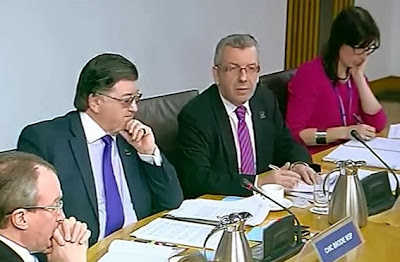
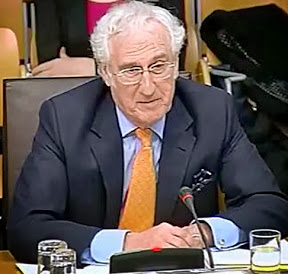
Click to watch: little gains from Lord Gill at private meeting with MSPs. IT HAS EMERGED Scotland’s top judge, Lord Brian Gill held a private meeting with two MSPs from the Scottish Parliament’s Public Petitions Committee who are currently investigating calls to create a register of judicial interests in Scotland. The meeting, of which there is now a debate about exactly what was recorded, what was left out and whether or not the Lord President objected to notes being taken at all, was discussed at last week’s Public Petitions Committee hearing on Tuesday the 28th January.

AND, contrary to claims of progress, discussions on what gains had emerged from the  private meeting between Gill, Petitions Committee Convener David Stewart and Deputy Convener Chic Brodie, now appear to show the Lord President led the two msps into believing a small change in how the lumbering Scottish Court IT database reports information on recusals might suffice as an improvement enabling data to be made more public even though in many cases where counsel have dared to raise the issue of a recusal, no note of what was said, or any reference has in fact been placed on the official record or within the IT database referred to during the committee’s discussions.

The situation on a further point, relating to declarations by judges Gill, Carloway, Sheriff Principal Alistair Dunlop and judicial colleagues who serve on the board of the Scottish Court Service also became murkier when it was claimed that information of this nature had come as a revelation to the msps who privately met the Lord President and would be part of an expected letter from Gill to the Petitions Committee.

However, clerks to the committee have since confirmed the information on Gill’s SCS Board disclosures, which are of a narrow focus and limited declaration, was already on the Scottish Parliament’s website and was referred to in briefing notes for the Petitions Committee months before the private meeting with Gill took place.

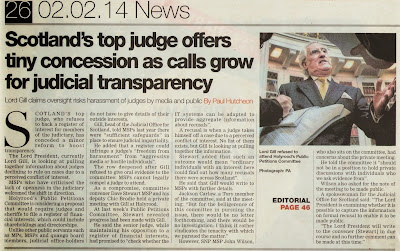
Sunday Herald reports:

Scotland's top judge offers tiny concession as calls grow for judicial transparency

Paul Hutcheon
Sunday 2 February 2014

SCOTLAND'S top judge, who refuses to back a register of interest for members of the judiciary, has conceded a minor reform to boost transparency.

The Lord President, currently Lord Gill, is looking at pulling together information about judges declining to rule on cases due to a perceived conflict of interest.

MSPs who have criticised the lack of openness in the judiciary welcomed the shift in direction.

Holyrood's Public Petitions Committee is considering a proposal that would require judges and sheriffs to file a register of financial interests, which could include shareholdings and directorships.

Unlike other public servants such as MPs, MSPs and quango board members, judicial office-holders do not have to give details of their outside interests.

Gill, head of the Judicial Office for Scotland, told MSPs last year there were "sufficient safeguards" in place to ensure judicial impartiality.

He added that a register could infringe a judge's "freedom from harassment" from "aggressive media or hostile individuals".

The row deepened after Gill refused to give oral evidence to the committee: MSPs cannot legally compel a judge to attend.

As a compromise, committee convener Dave Stewart MSP and his deputy Chic Brodie held a private meeting with Gill at Holyrood.

At last week's Public Petitions Committee, Stewart revealed progress had been made with Gill.

He said the senior judge, while maintaining his opposition to a register of financial interests, had promised to "check whether the IT systems can be adapted to provide aggregate information about recusals".

A recusal is when a judge takes himself off a case due to a perceived conflict of interest. No list of them exists, but Gill is looking at pulling together the information.

Stewart added that such an outcome would mean "ordinary individuals with an interest here could find out how many recusals there were across Scotland".

He said that Gill would write to MSPs with further details.

Jackson Carlaw, a Tory member of the committee, said at the meeting: "But for the belligerence of this committee in pursuing the issue, there would be no letter forthcoming, and there would be no investigation. I think it rather vindicates the tenacity with which we pursued the matter."

However, SNP MSP John Wilson, who also sits on the committee, had concerns about the private meeting.

He told the committee it "should not be in a position to hold private discussions with individuals who we ask evidence from".

Wilson also asked for the note of the meeting to be made public.

A spokeswoman for the Judicial Office for Scotland said: "The Lord President is examining whether it is possible to capture the information on formal recusal to enable it to be made public.

"The Lord President will write to the convener [Stewart] in due course and no further comment can be made at this time."

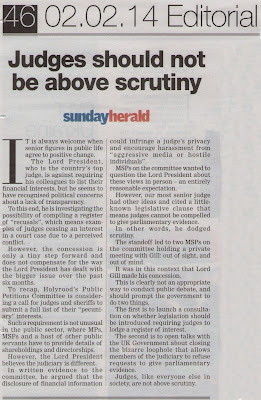
EDITORIAL: JUDGES SHOULD NOT BE ABOVE SCRUTINY

It is always welcome when senior figures in public life agree to positive change.

The Lord President, who is the country's top judge, is against requiring his colleagues to list their financial interests, but he seems to have recognised political concerns about a lack of transparency.

To this end, he is investigating the possibility of compiling a register of "recusals", which means examples of judges ceasing an interest in a court case due to a perceived conflict.

However, the concession is only a tiny step forward and does not compensate for the way the Lord President has dealt with the bigger issue over the past six months.

To recap, Holyrood’s Public Petitions Committee is considering a call for judges and sheriffs to submit a full list of their "pecuniary" interests.

Such a requirement is not unusual in the public sector, where MPs, MSPs and a host of other public servants have to provide details of shareholdings and directorships.

However, the Lord President believes the judiciary is different.

In written evidence to the committee, he argued that the disclosure of financial information could infringe a judge's privacy and encourage harassment from "aggressive media or hostile individuals".

MSPs on the committee wanted to question the Lord President about these views in person - an entirely reasonable expectation.

However, our most senior judge had other ideas and cited a little known legislative clause that means judges cannot be compelled to give parliamentary evidence.

In other words, he dodged scrutiny.

The standoff led to two MSPs on the committee holding a private meeting with Gill: out of sight, and out of mind.

It was in this context that Lord Gill made his concession.

This is clearly not an appropriate way to conduct public debate, and should prompt the government to do two things.

The first is to launch a consultation on whether legislation should be introduced requiring judges to lodge a register of interest.

The second is to open talks with the UK Government about closing the bizarre loophole that allows members of the judiciary to refuse requests to give parliamentary evidence.

Judges, like everyone else in society, are not above scrutiny.

Thursday, November 21, 2013

Scotland's top judge Lord Gill warns Holyrood Justice Committee against scrapping corroboration of evidence justice safeguard

Lord President Brian Gill – ‘good rule’ of corroboration should be retained. SCOTLAND’S top judge the Lord President, Lord Brian Gill, appeared before Holyrood’s Justice Committee yesterday, warning against supporting plans by the Scottish Government to remove the long held safeguard of Corroboration, where evidence in a court of law is needed from two separate sources for a conviction.

Speaking to MSPs on the Scottish Parliament's Justice Committee, 20 November 2013, Lord Gill, the Lord President of the Court of Session, said the rule - which requires that evidence against an accused person must come from more than one source - was one of the "finest features" of the country's justice system.

He told MSPs that only one judge in Scotland, the Lord Justice Clerk Lord Carloway - who recommended abolishing corroboration in his review of criminal law and practice - supported getting rid of the rule, with all other judges opposed to the move.

Lord Gill told MSPs corroboration justice safeguard should be retained (Click to watch)

Giving evidence to msps on the intentions of the Scottish Government to remove corroboration to help the Crown Office secure higher prosecution statistics, Lord Gill told the committee: "I don't think this will improve the quality of justice in Scotland in any way.

"I think there is a very serious risk there will be fewer convictions and I also think that if you make this change in isolation, without looking at the wider picture, there are consequences that at the moment are unknowable but could be very adverse to the system."

He added that scrapping corroboration "might increase the number of prosecutions" but said he was "certainly not convinced it will increase the number of convictions".

Lord Gill argued getting rid of the requirement would mean defence lawyers would be able to "go to the jury and say 'would you convict my client on the word of one person, with nothing else to support it?'".

He went on: "That could be a a very powerful line to take with juries and if corroboration is abolished I am not persuaded it will increase the conviction rate."

He stressed: "We've got to think very carefully about what the consequences of this could be. It's a major change which has consequences, many of which are unknown at this stage.

"It's not just a piece of law reform in the narrow area of the law of evidence, this affects the whole approach of our society towards justice and it could have consequences which could be very, very serious.

"By and large we do not have many miscarriages of justice in Scotland and when they are discovered we put them right. There are very few. My fear would be there will be many more if corroboration is abolished."

"I think we should be very proud of the fact we have something that other jurisdictions do not have, it is one of the great hallmarks of Scottish criminal law.

"I take the view we are all privileged in Scotland to live in what is a just society, and the reason for that is our criminal system is rooted in the idea of fairness and corroboration is, in my opinion, a critical element in that.

"So, I'm not here to apologise for the fact that we've got corroboration, I think we should be very grateful that we do."

Lord Gill told MSPs this was the "general view of the judiciary", adding: "I asked every judge to express their view individually to me. With the exception of my colleague the Lord Justice Clerk, all the judges were opposed to the abolition of corroboration."

Lord Gill added corroboration was "not some sort of legal relic from antiquity", saying: "We didn't get where we are by accident, the fact that we have this rule in our law, which I regard as one of its finest features, is a result of centuries of legal development and legal thought.

Concluding his testimony, Lord Gill told MSPs : "It has been found to be a good rule and I would say listen to the wisdom of the ages, it has a lot to tell us.”

All of Scotland’s High Court judges have announced their support for the retention of corroboration : Judges respond to public consultation on Carloway Report

On 3 July 2012, the Scottish Government launched a public consultation seeking views on how best to reform areas of Scottish criminal law and practice. This consultation was based on the recommendations set out in Lord Carloway’s Report on criminal procedure which was published in November 2011.

The Judges of the High Court of Justiciary, other than Lord Carloway, have now submitted their response available online here : Response by the Senators of the College of Justice to SG consultation : Reforming Scots Criminal Law & Practice  to proposals in the present consultation paper.  While their response provides support for the majority of the Carloway Review proposals, they unanimously agree that the rule of corroboration should not be abolished.

The full Carloway Review can be read online here: Carloway Review Report & Recommendations 2011 along with the Executive Summary and Lord Carloway's statement

It should be noted Scottish Law Reporter supports the retention of corroboration, and has reported on the issue in previous coverage HERE

Sunday, June 09, 2013

Transparency scandal as Scotland’s top judge threatens to withdraw judicial cooperation with Scottish Parliament over calls for judges to publish register of hidden interests

Lord Brian Gill : Too much transparency may end  judges involvement with Holyrood. CALLS FOR TRANSPARENCY in Scotland’s Judiciary have provoked Lord Brian Gill, Scotland’s top judge to issue a veiled threat to block any further cooperation from the judiciary with the Scottish Parliament after MSPs twice asked the Lord President to show up to give evidence on a proposal to create a compulsory register of interests for Scotland’s judiciary.

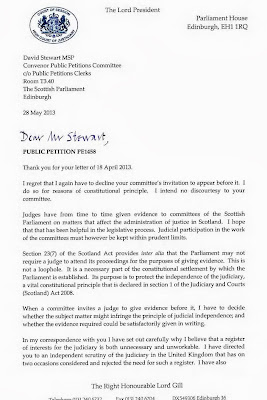
Responding to MSPs on Holyrood’s Public Petitions Committee who are considering Petition PE1458: Register of Interests for members of Scotland's judiciary, Lord Gill said : “Judicial participation in the work of the committees must however be kept within prudent limits” and went on to state it was up to Lord Gill as the Lord President to decide whether any appearance by a judge in front of MSPs may compromise the independence of the judiciary.

The top judge’s threat to withdraw help or cooperation from the judiciary on legislation including personal appearances by judges at Holyrood comes as a scandal involving multiple failures by the judiciary to declare conflicts of interest, financial deals & wealth, hospitality, paid outside work, links to law firms and even criminal convictions engulfs Scotland’s entire judicial system.

The Scottish Parliament are yet to respond to Lord Gill’s veiled threats to restrict or block all cooperation from the judiciary in future legislation, however critics of Scotland’s closed shop judiciary have urged the Scottish Parliament to move ahead of the obstructive judge and legislate for a compulsory register of judicial interests encompassing financial and other interests of Scotland’s judges.

Lord Gill’s letter to the Convener of the Public Petitions Committee :

PUBLIC PETITION PE1458

Thank you for your letter of 18 April 2013. I regret that I again have to decline your committee's invitation to appear before it. I do so for reasons of constitutional principle. I intend no discourtesy to your committee.

Judges have from time to time given evidence to committees of the Scottish Parliament on matters that affect the administration of justice in Scotland. I hope that that has been helpful in the legislative process. Judicial participation in the work of the committees must however be kept within prudent limits.

Section 23(7) of the Scotland Act provides inter alia that the Parliament may not require a judge to attend its proceedings for the purposes of giving evidence. This is not a loophole. It is a necessary part of the constitutional settlement by which the Parliament is established. Its purpose is to protect the independence of the judiciary, a vital constitutional principle that is declared in section 1 of the Judiciary and Courts (Scotland) Act 2008.

When a committee invites a judge to give evidence before it, I have to decide whether the subject matter might infringe the principle of judicial independence; and whether the evidence required could be satisfactorily given in writing.

In my correspondence with you I have set out carefully why I believe that a register of interests for the judiciary is both unnecessary and unworkable. I have directed you to an independent scrutiny of the judiciary in the United Kingdom that has on two occasions considered and rejected the need for such a register. I have also directed you to the decision of the United Kingdom Government to accept that finding, and to the decision of the United Kingdom Supreme Court not to create a register. That I think, is as much useful evidence as I am in a position to give on the subject; but if there is any further information that you feel would be relevant and helpful to the committee, please let me know and I will consider the matter further.

In your letter you have asked whether any central record has been kept of failures by judges to recuse themselves. The Lord President has been responsible for matters concerning the conduct of judicial office holders since April 2010. During that period there has been no case in which a judge has been found guilty of misconduct for a failure to recuse.

If you would find it helpful I would be pleased to meet with you to discuss the constitutional implications of the Committee's invitation.

Scottish Law Reporter has previously reported on a story which revealed several of Scotland’s judges are actually convicted criminals, one of whom was even convicted of cheating the benefits system : ONE OF OUR JUDGES IS A BENEFITS CHEAT– reveals investigation into undeclared criminal habits, tax dodging & secret fiddles of Scottish judiciary

Saturday, June 02, 2012

Lord Justice Clerk Lord Gill confirmed as new Lord President, controversial Lockerbie Lord Advocate Colin Boyd made a Court of Session judge

Lord GillLord President to be, Lord Gill LORD BRIAN GILL, Scotland’s current Lord Justice Clerk has been confirmed today as the new Lord President, replacing Lord Arthur Hamilton who retires later this month. The appointment of Lord Gill has been welcomed by many in the legal & political world, and also campaigners for law reform & the media. Lord Gill’s appointment is covered in the popular Scots law blog “A Diary of Injustice in Scotland” HERE and readers may be interested to view Lord Gill’s appearance before Holyrood’s Justice Committee, covered by Scottish Law Reporter in 2009, HERE

However, while many welcome Lord Gill’s appointment as Lord President, the hopes of reform to the justice system and courts have been set back with the First Minister’s nomination of Lord Colin Boyd, who has now been appointed to a post of judge at the Court of Session.

Lord Boyd was the Lord Advocate in the fit up trial of Abdelbasset al Megrahi for the bombing of Pan Am Flight 103 over Lockerbie, Scotland in December 1988. There had been speculation earlier in April that Lord Boyd was to be made a judge, reported on Professor Robert Black’s Lockerbie Case blog, HERE

The announcement from the Scottish Government :

Appointment of Lord President and Senators

First Minister Alex Salmond today welcomed the appointment by Her Majesty the Queen of The Rt Hon Lord Gill as Scotland’s new Lord President. Lord Gill replaces the Rt Hon Lord Hamilton who retires on 8 June. Mr Salmond said that Lord Gill was an outstanding individual who would lead Scotland’s judiciary with independence and integrity and had a clear vision for the continued modernisation of the Scottish courts. Lord Gill was nominated by the First Minister taking account of recommendations made by a selection panel constituted under the Judiciary and Courts (Scotland) Act 2008.

Mr Salmond said: "I warmly welcome the appointment of The Rt Hon Lord Gill as Scotland’s new Lord President. His commitment to reform and modernisation is clear and under his leadership I am confident there will be substantial improvements to the justice system. He is an individual of great stature and integrity and in leading Scotland’s judiciary will enjoy the respect and confidence of those around him."

"I would also like to take the opportunity to thank Lord Hamilton for his leadership over the last few years in establishing the new role of the Lord President and the new governance arrangements for the Scottish Court Service. The changes introduced by the Judiciary and Courts (Scotland) Act were of considerable constitutional significance, and their successful introduction will stand as a testament to his period in office."

Her Majesty the Queen, on the recommendation of the First Minister, has also appointed Lord Boyd QC, Michael Jones QC, and David Burns QC as Senators of the College of Justice.

First Minister Alex Salmond nominated Lord Boyd, Michael Jones and David Burns for appointment on the basis of a report by the independent Judicial Appointments Board for Scotland.

Lord Boyd, Michael Jones and David Burns will take up their appointments later in 2012.

Lord Gill is Scotland's longest serving judge. He is a graduate of the Universities of Glasgow and Edinburgh and lectured in the Faculty of Law of Edinburgh University before being admitted to the Faculty of Advocates in 1967. He was appointed Queen’s Counsel in 1981. He is a member of the English Bar (Lincoln’s Inn, 1991; Bencher 2002); an advocate depute 1977-1979; Standing Junior Counsel to the Foreign and Commonwealth Office (1974-1977), the Home Office (1979-1981) and the Scottish Education Department (1979-1981); and Deputy Chairman of the Copyright Tribunal (1989-1994).

He was appointed a Judge in 1994 and Lord Justice Clerk in 2001. Lord Gill is Chairman of the Lands Valuation Appeal Court and was Chairman of the Scottish Law Commission from 1996 to 2001. In 2008, he was appointed by the UK and Scottish Governments to Chair the Public Inquiry into the fatal explosion in 2004 at the ICL factory in Glasgow. Lord Gill was also Chairman of the Scottish Civil Courts Review (2007-2009). He is Chairman of the Council of the Royal School of Church Music and a Fellow of the Royal Society of Edinburgh and a Fellow of the Royal Scottish Academy of Music and Drama. In 2011, Lord Gill was awarded a Papal Knighthood of the Order of St Gregory the Great.

Lord Boyd qualified as a solicitor in 1978 and was called to the Bar in 1983. He was appointed QC in 1995. He practised at Caesar & Howie from 1978 to 1982 and as an Advocate from 1983 to 1997 building up a practice in civil and particularly planning law. He acted as Advocate Depute from 1993 to 1995 and was appointed Solicitor General for Scotland (for the UK Government) in 1997 and for the Scottish Executive in 1999. Lord Boyd was Lord Advocate from 2000 to 2006. His time in office saw the devolution of legislative responsibility to the new Scottish Parliament and the introduction of the European Convention on Human Rights into domestic law. He brought in significant reforms to the Crown Office and Procurator Fiscal Service. He was also responsible for the prosecution of the Lockerbie trial. He returned to practice as a solicitor advocate in 2007 joining Dundas & Wilson, Solicitors as a Consultant and Head of Public Law. He was appointed a Privy Councillor in 2000. He became a Life Peer in 2006 and is an Honorary Professor of Law at the University of Glasgow.

Mr Jones was called to the Scottish Bar in 1977 and to the Bar of England and Wales in 1987; he was appointed QC in 1989. He has acted as standing counsel to the Department of Trade in Scotland and has been an Advocate Depute. Apart from his practice, he has covered several roles within the Faculty of Advocates and has taught advocacy skills both in the United Kingdom and overseas. Since 2008 he has been Senior Partner with Simpson & Marwick, and Head of its Dispute Resolution Department and its Advocacy Unit. Mr Jones has been Part-time Chairman of the Police Appeals Tribunal since 1997 and Ordinary Judge of Appeal in Jersey and in Guernsey since 2005.

Mr Burns was admitted to the Faculty of Advocates in 1977 and took silk in 1991. Prior to his admission he worked as a legal assistant in Rochester, New York and San Francisco. From 1977 to 1989 he was a Junior Counsel involved in family law, personal injury and planning. From 1989 to 1991 he was an Advocate Depute and on return to private practice he resumed his involvement in planning, personal injury and criminal law. Mr Burns acted as Defence Counsel in the Lockerbie case from 2000 until 2002. In 1998 he was appointed Deputy Commissioner of Social Security and served as a temporary judge from 2002 to 2005. He became a part-time Sheriff in 2007.

The salary of the Lord President is £214,165 per annum and the salary of a Senator is £172,753 per annum.

The Judicial Appointments Board for Scotland was established by Ministers in 2002 and it became an independent advisory non-departmental public body on June 1, 2009. The Board has statutory responsibilities under the Judiciary and Courts (Scotland) Act 2008. The Board's role is to recommend for appointment to the office of judge, sheriff principal, sheriff and part-time sheriff. The First Minister retains the statutory responsibility for making nominations to Her Majesty the Queen. The First Minister is required by statute to consult the Lord President of the Court of Session before making his nomination to Her Majesty.

The process of selection for the Lord President is set out in the Judiciary and Courts (Scotland) Act 2008 ("the 2008 Act"). In line with those provisions the First Minister established a panel of 4 people and invited them to recommend individuals suitable for appointment. The panel was chaired by Sir Muir Russell (Chair of the Judicial Appointments Board for Scotland) and also comprised the Rt Hon Lord Hardie and the Hon Lady Dorrian (senators of the Court of Session) and Professor Coyle (a lay member of the Judicial Appointments Board for Scotland).

A recent report in the Herald newspaper regarding criticism of Lord Boyd’s role in the Lockerbie case :

Lockerbie trial QC criticised

Lucy Adams
Chief Reporter

The commission investigating whether there was a miscarriage of justice at the Lockerbie trial has criticised the former Lord Advocate who led the landmark prosecution.

Colin Boyd, QC, now Lord Boyd, was head of the team which has been accused of failing to disclose crucial information to the defence working on behalf of Abdelbaset Ali Mohmed al Megrahi, who was convicted of the bombing of Pan Am Flight 103.

In its 821-page report, the Scottish Criminal Cases Review Commission (SCCRC) criticises Lord Boyd for his handling of CIA cables, referring to Abdul Majid Giaka, an alleged double agent who was a Crown witness. Giaka identified Megrahi as a member of Libyan intelligence, but his subsequent evidence was rejected following revelations in the US intelligence agency's much-redacted cables that he had demanded and received reward money.

Lord Boyd originally told the trial there was no need for disclosure.

However, the SCCRC said it was "difficult to understand" his assurances on August 22, 2000, that there was "nothing" within the documents relating to Lockerbie or the bombing which could "in any way impinge" on Giaka's credibility. It added: "The matter is all the more serious given that part of the reason for viewing the cables on 1 June, 2000, was precisely in order to assess whether information behind the redacted sections reflected upon Majid's credibility."

The Crown subsequently shared some of the redacted cables after demands from the defence.

Lord Boyd last night rejected the commission's claim. He said: "I reject the suggestion that I or anyone else in the prosecution team failed to disclose material evidence to the defence. All of the relevant CIA cables were disclosed subject to some exceptions, principally to ensure that the lives of named individuals were not put at risk. They were disclosed as a result of a request from the court directed to me.

"I am satisfied that the Crown acted with propriety throughout the trial and endeavoured in this case, as with any other conducted in my name as Lord Advocate, to secure the accused's right to a fair trial." He added he was "satisfied" the verdict was proper and correct.

The SCCRC report refers to a number of occasions when it was not granted full access to security documents from the CIA. It was not allowed to disclose certain documents about the case – including one relating to timers found in Senegal which were similar to those thought to have caused the tragedy, and claims by former CIA staff.

The UK Security Services complied with all requests to share information with the SCCRC but said a number of documents could not be disclosed because of national security.

Yesterday, The Herald reported that the SCCRC dossier uncovers serious discrepancies in the Crown Office's reasons for not disclosing vital information. The commission, which reviews cases post-appeal and investigates possible miscarriages of justice, told the Crown it would take legal action if the prosecution did not hand over important documents and speed up information sharing.

Legal experts have now called for a public inquiry into who was responsible for the 1988 atrocity, full disclosure of the SCCRC report and an inquiry into Crown Office practice not to disclose key evidence to the defence during the trial.

Last night Justice Secretary Kenny MacAskill wrote again to his UK Government counterpart, Kenneth Clarke, to ask for an exemption under data protection laws to allow the document to be published.

A Scottish Government spokeswoman said: "With virtually every passing day, more and more of the content of the SCCRC's Statement of Reasons in the Megrahi case comes into the public domain. Ministers firmly believe this selective reporting of the information only emphasises the importance of the SCCRC being able to decide to disclose information in the Megrahi case."

A spokesman for the Crown Office said: "This highly selective reporting of the commission's consideration of the CIA cables and Majid gives a misleading account of this evidence and the role of Lord Boyd.

"In particular, it fails to acknowledge that the commission concluded that there was no miscarriage of justice on this point and it also ignores the trial court's thanks to Lord Boyd for his efforts to bring this complex and sensitive information before the court.

Monday, May 07, 2012

No justice gains for ordinary Scots as ‘Fat Cat’ £220K Scots judges ‘will hinder & restrict’ access to justice reforms to protect vested interests

NEARLY four years on from the Lord Justice Clerk, Lord Gill’s damning indictment of Scotland’s Civil Justice system as being “Victorian” and unfit for purpose, signs of a limited effort to mend Scotland’s thoroughly broken, corrupt, prejudiced & riddled with vested interests civil justice system with the Scottish Government’s announcement of the new Scottish Civil Justice Council and Criminal Legal Assistance Bill, which is claimed to be part of a four-year ‘Making Justice Work’ Programme.

The Scottish Government statement claims the ‘Making Justice Work’ project draws together a range of reforms across criminal, civil and tribunal justice. The goal is to ensure the justice system better meets the needs of those it serves - the people of Scotland – through a series of improvements to make it fairer, more accessible, cost-effective and efficient.

The Bill marks the Scottish Government’s commitment to two justice priorities:

The establishment of a Scottish Civil Justice Council to replace the Court of Session Rules Council and Sheriff Court Rules Council. The new Council will also have a wider policy role to advise and make recommendations on improving the civil justice system in Scotland.

The introduction of financial contributions in ‘criminal legal aid’ for those who can afford to pay, in order to protect access to justice for those who can’t afford to pay.

Justice Secretary Kenny MacAskill said: “Scotland has a justice system we can be proud of. It is a justice system which is steeped in history and one which is rightly admired by other jurisdictions. Through over 1,000 additional police officers on the streets making our communities safer, we have seen recorded crime in Scotland reach its lowest level in 32 years, we’ve seen those who are committing crimes being punished swiftly by our justice system and serving the longest prison sentences in a decade. However, there is no room for complacency and we need to ensure that we constantly look at new ways to improve our justice system even further, drive out inefficiencies, and make justice work for the people of Scotland.

“Today’s Bill is the first legislative step in the most significant programme of civil courts reform in Scotland for a century and implements one of the key recommendations made by Lord Gill in his expert review of the system. We listened to Lord Gill and we are acting.We will consult on proposals for civil courts reform toward the end of this year. Legislating for the new Council now will aid the pace of reform. On legal aid, the Scottish Government believes that it is right and proper that those who can afford to pay towards the cost of their legal defence costs do so.We shouldn’t have a system where those who can afford to contribute to the cost of their legal fees get taxpayers’ cash at the expense of those who simply cannot afford to pay. The Bill will ensure this isn’t the case. It will also deliver up to £3.9m of savings on the legal aid budget that will contribute to maintaining the current scope of legal aid in Scotland for those who need it most, protecting access to justice.”

Related information

Many of the Lord Gill Review recommendations will need new rules of court. To prepare those, the Review recommended a new, single body should be established with oversight of the entire civil justice system. This Bill will therefore establish a new body, the ‘Scottish Civil Justice Council’, which will replace the Court of Session and Sheriff Court Rules Councils, and place us on the path towards far-reaching reform of Scotland’s civil justice system through the Making Justice Work programme.

The changes to legal aid will also correct an anomaly in the system which the Scottish Government believes is unfair. Applicants for civil legal aid can already be required to contribute towards the cost of their case, whereas applicants for criminal legal aid do not, even if they might have the means available to do this.

However, legal observers have indicated the changes proposed in the new bill will do little to widen access to justice for Scots, or cure the tribal, anti-public attitude of many of Scotland’s highly paid judges who are on salaries up to £220,000 a year plus expenses & gold plated pensions.

Giving his opinion on the Scottish Government’s Making Justice Work initiative, a legal insider said : “No reforms of the courts or justice system will pass muster if the judiciary or the legal apparatus does not agree with them”.

He continued : “The fact is Scotland’s courts system has been out of control for some years, with highly paid untouchable, unaccountable judges leaning towards vested interests and the interests of the establishment in almost every decision of the court. There will be no gains for the Scots public over the wishes & interests of the fat cat judiciary no matter what the intentions of the Scottish Government may be.”

Friday, April 27, 2012

Lord President’s ‘tap on the shoulder judge routine’ : Solicitor Philip Mann appointed as £128K a year sheriff of Grampian,Highlands & Islands

NOMINATED by Scotland’s First Minister Alex Salmond, who in actuality plays only a bit part in sending the Lord President, Lord Hamilton’s ‘tap on the shoulder job offer to a legal colleague’ onto the Queen for approval, solicitor Philip Mann of Moray based law form Stephen & Robb has now been appointed as sheriff of Grampian, Highlands & Islands, earning a taxpayer funded salary of £128,296 a year plus expenses.

The law firm’s website still lists Mr Mann as “still available to give you the benefit of his considerable experience in many areas of the law but principally in buying and selling properties, Wills and Powers of Attorney and reparation claims”

The Scottish Government Press Release :

Appointment of Mr Philip Mann, solicitor, as sheriff of Grampian, Highlands and Islands based at Kirkwall and Lerwick.

Her Majesty the Queen has appointed Mr Philip Mann, solicitor, as sheriff of Grampian, Highlands and Islands based at Kirkwall and Lerwick.

First Minister Alex Salmond nominated Mr Mann for appointment, which was made on 16 April, on the basis of a report by the independent Judicial Appointments Board.

Mr Mann will take up his role on 2 July.

Philip Mann was educated at Keith Grammar School and Aberdeen University where he gained his degree in Law.  He was admitted as a solicitor in 1975 when he joined Fyfe and Murray, Solicitors, Greenock, having served his apprenticeship with Stephen & Robb, Solicitors and Estate Agents, Keith.  He re-joined Stephen & Robb in 1976 and has remained there throughout his career.  He is now their senior partner.  In 2002 Mr Mann became an honorary sheriff for the sheriff court district of Elgin.  In 2006 he was appointed as a part-time sheriff and in that capacity sits in courts all over Scotland.

The salary of a sheriff is £128,296 per annum.

The Judicial Appointments Board for Scotland was established by Ministers in 2002 and it became an independent advisory non-departmental public body on 1 June 2009. The Board has statutory responsibilities under the Judiciary and Courts (Scotland) Act 2008. The Board’s role is to recommend for appointment to the office of judge, sheriff principal, sheriff and part-time sheriff. The First Minister retains the statutory responsibility for making nominations to Her Majesty the Queen. The First Minister is required by statute to consult the Lord President of the Court of Session before making his nomination to Her Majesty.

Saturday, April 07, 2012

Proposals announced to ‘reform’ Scotland’s corrupt tribunal system under judicial leadership & control of Lord President

SCOTLAND’S notoriously corrupt TRIBUNALS SYSTEM is to come under the microscope with the launch of a Scottish Government consultation into reforming tribunals with a view to creating two generic tribunals, a First tier and an Upper tier, to be brought under the ‘judicial leadership’ (control, dictate - Ed) of Scotland’s top judge, the Lord President.

The plans, announced by an apparently less than convinced Minister for Community Safety, Roseanna Cunningham claim “greater clarity” will be brought to Scotland’s beleaguered vested interested stuffed tribunal system, which hosts members from all walks of life (including a cocaine using solicitor, a drunk driver sheriff, and a ‘retired’ nurse who stole from patients – Ed)

Reforming Scotland’s tribunals

The Scottish Government has today launched a consultation on reforming Scotland’s tribunal system with proposals centring around a unified, integrated structure which will be brought under the judicial leadership of the Lord President.

The proposals intend to create two generic tribunals, a First-tier and an Upper-tier, in which to transfer the separately operating tribunals in Scotland. There will also be genuine judicial independence by bringing the tribunal judiciary under the leadership of the Lord President.

Minister for Community Safety and Legal Affairs Roseanna Cunningham said: “I want to bring greater clarity and cohesiveness to Scotland’s tribunal system, ensuring that people at all points in the system receive a strong, fair and just service. Our proposed reforms will bring separate tribunals into a unified structure and provide for their independence by bringing judicial leadership under the Lord President. We also propose introducing new rule making procedures and new arrangements for the selection and appointment of tribunal judiciary.”

Ms Cunningham continued : “We are now embarking on the most radical reforms of our courts and tribunals systems for at least a century through our Making Justice Work programme. Our justice system needs to be better connected and make more effective use of modern technology to ensure a service that is high quality, continually improving, efficient and responsive to local people's needs. The character of tribunals has changed over recent decades; they are no longer considered to be administrative bodies but are now rightly perceived to be an integral part of the judicial system. These proposals underpin and strengthen that development.”

Ms Cunningham went on at further length : “The current system is complex and fragmented, and important questions have rightly been raised by third-party expert reviews around tribunal independence, system coherence and the quality of service provided to users. We want to retain and build on a tribunal system that puts its users at the centre. We want the public to have confidence in a system that treats them fairly, quickly and with respect. These changes require primary legislation and we are committed to bringing forward a bill within this parliament. The tribunals system we are proposing will make structural and organisational improvements but I am very clear that we must retain all the service benefits of the current, specialised system of tribunals with their particular jurisdictionally specific ethos. The particular needs of tribunal users remain central to this process. That is why I have ensured that appropriate measures are in place to protect each tribunal’s distinctive culture and specialist nature. I look forward to hearing the views of our valued stakeholders throughout this consultation process as we move forward with building a stronger, more responsive and supportive tribunal system for Scotland.”

The consultation is scheduled to run for 12 weeks. The coherent tribunal system proposed through this consultation supports a clearer, simpler and more effective way of resolving citizen to state and party to party disputes. The proposals seek to improve the effectiveness and quality of service delivery to users and secure better value for public money.

Consultation on proposals for a new tribunal system for Scotland

Easy read guide to the consultation

Friday, January 20, 2012

Lord President asks Westminster to amend Scotland Bill, closing Criminal Appeals route to UK Supreme Court on Human Rights issues

Lord_HamiltonLord President asks for amendment to Scotland Bill allowing Scottish Courts to bury handle Human Rights appeals. IN a move seen by many legal observers as an indication the retiring Lord President, Lord Hamilton may not be so retiring from the legal scene as some may have expected, the Lord President has written to the UK Parliament to ask its MPs to add a restriction on criminal appeals to the UK Supreme Court to the Scotland Bill provisions dealing with devolution issues, thus ensuring the Court of Session can ‘take care of’ any Human Rights infringements, and bury the chance of any appeal from Scotland being heard at the UK’s Supreme Court, a move welcomed (even if it was arranged) by the SNP. The move brings the Lord President into line with the wishes of the Scottish Government, who fell over themselves to castigate the UK’s Supreme Court and even it’s Scottish judges after rulings in the Cadder v HMA case and Nat Fraser appeal.

The Lord President’s representations to Westminster can be read online HERE

Now that the Lord President has ‘rolled over’ to make a judicial request to back up the harsh words from Scottish Ministers, who did not enjoy the impression which was created that Scotland’s justice system and its courts simply couldn't be trusted with appeals, particularly on ECHR issues, the way is now clear for Lord Hamilton to return to a few appointments at the behest of Scottish Ministers as soon as is practicably possible (String pulling comes to mind – Ed)

The Press Release from the Judiciary of Scotland : Lord President Makes Written Representations to Parliament

WrittenRepresentationsLPJan12jpg_Page1Click image to read Lord Hamilton’s representation to Westminster. Utilising the powers conferred on him by the Constitutional Reform Act 2005 the Lord President is laying before the United Kingdom Parliament written representations regarding the Scotland Bill presently before it. Section 5 of the Act provides that the Lord President may lay written representations before Parliament on matters relating to the judiciary or the administration of justice in Scotland. Equivalent powers are available to the Lord Chief Justice of England and Wales and the Lord Chief Justice of Northern Ireland.

The Lord President is urging Parliament to do two things:

(1) to extend the jurisdiction of the Supreme Court in Scottish criminal appeals and references to the remedying of infringements by the courts below as well as by the prosecutor; but

(2) to restrict those cases in which leave may be granted to appeal to the Supreme Court from the High Court of Justiciary to cases in which the High Court has certified that a point of law of general public importance is involved in the decision.

As to (2), the Court of Criminal Appeal in England and Wales and the equivalent court in Northern Ireland have long had a certification procedure which has proved to be valuable. The Lord President wishes to secure a similar provision for the High Court in Scotland.

The Lord President seeks, in the Scotland Bill, an amendment to the Scotland Act 1998 to the above effect.

Constitutional Reform Act 2005

Part 2

Section 5 Representations to Parliament.

(1)The chief justice of any part of the United Kingdom may lay before Parliament written representations on matters that appear to him to be matters of importance relating to the judiciary, or otherwise to the administration of justice, in that part of the United Kingdom.

(2)In relation to Scotland those matters do not include matters within the legislative competence of the Scottish Parliament, unless they are matters to which a Bill for an Act of Parliament relates.

(3)In relation to Northern Ireland those matters do not include transferred matters within the legislative competence of the Northern Ireland Assembly, unless they are matters to which a Bill for an Act of Parliament relates.

(4)In subsection (3) the reference to transferred matters has the meaning given by section 4(1) of the Northern Ireland Act 1998 (c. 47).

(5)In this section “chief justice” means—

(a)in relation to England and Wales or Northern Ireland, the Lord Chief Justice of that part of the United Kingdom;

(b)in relation to Scotland, the Lord President of the Court of Session.

Explanatory Notes

Section 5: Representations to Parliament

Section 5 provides that the Lord Chief Justice of England and Wales, the Lord Chief Justice of Northern Ireland and the Lord President of the Court of Session may table written representations to Parliament on matters relating to the judiciary or the administration of justice. In respect of the Lord President of the Court of Session and the Lord Chief Justice of Northern Ireland, this function is qualified by subsections (2) and (3) in order to respect the devolution settlements with Scotland and Northern Ireland respectively.

Constitutional Reform Act 2005

Thursday, September 15, 2011

Scotland’s Lord President, Lord Hamilton announces retirement date of 08 June 2012, First Minister goes on-the-hunt for new head of Scotland’s courts

Scotland’s Lord President, Lord Hamilton, has announced he is to retire on June 8 2012. While it is up to the Prime Minister, currently David Cameron to recommend a replacement to the Queen, that person must be recommended by the First Minister, currently Alex Salmond who in turn cannot make a recommendation until the panel constituted to find a replacement for Lord Hamilton makes its own recommendations.

Lord Hamilton was first appointed as a Senator of the College of Justice in 1995 and was promoted to the Inner House of the Court of Session in 2002. He was appointed to the offices of Lord President of the Court of Session and Lord Justice General of Scotland in 2005.

Under the Judiciary and Courts (Scotland) Act 2008 the First Minister will now establish a panel and invite them to make recommendations of individuals who are suitable for appointment to fill the vacancy.

The panel will comprise Sir Muir Russell, the chair of the Judicial Appointments Board for Scotland; one other lay member of that Board nominated by Sir Muir and two judges who will be nominated by the First Minister.

Mr Salmond said: "Lord Hamilton has given outstanding public service both in his role as a judge and as the Lord President and Lord Justice General.

"He has presided during a time of considerable change with the enactment of the Judiciary and Courts (Scotland) Act 2008 - legislation which he played in active part in promoting. It is in his role as both the first Head of the Scottish Judiciary and the chair of the Scottish Court Service that Lord Hamilton has demonstrated his leadership skills and willingness to take on a whole range of new responsibilities which are delivering an improved court system.

"Despite his substantial non-judicial responsibilities, Lord Hamilton has maintained a strong commitment to his judicial work, continuing to preside regularly in the most demanding and complex civil and criminal appeal cases. He will leave behind a substantial contribution to the development of Scotland's distinctive civil and criminal law."

The Rt Hon Lord Hamilton will be retiring after 17 years as a judge. It is for the Prime Minister to make a recommendation to the Queen on who should replace Lord Hamilton, but he may not recommend any person who has not been nominated to him by the First Minister. The First Minister may not nominate any person until the panel has made its recommendation and the First Minister must have regard to the panel's recommendation.

The Judiciary and Courts (Scotland) 2008 Act brought about the creation of the Scottish Court Service as a new statutory entity, governed by a judicially led corporate body as well as giving the Lord President the role of Head of the Scottish Judiciary with important new responsibilities for the disposal of business and the leadership of the Scottish judiciary as a whole.

Lord Hamilton is a graduate of the Universities of Oxford (BA, Worcester College) and Edinburgh (LLB). He was admitted to the Faculty of Advocates in 1968 and was Standing Junior Counsel to the Scottish Development Department (1975-78) and the Inland Revenue (1978-82). He served as an Advocate Depute from 1982 to 1985. From 1988 to 1995 he was a Judge of the Courts of Appeal of Jersey and Guernsey, and from 1992 to 1995 he was President of the Pensions Appeal Tribunals for Scotland. He was appointed as a Senator of the College of Justice in 1995 and as Lord President in 2005. In June 2003 he was elected an Honorary Fellow of Worcester College, Oxford and in January 2006 an Honorary Bencher of the Inner Temple, London.

(A good bloke like Arthur will be missed around the courts – Ed)