Showing posts with label Independence. Show all posts

Monday, August 05, 2013

Law Society of Scotland demands policy say in indyref “or else Union will stay as we see it”

Unionists R’ Us - because its more profitable, says Law Society THAT crafty, old, and well known unionist institution, the Law Society of Scotland has set out what it sees as key questions for debate on Scotland's constitutional future. The questions, thinly disguised as a debate (something the Law Society is not good at, unless it is controlling it and any outcome), has set out a series of key questions on Scotland's constitutional future HERE in a discussion paper published today, Monday 5 August

The paper 'Scotland's Constitutional Future, views, opinions and questions' (or, Scotland as the Law Society wants it – Ed) aims to inform and add value to the current discussion on independence and constitutional reform.

It focuses on a number of critical areas including;

Scotland's membership of the European Union - including a call on both the Scottish and UK Governments to publish all Law Officers' legal advice on an independent Scotland's membership of the EU and other international organisations.

The impact of independence on the economy - including questions around currency, Scotland's share of assets and liabilities as well as taxation, financial regulation and consumer protection.

Judicial and parliamentary restructuring - including questions on whether an independent Scotland should have a written constitution and whether the current model and structure of the Scottish Parliament would work for an independent Scotland.

The Society's paper provides a detailed analysis of the potential impact of independence on specific areas of both devolved and reserved areas of law.

The paper also raises important questions about Scotland's future if the electorate choose to remain part of the United Kingdom, particularly around the process and timetable for agreeing possible further devolution of powers from Westminster to Holyrood.

Bruce Beveridge, President of the Law Society of Scotland, issued lengthy comments beginning with : "In just over a year we will each be asked to decide if Scotland should become an independent country. It is the biggest question for our nation in over 300 years but everyone, whether for or against independence, wants the same result - for people in Scotland to live in peace and prosperity.

"However there are many questions to be answered before September 2014, answers which would allow all of us to make a more informed decision about our future - from how our parliament should be structured, the currency we would use, what level of tax we would pay to cross border treaties and our relationship with other countries in Europe and around the globe.

"Membership of the European Union continues to be a vexed question. We think people should have more information about an independent Scotland's future membership of the EU and, while acknowledging the right of government not to disclose legal advice received, we think both the Scottish and UK Governments should publish the Law Officer legal advice they have been given to help provide clarity for voters."

The paper also raises the issue of whether the UK Government would support an independent Scotland's application to join the EU in the event of a 'yes' vote and asks what the Scottish Government would propose during a transition period, particularly if the negotiations for entry to the EU are not concluded in the time between a 'yes' vote and 'independence day'.

Separate from the issue of EU membership, the paper also raises questions around a written constitution for Scotland, whether the current Scottish Parliament would need reformed to take account of its new responsibilities and the possible powers of a Scottish Supreme Court.

Beveridge, again plying the Unionist agenda, said: "Any new constitution for Scotland would have to be by consent of the people and respect the principle of separation of powers between government and the judiciary to ensure stability. We are keen to see more detailed proposals about our parliament and government in the event of independence. For example, would there be a qualified majority for certain types of legislation or would we see the introduction of a second chamber at the Scottish Parliament to ensure a system of checks and balances?

"Among those we spoke to there was a clear preference to retain the existing court structure of the High Court of Judiciary, Court of Session and Sheriff Court. In addition, the Scottish Government has indicated there would also be a Supreme Court of Scotland. However there has been no definition of a Supreme Court's powers, how its independence would be guaranteed or whether the court would be able to strike down legislation - all things we believe we should know before we go to the polls."

The paper also presents questions for those who argue for Scotland remaining within the UK but with further powers devolved from Westminster to Holyrood.

Beveridge again, firmly on the Unionist side, said, "There will be many who want Scotland to remain part of the UK but are still keen to know if a 'no' vote means retaining the status quo or if there will be opportunity for change.  The pro-union parties should be providing information at this stage about the potential for further devolution of powers from Westminster and how the parties would form a consensus to allow these to be delivered. We want to know more about what other powers could be devolved to Scotland, in the areas of fiscal policy, welfare and constitutional rights, and the timescale for delivery."

Beveridge laughably added : "The Law Society is very firmly a non-partisan organisation so will not take a view either for or against independence - that is for people in Scotland to decide - but we want to contribute to the debate and to provide a platform for discussion outwith the political arena to help ensure a better understanding of the implications of either a 'yes' or 'no' vote.

"Such a debate has inevitably generated impassioned views - which will only intensify as we approach September 2014 - and it is essential that there is clarity on these and many other issues before we are asked to make our decision on Scotland's future. "I hope our paper helps inform the debate and stimulate further discussion on what becoming an independent state would involve as well as examine what it would mean to remain part of the UK as we move towards this historic vote.

Thursday, January 10, 2013

The camera never lies, yet inquiry & SNP spin campaign clears First Minister Salmond of TV lying over ‘legal advice’ for independent Scotland’s chances of remaining in EU

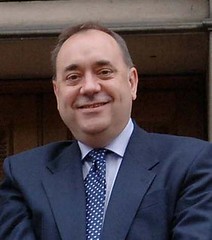
Alex_Salmond

First Minister Alex Salmond claimed legal advice had been sought during tv interview. PROVING the worthlessness and indeed, damage to reality by party political media campaigns & a so called “independent inquiry” undertaken by persons appointed by those accused and under investigation, Scotland’s struggling First Minister Alex Salmond has yet again been cleard of a complaint lodged under the mysterious “Ministerial Code”, this time Mr Salmond being cleared of claiming on television he had legal advice to the effect that an independent Scotland could remain in the European Union, even though Mr Salmond actually said those very words in a BBC television interview with Andrew Neil.

You decide - First Minister Alex Salmond claimed he had legal advice an independent Scotland will remain in the EU

The full report on the ‘investigation’ into Mr Salmond can be viewed online HERE The Scottish Government’s version of the timeline of the events is available HERE

Predictably, the Scottish Government’s media machine has issued a long tirade (reprinted below) with quotes from the First Minister, congratulating himself upon his apparent exoneration from misinforming & misleading the public on the EU legal advice claims.

It is rumoured the entire PR driven incident along with the enquiry has cost the taxpayer around £50,000 to come up with an intense media campaign, supportive political appearances, snide media comments & speeches, supportive online media forum comments and a report to clear Mr Salmond of a a habit which the First Minister and the SNP will be remembered for in 2012, the year Scots finally found out the Nationalists are like all other political parties, and no different from the ones they castigate.

Political observers will also recall 2012 for being the year in which Mr Salmond was accused of being an “instinctive liar” by Scottish Labour, the party who along with the Scottish Conservatives & Liberal Democrats have made instinctive lying in public life a national sport, now joined in earnest by the SNP.

A political insider commented on the fiasco : “Clearly the European Union can do without another nationalistic leader who's Government clears him of lying on television, even when the camera suggests he did exactly that”

Scottish Govt Press Release : FM cleared by ministerial code report

The First Minister acted fully in accordance with the Scottish Ministerial Code in relation to the debate on the existence or content of legal advice on an independent Scotland’s continued membership of the European Union, an independent report has concluded.

The First Minister appointed Sir David Bell KCB – an independent adviser to the Scottish Government on the Ministerial Code – to conduct the investigation following a complaint by Catherine Stihler MEP.

The report, which has been published today, says: “I have not found you, or the Scottish Government, to have breached the Ministerial Code in respect of any complaints made by Ms Stihler. I have though recommended that the Scottish Government considers revising those parts of the code relating to legal advice.”

Sir David examined five separate grounds of complaint from Ms Stihler – and in each case he found that the First Minister and the Scottish Government had acted fully in accordance with the Ministerial Code.

The report also concludes that “the Edinburgh Agreement was the appropriate moment to seek specific legal advice from the Law Officers … it was only when the details of the referendum process became clear that you were in a position to seek such advice.”

Sir David also recommends that the Scottish Government considers whether the part of the Ministerial Code relating to legal advice could be redrafted in a clearer and more accessible form – a recommendation which the Government accepts.

First Minister Alex Salmond said: “I would like to thank Sir David for his very thorough and detailed report, the findings of which clearly demonstrate that there was no breach of the Ministerial Code on this matter.”

“I welcome the report which demonstrates that I and the rest of the Scottish Government acted entirely in accordance with the Scottish Ministerial Code. I also welcome his conclusion that the signing of the Edinburgh Agreement was the appropriate moment at which to seek specific legal advice on an independent Scotland’s continued membership of the European Union.”

“Sir David also recommends that the Scottish Government considers whether the section of its Ministerial Code relating to legal advice provided to Ministers should be redrafted to make it clearer. That is a recommendation I am happy to accept, and work will now be taken forward by Government officials with that aim in mind.

“This has been the sixth complaint to be referred to the independent panel of advisers I introduced in 2008 to rule on these matters.  I am delighted that each complaint has been dismissed and the advisers concluded my ministers and I have acted entirely properly at all times.”

Tuesday, August 07, 2012

The Quiet Fan : Westminster criticises unusual silence of Lord Advocate Frank Mulholland over independence referendum legalities

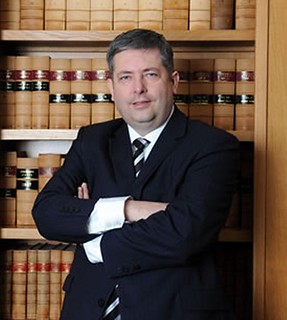
Lord Advocate Frank MulhollandLord Advocate Frank Mulholland, unusually silent over legalities of independence referendum. FRANK MULHOLLAND, Scotland’s usually vocal Lord Advocate on all things from illegal fish catches to organised crime (but not on seedy activities of COPFS staff or £1million breach of the peace cases), has been criticised by MPs of the Westminster Parliament for his unusual silence over the legalities of one of the most important issues to face Scots for decades, that of the SNP’s independence referendum and the legislative competency of the Scottish Parliament to deal with the issue.

The Scottish Affairs Committee, who have now called for referendum powers to be transferred to Holyrood for the independence referendum, reported by BBC News HERE, commented with regard to The legislative competence to hold a referendum on separation :

“…The Scottish Government … produced its own paper on 20 January 2012. In it, it argued that the 2010 question had been carefully drafted to meet the constraints of the Scotland Act; but if the UK Government was, as it had indicated, willing to extend devolved powers, then there should be a simpler question:

"Do you agree that Scotland should be an independent country?", apparently acknowledging that this would not be within the Parliament's legislative competence at present. It continued:

An adjustment of legislative competence under Section 30 of the Scotland Act 1998 would enable the Scottish Parliament to legislate for a referendum on the basis set out above. If the UK Government is unwilling to agree to such an adjustment without dictating unacceptable conditions, the Scottish Government will have the option of a referendum on the basis set out in paragraph 1.5. [i.e. a question like their 2010 draft which was designed to be within the limitations of existing legislative competence.][16]

The Committee, who have now called for powers to hold the referendum, said : “The Scottish Government, however, published no legal analysis, and the Lord Advocate, the Rt Hon Frank Mulholland QC—who is a member of the Scottish Government, and as its principal legal adviser will have advised his Ministerial colleagues on what their powers are—has made no contribution to debate on this issue. The Scottish Government nevertheless asserts that a referendum with a question about more devolution, or actually about separation but designed to look as if it were about extending the Scottish Parliament's powers, would be within its legislative competence.

25. We find the silence of the Lord Advocate remarkable. It is well understood that Law Officers do not, save exceptionally, make their advice public, but, on a matter such as this, there is a very strong public interest in understanding the legal basis of the Scottish Government's approach to a process which will determine the future of the country.”

However, as observers to the debate on the independence referendum will by now be well aware, it is not just Lord Advocate Frank Mulholland who has been seemingly gagged by the Scottish Government, who are also fighting a Freedom of Information order to release documentation relating to legal advice issued over the referendum, also reported by BBC News :

Scottish independence: Ministers to appeal EU FOI order

The Scottish government has said it will appeal after being ordered to reveal whether it holds legal advice on the status of an independent Scotland within the EU.

Labour MEP Catherine Stihler made an FoI request last May, asking the Holyrood administration for any legal advice it had received on the issue.

Ministers refused to reveal whether the information was held.

But Scotland's FoI Commissioner ruled its release was in the public interest.

Rosemary Agnew, the country's Freedom of Information Commissioner, said: "In the commissioner's view, the role of [the FoI Act] is important not only in ensuring transparency in information held by public authorities, but also in enabling transparency in information about process."

Ms Agnew said an independent Scotland's position in the EU "could have a bearing on how people vote in the referendum".

She ruled: "In this case, the commissioner considers that it is in the public interest to know the type of information that the ministers were taking into account in developing policy in relation to such a significant issue as independence.

Catherine Stihler Catherine Stihler described it as "a landmark judgement"

The Scottish government cited Section 18 when it refused to reveal whether the information was held. This can mean the information would be exempt from release or the authority considers its release would not be in the public interest.

The Labour Party said that in October 2011, Culture Secretary Fiona Hyslop wrote to Ms Stihler saying that "we consider that to reveal whether or not the information you have requested exists, or is held by the Scottish government, would be contrary to the public interest".

However, following Ms Agnew's ruling, ministers have until 21 August to reveal the information.

A spokesman for the Scottish government said it had been "surprised" by the commissioner's decision.

He added: "It is the longstanding and usual practice of the Scottish government to neither confirm or deny the existence or the content of legal advice.

"The approach we have taken on this issue is consistent with the UK government position in a similar case they dealt with under equivalent legislation. We therefore intend to appeal and contest the decision."

She added: "People have a right to know whether an independent Scotland would be part of the EU and on what terms, but the SNP want to keep it secret.

"By refusing to confirm or deny, Alex Salmond effectively took out a superinjunction against the people of Scotland.

"Now the Information Commissioner has ordered him to own up. She has ruled that approach is in breach of the law, which is a groundbreaking and welcome decision."

A Scottish government spokesman said: "We have received the decision and are considering its terms."

Monday, May 14, 2012

RIGGING THE BALLOT : Law Society of Scotland hints it wants key role to set questions & voting papers for Scottish Independence Referendum

Would you trust the Law Society of Scotland to set questions on Scottish independence ? THE Law Society of Scotland has given the strongest hint yet, contained in the Society’s response to the Scottish Government’s consultation on the independence referendum that it wants to set the tone of the SNP’s independence referendum by putting itself forward as an “independent body” to rig determine the exact wording of the questions & format of the ballot paper. The Law Society is thought to want its hands on the role after it participated heavily in the Calman Commission on Scottish Devolution, having  attended  oral evidence  sessions  in October  2008  and  February  2009  and  provided  the  Calman  Commission  with  written evidence on five separate occasions from July 2008 to May 2009.

A legal insider speaking to Scottish Law Reporter today said “As bad ideas go, this is one of the worst I’ve heard in awhile. The Law Society are not a very democratic organisation, either to its own members or with regard to the public interest. It is therefore not appropriate the Society be allowed to dictate terms of the independence referendum.”

While no one from the Scottish Government or Law Society would officially confirm the Law Society wanted the key role in the independence referendum, it is believed the Society has sought guidance on taking the place of the Electoral Commission in the referendum in a trade off with Westminster, given concerns expressed by some politicians of the Electoral Commission’s alleged bias for the union as an English based organisation.

The full response from the Law Society of Scotland to the Scottish Government's consultation on independence can be read online here Law Society of Scotland : Our terms for an independence referendum

The Law Society stated in it’s usual gun to the head style of wording that while it will not express a view on political issues, and therefore does not make proposals regarding the actual question to be put, or the design of the ballot paper, it actively engages and seeks to assist in the legislative and public policy decision making processes in furtherance of its responsibility to work in the public interest.

The Law Society omitted to publish any view on whether there should be a second question on the ballot paper, on the alternative of enhanced devolved powers, or "devo max", but says that if there is a second question, it should be clear, and its relationship with the first question, and the legal and political implications of positive or negative votes to each, should be clear and should be explained to voters in advance.

The Law Society also believes it is important that arrangements for a referendum are subject to scrutiny and oversight by an independent body, though whether that should be the Electoral Commission or another scrutiny body (hinting the Law Society itself could do it) is a matter of political judgment.

The Law Society supports initiatives to increase voter turnout, such as possibly holding the poll on a Saturday, and other measures provided there are safeguards against voter fraud or administrative error. And it believes the proposed spending limits are appropriate, "against a background of the need to ensure that referendum campaigns are run in a fair and transparent manner".

Within the Society’s submission, a concern has been expressed that the Government's draft bill precludes the court from entertaining any proceedings for questioning the number of ballot papers counted or votes cast, in that certification by a counting officer is not to be subject to judicial review, a blanket exclusion found in the Scottish and Welsh referendum Act of 1997 but not in more recent legislation.

Wednesday, May 09, 2012

Queen’s Speech 2012 : Even Independent Scotland’s internet & email will be spied on by UK Government online surveillance laws

THE Queen’s speech for 2012 has revealed the range of internet snooping laws and intrusions into daily live of all UK citizens which are to be brought into law by the increasingly hated Conservative-LibDem coalition Government at Westminster.

While some claim the spying charter for prying into the every day lives of everyone who lives in, visits for business or holidays in or even flies over the UK & uses UK based internet servers, will have safeguards from the engathered information being misused, most believe the plans, which an earlier Labour Government had to abandon after criticisms from the Conservatives, are measures now being boosted by the current UK ConDem Government to tackle dissent and protest against unpopular Government policies.

A Civil Rights campaigner speaking to Scottish Law Reporters branded the new spying powers as ‘draconian’. He also alleged the latest moves on internet spying were being put in place to legitimise the highly secretive & already stiff surveillance techniques used by the UK Government on all internet & email users.

An insider has tipped off the media over plans to retain surveillance data on “persons of interest” for an indefinite period, although how a person is defined as “a person of interest” appears to be left to the imagination of anyone with access to spying powers. “Persons of interest” currently include campaigners, those who write to their elected politicians, people in trouble with the Police, journalists, some doctors, scientists, people with a public profile and politicians who are not considered to act in the interests of the current Government.

Interestingly, web surveillance of foreign visitors to the UK is to be referred to in a case in the US Courts later this year, where an American businessman is to allege “commercial secrets from his firm’s email accounts were hacked & passed by a UK Government agency” to a competitor company in the UK.

GCHQ will of course, also be able to monitor all internet & email traffic in Scotland. It is thought the legislation will also be used in an attempt to clamp down on independence activists who campaign for an independent Scotland.

Queen's Speech: Internet monitoring plan to have 'strict safeguards'

Plans to make it easier for the police and intelligence agencies to monitor e-mails, phone calls and internet use have been unveiled, but with promises of "strict safeguards". The Draft Communications Bill would update existing procedures for allowing access to "vital" information. This includes phone numbers and e-mail addresses but not content of messages. Civil liberties groups said they were dismayed by the plan, which they described as a "snooper's charter". The issue has caused friction within the coalition amid criticism from some Lib Dem and Conservative MPs.

The government argues the law needs to keep pace with technological changes and enable the security services to confront changing threats to the UK. The proposed UK-wide legislation, which has been published in draft form, would seek to "maintain the ability" of the authorities "to access vital communications data under strict safeguards to protect the public". It would update the rules governing how information can be collected and retained by mobile and internet firms in a "lawful and efficient" manner and ensure it "remains available" to the authorities to protect the public.

At the moment basic information can be accessed by police, intelligence agencies or other public bodies without any external authorisation - simply by a senior official within the organisation signing the request off.

But security experts say existing laws date back to 2000 and they are not equipped to cover social media, Skype and other methods of communication. Ministers are stressing that the police and other bodies will not be allowed to look at the content of e-mails or text messages without a warrant, as is the case now.

Instead, access would be limited - as now - to details of when conversations took place, for how long and where someone was when they made a call. However, the police would be able to see which websites someone had visited.

The government have outlined a number of safeguards which they hope will allay fears about the plans. They include:
A 12-month limit on how long data can be retained
Measures to prevent unauthorised access
Strengthening independent oversight
Boosting the role of tribunals to consider complaints

But campaign group Liberty said the proposals threatened individual privacy and suggested the coalition had gone back on a pledge on coming to office to end the storage of web and e-mail records "without good reason".

"Two years ago, the coalition bound itself together with promises and action to protect our rights and freedoms," said its director Shami Chakrabarti.

"As the strains of governing in a recession begin to show, politicians of all parties should remember the values we are all supposed to share."

And former shadow home secretary David Davis, a frequent critic of the extension of state powers, said the proposals would be costly to implement and were "very similar" to the last Labour government's plans for a communications database dropped following Tory opposition.

He told MPs it would be "pretty straightforward" for terrorists to avoid scrutiny under the plans by using proxy servers and multiple phones. "We will create something which will not be effective against terrorism but which will be a general purpose surveillance on the entire nation."

The proposals sparked a row when they were first floated in April, with critics describing them as a "Big Brother" move.

Newspaper reports suggested GCHQ, the government's listening agency, would be authorised to monitor internet traffic in "real time" using so-called "black box" technology.

A spokesman for the Information Commissioner Christopher Graham said the "case for this proposal still has to be made". "We shall expect to see strong and convincing safeguards and limitations to accompany the bill," he said in a statement.

Prime Minister David Cameron has said any gaps in security must be plugged and it is the government's responsibility to do everything they can to keep the country safe. And the plans were backed by Conservative MP Bob Stewart who said granting access to such information would be justified if it "saved lives".

And Lib Dem MP Martin Horwood said it should be possible to "strike a perfectly good balance" between protecting traditional freedoms and applying the principles of existing legislation to new technology to "prevent our security services falling behind".

Friday, January 13, 2012

If London, the Tories & LibDems don’t give ATOSS about Scotland & Scots in need, is the Union ultimately A SICK JOKE ?

THERE is little doubt a few hundred scare stories about the break up of the union are about to be thrown at the Scots electorate. Most of the stories will have as much credibility as as a paper bag can hold a gallon of water, however, some of the stories, such as Margaret Thatcher’s Poll Tax which ripped Scotland apart in the 1980’s and leaves a horrific legacy of inescapable personal debt even to this day, are worth considering in the context of whether Westminster really gives A-TOSS about retaining the Union with Scotland.

Given we are in the deepest recession the world has ever seen, a recession caused by bankers & regulations made by national Governments in the nation’s capitals rather than devolved assemblies such as the Scottish Parliament, perhaps one of the most important subjects on everyone’s mind in Scotland should be the CONDEM Coalition Government’s dreaded Welfare Reform Bill, parts of which are already being implemented with a Concentration Camp zeal upon the long term sick, patients with debilitating illnesses & benefits claimants across the UK, particularly in Scotland.

Every day there are stories about the weak and the sick in Scotland being treated like cattle off to the slaughter by a Westminster appointed company receiving at least £100 million and doubtless all the hidden extras we will never get to hear about. The Tories it seems, may give A-TOSS about keeping the union but they certainly don’t give A-TOSS about caring for Scots in need.

So, simply, Scots may well have to consider, if the UK Government in London don't give A-TOSS for Scotland, and feel that £100 million is a good price to pay for torturing the long term sick, disabled and near death up and down the length of the country, then wouldn't it be better Scots looking after their own?

Its not as if we Scots don't have our own resources to deal with the population on a more fairer basis. After all, we are the only country in the world who discovered oil, and then lost it to another country, a resource which may come back to Scotland if the independence referendum swings in favour of a nation status. Isn’t it therefore time to take a hard look at whether Scots are safer with, and may expect fairer treatment in the hands of an independent Scotland?

Considering we are supposedly all in this recession together, yet like in the rest of the UK we Scots watch as our safety nets are gradually being stripped away from us, with who knows, the NHS next in the firing line as the block grant from London decreases to cover up the banker’s billions, Do YOU give A-TOSS for a Fairer Scotland with a stronger voice within the union or a stronger and more caring for Scots voice as an independent nation ?

* Scottish Law Reporter agreed to run this article after a GP working in the South of Scotland reported to one of our journalists she had been offered a substantial cash sum [by an unnamed party] as an incentive to withdraw her backing for a disability benefits claimant who is suffering from cancer.

Readers can find out more about ATOS Healthcare by using GOOGLE .

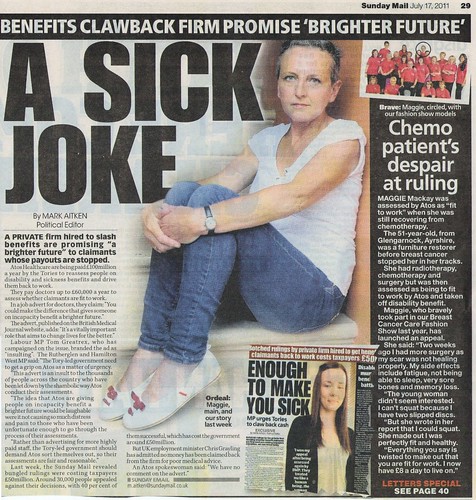
The Sunday Mail newspaper reports on how the UK Government is treating Scots in need :

ATOS A SICK JOKE Sunday Mail 17 July 2011 A SICK JOKE : Benefits clawback firm promise 'brighter future' but victim speaks out

Jul 17 2011 Mark Aitken, Sunday Mail

A PRIVATE firm hired to slash benefits are promising "a brighter future" to claimants whose payouts are stopped. Atos Healthcare are being paid £100million a year by the Tories to reassess people on disability and sickness benefits and drive them back to work.

They pay doctors up to £60,000 a year to assess whether claimants are fit to work. In a job advert for doctors, they claim: "You could make the difference that gives someone on incapacity benefit a brighter future." The advert, published on the British Medical Journal website, adds: "It's a vitally important role that aims to change lives for the better."

Labour MP Tom Greatrex, who has campaigned on the issue, branded the ad as "insulting". The Rutherglen and Hamilton West MP said: "The Tory-led government need to get a grip on Atos as a matter of urgency. "This advert is an insult to the thousands of people across the country who have been let down by the shambolic way Atos conduct their assessments.

"The idea that Atos are giving people on incapacity benefit a brighter future would be laughable were it not causing so much distress and pain to those who have been unfortunate enough to go through the process of their assessments."Rather than advertising for more highly paid staff, the Tory-led government should demand Atos sort themselves out, so their assessments are fair and reasonable."

Last week, the Sunday Mail revealed bungled rulings were costing taxpayers £50million. Around 30,000 people appealed against their decisions, with 40 per cent of them successful, which has cost the government around £50million. But UK employment minister Chris Grayling has admitted no money has been claimed back from the firm for poor medical advice.

An Atos spokeswoman said: "We have no comment on the advert."

Chemo patient's despair at ruling : Maggie Mackay was assessed by Atos as "fit to work" when she was still recovering from chemotherapy. The 51-year-old, from Glengarnock, Ayrshire, was a furniture restorer before breast cancer stopped her in her tracks.

She had radiotherapy, chemotherapy and surgery but was then assessed as being to fit to work by Atos and taken off disability benefit. Maggie, who bravely took part in our Breast Cancer Care Fashion Show last year, has launched an appeal.

She said: "Two weeks ago I had more surgery as my scar was not healing properly. My side effects include fatigue, not being able to sleep, very sore bones and memory loss. "The young woman didn't seem interested. I can't squat because I have two slipped discs."But she wrote in her report that I could squat. She made out I was perfectly fit and healthy. "Everything you say is twisted to make out that you are fit for work. I now have £8 a day to live on."

Enough to make you sick: Government urged to claw back millions from contractors after they wrongly assessed thousands on disability benefits

Jul 10 2011 Mark Aitken, Sunday Mail

BUNGLED rulings by the private firm deciding whether benefit claimants are fit to work are costing taxpayers £50million, we can reveal. The Government have been urged to claw back millions from the contractors after they wrongly assessed thousands on disability benefits.

Atos Healthcare is being paid £100million a year by the Tories to reassess people claiming disability and sickness benefits. But around 30,000 people appealed against their decisions, with 40 per cent of them successful, which has cost the government around s50million.

The Department for Work and Pensions' contract with Atos allows it to recoup money from the firm for poor medical advice. But UK employment minister Chris Grayling has admitted not a single penny has been claimed back.

Quizzed by Labour's Tom Greatrex, he said Atos "have met all of their targets for medical advice". Greatrex, MP for Rutherglen and Hamilton West, said: "The Toryled Government's failure to provide the taxpayer value for money is disgraceful and the attitude of the minister responsible for this defies belief.

"To suggest Atos has met its targets when it is needlessly costing the taxpayer millions is unacceptable. "It is astonishing that the Government did not recoup a single penny of taxpayer money from Atos, despite its obvious failings.

"At a time when the welfare budget is being slashed by billions, many people will be surprised that the government is not demanding repayment from a multi million pound international organisation. "The Government is very quick to demand money back from welfare recipients who don't live up to their responsibilities. They should do likewise with Atos."

DWP's contract with French owned Atos allows the government to "apply financial remedies" where the firm has "failed to meet contractual targets". A dwp spokeswoman said: "If a decision is overturned at appeal, it does not necessarily mean that the original decision was inaccurate. "Often, customers produce new evidence at their appeal." Atos said it had nothing to add to the DWP's statement.

We revealed in March how Glasgow GP Margaret McCartney went undercover at an Atos recruitment evening. She was told: "You are not in a typical caring role. This isn't about diagnosing. We don't call them patients. We call them claimants."

Campaigners attack drive to block benefits appeals as decisions get overturned

Jan 1 2012 By Mark Aitken, Sunday Mail

A FIRM employed by the Government to weed outbenefit cheats are losing more than two thirds ofthe appeals against their decisions. Controversial French company Atos are paid £100million a year to get people off disability and sickness benefit.

But Citizens Advice Scotland (CAS) have revealed that 69 per cent of people they represented at tribunals have won their appeals. Heart attack and lung disease victims are among those Atos have assessed as being well enough to look for jobs.And figures from parliament records show appeals will cost the taxpayer £60million this financial year alone. Incredibly, Atos will not be penalised for their abysmal performance.

CAS head of policy Susan McPhee said: “If the Government want to cut down on fraud and help people into work, we support that. “But with this system, they aretargeting many people who aregenuinely sick and unable to work. They are removing their income and plunging them into poverty. “Our advisers are overwhelmed by people who have been found ‘fit for work’ by the Employment Support Allowance (ESA) assessment when they are not. “Almost 70 per cent of these people who are helped by CAS have their assessment overturned at appeal – which shows how poor the system is and how many people are wrongly caught out by it.”

The figure is based on a sample of 269 ESA tribunals in 2010-11 – with 185successful. Figures obtained by Rutherglen and Hamilton West MP Tom Greatrex show there were more than 166,000 appeals against ESA decisions in 2010-11, costing the taxpayer £40million. And from April to August this year, there were almost 80,000 appeals,costing £19.1million. This means the bill for 2011-12 could be £60million.

Greatrex said: “I know from the Citizens Advice centres in my constituency the amount of time and resources taken up by helping some of the most vulnerable people navigate their way through this tortuous system. “These aren’t people trying to fiddle the system – they are constituents who suffer from serious illnesses such as Parkinson’s and cancer. “The rapid rise in cases Citizens Advice dealt with in the last year clearly shows there is a problem.

“The way to save money, reduce the backlog of appeals and lessen the huge burden on Citizens Advice is not to hire more judges or move to a six-day week at the Tribunal Service, as the Government are doing. “They must reform the Work Capability Assessment so it is fair and gets decisions right first time round.”

A Department for Work and Pensions spokeswoman said: “The reassessment of incapacity benefit claimants is pressing ahead on time and as expected.” Atos declined to comment.