Showing posts with label social networking. Show all posts

Tuesday, July 30, 2013

Inquiry call as Crown Office refuse to prosecute son of top Scottish judge who made rape threats against woman on Twitter social media

Son of top Scottish judge made rape threats on twitter. CALLS for an investigation into why Scotland’s Lord Advocate Frank Mulholland has refused to prosecute the son of a top Scottish judge who made threats of rape on twitter to a woman have today been made by legal insiders vexed at claims of underhanded tactics by Crown Office & Procurator Fiscal Service (COPFS) to subdue reporting on the story.

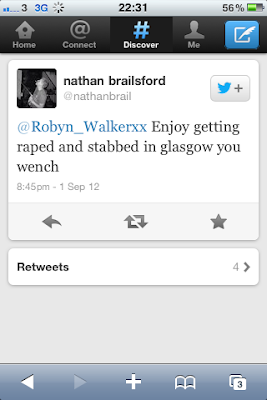
It has previously been reported by the Scottish media that the son of a high ranking Court of Session judge told a football player’s girlfriend she was going to “enjoy getting raped and stabbed in Glasgow”.

However, the Crown Office have angrily set upon journalists who recently made further enquiries of the story and so far no action has been taken, despite action taken by Police & the Crown Prosecution Service in England & Wales in cases where female campaigners and even a female Member of Parliament have recently been threatened in a similar manner.

Reporting of the threats has been published earlier, here :

Son of High Court judge tells David Templeton's girlfriend: Enjoy getting raped in Glasgow

ROBYN WALKER was the target of a series of lurid and threatening messages sent when her boyfriend decided to move from Hearts to Rangers.

A HIGH Court judge’s son told Rangers star David Templeton’s girlfriend she was going to be raped after he signed for the Glasgow club.

The message sent to Robyn Walker from the Twitter account of the privately educated
teenager said: “Enjoy getting raped and stabbed in Glasgow you wench.”

The 16-year-old’s father promised to “deal with it” when the message was brought to his attention by the Sunday Mail.

Police said they would investigate if any complaint was received.

Lawyers say the tweet could be an offence under telecom legislation.

Robyn was the target of a series of lurid and threatening messages sent when her boyfriend decided to move from Hearts to Rangers.

She said: “I was shocked when I got this tweet saying he wanted me raped and stabbed.

“It wasn’t nice but I have not complained to police.

“My friends said I should but I have decided not to take it any further.”

Templeton, 23, responded to the message and other threats on his Twitter page.

The Rangers star posted: “People slaughtering my gf! It’s embarrassing! She has nothing to do with what’s happened!”

The judge told us: “Thanks for bringing this to my attention, I will go and deal with it now.”

Both Lothian and Borders and Strathclyde Police said they can only investigate abusive comments made on social networking sites like Twitter if the targets complain to them. A spokeswoman for the Strathclyde force added: “Our football co-ordination unit will view the tweet to see if any criminality occurred.”

Leading criminal lawyer Matthew Berlow said: “Anyone who leaves an offensive message on a social networking site such as Twitter could be breaching the Telecommunications Act.”

Templeton signed for Hearts in 2007 before joining Rangers on August 31.

His move attracted heavy criticism from Hearts fans.

The sinister tweets can be revealed just months after we told how another internet troll threatened to sexually attack an alleged rape victim on a football fans’s message board.

He posted anonymously that he would “violently rape” the mum as MPs voiced escalating concern at the threatening and women-hating content of many messages left on social network sites and message boards.

His post was just one of scores of bile-filled messages directed at the woman after she accused Blackburn Rovers footballer David Goodwillie of rape.

Charges were brought against the player but later dropped.

Last month a 37-year-old man was was charged with breach of the peace over the posts and is due to appear in court.

Wednesday, March 25, 2009

Surveillance Society : Police will monitor social network websites

Social networking web sites like MySpace, Facebook, Bebo & others are to be subject to snooping powers proposed by the Government, justified by the Home Office as being needed to tackle crime gangs and terrorists who might use the sites, reports BBC News.

Several reported previous incidents such as this where Central Scotland Police apparently found significant aggressive behaviour by teens, and even evidence related to drug dealing, on the online website Bebo, may well justify more attention by law enforcement agencies to social networking sites to detect crime in the online & offline world …. (three cheers for law & order ! - Ed)

BBC News reports :

Social network sites 'monitored'

Social networking sites like Facebook could be monitored by the UK government under proposals to make them keep details of users' contacts.

The Home Office said it was needed to tackle crime gangs and terrorists who might use the sites, but said it would not keep the content of conversations.

It is part of a plan to store details of all phone calls, e-mails and websites visited on a central database.

Civil liberties campaigners have called the proposals a "snoopers' charter".

Tens of millions of people use sites like Facebook, Bebo and MySpace to chat with friends, but ministers say they have no interest in the content of discussions - just who people have been talking to.

'Overkill'

Liberal Democrat MP Tom Brake said the websites contained sensitive personal details and he was concerned information could leak from any government-controlled database.

The Independent newspaper quoted him as saying similar plans to store phone and email records threatened to be the "most expensive snooper's charter in history".

"It is deeply worrying that they now intend to monitor social networking sites which contain very sensitive data like sexual orientation, religious beliefs and political views," he said.

The newspaper also reported that Chris Kelly, Facebook's chief privacy officer, was considering lobbying ministers over the proposal, which he described as "overkill".

It is right to point out the difficulty of ensuring that we maintain a capability to deal with crime and national security... where that butts up against issues of privacy - Vernon Coaker, Home Office

Phone companies are already required to store details of all calls, such as the time and date, location and who made them, for 12 months for possible use in criminal investigations or court cases.

An EU directive ordering data on internet traffic to be stored in a similar way is due to come into effect in the UK on Monday, 6 April.

The government is also considering proposals to store all communications data on a single database, which may be run by a private company.

It has delayed legislation on the move amid concerns about civil liberties and is due to launch a consultation on the plan "shortly", which will set out privacy safeguards.

The Home Office claims the new database is necessary to allow police and security services "keep up with technological advances" and that billing information is already stored by telecoms companies.

A spokesman said: "The government has no interest in the content of people's social network sites and this is not going to be part of our upcoming consultation.

"We have been clear that the communications revolution has been rapid in this country and the way in which we collect communications data needs to change, so that law enforcement agencies can maintain their ability to tackle terrorism and gather evidence."

'Browsing habits'

Shami Chakrabarti, of campaign group Liberty, said she would be "flabbergasted" if the the police and security services were not monitoring social networking sites already and it was "permissible" on human rights grounds to examine the profile of suspects.

But what she said was unacceptable was the government storing all communications data centrally, which she said would allow them to monitor the web browsing habits of ordinary citizens.

"With websites, as opposed to traditional phone calls and e-mails and so on, the difference between what the website you're visiting and what you're doing there, is really blurred.

"I mean just by my web browsing habits, just by which sites I'm visiting, you'll be able to build up... a pretty detailed picture of who I'm associated with, perhaps what my politics is, what my religious preference is and shopping habits are.

"It's a pretty detailed bit of surveillance about a person, about all individual people, most of whom, let's be clear about it, are completely innocent."

'Difficult area'

She added: "That's the difference between being a suspect and just an ordinary citizen, being part of the mainstream population and going about your business in a normal way."

Details of the social website proposals were disclosed by Home Office minister Vernon Coaker earlier this month, at a Commons committee to examine draft EU directives.

He said that the government was considering acting on social networking sites because they were not covered by the latest proposals from Brussels.

Mr Coaker acknowledged that the plan would raise fresh concerns about the right to privacy, saying he accepted it was an "extremely difficult area".

"It is absolutely right to point out the difficulty of ensuring that we maintain a capability and a capacity to deal with crime and issues of national security, and where that butts up against issues of privacy," he said.

The Cabinet Office already monitors popular social network sites such as Facebook, Netmums, Fixmystreet and MumsNet to see what users are saying about public services.