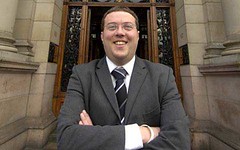
 Former Glasgow City Council Chief Steven Purcell. After our report last week on the scandal surrounding the resignation of Steven Purcell, the former head of Glasgow City Council, newspapers have today revealed Mr Purcell has fled the UK after a bizarre week of developments which began with his resignation, and today ended up with revelations of Class A drug use (cocaine), a possible attempted suicide during a brief stay at Castle Craig Hospital in the Borders and reported encounters with the Scottish Crime & Drugs Enforcement Agency last year during his leadership of Glasgow City Council.
 Peter Watson (now on holiday in the Cayman Islands) of Levy McRae represented Steven Purcell. Amid all the twists & turns of last week, where Glasgow Law firm Levy & McRae, principally Peter Watson who, along with public relations expert Jack Irvine of Media House PR group, attempted (but failed, spectacularly - Ed) to stage manage media reporting & investigation of the downfall of his client Mr Purcell, lessons should be learned on how not to approach a scandal using bullying tactics & veiled threats against journalists & the national media over a story which most certainly has a place in the public eye, not least as Mr Purcell had apparently been using Class A drugs for sometime, while leading Scotland’s largest local authority.
 Lord Advocate Elish Angiolini hired Levy McRae to go after disabled abuse victim Hollie Greig. Mr Purcell's judgement in bringing in a notorious law firm & pr company to handle his 'departure leaves many questions and much damage. Perhaps it might have been the case some were too enthralled with Levy McRae’s successes in silencing media expsures, such as Mr Watson's recent success for his client, the Lord Advocate Elish Angiolini, where Scottish newspapers were bullied into not reporting on the allegations of abuse made by downs syndrome girl Hollie Greig who identified several senior members of Scotland’s legal establishment, led to interdicts gained by Levy McRae who represent the Lord Advocate Elish Angiolini, and a Sheriff identified by Ms Greig in the course of making her allegations. Such was the desperation of Levy McRae and their clients to keep Hollie Greig’s case under wraps and out of the public eye, Grampian Police were ordered to arrest journalist Robert Green, who had been investigating & reporting on Ms Greig’s case.
Alas there was to be no similar success, as fortunately the media were having none of Levy McRae's spin or attempts to block legitimate reporting of events surrounding their client, the now former head of Glasgow City Council who has now had to flee the country. (Must have been some bender he went on - Ed)
However, as has been revealed today in the national media, Peter Watson of Levy McRae, along with Jack Irvine of Media House have went off on a holiday to that well known bastion of honesty, the Cayman Islands (Cayman Islands, oh yes, that's the place were the likes of drugs dealers, tax cheats, dictators, killers, abusers, embezzlers and yes, lawyers, stuff their money, isn't it ? – Ed)
Today the Sunday Herald reports on the Steven Purcell scandal, also giving a good insight into the abysmal failure of Levy McRae & Media House, who have by the looks of it, ended up ruining their own client. We all know who to blame …
 How PR advisers made a crisis out of a drama
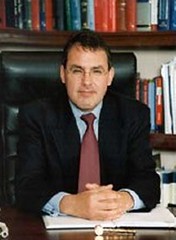
Despite his manifest problems, Steven Purcell might still have had an outside chance of returning to politics had it not been for the disastrous way his departure was handled. Instead of heeding his council advisers and fellow councillors and opting for full disclosure, he turned to crisis PR guru Jack Irvine of Media House and litigation lawyer Peter Watson of Levy & McRae (pictured).
But his choice of two of the biggest hitters in Scotland’s media scene immediately alerted the press to the fact that there was more to the story than met the eye.
The Irvine-Watson campaign was so old-school it was prehistoric. Aggressive and clumsy, it tried to cow the mainstream media into accepting that Mr Purcell’s problems were limited to stress and exhaustion, and seemed to ignore the inevitability of more details leaking out, especially via the internet.
It was also hopelessly confused. On Wednesday, when it was revealed that council officials had referred to “chemical dependency” in an early draft of a statement explaining Mr Purcell’s resignation, Mr Irvine issued a statement saying the story had “no foundation”.
However, later in the day, Mr Watson’s side wrote to the UK Information Commissioner complaining that council officials appeared to have broken the Data Protection Act by providing information about Mr Purcell’s health to the media – thus suggesting there was a solid basis to the story.
Throughout the campaign on behalf of Mr Purcell, the media was warned that inquiring into his health might breach his right to a private life under the European Convention on Human Rights. However, on Thursday Levy & McRae released a statement from Dr Florian Kaplick, a consultant psychiatrist at Castle Craig hospital, which provided new medical details. It confirmed Mr Purcell had been a patient at the rehab clinic for three days, having been admitted by his family and a consultant, Dr Raymond Dempsey. It also said Mr Purcell had not been treated for “a drug problem”, but did not deny he had one.
Media House admits to having an “on-off” PR relationship with Castle Craig. The release undermined any notion that Mr Purcell’s health was out of bounds.
After presiding over the debacle, on Friday Mr Watson and Mr Irvine flew first-class to the Cayman Islands for a week’s holiday at a five-star hotel. Mr Purcell was also reported to have fled Scotland, but in less glamorous circumstances.
One senior PR consultant said: “The principle that applies to politicians who err in their personal life is ‘Get it out there.’ In most of these stories there’s a bit of pathos. They have to put up their hands and say, ‘I’ve made some stupid decisions, I’ve paid for it, and I’m now trying to rebuild my life.’ They have to be honest and straightforward and show some humility.”
Unfortunately for Mr Purcell, it is now too late.
 Purcell: the end of the line
Special Report by Tom Gordon and Paul Hutcheon Published on 7 Mar 2010
The officers of the Scottish Crime and Drug Enforcement Agency are not average police.
The detectives of the elite squad don't spend their days huckling shoplifters or sweeping drunks off the streets at closing time. Instead, their duties are focused on the most serious and violent criminals in the country. They investigate the bosses of organised crime, seize their drugs, and freeze cash and assets."
So when two SCDEA officers spoke to Steven Purcell last year about his name cropping up in an investigation, it was never going to be a run-of-the-mill chat.
That meeting, in Mr Purcell’s office in Glasgow’s City Chambers on May 12 last year, was the first glimpse of the scandal which finally broke around him last week.
Questioned afterwards by his closest colleagues, the leader of Glasgow City Council denied he was using cocaine, but admitted to having dabbled with the drug in the past.
It also emerged that some of those around him in the Yoker area of the city, where he grew up, were the subject of the SCDEA’s interest. Mr Purcell was also warned by his aides that they would resign if he took drugs again.
One friend said there was a strong suspicion that his rapid decline after he returned from London was the result of him “crashing” after a binge.
Uneasy, but satisfied that steps were being taken to address the situation, the staff went back to work. Shorty afterwards, Mr Purcell moved out of Yoker to a flat in Broomhill Drive in the city’s west end, to distance himself from his old contacts. His new landlord was Katrina Scott Moore, the former partner of Brian Dempsey, a property developer and former Celtic FC director, and a friend of Mr Purcell.
Over the next 10 months, the issue faded away as fresh political crises over school closures, the bill for the 2014 Commonwealth Games, and the Glasgow North East by-election came and went.
But if any of Mr Purcell’s inner circle harboured nagging doubts about their boss, their fears would soon resurface.
The last week in February began ordinarily enough for Mr Purcell, with a formal meeting with James Dornan, leader of the SNP group on the Labour-run city council. On the Tuesday, February 23 ,Mr Purcell went to London for two nights to attend a dinner held by the Scottish Council for Development & Industry – one more night than was strictly necessary.
Almost immediately after he came back on Thursday February 25, he went to a Labour fundraising event at the Hilton Hotel in Glasgow which was attended by Gordon Brown. Many of the guests who saw Mr Purcell say that – at least until midnight – he appeared well.
However, a fellow councillor finally became so concerned by his agitation that they put Mr Purcell in a car and sent him home.
The next morning, the councillor’s fears were justified. Although Mr Purcell was in his office early, staff found the 37-year-old in tears and talking “gibberish”. It was clear he was unwell. Despite regaining control for an 11am meeting, afterwards he deteriorated again, cancelling an engagement with the restaurateur Charan Gill and then walking out of the City Chambers.
After a brief return late in the afternoon, he left again and in the evening sent a text message to a colleague, who realised Mr Purcell was badly stressed. He also began seriously discussing resignation.
The next day, two of Purcell’s closest aides visited him at Broomhill Drive – his advisers Brian Lironi and Colin Edgar, head of press at Glasgow City Council. They are said to have found him “in bits”, according to council insiders. Again, he was talking about resignation.
During the day, Mr Purcell was asked about drug use. According to a source close to events, he admitted taking cocaine in the past. However, he did not regard cocaine as a problem – his problem was with alcohol. Mr Purcell had missed meetings on Monday mornings after over-indulging at the weekend.
But there was scepticism about his answers. One friend said there was a strong suspicion that his rapid decline after he returned from London was the result of him “crashing” after a binge. Mr Purcell had also developed a raging paranoia, and believed even his most trusted colleagues were plotting against him.
Despite reports last week that his advisers and family members tried to talk Mr Purcell out of resigning, no-one actually did. Instead the discussion was about whether he should quit immediately or wait until the annual general meeting of the city Labour group in May. If it was the latter, the plan was to clear his diary for eight weeks, and use the time to let him recuperate and line up a job outside politics.
The following morning, however, Mr Purcell’s condition deteriorated, and he was described by those around him as being exceptionally unwell. A long talk with Dr Raymond Dempsey, a therapist and the brother of Brian Dempsey, had convinced Mr Purcell’s friends that the councillor needed professional help.
With Mr Purcell’s agreement, Dr Dempsey referred the politician to the Castle Craig hospital in Peebleshire, which claims to be one of Europe’s top rehabilitation centres for treating drink and drug addiction.
Mr Purcell’s younger brother, Gerry, drove him there on Sunday night. But he was later called by the hospital and asked to return: Mr Purcell had gone missing from the open facility. Many of his friends feared the worst.
He later returned under his own steam, but his clothes were soaked, and it was feared there had been a suicide attempt involving open water.
It is also understood that discussions took place within the hospital that night on whether to section Mr Purcell.
On Monday morning, his council staff met in Glasgow City Chambers to discuss his future. All agreed that Mr Purcell had to
quit immediately. A senior aide was delegated to make the phone call. To his surprise, he found that Mr Purcell had changed his mind overnight and decided to stay on as leader.
He felt he was better and would have the support of his fellow Labour councillors, he insisted.
The aide urged him to reconsider and gave him half an hour to think about resigning, saying that if he went immediately there was still a chance he might be able to resurrect his career. But when the aide called back, Mr Purcell was adamant.
An aide then updated the three Labour councillors closest to Mr Purcell – Paul Carey, Paul Rooney and George Ryan – about the events of the weekend.
Deputy council leader Jim Coleman and Labour group chairwoman Jean McFadden were also briefed, as were council chief executive George Black, chief solicitor Ian Drummond and Labour group business manager Aileen Colleran.
Ms Colleran then alerted Colin Smyth, the general secretary of the Scottish Labour Party. By mid-afternoon, all knew of Mr Purcell’s problems.
Around the same time, Mr Carey, Mr Rooney and Mr Ryan concluded that Mr Purcell needed to resign for the sake of his own health. Mr Lironi, Mr Edgar and Michell McGinty – another adviser to the council leader – then began drafting a statement referring to drink and drugs.
Their “full disclosure” strategy was based on the idea that Mr Purcell could have a future as a politician if he was seen to be honest about his problems. Mr Ryan – who had been Mr Purcell’s right-hand man when he toppled Charlie Gordon to become council leader in 2005 – had the grim task of asking his old friend to stand down.
But by 4pm, after several calls with Mr Ryan, Mr Purcell was still refusing to go. He did, however, agree to a public statement explaining his sudden “leave of absence”. One draft – which would later gain much publicity – said Mr Purcell was being treated for a “chemical dependency”. Another draft referred to “drink and drugs”.
Finally Mr Purcell agreed to a public reference to “drink and previous use of drugs”, with the statement going out in Mr Coleman’s name. He also agreed to quit.
Then the unexpected happened.
Mr Purcell told his council team to share the agreed statement with Peter Watson, a litigation expert at the Glasgow law firm Levy & McRae. When Mr Watson saw it, he refused to agree to it, and offered a bowdlerised version referring merely to a leave of absence on medical advice. Mr Coleman, who recognised the need for candour, refused to put his name to it.
Later on the Monday night, Mr Purcell called a senior aide and asked to meet him in Glasgow with Mr Watson and crisis PR guru Jack Irvine, a former tabloid newspaper editor and the founder of the public-relations company Media House. Opposed to how Mr Watson and Mr Irvine were carving him out of the picture, the aide refused, even threatening a constructive dismissal action.
The meeting never took place and Mr Purcell remained in Castle Craig, but it was already too late to keep the story under wraps. Late in the afternoon, all Labour councillors had been told to report for a special meeting at 10am on Tuesday to hear about Mr Purcell’s future, and by early evening the story was beginning to seep out.
By late on Monday night, The Herald had the story that Mr Purcell would step down the next day. The following morning set the bizarre tone for the rest of the week’s coverage.
At their meeting, the Labour group were told by Mr Edgar that Mr Purcell had resigned and press queries were to be passed to Mr Irvine at Media House. There was no discussion of the exact nature of Mr Purcell’s problems, just that “stress and exhaustion” were involved.
Mr Purcell’s decision to use crisis specialists like Mr Irvine and Mr Watson was a forlorn move. It immediately red-flagged the story, telling every journalist in Scotland that something was not right.
One friend put the decision down to drug-induced paranoia.
Still, for a few hours at least, the plan seemed to be working. Mr Watson’s reputation and Mr Irvine’s media reach kept the facts under wraps. “Earlier this morning Steven made the effort to telephone his resignation as leader of Glasgow City Council,” their statement said.
“Steven does this with a heavy heart but the strain of running one of the UK’s largest authorities combined with the added pressures of the Commonwealth Games planning and the controversy over Strathclyde Partnership for Transport (SPT) has just proved too much for a man who lived and breathed Glasgow 24 hours a day.”
But most of the reporting was sceptical, peppered with talk of riddles and mysteries, and highlighted that the presence of Mr Irvine and Mr Watson hinted that there was something darker afoot.
By Wednesday morning, the Media House strategy began unravelling, as one paper revealed Mr Purcell had gone to Castle Craig. By mid-morning Mr Irvine was forced to put out a statement confirming Mr Purcell had been at the clinic, but that he had now left. “Councillor Purcell is recuperating with family and he asks the media to allow him time and space to recover to full health,” the statement pleaded in vain.
Each day brought a new twist. Mr Purcell’s disappearance from Castle Craig leaked out – although not the possible suicide attempt – and then one of its consultants said the councillor had not been treated for a drug problem.
The internet, including the Guido Fawkes website beloved of the political classes, was also buzzing with jokes about Mr Purcell and cocaine.
On Friday, the first, hazy reporting of the SCDEA angle emerged. Then, in a grim twist, one of Mr Purcell’s political acolytes collapsed at the City Chambers and died from a heart attack. Danus McKinlay, who was being groomed as a Labour council candidate, was only 18.
Two hours later, Mr Purcell announced he was resigning from the council completely. After four days of trying in vain to use fiction to save his political career, he was overwhelmed by facts and gave in to reality.

