Showing posts with label self regulation. Show all posts

Saturday, January 25, 2014

BBC Scotland’s Lawyers Behaving Badly reveals solicitors guilty of misconduct are still benefiting from MacAskill’s £151m a year legal aid pot

Self Regulation by the Law Society of Scotland has failed profession & clients. THE fact is, regulation of the legal profession by the Law Society of Scotland, the Scottish Legal Complaints Commission and the Scottish Solicitors Discipline Tribunal does not serve any purpose of protecting the profession from bad apples or giving the client a fair hearing enabling proper and full closure of complaints.

All self regulation of the legal profession has achieved in Scotland is to centre extraordinary power at the Law Society’s Drumsheugh Gardens HQ in Edinburgh. It is no use pretending the profession is clean, and it is no use trying to blame someone else for a problem of the profession’s own creation. Over then to BBC Scotland for their investigation of Lawyers Behaving Badly.

BBC Scotland investigates Lawyers Behaving Badly Part 1

BBC Scotland investigates Lawyers Behaving Badly Part 2

Lawyers Behaving Badly: Firms employing misconduct solicitors still get legal aid

By Samantha Poling Investigations correspondent, BBC Scotland

The BBC investigated lawyers who had been found guilty of professional misconduct

Law firms with solicitors who have been found guilty of professional misconduct are still receiving millions in legal aid, according to a BBC investigation.

It found that 33 solicitors guilty of misconduct such as dishonesty, are working for firms eligible to claim public funds through legal aid cases.

Four solicitors were found to have deliberately misled their clients.

The Law Society of Scotland, which regulates solicitors' conduct, said it was doing its job properly.

The programme - BBC Scotland Investigates: Lawyers Behaving Badly - found one solicitor was convicted of domestic abuse and assault and another who was on the Criminal Legal Aid register despite a conviction for embezzling court fines.

The investigation revealed that 22 solicitors had findings of professional misconduct but remained on the Criminal Legal Assistance Register.

For civil law cases, a total 22 firms which employed solicitors found guilty of professional misconduct remained on the legal aid register.

The list included the firm Robertson and Ross, which was banned from the Criminal Legal Assistance Register by the Scottish Legal Aid Board, for submitting fake travel claims totalling more than £220,000.

Robertson and Ross issued a statement saying it was an ex-employee who claimed fake travel expenses and the full amount was repaid.

They said "neither the firm or any current member/employee has any formal finding of dishonesty against them", and said the firm should remain on the Civil Legal Aid Register.
'Bad apples'

The BBC also discovered that three firms on the Civil Legal Aid Register employed solicitors who had been disciplined for the way they handled legal aid cases.

Combined, the firms received almost £7.5m last year from the £150m Scottish Legal Aid budget.

Professor Julian Webb, from Warwick School of Law, said: "One can always say, and I think the profession's defence on this one is, what we are dealing with is the bad apples, that the system at root is not necessarily a bad one.

"Most solicitors, certainly, I don't think, go into the profession with the intention of being dishonest or defrauding clients."

He added: "Whether the structures are sufficiently robust to capture or catch those bad apples and catch them early enough, I think certainly in the Scottish examples, is a really moot question."

The Scottish Legal Aid Board said they monitored solicitors and acted decisively where they could, such as when the Legal Aid fund was abused or when their code of practice was breached. But it was not their job, they said, to regulate the legal profession.

A spokesman said the cases that involved solicitors convicted of domestic abuse and of embezzling fines did not result in them being struck off the professional register.

He said the Scottish Legal Aid Board did not have the power at that time to remove the solicitors from the register.

"In the cases where a solicitor was convicted for assault and the clerk of court was convicted for embezzlement, the Scottish Solicitors' Disciplinary Tribunal determined in 2001 and 2004 respectively that neither offence was sufficiently serious for either solicitor to be struck off," the spokesman said.

"At that time, as well as the general regulatory powers and functions in relation to solicitors, the Law Society of Scotland alone exercised the statutory power through Section 31 of the Legal Aid (Scotland) Act to exclude a solicitor from undertaking legal aid and representing legal aid clients. They did not exercise this power."

He added: "Solicitors undertaking criminal legal aid must register with us, and we have powers to de-register a solicitor from criminal legal aid work where we have evidence of abuse of the legal aid fund or breaches in our criminal Code of Practice.

"Where appropriate, a report is sent to the procurator fiscal, who makes a determination on whether to prosecute or not. This is not a matter for the board."

The system of regulating solicitors in Scotland falls between the Scottish Legal Complaints Commission, which deals with service complaints, and the Regulation Committee of the Law Society of Scotland, which deals with complaints about conduct.

The Law Society of Scotland has a dual role of representing solicitors and regulating their conduct, which has led to accusations of a lack of robustness.

Carole Ford, the lay convener of the Law Society's regulation committee, said: "The Law Society looks only at conduct issues.

"It is not looking at any other aspect of complaints and the Law Society's system is overseen. The Scottish Legal Complaints Commission has oversight of what the Law Society does. There is absolutely no doubt that the Law Society is doing its job properly."

Andrew Hopper, who is both a solicitor and Queen's Counsel, has worked mostly on cases involving professional regulation and discipline in relation to solicitors for the past 25 years. He said it was "unsettling" to find cases where findings of dishonesty were made but no strike-off followed.

He said: "It's unsettling for the profession as well as the public. If you have a concept that you can have solicitors who have been found to be dishonest continuing in practice, that affects the reputation of the whole profession.

"It is disturbing, it creates a two-grade profession and it is dreadful to my mind for the reputation of the whole profession that this should have been able to occur."

The Scottish Solicitors Discipline Tribunal, which struck off nine solicitors last year, insisted the system was robust.

They told the BBC they were always concerned if a solicitor was found guilty of dishonesty. But they said they would have to assess the extent to which anyone had suffered as a result of that dishonesty before taking a decision to strike off.

Wednesday, January 15, 2014

LOVE US OR ELSE: Law Society of Scotland statement on BBC documentary "Lawyers Behaving Badly"

Law Society tells beeb how great it is before complaints secrets hit screen. IN response to the forthcoming BBC Scotland investigation – Lawyers Behaving Badly, the Law Society of Scotland has mounted a press offensive to portray the Scots legal sector as a collection of fluffy cuddly animals who are integral to the survival of mankind, society and the universe as we know it.

Solicitors as we all know (haha – Ed) play a crucial role in our society and our economy, helping thousands of people and businesses with the widest spectrum of legal issues. The evidence shows that the public have confidence in Scottish solicitors. In a major poll of Scottish public opinion by Ipsos MORI, 87% of people who had used a solicitor said they were happy with the service received. Over three quarters said they had trust in the profession as a whole recognising that they work hard to help people deal with difficult situations. We do not take this position for granted.

We recognise the interest which BBC Scotland has shown in the whole system of regulation and appreciate its focus in ensuring strong systems are in place to protect clients in the relatively few occasions when things go wrong.

That is why we sought to be as helpful as possible to the production team over the last three months as they prepared their documentary. We provided a host of background information and ensured the non-solicitor convener of our regulatory committee, Carole Ford was available for an interview which lasted well over one hour.

Individual cases and recent reforms

In highlighting some of the most difficult and complicated cases, we do not believe the BBC gave sufficient weight to the major reforms to legal regulation in Scotland over recent years. Indeed the specific cases raised by the BBC all predated these reforms.

Since the system was overhauled in 2008, we have a clear system of co-regulation in Scotland, with different organisations undertaking different roles. You now have an independent and separate Scottish Legal Complaints Commission (SLCC) which receives complaints from the public and decides which should be admitted for investigation. We are surprised the BBC decided not to carry any interview with the SLCC as part of its documentary, given the critical role it now plays in the regulation system.

There is also a separate and independent discipline tribunal, involving solicitors and non-solicitors, to decide in serious cases of wrongdoing. The Law Society is responsible for setting standards, providing training and support and setting clear and robust tests for those wishing to enter the profession. We also proactively inspect firms, investigate conduct complaints passed to us by the SLCC and intervene in firms when there is a critical need to do so.

There is also clear oversight and control of our own regulatory work as well as redress for consumers whenever they think we get it wrong. Within the Law Society, every single regulatory sub-committee is made up of solicitors and non-solicitors from outwith the legal profession altogether in order to ensure the public interest features in each and every decision.

The SLCC has oversight powers for our own complaints handling and our guarantee fund and people can make a handling complaint to the SLCC if they are unhappy with how we have dealt with their case. People can also take an appeal directly to the independent discipline tribunal and ultimately take action against us to the Court of Session

Legal aid

Part of the broadcast focused on the issue of the criminal and civil legal aid registers. The BBC has raised concerns over a number of solicitors who have had findings of professional misconduct against them and are on the legal aid register.

In each of the cases mentioned, the Society did act properly, investigating the complaints thoroughly and taking action to the independent Scottish Solicitors' Discipline Tribunal. It is only because of the actions of the Society and our evidence gathering that the findings of misconduct were made against the solicitors involved. However, it is always a matter for the independent tribunal to decide what action is taken against a solicitor found guilty of misconduct, whether that be a fine, censure, restriction, suspension or strike off. In these cases, the tribunal chose not to strike off the solicitor concerned.

It is the Scottish Legal Aid Board and not the Law Society of Scotland which maintains the legal aid registers. Whilst the Board has the ability to remove a solicitor from the register, the Society has no such power other than through the civil legal aid quality assurance scheme where a poor service has been provided by the firm directly to clients.

In cases involving the abuse of legal aid money, we are dependent on the Board in making a conduct complaint through the Scottish Legal Complaints Commission for us to investigate and, where necessary, take to the discipline tribunal.

Regulation in England and Wales

We think it would be wrong to look at the system of regulation in England and Wales as a model to follow here in Scotland. There is much evidence to suggest the system there is more complicated, bureaucratic and expensive. The chair of the Legal Services Board in England and Wales even described that system as "over engineered and exceptionally complex".

The Scottish Government looked at that model when it reviewed the whole regulatory system in 2009 and ultimately rejected it. Indeed, so many concerns have been raised that the UK Ministry of Justice ran a public consultation on how the system in England and Wales could be simplified. We were surprised that the BBC made no mention of these concerns or the recent calls for reform.

The Scottish regulatory system

The regulation of solicitors in Scotland is similar to that in Ireland, north and south, and in many states and provinces in the USA and Canada. Other professions in Scotland, including accountants with ICAS, chartered surveyors and RICS and teachers and the General Teaching Council, operate to a similar system of regulation.

That is not to say the current system here in Scotland is perfect. It isn't and we have been working with government, consumer groups and the SLCC to review a series of possible reforms which we believe could help make the system of regulation even stronger. That should not detract though from the core of the system which is built around the public interest and protecting clients.

The Law Society of Scotland has been in involved the regulation of solicitors and has worked in the public interest for almost 65 years. We take our responsibilities extremely seriously and will continue to work hard to maintain the highest possible standards of professionalism from Scottish solicitors and ensure they remain the respected and trusted advisors of choice.

If you are solicitor with any further questions on these matters, please contact the regulation team on 0131 476 8131.If you are a member of the press or public, please contact the Law Society's communications team on 0131 226 8884 or 0131 476 8115.

To learn more about the work of the Society, please visit the A to Z of what we do section of our website or follow us on Twitter (with all the other twits – Ed)

Monday, April 06, 2009

Justice Secretary failed to approve code of conduct as SLCC went 'on the razzle' with £4.5million

In an interesting turn of events, it has been reported the Justice Secretary Kenny MacAskill failed to approve a code of conduct for the Scottish Legal Complaints Commission, before it began receiving public money in January 2008.

The SLCC was set up by an Act of the Scottish Parliament (the Legal Profession & Legal Aid (Scotland) Act 2007) to act as a single gateway for complaints against solicitors. Revelations from leaks & FOI enquiries show the law complaints body, tasked with taking on many duties formerly undertaken by the Law Society of Scotland's "Client Relations Department", has been operating for well over a year without an approved code of conduct, which only came to light after media coverage of the antics of several board members & officials.

Some inside the profession speculate the lack of implementation of a code to regulate the SLCC's members decisions & actions may render most of their work to-date, invalid. (What work ? they’ve been too busy demanding pensions & insurance perks ! – Ed)

Peter Cherbi’s “Diary of Injustice in Scotland” law blog reports exclusively :

MacAskill 'negligent' as revelations show £4.5m Legal Complaints Commission operating with no standards oversight one year on

SLCCScottish Legal Complaints Commission avoided standards code for over one year. It has emerged that while the Scottish Legal Complaints Commission rushed through key policies enabling it to refuse to investigate the most serious & severe complaints against crooked lawyers which occurred before 1st October 2008, the commission delayed implementing an official code of conduct which would have made their actions & decisions accountable to the Standards Commission for Scotland and Scottish Ministers.

MacAskill tight lipped Justice Secretary MacAskill still to sign off on scrutiny of law complaints quango over one year later. The 'draft' code of conduct, which has apparently been one of the last things on the law complaints body’s mind, is only now being rushed through due to coverage in the media of the disorderly conduct of board members & officials, where some appear out of touch and confused as to what their actual job entails, while others indulged in protracted hate fuelled exchanges over consumer organisations and campaign groups who have pressed for reform of the SLCC's poor, and ever so slightly anti-consumer attitude, to-date.

The Justice Secretary was asked why it has taken him over a year to sign off on rules of accountability for the highly paid members of the Scottish Legal Complaints Commission, who receive up to £350 a day plus expenses for their work, and which Mr MacAskill has already thrown nearly £2.5 million of taxpayers money into.

A spokesman for the Justice Secretary would only say : "The SLCC has submitted its draft Code of Conduct for Ministerial approval. This will be available to the media once it has been approved.”

"There has been a draft document in place since before the Commission opened. This has been under development and has just recently been submitted for Ministerial approval. It will now be considered and the agreed code will be made publicly available."

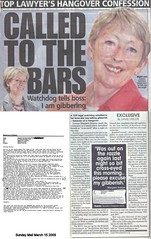
Margaret Scanlan - Called to the Bars - Sunday Mail  15 March 2009 emailSLCC officials may challenge Justice Secretary ‘on discipline’ after he ‘forgot’ to implement conduct role. However it has emerged that SLCC officials & board members feel their actions, reported in the media, cannot be disciplined under the so far unapproved 'draft' code of conduct and the Justice Secretary today refused to be drawn on the prospect he may be powerless to discipline his own appointments to the commission due to a lack of an official code of conduct he is yet to approve, one year on. Sources within the Scottish Government’s Justice Department however, have privately expressed fury with the revelations of the conduct of the SLCC officials named in the media, which I reported here : MacAskill must clean up law complaints body as members 'booze culture conduct' reflects lack of discipline & will to investigate crooked lawyers

In a further development, a senior solicitor this morning alleged the Justice Secretary may have been negligent in not ensuring the SLCC, set up with millions of pounds of taxpayers money had a code of conduct in place to scrutinise its workings.

He said "It is almost unthinkable that millions of pounds of public money was handed over to a few people who then took decisions they would not do the job the commission was intended to do".

He went on "It is possible that since no code of conduct was in place, and there was effectively no oversight of the work of the commission members, their decisions on everything so far, could well be invalid. There is little chance officials or board members could be held accountable for their actions, including the recent reports in the media relating to email exchanges between commission officials since there is currently no enforceable code of conduct."

standards commissionStandards Commission for Scotland investigate integrity in public life. The Standards Commission for Scotland, which would be responsible for investigating the SLCC’s officials, sensationally admitted today there was still no external oversight in place for the joint taxpayer-legal profession funded legal complaints commission, even after millions of pounds of taxpayers money had been spent and over one year of work had take place at the SLCC by Ministerial appointees at £350 a day each.

A spokesman for the Standards Commission said : "The Commission has internally approved a draft Code of Conduct, which is in the process of being agreed by Ministers and available from the SLCC or via their website."

The Standards Commission was then asked for their position on rumours that SLCC board members & officials may challenge any disciplinary inquiry, due to the huge gaffe by the Justice Secretary in not ensuring a code of oversight existed before commission members began work last January.

A spokesman for the Standards Commission admitted : "The Office of the CIO is unable to investigate conduct which occurred prior to the relevant code of conduct being approved."

"Any complaint regarding the conduct of an SLCC Commissioner prior to this date should be made in writing to the Chief Executive Officer, Eileen Masterman, at The Stamp Office, 10 – 14 Waterloo Place, Edinburgh, EH1 3EG."

Eileen MastermanSLCC CEO Masterman “agreed” with offensive opinions on consumer organisations. It turns out however, that SLCC Chief Executive, Eileen Masterman, who is on £1350 per week, and is currently on holiday, is herself implicated in the widely reported email-gate scandal where bitter hate fuelled exchanges took place regarding personal opinions of several board members against consumer organisations & campaign groups, as it turns out just because many outsiders to the SLCC don't agree with the Law Society's line on regulating Scotland's legal profession.

A member of staff at the Scottish Legal Complaints Commission condemned the actions of some of her colleagues, claiming "They have brought the commission into widespread disrepute and damaged its credibility with the public"

She went on "It appears there are some within the commission who see their job as a mission to undermine what was a genuine attempt to clean up regulation of the legal profession started by the previous administration.

“I don't think consumers will get any satisfaction with the way the commission is being bullied around by interests from the legal profession who should never have been part of it in the first place as we are now seeing demonstrated in their attitudes.".

It was confirmed today that complaints have been lodged with the Chief Executive against SLCC board members and officials, however who will actually investigate the issues is still to be decided given the CEO’s actions are also of a questionable nature, and that so far, no action has been taken against board members for their less than ethical standards of work.

You may wish to read more articles on problems at the Scottish Legal Complaints Commission here : Some previous articles on the SLCC

If it is true as some think, the decisions taken by commission members are now invalid due to there not being a code of conduct or method of oversight & accountability of their decisions to this date, I would put it to the SLCC that one of their top priorities should now be to clear the air and take a decision to investigate all complaints against solicitors, including issues arising prior to 1st October 2008, including the many cases where the Law Society of Scotland whitewashed complaints against thoroughly crooked solicitors.

Wednesday, March 04, 2009

Law Society of Scotland is ‘World’s Worst Regulator’

The Law Society of Scotland, as we all know, isn’t the world’s best regulator .. hence all the trouble over the years it has caused those among the profession who keep their nose clean, by also keeping the bad apples in the bunch.

Peter Cherbi’s “A Diary of Injustice in Scotland” law blog goes a little further into the Law Society’s performance, and finds its actually one of the world’s worst regulators, with the same faces still at the Law Society despite all the scandals over the years ... (which would be like keeping Sir Fred Goodwin on at the RBS after its collapse, wouldn't it ? - Ed) …

Toxic levels of complaints, poor standards of service & soaring fraud by solicitors makes Law Society of Scotland 'World's worst regulator'

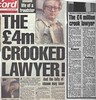
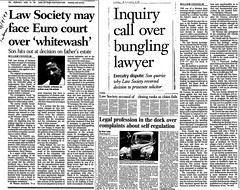
The 4m Crooked Lawyer (John McCabe) - Daily Record 1991Crooked lawyers give Scotland a bad name. While the attention of most remains focussed on the crisis in the banking system, the problems which have caused the collapse of our great financial institutions are nothing new to Scotland's legal sector. Year in year out, clients have been losing millions of pounds of their money to , ambitions, greedy, and downright crooked lawyers over the past couple of decades, and the regulator responsible, the Law Society of Scotland, has done little or nothing about it.

Tangled Web of deceit that ensared 4million - Scotlsman 28 November 1991A crooked lawyer’s tangled web of deceit. During 1991, one of the most famous cases of fraud by the Scots legal profession occurred with revelations that John McCabe, a solicitor working at the now defunct Edinburgh firm of Scott Moncrieff & Dove Lockhart, operated a multi million pound fraud scam against clients & banks, which ultimately was discovered after he became careless and so entrenched in deceit & debt, there was simply no place left to run (although he did try running to Uruguay). While clients stood ruined, and banks took huge losses, the Law Society of Scotland could only watch on as the press of the day mauled both the legal profession and the poor standards of regulation which allowed McCabe to get away with what he did, and ultimately, McCabe was jailed for 10 years for his crimes.

Just imagine for a minute, if every one of the 10,000 lawyers in Scotland stole £4million from their clients. What would be done about it ? .. well nothing much, as long as the Law Society has anything to do with regulating lawyers …

Lawyers left to make good the cost of colleague's dishonesty - Scotsman 1991Law Society Chief Kenneth Pritchard failed on reforms. Amid the recriminations of the McCabe case, and the costs of compensating his victims, the Law Society's Kenneth Pritchard (now a Sheriff), promised reforms to ensure no repetition, and that standards would rise in Scotland's legal profession to ensure public confidence remained in solicitors.

Kenneth Pritchard : “The aim of the new rules … is not to help the legal profession shrug off an obligation to meet losses, but to reduce the amount the Guarantee Fund might have to repay. "It should become much more difficult for solicitors to defraud clients. “There is not a reluctance among solicitors to pay this money. there is an acceptance that we must do so to maintain the good name and standing of the profession.". What good name ?

Policy is to protect both says Law SocietyLaw Society Chief Pritchard performs a u-turn & orders legal firm to drop 'crooked lawyers' case. However, three years on in 1994, the same Law Society Chief, Kenneth Pritchard who had promised reforms to prevent crooked lawyers hurting their clients, was revealed to have personally intervened in a case of litigation against a firm of crooked lawyers, ordering the clients solicitors to withdraw from acting, letting the crooked lawyers off the hook in a policy of protection for crooked lawyers.

Extract of Court PleadingsCourt documents revealed Law Chief's duplicity. Kenneth Pritchard wrote to legal firm Skene Edwards advising them to withdraw from acting in the case, and that letter was subsequently discussed in the Scottish Parliament debate chamber by Cabinet Secretary for Business John Swinney.

You can read more about how the Law Society of Scotland and Kenneth Pritchard did nothing to stem the rising tide of crooked lawyers, and actually closed ranks with crooked lawyers to protect them from punishment while denying clients access to justice, here : Law Society intervention in claims 'commonplace' as ex Chief admits Master Policy protects solicitors against clients

After the exploits of McCabe, the Law Society of Scotland professed to have 'cleaned up Scotland's legal profession, but much worse was to come as the following demonstrates.

Scotsman coverage of some of the stories relating to Andrew PenmanBorders lawyer Andrew Penman became Scotland's most famous crooked lawyer. From 1994 to the present day, my own battle with the Law Society of Scotland ended up in the press, showing yet again the Law Society of Scotland would simply close ranks with crooked lawyers to protect them from client complaints & financial claims for dishonesty & fraud. Indeed, the Law Society went out of its way in a determined effort to prevent me from obtaining legal representation and access to the courts to pursue Penman and his legal firm Stormonth Darling solicitors, for the untold damage it did to my family. Nothing then had changed - there were still plenty of crooked lawyers in business, and the Law Society of Scotland still covered up for crooked lawyers no matter what.

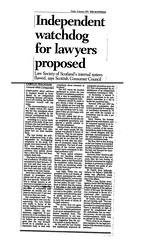
Scotsman 8 January 1999 Independent watchdog for lawyers proposedProposals since 1999 to bring independent regulation to lawyers were blocked by Law Society. The legacy of Andrew Penman, and the cover up by the Law Society of his actions was felt by all solicitors just as in the McCabe case, and assisted with the drive to bring about independent regulation of lawyers and end the closed shop operated by the Law Society of Scotland that allowed thousands of complaints to be binned while investigations were whitewashed.

REVEALED - Top Lawyer at the centre of 12 negligence claims2006, and still plenty crooked lawyers in Scotland. Things are now so bad in Scotland that many solicitors & legal firms have 'toxic levels of client complaints & claims' for poor legal service, rendering the use of Scots solicitors a dangerous game of Russian roulette for consumers, where selecting the worst of a bad bunch can see you end up financially ruined and your lives destroyed by a greedy lawyer out to take as much as possible, safe in the knowledge his regulator, the Law Society of Scotland, will do nothing to help members of the public.

Cash Link to Law Chief StabbingLawyers staged mafia hit on one of their own. Indeed the corruption of Scotland's legal profession became so entrenched, the Law Society's own Chief Accountant, Leslie Cumming, was subject to a mafia hit, staged by crooked lawyers in an attempt it has since been claimed to put off investigations into crooked lawyers .. and while the then Law Society Chief Douglas Mill was busy blaming clients for the attack on Cumming, it became clear to all the motives for the attack came from within the ranks of Scotland's solicitors, who had become so evil they would consider and use murder hits to escape justice for their vast network of corruption against clients.

EXCLUSIVE Lawyer sued for 1million 2007, and even more crooked lawyers. The media coverage of countless scandals within the Scots legal establishment, and the Law Society’s seeming ability to whitewash any crooked lawyer, no matter the crimes they had committed, ultimately brought about the creation of legislation passed in 2007 to 'improve' regulation of the legal profession, however the 'independent' Scottish legal Complaints Commission which was created as a result of the LPLA (Scotland) Act 2007 has since been co-opted by the Law Society, and is mired in many scandals itself, as the legal profession fights back to retain its crooked regulatory powers over crooked lawyers.

Let us finally take a look at some of the people who have perpetuated this disgraceful state of affairs the Scots legal services market finds itself in :

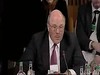
Douglas Mill at the Scottish ParliamentDouglas Mill, ex-Chief Exec. of the Law Society. Douglas Mill, recently famed on television for supporting Sir Fred Goodwin who brought RBS to its knees, made no bones about it, he had no time for clients who complained against crooked lawyers, and saw it as his mission to interfere in complaints & financial claims against crooked lawyers. Mill horrendously hounded clients who dared make a complaint against a solicitor, and personally saw to it that attempts at legal action against solicitors failed at every turn, even demanding legal aid be refused to anyone seeking to take a lawyer to court.

Philip Yelland - Director of Regulation - Law Society of ScotlandPhilip Yelland, Head of Client Relations. During all this time, and all these scandals, one man has been the key to ‘Client Relations’ at the Law Society of Scotland, Mr Philip Yelland, who has presided over scandal after scandal, where curiously many of the crooked lawyers got off the hook, or investigations were simply whitewashed, while the Law Society saw to it members of the public were denied access to justice and a solicitor to try and pursue the thousands of McCabes and Penmans for the damage they did to many clients.

Michael Clancy - Director of Law Reform - Law Society of ScotlandMichael Clancy, Director of Law Reform. Despite the hundreds of ‘crooked lawyer’ scandals in the last two decades, and all the promises of reform from the Law Society itself, nothing has been done to help thousands of people with outstanding cases against crooked lawyers, and some at the Law Society such as Michael Clancy, have come down hard against any proposals to bring in Parliament or new legislation to help clean up the legal profession’s sins of the past.

You can read my own proposals, in effect. a “Truth & Reconciliation” proposal for the Law Society’s sins of the past here : The polluter pays - Why cleaning up lawyers sins of the past would be good for the public & legal profession alike

We are now at a point where no matter the scale of corruption in Scotland’s legal services market, nothing will bring the reforms and consumer protection that all Scots and consumers of legal services in this country should have. The feeling now by many is that when someone goes to a lawyer, the odds are they are going to get ripped off, and with lawyers experiencing a marked downturn in legal business, levels of fraud against clients through faked up legal fees and menacing demands for expenses on work not carried out are sharply rising.

If we are to have good regulation of legal services in Scotland, the Law Society of Scotland and those associated with it, presently or formerly, cannot be allowed anywhere near such a body, as the crop of scandals at the Scottish Legal Complaints Commission show very clearly.

As long as we have a Justice Secretary who says he will protect lawyers from much needed reforms, the Scots public will always take second place to the criminal element of society that walks around with a Law Society of Scotland membership badge, professing to offer the best in legal services when in reality they offer levels of toxicity to consumers that Chemistry could never hope to define.

Monday, February 23, 2009

Ex Law Society boss Douglas Mill lands Glasgow University 80k post – memos not included

After ruining the legal profession’s reputation in Scotland, Douglas Mill is off to Glasgow University to do some more of what he’s good at, whatever that is … and to cap it all, the announcement was made on Friday the 13th. (Yes, Jason IS coming to Glasgow Uni – Ed)

Peter Cherbi’s “A Diary of Injustice in Scotland “ reports :

Former Law Society Chief Douglas Mill who resigned over ‘crooked lawyer’ memo scandal lands £80k Glasgow University legal post

Douglas Mill at the Scottish ParliamentGlasgow University’s Friday the 13th ? Former Law Society Chief Douglas Mill, who made himself famous as the most senior Law Society official who publicly & personally intervened in complaints & claims against crooked lawyers, he himself described as 'valid', has been appointed "Director of Professional Legal Practice of the University of Glasgow's School of Law". The post was announced on Friday 13th February 2009, and pays around £80,000.

More on the scandal which brought down Douglas Mill from his 11 year stint as the Law Society’s Chief Executive, can be read here : Breaking News : Law Society Chief Executive Douglas Mill who lied to Parliament, pursued 'personal vendetta' against critics - to resign

The University of Glasgow has issued a Press Release, but no one was apparently available, or willing to expand on it. However, a source at the University joked yesterday : “We got to hear about it last week on Friday the 13th. I wonder if its going to be anything like the movie ?”. “I heard he will be giving a cradle to Granny’s grave course!”

A former Council member of the Law Society, who spoke on other issues earlier this week, said “The consultation business isn’t doing too good these days, like the rest of us, but I’m sure Douglas will pick up a good salary at Glasgow for doing what he’s best at, and we all know what that is.”

A quick recap on who Douglas Mill actually is :

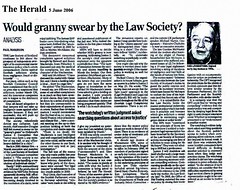
The Herald 5 June 2006 - Would granny swear by the law societyDouglas Mill used his dead granny to protect crooked lawyers. Mill, known for his 'pugnacious style' famously swore on his "Granny's Grave" during a session of Holyrood's Justice Committee in their consideration of complaints reforming legislation, boasted he had never intervened in claims & complaints against crooked solicitors & legal firms, but ended up being exposed as a liar before Holyrood by Cabinet Secretary John Swinney during a bitter debate which saw the contents of Mill's own memos & efforts to interdict members of the public from access to justice against a series of corrupt legal firms across Scotland.

Holyrood confrontation between Douglas Mill & John Swinney over 'crooked lawyer' memos ended Law Chief’s stint as Chief Exec


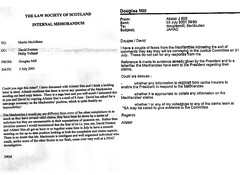
Douglas Mill Secret MemosMemos of a downfall. Douglas Mill, in his post as the Law Society’s Chief Executive, found himself obsessed with hounding hundreds of members of the public who dared register complaints against crooked legal firms. Mill could not resist the opportunity to personally intervene in client complaints and financial claims made against crooked solicitors and their legal firms and his efforts depicted a concerted policy to ensure members of the public were constantly denied access to justice & legal representation solely to derail cases against legal firms reaching Scotland’s courts.

Douglas Mill - A Lawyer's never loved in his own home land - The Scotsman 15 August 2006Mill became so desperate to protect self regulation, he made newspaper suicide jibe. However, Douglas Mill became the legal profession's own worst enemy, as his policies and those of his Law Society colleagues became clearly out of touch with civilised thinking, and in his tenacious battle with consumers & the Scottish Parliament over regulation of the legal profession reforms, became so desperate he famously drafted in an English QC to argue it was a breach of a lawyer's human rights to have someone else other than a lawyer investigate complaints against lawyers, an issue I reported in an earlier article here : Law Society of Scotland & Lord Lester QC challenge new legislation to protect Scottish public against crooked lawyers

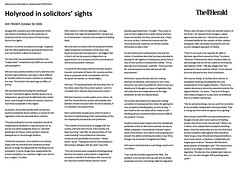
Holyrood in Solicitor's Sights Octover 30 2006 The Herald Douglas Mill threatened legal action over lawyer's right to regulate themselves. When the 'rights for lawyers to investigate themselves' argument didn't work, Mill then turned his anger towards the Parliament & Government, threatening court action over the Legal Profession & Legal Aid (Scotland) Bill - legislation designed to usher in a new era of independent regulation of Scotland's solicitors. Mill's threats of courtroom attacks on the Government & Parliament brought new lows in public opinion of the Law Society of Scotland, viewed by many clients these days as little more than an organisation bent on protecting the criminal element of Scotland's legal profession.

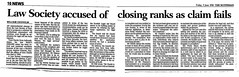
Scotsman 5 June 1998 Law Society accused of closing ranks as claimi fails Douglas Mill hounded victims by blocking their legal aid. Douglas Mill went on to be featured in many more scandal busting media reports, which depicted an operational policy of protection for crooked lawyers at the Law Society of Scotland. Subjects ranged from fiddling client’s legal aid applications to take on the Law Society, to even telling the Financial Services Authority to "take a hike" over scrutiny of the Law Society's Master Policy & Guarantee fund.

Cash link to law chief stabbingDouglas Mill demanded press censorship after attack on Leslie Cumming. Never one to miss an opportunity, Douglas Mill even used the attack against former Law Society Chief Accountant Leslie Cumming, as a chance to blame those who criticised the legal profession for whipping up a feeling of hate, Mill going on to demand the media, critics and clients all be silenced on ‘crooked lawyer’ stories …. however, Mill’s plan backfired when it turned out the mafia style hit against Cumming, which is yet to be resolved after three long years, was organised by some of the crooked lawyers within the profession Mill’s policies had shielded from complaints & investigations.

However, Mill’s time at the top of Scotland’s legal profession came to a bitter end after the video coverage of his confrontation with Cabinet Secretary John Swinney was posted to You Tube, and it became clear to everyone he, the Law Society of Scotland and the Scots legal profession as a whole had no credibility left with the public.

Douglas Mill’s best known gift to the legal profession has been that of crooked Borders lawyer, Andrew Penman, who ended up costing every Scottish solicitor hundreds of pounds a year in complaints levies, and levels of public disrespect which have put lawyers on a par with rapists or sex perverts.

Here’s the announcement from Glasgow University. Judge for yourselves if Scotland might get better law students under Mr Mill’s tuition …

From the University of Glasgow's news release :

School of Law appoints Director of Professional Legal Practice

Former Chief Executive of the Law Society and Glasgow graduate, Douglas Mill has been appointed as the Director of Professional Legal Practice of the University of Glasgow’s School of Law. He will take up his post on 1 March 2009. Douglas, who currently runs his own business consultancy after 11 years at the helm of the Law Society of Scotland and 18 years experience of private practice, will take up the newly created post on 1 March 2009.

Douglas will lead the team that will develop and teach the Diploma in Legal Practice at the University of Glasgow for September 2010. Assuming that the Law Society's proposals for reform of solicitor's education and training are accepted by the members at the May AGM, this will coincide with the start of the new framework for professional legal education under which the new Diploma will be significantly different from the current Diploma. Glasgow will also be offering post-diploma education for trainees in terms of the new framework from September 2011 and CPD. In recent years, Glasgow has run the Diploma jointly with the University of Strathclyde through the medium of Glasgow Graduate School of Law (GGSL). From September 2010, Glasgow will be offering the Diploma independently.

Douglas Mill said: “I am delighted to return to my alma mater to take up the challenge of delivering the University’s ambitious strategic plans for the School of Law. I enjoy working with students and have always been very involved in Legal education. With the Law Society poised to outline a new style of diploma, Glasgow has the opportunity to develop full ‘cradle to grave’ law training which will link into lifetime learning for solicitors in Scotland. Glasgow has always been unimpeachably good as a legal university but it has been ten years since they have run the diploma independently. With the 300th anniversary of the Regius Chair in School of Law coming up in 2013, we aim to establish a centre of excellence for professional legal studies at Glasgow.

Professor Tom Mullen, Head of the Law School said: “We aim to make the University of Glasgow’s School of Law one of the top 7 law schools in the UK, and expanding professional legal education is a key part of our strategy for achieving that aim. With his background and experience, Douglas is ideally placed to lead the team that will enhance our provision of professional legal education, and the timing of the appointment is perfect given the Law Society of Scotland’s plans for new quality-based continuous professional development.”.

Friday, February 20, 2009

Lord Justice Clerk Lord Gill calls for review of solicitor advocates amid regulation failure by Law Society of Scotland

Solicitor-advocates are in the news as Lord Gill, the Lord Justice Clerk calls for a review of the way the Law Society fails to regulate their work …

The Scotsman reports :

Senior judge calls for review of solicitor advocates system

Published Date: 19 February 2009
By EMILY PYKETT

A SENIOR judge in Scotland has called for a review of the system of solicitor advocates representing people in court.

The Lord Justice Clerk, Lord Gill, yesterday heard the appeal of a convicted killer over the conduct of his defence at his trial at the High Court in Glasgow in 1998.

Judges sitting at the Court of Criminal Appeal in Edinburgh rejected Alexander Woodside's appeal. However, Lord Gill branded a decision by one of Woodside's defence team to absent himself from the trial for a day to go to London as part of a Law Society delegation to lobby on legal aid fees as "a dereliction of his duty".

He said Woodside's appeal raised concerns over practice among solicitor advocates in the courts.

Lord Gill said: "This appeal has highlighted problems of rights of audience that seem not to be unique to this case. I think it would be opportune if there were to be a review of the working of the system overall." He added: "I fail to see how any practitioner could be justified in absenting himself from any part of a murder trial except in an emergency."

Woodside, 31, had been defended at his trial by solicitor advocates Gerry Brown and Michael McSherry.

David McGlashan, of Livingstone Brown, instructed Mr Brown, a senior partner with the firm, with Mr McSherry there to assist him.

Lord Gill said he did not believe evidence from Mr McGlashan in which he stated he discussed with Woodside the option of being defended by counsel.

He added: "The reality is that Mr Brown decided at the outset that he would defend the appellant, with Mr McGlashan in the role of his instructing solicitor. No other option was put to the appellant."

The judge said the appeal highlighted a further problem arising from a solicitor advocate being able to accept instructions from his own firm.

Lord Gill also said the current rules "provide no safeguard to protect the accused in such a case being defended by an inexperienced solicitor advocate whose reach exceeds his grasp".

However, the Lord Justice Clerk said this did not amount to a miscarriage of justice.

Lord McCluskey, a former High Court judge, was one of those who argued against the plans for a system of solicitor advocates almost 20 years ago.

Last night he told The Scotsman: "I have helped with the training of people and I am reasonably sure the solicitor advocates who act on behalf of people in courts are competent.

"The system has endured for 20 years; it has structural weaknesses – the principal of which is advocates are under jurisdiction of the dean – but there is no equivalent governing the general behaviour of solicitor advocates.

"But on the whole, I would have said that they have done a perfectly competent job."

However, after the appeal court ruling, Richard Keen, QC, the dean of the Faculty of Advocates, said: "I welcome the idea that the problems outlined by the Lord Justice Clerk should be the subject of a review. The particular problem of solicitors not clearly advising clients as to the availability of counsel is a long-standing one and suggestions that they should not have to do so are extremely worrying."

The right to appear in the High Court was extended to solicitors under 1990 law reform legislation, where previously the work was only carried out by advocates from the Scottish Bar.