Showing posts with label Frank Mulholland. Show all posts

Thursday, October 15, 2015

Lord Advocate & Crown Office identify two ‘new’ Libyan suspects sought for questioning over 1998 terrorist bombing of flight Pam Am 103 over Lockerbie

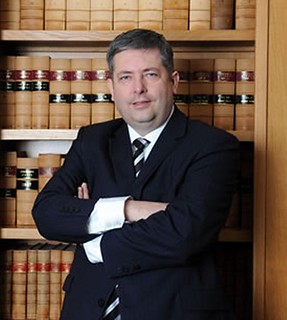
Lord Advocate Frank Mulholland

Old Lockerbie suspects sought anew by Lord Advocate. SCOTLAND’S Lord Advocate Frank Mulholland has requested the help of Libyan judicial authorities for Scottish police officers and the FBI to interview two Libyan suspects in the bombing of flight Pan Am 103 over Lockerbie in 1988.

The request – 27 years after the destruction of Pan Am Flight 103 over Lockerbie, Scotland in December 1988, comes after the Crown Office said earlier today that the two men are believed to have acted with Abdelbaset Ali Mohmed al-Megrahi, the only person ever convicted of the bombing, which caused the deaths of 270 people.

Neither suspect was named by the Crown Office although it is thought the identities of both have appeared in claims by prosecutors at previous stages of the case.

A Crown Office spokesman said today: "The Lord Advocate and the US Attorney General have recently agreed that there is a proper basis in law in Scotland and the United States to entitle Scottish and US investigators to treat two Libyans as suspects in the continuing investigation into the bombing of flight Pan Am 103 over Lockerbie.

"The Lord Advocate has today, therefore, issued an International Letter of Request to the Libyan Attorney General in Tripoli which identifies the two Libyans as suspects in the bombing of flight Pan Am 103. The Lord Advocate and the US Attorney General are seeking the assistance of the Libyan judicial authorities for Scottish police officers and the FBI to interview the two named suspects in Tripoli. The two individuals are suspected of involvement, along with Abdelbaset Ali Mohmed Al Megrahi, in the bombing of flight Pan Am 103 in December 1988 and the murder of 270 people."

BBC News reported:

Two new Lockerbie bombing suspects identified

Scottish prosecutors want to interview two Libyans they have identified as new suspects over the Lockerbie bombing.

They believe the two suspects acted along with Abdelbaset al-Megrahi - the only person to have been convicted of the atrocity.

The BBC understands the pair are Mohammed Abouajela Masud and Abdullah al-Senussi.

A total of 270 people died when the Pan Am 103 flight was blown up on the evening of 21 December 1988.

The flight was on its way from London to New York when it exploded above Lockerbie, in southern Scotland, killing everyone on board and 11 people on the ground.

Senussi was the brother-in-law and intelligence chief of former Libyan dictator Colonel Gaddafi. He is currently awaiting execution in a Libyan jail.

Masud is reported to be serving a prison sentence in Libya for bomb making.

Scotland's Lord Advocate Frank Mulholland QC recently met the US Attorney General, Loretta Lynch, in Washington to review progress made in the ongoing investigation.

They have now requested permission from the Libyan authorities for Scottish police and the FBI to interview the two new suspects in Tripoli.

A Crown Office spokesman said: "The Lord Advocate and the US Attorney General have recently agreed that there is a proper basis in law in Scotland and the United States to entitle Scottish and US investigators to treat two Libyans as suspects in the continuing investigation into the bombing of flight Pan Am 103 over Lockerbie.

"The Lord Advocate has today, therefore, issued an International Letter of Request to the Libyan attorney general in Tripoli which identifies the two Libyans as suspects in the bombing of flight Pan Am 103.

"The Lord Advocate and the US Attorney General are seeking the assistance of the Libyan judicial authorities for Scottish police officers and the FBI to interview the two named suspects in Tripoli.

"The two individuals are suspected of involvement, along with Abdelbaset Ali Mohmed al-Megrahi, in the bombing of flight Pan Am 103 in December 1988 and the murder of 270 people."

The Libyan attorney general declined to comment to the BBC on whether a letter had been received from the Crown Office and whether the Libyan government would be assisting in the investigation.

Rival governments

Libya has struggled to stabilise since ousting long-term leader Colonel Muammar Gaddafi in 2011. Elections in 2014 produced two rival governments as Islamist and secular militias fight for control of the country.

The Crown Office said it would be inappropriate to confirm any identities to preserve the integrity of the investigation.

Megrahi's part in the bombing has been called into question in a series of books and documentaries.

And a petition seeking "Justice For Megrahi", backed by politicians and family members of some victims, was raised at the Scottish Parliament in 2012.

Jim Swire, whose daughter died in the bombing, told the BBC: "I think there is a need for evidence to be made available as to why these two are suspects.

"We have recently been refused permission in Scotland to have to have a further appeal held into Megrahi's conviction, and many in this country simply don't believe Megrahi was involved and that this was a miscarriage of justice.

"To try and bolt two more names on top of that is a very difficult situation. It will need to be supported by better evidence than was produced to achieve the conviction of Megrahi."

But Frank Duggan, president of Pan Am 103 Relatives, told BBC Radio Scotland's Newsdrive programme he was not confident there would be further prosecutions.

'Really gratified'

He said: "I would like to think there would be, but they would have to be indicted by the US government or by the Scottish government and the Libyan government would have to turn them over - the Libyans have always said they are not going to turn over anyone to a foreign government.

"And it's been 26 years. It's too long, people are dead, stories have been forgotten.

"I'd like to think that it will be one small measure of closure but I don't expect the kind of justice that we all hope for."

Stephanie Bernstein, who lost her husband in the bombing, told the BBC that she was "surprised, delighted and really gratified" by the announcement.

She added: "There are many, many people who I hope are not sleeping so well tonight knowing that the Scottish government and the US government are committed to pursuing this case."

Friday, October 09, 2015

TRIAL BALLOON: Lord Advocate deflects calls for inquiry on Crown Office handling of mortgage fraud allegations against solicitor who represented MP Michelle Thomson

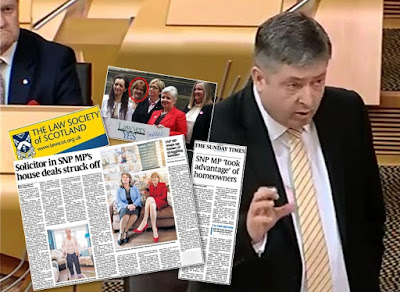
‘Unconvincing’ Lord Advocate raises fears of cover up. DURING one of the worst performances ever by a Lord Advocate before the Scottish Parliament – top prosecutor Frank Mulholland said he did not think there should be an inquiry into the handling of an investigation of a lawyer who was struck off over property deals involving SNP MP Michelle Thomson.

Responding to questions on when the Crown Office & Procurator Fiscal Service (COPFS) was informed of allegations of mortgage fraud involving solicitor Christopher Hales – Frank Mulholland told MSPs that he does not believe there should be an inquiry into when prosecutors knew and how the case has since been handled - after it emerged the Law Society briefly informed the Crown Office of the ‘issue’ in December 2014.

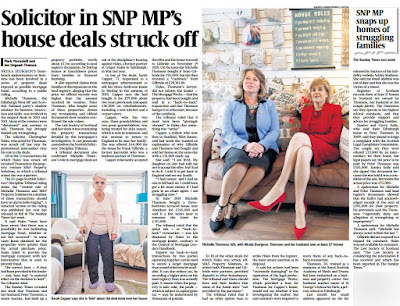
Hales, who once listed his occupation as “Police Constable” – and is now struck off by the Scottish Solicitors Discipline Tribunal from working as a solicitor - handled numerous property deals for his client – SNP MP Michelle Thomson. Mr Hales acted for Ms Thomson before she was elected as an SNP MP.

According to a ruling by the Scottish Solicitors’ Discipline Tribunal, a full version of which has been published by the Sunday Times, Mr Hales failed to provide key information to mortgage lenders in breach of guidelines designed to prevent fraud in numerous cases.

In the Scottish Parliament on Thursday, Labour MSP Jackie Baillie asked Mr Mulholland about the timeline in the case.

During the 10 minute session, Lord Advocate Frank Mulholland presented a timeline of events as the Crown Office saw it:

18 December, 2014 - The issue of solicitor Christopher Hales was raised "informally" by the Law Society of Scotland with the Crown Office. Neither the clients nor properties were named.

28 April, 2015 - The issue was raised again and it was noted that the matter of referral to the Crown Office was still under consideration by the Law Society. Neither the clients nor properties were named.

1 July, 2015 - The Crown was advised by the Law Society that it was required to obtain authorisation from its Guarantee Fund Sub Committee to formally refer the case.

3 July, 2015 - Referral was received by the Crown following the required authorisation. Documents were handed over to the Crown Office and in those documents the names of clients and properties were disclosed.

9 July, 2015 - A formal referral was made to the Crown Office and instructions were issued to Police Scotland.

Frank Mulholland  questioned by MSPs about when the Crown Office was first notified of allegations of mortgage fraud against Christopher Hales.

Mr Mulholland said: "As the Crown has made clear on a number of occasions, the case of Christopher Hales was first brought to its attention by the Law Society of Scotland at a meeting on 18 December, 2014."

Ms Baillie asked if Mr Mulholland believed there should be an investigation into the processing of information between the Law Society and the Crown Office.

She asked if he would order such an inquiry, given that there may have been "additional opportunities for alleged mortgage fraud" due to the delay.

Mr Mulholland responded: "I don't have the power to order an inquiry, and I don't think there should be an inquiry."

He said Police Scotland were instructed to investigate the allegations on 3 July 2015 and formally issued officers to do so on 9 July.

He said the issue was raised at routine quarterly meetings between the Law Society and the Crown Office.

Mr Mullholland said the Crown Office was first made aware on 18 December 2014 that the case was under consideration for referral. The issue was raised again on 28 April.
Image copyright PA Image caption Ms Thomson denies acting illegally

Mr Mulholland added: "The first time the Crown was made aware of the identity of the clients and the properties, was the 3rd of July."

Mulholland was also asked by Jackie Baillie if the Crown Office had begun any Proceeds of Crime actions against those involved.

Embarrassingly for the Lord Advocate, and appearing to have little clue as to the sequence of events, he responded “not yet”.

Police Scotland launched an inquiry only after the Crown Office was finally handed the detailed case files in the Hales case by the Law Society, some seven months from the day it first alerted prosecutors to the case.

Hales was banned from the legal profession in May 2014 over 13 property deals linked to Thomson and her business partners. The transactions involved “back to back” sales, where homes – often owned by vulnerable people – were bought at below full market value and then resold at far higher prices, in some cases on the same day; where large cash sums were transferred between the parties involved; where mortgage loans were sought that were higher than the price paid for the home, and where higher prices than those actually paid were recorded in the Scottish land registry.

Mortgage companies involved in those transactions, including Lloyds, which gave loans through its subsidiary Birmingham Midshires, and Virgin Money, which now owns the mortgage book for Northern Rock, which lent money for one sale, have confirmed they are now in contact with the police.

The Sunday Times disclosed it had submitted new evidence of an unusual property transaction to Police Scotland detectives after a couple who sold a home to Thomson alleged they had £32,000 deducted from the sale proceeds to pay off a loan they had no knowledge of.

The solicitor involved in that transaction, James Craig, had been found guilty of professional misconduct in February 2014 by the Scottish Solicitors Disciplinary Tribunal (SSDT), the body that struck off Hales three months later, and fined £2,500 for breaching money laundering regulations. There was no evidence that Craig acted improperly in the case reported by the Sunday Times.

The Sunday Mail reported that a second lawyer named in the SSDT judgment on Hales called Christopher Tulips, whose firms Strefford Tulips was involved in several deals for Thomson’s firm M&F Property Solutions, had also been censured and fined £2,500 for his role in back-to-back property deals. The published ruling by the SSDT on Tulips is anonymised, so it remains unclear whether his case involved transactions linked to Thomson.

Last week, the Law Society said its director of financial compliance Ian Messer "informally" raised concerns about the case of Mr Hales during two separate meetings with prosecutors in December 2014 and April 2015.

However, the Law Society did not "formally" submit its evidence to the Crown until July 2015, two months after Ms Thomson was elected SNP MP for Edinburgh West.

Law Society chief executive Lorna Jack gave an "absolute and categorical assurance" last week that the election played no part in the timings of the case.

She said Mr Messer would have seen Ms Thomson's name in the unredacted report into Mr Hales but may not have been aware she was a Westminster candidate.

The secretary to the Law Society committee that struck Mr Hales off, Sheila Kirkwood, is said to be a personal acquaintance of Ms Thomson with close links to the SNP.

Lorna Jack has pledged to look more deeply into Ms Kirkwood's links with Ms Thomson, but said she has received an assurance the secretary was unaware of the MP's links to Mr Hales until she read about it in media reports.

Ms Thomson is linked to 13 transactions Mr Hales conducted in 2010-11 where properties were said to have been bought cheaply from clients looking for a quick sale and then sold at a huge mark-up on the same day.

Complicated "cashback" deals were said to have been used to artificially inflate property prices in order to secure bigger loans from lenders.

Ms Thomson has denied acting illegally.Ms Thomson has surrendered the SNP party whip and has also stood down as the party's business spokeswoman at Westminster until the investigation into Mr Hales has concluded.

Previously, First Minister Nicola Sturgeon denied having any prior knowledge of a scandal which led to one of her most prominent MPs stepping down from the party.

During First Minister’s Questions last Thursday, 1 October,  Nicola Sturgeon said in response to questions that "serious issues" had been raised around the conduct of Michelle Thomson. The First Minister said that a police investigation should be allowed to take its course.

NO HOMELESSNESS FOR POLITICIANS:

The House of Commons Register of Members’ Interests lists 16 SNP MPs as holding property interests from which most receive rental income.

Under the rules, Members of Parliament are required to list a property if (i) its value is over £100,000 and (ii) if they receive rental income of at least £10,000 a year.

Tasmina Ahmed-Sheikh(Ochil and South Perthshire): Three flats in Glasgow and a house in Kingussie, Highlands and Islands (i/ii).

Richard Arkless(Dumfries and Galloway): A house in Broxburn, West Lothian, and a flat in Glasgow (i/ii).

Ian Blackford(Ross, Skye and Lochaber): Croft, including two holiday rental properties on the Isle of Skye (i/ii). A house in Lanark (i),

Deidre Brock(Edinburgh North and Leith): A half share in two Edinburgh flats (i).

Lisa Cameron(East Kilbride, Strathaven and Lesmahagow): A house in South Lanarkshire (i/ii). Five residential and holiday let apartments in Edinburgh and South Lanarkshire (i/ii).

Martyn Day(Linlithgow and East Falkirk): A house in West Lothian (i).

Patricia Gibson(North Ayrshire and Arran): A flat in Edinburgh (i).

Calum Kerr(Berwickshire, Roxburgh and Selkirk): A house in Wester Ross (i/ii).

Chris Law(Dundee West): A flat in Dundee (i) and a flat in Aberdeen (i).

Angus Brendan MacNeil(Na h-Eileanan an Iar): Jointly owns a house in Fort William plus a flat in Glasgow and a flat in London (i/ii).

Stuart McDonald(Cumbernauld, Kilsyth and Kirkintilloch East): A flat in East Dunbartonshire (i).

John McNally(Falkirk): Owns a hair salon, The Barber Shop, from which he receives £600 a month in rent.

John Nicolson(East Dunbartonshire): A terrace house in London’s Tower Hamlets (i/ii). He occasionally receives income for renting it out for photoshoots.

Steven Paterson(Stirling): A half share in a flat in Stirling (i).

Tommy Sheppard(Edinburgh East): Commercial premises and residential property in Edinburgh (i) owned by entertainment company Salt ‘n’ Sauce Promotions of which he is a shareholder.
Share article

Michelle Thomson(Edinburgh West): Two residential properties in Edinburgh, one in Falkirk, one on the Isle of Bute, one in East Calder, one in Stirling, one in Dollar, a half share of a property in Edinburgh and a quarter share of a property in Edinburgh (i/ii). She is a shareholder in the property management firm Your Property Shop.

Tuesday, March 18, 2014

NO JUSTICE: Victims of crime often end up as victims of secretive Crown Office prosecutors & Scotland’s “Gentlemen's Club” of a justice system

Lord Advocate Frank Mulholland

Lord Advocate Frank Mulholland – Crown Office failed to explain dropped rape prosecution. AS questions grow over the Crown Office & Lord Advocate’s role in the dropped prosecution of footballer David Goodwillie for rape, and other cases come to light where victims of crime and their families often end up as victims of the justice system itself and the sinister role of the Crown Office across a multitude of cases, crime victims are launching a campaign demanding their voice is heard in Scotland’s justice system reports the Sunday Mail newspaper.

As most victims of crime in Scotland will know from experience, dealing with Scotland’s secretive, unaccountable Crown Office & Procurator Fiscal Service (COPFS) – which often pursues its own agenda in criminal investigations or prosecutions, often places victims of crime in a far worse position after inept prosecutors and COPFS staff frequently dither, delay or fail to present cases or evidence in court – especially when friendships, associations and the vested interests of Scotland’s notorious gentlemen’s club of a justice system come into play.

Police and prosecutors have let us down claim victims of crime as they launch new campaign for justice

Mar 16, 2014 08:41
By Marion Scott Sunday Mail

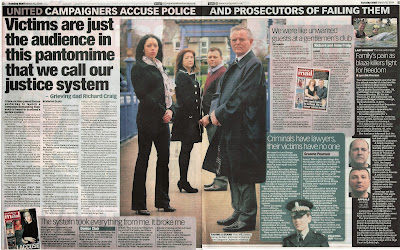
PARENTS Anne and Richard Craig whose son died in a school attack and Denise Clair, who claims to have been raped by a footballer, have spoken out about their experiences of Scotland's justice system.

CRIME victims joined forces yesterday to launch a campaign demanding their voice is heard in Scotland’s justice system.

Anne and Richard Craig, whose son Euan, 14, was punched to death at school, say their suffering was made worse by their dealings with prosecutors and courts.

They met Denise Clair, who fears her fight to discover the truth of what happened on the night she claims to have been raped by footballer David Goodwillie has been undermined by Crown Office decisions.

Anne, Richard and Denise were brought together by Scottish Labour’s justice spokesman Graeme Pearson, a former police chief, who is demanding extensive reform to improve the treatment of victims of crime.

The three – all supported by the Sunday Mail – have spoken to the MSP about their ordeals in a video to be shown at next weekend’s Labour conference in Perth.

Pearson, who has urged Justice Secretary Kenny MacAskill to act, said: “I spend a lot of my time speaking to families like the Craigs and victims like Denise Clair and it’s disheartening hearing what they have to say.

“Under this Government, we have a criminal justice system that no longer has victims at its heart.

“In fact, if they didn’t feel victimised enough before they entered the system, they most certainly do by the time they emerge at the other end.”

Senior firefighter Richard, 45, is disgusted that Darren Taylor was jailed for just three-and-a-half years for his attack on Euan, who died after being punched five times at Rosshall Academy in Glasgow two years ago.

Richard, of the city’s Cardonald, said: “Victims are the very last thing that matter today in Scotland’s criminal injustice system.

“If, like us, you suddenly find yourself thrust into that nightmare, you very soon discover victims are merely the audience in a pantomime.”

His wife Anne, 44, who works with homeless people, said: “We’ve just been told Taylor will be free in August.

“He’ll be free and we still don’t know how this could have happened to our boy, or how we can prevent it happening to other families.

“There’s more chance of winning the lottery than winning justice in Scotland.”

Denise, 27, was on a night out in Bathgate, West Lothian, in 2011 but woke the next day, naked, alone and terrified, locked inside a strange house in nearby Armadale.

Witnesses claimed she was so drunk or drugged that she was “100 per cent” incapable of consenting to sex but the Crown dropped Goodwillie’s rape prosecution.

He categorically denies doing anything wrong but Denise, who was given criminal injuries compensation for being attacked, is suing him in a civil action.

Denise will never know whether her drink was spiked because a specialist sex crime unit took too long to carry out blood tests.

She called police just after 9am but no doctor was available to do the tests until after 6pm.

Denise said: “My life will never be the same again but nobody has apologised, nobody has promised to ensure it won’t happen to other victims.”

The campaigners have described a culture of “institutional indifference” to Scotland’s victims of crime.

Sandy Brindley, of Rape Crisis Scotland, said: “Reporting rape can take a great deal of courage and far too many rape survivors continue to feel very let down by the justice system they believed was there to protect them.

“Only around a quarter of rapes reported to the police ever make it to court – and for those survivors whose cases do get to court, the experience can be very traumatic.

“Survivors often tell us of how violating they find the experience, particularly when their past sexual history is brought up in court.”

David Sinclair, of Victim Support Scotland, said: “Our service is in every sheriff and high court in Scotland and we are available to assist witnesses and victims in every way we possibly can.

“We do recognise there is still work to do to improve the system.”

He said they hoped to establish a central information hub, which would reduce the number of times a victim of crime would have to give a statement about what happened to them.

The Crown Office declined to comment but the Scottish Government said: “Our Victims and Witnesses Bill, recently passed by the Scottish Parliament, has been developed in close dialogue with established organisations representing victims and witnesses, including Victim Support Scotland.

“The measures contained in the Bill will make important improvements to the criminal justice system for victims and witnesses.

“It will improve support, provide greater protection to their rights, ensure a more joined-up support across the system and give victims and witnesses confidence that their voices will be heard.”

The new law will also introduce a victims’ surcharge fund.

Case study: Denise Clair

What I believe happened to me that night was hard to come to terms with – but how I was treated by the criminal justice system was every bit as bad.

Because they let me down, I’ll never know what happened to me that night and that’s unforgivable.

If I’d known how I was going to be treated, I’d never have called the police that day. They did their job but the system went on to let me down at every turn.

I had to give up my career with the prison service because the criminal justice system left me
broken. They took everything from me and left me feeling worthless.

They told me the evidence in my case was good, then they pulled the rug out from under me and dropped the charge. No proper explanation was given.

I was told to go away and get on with my life. Now I’ve got the extra trauma of relying on the civil court for some form of justice.

I’m not alone – there are hundreds like me who mistakenly thought victims came first.

It’s taken me a long time to rebuild my self-confidence but I’m determined to come out fighting to help other victims.

Case study: Richard and Anne Craig

Richard: There was a great hue and cry about what a wonderful thing victim impact statements were going to be – but the forms have space for a single sentence.

Then, after all the pain of sitting down for hours, trying to put your loss into words, these statements aren’t read out in court.

Isn’t that what they were supposed to be used for?

We quickly formed the impression that prosecution lawyers are just not used to being challenged.

What the public already know, but the Crown Office appear to have failed to understand, is that we don’t have a justice system.

It’s about making deals behind closed doors and bending over backwards to ensure criminals aren’t too traumatised from the slap on the wrist they are undoubtedly going to get in what passes for sentences.

It’s not about making sure victims come out the other side feeling less victimised, or God forbid, that they’ve had justice.

Anne: The first thing we were told when we went into court was that prosecutors weren’t there to represent us.

I’d always believed they were fighting for victims but nothing could be further from the truth. They told us they were there simply to present the facts.

If only they’d at least done that, Euan’s killer might have received a sentence that matched the severity of the crime.

Instead, they sat silent while the defence presented a picture of a lad who made a mistake.

The prosecution refused to introduce evidence that showed another side to him.

Nobody talked about what a wonderful boy our son was or how our family have been devastated by his loss.

We were excluded, almost as if we were mere bystanders. We weren’t consulted about why the charges were reduced and when we asked questions we were treated like unwanted guests at a gentlemen’s club.

Graeme Pearson: Criminals have lawyers but victims don't

WE need to turn things around so ordinary people feel they’re at the centre of the system, not on the fringe.

Right now, they feel as if they’ve been spat out, not listened to.

Justice Secretary Kenny MacAskill keeps boasting that there is a 30-year low in recorded crime. But if police are not out arresting people because they are now doing the jobs of support workers then the figures will reflect that.

We now have many more alternatives to prison than ever before, including police and fiscal fines and warnings. No wonder victims say they’ve lost all confidence in the system.

There are many police officers, support staff and prosecutors working very hard to bring justice to victims.

But until we make radical changes, victims will continue to come out the other end feeling victimised for a second time.

They need to be able to walk away feeling their voices have been heard. When you see things like the impact statement forms, you can see why families feel their input is completely disregarded.

I’ve seen better-structured insurance claim forms – and they should be read out in court if witnesses wish, as well as being read out at parole hearings.

I proposed all of those things but they were rejected by the Government.

Victims should be told at the point of sentencing when the earliest date of release is for those sentenced to prison.

The criminals have lawyers talking up for them but victims and their families have no one.

It’s really simple. We need a criminal justice system that protects witnesses from abuse and allows them to deliver the best evidence.

We need a system that works for victims and witnesses every bit as well as it works for the accused.

Wednesday, November 20, 2013

Selective Evidence : Lord Advocate demands MSPs remove corroboration of evidence justice safeguard to give Crown Office 'a better conviction rate'

Lord Advocate Frank Mulholland

Desperately seeking prosecutions - Lord Advocate prefers dirty evidence for a result. SCOTLAND’S top law officer, Lord Advocate Frank Mulholland who heads the Crown Office & Procurator Fiscal Service (COPFS) has told MSPs on the Scottish Parliament's Justice Committee that Corroboration, a long held safeguard in Scots law requiring evidence from two separate sources for a conviction should be removed from the justice system to give Prosecutors a better chance of securing convictions, even if the evidence is dodgy and cannot be trusted.

While claim & counter claim rage over the debate about corroboration and whether it should remain or stay in the justice system, it is now generally accepted by all with a clear legal head and understanding of the pros & cons that the Lord Advocate and Crown Office and want corroboration scrapped due to mounting evidence Prosecutors are just not up to the job of catching criminals.

Over the years it has become clear that Scotland’s overfunded Crown Office which soaks up over £100 million each year in taxpayer funds, regularly fails to secure convictions in rape cases because of poor presentation of evidence, poor interviews with victims and poor quality investigations into rape and abuse cases.

Lord Advocate demands removal of corroboration safeguard (Click to watch)

With the Justice Committee scrutinising the Bill, the Lord Advocate Frank Mulholland explained to MSPs he supported abolishing corroboration because it could make it easier to prosecute offences such as domestic abuse, sexual abuse and rape, where often evidence only comes from the victim.

When asked for his view on the proposal, the Lord Advocate said: "I support it and I support it for quite a particular reason. Prosecutors see the effect of the rule of corroboration on certain areas of criminal offending, in particular sexual offending, including rape and domestic abuse."

Mulholland claimed : "I have never said the abolition of corroboration was all about increasing the conviction rate, I see it as access to justice for the victims of domestic abuse, rape and sexual offending. It seems to me that is something any modern criminal justice system should have."

Mr Mulholland said that in 2012-13 there were 2,803 charges of domestic abuse which could not be taken to court because there was insufficient admissible evidence.

He told MSPs: "That I would suggest is a matter of real concern, that we are not giving the possibility of access to justice for a sizeable proportion of victims in those charges."

He also said that over the last two years about 13% of rape cases - approximately 170 - reported to the Crown could not be proceeded with because of the requirement for corroboration, although there are claims & counter claims over how the Crown Office have manipulated the figures & statistics on these cases to use in their fight to remove what are long held legal safeguards against miscarriages of justice.

Citing an example of an abuse case which COPFS failed to prosecute, Mulholland told the Justice Committee : "I had a case where two sisters had been horrifically sexually-abused as children over a period of many years by a relative, a member of the family. The girls were told no-one would believe them if they spoke up, that no-one would love them if they spoke up. So, they didn't speak up. But eventually as adults they got the courage to speak up and make a complaint to the police.”

Mulholland continued : "We took the case up, we indicted the case in the High Court and we were prepared to proceed to trial. But one of the complainers, one of the victims, mentally could not go ahead with it.We tried to support that victim through the process, give her as much support as was necessary. But at the end of the day we couldn't force that woman to give evidence. The effect of that meant the whole case fell. That, to me, is something this Parliament, the committee, the public at large, should be concerned about."

However, critics of the Lord Advocate rounded on his claims the Crown Office supported victims of abuse, pointing to other abuse cases Prosecutors are alleged to have failed to act on, such as in the case of Hollie Greig, a downs syndrome victim who reported incidents of abuse to authorities and received compensation payments on account of evidence presented, yet strangely no one was prosecuted for the abuse.

In the case of Hollie Greig, which involved allegations against Scotland’s former Lord Advocate now Dame Elish Angiolini DBE QC (born McPhilomy), Prosecutors decided to jail the journalist and campaigner Robert Green for handing out leaflets questioning the Crown Office decision not to go ahead with a prosecution of persons accused of child abuse.

Countering arguments put forward by the legal profession for the retention of corroboration, Mr Mulholland said: "I respect people in the legal profession, their views, I respect judges' views. Everyone involved in the criminal justice system has an opinion on this. But they are not seeing the cases which cannot be taken up because of the requirement for corroboration. It's police and prosecutors that are seeing this."

Justice Secretary Kenny MacAskill has pledged to press ahead with the proposal to abolish corroboration, which is included in the Government's Criminal Justice (Scotland) Bill. In an attempt to cover up for persistent failures of Prosecutors and the Crown Office to engather evidence of crime and prosecute cases in a competent manner, MacAskill said last month the requirement to have evidence from two separate sources resulted in "the inability to prosecute offences and the denial of justice for too many".

While most of the legal profession and the judiciary are opposed to the removal of corroboration, Justice Secretary MacAskill insisted: "Laws are made by parliament, not one profession. This is about justice in our communities, not a debate between learned legal friends."

Speaking for Justice Secretary Kenny MacAskill, a Scottish Government spokeswoman said: "We remain committed to abolishing the requirement for corroboration, as recommended by the Lord Justice Clerk, Lord Carloway, in his wide-ranging review of Scots law and practice.

"Our proposals are supported by the Crown Office, Police Scotland and a range of victims' organisations including Victim Support Scotland, Scottish Womens' Aid and Rape Crisis Scotland, and are designed to make our justice system fit for the 21st century.

"As the Lord Advocate said at the Justice Committee today, abolishing the requirement for corroboration is about ensuring access to justice for victims. He gave compelling and real-life experiences of the negative impact the rule of corroboration currently has on victims. This is a barrier to justice that does not exist in any other jurisdiction in the western world.

"There is no evidence that other legal systems have an issue with miscarriages of justice due to the absence of this rule. The high standard in criminal cases of proof beyond reasonable doubt will remain."

Lord Hope – removal of corroboration is potentially dangerous LORD HOPE, who previously served as Lord Justice General of Scotland and Lord President of the Court of Session, and until June was deputy president of the UK Supreme Court has criticised plans by the Scottish Government to remove the long held safeguard of corroboration in criminal trials, where evidence is needed from two separate sources for a conviction.

In an interview for Holyrood Magazine, Lord Hope described the proposal contained in the Criminal Justice (Scotland) Bill, to abolish corroboration, as “potentially dangerous”.

The drive to remove corroboration primarily comes from the Crown Office & Procurator Fiscal Service (COPFS) who are hungry for increasing their statistics of successful prosecutions, whether the accused is actually guilty of a crime or not.

Speaking further to Holyrood Magazine, Lord Hope went on say : "I just express concern that the proposal seems very far-reaching and, potentially, quite dangerous if you have a situation where somebody is at risk of being convicted on his own confession which I would have thought was absolutely fundamentally wrong in Scots law.

"It may be that the number of cases that go to trial now on confessions are comparatively few, but we developed our law of corroboration initially as a barrier against people being taken to court on a confession which had been extracted by torture.

"This is in the early 18th century when things were very, very different, and people reacted against this, and I'd be very sad to see that kind of protection go."

It should be noted Scottish Law Reporter supports the retention of corroboration, and has reported on the issue in previous coverage HERE

Friday, September 06, 2013

Son of Scotland’s Solicitor General pleads guilty to drink driving & no insurance, receives 6 penalty points, banned for 18 months

Lesley-Thomson-1956011Son of Solicitor General Lesley Thomson convicted, banned on drink driving. ANDREW THOMSON (26), the son of Lesley Thomson, Scotland’s Solicitor General, has been convicted  of criminal offences after pleading guilty to driving while under the influence of more than twice the legal limit of alcohol, when he smashed into the tent at a roadside on Islay. Mr Thomson also had no insurance.

Thomson, whose mother is Lesley Thomson, Lord Advocate Frank Mulholland’s deputy, admitted driving a car dangerously, without insurance and mounting a grass verge into the side of a marquee. He also pleaded guilty to driving with 83 microgrammes of alcohol in his breath - the limit is 35mcg - near Port Ellen on June 7. Thomson, of Glasgow, was on Islay to take part in the Eat Sand rugby tournament with Melrose Rugby Club, but was arrested the night before it began.

The 26-year-old son of Solicitor General Lesley Thomson was fined £1100 and given an 18-month driving ban at Oban Sheriff Court and Sheriff Douglas Small told him: “You were clearly a danger to yourself and others around you.”

Daily Record:

LAW CHIEF’S BOOZE RAP SON IS BANNED

Daily Record Date 25/07/2013

THE son of one of Scotland’s top law officials has been banned from the roads after driving into a marquee at an island rugby bash.

Andrew Thomson was more than twice the legal limit and had no insurance when he smashed into the tent at a roadside on Islay.

The 26-year-old son of Solicitor General Lesley Thomson was fined £1100 and given an 18-month driving ban at Oban Sheriff Court yesterday. The part-time barman, of Govan, Glasgow, had travelled to Islay to take part in a tournament with Melrose Rugby Club in June but was arrested the night before it began.

Thomson admitted the driving offences and Sheriff Douglas Small told him: “You were clearly a danger to yourself and others around you.”

His mother was appointed Solicitor General, the country’s second highest prosecutor’s office, in 2011.

Daily Mail:

Son of Solicitor General banned for drink-driving

Daily Mail Date 25/07/2013

THE son of Scotland’s Solicitor General drove into a marquee while more than double the drink-driving limit.

Andrew Thomson was yesterday banned from driving for 18 months and fined after the incident on the Inner Hebridean island of Islay.

Thomson, whose mother is Lesley Thomson, Lord Advocate Frank Mulholland’s deputy, admitted driving a car dangerously, without insurance and mounting a grass verge into the side of a marquee.

He also pleaded guilty to driving with 83 microgrammes of alcohol in his breath - the limit is 35mcg - near Port Ellen on June 7. Thomson, of Glasgow, was on Islay to take part in the Eat Sand rugby tournament with Melrose Rugby Club, but was arrested the night before it began.

Procurator fiscal John Service told Oban Sheriff Court that Thomson, 26, was spotted driving north from Port Ellen on the A846 in a car which was not his. After going a short distance he turned and headed back to the town.

Mr Service said: ‘He started to lose control of the car, as a result of which it mounted the kerb then the grass verge. The car went towards a marquee which had been erected at the side of the road and the accused drove the car through the side edge of it, collided with a barrel and some tables which were at the side of the marquee.’ The front and rear offside tyres were damaged but Thomson drove the car to the White Hart Hotel in Port Ellen where he abandoned it.

Police arrested him at the hotel. He later told them: ‘I was only in charge of the car for 20 seconds. This was stupidity.’ Defence agent Brian Fitzpatrick said Thomson’s decision to drive was ‘impulsive and spontaneous’ and the car was owned by someone involved with the marquee.

Mr Fitzpatrick added: ‘He has compensated the person whose car it was. The driving was very brief and he has already had some consequence from this piece of stupidity.’ Sheriff Douglas Small said: ‘I can’t ignore the fact that you were over two times the limit. You were clearly a danger to yourself and others around you.’ Thomson, who works part-time in a bar, was fined £1,100.

Before her appointment as Solicitor General for Scotland, Mrs Thomson was the Area Procurator Fiscal for Glasgow and Strathkelvin.

She has 25 years’ experience as a prosecutor, having been a district and an area procurator fiscal in Selkirk, Edinburgh and the Lothians.

Asked about the case last night, a Crown Office spokesman said: ‘Andrew Thomson pled guilty to contraventions of sections 2, 5 and 143 of the Road Traffic Act 1988 today at Oban Sheriff Court.

‘The sheriff imposed a £1,100 fine, an 18-month driving ban with the requirement to re-sit his driving test, and his licence was endorsed with six penalty points.’

The earlier report of the arrest:

Sunday Mail:

Son of Scotland's Solicitor General arrested following car crash at an island rugby tournament

16 Jun 2013 08:36

ANDREW Thomson, 26, whose mother is the Solicitor General Lesley Thomson, faces motoring charges after a car drove into a marquee on Islay.

THE son of Scotland's Solicitor General Lesley Thomson has been arrested following a car crash at a beach rugby tournament.

No one was hurt when the car careered into a marquee on the Hebridean island of Islay.

Andrew Thomson, 26, a former Glasgow University student, was held in police cells overnight but left the island the following day. He is thought to have taken the car before driving off and faces a number of motoring charges.

Thomson, a keen amateur player, had been due to take part in Islay's Eat Sand rugby contest last week but was arrested before taking part.

He had travelled to the event with Melrose Rugby Club where his mother -now No2 at the Crown Office -was a committee member.

John Reed, club president, said last night: I am aware there was an incident and that people from Melrose weren't happy about it."

A Police Scotland spokesman said: "We can confirm a 26-year-old man was arrested in connection with alleged road traffic offences. A report has been submitted to the procurator fiscal.・

Monday, August 26, 2013

£10M Tax Cheat Voudouri fled Scotland while Crown Office & senior cops bickered over credit, promotions & bonuses for prosecution ‘result’

Convicted £10m tax cheat skipped £100m Lord Advocate after sentence deal collapsed. INFIGHTING between prosecutors, Police & tax officials over who could take public credit for jailing convicted tax cheat Michael Voudouri allowed the fraudster to easily flee Scotland after the collapse of a secret lighter sentencing deal done with Scotland’s £100m a year Crown Office & Procurator Fiscal Service (COPFS).

The bizarre inter agency wrangling over bonuses, promotions, and even squabbles over the final wording of public statements after Voudouri was safely behind bars, came to light in a leak detailing the bitter recriminations being played out between the agencies who wanted to claim credit for putting Voudouri in jail.

In communications seen by journalists, several key players in the prosecution openly touted for promotions accompanied by higher salaries while others suggested they were “due bonuses for bringing the tax fraudster to justice”.

However, UK tax officials are said to have taken a dim view of the way the Crown Office handled the prosecution and poor presentation of evidence which led to prosecutors being forced to accept a guilty plea for much lesser amounts of fraud than had been alleged after thorough and hugely expensive investigations.

One tax insider branded the Crown Office handling prosecution as being so bad, that he felt such tax avoidance cases should be prosecuted in England & Wales by the Crown Prosecution Service, writing that the “Scottish Crown Office appeared to be riddled with strutting peacocks”.

Voudouri, who skipped bail after being found guilty, is thought to have fled to Cyprus, where newspapers tracked him down to various properties although he has since fled addresses in Cyprus attributed to him at the time.

At the heart of the case which led to the conviction of Voudouri was Q-Tech distribution, a company said to have made a fortune by claiming back VAT on false Europe-wide business transactions in a scam known as carousel fraud.

Prosecutors from the Crown Office said Voudouri was involved in funds being concealed and "removed from the jurisdiction of the Scottish Courts".

He set up bank accounts in Greece and Cyprus as well as limited companies across the globe to keep the cash away from the authorities.

Voudouri had been accused of laundering a total of £48.2m of money from Q-Tech. But the Crown accepted a guilty plea after the sum was reduced to £10.3m. He was bailed but failed to turn up for sentencing in November. Judge Lord Tyre immediately issued a warrant for his arrest after lawyer Vincent Belmonte said he had no way of contacting his client.

Voudouri was jailed for four years in 2004 when he admitted a £3m VAT scam although he was suspected of stealing 10 times that amount. He also admitted a separate charge of hiding £1.2m of dirty cash while he was serving a sentence in HMP Glenochil.

In June, a Proceeds of Crime recovery case against Voudouri had to be postponed for six months at the High Court in Edinburgh after the Crown admitted they had been unable to trace him. The court hearing relates to Voudouri’s Bridge of Allan home, which has been targeted under proceeds of crime laws.

Prosecutor Barry Divers told judge Lord Uist: “There are ongoing efforts being made to trace him and return him to this country for sentence and for completion of this confiscation.”

Earlier in March of this year, Voudouri’s lawyer Richard Housley and accountant Caroline Laing were jailed for six-and-a-half years for their part in an international money laundering network they set up for him.

At the High Court in Edinburgh, Lindsey Miller, head of the Crown’s serious and organised crime division, said: “After an extremely complex investigation, today we have seen justice delivered to individuals who participated in money laundering and fraud on an industrial scale.

“The investigation into their crimes has spanned the globe, with our economic crime unit gathering evidence from companies and financial institutions in the UK, Greece, Cyprus, Switzerland, the US and the British Virgin Islands.

"This case powerfully demonstrates the ability of our specialist units to prosecute cases of the utmost scale and complexity and bring to justice all those who seek to benefit from crime.”

Recently the convicted tax cheat was put on HMRC’s list of most wanted list, becoming Scotland’s top target.

No one from the Crown Office or Police Scotland was available for comment.

Tuesday, July 09, 2013

Lord Advocate, Crown Office target newspapers with murder squad detectives over revelations of alleged bullying, misconduct by Police Chiefs

Lord Advocate Frank Mulholland

Lord Advocate Frank Mulholland instructed Police witch-hunt against media leaks. SCOTLAND’S £100m a year Crown Office & Procurator Fiscal Service (COPFS) headed by Lord Advocate Frank Mulholland, has launched a highly criticised investigation against the Sunday Mail newspaper over revelations of alleged bullying and misconduct by Police Chiefs.

The investigation at the behest of the Crown Office is widely seen as an attempt to thwart future whistle-blowers from leaking information surrounding dodgy dealings and widespread misconduct in the new single Police Service of Scotland (PSS) and other parts of Scotland's widely discredited justice system and it’s errant children.
 
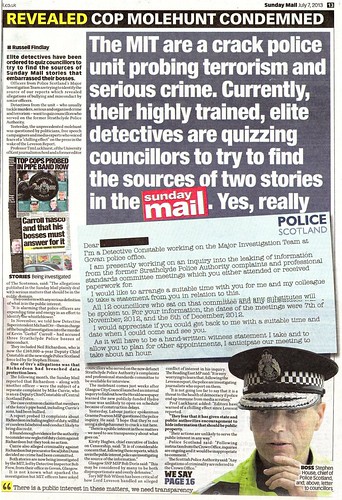
COP MOLEHUNT CONDEMNED Sunday Mail 7 July 2013 wTop cops probe councillors to try to find sources of Sunday Mail reports that embarrassed police chiefs 
  
By Russell Findlay Sunday Mail Jul 2013 08:30
 
POLITICIANS, free speech campaigners and media experts condemn detectives' investigation after we revealed allegations of bullying and misconduct by senior officers.
 
ELITE detectives have been ordered to quiz councillors to try to find the sources of Sunday Mail stories that embarrassed their bosses.
 
Officers from Police Scotland’s Major Investigation Team are trying to identify the source of our reports which revealed allegations of bullying and misconduct by senior officers.
 
Detectives from the unit who usually tackle murders, serious and organised crime and terrorism  want to quiz councillors who served on the former Strathclyde Police Authority.
 
Yesterday, the unprecedented molehunt was questioned by politicians, free speech campaigners and media experts who voiced fears of a “chilling effect” on the press in the wake of the Leveson Report.
 
Professor Tim Luckhurst, of the University of Kent journalism school and a former editor of The Scotsman, said: “The allegations published in the Sunday Mail plainly deal with serious matters that should be in the public domain. They conform with any serious definition of what is in the public interest. It is alarming that police officers are expending time and energy in an effort to identify the whistleblower.”
 
In November, we told how Detective Superintendent Michael Orr, then in charge of the bungled investigation into the murder of Kevin “Gerbil” Carroll had accused three Strathclyde Police bosses of misconduct. They included Neil Richardson, who is now the £169,000-a-year Deputy Chief Constable at the new single Police Scotland force led by Sir Stephen House. One of Orr’s allegations was that Richardson had breached data protection laws.
 
The following month, the Sunday Mail reported that Richardson along with another officer were the subject of a separate complaint by Mike Currie, who is an ex-Deputy Chief Constable of Central Scotland Police. The case centres on claims that members of the force’s pipe band, including Currie’s sons, had been bullied.
 
A report probed 13 complaints about Richardson including neglect of duty, willful or careless falsehood and conduct likely to bring discredit. It found enough evidence for the authority to consider one neglect of duty claim against Richardson but they took no action. Currie also alleged criminality against Richardson but procurator fiscal John Dunn decided no crime had been committed.
 
Both stories are now being investigated by the MIT, led by Detective Inspector Bob Frew, from their office in Govan, Glasgow.
 
It is not known what sparked the investigation but MIT officers have asked councillors who served on the now defunct Strathclyde Police Authority’s complaints and professional standards committee to be available for interview.
 
The molehunt comes just weeks after Glasgow City Council launched an internal inquiry to find out how the Herald newspaper learned the new publicly-funded Hydro venue was unlikely to open on schedule because of construction delays.
 
Yesterday, Labour justice spokesman Graeme Pearson MSP questioned the police inquiry. He said: “I hope that they’re not using a sledgehammer to crack a nut here. There is a public interest in these matters we need to see transparency about what goes on.”
 
Kirsty Hughes, chief executive of Index on Censorship, said: “It is of considerable concern that, following these reports, which are in the public interest, police are investigating the source of the information.”
 
Glasgow SNP MSP Bob Doris said: “This may be considered by many to be both disproportionate and overly defensive.”
 
Tory MP Rob Wilson has been critical of how Lord Leveson handled an alleged conflict of interest in his inquiry. The Reading East MP said: “It is very worrying to learn that, following the Leveson report, the police are investigating journalists who report on them. It is not going too far to say that it is a threat to the health of democracy if police end up immune from media scrutiny.”
 
Prof Luckhurst added: “Editors have warned of a chilling effect since Leveson reported. They fear that it has given state and public authorities encouragement to hide information that should be public property. Their actions are unlikely to serve the public interest in any way.”
 
Police Scotland said: “Following instruction from the Crown Office, inquiries are ongoing and it would be inappropriate to comment.”
 
The Scottish Police Authority said: “Any allegations of criminality are referred to the Crown Office

Mail Opinion: A chilling threat to a free press 7 Jul 2013 00:01
 
MAIL OPINION says getting straight answers from the authorities, particularly Police Scotland, is like getting blood from a brick.
 
Look up irony in the dictionary and you might find a listing for a Channel 4 documentary being shown on Tuesday night.
 
The programme details Nat Fraser’s retrial for the murder of his wife and is, the producers tell us, the first time in Britain cameras have been allowed in court to film a murder trial.
 
It is a Scottish court and it is ironic because Scottish justice, from arrests to convictions, from criminal courts to civil, is more hidden and closed to the public than ever before.
 
Our papers and broadcasters are the eyes and ears of our readers, viewers and listeners. We find out stuff and then we tell you about it.
 
We like to pretend that we get it whispered in our ears at clandestine meetings with sources in underground car parks at midnight.
 
In reality, most of it has been obtained or, at least, confirmed by straightforward enquiries to the authorities.
 
Has been because, these days, getting straight answers to anything from most of them, but particularly Police Scotland, is like getting blood from a brick. Closing down traditional, official and once-helpful channels of communication is one thing.
 
Charging an elite crime squad set up to investigate terrorists and organised criminals with finding the sources of two Sunday Mail stories about alleged misconduct by senior officers is something else.
 
Who instigated these inquiries? And why? Who sanctioned them? And for what purpose will detectives spend their time quizzing councillors to try to find out if one, two, more or none of them passed information to our journalists.
 
That, of course, is the only part of this misguided, heavy-handed investigation that we know about. Who knows what else they are doing? How much more time and expense is being squandered in pursuit of..what exactly?
 
Do Lord Advocate Frank Mulholland, Police Scotland chief constable Stephen House and their lieutenants really believe this molehunt will end in a prosecution?
 
Or are they content that it might help deter other politicians, police officers, firefighters, doctors, nurses, prosecutors, court officials and civil servants thinking about blowing the whistle in the public interest?
 
Because who needs whistle-blowers, right? Because the authorities will tell us all about the Met smearing Stephen Lawrence’s family? Or the truth about Hillsborough?
 
About how the Care Quality Commission destroyed evidence of their failure to stop children dying needlessly? About GCHQ spying on our emails? About MPs stealing our money and calling it expenses?
 
God and Lord Leveson knows that papers are not perfect but we do our best to tell our readers what is going on.
 
We really don’t want to sound as if we wrap our homes in tinfoil to stop martians stealing our thought waves but there is something going on, right now, right here in Scotland, that is as insidious as it is dangerous.
 
Public authorities, from councils and courts to police and government, seem increasingly keen to treat newspapers and, to a lesser extent, broadcasters like an enemy.
 
We are not their enemy.
 
Their enemy is an arrogant and apparently escalating disregard for the people who inform the people who pay their wages.

Thursday, May 16, 2013

Shame for Crown Office & Lord Advocate as former Procurator Fiscal Stuart MacFarlane admits downloading child porn, added to sex offenders register

crown officeSilence from Crown Office after former prosecutor admits downloading child porn A  FORMER PROCURATOR FISCAL DEPUTE who served under ex-Lord Advocate now Dame Elish Angiolini DBE QC (born McPhilomy) at Scotland’s Crown Office & Procurator Fiscal Service (COPFS) is facing a possible custodial sentence after he ADMITTED downloading indecent images of children. Scottish Law Reporter earlier reported on the case in January of this year HERE

Stuart MacFarlane (45) from Glasgow was caught with at least 15,000 images of child pornography on computer equipment at his home after Police succeeded in gaining a search warrant to raid his premises and seize computer equipment.

Images seized by Police showed acts of a sexual nature against minors, and also pictures of sexual acts with animals. However, despite the severity of evidence seized, and the ex Procurator Fiscal’s admitting to downloading the material, sentence on MacFarlane was deferred at Paisley Sheriff Court although his name was placed on the sex offenders register.

The current Lord Advocate, Frank Mulholland, and the Crown Office have issued no statement or comment on the case and MacFarlane’s admission to downloading child porn and no details have yet been made public on how the admitted paedophile obtained the material or from whom. However, a Police source has said further action related to the case could follow.

A legal insider at COPFS has come forward this afternoon and told Scottish Law Reporter there have been other cases swept under the carpet of prosecutors, staff and former members of COPFS staff who were also found to be in possession of inappropriate images of children.

It is thought current & former COPFS staff thought to be involved in activities similar to MacFarlane have accessed such images through contact with online paedophile rings and in one worrying case, it has been revealed that evidence seized by Police in one case, was found on personal computer equipment of another prosecutor who has since stood down from his position yet has not faced criminal charges.

The now shamed ex Procurator Fiscal Stuart MacFarlane escaped prosecution for earlier charges of indecency with a prostitute while serving under Lord Advocate Elish Angiolini, the Crown Office claiming at the time “it was not in the public interest” to prosecute the former prosecutor who has now admitted to being a paedophile.

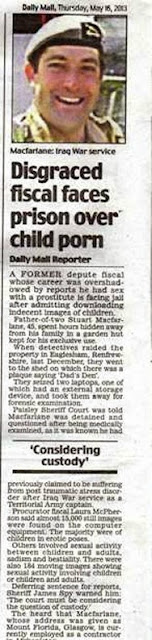
Daily Mail newspaper reports the story :

Disgraced fiscal faces prison over child porn

Daily Mail Reporter

A FORMER depute fiscal whose career was overshad­owed by reports he had sex with a prostitute is facing jail after admitting downloading indecent images of children.

Father-of-two Stuart Macfar­lane, 45, spent hours hidden away from his family in a garden hut kept for his exclusive use.

When detectives raided the property in Eaglesham, Renfrew­shire, last December, they went to the shed on which there was a plaque saying 'Dad's Den'.

They seized two laptops, one of which had an external storage device, and took them away for forensic examination.

Paisley Sheriff Court was told Macfarlane was detained and questioned after being medically examined, as it was known he had previously claimed to be suffering from post traumatic stress disor­der after Iraq War service as a Territorial Army captain.

Procurator fiscal Laura McPherson said almost 15,000 still images were found on the computer equipment. The majority were of children in erotic poses.

Others involved sexual activity between children and adults, sadism and bestiality. There were also 184 moving images showing sexual activity involving children or children and adults.

Deferring sentence for reports, Sheriff James Spy warned him: 'The court must be considering the question of custody.'

The heard that Macfarlane, whose address was given as Mount Florida, Glasgow, is cur­rently employed as a contractor in Afghanistan.

BBC News also reported on the case here :

Ex-prosecutor Stuart MacFarlane had indecent images

A former prosecutor is facing a prison term after he admitted downloading indecent images of children. Stuart MacFarlane, 45, from Glasgow, was caught with almost 15,000 images at his former family home in Eaglesham, East Renfrewshire, on 28 December 2012. Sentence on MacFarlane was deferred at Paisley Sheriff Court and his name was placed on the sex offenders' register.

A case against the ex-depute procurator fiscal, after he was allegedly caught with a prostitute, was dropped in 2006.

The court heard how police, acting under a search warrant, searched MacFarlane's then family home at the end of last year. They seized two laptops and an external hard drive from an outside shed, which had a plaque outside stating "Dad's Den".

After the computer equipment had been fully analysed, it was discovered that there were almost 15,000 still images. Some showed children posing alone, others showed sexual activity between children and adults, while others featured an animal. The girls involved in the images are thought to have ranged from three to 14 years of age.

MacFarlane, who now lives in Mount Florida, Glasgow, later admitted downloading the images between March and December last yea

BBC News reported on the earlier case involving dropped charges against MacFarlane, here : Fiscal indecency charge dropped

The case against a prosecutor allegedly caught with a prostitute has been dropped because "it was not in the public interest" to proceed to trial.

Stuart MacFarlane, 37, a principal procurator fiscal depute in Glasgow, was arrested after a police function. He faced indecency and resisting arrest charges and resigned from the Crown Office earlier this month. Glasgow Sheriff Court heard the case would not proceed after "changes to his situation and medical reports".

It was alleged that Mr MacFarlane and Joanna Crane, 27, had been caught by police while she was performing a sex act on him. The offences were alleged to have taken place in Bothwell Street on 29 October.

David Spiers, procurator fiscal at Hamilton, told Glasgow Sheriff Court: "Mr MacFarlane's lawyer has advised of changes in his situation. "Considering this and specialist medical reports it would not be in the public interest to proceed further with this case."

The charge against Ms Crane was also dropped. She had pleaded not guilty to committing an offence of public indecency by engaging in a sexual act in a public place.

Mr McFarlane, who lives near Eaglesham, had not tendered a plea.

Monday, April 29, 2013

Proceeds of Crime seizures & Cashback for Communities £80m ‘success’ wiped out by £1Billion cost of Crown Office & staff ‘bonus culture’ over last decade

Lord Advocate Frank MulhollandLord Advocate & Crown Office receive £100million annual funding. PROCEEDS OF CRIME legislation created in 2003 by the then Scottish Executive, has, according to claims made by Scotland’s Crown Office & Procurator Fiscal Service (COPFS) in its latest 2012-2013 annual report on the activities of the Civil Recovery Unit, (CRU) netted around £80 million seized from criminals. However, legal observers have questioned the reliability of the figures provided in the report, which in some cases, relies on “questionable accounting”, ‘staged payments’ from crooked companies, and “speculative figures” relating to cases yet to be decided in the courts.

Unsurprisingly, a fact NOT DISCLOSED in the report is that the total asset seizures announced by the Crown Office yesterday, actually amount to much less than even 10% of the total running cost of the Crown Office over the past ten years, put at a staggering ONE BILLION POUNDS over the last decade, a cost which also includes MASSIVE bonus payments totalling HALF A MILLION POUNDS in just two years, to Crown Office staff and prosecutors.

In the past year, the Crown Office claims about £12m was taken from people involved in activities such as drug dealing, human trafficking and benefit fraud with around £8m of the 2012/13 total coming from convicted criminals. The remaining £4m comes from cash and assets seized through civil court orders. The Crown Office claimed the Proceeds of Crime (Scotland) Act 2002 had become a "powerful tool" against crime.

Lesley Thomson Procurator Fiscal Glasgow

Solicitor General Lesley Thomson Solicitor General Lesley Thomson QC, who announced the figures, said: "By full use of the proceeds of crime legislation, law enforcement can strike at the very heart of criminality in Scotland to ensure that criminal networks big and small are disrupted and dismantled.

"My message is clear - if you try to make a profit from crime, the Crown will use this legislation to the maximum to take that profit from you and ensure it is put it to a much better use in communities across Scotland through the Scottish government's CashBack scheme."

However, the Solicitor General made no reference to the Bonus culture at the Crown Office which has richly rewarded those involved in prosecutions & asset recovery efforts over the years, reported by the media revealing payments totalling £580,000 to Crown Office staff. Media reports also revealed that former Lord Advocate from 2006-2011, Dame Elish Angiolini DBE QC (born McPhilomy) received a taxpayer funded £28,000 ‘golden goodbye’ deal after leaving her job, reported HERE

Since the media report exposing Crown Office bonuses, the practice has been dropped in favour of inflated salaries and generous expenses allowances in an effort to get round further adverse publicity.

Over the last 10 years around £50m has been seized by the Crown Office's Serious and Organised Crime Division (SOCD), which deals with the confiscation of proceeds of crime following a conviction. The remaining £30.5m was secured by the Civil Recovery Unit, headed by Ruaraidh MacNiven, who formerly worked for Lord President Lord Hamilton.The CRU, which has been criticised in court by judges for providing dodgy evidence on previous occasions, can recover proceeds of crime through the civil courts without the need for a criminal conviction.

Commenting further on the figures released in the report, Lindsey Miller, head of the Crown Office's Serious and Organised Crime Division said the £80m that had been seized could otherwise have been reinvested in criminal enterprises.

She said : "We have not become complacent in our success. Crime evolves and we must evolve with it. In the last year alone, we have seen successful confiscation orders against people who have participated in all types of crime, including drug dealing, selling counterfeit goods, embezzlement, human trafficking and benefit fraud. We will continue to use our experience and expertise to maximise disruption to criminal enterprises."

In the past financial year, around £4.3 million was netted from those involved in the so-called "black fish" cases, relating to large-scale undeclared landings of fish in the north of Scotland. Confiscation orders totalling £4,314,290 were made last year against a number of vessel skippers, as well as Shetland Catch Ltd and Fresh Catch Ltd.

James Mangan, 54, Robert Robb, 65, and Craig Hunter, 41, all members of an organised crime network involved in importing Class A drugs, which was unearthed by Strathclyde Police's Operation Trust have also been targeted for asset seizures.

The Civil Recovery Unit (CRU) will eventually recover £5.6m after Aberdeen-based drilling company Abbot Group Ltd accepted it had benefited from corrupt payments made in connection with a 2006 contract entered into by one of its overseas subsidiaries and an overseas oil and gas company. The money is to be paid in three stages to the end of March 2015.

Other examples of asset seizures include the home of gangland figure Kevin "Gerbil" Carroll, who was gunned down in a supermarket car park in 2010, although no reference is made to the fact the Crown Office failed to secure a conviction for the murder of Mr Carroll after a judge ruled the Crown had presented insufficient evidence in the case of an accused suspect.

Justice Secretary Kenny MacAskill Eager as ever to comment on the Crown Office spin, Justice Secretary Kenny MacAskill said: "Prosecutors and police are cracking down on organised crime and criminals have nowhere to hide.More than £12m has been confiscated from criminals last year, hitting them where it hurts - their wallets.

MacAskill continued : "Our communities are benefiting from the hard work of prosecutors and police putting ill-gotten gains to good use through our CashBack for Communities Programme, which invests crooks' cash in facilities and activities for our young people and their communities across the length and breadth of the country."

The Cashback for Communities scheme referred to by the Justice Secretary takes money recovered through proceeds of crime legislation and invests it in activities and facilities for young people at risk of turning to a life of crime. The Scottish Government claim more than £50m has been ploughed back into Scottish communities since Cashback began operating in 2007.

Thursday, October 25, 2012

The Lord Advocate’s SECRET SLUSH FUND : Crown Office have used secret cash to ‘make payoffs’ & ‘cover up’ criminal, civil cases involving staff

Lord Advocate Frank MulhollandEvidence emerges of a secret slush fund at Lord Advocate’s Crown Office. SCOTLAND’S Crown Office & Procurator Fiscal Service (COPFS) has today been accused of operating a secret, unaudited “slush fund of public money” used to pay for legal advice, and private legal representation for its own members of staff who have been charged with criminal offences or who have become involved in civil legal disputes.

The fund, which legal insiders claim is buried deep in the budget for the Crown Office, is rumoured to have paid out millions of pounds over its existence in cases involving its own staff. There are also suggestions the fund has been used to PAY-OFF ‘media friendly’ law firms to keep headlines involving criminal charges against COPFS staff out of the press and that the fund may have been used “to purchase testimony” from witnesses”.

The claims come after the Crown Office refused to respond to Freedom of Information requests made by journalists investigating leaks that “a substantial fund which is not subject to external audit or accountability”, is maintained by prosecutors to pay huge sums relating to legal costs of their colleagues caught up in scandals, criminal charges and civil legal actions.

Legal insiders claim the fund, which is bankrolled by the Scottish Government, has been operating on an almost “cash-in-hand basis” with several high profile law firms receiving large sums of money for representing Crown Office personnel up to the most senior rank in the organisation.

Documents passed to Scottish Law Reporter show that journalists used FOI laws in June of this year to ask COPFS officials “Are there any arrangements for former Crown Office staff to continue to receive payment of public funds, respective legal advice, action or representation of issues or cases in which they were personally involved in prior to leaving COPFS, and if so, how many such cases have occurred since 2009, how many continue to this date, and how much has been paid in relation to the cases.”

It then took the Crown Office OVER TWO MONTHS to reply, after a series of secret internal discussions concluded the information should not be handed over, out of fears it would reveal significant sums of public money had been handed over by the Lord Advocate’s staff to law firms without any accounting of fees or questions as to the level of charges, which in some cases have skyrocketed past six figure sums.

Gertie Wallace, of the Crown Office ‘Policy Division’ replied to journalists, applying exemptions under Section 35(1)(b) and 35(1)(c) of FOISA to all of the information requested. Gertie Wallace then went onto state : “I consider that the release of the information would substantially prejudice the apprehension and prosecution of offenders and the administration of justice.”

“I am satisfied that in all the circumstances there are compelling reasons that the public interest in disclosing is not outweighed by the public interest in not disclosing the information. I consider the public interest is best served by applying the exemptions under section 35(1) (b) and (c) in this particular instance. “

The Crown Office also refused to disclose the detailed reasons for refusing to disclose the information, citing live criminal proceedings against its own staff.

Wallace went onto say : “I cannot provide you with the detailed reason for this decision because to do so would in itself disclose information which is exempt under this section and also under section 26(c) of FOISA in light of live criminal proceedings which are subject to the Contempt of Court Act 1981. Section 26(c) is an absolute exemption and not subject to the public interest test.”

Following the refusal to disclose, journalists then asked the Crown Office to review their decision, and in response, David Harvie, the Director of Serious Casework concluded the information on how much public money was being lavished on legal fees for staff should not be handed over.

The full details of the FOI battle to reveal taxpayers cash being spent on Crown Office staff and their dealings with law firms can be viewed HERE

Speaking to Scottish Law Reporter earlier today, a solicitor from a well known law firm expressed dismay at the Crown Office refusal to release the information.

The solicitor went onto say that it was well known in legal circles, there is a small exclusive club of law firms who are being paid substantial sums by the Crown Office for work involving their own staff.

He said that in one case he knew of involving criminal charges arising out of drink driving offences, the Crown Office handed over TENS OF THOUSANDS OF POUNDS to a law firm who were defending a senior Crown Office staffer in a case that had dragged on unnecessarily for many months, even attracting criticism from a Sheriff.

He also backed media attempts to reveal how much public money is being spent by the Crown Office on law firms and their staff involved in cases.

SLUSH FUND IN ACTION ?

Questions remain over who paid for lawyers working for Lord Advocate Elish Angiolini in battle against anti-abuse campaigner. One case which has brought the issue of this secret fund into focus is that of a case involving legal action taken by the previous Lord Advocate, now Dame Elish Angiolini DBE QC (born McPhilomy) over a campaign asking for an investigation into abuse against vulnerable people in the Aberdeen area, and allegations of a paedophile gang rumoured to contain members of Scotland’s judiciary.

Groups of law journalists and media publications had sought to use Freedom of Information laws to establish whether the Crown Office did pay for legal representation of Dame Angiolini (born McPhilomy)in the case of Robert Green, a journalist & anti-abuse campaigner who was jailed for six months on a breach of the peace charge, at a cost to taxpayers of around ONE MILLION POUNDS after he was found guilty of handing out leaflets asking for an investigation into allegations of sexual abuse against a downs syndrome victim, Hollie Greig.

The Crown Office refused to disclose any information in response to FOI requests involving Angiolini, and in some cases, enacted a media boycott of certain publications in retaliation for publishing material and allegations connected with the case involving Angiolini

The law firm involved in representing Dame Angiolini (born McPhilomy) was LEVY MCRAE of Glasgow, who also represented the shamed former Glasgow City Council Boss & Cocaine addict Steven Purcell. Partners at Levy McRae have recently been caught up in bitter court fights over personal actions, while others at the firm are known to work for the Cayman Islands tax dodge haven, where some of the world’s biggest drugs gangs, terror groups and mobsters are known to keep their money from state tax authorities. It is also known that Levy McRae have personal ties to Justice Secretary Kenny MacAskill, who used to work at the firm, reported by SLR, HERE

Tuesday, August 07, 2012

The Quiet Fan : Westminster criticises unusual silence of Lord Advocate Frank Mulholland over independence referendum legalities

Lord Advocate Frank MulhollandLord Advocate Frank Mulholland, unusually silent over legalities of independence referendum. FRANK MULHOLLAND, Scotland’s usually vocal Lord Advocate on all things from illegal fish catches to organised crime (but not on seedy activities of COPFS staff or £1million breach of the peace cases), has been criticised by MPs of the Westminster Parliament for his unusual silence over the legalities of one of the most important issues to face Scots for decades, that of the SNP’s independence referendum and the legislative competency of the Scottish Parliament to deal with the issue.

The Scottish Affairs Committee, who have now called for referendum powers to be transferred to Holyrood for the independence referendum, reported by BBC News HERE, commented with regard to The legislative competence to hold a referendum on separation :

“…The Scottish Government … produced its own paper on 20 January 2012. In it, it argued that the 2010 question had been carefully drafted to meet the constraints of the Scotland Act; but if the UK Government was, as it had indicated, willing to extend devolved powers, then there should be a simpler question:

"Do you agree that Scotland should be an independent country?", apparently acknowledging that this would not be within the Parliament's legislative competence at present. It continued:

An adjustment of legislative competence under Section 30 of the Scotland Act 1998 would enable the Scottish Parliament to legislate for a referendum on the basis set out above. If the UK Government is unwilling to agree to such an adjustment without dictating unacceptable conditions, the Scottish Government will have the option of a referendum on the basis set out in paragraph 1.5. [i.e. a question like their 2010 draft which was designed to be within the limitations of existing legislative competence.][16]

The Committee, who have now called for powers to hold the referendum, said : “The Scottish Government, however, published no legal analysis, and the Lord Advocate, the Rt Hon Frank Mulholland QC—who is a member of the Scottish Government, and as its principal legal adviser will have advised his Ministerial colleagues on what their powers are—has made no contribution to debate on this issue. The Scottish Government nevertheless asserts that a referendum with a question about more devolution, or actually about separation but designed to look as if it were about extending the Scottish Parliament's powers, would be within its legislative competence.

25. We find the silence of the Lord Advocate remarkable. It is well understood that Law Officers do not, save exceptionally, make their advice public, but, on a matter such as this, there is a very strong public interest in understanding the legal basis of the Scottish Government's approach to a process which will determine the future of the country.”

However, as observers to the debate on the independence referendum will by now be well aware, it is not just Lord Advocate Frank Mulholland who has been seemingly gagged by the Scottish Government, who are also fighting a Freedom of Information order to release documentation relating to legal advice issued over the referendum, also reported by BBC News :

Scottish independence: Ministers to appeal EU FOI order

The Scottish government has said it will appeal after being ordered to reveal whether it holds legal advice on the status of an independent Scotland within the EU.

Labour MEP Catherine Stihler made an FoI request last May, asking the Holyrood administration for any legal advice it had received on the issue.

Ministers refused to reveal whether the information was held.

But Scotland's FoI Commissioner ruled its release was in the public interest.

Rosemary Agnew, the country's Freedom of Information Commissioner, said: "In the commissioner's view, the role of [the FoI Act] is important not only in ensuring transparency in information held by public authorities, but also in enabling transparency in information about process."

Ms Agnew said an independent Scotland's position in the EU "could have a bearing on how people vote in the referendum".

She ruled: "In this case, the commissioner considers that it is in the public interest to know the type of information that the ministers were taking into account in developing policy in relation to such a significant issue as independence.

Catherine Stihler Catherine Stihler described it as "a landmark judgement"

The Scottish government cited Section 18 when it refused to reveal whether the information was held. This can mean the information would be exempt from release or the authority considers its release would not be in the public interest.

The Labour Party said that in October 2011, Culture Secretary Fiona Hyslop wrote to Ms Stihler saying that "we consider that to reveal whether or not the information you have requested exists, or is held by the Scottish government, would be contrary to the public interest".

However, following Ms Agnew's ruling, ministers have until 21 August to reveal the information.

A spokesman for the Scottish government said it had been "surprised" by the commissioner's decision.

He added: "It is the longstanding and usual practice of the Scottish government to neither confirm or deny the existence or the content of legal advice.

"The approach we have taken on this issue is consistent with the UK government position in a similar case they dealt with under equivalent legislation. We therefore intend to appeal and contest the decision."

She added: "People have a right to know whether an independent Scotland would be part of the EU and on what terms, but the SNP want to keep it secret.

"By refusing to confirm or deny, Alex Salmond effectively took out a superinjunction against the people of Scotland.

"Now the Information Commissioner has ordered him to own up. She has ruled that approach is in breach of the law, which is a groundbreaking and welcome decision."

A Scottish government spokesman said: "We have received the decision and are considering its terms."