Showing posts with label Lord Carloway. Show all posts

Tuesday, September 27, 2016

Lord Carloway opens new Legal Year 2016-2017– review, reforms, & modernisation - reality clogged courts with huge public price tag, erosion of rights & shiny new QCs

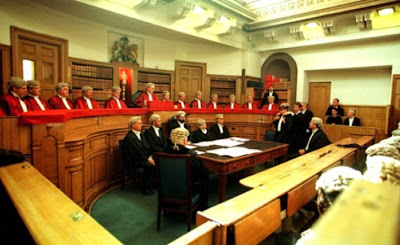
Lord Carloway opens the 2016-17 legal year. SCOTLAND’S top judge – the Lord Justice General & Lord President – Lord Carloway (Colin Sutherland) has opened the new legal year with traditional speech, full of traditional fare.

OPENING OF THE LEGAL YEAR 2016-2017

The opening of each legal year marks a new chapter in the history of our justice system, our court service, and in our professional lives. It is in the nature of things that some chapters - some years - will be particularly significant and momentous, and will live long in our collective memory. The implementation of the structural provisions of the Courts Reform (Scotland) Act 2014 over the last year may well be considered by many to be of great significance. In the same way, chapters which appear to pass uneventfully may take on a new significance with the passage of time. Sometimes changes which are continuous or gradual are the ones which are truly transformative. The full picture cannot be seen by focusing only on one or two discrete chapters in isolation.

In February 2017, a decade will have passed since Lord Gill was tasked with carrying out a review of the civil justice system. Over that period, all of our professional lives - as judges, advocates, solicitors, and court staff - have become steeped in the process and language of change. The purpose and principles of the reforms - to make the justice system work efficiently and, in particular, to promote just decisions which are delivered in proportionate time and at proportionate cost - are well known. We must not lose sight of that goal. The purpose of procedural reform is ultimately as a means to an end. It is to secure substantive rights by ensuring that the public have access to the courts, unhindered by undue delay or expense.

In the past year, the headline recommendations of the reforms - the creation of the Sheriff Appeal Court; the increase in the privative jurisdiction of the Court to £100,000, and the introduction of the All Scotland Personal Injury Sheriff Court at Edinburgh Sheriff Court - have begun to bed in. A significant proportion of appellate and first instance business will be taken out of our Supreme Courts. Although that effect has certainly been felt administratively, the impact on court time - on the number of sitting days - will probably not become apparent for another few years. Teething problems are to be expected in any change of this magnitude.

The focus must now shift from structure to function. The success of the reforms, and of the new courts, will depend not only on the structure which is now in place, but on the continued commitment of the judiciary, court staff, and the profession to make sure that the goal of the reforms is met.

Progress towards a modern justice system continues on a number of other fronts in both the civil and criminal spheres. Digital innovation is crucial to ensuring that the service which the courts provide is in line with public expectation in the modern era. The digital process is coming, and coming soon, with the Integrated Case Management System (ICMS) undergoing live testing in Sheriff Courts across Scotland. The online portal will launch in November at the same time as the new Simple Procedure Rules come into force. It should allow all Simple Procedure cases to be submitted (and managed) electronically. In time, it will be rolled out to other forms of Sheriff Court business and hopefully to the Court of Session in the coming year.

Changes to the way in which civil business in the Court of Session is programmed are also about to be implemented. At first instance, two Outer House judges will sit throughout the term to hear ordinary civil business. The aim of this measure is to reduce the prospect of losing proof and judicial review diets. Programming of cases continues to be a major challenge, given the level, and more significant, the timing of settlements. However, with two permanent Lords Ordinary in the Outer House, augmented by 2 more at any given time, to deal with Ordinary and Family causes, the Cinderella reputation of the non-commercial Outer House ought to be successfully addressed. In January, there will again be four full time commercial judges, returning the court to its complement before the untimely death of Lord Jones.

The increased efficiency of the Criminal Appeal Court and the diversion of summary business from that court ought to mean that there will be two civil Divisions sitting in appellate business throughout the year along with one criminal Division, reversing the situation five years or so ago.

The programming of civil business throughout the legal year is also about tobe altered. There will be no significant summer recess at the end of the legal year 2017-2018. The beginning of the winter term will start a few days after the end of the summer term. Whilst it is to be anticipated that the courts will not run at full power over the summer months of 'vacation', as it is still commonly called, since the judges too need a holiday, the sitting days of the civil courts, both first instance and at appellate level, will be evenly spread over the whole legal year.

Put another way,business will be programmed on the basis that the civil courts will sit throughout the year other than for periods of two weeks at both Easter and New Year. Practitioners will take their vacations according to their own business calendars rather than having to follow that of the court. This is perhaps less of a culture shock than it first appears. Many of our civil courts now sit in procedural matters and urgent disposals in the summer months. The e-motion system sees many matters, which might previously have been held over, dealt with routinely. Judicial Reviews have a timetable which must be adhered to. The commercial courts have been used to fixing substantive diets during recess periods.

Vacation has been a feature of history in the criminal courts for many years. In the criminal sphere, there are important changes to make; notably in the way in which we take evidence from children, and vulnerable witnesses, are progressing, under the auspices of the Evidence and Procedure Review. The central objective is to take children out of the court environment. The response from the legal profession has been very positive. The intention is that in the future the necessary culture shift will result in a more consistent use of special measures, and in particular evidence on commission, in so far as permitted under current legislation. Thereafter, questions of how best to capture the evidence of all witnesses will be considered. The answers may ultimately lead to more radical change, perhaps initially at summary level. The new methodology may impact on the way in which evidence is presented in the civil sphere where the eviscerated spectre of hearsay has long since departed.

Modernisation of the court estate and court service itself also continues. The proposal to have a new Justice Centre in Inverness, incorporating facilities for the criminal and civil courts, tribunals and the children's hearings, have recently been announced. Plans are now being developed. Because of the substantial recent increase in the number of criminal trials, although not indictments, in the High Court, a new West court in the Saltmarket in Glasgow has been opened. Work is well underway on the East Court there too.

The past legal year has been particularly significant for the judiciary. Lady Dorrian on her appointment as Lord Justice Clerk has become the most senior female judicial office holder in Scottish legal history, a significant milestone in the history of the courts. Lord Glennie has been appointed to the First Division, and Lord Turnbull to the Second Division. This will maintain a sufficient complement in the temporary absence of Lady Smith on important inquiry duties.

The courts are now largely operating with a full complement of judges following the appointments of Lords Ericht and Clark, Lady Carmichael, Lord Becket, and shortly Frank Mulholland QC. This, along with some continued use of experienced sheriffs and a few retired judges, sheriffs and sheriffs principal, acting up as judges in the High Court and occasionally the Outer House, ought to produce the requisite degree of efficiency.

However, there is continuing concern about the time which Outer House Opinions are taking to be issued following avizandum. Further steps are being explored in this jurisdiction, as they are in others, to ascertain the nature and cause of this common phenomenon, in an effort to solve what is recognised as a serious and ongoing problem. The time which it is taking to fix hearings in long proofs also remains a subject of worry. This is, however, recognised and hopefully the changes to the Outer House and the court terms will go some way to bring down the relative waiting periods.

I am pleased to take this opportunity to thank all of my judicial colleagues, not least of course the Lord Justice Clerk, but also Lords Bracadale, Menzies, Boyd and Turnbull for their work as the administrative judges, and the Principal Clerk, and all of the court staff, whose commitment and hard work are important driving forces in the continued progress of our justice system. I wish to thank too the legal profession and all the clerks and support staff who have engaged with the spirit and letter of the reforms which have been implemented in the last year. Their support, and occasional patience, is much appreciated.

It is now my pleasure to introduce those who have gained the rank and dignity of Her Majesty's Counsel.

Ms Edwards, as Assistant Principal Crown Counsel you bring a wealth of experience from your work in the High Court of Justiciary at both first instance and appellate levels, particularly in the important area of taking evidence from child and vulnerable witnesses.

Ms Henderson, as a leading specialist in clinical negligence claims, you have contributed much to the development of the law in this area, particularly in complex cases involving catastrophic injuries.

Mr Love, you bring vast experience in the field of personal injury litigation and regulatory matters, from a career as both a well-established solicitor and advocate.

Mr Macfarlane, your wealth of experience in family law, and in particular child law, and as an accredited mediator, has contributed much to the development of the law in recent years. To this you have added the string of Advocate Depute.

Mr Mackenzie, with your broad civil practice, including as Standing Junior Counsel to the Scottish Government for the past decade, you bring a wealth of experience to the senior bar in public law, planning and environmental law.

Mr McKay, you are a leading expert in the field of planning and environmental law, with a distinguished practice in planning appeals, as well as public inquiry and project consent advisory work.

Mr Ross, with your academic background and in your role as First Standing Junior Counsel to the Scottish Government, you bring much experience particularly in the area of administrative law, judicial review and human rights.

Ms Ross, you have a distinguished practice in EU law, public and administrative law, as well as in commercial matters. You have contributed much to the work of the Commercial Court. You skills as a civil advocate are well recognised, even when attacking the reasoning of the Divisions.

Ms Springham, you bring your skills and experience from a broad civil practice, particularly in reparation and public law, as well as in your work for the Equality and Human Rights Commission.

Ms Sutherland, through your work as both a solicitor and an advocate, you have contributed significantly to the development of the law on clinical negligence, as well as your important work as Junior Counsel to in the Vale of Leven Hospital Inquiry.

Ms Tanner, you have a distinguished civil practice, as well as public service as an Advocate Depute. Your work in the criminal courts particularly at first instance has been a major feature of your career.

Mr Walker, you are a leading expert in international commercial law, with particular specialism in international arbitration and energy disputes. Your international experience gives you invaluable insight into our system.

Mr McSporran, you are one of only a handful of practitioners to distinguish themselves as both prosecutor and defence solicitor. As a Solicitor Advocate, you have continued your public service as a Senior Advocate Depute, bringing the benefit of your work, notably in the Criminal Appeal Court, to the senior bar.

The rank and dignity of Queen's Counsel is hard earned and well-deserved for each of you. I offer you all my sincere congratulations and best wishes for this next chapter in your legal career. I should say that, for my own part, which is not inconsiderable, I will attach particular importance to service as an Advocate Depute when determining suitability in the future.

The court will now adjourn.

Friday, October 23, 2015

Quango Law: Scottish Sentencing Council established after two top judges condemn Ministers sentencing quango as an 'attempt to undermine independence of the judiciary'

Judges must now give nod to quango on sentencing. SIX YEARS after proposals to create a Scottish Sentencing Council (SSC) were condemned by Scotland's longest serving judge as a "quango" - with constitutional issues, the sentencing body has finally been established by the Scottish Government, with a brief to “raise public awareness and understanding of sentencing practice”.

The ‘arms length’ body – which some fear may begin to interfere with sentencing on a case by case basis, is headed by the Lord Justice Clerk - Lord Carloway.

Carloway previously backed the Scottish Government’s ‘unfinished plan’ to remove the long held safeguard of corroboration – where evidence in a criminal trial is required from two separate sources for a conviction.

Earlier this week, legal insiders told SLR it was revealing the sentencing council has only came into being after the retirement of Lord Gill from the post of Lord President, earlier this year.

Gill, who was opposed to the Scottish Government’s plan to create a quango style sentencing council retired in May 2015.

It is thought Gill remained opposed to the idea of political meddling in sentencing to the end of his term as Lord President.

Welcoming the establishment of the Sentencing Council, Justice Secretary Michael Matheson said: “The creation of the Scottish Sentencing Council is extremely important for the criminal justice system in Scotland and I welcome today’s official launch. We know that sentencing can be an extremely complicated and emotive issue which is why we want to provide greater clarity and openness around why and how sentences are decided.

Matheson also claimed, unconvincingly, the courts would remain independent of ministers desires for sentencing headlines to suit the Scottish Government’s policy of cooking the books on crime statistics & convictions.

The Justice Secretary said: “While the independence of Scotland’s judiciary of course remains a fundamental part of the Scottish legal system, as does judicial discretion in individual sentencing decisions, the Council will help to ensure transparency and consistency in all sentencing decisions made in Scotland, as well as helping the public better understand the sentencing process.”

However, legal insiders say the sentencing quango is little more than thinly veiled political meddling in matters constitutionally reserved to the courts.

Both of Scotland’s previous Lord Presidents have publicly criticised the sentencing council since proposals were first made in 2009 as part of the The Criminal Justice and Licensing (Scotland) Act 2010.

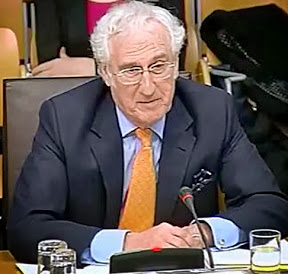
During evidence heard at the Scottish Parliament’s Justice Committee in 2009, Lord Brian Gill – in his role as Lord Justice Clerk criticised the sentencing plan,  branding the Scottish Government’s proposal to create a sentencing council as muddled legislation interfering with the sentencing duties of the courts.

Lord Gill said: I am slightly troubled by the term "inconsistency". Forgive me for going back to a slightly earlier point, but it relates to the point that has just been raised with the Lord Justice General.

If the legislation sets out to achieve what is described as consistency, it seems essential that it should define what it means by consistency and inconsistency. The consultation paper started off by talking about inconsistency and then spoke about a perception of inconsistency, which is rather a different thing. It is not quite clear yet what the legislation seeks to achieve. There is no definition of consistency in the draft, and it seems to me that those who would form a sentencing council would find some difficulty in knowing exactly what they were trying to do unless the legislation gave them a clear definition by which to judge their own views and decisions.

That raises in a clear way the constitutional issue that underlies legislation. It is part of the constitution that it is for the appeal court to determine sentencing, except to the extent that legislation lays down what the sentence should be. To read the bill, one might think that it involved merely the creation of some quango but, in fact, there is a huge constitutional question underlying the bill. That is what troubles me."

The Justice Committee also heard from the then Lord President – Lord Hamilton – who accused the Scottish Government of putting forward proposals to undermine the independence of the judiciary.

The current complement of the Scottish Sentencing Council includes 12 members selected by the Scottish Government are:

Lord Carloway (Lord Justice Clerk, Council Chair), Lord Turnbull (Senator Member), Sheriff Principal Ian R. Abercrombie QC (Sheriff Principal Member), Sheriff Norman McFadyen (Sheriff Member), Allan Findlay (Stipendiary Magistrate Member), Gillian Thomson (Justice of the Peace Member), Catherine Dyer (Crown Agent, Prosecutor Member), Stephen O’Rourke (Advocate Member), John Scott QC (Solicitor Member), Val Thomson (Assistant Chief Constable, Constable Member), Sue Moody (Lay Member with knowledge of victims’ issues), Professor Neil Hutton (Lay Member),

Sentencing quango member, Sue Moody, who has knowledge of victims’ issues, said: “I am delighted to be part of the new Sentencing Council. The Council is good news for the victims of crime in Scotland. It will help to demystify sentencing for the public, and will ensure that the interests and needs of victims are taken into account when sentencing guidelines are prepared. This is an important opportunity for victims to contribute their views.”

Chair of the Scottish Sentencing Council Lord Carloway said: “Sentencing is much more complex than it sometimes appears - there can be many different factors involved. The Council will work to raise awareness and understanding of sentencing practice - not only for our justice partners but for the wider public - helping to build confidence in our justice system. I expect the Council to take Scotland into a new era, in which we pursue a more principled approach to sentencing with improved consistency. This will be at the heart of our programme.”

The Scottish Sentencing Council will also:

help develop sentencing policy
conduct research into sentencing practice
publish information about sentences
provide general advice and guidance on sentencing
publish guideline judgments. (These are court opinions which provide guidance on sentences in similar cases)
The High Court, new Sheriff Appeal Court and Scottish ministers can request the Council to prepare or review sentencing guidelines on any matter.

Every three years the Council must prepare and submit a three year business plan to the Scottish Ministers, after consulting the Ministers, the Lord Advocate, the Lord Justice General, and any other people it considers appropriate.

The Council must also prepare and submit an annual report on its activities to Ministers.  The business plan and annual report are then laid before the Scottish Parliament.

A launch event for the sentencing council will take place on 17 November. Lord Carloway, the Lord Justice Clerk and Chair of the Council, and Mr Michael Matheson, Cabinet Secretary for Justice, will speak at the event.

Members of the judiciary, justice partners and other stakeholders have been invited to attend, and further spaces may become available nearer the time. Those involved in the justice system who would like to be added to the waiting list, should contact sentencingcouncil@scotcourts.gov.uk

Carloway & Corroboration:

Earlier this year, Lord Carloway – who authored Carloway Review Report & Recommendations 2011 -  essentially backing up Ministers plans to remove corroboration - was criticised by lawyers after the judge accused the legal profession of opposing the removal of corroboration on the basis of financial greed.

Lord Carloway said in a speech at a conference of Commonwealth Law Reform Agencies in Edinburgh that his proposals to abolish corroboration has been met with “real hostility” from some lawyers.

He suggested in his speech that some of this ire came from lawyers who had a financial interest in retaining corroboration.

Lord Carloway said: “Reactionary or excessively defensive forces among the legal profession can, and often do, behave in a manner obstructive to progressive law reform, especially where there is transparent perceived financial self-interest.”

However, the remainder of the judiciary demanded corroboration be retained.

In October 2013, Scotland’s top judge Lord Brian Gill – who opposed the removal of corroboration, gave evidence to the Justice Committee, reported HERE, defining corroboration as one of the "finest features" of Scotland’s justice system.

And, Judges of the High Court of Justiciary opposed Carloway on the removal of corroboration, signing a petition against it, available here: Response by the Senators of the College of Justice to SG consultation : Reforming Scots Criminal Law & Practice .

Scottish Law Reporter previously reported on the Scottish Government's plans to remove corroboration from Scots Law, HERE

Friday, March 13, 2015

Digitally recorded statements could lead to miscarriage of justice as Evidence and Procedure Review calls for recordings of witness testimony to be admitted as evidence at trials

Courts proposal on taped witness statements could skew justice A REPORT published today by the Scottish Court Service claims digital technology should be used to “transform our criminal justice system” and ‘capture’ evidence from witnesses in advance of a criminal trial.

The review, chaired by a senior judge concludes witness accounts recorded at or soon after the scene of a crime should be admissible at trial, and criminal trial procedure should be re-thought to permit such developments.

In response, solicitors say the latest round of politically rooted meddling in the justice system contains little in the way of safeguards for accused and protections for the right to a fair trial.

The Evidence and Procedure Review  – chaired by Lord Carloway - calls for Scotland to harness the opportunities that new technologies bring to improve the quality and accessibility of justice – by recording statements from witnesses in advance of criminal proceedings. The Evidence and Procedure Review was an internal Scottish Court Service research project led by the Lord Justice Clerk, Lord Carloway, supported by a small reference group and a full-time Project Director.

However, legal insiders say the proposals are of serious concern to how the justice system deals with witnesses and the rights of all accused persons – who have the right to test evidence put forward by the prosecution in court.

The move – which some see as a plan to substitute dodgy witnesses for a video recording - may also increase a growing trend in criminal trials where it has become obvious witnesses have been ‘coached’ by prosecutors in their delivery of evidence while under oath.

The growing trend of dodgy evidence presented in court by the crown - an issue familiar to many experienced criminal defence solicitors and counsel -  has now reached a point in Scotland where trials attract regular criticism from the bench of crown agents conduct and the incredulity of witness testimony – among them – statements given by serving Police Officers.

Published here: the Evidence and Procedure Review consists of five Chapters:

Chapter 1 introduces the Review, its remit and details the considerations that led to the Review taking place.

Chapter 2 considers how children and vulnerable witnesses are treated in Scotland, Australia, England and Wales and Norway, and concludes that Scotland there is more that we could to improve the way in which such witnesses are required to give evidence. 

Chapter 3 looks at the legal issues raised if witness statements recorded prior to trial are to be generally admissible.   It reviews the law on hearsay, under which such statements are currently generally excluded, and considers the implications of a rule that would provide for their general admissibility. 

Chapter 4 considers how criminal procedures would have to change to accommodate and take full advantage of the availability of such evidence; it also covers how the infrastructure of the justice system, both in terms of the technology available and the nature of facilities in the courts, police offices and elsewhere will have to be rendered fit to undertake the tasks of recording, editing, storing and presentation of such testimony.

Chapter 5 provides some concluding remarks.

A statement released by the Scottish Court Service said: “We need to rethink what constitutes the best evidence at trial – and this may mean a transformation in the way the evidence of witnesses in general is captured and presented.  It is highly likely that a witness account taken at the scene of a crime or shortly after will be more reliable, full and accurate than their attempt to recall what happened many months later in court. The Report explores what legal and other changes need to be made to allow pre-recorded witness statements to be admitted as direct evidence, and what safeguards need to be in place. There are, potentially, great benefits – these include greater accuracy and reliability of the evidence; the ability to manage cases more effectively; and less reliance on witnesses turning up at court on the trial day.

Scotland needs to move to the forefront of law and practice in relation to children and vulnerable witnesses.There’s extensive evidence that giving testimony at court is especially distressing and potentially damaging for young and vulnerable witnesses; and it is a poor way to get good evidence from them. Although Scotland does have a range of protections available, experience elsewhere, such as in England and Wales, Australia and Norway, suggests we can go further to protect such witnesses and ensure their evidence is taken in the most appropriate way in advance of the trial.

The Report is a starting point for developing ideas and proposals – it aims to be a catalyst for developing reforms that will bring a better experience for those called to give evidence in criminal proceedings, a system of justice that deals with cases speedily, effectively and fairly, and one which remains relevant, trusted and respected by the Scottish people.  The Scottish Court Service will now work with the Scottish Government, other justice agencies, the legal professions and victims groups to explore the implications of the report’s propositions and develop proposals for change.”

Chief Executive of the Scottish Courts Service - Eric McQueen said: “This Report aims to stimulate discussion about the very nature of criminal trials - how do we ensure the testimony of witnesses is as reliable, accurate and complete as it could be; how do we eliminate unnecessary delays and preserve a fair, transparent and just system; how do we make sure that  young and vulnerable witnesses  are safeguarded against further trauma?

"The propositions in this Report could transform our criminal justice system.  We now need work through their implications with everyone with an interest, so that the proposals that emerge are ambitious, workable and will help create a modern, fair and efficient criminal justice system for the digital age.”

Speaking to Scottish Law Reporter earlier today, a criminal defence solicitor said “The proposals presented by the SCS are just another politically motivated ‘think-of-the-PR project’ with little real regard for the interests of justice or the right to a fair hearing”.

James Wolffe QC, Dean of the Faculty of Advocates, promised to consider the report's conclusions in detail but in an initial response said: "It is fundamental to the rule of law that an accused person should be able to challenge and test the evidence led by the prosecution. That is the mechanism by which we, in Scotland, seek to ensure that only the guilty are convicted. All of us have an interest in securing the sound administration of justice in Scotland – and, used appropriately, technology may provide opportunities for improving that system."

Lord Carloway – who chaired the report – previously called for the removal of CORROBORATION – a long held safeguard against miscarriage of justice in Scots law where evidence in a criminal trial is required from two separate sources for a conviction.

The plot to remove corroboration was instituted by the now sacked Justice Secretary Kenny MacAskill. The bitter debate on removal of corroboration reached a point where Crown Office insiders – angry over adverse media coverage – lashed out at members of the judiciary after a number of High Court judges signed a petition against the planned removal of corroboration.

Prosecutors at Scotland’s Crown Office & Procurator Fiscal Service (COPFS) appeared before MSPs at the Scottish Parliament to back the removal of corroboration in an effort to assist the Crown Office in obtaining higher rates of convictions.

The proposal to remove the right of corroboration was effectively shelved after Scotland’s top judge warned the Scottish Parliament’s Justice Committee against meddling with legal safeguards which cut across almost any criminal offence in law – ensuring the right to a fair trial.

Thursday, November 21, 2013

Scotland's top judge Lord Gill warns Holyrood Justice Committee against scrapping corroboration of evidence justice safeguard

Lord President Brian Gill – ‘good rule’ of corroboration should be retained. SCOTLAND’S top judge the Lord President, Lord Brian Gill, appeared before Holyrood’s Justice Committee yesterday, warning against supporting plans by the Scottish Government to remove the long held safeguard of Corroboration, where evidence in a court of law is needed from two separate sources for a conviction.

Speaking to MSPs on the Scottish Parliament's Justice Committee, 20 November 2013, Lord Gill, the Lord President of the Court of Session, said the rule - which requires that evidence against an accused person must come from more than one source - was one of the "finest features" of the country's justice system.

He told MSPs that only one judge in Scotland, the Lord Justice Clerk Lord Carloway - who recommended abolishing corroboration in his review of criminal law and practice - supported getting rid of the rule, with all other judges opposed to the move.

Lord Gill told MSPs corroboration justice safeguard should be retained (Click to watch)

Giving evidence to msps on the intentions of the Scottish Government to remove corroboration to help the Crown Office secure higher prosecution statistics, Lord Gill told the committee: "I don't think this will improve the quality of justice in Scotland in any way.

"I think there is a very serious risk there will be fewer convictions and I also think that if you make this change in isolation, without looking at the wider picture, there are consequences that at the moment are unknowable but could be very adverse to the system."

He added that scrapping corroboration "might increase the number of prosecutions" but said he was "certainly not convinced it will increase the number of convictions".

Lord Gill argued getting rid of the requirement would mean defence lawyers would be able to "go to the jury and say 'would you convict my client on the word of one person, with nothing else to support it?'".

He went on: "That could be a a very powerful line to take with juries and if corroboration is abolished I am not persuaded it will increase the conviction rate."

He stressed: "We've got to think very carefully about what the consequences of this could be. It's a major change which has consequences, many of which are unknown at this stage.

"It's not just a piece of law reform in the narrow area of the law of evidence, this affects the whole approach of our society towards justice and it could have consequences which could be very, very serious.

"By and large we do not have many miscarriages of justice in Scotland and when they are discovered we put them right. There are very few. My fear would be there will be many more if corroboration is abolished."

"I think we should be very proud of the fact we have something that other jurisdictions do not have, it is one of the great hallmarks of Scottish criminal law.

"I take the view we are all privileged in Scotland to live in what is a just society, and the reason for that is our criminal system is rooted in the idea of fairness and corroboration is, in my opinion, a critical element in that.

"So, I'm not here to apologise for the fact that we've got corroboration, I think we should be very grateful that we do."

Lord Gill told MSPs this was the "general view of the judiciary", adding: "I asked every judge to express their view individually to me. With the exception of my colleague the Lord Justice Clerk, all the judges were opposed to the abolition of corroboration."

Lord Gill added corroboration was "not some sort of legal relic from antiquity", saying: "We didn't get where we are by accident, the fact that we have this rule in our law, which I regard as one of its finest features, is a result of centuries of legal development and legal thought.

Concluding his testimony, Lord Gill told MSPs : "It has been found to be a good rule and I would say listen to the wisdom of the ages, it has a lot to tell us.”

All of Scotland’s High Court judges have announced their support for the retention of corroboration : Judges respond to public consultation on Carloway Report

On 3 July 2012, the Scottish Government launched a public consultation seeking views on how best to reform areas of Scottish criminal law and practice. This consultation was based on the recommendations set out in Lord Carloway’s Report on criminal procedure which was published in November 2011.

The Judges of the High Court of Justiciary, other than Lord Carloway, have now submitted their response available online here : Response by the Senators of the College of Justice to SG consultation : Reforming Scots Criminal Law & Practice  to proposals in the present consultation paper.  While their response provides support for the majority of the Carloway Review proposals, they unanimously agree that the rule of corroboration should not be abolished.

The full Carloway Review can be read online here: Carloway Review Report & Recommendations 2011 along with the Executive Summary and Lord Carloway's statement

It should be noted Scottish Law Reporter supports the retention of corroboration, and has reported on the issue in previous coverage HERE

Tuesday, November 05, 2013

What now for Crown Office plan to skew justice in prosecutors favour, as senior judge Lord Hope brands removal of corroboration “potentially dangerous”

Lord Hope – removal of corroboration is potentially dangerous LORD HOPE, who previously served as Lord Justice General of Scotland and Lord President of the Court of Session, and until June was deputy president of the UK Supreme Court has criticised plans by the Scottish Government to remove the long held safeguard of corroboration in criminal trials, where evidence is needed from two separate sources for a conviction.

In an interview for Holyrood Magazine, Lord Hope described the proposal contained in the Criminal Justice (Scotland) Bill, to abolish corroboration, as “potentially dangerous”.

The drive to remove corroboration primarily comes from the Crown Office & Procurator Fiscal Service (COPFS) who are hungry for increasing their statistics of successful prosecutions, whether the accused is actually guilty of a crime or not.

Speaking further to Holyrood Magazine, Lord Hope went on say : "I just express concern that the proposal seems very far-reaching and, potentially, quite dangerous if you have a situation where somebody is at risk of being convicted on his own confession which I would have thought was absolutely fundamentally wrong in Scots law.

"It may be that the number of cases that go to trial now on confessions are comparatively few, but we developed our law of corroboration initially as a barrier against people being taken to court on a confession which had been extracted by torture.

"This is in the early 18th century when things were very, very different, and people reacted against this, and I'd be very sad to see that kind of protection go."

The Crown Office led campaign to remove corroboration was eagerly joined in its infancy by Justice Secretary MacAskill, who was apparently persuaded by senior COPFS officials that the change would give the Scottish Government glowing conviction rates to announce and help bolster the SNP’s record on justice issues.

MacAskill then commissioned Lord Carloway, the current Lord Justice Clerk to write a report agreeing with the removal of corroboration. This report, is known as the Carloway Review Report & Recommendations 2011

Meanwhile, the changes to corroboration have been opposed by just about anyone with a clear legal head, many solicitors, advocates, QCs and many in the judiciary who signed their own joint response against the Carloway proposals in an earlier announcement made by the Judiciary of Scotland,here :

Judges respond to public consultation on Carloway Report

On 3 July 2012, the Scottish Government launched a public consultation seeking views on how best to reform areas of Scottish criminal law and practice. This consultation was based on the recommendations set out in Lord Carloway’s Report on criminal procedure which was published in November 2011.

The Judges of the High Court of Justiciary, other than Lord Carloway, have now submitted their response available online here : Response by the Senators of the College of Justice to SG consultation : Reforming Scots Criminal Law & Practice  to proposals in the present consultation paper.  While their response provides support for the majority of the Carloway Review proposals, they unanimously agree that the rule of corroboration should not be abolished.

Speaking to Scottish Law Reporter earlier today, one senior solicitor castigated the planned law changes, saying : “MacAskill’s plan to remove corroboration is a cave-in to assist the Lord Advocate and various ‘usual suspect’ pressure groups along with Police Scotland, all of whom have an interest in skewing prosecutions in their favour regardless of the evidence.”

Criticising the current debate on the law change, he continued : “The public debate on corroboration has itself been skewed by campaign groups who attack, even personally harass anyone or any profession criticising their motives.”

“What is now needed is that the Justice Committee of the Scottish Parliament realise the vested interests of those involved in this appalling law change, and throw it out in the interests of justice & a fair trial, before we end up with a situation where the Lord Advocate simply needs to proclaim someone guilty and sentence them without even the need of a trial.”

The full Carloway Review can be read online here: Carloway Review Report & Recommendations 2011 along with the Executive Summary and Lord Carloway's statement

It should be noted Scottish Law Reporter supports the retention of corroboration, and has reported on the issue in previous coverage HERE

Friday, June 21, 2013

Criminal Justice Bill published as MacAskill looks to abolish fair trial safeguards of corroboration

The Scottish Government has today published the Criminal Justice Bill, which intends to abolish the requirement of corroboration in criminal trials.

A raft of measures to ‘improve the criminal justice system’ have been outlined in the Criminal Justice (Scotland) Bill, published today.

The bill takes forward a range of proposals to modernise and improve efficiency within the criminal justice system, responding to reviews by Lord Carloway and Sheriff Principal Bowen. The bill includes provisions that will abolish the requirement for corroboration in criminal trials alongside increases to the jury majority required for a guilty verdict to two-thirds of jurors.

The bill also raises the maximum sentence for handling knives and other offensive weapons from four to five years. This comes on the back of Recorded Crime Figures from earlier this week which show that crimes of handling an offensive weapon are at a 27-year low, down 29 per cent since last year, a reduction of 60 per cent since 2006-07.

Other key measures contained in the bill are:

  • Modernising the law around arrest and questioning of suspects
  • Improving the right to legal advice for individuals taken into police custody
  • Introducing a statutory aggravation for human trafficking
  • Strengthening court powers to impose sentences on those who commit offences while on early release
  • Establishing a Police Negotiating Board for Scotland for the negotiation of police officer pay and conditions 

Also published today are responses and analysis to a consultation on whether additional safeguards would be needed if the requirement for corroboration is removed.

The consultation asked whether the not proven verdict should be abolished. We have taken on board views that now is not the right time to consider any further  change in the light of other significant reforms being proposed. However, we have agreed in principle with the Scottish Law Commission that a review of this verdict should be carried out by them in a future work programme.

Justice Secretary Kenny MacAskill said: “This week’s recorded crime figures show that crime in Scotland is at a 39-year-low. We want to build on this impressive downward trend by ensuring that we have a justice system that is efficient and streamlined and that is what this bill will do.

“Taken together, these reforms aim to strike a balance between strengthening the powers available to police and prosecutors, while protecting the rights of the accused.

“I have made clear a number of times that I believe that the requirement for corroboration should be abolished as it can represent a barrier to justice. It is an outdated rule which can deny victims the opportunity to see those responsible for serious crimes brought to justice.

“Removing the need for corroboration represents a move towards focusing on the quality of evidence rather than quantity.

“We continue to take a zero tolerance approach towards knife crime, and this week’s figures show this is paying off. There will be no let-up in our efforts to rid Scotland’s streets of knives, and increasing the sentencing powers available to prosecutors will provide them with a valuable additional tool.

“This bill is another step forward in the Government’s  Making Justice Work programme, which aims to create a justice system fit for to a  modern democratic society – one that contributes positively to a flourishing Scotland, helping to create an inclusive and respectful society in which all people and communities live in safety and security, where individual and collective rights are supported and where disputes are resolved fairly and quickly.”

Related information

Criminal Justice Bill Responses to the additional safeguards consultation Responses to the Sheriff and Jury consultation Consultation analysis for additional safeguards

Scottish Law Reporter supports the retention of corroboration, and has reported on the issue in previous coverage HERE

The full Carloway Review can be read online here: Carloway Review Report & Recommendations 2011 along with the Executive Summary and Lord Carloway's statement

Judges respond to public consultation on Carloway Report

On 3 July 2012, the Scottish Government launched a public consultation seeking views on how best to reform areas of Scottish criminal law and practice. This consultation was based on the recommendations set out in Lord Carloway’s Report on criminal procedure which was published in November 2011.

The Judges of the High Court of Justiciary, other than Lord Carloway, have now submitted their response available online here : Response by the Senators of the College of Justice to SG consultation : Reforming Scots Criminal Law & Practice  to proposals in the present consultation paper.  While their response provides support for the majority of the Carloway Review proposals, they unanimously agree that the rule of corroboration should not be abolished.

BBC News has reported further on the story, here :

High Court judges oppose abolition of corroboration

High Court judges have rejected proposals to abolish the centuries-old requirement for corroboration in Scottish criminal prosecutions.

Judge Lord Carloway, who carried out a review of Scots criminal law last year, said the rule ensuring all key evidence was backed by two sources was archaic.

He said it no longer had a place in a modern legal system.

But, in a consultation response, judges said corroboration provided a safeguard against miscarriages of justice.

The Senators of the College of Justice said removing the need for corroboration, which is unique to Scotland's legal system, would lead to "decreasing confidence in the legal system" and to lower conviction rates generally.

They said: "In our view, it is often difficult to assess the true facts on the basis only of the evidence of one witness. A witness may be credible and plausible, yet not be telling the truth (or the whole truth).

"The Scottish courts have on many occasions been grateful for the requirement of corroboration, which in our view provides a major safeguard against miscarriages of justice.

"One particularly anxious area is that of alleged sexual offences, where (without corroboration) the issue becomes one of the complainer's word against the accused's. Our concern is that the abolition of corroboration may result in miscarriages of justice."

The judges also expressed concern about police procedure if the corroboration requirement was removed.

"We are also concerned that the abolition of corroboration may result in less diligent police investigation pre-trial: knowing that corroboration is not required, there may be a relaxation in the search for supporting evidence (even though such may well exist)," they said.

"Furthermore the court or jury, faced with the dangers of one person's word against another's, may be reluctant to convict. In our experience, juries have always found corroborative evidence of great assistance.

"The current perception may be that the conviction rate in certain types of crime (for example, sexual offences) is low. It is our considered view that if corroboration were to be abolished, that would lead to decreasing confidence in the legal system, and to lower rates of conviction generally."

The judges were responding to a Scottish government consultation on the review.
'Medieval' thinking

In 2010, Lord Carloway was asked to lead a review of Scots law and practice in the wake of a high-profile human rights decision by the UK Supreme Court, on the Cadder case.

The Cadder ruling put an end to police being able to question suspects without the option of legal representation.

In his 400-page review, Lord Carloway said the requirement for evidence to be corroborated has lain at the heart of the criminal justice system "since time immemorial" but was based on "medieval" thinking.

His 76 recommendations looked at four areas: custody, investigation, evidence and appeals.

Judges supported the majority of the Carloway Review proposals but stopped short of agreeing with the abolition of corroboration.

They also said that if the requirement is removed, additional changes should be made to the criminal justice system.
'Additional safeguards'

Consideration may have to be given to changing the current requirement for a verdict of guilty from a minimum of eight jury members out of 15 to the type of majority required in England, of 10 out of a jury of 12, they said.

The judges added: "In our view, if the requirement of corroboration were to be abolished, it would reinforce the case for retaining the 'not proven' verdict to allow a jury a principled third option where they found it impossible to work out which of the complainer or the accused was telling the truth."

A Scottish government spokeswoman said: "The proposed abolition of the requirement for corroboration was recommended in an independent review by Lord Carloway. Lord Carloway's recommendations have been subject to a government consultation exercise.

"The consultation specifically sought views on whether any additional safeguards would be required as a result of removing the corroboration rule and we will carefully consider all responses."

Earlier this year, Lord Carloway was appointed the country's second top judge when he took up the role of Lord Justice Clerk.

Wednesday, December 19, 2012

‘Amateurish’ Justice Secretary launches consultation on Criminal Justice proposals, ending corroboration supported, jury majorities, not proven verdict & judges powers to be looked at

Caution, amateur at work - Justice Secretary launches another consultation aimed at loading the dice in court. THE Scottish Government has today launched a Consultation on additional safeguards to the legal system, issuing new proposals which include ending the not-proven verdict, increasing the jury majority required to return a verdict and increasing the powers of trial judges to abandon cases if they feel there is a lack of evidence. The move comes after stinging criticism from all quarters of the justice system against proposals put forward by High Court judge Lord Carloway in his Carloway Review Report & Recommendations 2011 which put forward proposals that appear to give Scotland’s institutionally corrupt Crown Office & Procurator Fiscal Service (COPFS) an unfair edge in criminal prosecutions by removing long held safeguards & procedures in criminal trials.

However, one of the key controversial recommendations of the Carloway review, the ending of corroboration – a move which is being opposed by most of Scotland’s legal fraternity and the remainder of the judiciary appears to be still on the table, according to a lengthy statement issued by Scotland’s five years in the job too long Justice Secretary Kenny MacAskill, who said earlier today : “I agree with Lord Carloway’s recommendation that the requirement for corroboration should be abolished. The rule stems from another age, its usage has become confused and that it can bar prosecutions that would in any other legal system seem entirely appropriate.”

Responses to the Carloway Report from Scotland’s legal establishment almost unanimously opposed the judge’s plan to remove corroboration, and among those opposing the plan were Lord Carloway’s own colleagues in the judiciary reported here along with allegations of anger within the Crown Office, who are lobbying for corroboration to be dropped so they can obtain a higher conviction rate, even on the flimsiest of evidence.

Speaking to Scottish Law Reporter earlier today, a legal insider described Mr MacAskill’s moves as “amateurish” and little more than an attempt to appease and bolster the success rate of Scotland’s lacklustre prosecution service, the Crown Office.

He said : ”The SNP’s proposals to tinker with the justice system appear to have but one interest in mind, that of improving the Lord Advocate’s prosecution statistics at the expense of ensuring accused persons get a fair trial in Scotland.”

No one from the Scottish Government was willing to give further comment.

The Scottish Government issued the following Press Release : New safeguards for legal system proposed

New proposals for safeguards to the legal system are being proposed in the light of the responses to the Carloway consultation, published today.

The consultation responses show majority support for almost all the recommendations proposed by the independent review of Scottish law and practice, led by senior high court judge Lord Carloway.

However, while third sector organisations such as Rape Crisis and Victim Support were in favour of abolishing the requirement for corroboration, the majority of respondents from the legal profession were not in favour of this proposal. A large majority of respondents felt that safeguards should be put in place if corroboration was abolished.

Given this, the Scottish Government is today beginning a further consultation on what these additional safeguards might be.

The Scottish Government is now seeking views on:

proposals to increase the jury majority required to return a verdict;
to widen the trial judge’s power to rule that there is no case to answer and
on whether the “not proven” verdict should be abolished.

Currently a jury in Scotland can convict on a majority of 8 of 15 jurors. The consultation is now seeking views on whether this should be changed to require a majority of 9 or 10 of 15 jurors to return a verdict.

We are also consulting on plans to provide the trial judge with a power to withdraw a case from a jury on application by the accused where the judge considers that, on the basis of the evidence led, no reasonable jury could convict.

Lord Carloway stated in his report that, in the event that it was proposed to look at jury majorities, it would also be necessary to consider whether the ‘third verdict’ remained appropriate, and we are inviting views on this issue.

Justice Secretary Kenny MacAskill [issued an even longer winded than usual statement, saying: “When we consulted on Lord Carloway’s findings, we made clear that we were open to considering whether any additional changes to the justice system would be required in the light of his recommendation that the requirement for corroboration should be abolished.

“It is clear from the consultation responses we have received that the great majority of respondents think that it is necessary to consider additional safeguards, and they have highlighted, in particular, the question of jury majorities and the ‘not proven’ verdict.That is why I have decided that a further consultation on these additional safeguards to the legal system is needed, to ensure that Scotland can continue to have a legal system that is rightly regarded as one of the best in the world.

“I agree with Lord Carloway’s recommendation that the requirement for corroboration should be abolished. The rule stems from another age, its usage has become confused and that it can bar prosecutions that would in any other legal system seem entirely appropriate.

“I am confident that in a system without a requirement for corroboration we would continue to see police and prosecutors striving to find the best evidence that can practically be made available to the court.  I trust Scottish judges and juries would continue to apply good judgement and would only convict on the basis of clear evidence.”

The review of the legal system, led by Lord Carloway, looked at a range of aspects of Scottish criminal law and practice in the aftermath of the Cadder decision, that detention of suspects by the police for up to six hours without access to legal advice did not comply with the European Convention on Human Rights (ECHR).

A consultation on Sheriff and Jury reform is also being published today. The consultation document seeks views on implementation of Sheriff Principal Bowen's key proposals and also includes draft bill provisions. It is intended that these provisions will be introduced to Parliament in the upcoming Criminal Justice Bill along with Lord Carloway’s recommendations.

The Bowen reforms seek to ensure that procedures in place in criminal courts for dealing with accused in sheriff and jury cases are as effective as they can be. The changes propose moving to a system where there is earlier and improved communication between the parties involved, active judicial case management and greater control by the court on the programming of cases.

Related information Consultation on additional safeguards , Carloway consultation responses , Bowen consultation

Wednesday, October 17, 2012

Crown Office anger as High Court judges oppose Scottish Government plan to abolish safeguard of corroboration

Judges report opposes removal of corroboration safeguards for criminal trials in Scotland. Justice Secretary Kenny MacAskill’s plans to ram through controversial and highly questionable changes to Scotland’s criminal justice system have taken a hit after it was made known Scotland’s High Court judges have strongly come out against the Scottish Government’s plans to abolish the long held requirement of corroboration in Scottish criminal prosecutions.

The opposition of Scotland’s judges to the major plank of the Carloway Review Report & Recommendations 2011 have been welcomed by many, who see the SNP’s decision to remove the well understood safeguard of corroboration as little more than a politically motivated plan to allow Scotland’s institutionally corrupt Crown Office to secure more convictions based on miserly requirements of uncorroborated evidence.

The Judiciary of Scotland made the following announcement :

Judges respond to public consultation on Carloway Report

On 3 July 2012, the Scottish Government launched a public consultation seeking views on how best to reform areas of Scottish criminal law and practice. This consultation was based on the recommendations set out in Lord Carloway’s Report on criminal procedure which was published in November 2011.

The Judges of the High Court of Justiciary, other than Lord Carloway, have now submitted their response available online here : Response by the Senators of the College of Justice to SG consultation : Reforming Scots Criminal Law & Practice  to proposals in the present consultation paper.  While their response provides support for the majority of the Carloway Review proposals, they unanimously agree that the rule of corroboration should not be abolished.

Yesterday’s announcement from the Judiciary of Scotland has certainly angered the Crown Office, who have today been privately briefing against the judge’s decision to oppose the removal of corroboration. Several law journalists have reported in alleging that Crown Office spin doctors have launched personal attacks on some of the High Court judges, even calling into question their remit to give a public opinion on what one Crown Office insider called the Justice Secretary’s plans to remove corroboration, come what may.

Scottish Law Reporter supports the retention of corroboration, and has reported on the issue in previous coverage HERE

The full Carloway Review can be read online here: Carloway Review Report & Recommendations 2011 along with the Executive Summary and Lord Carloway's statement

BBC News has reported further on the story, here :

High Court judges oppose abolition of corroboration

High Court judges have rejected proposals to abolish the centuries-old requirement for corroboration in Scottish criminal prosecutions.

Judge Lord Carloway, who carried out a review of Scots criminal law last year, said the rule ensuring all key evidence was backed by two sources was archaic.

He said it no longer had a place in a modern legal system.

But, in a consultation response, judges said corroboration provided a safeguard against miscarriages of justice.

The Senators of the College of Justice said removing the need for corroboration, which is unique to Scotland's legal system, would lead to "decreasing confidence in the legal system" and to lower conviction rates generally.

They said: "In our view, it is often difficult to assess the true facts on the basis only of the evidence of one witness. A witness may be credible and plausible, yet not be telling the truth (or the whole truth).

"The Scottish courts have on many occasions been grateful for the requirement of corroboration, which in our view provides a major safeguard against miscarriages of justice.

"One particularly anxious area is that of alleged sexual offences, where (without corroboration) the issue becomes one of the complainer's word against the accused's. Our concern is that the abolition of corroboration may result in miscarriages of justice."
Lord Carloway Lord Carloway is Scotland's second top judge after taking on the role of Lord Justice Clerk this year

The judges also expressed concern about police procedure if the corroboration requirement was removed.

"We are also concerned that the abolition of corroboration may result in less diligent police investigation pre-trial: knowing that corroboration is not required, there may be a relaxation in the search for supporting evidence (even though such may well exist)," they said.

"Furthermore the court or jury, faced with the dangers of one person's word against another's, may be reluctant to convict. In our experience, juries have always found corroborative evidence of great assistance.

"The current perception may be that the conviction rate in certain types of crime (for example, sexual offences) is low. It is our considered view that if corroboration were to be abolished, that would lead to decreasing confidence in the legal system, and to lower rates of conviction generally."

The judges were responding to a Scottish government consultation on the review.
'Medieval' thinking

In 2010, Lord Carloway was asked to lead a review of Scots law and practice in the wake of a high-profile human rights decision by the UK Supreme Court, on the Cadder case.

The Cadder ruling put an end to police being able to question suspects without the option of legal representation.

In his 400-page review, Lord Carloway said the requirement for evidence to be corroborated has lain at the heart of the criminal justice system "since time immemorial" but was based on "medieval" thinking.

His 76 recommendations looked at four areas: custody, investigation, evidence and appeals.

Judges supported the majority of the Carloway Review proposals but stopped short of agreeing with the abolition of corroboration.

They also said that if the requirement is removed, additional changes should be made to the criminal justice system.
'Additional safeguards'

Consideration may have to be given to changing the current requirement for a verdict of guilty from a minimum of eight jury members out of 15 to the type of majority required in England, of 10 out of a jury of 12, they said.

The judges added: "In our view, if the requirement of corroboration were to be abolished, it would reinforce the case for retaining the 'not proven' verdict to allow a jury a principled third option where they found it impossible to work out which of the complainer or the accused was telling the truth."

A Scottish government spokeswoman said: "The proposed abolition of the requirement for corroboration was recommended in an independent review by Lord Carloway. Lord Carloway's recommendations have been subject to a government consultation exercise.

"The consultation specifically sought views on whether any additional safeguards would be required as a result of removing the corroboration rule and we will carefully consider all responses."

Earlier this year, Lord Carloway was appointed the country's second top judge when he took up the role of Lord Justice Clerk.

Tuesday, July 03, 2012

MacAskill determined to remove ‘Corroboration’ so ‘institutionally incompetent’ Crown Office can clock up conviction rates

CORROBORATION, a cornerstone of Scots Law which acts as a safeguard against miscarriage of justice, is to be abolished by the Scottish Government who are ‘sympathetic’ to the recommendations of the Carloway Review which will see the removal for the need for evidence to be supported by two independent sources.

A ‘loaded’ consultation was today announced by the Scottish Government under the guise of a Radical overhaul of criminal justice, the motives of which appear to be to make it easier for Scotland’s inept Crown Office & Procurator Fiscal Service (COPFS) to achieve a greater number of guilty verdicts in cases which would otherwise never see a courtroom.

It appears no matter the result of the consultation, the Scottish Government are determined to adhere to demands from Scotland’s prosecutors for the removal of corroboration, as we reported earlier in June, HERE. More on Lord Carloway’s ‘Carloway Review’ can be read HERE

Scottish Government Press statement : Radical overhaul of criminal justice

A consultation on plans to overhaul Scotland's system for the investigation and prosecution of crime, including the removal of the requirement for corroboration and reform of arrest and detention, has been published today by Justice Secretary Kenny MacAskill.

The Scottish Government has signalled its intention to accept the broad reasoning of Lord Carloway's recent review into Scots law and practice as a package, and today's consultation seeks views on the many "far-reaching" proposals set out in the report, ahead of bringing forward legislation at an early opportunity.

Key recommendations in the Carloway Report, which was published in November and followed the UK Supreme Court's Cadder ruling, included:

The right to legal advice when taken into custody

Limit the period of arrest before charge to 12 hours

Particular protection and rights for children and vulnerable adults

Greater flexibility for police in conducting investigations whilst ensuring fairness for suspects

Less restrictive rules around evidence and a removal of the need for corroboration

Adjustments to the relationship between the Scottish Criminal Cases Review Commission (SCCRC) and the High Court

Justice Secretary Kenny MacAskill - corroboration to be axed as SNP drink to Crown Office’ tune. Launching the three month consultation, Mr MacAskill said [in a lengthy statement] : "As much as the UK Supreme Court's Cadder decision caused upheaval - to which we reacted quickly - it also provided the opportunity to re-evaluate our criminal justice system in more detail.  The review carried out last year by Lord Carloway is not only weighty and authoritative, but far-reaching and radical. Lord Carloway's report provides a clear and coherent package of reforms to modernise the Scottish Criminal Justice System which I believe will resonate well into the future in the same way as the Thomson Committee's work of the 1970s still resonates today.  Some of his proposals, such as the removal of the requirement for corroboration, are monumental and will overhaul many years of legal practice.

"Many of the Carloway recommendations, particularly around access to a lawyer, arrest and appeals, have already met with broad agreement in principle, though the consultation asks key questions around points of detail.

"On corroboration, the consultation paper agrees that the requirement should be abolished.  It reflects that the rationale for the rule stems from another age, that its usage has become confused and that it can bar prosecutions that would in any other legal system seem entirely appropriate.  The focus of our consultation is on deciding how to best achieve abolition and what, if any, additional measures require to be taken as a consequence.

"Throughout Lord Carloway’s report, there is a clear focus upon the overall quality of evidence above the application of outdated and technical rules.  I am confident that in a system without a corroboration requirement we would continue to see police and prosecutors striving to find the best evidence that can practically be made available.  Scottish judges and juries would continue to apply good judgement and would only convict on the basis of clear evidence.

"We all agree that our justice system as a whole needs to be fair and balanced.  Lord Carloway has said that removing the requirement for corroboration does not upset that balance, but for those that do then the consultation provides a platform to tell us what they say needs to be done to redress this. The changes proposed by Lord Carloway are far-reaching and radical. There may be more prosecutions in serious cases. There may be a need for weekend courts. In the current climate, we cannot ignore the financial implications of the proposed changes and detailed modelling work will be required. However, our focus is firmly upon the best structure for our legal system and modernising it for the future. This is a balanced package of measures that will put Scotland at the forefront of human rights protections for suspects and accused, while at the same time ensuring victims are not denied justice by outdated and highly technical rules of evidence."

Lord Carloway's Review started in November 2010 as a part of the Government's response to the Cadder decision on the right of suspects to receive advice from a lawyer before police questioning. Lord Carloway's consultation ran 8 April - 3 June 2011.  The Terms of Reference for the Carloway Review were as follows:

(a) To review the law and practice of questioning suspects in a criminal investigation in Scotland in light of recent decisions by the UK Supreme Court and the European Court of Human Rights, and with reference to law and practice in other jurisdictions;

(b) To consider the implications of the recent decisions, in particular the legal advice prior to and during police questioning, and other developments in the operation of detention of suspects since it was introduced in Scotland in 1980 on the effective investigation and prosecution of crime.

(c) To consider the criminal law of evidence, insofar as there are implications arising from (b) above, in particular the requirement for corroboration and the suspect's right to silence;

(d) To consider the extent to which issues raised during the passage of the Criminal Procedure (Legal Assistance, Detention and Appeals)(Scotland) Act 2010 may need further consideration, and the extent to which the provisions of the Act may need amendment or replacement; and

(e) To make recommendations for further changes to the law and to identify where further guidance is needed, recognising the rights of the suspect, the rights of victims and witnesses and the wider interests of justice while maintaining an efficient and effective system for the investigation and prosecution of crime.

Related information

Reforming Scots Criminal Law and Practice: http://www.scotland.gov.uk/Publications/2012/07/4794

The full Carloway Review can be read online here: Carloway Review Report & Recommendations 2011 along with the Executive Summary and Lord Carloway's statement or can also be downloaded as pdfs from the Scottish Government website here : CARLOWAY REVIEW DOWNLOADS (Scottish Gov links are not always available as they like to vary or delete the links to stop people finding this kind of stuff – Ed

A legal insider commenting on Mr MacAskill’s plans said : “This is a case of – if you cant fiddle the judge or rig the jury in your favour, fiddle the legal system instead to make it easier to achieve a guilty verdict. Simply, this will cause more miscarriages of justice in Scotland but clearly this is not on the mind of the Justice Secretary, if indeed, anything actually is.”

Thursday, April 26, 2012

DO U TRUST LAW ? : Inheritance fight will go to UK Supreme Court after Scots judge rules against Party Litigant widow in 27 year battle over will

A LENGTHY LEGAL BATTLE over Scots farmer James Clark’s £2.2 million pound residual estate which has cost nearly one million pounds in legal fees for both sides in the long running case is now to be taken to the UK’s Supreme Court in London after the late farmer’s first wife Joan Pentland Clark, who has been forced to appear in court as a party litigant, suffered an unexpected setback after a ruling was issued by Scotland’s pro-establishment Court of Session, finding against claims there was a fraudulent breach of trust on the part of executors (one of whom was a solicitor) of the estate of the deceased Mr Clark, who died in 1985. The appeal will be keenly watched by legal observers after claims that important factors such as current protections for wills from corrupt Executors appear now to be in doubt after the ruling issued by Lord Carloway.

Media coverage of the case has revealed the dying farmer signed several now highly disputed documents on his deathbed heavily adjusting the terms of disposition and awarding leases which had not been agreed to with the bank who owned titles to the land for security of loans.

While Mrs Pentland Clark prepares her appeal to the UK’s Supreme Court, on which Human Rights grounds will play a major factor, it has today emerged through revelations of the content of email correspondence that Professor Allan Miller, chair of the Scottish Human Rights Commission has point blank refused via his staff to see Mrs Pentland Clark to discuss or offer any assistance on the case.

More about the case can be seen at Do U Trust Law, which provides the wider public with the details of the Clark family’s 26 years of litigation in their struggle for Justice and resolution.

This case is important from a public perspective because - inherent in the decision of the Inner House of the Court of Session dated 27 March 2012 - Scotland's highest Court has abandoned the fundamental safeguards prohibiting self-interested Executors acting in their own interest to the detriment of their trust duty.

That fundamental prohibition against self-dealing by fiduciaries is common to all civilised countries - and its abandonment by the Scottish Court begs the question:- what are the implications for Scotland's fund management industry, and can any Scottish testator trust the Court's to enforce his Will ?

Media coverage from The Mail on Sunday regarding the case follows :

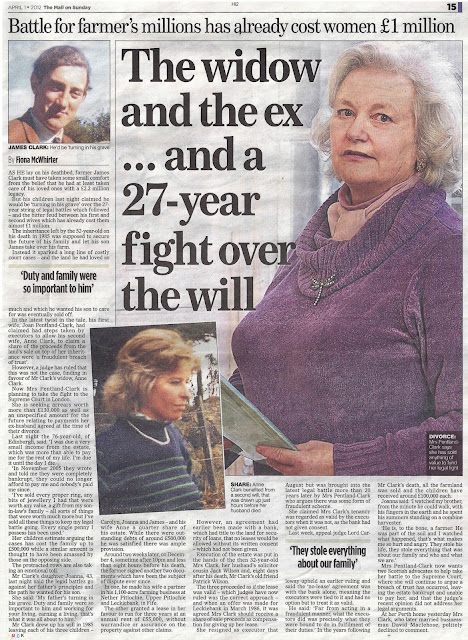
The widow and the ex … and a 27 year old fight over the will.

Battle for farmer’s millions has already cost women £1 million.

By Fiona McWhirter April 1 2012 Mail on Sunday

As he lay on his deathbed, farmer James Clark must have taken small comfort form the belief that he had at least taken care of his loved ones with a £2.2 million legacy.

But his children last night claimed he would be ‘turning in his grave’ over the 27-year string of legal battles which followed – and the bitter feud between his first and second wives which had already cost them almost £1 million.

The inheritance left by the 52-year-old on his death in 1985 was supposed to secure the future of his family and let his son James take over the farm.

Instead it sparked a long line of costly court cases – and the land he loved so much and which he wanted his son to care for was eventually sold off.

In the latest twist in the tale, his first wife, Joan Pentland-Clark, had claimed steps taken by executors to allow his second wife, Anne Clark, to claim a share of the proceeds from the land’s sale on top of her inheritance were ‘a fraudulent breach of trust’. However, a judge has ruled that this was not the case, finding in favour of Mr. Clark’s widow, Anne Clark.

Now Mrs Pentland-Clark is planning to take the fight to the Supreme Court in London. She is seeking arrears worth more than £130,000 as well as an unspecified amount for the future relating to payments her ex-husband agreed at the time of their divorce.

Last night the 76-year-old, of Edinburgh, said: “I was due a very small income from the estate, which was more than able to pay me for the rest of my life. I’m due it until the day I die. In November 2005 they wrote and told me they were completely bankrupt, they could no longer afford to pay me and nobody’s paid me since. I’ve sold every proper ring, any bits of jewellery I had that were worth any value, a gift from my son-in-law’s family – all sorts of things that were worth much more but I’ve sold all these things to keep my legal battle going. Every single penny I possess has been used.”

Her children estimate arguing the case has cost the family up to £500,000 while a similar amount is thought to have been amassed by the opposing side. The protracted rows are also taking an emotional toll.

Mr. Clark’s daughter Joanna, 43, last night said the legal battles go against her father’s principles and the path he wanted for his son. She said: “My father’s turning in his grave. Duty and family were so important to him and working for your living, earning a living, that what it was all about for him.”

Mr Clark drew up his will in 1985 leaving each of his three children, Carolyn, Joanna and James – and his wife Anne a quarter share of his estate. While there were outstanding debts of around £500,000 he was satisfied there was ample provision.

Around two weeks later, on December 4, sometime after 10pm and less than eight hours before his death, the farmer signed another two documents which have been the subject of dispute ever since. In one, he made his wife a partner in his 1,100-acre farming business at Nether Pitlochie, Upper Pitlochie and Leckiebank, in Fife. The other granted a lease in her favour to run for three years at an annual rent of £55,000, without warrandice or assurance on the property against other claims. However, an agreement had earlier been made with a bank, which had title to the land for security of loans, that no leases would be allowed without its written consent – which had not been obtained.

Execution of the estate was put in the hands of the then 32-year-old Mrs Clark, her husband’s solicitor cousin Jack Wilson and, eight days after his death, Mr Clark’s old friend Patrick Wilson. The three proceeded as if the lease was valid – which judges have now ruled was the correct approach – and when an offer was made for Leckiebank in March 1986, it was agreed Mrs Clark should receive a share of the proceeds as compensation for giving up her lease.

She resigned as executor that August but was brought into the latest legal battle more than 20 years later by Mrs. Pentland-Clark who argues that there was some form of fraudulent scheme. She claimed Mrs Clark’s tenancy was regarded as valid by the executors when it was not, as the bank had not given consent.

Last week, appeal judge Lord Carloway upheld an earlier ruling and said the ‘no-lease’ agreement was with the bank alone, meaning the executors were tied to it and had no option but to treat it as valid. He said: “Far from acting in a fraudulent manner, what the executors did was precisely what they were bound to do in fulfilment of their duties.” In the years following Mr Clark’s death, all the farmland was sold and the children have received around £100,000 each.

Joanna said: “I’ve watched my brother, from the minute he could walk, with his fingers in the earthand he spent his summers standing on a combine harvester. He is, to the bone, a farmer. He was part of the soil and I watched what happened, that’s what makes me so hurt and angry. They stole his life, they stole everything that was about our family and who and what we are.”

Mrs Pentland-Clark now wants two Scottish advocates to help take her battle to the supreme Court, where she will continue to argue a breach of trust has occurred, leaving the estate bankrupt and unable to pay her, and that the judge’s recent opinion did not address her legal arguments.At her Perth home yesterday Mrs Clark who later married businessman David Maclehose, politely declined to comment.