Showing posts with label Scottish Legal Services Ombudsman. Show all posts

Monday, September 08, 2008

Scottish Legal Services Ombudsman’s notice criticising Law Society of Scotland over poor complaints handling

The Scottish Legal Services Ombudsman has issued a notice criticising the Law Society of Scotland for poor complaints handling … a power not very much used as it should be …

Anyway, if you can get through the needed degree in algebra to understand Jane Irvine’s notice … then it might have some effect … however, we think not !

Monday, 8 September 2008

Scottish Legal Services Ombudsman

Section 34A of the Law Reform (Miscellaneous Provisions)(Scotland) Act 1990

Failure of the Law Society of Scotland [LSS] to comply with a recommendation from the Scottish Legal Services Ombudsman arising out of an Opinion by the Ombudsman on the Law Society’s handling of a complaint.

Factual background and Ombudsman’s recommendation

Mrs X, Mrs Y and Mrs Z went to the solicitors T, for advice about applying for guardianship of Mr X [Mrs X’s son] and to transfer the titles to Mrs X’s house into the names of Mrs Y and Mrs Z. The house had originally been bought in Mrs X and Mr X’s names.

The solicitors T failed to secure guardianship of Mr X. Mrs X, Mrs Y and Mrs Z therefore instructed another firm of solicitors H in this matter.

The LSS investigated 11 complaints of inadequate professional service against the firm of solicitors T and one complaint of professional misconduct against an individual named solicitor in that firm. The LSS upheld 6 complaints of inadequate professional service. The LSS decided to take no action in relation to the other 5 inadequate professional service complaints and the complaint about professional misconduct.

Mr Y complained to me on behalf of Mrs X, Mrs Y and Mrs Z about the LSS’s handling of their complaint and in particular that it was guardianship of Mr X that his family wanted and that they had instructed the solicitor accordingly.

Following my investigation, I concluded that I was critical of the manner in which the LSS had reached its decision in relation to Issues 1, part of 7 and 9. I was not persuaded or satisfied with the reasoning provided by the LSS in respect of these issues. I therefore recommended that the LSS reconsider all of these issues.

In relation to Issue 1 – I found that Mrs X, Mrs Y and Mrs Z had plainly and clearly asked the solicitors by letter to represent them in gaining guardianship of Mr X and this had not happened. There had been a failure to carry out an instruction. I recommended that the LSS should reconsider this complaint and provide detailed reasoning for its decision.

Regarding Issue 7 – I did not think that the LSS had provided clear reasoning in reaching its decision in relation to this complaint. The LSS had upheld Issue 5 which looked at the solicitors’ failure to provide the complainers with clear advice and instructions as to the format of the medical reports required and how to obtain these. Issue 7 looked at the failure to identify and approach the appropriate medical practitioners directly. I did not think that that the LSS had provided sufficient detailed reasoning in relation to identifying appropriate medical practitioners. In relation to Issue 5, the LSS had concluded that there was an obligation on the solicitors to ensure that the complainers were aware of the terms of the Act. I thought this should apply equally to this complaint.

In relation to Issue 9, I considered that the LSS had given too much weight to one piece of evidence and felt that there was in fact no evidence of what had or had not been said during a meeting.

I also recommended that the LSS pay Mr Y compensation and costs for the stress and inconvenience caused by the LSS’s inadequate investigation.

The LSS’s reasons for not accepting the Ombudsman’s recommendations

The LSS considered my recommendations and did not consider that it was necessary to accept the recommendations.

In the LSS’s view, the Committee had provided comprehensive reasons for its decisions and, in particular, why it had departed from the Reporter. The LSS said that the Committee’s reasons were sustainable. They were not perverse, illogical or clearly wrong. The LSS was not persuaded that the points made by the Ombudsman were so fundamental that the decisions reached by the Committee ought to be disturbed. The LSS was also content that the decisions were properly explained.

Issue 1 – The LSS said that the phrase “Guardianship” was legally meaningless. The LSS said that what could be sought was either a Financial Guardian, Welfare Guardian or both. The LSS went on to explain that such a Guardian was appointed by the Court and it was a specific person who was appointed. Accordingly, to say that a number of people wanted Guardianship, was, in legal terms meaningless. Accordingly, to say that the solicitors had plain and clear instructions regarding Guardianship could not be correct. The LSS said that as the term did not make sense in law, they were therefore not clear instructions. The Committee did not consider that the solicitor could be criticised for not doing something which could not be achieved in law. The LSS stated that what the Committee had done was to look behind the issue and note that at the root of the complainer’s concerns was the transfer of the title of the property.

It was the LSS’s view that on the instructions the solicitors had, they exercised their professional judgement that in order to obtain what the complainers were really after was best done by way of an Intervention Order and the Committee considered that this was a reasonable exercise of judgement.

Issue 7 – Again, the LSS did not understand why the Ombudsman did not totally follow the Committee’s reasoning in relation to this issue. The Committee noted that the solicitors agreed with the complainers that the complainers should approach the medical practitioners as a cost saving measure. The LSS wanted to emphasise that there was an agreement that the complainers would do this and the solicitors could not be criticised for failing to identify and approach when it had been agreed otherwise in order to (a) save money and (b) the complainers would know whom to approach as treatment was already being given.

The LSS noted that I had made reference to Issue 5. The LSS commented that there was a difference between Issues 5 and 7 in that the identification of the doctors was a different issue from giving the doctors clear information as to the form of the medical report required to satisfy the Court.

Issue 9 – The LSS stated that it was for the Committee to assess the evidence. There was conflicting evidence from the parties as to what happened. The other two pieces of evidence were, firstly, the £500 payment to account and secondly, the fact that the file was silent. The Committee regarded the latter issue as neutral. The Committee considered that the payment of £500 was a factor to be weighed up in the balance. It was accepted that it did not prove that the solicitors told them, but it was supportive of the solicitors’ position.

The LSS did not accept that the payment was an irrelevant factor; rather it was one factor to be weighed in the balance. It did not prove that the solicitor did not do something, but it was supportive of their position and the Committee were entitled to decide the weight to be attached. The LSS said that if this matter was considered irrelevant then all the Committee would have been left with was two conflicting views and a silent file and would not have been able to uphold the issue because of lack of evidence.

The LSS was content that the decision reached was reasonable and reasonably explained.

The Ombudsman’s view

I was concerned that the LSS had missed the crux of Mrs X, Mrs Y and Mrs Z’s complaint in relation to Issue 1. Put simply the complainants had asked the solicitors to do something for them and this was not carried out. The LSS had attempted to look behind the request and had not upheld the complaint on this basis. If a specific instruction has been given to a firm of solicitors, a client would expect this to be acted upon and if there was a problem with the instruction as given, I would expect the solicitors to explain this to the client and explain what they are able to do. This was the complaint that the LSS agreed to investigate and is the issue that the LSS has side stepped.

In relation to Issue 7, I accept that the complainants had agreed to approach the medical practitioners themselves as a cost saving mechanism. There should have been a duty on the solicitors to ensure that the complainants knew exactly who to contact. The Act is specific regarding the qualifications required by the medical practitioner completing the form and this was not something that the solicitors explained to Mrs X, Mrs Y and Mrs Z. The LSS has already upheld the complaint that the solicitors failed to provide the complainers with clear advice and instructions as to the format of the medical reports required. The Committee stated that the solicitor had an obligation to ensure that the complainants were aware of the required terms of the Act. Applying this same logic, it would appear equally that the solicitors failed to provide the complainers with clear advice in relation to the appropriate medical practitioners to approach as this was also a specific requirement under the Act. I do not think that the LSS has looked at this complaint consistently and in line with the other complaints that it has already decided.

Regarding Issue 9 – I think that too much weight was given to the fact that £500 was paid on account. I do not think that this shows one way or another whether the solicitors told the complainants about civil legal aid. I think that the LSS could have simply stated that there was insufficient evidence to uphold this complaint rather than attaching so much importance to the £500.

Jane Irvine
Scottish Legal Services Ombudsman
http://www.slso.org.uk/
_________________________________
Scottish Legal Services Ombudsman

Section 34A of the Law Reform (Miscellaneous Provisions) (Scotland) Act 1990

Failure of the Law Society of Scotland to comply with a recommendation from the Scottish Legal Services Ombudsman arising out of an Opinion by the Ombudsman on the Law Society’s handling of a complaint.

Background and Ombudsman’s recommendation

Following the death of the complainer’s husband, the complained of firm of solicitors handled the administration of his estate. The complainer complained of a lack of information from the solicitors which put her in difficult circumstances.

The complaint has been considered by the LSS. The LSS decided not to investigate some of to the issues raised and subsequently closed its complaint file when it appeared the complainer had abandoned the complaint.

When I examined the matter although concluding the LSS handled the complaint in a generally satisfactory manner, I was concerned at the speed with which the decision was taken to close the complaint file. Part of that concern was that the complainer may not be familiar enough with the British system to manoeuvre her way through it at a particularly distressing time. I had observed the LSS Sifting Panel’s comments that further information should be sought on the solicitors’ alleged failure to communicate with the client. In light of those comments I recommended the LSS consider whether to provide the complainer with another opportunity to give the LSS the information it had requested. I considered it reasonable for the LSS to set a clear time limit to receiving that information.

As I considered the speed of decision to close the complaint file had inconvenienced the complainer I recommended the LSS should pay her £25 in compensation and £10 towards the cost of bringing her complaint to me.

The LSS’s reasons for not accepting the Ombudsman’s recommendations.

The LSS does not accept my recommendations. Its stated view is that the Ombudsman had recognised the LSS provided the complainer with a letter stating clearly if she did not respond within 14 days then the file would be closed. The complainer was not in touch within that period and the file was then closed. The question then arises as to whether the LSS ought reasonably to have adjusted its process to take account of any special circumstances pertaining to the complainer. The Ombudsman had suggested two such circumstances that the complainer might not be familiar with “the British System” and secondly that she was going through a distressing time.

The LSS stated has two sources of information to indicate that understanding English or a “British system” was not an issue for the complainer. She had stated she was not a native English speaker but thought her level good enough. The LSS said the standard of correspondence from the complainer was very good.

If the LSS treated all non British people differently or automatically adjusted its process without due cause then that could be seen as discrimination in itself. In the LSS’s view each situation required to be looked at objectively in order to form a reasonable conclusion. In this case the complainer had not indicated she had any special needs and it was reasonable and supportable that her English was not at a level where it would be a barrier thus requiring an adjustment to the process. The LSSS had taken advice from its Head of Diversity in reaching this considered view.

The LSS noted the Ombudsman’s second contention was that the complainer was suffering a distressing time. That was sadly very much the case. It was also very unfortunately often the case for many complainers if not nearly all to be in a distressing situation upon contacting the LSS. Often the reason they have contacted a solicitor is because they have suffered a distressing life event. It is therefore doubly distressing to have to require to make a complaint on top of that.

There was in the LSS’s view no good reason why it required to adjust its process to take account of the complainer’s situation.

Ombudsman’s view

I considered the LSS response had failed to address the concerns I had identified and had concluded that when linked together amounted to circumstances that merited the LSS contacting the complainer for further information albeit with a very specific deadline.

I had drawn the LSS’s attention to the specific but linked difficulties i.e. by implication the exceptional circumstances the complainer faced. I considered the LSS’s response separated these concerns, appearing to examine them as unrelated matters.

I had referred to the complainer’s knowledge of “the British System” but there was however no special pleading with regard to her knowledge of the English language which is how the LSS had interpreted that reference. The problems identified were in relation to how solicitors carry out their functions and how the Inland Revenue operates. Both of these are to do with the legal and tax systems in Scotland and Britain.

The other linked concern I highlighted was in relation to the complainer’s personal circumstances. I agreed many complainers who approach the LSS experience similar and no doubt even more distressing circumstances. The complainer’s situation was cited as only one of the concerns I had identified. I had also set my recommendation in the context of the view of a LSS Sifting Panel that the complainer should be asked for further information on the solicitors’ alleged failure to communicate with her.

I confirmed my appreciation the LSS’s 14 day time limit for replies from complainers can move things on successfully. I had however in the past identified a concern which continues in light of this LSS response with the differing time limits allowed to complainers and to complained of solicitors.

The matters I had identified gave me enough concern to recommend the reconsideration by the LSS of its decision. Those matters were deliberately linked in the recommendation to underline that view.

The LSS second response

In its response to my views the LSS confirmed it adhered to its initial response. The LSS felt it had acted fairly albeit appreciating the complainer in common with many others found herself in highly distressing circumstances.

Ombudsman’s conclusions

This is a complaint which raises issues of the use of reasonableness when examining all a complainer’s circumstances relevant to a complaint. My view remains that in this case it is not a matter of language but of a lack of familiarity with both the legal and the tax systems in Scotland. The LSS is also aware that I consider time limits are necessary and important to a complaints process and hence why I took care to specify in the recommendation that it was reasonable for the LSS to set a clear time limit to receiving that information. However as the time limit for a complainer is 14 days rather than the 21 days statutory time limit for solicitors, I consider that a tight deadline and in particular not that long when it the result is to exclude someone from a complaint process. I agree with the LSS that complaints have to be managed and setting time limits is an important part of that process. However it is a very serious step to throw a complaint out of a complaint system leaving a lay complainer nowhere else to go - save court and so I consider these cases very seriously.

My conclusion remains that the complainer’s circumstances when taken as a whole merited the LSS using the flexibility available to it to give one final and limited opportunity for the complainer to provide the information the LSS required. I concluded in simply adhering to its formal response the LSS has failed to appreciate and therefore give appropriate consideration to the actual terms of my recommendation.

Jane Irvine
Scottish Legal Services Ombudsman
http://www.slso.org.uk/

Monday, January 14, 2008

Outgoing Legal Services Ombudsman may bring harmony to SLCC

The outgoing Scottish Legal Services Ombudsman, Jane Irvine, appointed recently as Chairman of the new Scottish Legal Complaints Commission, may bring a slight touch of harmony to proceedings .... not if the lawyer membership have their way of course ...

The Scotsman reports :

Irvine brings stability to new commission

By JENNIFER VEITCH

WE'VE known for more than a year that it was coming and now, at last, we know who is going to be running the new Scottish Legal Complaints Commission.

The appointment of Jane Irvine, the current Scottish Legal Services Ombudsman, as chairwoman of the new commission seems like a sensible move. From the profession's perspective, at least they know who they will be dealing with, and both can build on the existing relationships established since 2006.

Irvine's pragmatic and plain-speaking approach certainly appears to have earned her respect from the Law Society of Scotland and Faculty of Advocates. Along with commissioners – including lawyers Alan Paterson, David Smith, Margaret Scanlan and David Chaplin – Irvine should bring continuity and stability after a period of uncertainty about the new gateway for service complaints.

The focus can now firmly shift to ensuring there is a smooth transition – both for the profession and for the public – from the old to new complaints handling systems.

Certainly there are many logistical issues that need to be addressed before the commission opens for business in October.

For example, when exactly will the window shut on complaints being made under the existing system and open for the new one? What approach will the commission take in looking at historical cases?

Irvine needs to ensure the commission communicates early and effectively with the public and the profession to raise awareness of the new system and all the changes it will bring.

Even bigger challenges remain to be resolved, however, not least of which is how complaints about the legal service will be judged by the commission, when the Law Society of Scotland is still working on a new set of standards for the profession.

Last year, Irvine warned that the profession was being hampered by a "weak" code of conduct for solicitors, with a "patchwork" of rules and guidelines, "sprinkled with confusing exclusions".

The profession may yet risk having standards imposed upon it from the commission's rulings.

Also, will the commission be able to clearly distinguish between service and conduct issues? If this is not always possible, how will this fit with the Law Society of Scotland's own investigations into solicitors?

Many of these issues have already been flagged up by Irvine and Richard Smith, the commission's interim chief executive, who has been speaking to the profession about its role since last summer. Irvine may wish to use less slightly less bullish language than Smith, however, who once commented that the commission was holding out a hand to the profession with "a fist inside the glove".

To start with at least, the commission should enjoy a generous degree of public, and some professional, goodwill. Despite the Law Society of Scotland's repeated protestations about the tiny proportion of complaints arising from transactions, the new complaints gateway is being introduced in response increasing consumer frustration with the existing system.

It is worth remembering that solicitors are not always happy with the current system either, as Caroline Flanagan acknowledged during her presidency, when the Law Society of Scotland gave up trying to retain control of service complaints handling.

Of course, it remains to be seen whether the new system will be better than the old. It won't be a magic bullet, and it seems unlikely that most complaints will reach a different resolution just because the commission looks at the same set of facts.

But, as Irvine herself wrote when she presented her last annual report, there has been a "constant theme of lack of trust" in the Law Society of Scotland. "Clients simply do not believe an institutional members' body can deal with consumer complaints fairly," she said.

If the commission can provide greater transparency and clarity for all concerned, then that seems very much in the public's and the profession's interests.

Saturday, October 20, 2007

'Lost' news report shows Legal Services Ombudsman 'compromised' independence on orders of Law Society

A story reported by Scotland on Sunday from August 1999 resurfaces to show that Garry S Watson, the then Scottish Legal Services Ombudsman, compromised the independence of his office by withholding information from a client whom had previously been told by Mr Watson should expect disclosure & 'transparency' in his case.

Peter Cherbi, was told by Mr Watson in a report on how the Law Society of Scotland poorly investigated & handled the now famous 'Cherbi executry complaint' against Borders solicitor Andrew Penman of Stormonth Darling Solicitors, Kelso, "It is most important that there is transparency of decision-making within committees." , but after receiving 'written submissions' upon strict orders from the Law Society of non disclosure to Mr Cherbi, Mr Watson changed his mind and refused to proceed further.

Referring to the Scotland on Sunday story directly :

Cherbi complained about Penman to the Law Society, who originally planned to prosecute him at a Scottish Solicitors Discipline Tribunal.

But after written submissions regarding Penman were received, they decided instead on a reprimand and ordered him to pay £1000 compensation to Cherbi's estate. Angry at the Law Society's decision, Cherbi complained to the ombudsman in May 1997.

Watson investigated and concluded : "It is most important that there is transparency of decision-making within committees." Watson added he and Cherbi should be told why the Law Society decided not to prosecute Penman.

But un June 1997, Watson informed Cherbi that the Law Society had sent him the written submissions relating to Penman on the basis they remained confidential, and that the case was closed.

The submissions, apparently made on behalf of Mr Penman by his representative before the Law Society Complaints Committee, Mr James Ness, the then Competence Committee Convener, were claimed to report 'personal circumstances' of Mr Penman only, but a source told Scottish Law Reporter today the submissions made by Mr Ness on behalf of Mr Penman both verbally and in writing went much further, attacking Mr Cherbi as an individual and claiming Mr Penman through his long legal career 'did not deserve to lose out' to a complaint filed by Mr Cherbi.

The 'personal circumstances' of a lawyer such as Mr Penman who was widely condemned in a Law Society report and initial decision to prosecute before the SSDT, should not have changed the outcome of the Complaints Committee's verdict into the complaint before them, and while Mr Watson in his report recommended such practice be stopped, it continues in varying forms to this day.

Informed sources have indicated the apparent compromising of Mr Watson's office by the Law Society, where orders were given not to disclose information to a client, and to effectively close a case which was recommended for reopening, has occurred in more than just one case, only it appears members of the public who had complained to the Scottish Legal Services Ombudsman have either not been told or simply had not realised what occurred.

Mr Cherbi, Scotland on Sunday reported, attempted to take legal action against Mr Watson for his apparent change of position due to instructions received from the Law Society, but was later reported to have been obstructed to a significant degree by the Law Society itsself, as to avoid any legal challenge surfacing against Mr Watson's office, which would have significantly damaged the Legal Services Ombudsman's role & credibility.

Mr Watson was a noted supporter of self regulation of the legal profession during his tenure as Scottish Legal Services Ombudsman, expressing his desire that lawyers retain the right to regulate complaints against themselves on many occasions ... although subsequent holders of Mr Watson's post have changed their mind, notably Linda Costelloe Baker, who roudnly condemned self regulation of the legal profession by the Law Society of Scotland before the Scottish Parliamnet on several occasions.

Garry Watson, after leaving the post of Scottish Legal Services Ombudsman, became the 'temporary' Standards Adviser to the Scottish Parliament in 2000, until the role was shortly designated a permanent position. He is now with Places for People, among other things, who report his 'profile' here

Scotland on Sunday reports :

Law Watchdog faces threat of court fight - Scotland on Sunday 9 August 1999

Law watchdog faces threat of court fight.

Client prepares to sue after allegation that ombudsman compromised independence.

By Peter Laing Scotland on Sunday August 8 1999

THE government-appointed watchdog charged with overseeing the complaints process against solicitors in Scotland is himself facing legal action.

Scottish Legal Services Ombudsman Garry Watson has been accused of failing to handle properly a complaint against the Law Society of Scotland, the professional body which represents solicitors.

Peter Cherbi says he intends to sue Watson claiming the ombudsman "took instructions" from the Law Society on what information to release about his case, and, therefore, compromised his independence.

Cherbi, from Jedburgh, says Watson's handling of the case may have harmed his chances of ever recovering a £300,000 inheritance from an incompetent solicitor.

Cherbi has instructed his solicitor to begin legal proceedings against Watson, who could receive a write seeking damages within the next few weeks. It is believed to be the first time anyone has attempted to sue an ombudsman.

Complaints against solicitors are investigated by the Law Society under a controversial system of self-regulation. Anyone who is unhappy with the decision of the Law Society can then ask for an investigation by the ombudsman, who has the power to make recommendations to the society.

But the ombudsman is currently flooded with complex cases, and last month had to apologise for delays of up to a year in handling them.

Cherbi's case started in 1990 when his 73-year-old father died, leaving behind an estate valued at around £300,000.

Four years later he realised the estate, which was handled by local lawyer Andrew Penman, was almost worthless. Cherbi believes the money was lost through avoidable interest payments, fees and the mishandled selling of shares and investments.

Cherbi complained about Penman to the Law Society, who originally planned to prosecute him at a Scottish Solicitors Discipline Tribunal.

But after written submissions regarding Penman were received, they decided instead on a reprimand and ordered him to pay £1000 compensation to Cherbi's estate. Angry at the Law Society's decision, Cherbi complained to the ombudsman in May 1997.

Watson investigated and concluded : "It is most important that there is transparency of decision-making within committees." Watson added he and Cherbi should be told why the Law Society decided not to prosecute Penman.

But un June 1997, Watson informed Cherbi that the Law Society had sent him the written submissions relating to Penman on the basis they remained confidential, and that the case was closed.

For the past two years, Watson and Cherbi have exchanged increasingly acrimonious letters on the subject.

Cherbi said : "In my opinion, by accepting the submissions about Penman on the basis that he would not divulge their contents, he has effectively been told what to do by the Law Society.

"As ombudsman he should be telling the Law Society what to do. I believe he has compromised the independence of his office.

"In my opinion, by not handling my case correctly, and refusing to pass on important information, he has made it more difficult to recover any of the inheritance I lost. For that reason, I have instructed my solicitor to begin proceedings for compensation"

Watson has refused to comment on the case. But in a letter he sent to Cherbi in February last year, he explained why the representations regarding Penman were not passed on.

He wrote "I ascertained that they [the representations] related entirely to the personal circumstances of the solicitor and had nothing to do with yourself. I can certainly see no reason why there should be a need for me to pass on information when it did not relate to, and was not relevant to, yourself. To suggest my actions compromise the independence of my office is patently absurd."

Watson, who was prepared to talk to Scotland on Sunday on general terms, added : "I deny any suggestion that my office is influenced by the Law Society.It is totally independent."

Watson said a new member of staff had been taken on to help bring down the time taken to deal with cases. he hopes to bring the average delay down from a year to two-four months.

The Scottish Consumer Council, in a report released earlier this year, revealed problems with the ombudsman, including that 85% of people whose complaints were not upheld by the ombudsman did not receive a satisfactory explanation.

Monday, January 29, 2007

Law Society of Scotland rejects complaint over estate ruined by huge legal fees

It looks like the Edinburgh legal & financial investment firm of Turcan Connell, which has offices at 1 Earl Grey Street, Edinburgh and in Guernsey,the Channel Islands can be added to the long list of legal firms to stay away from, judging from today's Herald newspaper report on how they administered an estate.

Turcan Connell seem to like the money and publicity .. as long as they are getting it written for their benefit, that is ... noting their recent claim to fame of hitting £450m in their investments ... see here : Law firm Turcan Connell funds hit £450m ... but despite the £450m in their investment portfolio .. they still manage to ruin an estate ... much in the same way, it seems that crooked Borders solicitor Drew Penman - Scotland's Most Famous Crooked Lawyer of Stormonth Darling Solicitors, Kelso .. did to my family .. and a few other clients too.

I can sympathise with Dr Kate Forrest on this one .. making a complaint against a firm of solicitors who have raped an estate can be a tedious affair .. and the Law Society, it all it's crooked glory, are loathed to do anything on such cases, as they have done in the case of Dr Forrest's complaint against Turcan Connell .. well ..actually, the Law Society of Scotland have went one better, and thrown the complaint out.

Quotes from the Herald article today :

Forrest complained that the firm had told her only that it would charge £200 an hour, had entered into unnecessary work, and had failed to give her estimates, or issue itemised bills, despite repeated requests. She claims the firm then gave an undertaking to halt the charges, in a meeting with witnesses at the firm's office, but this did not materialise.

When the Law Society examined the complaint, it ruled that the meeting could not be taken into account as the firm had no record of it, and it accepted an explanation by managing partner Douglas Connell that the complaint had been based entirely on a "misunderstanding".

The £16,000 in charges had the effect of more than wiping out any assets in the estate, which had gross assets of £69,574 but debts of £55,731.

The Law Society reported that the firm had "apologised for the oversight" in billing, and that "simple oversight … should not be defined as inadequate professional service"

Well, when a lawyer tells you they will charge only a set fee .. believe me .. it's a LIE. You got that one, right ? in English. A LIE.

Ask a lawyer for estimates of work ? What you get, if anything, is a LIE. Got that ? A LIE. I've tried it myself. They didn't provide me with an estimate despite repeated requests, and the lawyer then denied I ever made such requests - removed the file notes which matched my email records, took a sickie to get out of the complaint (he got off the hook of course) and then became a Law Accountant.

Another client of a lawyer who contacted me, told me they got an estimate back for £1500 and the final bill ended up at £8000.

Lawyers fake up paperwork on a daily basis. There must be more faked paperwork in lawyers offices in Scotland than there is fake currency floating round the planet.

They don't always fake up the paperwork too well though .. When Drew Penman was faking up the paperwork on my complaint .. he got some of the dates wrong and some of the staff entries upside down .. managed to insert the wrong documents into the wrong order .. and cleverly, the Law Society Complaints Reporter found this one out for himself .. that's why he recommended Drew Penman be prosecuted before the SSDT and be struck off .. but, being represented by equally crooked James Ness, now the Director of Law Care ... Penman got off the hook with even more fiddled evidence at the Complaints Committee hearing.

So you see .. faking up the paperwork is common .. and fake estimates from a lawyer for work .. if you ever actually manage to get one .. aren't worth the ink it takes to type them out.

I liked the part in the article where the Law Society said it couldn't accept the information relating to the 'meeting' where fees were discussed .. "as the firm had no record of it" ... great cop-out there, if familiar .. which goes down to fiddled minutes of meetings - which usually exist .. but the lawyer can remove them at will, because the Law Society of Scotland says they can do that .. it's called "right of lien" which is also used to keep files from a client until they pay for their services .. and even then .. surprise, any file the lawyer deems shouldn't be released to the client, is held back.

Maybe the minutes of the meeting did actually exist in this case ... we shall perhaps, never know .. but I know the same happened in my complaint against Drew Penman ... minutes of meetings were denied to exist .. the mysteriously turned up .. some of them faked of course .. so Dr Forrest should perhaps pursue that one further.

More quotes from the Herald article :

"If a client feels a fee is too much then it can be referred to the Auditor of Court who can decide what a reasonable fee might be. Firms may also charge for providing a bill which itemises each letter, phone call, etc, especially if it is for a large volume of work.

"If someone takes a court action against a solicitor then the society is not involved in that process."

Well, the process involving the 'Auditor of the Court' is usually referred to as "Judicial Taxation" ... but it's certainly no cure for the whims of crooked legal firms to charge what they want for services which usually are poorly handled.

You will all remember the famous £45,000 bill for photocopying which Tods Murray hit one of their clients with .. which was I heard, reduced to around £7,000 or even less after 'Judicial Taxation' .. but it doesn't always go the way of the client .... as the Auditor of the Court can get things wrong a lot too .. and there have been a few challenges to the validity of the Auditor of the Court's position over the years .. one fine example being a Judicial Review of the Auditor's actions, which you can read about here : OUTER HOUSE, COURT OF SESSION [2006] CSOH 169 OPINION OF J GORDON REID Q.C., F.C.I.Arb (sitting as a Temporary Judge) in the Petition of DANIEL PATRICK COYLE Petitioner; for Judicial Review of a decision of the Auditor of the Court of Session .. some good info on the Auditor of the Court contained in that one ...

However, the Law Society's statement : "If someone takes a court action against a solicitor then the society is not involved in that process." is simply, a LIE.

Here's proof of otherwise : The Corrupt Link Revealed - How the Law Society of Scotland manages client complaints & settlements.

More proof here : Law Society of Scotland claims success in gagging the press over Herald newspaper revelations of secret case memos

The Law Society of Scotland have a well practiced policy of managing all claims against solicitors, to make sure claims get nowhere and clients lose everything.

Indeed, what is happening to the estate in terms of the legal charges which will wipe out the estate assets, is quite common. After all, that's exactly what Drew Penman did to me .. and that's exactly what lawyers up and down Scotland do to estates - wipe them out by using up all their assets, cash, opening up high interest overdraft accounts with favoured Banks and squandering all the money in cosy deals between themselves and the Banks. Simple stuff - it's policy on all estates.

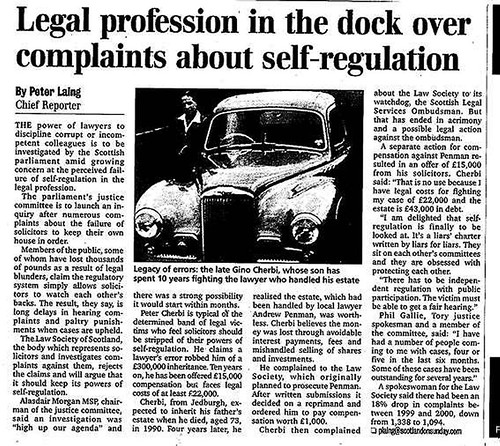
Here is a remarkably similar story Peter Laing from Scotland on Sunday wrote about my case involving crooked lawyer Andrew Penman from Kelso legal firm Stormonth Darling Solicitors :

Scotland on Sunday February 2001 - Legal Profession in the dock over complaints about self regulation

Take a will to a lawyer, and plenty of you will get the same. I get reports of this all the time, and I know it's true, because it happened to my family.

I doubt Dr Forrest will be able to get a lawyer to sue a lawyer .. many of us have tried it, and it doesn't work.....

Complaints such as Dr Forrest's should be referred to the new SLCC, as it's plain for all to see the Law Society of Scotland are not doing their job, and never really have. It's time for a full review of the treatment of complaints against lawyers by clients over the years which have been subject to the utmost prejudice in favour of solicitors, by the most corrupt self regulatory body in existence - the Law Society of Scotland.

Here's the link to the Herald article today, and prepare yourselves for an even more gruesome story of the lengths crooked lawyers will go to defeat complaints later this week. Gruesome, and perhaps even, evil.

http://www.theherald.co.uk/business/77839.html

Legal bill wipes out net assets
IAIN MORSE and SIMON BAIN January 02 2007

A leading Edinburgh law firm which charged fees of more than £16,000 to administer an estate with net assets of under £14,000 has had a complaint against it to the Law Society of Scotland rejected.

The complaint was made by widow Dr Kate Forrest, a lecturer in Russian in Edinburgh, against Turcan Connell, the multi-disciplinary firm which prides itself on its "family office".

Forrest complained that the firm had told her only that it would charge £200 an hour, had entered into unnecessary work, and had failed to give her estimates, or issue itemised bills, despite repeated requests. She claims the firm then gave an undertaking to halt the charges, in a meeting with witnesses at the firm's office, but this did not materialise.

When the Law Society examined the complaint, it ruled that the meeting could not be taken into account as the firm had no record of it, and it accepted an explanation by managing partner Douglas Connell that the complaint had been based entirely on a "misunderstanding".

The £16,000 in charges had the effect of more than wiping out any assets in the estate, which had gross assets of £69,574 but debts of £55,731.

The Law Society reported that the firm had "apologised for the oversight" in billing, and that "simple oversight … should not be defined as inadequate professional service".

In November, Jane Irvine, the Scottish Legal Services Ombudsman, issued a rare public rebuke to the Law Society over its handling of complaints, urging it to "recognise that the consumer age has dawned".

The Scottish Executive is poised to scrap self-regulation by the profession, policed by the ombudsman, and introduce a Scottish Legal Complaints Commission, which the society is fiercely resisting.

The number of complaints received by the Law Society of Scotland has shot up from 2402 during 2002 to 4849 last year. The 12-page annual report of the society's Client Relations Office records 1057 cases in which no action was taken at all last year, while in 108 cases a solicitor's conduct was found unsatisfactory.

The current procedure starts with a reference to the law firm against which the complaint is made, and internal procedures to be followed by firms are laid down by the society. Only after these are exhausted can complainants proceed to the Law Society itself. And then, perhaps surprisingly, complainants can be charged by the law firm for their work in submitting the relevant evidence to the society.

The evidence regarded as acceptable by the society may be limited only to the files presented by the law firm, though it can order the production of "missing"documents - such as the record of a meeting. If a complaint is rejected by the society, the complainants have recourse to the courts. But this means finding a law firm prepared to act against another firm - which as The Herald has reported can be difficult in Edinburgh - at a minimum cost of several thousand pounds, a considerable disincentive to taking legal action.

Kate Forrest says she is left with no choice but to go to court if she wishes to challenge an outstanding fee in excess of £8000. She says: "For me this would be expensive and risky. I am not rich and they know this very well."

The Law Society of Scotland said: "A complaint about a fee could be service or conduct as it could result from a breach of a rule if there was no letter of engagement, or IPS (inadequate professional service) if there was insufficient communication about a fee with a client.

"If a client feels a fee is too much then it can be referred to the Auditor of Court who can decide what a reasonable fee might be. Firms may also charge for providing a bill which itemises each letter, phone call, etc, especially if it is for a large volume of work.

"If someone takes a court action against a solicitor then the society is not involved in that process."

Turcan Connell said: "We care deeply about ensuring that we give every client the best possible service. Our trust and tax experts are among the most proficient in Scotland, and we always strive to protect our clients' interests and minimise their costs as far as possible.

"Dr Forrest is no longer a client. We resolutely protect the privacy of all current and former clients, and would not make any public comment on an individual's personal circumstances or relationship with us."