Showing posts with label Censorship. Show all posts

Tuesday, November 23, 2010

Law Society President Jamie Millar attacks leak of dictatorship style ‘media protocol’, says act of leaking by solicitor was repugnant

A little over two days since the details of the Law Society of Scotland’s gagging order media protocol were leaked to online legal websites, the Law Society’s current President, Jamie Millar, has attacked said leak (Comedy capers – Ed)

The Law Society of Scotland’s President Jamie Millar’s letter :

22 Nov 2010
Dear colleagues

You may be aware of this already but if not I would draw to your attention the attached report in the Firm Magazine online -

I would also draw to your attention the note from the Registrar which formed part of the Council agenda (Agenda item 6a) issued to all members of the Council on Friday which indicated those papers which were confidential. Included in the list of confidential papers was the protocol on media communications.

The article in the Firm indicates that the publication has received comment from one senior member of the Society's Executive and two members of the Society's Council. It is clear that that the protocol has been leaked to the Firm and given the unattributed comments in the article the conclusion must be reached that it was leaked by one or more Council members or a senior employee of the Society despite the confidentiality attached to the paper when issued.

I find it repugnant that a solicitor should choose to flaunt one of the basic principles of our profession by breaching confidentiality but to do so in an unattributed way is cowardly and not worthy of someone who has had the dignity of the solicitor's profession conferred upon him or her.

I have always been prepared to engage in open debate with any member of the profession on any issues and to stand up and be identified and counted in relation to any issue.

I invite whoever has breached the confidentiality of the business of the Council of the Society to have the courage of his or her convictions, to identify himself or herself to me, to engage in open and transparent debate on the matter and allow the other members of the Council of the Law Society of Scotland the courtesy of an opportunity to have their say before the matter is put to public debate. Quite apart from the breach of confidentiality, I find the leak of this matter to be disrespectful to the 50 or so members who make up the governing body of the Law Society of Scotland, its Council.

I do not intend to dwell in this e-mail on the merits or demerits of the protocol other than to make it quite clear that the adoption or rejection of that protocol will be a matter for the Council to decide on Friday at the next meeting of the Council and that the protocol does not seek to prevent any Council member expressing any opinions on any matter in their personal capacity or as spokesperson for another body but sets out the basis on which Council members will comment as spokespersons of the Society.

To save the person who leaked the protocol to the Firm the trouble of forwarding this e-mail to Steven Raeburn I am copying it to Steven. I am also copying it to Peter Nicholson of the Journal and I confirm that this e-mail is not off the record and can be published in its entirety in their respective publications.

Regards

Jamie Millar
President
The Law Society of Scotland

Sunday, November 21, 2010

Drumsheugh Dictatorship on the march : Law Society of Scotland gags its own Council members with ‘big brother’ media protocol

AFTER revelations of the Law Society of Scotland’s BACKROOM PLOT to take over the Scottish Legal Aid Board & the Scottish Legal Complaints Commission were exposed in the media and on Scottish Law Reporter, the Law Society of Scotland has issued an overly harsh, reminiscent of a dictatorship, ‘media protocol’ which intends to ban office bearers, Council members & committee members from talking to the press.

The gagging order media protocol will come up for a rigged vote to wave it through democratic discussion at the Law Society’s Council meeting on Friday 26 November 2010

The draft protocol was suspiciously leaked to online law magazine “The Firm”.

The Media Protocol states :

Title: Media Protocols

Aim

The purpose of this paper is to set out draft protocols for office bearers, Council members and committee members in their dealings with the media on behalf of the Law Society of Scotland. The paper also outlines the role of the Communications & Marketing Team in supporting the efforts of members to promote the work and policy positions of the Society through the media.

Brief History/Background

As a respected and authoritative organisation, the Law Society of Scotland is frequently approached by the media for comment on a broad range of issues. Similarly, the Society will often wish to proactively seek media coverage to ensure that key decision makers and the wider public are aware of the work being undertaken by the Society and to promote the organisation’s various policy positions.

The Law Society of Scotland’s Communications & Marketing Team (CMT) sits as part of the Society’s executive. Its central objective is to maintain and enhance the Society’s reputation and, to that end, aims to ensure the media report on the Society accurately and fairly.

To meet this aim, it is essential for the CMT to be aware of and manage all aspects of the Society’s media relations. The CMT therefore operates a 24 hour, 365 days a year media relations operation, with a designated communications manager available to deal with media enquiries both during and outwith traditional office hours. This ensures an experienced communications manager is available at any time to respond to media requests and to assist the Society’s office bearers, Council members, committees and executive with any media communications requirements.

Until now, there has been general agreement on the importance directing any and all media communications on behalf of the Society through the CMT. This ensures that the Society’s media relations are properly coordinated and that there is a consistency of message.

At its October 2010 meeting, the Board of the Law Society of Scotland requested a more formalised set of protocols for members in their dealings with the media. The following paper provides the recommended protocols.

Key Factors

A. Protocols for reactive media comment

1. All media requests for Society comment should be made through the CMT press office.

Where an office bearer, Council member or committee member is approached directly by the media and asked to comment on behalf of the Society, they should advise the journalist to make the request via the CMT press office.

2. Where the CMT receives a media request for comment, the relevant communications manager will identify an appropriate Society spokesperson, taking into account the subject matter, the requested format of a response (i.e. written statement, opinion article, broadcast interview etc) as well as the practical availability of individuals.

3. The communications manager will contact the designated spokesperson and brief them on the nature of the request. The communications manager and designated spokesperson should then agree on how to respond to the media request, both in terms of content and format. This may involve consultation with other relevant individuals such as office bearers and committee conveners.

4. Written response statements should be issued to the relevant journalist by the CMT press office and should not be issued by the designated spokesperson. Where there is agreement to provide an interview, either in person or by telephone, the communications manager and designated spokesperson will agree as to who will contact the journalist with respect to any practical arrangements, such as the time and location of the interview.

5. The communications manager may, following consultation with the designated spokesperson and other relevant individuals, decide against providing any reactive comment where doing so is deemed as inappropriate. In such circumstances, the communications manager will respond to the journalist and confirm the Society will not be issuing a comment.

6. Where an office bearer, Council member or committee member disagrees with the communication manager’s proposed strategy for dealing with a specific media request, they should first discuss the matter with the Head of Communications & Marketing. If the matter cannot be resolved with the Head of Communications, attempts should be made to resolve the matter with the Chief Executive and/or the President.

7. In cases where two or more relevant council members and/or committee members disagree on how to respond to a specific media request, attempts should be made to resolve the disagreement with the Head of Communications. If the matter cannot be resolved with the Head of Communications, attempts should be made to resolve the matter with the President.

8. In circumstances where a Council or committee member wishes to respond to a media request in an individual capacity and with a statement that purposely conflicts with the position of the Society, the member should inform the CMT as a courtesy. The CMT will however be unable to issue any such press comment on behalf of the member. In these circumstances and following consultation with the office bearers and others, the CMT may chose to issue a public response to the member’s statement on behalf of the Society.

B. Protocols for proactive media comment initiated by the CMT

1. To promote the work and policy positions of the Law Society of Scotland, the CMT will frequently wish to issue press comment proactively. In such circumstances, the CMT will aim to plan such media communications in advance by scanning ahead for likely media opportunities and, where possible, agreeing comments in advance with the relevant individuals.

2. Where a communications manager wishes to issue a proactive media comment, they will contact the relevant individuals within the Society to first agree that a proactive communication should be issued and to discuss the nature of that communication. A suitable spokesperson for the Society should be determined, with the statement issued in their name.

3. All proactive written media communications should be issued by the CMT press office.

Similarly, all proactive attempts to secure media interviews should be managed by the CMT.

4. Where an office bearer, Council member or committee member disagrees with the communication manager’s proposal to issue a proactive media comment, the matter should be discussed first with the Head of Communications & Marketing. If the matter cannot be resolved with the Head of Communications, attempts should be made to resolve the matter with the Chief Executive and/or the President.

C. Protocols for proactive media comment initiated by an office bearer, Council member and Committee member.

1. An individual office bearer, Council member or committee member may wish to promote their work in the Law Society of Scotland or advocate a certain policy position by issuing a proactive statement to the media. In such circumstances, the relevant individual should contact the CMT to discuss the matter with a communications manager. No proactive media communication should be issued by an individual on behalf of the Law Society prior to a discussion taking place with a CMT communications manager.

2. The individual member and communications manager should agree on the principle of issuing a proactive media communication and the nature of that communication. The individual member may wish to write the content of the communication themselves.

Alternatively the individual member can request that the communication manager draft a full written statement after providing them with background information. The individual member and communications manager should collectively agree the final statement before it is issued to the media following consultation with the Head of Communications & Marketing.

3. All proactive written media communications should be issued by the CMT press office. Similarly, all proactive attempts to secure media interviews should be coordinated by the CMT.

4. Any follow up media requests following the issuing of the proactive communication should be handled in the normal way as detailed in section A.

5. In circumstances where a communication manager disagrees with an individual member’s request to issue a proactive media communication, the matter should be discussed with the Head of Communications & Marketing. If the matter cannot be resolved with the Head of Communications, attempts should be made to resolve the matter with the Chief Executive and/or the President.

6. If the proposed media communication crosses the subject area of another committee, it is the responsibility of the individual member who wishes to issue the proactive communication to contact the relevant committee convener to discuss the matter. In cases where there is disagreement between two or more relevant council members and/or committee members, attempts should be made to resolve the matter with the President.

7. In circumstances where a Council or committee member wishes to act in an individual capacity and issue a proactive media statement that purposely conflicts with the position of the Society, the member should inform the CMT as a courtesy. The CMT will however be unable to issue any such press comment on behalf of the member. In these circumstances and following consultation with the office bearers and others, the CMT may chose to issue a public response to the member’s statement on behalf of the Society.

Recommendation
To approve the protocols set out in this paper.
Author: Kevin Lang
Title: Head of Communications
Date: 16th November 2010

Saturday, January 17, 2009

Secret Scotland : Legal Complaints Commission censored Freedom of Information requests to law journalists

Such are the scale of problems at the Scottish Legal Complaints Commission, Freedom of Information requests made by law journalists outside the legal establishment have been censored in an attempt to keep scandals under wraps which may discredit the quango created to replace the Law Society’s regulatory function.

In a recent article by Peter Cherbi on “A Diary of Injustice in Scotland”, the SLCC were caught censoring material to law journalists, material which had already been released to other FOI requests.

FOI disclosures censored to law journalists as MacAskill’s legal complaints commission prefers secrecy to public accountability


SLCC squareIn a picture of what is fast becoming a gauge of accountability for Scottish legal issues under the current SNP controlled Scottish Government, Justice Secretary Kenny MacAskill's unaccountable Scottish Legal Complaints Commission has decided it is better to operate under complete secrecy rather than be the transparent independent organisation it claims to be.

Material taken from an FOI release from MacAskill's legal complaints quango, the SLCC, which is populated by ex Police Chiefs, lawyers, members of the Law Society of Scotland, & ex public service ministerial appointees, show the SLCC to be just as secretive as the Law Society of Scotland are when it comes to operational matters, even after receiving multi million pound gifts of taxpayers money from the Justice Secretary.

Financial accountability at the Legal Complaints Commission – Keep everything secret, just like the Law Society of Scotland.

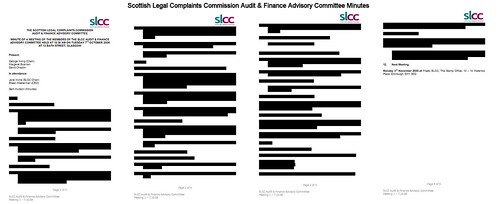
Audit & Finance Committee montage

Worse is to come in that while MacAskill's ministerial creation, the SLCC, will release information to the legal profession itself, and selected individuals, it now appears the SLCC have been found out to be apparently operating secret rules of information discrimination which are applied to those deemed too dangerous to the issue of handling legal regulation & complaints against Scottish solicitors, ensuring certain individuals do not receive compromising material.

One of those individuals on the SLCC's exclusion list, appears to be me, where as you can see from the following FOI release, papers which were released to others, were completely censored in response to my own FOI request, which has now been passed to the FOI Commissioner, Kevin Dunion for investigation.

Legal complaints quango releases rules discussion to some friends in the legal world :

SLCC 7&8th April Meeting  Original Page 1SLCC 7&8th April Meeting  Original Page 2SLCC 7&8th April Meeting  Original Page 3SLCC 7&8th April Meeting  Original Page 4SLCC 7&8th April Meeting  Original Page 5SLCC 7&8th April Meeting  Original Page 6

… and the censored versions released to enquiring law journalists:

SLCC 7&8th April Meeting Blanked out Page 1SLCC 7&8th April Meeting Blanked out Page 2SLCC 7&8th April Meeting Blanked out Page 3SLCC 7&8th April Meeting Blanked out Page 4SLCC 7&8th April Meeting Blanked out Page 5SLCC 7&8th April Meeting Blanked out Page 6

So as you can see its full steam backwards for MacAskill’s Scottish Legal Complaints Commission, as censorship seems to be the preferred order of the day, supported by elements of the Scottish Government’s Justice Department who themselves see the information I requested, as far too damaging to release to the public.

A source at the Justice Department earlier this week condemned the SLCC’s attempts to maintain public secrecy over it’s less than perfect operations : “I don’t think anyone out there would believe the SLCC is an honest organisation when it stoops to this kind of level – especially when they have had so much of the taxpayer’s money to begin with”.

Jane IrvineJane Irvine, SLCC Chairman. I asked Jane Irvine, the SLCC’s Chairman for an explanation as to why FOIs were censored when the information had already been released to others, but so far, no ‘official’ statement has been given on why the SLCC felt secrecy should be maintained, at a significant use of black ink to conceal the workings of the quango from the general public, who have paid some £2 million pounds plus into the commission on the Justice Secretary’s say so …

It seems therefore, the SLCC has been forced to resort to secrecy, due to the many ongoing scandals surrounding the beleaguered lawyers complaints quango, scandals which have seen the likes of stories reporting that the quango’s members have concentrated more on pensions benefits & insurance protection than actual case handling.

You can read two of my recent ‘hot topic’ articles on the going’s on at the SLCC here :

Complaints Commission 'unfit for purpose' as secret meetings with insurers & pensions take focus over consumer protection against crooked lawyers

MacAskill silent on taxpayers £2million 'write off' to lawyers quango as Complaints boss reveals Law Society defaulted on levies

A legal insider reported to me that my recent reports on the faulty operation of the SLCC, “it was felt internally PC had caused considerable damage to the organisation's public credibility to the point where attempts must be made to prevent this kind of news from reaching the public in the future”.

Fine then, and as that appears to amount to an attempt of censorship, I decided to test it out and ask some difficult questions of the Scottish Government today on another article I am writing about, concerning Mr MacAskill’s recent announced ‘consultation” on legal services in Scotland.

MacAskill tight lippedJustice Minister concerned over quango revelations ? : I was given what appears to be a hostile rebuke by the Scottish Government’s Press Officials today, who now refuse to talk to me over apparent concerns I am revealing highly sensitive issues which appear to show a concerted attempt by the present Scottish Government to undermine independent regulation of the Scottish legal services market.

Also up for criticism seems to be my damaging portrayal of last week’s announcement by Mr MacAskill of the Legal Profession Bill consultation, which, rather than actually widening ordinary Scots access to justice, will leave the legal services market as restricted and monopolised by the Law Society of Scotland as before, rather than allowing Scots to chose their own legal representatives.

I shared the Scottish Government’s Press comments to me today with a friend who is an Editor of one of Scotland’s national newspapers, his comments were : “Well Peter what do you expect ? You are doing a lot of good reporting on complicated legal issues and they will have to try and shut you up. At least you can’t be bought off with threats of ‘pulling the ads’ or a threatening telephone call from the Law Society !”.

Thanks for the vote of confidence .. I hope some of the media will take up the issues and continue to expose the lack of justice when it comes to dealing with those who supposedly represent justice !

You can read through some of the censored FOI releases, and compare them with some of the uncensored material (in Acrobat .pdf format) from Mr MacAskill’s less than open Scottish Legal Complaints Commission here :

Monday, July 07, 2008

Lawyers would like media to censor portrayals of legal profession as crooked, dishonest

Oh the pain of it - seeing oneself and one's profession portrayed as a money grabbing crooked club .. is just too much for some it seems, as one journalist suggests the legal profession 'work more closely' with the media.

Television often portrays society as it is … perhaps the legal profession would like to clean up its image and infamy which provokes such distasteful portrayals of lawyers as ‘crooked’ ?

The Scotsman reports :

Jennifer Veitch: Rough justice for legal profession on television

By Jennifer Veitch

SO, HAVE you been hooked by the coverage of the trial of the year yet?
No, I'm not talking about the BBC's controversial drama series, Criminal Justice – more of that later – but the bringing-to-book of River City's arch-villain, Archie Buchanan.

Dedicated followers of recent shenanigans in Shieldinch will know that
Archie finally appeared in the dock last week, after being accused of embezzling funds from his clients.

For those who aren't soap aficionados, the dastardly Archie had planned to abscond with his lover Niamh – another crooked lawyer who had blackmailed him and prompted the embezzling – but was hit over the head by his mum, Liz, and dumped over a cliff by his wife Gina and her sister Eileen, only to pop up again at New Year claiming to have lost his memory, the ability to shave, and insisting that everyone call him "Douglas".

Still with me? Do keep up.

It remains to be seen whether Archie/Douglas will actually be sent to jail – his lawyer Charlie Houston (also crooked, of course) has tried his best to suggest that the firm's other partners, Fi Kydd (the recently deceased lesbian alcoholic) and Gerry McGrade (currently recovering from a cocaine-induced stroke) might have had their fingers in the sweetie jar.

So far, so ridiculous, you might think.

Yet the fact that all three solicitors in this fictional firm have had such a raw deal from the River City scriptwriters does beg the question: why are lawyers such a common inspiration for TV villains?

After all, it's not just the Scottish soap world that portrays the profession in a rather dim light. Viewers of EastEnders are probably still having nightmares about that scary solicitor Stella Crawford tormenting poor little Ben Mitchell.

No doubt it will soon be time for her bleach blonde boss, Ritchie Scott, to pop up yet again to save Ben's daddy, Phil, or his uncle Grant, from prison.

Earlier this year, Glenn Close portrayed the deliciously amoral litigator Patty Hewes in Damages, whose dastardly machinations prompted her rival to blow his brains out over her plush office carpet.

But it has taken last week's BBC drama series, Criminal Justice, to really touch a nerve with the legal profession.

The show's array of unethical practitioners, including the bitchy barrister Alison Slaughter, who bullies her hapless client, Ben Coulter, actually prompted the Bar Council to lodge a rather strongly worded complaint with the corporation.

Chairman Timothy Dutton QC said: "Naturally, some licence needs to be taken for dramatic purposes. But Criminal Justice goes too far. Criminal justice is not a game and it is a travesty to suggest that practitioners see it in that way."

It is perhaps fair to say that Dutton didn't find the show all that entertaining.

I have to say that even as a lowly law student, I have found that my smattering of knowledge about the legal systems of Scotland and England is beginning to ruin my enjoyment of televisual legal drama.

For example, at Archie's trial in last week's River City, his solicitor was wearing not only a wig, he was making an opening speech and addressing the judge, not the jury.

Of course you have to suspend your disbelief when watching soaps, but such jarring inaccuracies, which could easily have been checked, don't help.

When the public's perceptions of the legal system must be shaped by what they see on TV, can the profession do anything about it?

Perhaps lawyers could do more to influence what is being written for the small screen by improving the way that the profession communicates with the media and, by extension, the public.

For example, it is surely not beyond the professional bodies to club together to provide a website that explains – in plain English – how the different legal systems of the UK are structured and the basic legal procedures that are followed in the criminal and civil courts.

Scriptwriters, editors, journalists and anyone interested in the law could use it as an easy-to-follow resource.

And then there would be no excuse for Auntie's bloomers ruining our enjoyment of Archie getting his comeuppance.


Tuesday, February 26, 2008

Lawyers demand critics be silenced, vent bitterness against reforms

Having a chip on the shoulder is one thing, but having a chip on the shoulder the size of ice shelf is something else, as Donald Reid vents his frustration over critics of reforms to the legal profession.

Its good to have opinions of course, although Mr Reid ends his piece with a plea that victims of the legal profession itself should not be allowed to have any input into the debate on reforms to the legal profession itself.

Go tell the same to rape and abuse victims Mr Reid - ban them from having any say in reforms to the law too ...

The Scotsman reports :

Lawyers … and other reptiles

By Donald Reid

IDLING on The Scotsman website, I found some feedback on my last piece. I'm so flattered. It's all hate mail.

One correspondent, however, inadvertently gave me a good bit of advice, namely to read Jess Brallier's (now out-of-print) book, Lawyers and Other Reptiles. It's wonderful. I have always loved lawyer jokes and quotes, and this book is full of them. All I can say is the title is a bit hard on reptiles. What have they done to be cast as bedfellows with the lowest form of living scum?

My favourite quote so far is from the New Yorker: "I told you that you should've got yourself some legal advice before running to a lawyer."

It hints at several of the reasons why such expressed vitriol against our noble profession so proliferates. The first reason is money. Lawyers are expensive. If you "run" to a lawyer, the chances are you'll get a bill, and a hefty one at that. No-one likes bills, and an easy way to externalise this dislike is to blame the biller rather than the billed. In the excitement of their initial consultation, I find it hard to get clients to face the financial reality of their principled crusade, or their precarious venture. I have to tell them that the practice of the law, and the results obtainable, are not necessarily the same as the client's perception of justice.

Yes you should think twice before going to a lawyer. The fact that the money you pay him or her is substantially to cover the overhead he or she has to maintain in order to give you the service you seek is not an easy swallow. After all, you've seen his/her Merc.

But the quote is tellingly ironic as well. How can you get legal advice on whether to get legal advice? The fact is you can't really. Lawyers are no doubt expensive, time-consuming, anxiety-broking vultures (now we're insulting scavenging birds), but they are necessary. You can't avoid them. One of the ironic outcomes of the political drive to treat lawyers like bad children is the enormous length of the engagement letter that solicitors are now required to issue before any work is done. My tongue is not entirely in my cheek when I say that clients should perhaps get a different lawyer to check over the intended lawyer's terms and conditions. But who checks the terms and conditions of the checker?

I think the main reason for books such as Brallier's is this: lawyers don't deserve it, and the lawyer-bashers know this full well. The jokes are only funny because they are jokes. They express the angers and frustrations of litigants and clients precisely because their lawyers have not caused the problems, but rather have earned a living out of them. I can understand the epithet "parasite" but it can be used, with greater or lesser justification, upon all sectors of service industry. Yes, there are some very serious cases of bent, greedy and self-serving lawyers. But if these were the norm, rather than demonstrably the tiny minority, the whole joke culture would collapse. After all, no-one makes jokes or collects pithy sayings about perverts or genocidal maniacs, bankers or any other persons held to be truly reprehensible. Do they?

These critics will say that they are the victims of bad lawyers whose actions have damaged or ruined them beyond any joking. Perhaps they are right; certainly they are humourless; but they are a minority. They allege corruption at the very core of the profession and its governing body, which is surely beyond credibility. Is it right to allow them such influence in current demands for reform? There may be a few rotten apples. But the tree is still healthy.

I'm not joking.

Thursday, November 08, 2007

Contempt charge over solicitor's post trial comments is 'an attack on freedom of speech'

Lord Calloway's treatment of comments made by solicitor Ameer Anwar after the trial of a client, found guilty & sentenced to eight years on terrorism offences, by way of passing the issue to the courts to decide if said comments merit a contempt of court charge, are being seen by some as an attack on freedom of speech.

The Scotsman reports :

Treatment of terror trial lawyer 'is an attack on freedom of speech'

HAMISH MACDONELL SCOTTISH POLITICAL EDITOR

A HIGH-POWERED coalition of politicians, writers and lawyers last night joined forces to warn that the courts' treatment of human rights lawyer Aamer Anwar represented an "attack on freedom of speech".

Iain Banks, the author, joined veteran Labour politician Tony Benn, Respect MP George Galloway, Bashir Mann, convener of the Muslim Council of Scotland and human rights lawyer Gareth Pierce, among others, to appeal to the courts to stop pursuing Mr Anwar.

Mr Anwar is facing a contempt of court charge for speaking out against a series of verdicts in September. His client, Mohammed Atif Siddique, had been jailed for eight years on terrorism offences and Mr Anwar reacted by issuing a strong press statement outside the court.

Mr Anwar claimed that the verdicts were a tragedy for justice and freedom of speech and alleged that his client had not received a fair trial.

Lord Carloway looked into Mr Anwar's remarks and decided that the lawyer had made an "unjustified attack on almost every area of the trial process".

The judge then passed the issue to the courts to decide whether Mr Anwar had been guilty of contempt of court.

If Mr Anwar is found to have been in contempt of court, he could be jailed - a prospect which has angered many senior politicians and lawyers.

Last night, a number of high-profile Scots came together in Mr Anwar's defence and sent a letter to The Scotsman warning the courts could cause considerable damage to freedom of speech in Scotland if the case against Mr Anwar was pursued.

The authors of the letter stated: "The possibility that Aamer Anwar may have to face contempt charges is deeply worrying and is an unprecedented attack on freedom of speech."

The letter writers praised Mr Anwar's work as a human rights lawyer over the last few years and added: "If the judiciary is successful in silencing Aamer Anwar, then this will have far-reaching consequences.

"We should all be very worried if the effect of this case is to make lawyers reluctant to carry out this work for fear of the repercussions.

"We believe that the current attack on Aamer Anwar is an attack on the fundamental right of all lawyers to represent their clients."

Last night, Mr Anwar said he could not comment while the issue was still "under judicial consideration".

However, in a further development which will increase the pressure on the judiciary over the case, Margo MacDonald, the independent MSP, said that she wanted to raise the issue in the Scottish Parliament, probably in the form of a parliamentary motion, if she was allowed to do so.

Ms MacDonald said: "I am concerned about any restraint being put on lawyers who speak their minds, give their opinions or campaign against injustice - and Aamer Anwar does all three.

"When he spoke after the guilty verdict against Mr Siddique, he was speaking on behalf of his client and I think it might have been wise for everyone to take account of the heightened sensitivity at that time."

Monday, August 27, 2007

Law Society of Scotland computers identified in Wikipedia censorship war

Much too complicated a story for our meager resources at Scottish Law Reporter, but Peter Cherbi delivers the explanation on why the Law Society of Scotland decided to censor it's Wikipedia entry and edit out critical paragraphs

It is of course, disappointing to see the Law Society identified as a censor of free speech yet again, but indicative of the style of leadership at Drumsheugh Gardens which seems to prohibit debate at any cost.

Wikipedia manipulated & censored by Law Society of Scotland in propaganda war against critics & reformers

It's taken the media long enough to report something I covered 18 months ago back in February 2006 where the Law Society of Scotland were censoring out information on it's Wikipedia entry, critical of it's operation as self regulator of the legal profession.

Today, Scotland on Sunday and a few other newspapers finally report on the story, giving the Law Society's editing out the critical information as part of the legal profession's media campaign against criticism of it's ways, which we all know to be less than honest ....

Here are some screenshots of the changing face of the Law Society of Scotland's Wikipedia entry.

This is how the Law Society of Scotland's Wikipedia entry looked with some more truthful details before the censorship started ...

Wikipedia Law Society page before edit

Next up follows the edited version by the Law Society, and the current version, which can be seen to omit any criticism at all of how the Law Society functinos or deals with complaints against it's members ...

Wikipedia Law Society page after  ediit law society of Scotland wikipedia 26 August 2007

Of course, manipulating the media is a common thing for the Law Society of Scotland when it comes to news reports critical of it's performance as a self regulator of complaints against it's own member solicitors ... and sometimes officials have even resorted to threatening journalists careers if they report too many (or any) stories of client complaints against legal firms in Scotland.

I've covered some of those media manipulation stories by the legal profession in previous articles here :

Law Society of Scotland actively censors the Scottish Press to kill articles on crooked lawyers

Scottish Legal Profession censors the Press to kill off bad publicity - Part II

Law Society of Scotland claims success in gagging the press over Herald newspaper revelations of secret case memos

Scottish media opinion being manipulated by legal profession against Parliamentary reforms of LPLA Bill ?

... with some more upsetting articles on Law Society manipulation of the popular media here ;

Scots Law Chiefs turn hostile on consumer organisation in propaganda war against deregulation of legal services markets.

Lawyers complaints system thought to have caused intimidation of clients for years

Lawyers protests over low legal aid fees revealed to be fake as Law Society's own research points to increase

Chief Executive of the Law Society of Scotland branded a liar after FSA denies claims of intervention to block complaints body

Law Society of Scotland threatens Court challenge against Scottish Executive over LPLA legal reform Bill

Scottish legal profession campaigns against open debate in Scottish Parliament on independent regulation of complaints against lawyers

Fairly obvious then, after reading through those previous articles, the legal profession in Scotland hates criticism of itself and prizes control over the media and free speech as being one of it's main weapons against reforming the complaints system against lawyers and keeping the public silent on the culture of injustice within the legal profession itself.

For my own part, I am reminded of the Law Society of Scotland's special briefings against myself and other critics of the legal profession on the same night & day after their Chief Accountant was attacked, apparently in a 'hit' arranged by crooked lawyer(s) ...surprisingly .. yet to be caught some 19 months after the 'hit' took place ...

Scotland on Sunday reported that story here : Cash laundering link to law chief stabbing and dutifully mentioned my blog - which was only 3 weeks old but apparently causing consternation in the Law Society HQ and other parts of the Scottish legal profession...

Cash Link to Law Chief Stabbing Scotland on Sunday 29 January 2006

Senior officials at the Law Society called a few journalists and asked them in for 'special briefings' to be given files on myself & others, with orders to run stories alleging it was critics of the legal profession who were responsible for the attack on Mr Cumming, and that they should be immediately silenced, websites taken offline - and one identified official - very senior in rank at the Law Society, allegedly said to a journalist that [named] campaigners against crooked lawyers "should be locked up in Guantanamo Bay for a bit of torture" ... something the press sadly decided to leave out ... it would have made a good headline though as the journalist knows himself - something like Law Boss calls for critics to be tortured ? ...

Here's today's Scotland on Sunday article on the Law Society of Scotland up to it's usual tricks of media manipulation ...

Wikipedia warzone

MURDO MACLEOD

THEY are the Wikipedia timewasters, anonymous cyber-vandals who use one of the internet's greatest resources to abuse rivals, spread gossip and cause widespread confusion.

But Scotland on Sunday can today reveal that many of the culprits are staff at major companies, councils, government departments and other organisations who spend their time sabotaging the free online encyclopaedia rather than working.

From the Prince of Wales's official residence to British Airways, the Ministry of Defence and Aberdeenshire Council, this newspaper has established precise numbers, times and details of how employees used work computers to anonymously edit Wikipedia articles, often to spread abuse, bigotry and outright nonsense.

Among the biggest Wikipedia timewasters in the UK appear to be MoD employees, who were responsible for more than 4,600 anonymous edits in the past four years.

They included 100 entries about Formula One, contributions about the 1970s cartoon series Captain Caveman and several disparaging references to Scots Pop Idol winner Michelle McManus.

MoD computers have been used to edit the entry on the Faslane Peace Camp, claiming the submarine base was vital to the local economy and that if the nuclear base left, the campaigners would find something else to complain about.

Wikipedia was founded in 2001 and currently has two million English articles, all of them written and edited by computer users around the world. The site has always been vulnerable to abuse and last week it emerged the CIA had edited articles including those relating to casualty levels in Iraq.

Many malicious editors of Wikipedia try to mask their identities, but using sophisticated scanning software, Scotland on Sunday has traced thousands of edits back to hundreds of organisations, several of which last night launched investigations to track down those responsible.

Computers operated by Scotland's local authorities were used in 16,190 Wikipedia edits in the past four years.

Top of the league is Aberdeenshire with 2,004 changes. They were used to make no fewer than 12 entries about Jaffa Cakes, along with a comment that all "neds" are "gay".

In second place was South Lanarkshire Council, which recorded 1,505 Wiki edits, including obscene and bigoted remarks about Celtic FC and Rangers owner David Murray.

Perhaps one of the most surprising sources for anonymous Wiki editing is Clarence House, the home of the Prince of Wales. An enthusiastic linguist at the royal residence added a paragraph on the usage of the Australian greeting "G'Day", while another remarked on the sexuality of a Surrey businessman.

In addition, a computer on the network of the Scottish Criminal Cases Review Commission was used to make comments about Rangers, calling them "the world's most bigoted football club". And a Scottish Parliament computer was used to change Tory MSP Phil Gallie's date of birth to 1839.

British Airways computers have been used to make anonymous edits about the 2005 Helios air crash north of Athens, which killed all 121 on board. Meanwhile, a BBC computer was used to remove criticism of its iPlayer software.

Computers at the Law Society of Scotland have been used to make anonymous edits which removed a paragraph which was critical of them.

Wikipedia is also being used as a weapon in disputes within organisations. Lesley Hinds, chairwoman of NHS Health Scotland, was criticised in an anonymous, ungrammatical and misspelt Wikipedia posting which came from an NHS Health Scotland computer.

It said: "Health Scotland is under the relocation review which will most likely see it being moved from Edinburgh to Glasgow. Lesley Hinds appears to support this which is surprising since she is meant to represent the interests of Edinburgh in her Lord Provost role. When this policy was released it was expected she would of resigned is [sic] protest but instead has continued working in both jobs."

Mike Emmott, employee relations adviser with the Chartered Institute of Personnel and Development, said: "Most employers would expect anyone wanting to edit Wikipedia to do it at home and in their own time. Employers are not Attila the Huns who will ban everything and they accept a little bit of give and take, but it is hard to see how vandalising Wikipedia pages is acceptable. A ringleader for this kind of activity could even find themselves being dismissed."

Andre Coner, a consultant with computer security firm Commissum, said: "It's a myth that everyone is anonymous online. They're not. In order for you to send and receive information, the various servers need to know where your computer is."

Spokeswomen for both the MoD and the Scottish Parliament said they were aware of the issue and were looking into the origin of the offending edits. A BA spokesman said it was also looking into the issue.

And South Lanarkshire Council pledged "appropriate action".

However, a spokeswoman for Aberdeenshire Council suggested that most of the edits would have come from youngsters using school computers and members of the public using library machines.

A spokeswoman for the Law Society of Scotland said it had removed inaccurate and outdated criticism and that since the number beside the edit could be identified as belonging to the Law Society it could not be construed as anonymous.

Cut and run

January 31, 2006, 6.58pm

A user going by the name of Sjharte, who identifies himself as being an Edinburgh-based lawyer, added the following paragraph to the Wikipedia page on the Law Society of Scotland.

"There has been criticism of the Law Society of Scotland from some sections of the Scottish public citing the level of complaints by members of the public against Scottish solicitors. The Scottish Executive has instituted studies into regulation of the Scottish legal profession."

February 8, 7.11pm

An anonymous writer deletes the paragraph. The edit can be traced to a computer on the Law Society of Scotland network.

7.46pm

Another Wikipedia editor, under the name of ALoan, restores the critical paragraph.

February 17, 1.22pm

Again an anonymous writer deletes the paragraph of criticism. Again from a computer on the Law Society of Scotland network.

February 19, 10.17pm

"Sjharte" edits the page to bring back the paragraph.

February 23, 5.27pm

Again an edit is made from a Law Society computer.

8.27pm

"Sjharte" puts the critical paragraph back in.

March 24, 3.18pm

Anonymous but traceable. The Law Society computer is used to wipe out the paragraph again.

9.29pm

Sjharte has another go, adding the critical paragraph and branding the anonymous edits as "vandalism".

April 13 ,2006, 10.56am

Resistance is useless. Again the criticism is blanked out. Again the edit is anonymous. Again it can be traced to a Law Society of Scotland computer.


WHAT IS WIKISCANNER?


Wikiscanner allows users to hunt for anonymous edits which came from computers at the networks of various organisations.

This is the basic Wikiscanner link, enjoy: http://wikiscanner.virgil.gr/

This is the link which takes the user to all the anonymous edits originating with computers on Ministry of Defence networks:
http://wikiscanner.virgil.gr/f.php?ip2=82.110.109.192-255&nolimit=1

This is the link which takes the user to all the anonymous edits originating with computers on British Airways networks:
http://wikiscanner.virgil.gr/f.php?ip1=163.166.150.0-255&ip2=163.166.137.0-255&ip3=163.166.0.0-136.255

This is for the Scottish Criminal Cases Review Commission:

http://wikiscanner.virgil.gr/f.php?ip1=82.70.48.72-79