Showing posts with label Scottish Information Commissioner. Show all posts

Wednesday, September 28, 2016

Appeals to Scottish Information Commissioner up 14% as concerns remain over Scots public bodies handling of Freedom of Information requests

Report – improvements in Transparency not universal. A REPORT on how Scottish public bodies handle Freedom of Information requests has found while most appear to be improving at dealing with FOI, improvements are not universal and there remain significant concerns.

The Annual Report 2015/16 published by the Scottish Information Commissioner - reveals that 540 appeals were made to the Commissioner in 2015/16 - a 14% increase on last year. The report also discloses there were 68,000 FOI requests made in Scotland in the last year.

The Freedom of Information Act (Scotland) 2002 has now been in force since 2005 – yet significant gaps in transparency remain and increasingly complex & creative ways in which public bodies dodge Freedom of Information requests – have risen.

Speaking at the launch of her 2015/16 Annual Report, Scottish Information Commissioner Rosemary Agnew said: "These signs of improvement in FOI performance are welcome. As my report demonstrates, the majority of information requests result in some or all of the information being disclosed. It is encouraging that only a very small proportion of requests are appealed. I'm also pleased that the number of appeals made about a failure to respond has fallen significantly following our work to tackle this issue.

"Unfortunately, our experience is that these improvements are not universal. There is still a clear gap between the best performing authorities and those who lag behind. As you will see from my report, my focus still lies in promoting good practice and intervening when I find poor practice."

The Commissioner's 2015/16 Annual Report reveals that:

  • 540 appeals were made to the Commissioner in 2015/16. This is a 14% increase on last year, but is down from 578 appeals two years ago.
  • The number of "failure to respond" appeals fell significantly in 2015/16. The Commissioner accepted 61 "failure to respond" cases for investigation. This was 16% of her investigation caseload - a significant reduction on the 25% three years ago.
  • Appeals volumes fell for some sectors. Most notably for the Scottish Government and its agencies, where appeals fell from 23% of the Commissioner's caseload in 2014/15 to 15% this year (from 111 appeals to 84).
  • Appeal volumes increased for others. Appeals in relation to non-departmental public bodies increased, from 6% of the Commissioner's caseload in 2014/15 to 10% this year. This was largely due to an increase in Scottish Fire and Rescue Service appeals, from 1 in 2014/15 to 12 this year.
    There was also a significant increase in appeals about requests made to Police Scotland. They rose from 9% of appeals last year to 15% in 2015/16 (from 45 to 81 appeals). 3% of Police Scotland's information requests resulted in an appeal, compared to a national average of 0.8%.
  • 61% of appeals came from members of the public. The media accounted for 20% of appeals, and prisoners 7%.
  • 60% of the Commissioner's decisions found wholly or partially in the requester's favour. If an authority has incorrectly withheld information, the Commissioner's decision will require it to be released.
  • 73% of cases were resolved by the Commissioner within 4 months.
  • Public authorities reported receiving 68,156 information requests in 2015/16. This is a 2% increase on 2014/15. Figures are reported in a publicly-available database set up by the Commissioner. The portal data also shows that 75% of requests resulted in some or all of the requested information being provided, and that public authorities themselves are reporting 35% fewer 'failures to respond' to information requests since 2014/15.
  • Public awareness of FOI is at its highest ever level, at 85%. This is up from 84% last year, and 78% in September 2013.
  • FOI awareness is lower amongst 16-24 year olds. Ipsos MORI polling also revealed lower awareness amongst young people. The Commissioner is working in partnership with Young Scot to address this lower awareness.

Rosemary Agnew added: "We are also conscious of how important it is we perform well. We appreciate that it is frustrating for requesters, who have already had to wait for several months, if our investigations are unnecessarily protracted. It can also be stressful for authorities who have to wait for the outcome of our investigations. When someone has to appeal, we work hard to resolve the issue quickly, with 73% of our cases taking no more than four months, and 60% of our decisions finding wholly or partly in the requester's favour. The focus now must be on making it work even better at every stage."

Towards a transparent Scotland:

  • Public awareness of FOI reached its highest ever level, at 85%
  • We reduced "failure to respond" appeals by 24% (and by 35% from 2013/14)
  • We issued our highest ever number of EIR decisions, at 61
  • 540 appeals were made to the Commissioner - a 14% increase on last year
  • We resolved 20% of our cases without the need for a decision
  • We met or exceeded almost all of our investigation performance targets
  • We answered 100% of our own FOI requests within 20 working days
  • We delivered 3 regional roadshows, with 97% of participants rating them as "good" or "excellent".

Appeal statistics - by region and sector:

The Commissioner's 2015/16 Annual Report and Accounts (above) has details of the appeals received by the Commissioner over the year.  The spreadsheets below have more information on all of the appeals received by the Commissioner since 2005, when FOI law came into effect in Scotland. 

You can view this information by either geographic region, or by public authority sector (central government, local government, health, etc).

 Public authority tables by Region 2005 - 2016 (Excel - 1.98MB)

Public authority tables by Sector 2005 - 2016 (Excel - 1.94MB)

Got a story to share on your experiences with Freedom of Information and public bodies, or contact with the Scottish Information Commissioner? Tell us at scottishlawreporter@gmail.com

Thursday, October 09, 2014

FOI FREEDOM TO LIE: Scots Info Commissioner admits Data Protection breaches as journalist's call to reform Freedom of Information Act ditched by Holyrood

Axe Honesty First: SIC Rosemary Agnew broke Data Protection Act THE high-powered watchdog responsible for promoting and enforcing Scotland’s freedom of information laws has issued an unreserved apology to a retired Borders journalist after admitting three breaches of the Data Protection Act (DPA).

But the Scottish Information Commissioner (SIC) will not be hit with any form of punishment after an investigation by the England-based Information Commissioner (IC) concluded there was no need for further action.

A second complaint against the SIC by former Scotsman reporter Bill Chisholm, from Jedburgh, that the Commissioner - Rosemary Agnew released around 200 pages of personal correspondence to a Freedom of Information (FOI) requester without asking his permission and without even consulting him was not upheld.

Earlier this year Mr Chisholm submitted Petition PE1512 Amendments to the Freedom of Information Scotland Act 2002 to the Scottish Parliament seeking an addition to the Freedom of Information Scotland Act (FOISA) which would force councils and other public authorities to provide “honest and accurate” responses to requests for information.

Holyrood evidence session with Bill Chisholm on reform to Freedom of Information

But the petition met stiff opposition from Ms Agnew’s office and from the Scottish Government. They both claimed there was no need for amended legislation, and in any case Mr Chisholm’s proposals would be “unworkable”.

Last week MSPs on the Public Petitions Committee agreed unanimously to close down Mr Chisholm’s petition which means it will receive no further consideration.

While his petition was still “live” Mr Chisholm decided not to disclose details of the SIC’s triple breach of the Data Protection Act which occurred earlier this year.

Ms Agnew, who gave evidence to the Petitions Committee in May, received a FOI request asking for copies of all documents and email exchanges relating to Mr Chisholm’s petition. The extensive collection of correspondence was released by the SIC, and the contents were subsequently published on an internet website.

But in providing the information to the requester Ms Agnew’s office failed to redact Mr Chisholm’s email address from three separate documents, thereby committing clear breaches of the Data Protection regulations.

Before lodging a complaint with the SIC Mr Chisholm rang the Information Commissioner’s Helpline to ask for their opinion and advice. He said: “At this stage I did not identify the SIC as the offender. I was told several times by the person who took my call that the public authority concerned had no right to release any information without contacting me first. I was advised to seek an explanation before asking for an investigation.”

The SIC subsequently carried out its own internal enquiry which confirmed the three breaches of the Data Protection Act but dismissed the rest of the complaint.

Margaret Keyse, Head of Enforcement at the SIC told Mr Chisholm in a written decision: “I examined the information we disclosed and what we told the requester. It was clear from the response that we intended to withhold your email address, because it was your personal data and because we considered that disclosure would breach the DPA. We redacted it in most places where it appeared but, through a clerical error, we failed to redact it in three places.

“I am very sorry that this has happened and apologise unreservedly for any distress this has caused you. Although the accidental disclosure was the result of a clerical error rather than procedural failure, the Scottish Information Commissioner will also reflect on this and incorporate any lessons learned in the review of our internal procedures for responding to information requests.”

Mr Chisholm was not satisfied with the outcome of the SIC investigation, and referred the case to the ICO for their consideration.

In their decision notice, sent to Mr Chisholm at the weekend, the ICO’s Lead Case Officer Rachel Webster said: “Given that your email address should have been withheld it appears unlikely that the SIC has complied with the Data Protection Act 1998. In particular it appears that the SIC has contravened the First Principle by disclosing your email address.

“The SIC has explained in their response the changes they have made to their procedures to try and prevent any future reoccurrence of this problem. I am satisfied at the changes they have made and do not anticipate taking any further action at this time.”

But Ms Webster went on to say that the SIC had not broken FOI rules by passing the 200 pages of correspondence to the requester.

She wrote: “It appears from the information provided that the personal data released by the SIC was limited. As such it is likely in this case given that some of your personal data was already in the public domain as a result of your petition and that the SIC believed it was in the legitimate interests of the requester to be provided with the information that contained your personal data, in our view, it was reasonable for this to be released.

Commenting on the outcome Mr Chisholm said: “The advice I was given by the ICO in June appears to have been flawed or plain wrong. I maintain that the SIC had no right to issue correspondence I had with them without even having the courtesy to inform me beforehand.

“The decision by the ICO to take no further action simply emphasises the point I was trying to make via my petition. Public authorities can flout FOISA or breach the DPA without fear of punishment. The entire system lacks credibility, but there are too many vested interests to allow any strengthening of the law.”

Sunday, May 18, 2014

Scottish Information Commissioner rejects call for honesty in Holyrood petition proposal to amend law on inaccurate & false FOI responses from public bodies

Scots FOI Chief rejects calls for honesty over lack of powers to deal with inaccurate data from public bodies. APPEARING to reject calls for new ‘honesty powers’ to deal with Scots public authorities who provide dishonest or inaccurate data in response to Freedom of Information requests, Scottish Information Commissioner Rosemary Agnew has claimed Scotland’s FOI system is "open, transparent and honest" – even though evidence & case examples suggest public authorities are releasing dodgy data in an attempt to avoid public scrutiny of their activities.

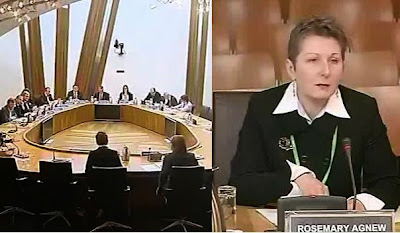
The Scottish Information Commissioner made the claims to MSPs during her appearance on 6 May at the Scottish Parliament’s Public Petitions Committee where msps considered proposals to give the Commissioner new powers to deal with dishonest public bodies, contained in Petition PE1512 Amendments to the Freedom of Information Scotland Act 2002 filed by retired Scotsman journalist Mr William Chisholm.

The petition calls on the Scottish Parliament to urge the Scottish Government to strengthen the Freedom of Information (Scotland) Act 202 by requiring public bodies to provide full and accurate information in all responses to FOI requesters, and to extend the powers of the Scottish Information Commissioner (SIC) to enable the Commissioner to investigate complaints alleging erroneous responses. The petition also seeks powers to impose monetary penalties on any public body which breaches the amended FOISA regulations on accuracy.

Scottish Information Commissioner Evidence to MSPs on Petition PE1512 6th May 2014

Giving evidence to MSPs, Ms Agnew appeared to suggest a variety of reasons could lead to the information being requested not being released, such as public bodies not searching for the information in the correct place, inaccuracies in public records, or the information not being held by the public body.

Throughout the debate Ms Agnew appeared unable to justify her opposition to the petition’s proposals to bring requirements of honesty into the FOI framework, giving at times rambling answers to questions put by msps. The full meeting minutes are available here: Official Report of meeting 6 May 2014 (434KB pdf)

The Commissioner went on to tell the Committee tthe most effective way to deal with FOIs was "getting it right first time"  - although many FOI requesters including some msps who use Freedom of Information to find out what Scottish public authorities are really up to, may find Ms Agnew’s claim on this point hard to swallow.

Commenting on Ms Agnew’s appearance before MSPs, the Petitioner, Mr Chisholm said: “In her evidence to the Committee on May 6th, the Scottish Information Commissioner (SIC) said she saw no need to amend the current legislation. This, despite the fact that 12,000 responders to FOI requests may be breaking the law in any given year, and even though there has not been a single prosecution or conviction under Section 65 of FOISA.”

Mr Chisholm continued: “The SIC also explained that an individual with a complaint about the accuracy of a FOI response had recourse under other Acts as well as FOISA. But it would seem much more logical for all issues relating to Freedom of Information to be monitored and governed by FOISA. How is that individual supposed to negotiate the labyrinth of legislation which seems to have been concocted to protect local authorities, Government agencies, and other organisations covered by FOISA?”

Concerns have also been raised over the Information Commissioner’s policy towards public authorities who provide dodgy information in response to FOI requests after it emerged in responses to the petition that not one single prosecution of a public body breaching FOI laws has taken place – even though the Information  Commissioner and Police Scotland identified 10 cases where there was evidence that suggested a section 65 offence may have been committed.

Concluding the debate. the  Committee agreed to defer consideration of the petition to a future meeting to allow time for the  Scottish  Government  to  respond  and  to  enable  the  petitioner  to comment on evidence received.

Scottish Law Reporter previously reported on the Petition 1512 here : MSPs to question Scottish Information Commissioner over proposal to amend law on inaccurate & false FOI responses from public bodies

REVEALED: BRIEFING TO UNDERMINE PETITION

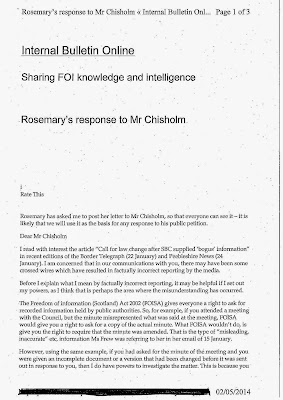
Disclosures obtained under Freedom of Information legislation and forwarded to Scottish Law Reporter have revealed how the Scottish Information Commissioner held discussions on how to respond to queries from the Scottish Parliament’s Petitions Committee on calls to integrate honesty clauses into the FOI Act.

In documents published today, the SIC is seen to discuss with staff as to how to reply to MSPs questions on the petition, and

Apparently concerned of queries over the lack of prosecutions of FOI violations, the SIC staff express concerns as noted : “Rosemary is to give evidence to the committee on Tuesday 6 May. One of the issues we expect will come up is about the number of s65 cases we've had. IT s a bit of a side issue (Mr Chisholm's concern appears to be about whether he was provided all information in scope of his request, though we never did have an application to investigate), but it was raised during Tuesday's committee meeting as one of the tests of whether FOISA is working.”

Commenting on the documents earlier today, transparency campaigners described the SIC’s efforts to wind up Mr Chisholm’s petition as “outrageous”.

A legal insider added “Considering the Information Commissioner has already admitted she does not have powers to investigate cases of dishonest FOI responses, perhaps the SIC may better focus its obvious influence in ensuring an honesty clause is attached to the Freedom of Information Scotland Act rather than expending so much effort to kill off the idea that anyone making an FOI request should expect honesty in responses from public bodies funded by taxpayers.”

Tuesday, April 29, 2014

MSPs to question Scottish Information Commissioner over proposal to amend law on inaccurate & false FOI responses from public bodies

Scots FOI Chief to face grilling over lack of powers to deal with inaccurate data from public bodies. SCOTTISH Information Commissioner Rosemary Agnew has been called to appear before Holyrood’s Public Petitions Committee on Tuesday 6th May 2014 to face questions from MSPs on revelations there are no powers in the Freedom of Information (Scotland) Act 2002 to deal with inaccurate or false data provided by Scots public authorities in response to Freedom of Information requests.

The astonishing lapse of any effective legislation to deal with false, misleading or inaccurate responses to Freedom of Information requests has come to light during msps consideration last week of Petition PE1512 Amendments to the Freedom of Information Scotland Act 2002 filed by retired Scotsman journalist William Chisholm.

The petition calls on the Scottish Parliament to urge the Scottish Government to strengthen the Freedom of Information (Scotland) Act 202 by requiring public bodies to provide full and accurate information in all responses to FOI requesters, and to extend the powers of the Scottish Information Commissioner (SIC) to enable the Commissioner to investigate complaints alleging erroneous responses. The SIC should also be able to impose monetary penalties on any public body which breaches the amended FOISA regulations on accuracy.

Petition PE01512 Amendments to the Freedom of Information Scotland Act 2002 Scottish Parliament

Speaking to MSPs, Mr Chisholm said : “Until my recent experience with a freedom of information request to my local authority, I was unaware that organisations that are covered by the 2002 act are not duty-bound to give accurate and honest answers or to supply up to-date information. Surely without such a built-in caveat the FOI system’s credibility is diminished. On the other hand, if accuracy and honesty were guaranteed, the FOI system would become an even more powerful weapon in the quest for knowledge”

After challenging responses by his local authority on varying figures provided for legal costs associated with an appeal against an ICO fine, Mr Chisholm told msps he had contacted his local msp who then approached Nicola Sturgeon, the Cabinet Secretary for Infrastructure, investment & Cities on the matter.

Mr Chisholm told members of the Petitions Committee:  “Nicola Sturgeon, in her capacity as the Cabinet Secretary for Infrastructure, Investment and Cities, confirmed in correspondence with me and my constituency MSP that information supplied in FOI requests is not necessarily accurate or up to date. Furthermore, if a requester is dissatisfied because he or she believes that the information is misleading, inaccurate, contains errors or is otherwise deficient, that is not something that the commissioner can address in terms of FOISA”

Mr Chisholm said the experience left him with the feeling that the FOI system could be undermined if public authorities failed to supply truthful responses to requesters, so he decided to pursue the issue with the Scottish Information Commissioner and beyond. He also revealed to msps that one study suggests that up to one in four FOI responses could be inaccurate.

During the debate, John Wilson MSP (SNP) took note of the fact the Scottish Information Commissioner had suggested MSPs close the petition on its first hearing – this came after Rosemary Agnew filed a highly irregular pre-emptive letter PE1512/A: Scottish Information Commissioner Letter of 15 April 2014 (80KB pdf) against the petition before msps had even heard the petitioner or called for evidence.

Mr Wilson went on to say: “ I am intrigued by the figures, which I note are from the Bureau of Investigative Journalism. In your submission, you say that they suggest that almost one in four responses to FOI requests contains inaccurate information. Following on from Mr Brodie’s point, if, as the Information Commissioner suggested, we do not change the legislation, how do we ensure that local authorities provide accurate information to those who make an FOI request?”

Responding to Mr Wilson’s enquiries, Mr Chisholm said: “There is no mention of accuracy in the 2002 act. I think that the SPICe briefing confirms that. Would it not be advantageous for FOISA to include a written guarantee of accuracy?”

John Wilson added: “I agree with you on that. One of the major issues that I have identified is the way in which local authorities record the decision-making process. As we discussed during our consideration of the petitions regarding decisions made at board meetings of the police and fire and rescue services, unless accurate or detailed minutes are taken of decisions and who participated in them, it becomes impossible for individuals making an FOI request to be provided with the accurate information that they require. Local authorities do not record the decision making process in an accurate manner.”

Since last week’s hearing in which it was suggested msps ask the Scottish Information Commissioner to attend an evidence session, and give statistics on how many prosecutions there have been for false information provided in response to Freedom of Information requests, the Scottish Information Commissioner has been forced to admit in a further written response PE1512/C: Scottish Information Commissioner Letter of 25 April 2014 (27KB pdf) there have been no prosecutions since the FOI act came into force in Scotland.

A letter from Ms Agnew to msps stated: “Since FOI law came into effect in January 2005, the Commissioner and Police Scotland have identified 10 cases where there was evidence that suggested a section 65 offence may have been committed.”

Section 65 of FOISA applies when: (i)  information has been requested from a Scottish public authority i.e., a request has been made for that information and it is held by the authority, and (ii)  the requester is entitled to be given the information (or any part of it).

Section 65 applies to the public authority and any person who is employed by, is an officer of or is under the direction of the authority (e.g. a contractor).

Section 65 makes it a criminal offence to intentionally alter, deface, block, erase, destroy or conceal a record (i.e. information) which is the subject of a request in order to prevent the information being disclosed following the receipt of the request.

Anyone found guilty of an offence would be subject to summary conviction and may be fined personally up to £5,000. Both of which are serious sanctions. 

Rosemary Agnew told MSPs in her latest letter: “Since FOI law came into effect in January 2005, the Commissioner and Police Scotland have identified 10 cases where there was evidence that suggested a section 65 offence may have been committed.”

However, Ms Agnew was forced to admit: “In none of the cases was it possible to raise criminal proceedings because of the restrictive timescales set out in FOISA”

In response to the fact no prosecutions have resulted, Mr Chisholm has now told the Public Petitions Committee in a further submission PE1512/D: Petitioner Letter of 28 April 2014 (73KB pdf) : “The information now available from the Commissioner concerning the operation of section 65 of the Freedom of Information (Scotland) Act (FOISA) proves conclusively that current arrangements for the investigation and punishment of wrongdoing by public authorities is neither robust nor fit for purpose.”

“It is both astonishing and deeply concerning to learn there has not been a single successful prosecution since the Act became law in 2005 even though research suggests inaccurate and therefore misleading responses are being supplied to FOI requesters in up to one in four cases. Only ten complaints were even considered for potential legal proceedings and all of those were abandoned after becoming entangled in time limits.”

“The fact that complaints made under Section 65 of FOISA have NEVER resulted in a single criminal case being taken to court – let alone a conviction - certainly suggests the legislation is weighted heavily in favour of public bodies rather than the general public.”

Petition PE1512 will be heard again on Tuesday 6 May 2014 at the Scottish Parliament.

Thursday, February 02, 2012

Agnew gets FOI role, Holyrood msps discuss secret plan ‘to bulldoze FOI decisions database’ in move to wipe past findings by Information Commissioner

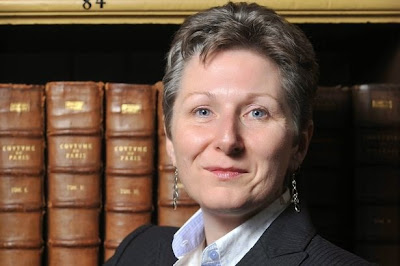
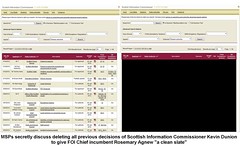
msps plan to delete foi decisionsRosemary Agnew ditches lawyer complaints to become Information Commissioner. THE DAY AFTER msps at the Scottish Parliament unanimously approved the appointment of a lawyer complaints boss Rosemary Agnew as the new Scottish Information Commissioner, Holyrood insiders have spilled the beans on a SECRET PLAN discussed by msps who are suspicious of Freedom of Information laws TO WIPE the current itspublicknowledge website of the Scottish Information Commissioner including all of the outgoing Commissioner Kevin Dunion’s previous decisions and replace it with a new website in what is described by one Scottish Parliament employee as “a bid to bring relief for some at Holyrood and give Rosemary a clean slate”.

A whistle-blowing member of staff at the Scottish Parliament who has been involved in the secret discussions for the website redesign told Scottish Law Reporter this morning the secret plan to wipe all decisions was being discussed between only a few msps amid concerns of protests from the public & media over the content of Mr Dunion’s current website and all previous decisions being lost or being made deliberately difficult for members of the public to access in any replacement website.

The insider confirmed : “The plan being discussed is for the entire FOI website to be taken offline while officials & msps argue over the redesign which ‘may’ archive only short summaries of selected cases or more probably remove all content of Mr Dunion’s previous investigations & decisions to give the new Scottish Information Commissioner a fresh start.”

The source continued : “So you can expect to see decisions such as the one revealing the SPCB’s attempt to cover up MSP David McLetchie’s theft of expenses for taxi journeys to be deleted from public view. I’m sure he and the Scottish Conservatives will be very happy at this prospect, as will a few other msps caught out by Mr Dunion’s decisions on poorly handled foi requests.”

FOI decicions website to be deleted - msps secret plansBefore & After Dunion ? MSPs plan to delete all previous decisions on Info Commissioner’s website. Many of Mr Dunion’s decisions on cases brought to his attention during his two terms of office serving as Scotland’s Information Commissioner since 2002, have revealed scandals involving politicians expenses, hospital deaths, failings of Police Forces around the country, failures of the justice system including Scotland’s Prosecutors & justice bodies such as the Crown Office, and Rosemary Agnew’s current employment base, the Scottish Legal Complaints Commission which has been investigated on at least TWENTY OCCASIONS by the Scottish Information Commissioner and his team, with most decisions going against the SLCC during Agnew’s term as Head of Investigations and then its Chief Executive.

Further decisions of Mr Dunion and his investigations team have led to exposures of scandals involving local authorities & the Scottish Government, with some cases bitterly fought in the courts by lawyers acting for the Scottish Government in attempts to block publication of material sought by members of the public & media.

An insider said today “It will be a disaster for openness & transparency if msps went ahead and bulldozed Mr Dunion’s entire work over the past decade.”

A law reform campaigner speaking to Scottish Law Reporter earlier today said : “Msps and the Scottish Government must be preparing to hide something big to appoint someone with a record of being anti-foi. What are the big political issues around just now ? independence referendum and a crap justice system with more criminals in it than outside it .. couldn't be a coincidence of course.”

Internal notes on discussions on the planned changes to the Information Commissioner’s current website shown to a journalist staggeringly reveal one msp wants the new website to be handled by the same team who handled the ‘redesign’ of the Scottish Parliament’s E-Petitions website, which has been purposely kept offline for nearly a year out of fears football fans may use it to lodge e-petitions to challenge the Scottish Government’s controversial anti bigotry law, the Offensive Behaviour at Football and Threatening Communications (Scotland) Bill. Scottish Law Reporter covered the year long loss of the E-Petitions website due to sectarian fears, HERE

Meanwhile, msps were at pains to portray their choice of Information Commissioner, Ms Agnew as a step in the right direction.

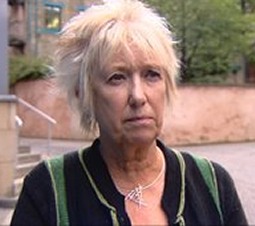
Justice Committee Convener Christine Grahame Christine Grahame MSP who has been caught out before via foi requests and was recently accused by a former employee of allegedly making sectarian jibes against fellow msps and alleged expenses fiddling, released a statement on Agnew’s appointment claiming : "The commissioner's role is an important one. The commissioner is responsible for enforcing and promoting Scotland's freedom of information laws which give people anywhere in the world access to information held by more than 10,000 public authorities in Scotland."

She added: "Rosemary Agnew will bring to the post a range of skills and experience, including an understanding of the challenges freedom of information presents to those seeking and providing information. I believe Rosemary Agnew will prove to be an effective and fair commissioner who will bring to the post enthusiasm and a determination to continue to ensure that the freedom of information regime in Scotland remains highly regarded throughout the world."

Christine Grahame also sat on the secret closed-to-the-public all women msp only selection panel which gave Agnew the £78,000 a year plus expenses job for a SIX YEAR TERM. Grahame introduced the motion in the Parliament herself to require msps to vote for her choice. “S4M-01865 Christine Grahame on behalf of the Selection Panel: Appointment of the Scottish Information Commissioner—That the Parliament nominates Rosemary Agnew to Her Majesty The Queen, for appointment as the Scottish Information Commissioner.”

Carole Ewart, co-convener of the Campaign for Freedom of Information in Scotland said: "We congratulate Ms Agnew on her appointment, and look forward to continuing working with the Commissioner's office to develop and promote this important legislation. The Scottish Information Commissioner is a key figure in the success of FOI and, as FOI is at a pivotal stage in Scotland, we would like to see her continuing the positive developments her predecessor has established."

A journalist from a national newspaper branded the comments by msps & alleged FOI campaigners as “barmy” and pointed to the number of decisions taken by the Scottish Information Commissioner “to rebuke” Agnew’s handling of FOI requests as evidence the incumbent for Mr Dunion’s job appears to be anti-foi and against transparency & accountability.

Whether Ms Agnew chooses to promote Freedom of Information by continuing Mr Dunion’s demands for FOI to be safeguarded & expanded, or simply decides to allow public bodies, politicians and others to keep their secrets to themselves, remains to be seen.

Wednesday, January 11, 2012

SHAMELESS : Scottish Legal Complaints Commission’s Chief Exec Rosemary Agnew in running for Freedom of Information Commissioner post

Scotland’s new Information Commissioner for the next EIGHT YEARS ? SLCC Chief Exec Rosemary Agnew is tipped by some to replace Kevin Dunion, yet others question her openness credentials after SLCC widely abused FOI REVELATIONS in the media this week report Rosemary Agnew, the current Chief Executive of the Scottish Legal Complaints Commission (SLCC), who is one of the candidates favoured to replace the outgoing Kevin Dunion for the position of Scottish Information Commissioner, has been ‘rebuked’ on at least FIVE OCCASIONS by the Information Commissioner for withholding information to the extent the SLCC has been named in a league of shame of public bodies which openly flout Freedom of Information laws.

From further reports it transpires Ms Agnew had also shockingly used FOI exemptions refuse the release of key data on how much compensation was paid to clients of solicitors, while Scottish Parliament officials conducted interviews for the key FOI post which will give the candidate a position in protecting information rights in Scotland for the next EIGHT YEARS.

The Scottish Legal Complaints Commission has not issued any statement so far on what effect Ms Agnew’s decision to stand for the FOI role will have on the SLCC, which has already lost an earlier Chief Executive, Eileen Masterman in mysterious circumstances which where also covered up from Freedom of Information requests made by journalists after revelations Ms Masterman had negotiated a large PAY OFF which was personally sanctioned by Justice Secretary Kenny MacAskill.

If Ms Agnew gets the post, the SLCC will have to recruit its THIRD CHIEF EXECUTIVE IN THREE YEARS, an issue which has raised concerns among consumer groups & the legal profession about the ability of the law complaints regulator to do its job properly.

During Ms Agnew’s term at the Scottish Legal Complaints Commission, firstly as Head of Investigations and then taking over the role of Chief Executive upon the demise of Eileen Masterman, the SLCC has been the subject of multiple investigations by the Scottish Information Commissioner, most of which have gone against the SLCC who frequently sought to cover up its workings and information which identified massive failings within the quango, along with bitter personal feuds between its board members who openly turned on members of the public & journalists in secret email exchanges which also featured in the media. Ms Agnew was also reported to have refused to monitor individual claims against the Law Society of Scotland’s Master Policy, a matter reported by Scots law blog Diary of Injustice, HERE.

Reported in the Daily Record newspaper earlier this week :

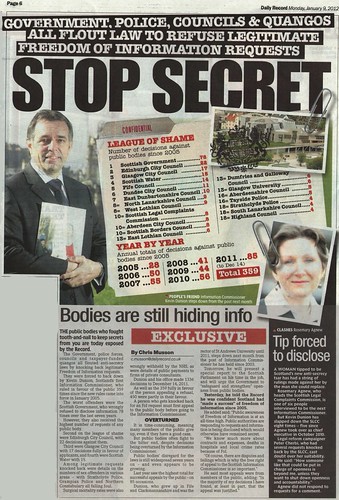
stop secret Daily Record 9 January 2012STOP SECRET : Revealed: Government, police & local councils all among public bodies who flouted anti-secrecy laws

Jan 9 2012 Exclusive by Chris Musson

TIP FORCED TO DISCLOSE

A WOMAN tipped to be Scotland's new anti-secrecy tsar has had a string of rulings made against her by the man she could replace.

Rosemary Agnew, who heads the Scottish Legal Complaints Commission, is one of six people interviewed to be the next Information Commissioner. But Kevin Dunion has slapped down the SLCC eight times - five since Agnew took over as Chief Executive in October 2010.

Legal Reform campaigner Peter Cherbi, who had several requests knocked back by the SLCC, cast doubt over her suitability. He said : "How someone like that could be put in charge of openness is beyond me, unless they want to shut down openness and accountability."

Agnew did not respond to requests for a comment.

THE public bodies who fought tooth-and-nail to keep secrets from you are today exposed by the Record. The Government, police forces, councils and taxpayer-funded quangos all flouted anti-secrecy laws by knocking back legitimate Freedom of Information requests. They were forced to back down by Kevin Dunion, Scotland’s first Information Commissioner, who ruled in favour of the public 359 times since the new rules came into force in January 2005.

The worst offenders were the Scottish Government, who wrongly refused to disclose ­information 78 times over the last seven years. However, they also received the highest number of requests of any public body. Second on the league of shame were Edinburgh City Council, with 22 decisions against them. Third were Glasgow City Council with 17 decisions fully in favour of applicants, and fourth were Scottish Water with 15.

Among legitimate requests knocked back were details on the numbers of sex offenders in various areas – with Strathclyde Police, Grampian Police and Northern Constabulary all falling foul. Surgical mortality rates were also wrongly withheld by the NHS, as were details of public payments to firms of private consultants.

Dunion and his office made 1336 decisions to December 14, 2011. As well as the 359 fully in favour of the person appealing a refusal, 450 were partly in their favour.

A person who gets knocked back for an FoI request must first appeal to the public body before going to the Information Commissioner. It is time-consuming, meaning many members of the public give up, even if they have a good case.

But public bodies often fight to the bitter end, despite decisions being overturned by the ­Information Commissioner. Public bodies’ disregard for the laws is still widespread seven years on – and even appears to be growing. Last year saw the highest total for successful appeals by the public – on 85 occasions.

Dunion, who grew up in Fife and Clackmannanshire and was the rector of St Andrews University until 2011, steps down next month from the post of ­Information Commissioner he has held since 2003. Tomorrow, he will present a special report to the Scottish ­Parliament on his time in the job, and will urge the Government to “safeguard and strengthen” openness from public bodies.

Yesterday, he told the Record he was confident Scotland had “made a success” of freedom of information since 2005. He added said: “Public awareness of Freedom of Information is at an all-time high. Public authorities are responding to requests and information is being disclosed which would otherwise have remained secret. “We know much more about contracts and expenses, deaths in hospitals and local crime rates because of FoI. “Of course, there are disputes and failings which is why the free right of appeal to the Scottish Information Commissioner is so important.”

He said most appeals were from members of the public, adding: “In the majority of my decisions I have found, at least in part, that the appeal was justified.”

Tuesday, January 10, 2012

Outgoing Information Commissioner Kevin Dunion urges Scottish Parliament to “Safeguard Freedom of Information Rights”

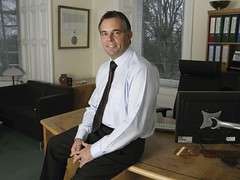
Kevin DunionOutgoing Information Commissioner Kevin Dunion urges Holyrood to safeguard information rights. THE outgoing Scottish Information Commissioner, Kevin Dunion, who was appointed to the post in 2003 and reappointed for a second term in 2008, will lay a Special Report before the Scottish Parliament entitled Informing the Future -The State of Freedom of Information in Scotland. Afterwards he will address the Justice Committee on the measures which he believes should be taken to safeguard and strengthen rights to information in Scotland. The full report by Mr Dunion to the Parliament can be downloaded here : Special Report to the Scottish Parliament 2012 (pdf - 724 kB)

This is the first time that a departing Parliamentary officeholder has formally made a submission to Parliament reflecting on their full term in office.In his final report, the Commissioner recommends that:

Additional bodies should be designated under FOISA to ensure rights follow the public pound.

Charges which deter or exclude requesters must be avoided.

The Commissioner should be empowered to take evidence under oath.

The Commissioner should have discretion over considering late submissions to his investigations by public authorities.

Timescales for bringing prosecutions under section 65 (offence of destroying information after a request) should be extended.

FOISA should be altered to expressly exclude environmental information so it can be dealt with solely under the Environmental Information (Scotland) Regulations 2004 (the EIRs).

Provisions relating to charging for information under publication schemes should be clarified.

The Commissioner concludes that, overall, the state of freedom of information in Scotland is still strong. Public awareness of FOI rights is at an all time high and public authorities are generally complying with their obligations. However he warns that appeals against authorities are rising sharply, with appeals for 2011/12 projected to be 25% up on 2010/11. Increasingly, the Commissioner's decisions are finding that authorities have failed to deal with requests correctly.

The Commissioner also makes a final call for action to Ministers to use their powers to designate arm's length organisations, such as local authority trusts and private contractors, which now increasingly provide public services and facilities such as education, health, sports and leisure.

Mr Dunion said: "It is testimony to the effect of FOI that information on important matters such as public sector contracts, hospital acquired infections and school closures has not only been disclosed but proactively published. This success may be undermined if the right to information is lost when service delivery changes. It is nearly ten years since Parliament was told that powers to designate additional bodies such as local authority trusts and private contractors would be used. Disappointingly, successive administrations have failed to make good on this despite opinion polls showing that the public is strongly in favour of such action."

The Commissioner rejects suggestions that FOI is a burden and points out that Scotland is in danger of falling behind other countries, including the rest of the UK, saying: "The view that FOI is an intolerable regulatory burden on authorities turns the clock back 20 years and is not supported by evidence. Alternative measures such as codes of practice and voluntary charters have been shown not to work effectively – often because there is no capacity for a Commissioner to enforce compliance and hear appeals. Designation is not just about extending the reach of FOISA, but safeguarding vital rights to information."

The UK Government has already made its first designation order and is consulting with nearly 400 other bodies.The Commissioner's report recommends that Ministers should proceed with designation of those bodies already consulted in Scotland and a rolling review of designation be instituted to ensure rights to information keep pace with changes in the delivery of public services.

The Special Report sets out a number of other recommendations to clarify and strengthen FOISA, only one of which is being addressed by the Freedom of Information (Amendment)(Scotland) Bill which was announced by Ministers on 16 December 2011.

Mr Dunion said : "I believe my Special Report is particularly timely given the current consultation by the Scottish Government on a Freedom of Information (Amendment)(Scotland) Bill, and as an early contribution to the Government's intended consultation on a Transparency Agenda for Scotland in 2012."