Showing posts with label SNP. Show all posts

Friday, October 09, 2015

TRIAL BALLOON: Lord Advocate deflects calls for inquiry on Crown Office handling of mortgage fraud allegations against solicitor who represented MP Michelle Thomson

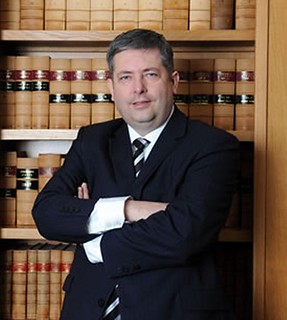
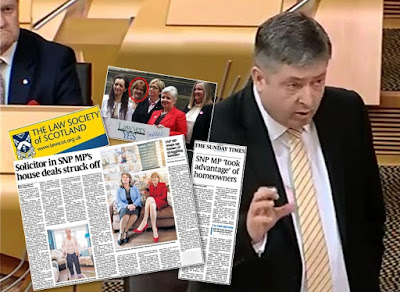
‘Unconvincing’ Lord Advocate raises fears of cover up. DURING one of the worst performances ever by a Lord Advocate before the Scottish Parliament – top prosecutor Frank Mulholland said he did not think there should be an inquiry into the handling of an investigation of a lawyer who was struck off over property deals involving SNP MP Michelle Thomson.

Responding to questions on when the Crown Office & Procurator Fiscal Service (COPFS) was informed of allegations of mortgage fraud involving solicitor Christopher Hales – Frank Mulholland told MSPs that he does not believe there should be an inquiry into when prosecutors knew and how the case has since been handled - after it emerged the Law Society briefly informed the Crown Office of the ‘issue’ in December 2014.

Hales, who once listed his occupation as “Police Constable” – and is now struck off by the Scottish Solicitors Discipline Tribunal from working as a solicitor - handled numerous property deals for his client – SNP MP Michelle Thomson. Mr Hales acted for Ms Thomson before she was elected as an SNP MP.

According to a ruling by the Scottish Solicitors’ Discipline Tribunal, a full version of which has been published by the Sunday Times, Mr Hales failed to provide key information to mortgage lenders in breach of guidelines designed to prevent fraud in numerous cases.

In the Scottish Parliament on Thursday, Labour MSP Jackie Baillie asked Mr Mulholland about the timeline in the case.

During the 10 minute session, Lord Advocate Frank Mulholland presented a timeline of events as the Crown Office saw it:

18 December, 2014 - The issue of solicitor Christopher Hales was raised "informally" by the Law Society of Scotland with the Crown Office. Neither the clients nor properties were named.

28 April, 2015 - The issue was raised again and it was noted that the matter of referral to the Crown Office was still under consideration by the Law Society. Neither the clients nor properties were named.

1 July, 2015 - The Crown was advised by the Law Society that it was required to obtain authorisation from its Guarantee Fund Sub Committee to formally refer the case.

3 July, 2015 - Referral was received by the Crown following the required authorisation. Documents were handed over to the Crown Office and in those documents the names of clients and properties were disclosed.

9 July, 2015 - A formal referral was made to the Crown Office and instructions were issued to Police Scotland.

Frank Mulholland  questioned by MSPs about when the Crown Office was first notified of allegations of mortgage fraud against Christopher Hales.

Mr Mulholland said: "As the Crown has made clear on a number of occasions, the case of Christopher Hales was first brought to its attention by the Law Society of Scotland at a meeting on 18 December, 2014."

Ms Baillie asked if Mr Mulholland believed there should be an investigation into the processing of information between the Law Society and the Crown Office.

She asked if he would order such an inquiry, given that there may have been "additional opportunities for alleged mortgage fraud" due to the delay.

Mr Mulholland responded: "I don't have the power to order an inquiry, and I don't think there should be an inquiry."

He said Police Scotland were instructed to investigate the allegations on 3 July 2015 and formally issued officers to do so on 9 July.

He said the issue was raised at routine quarterly meetings between the Law Society and the Crown Office.

Mr Mullholland said the Crown Office was first made aware on 18 December 2014 that the case was under consideration for referral. The issue was raised again on 28 April.
Image copyright PA Image caption Ms Thomson denies acting illegally

Mr Mulholland added: "The first time the Crown was made aware of the identity of the clients and the properties, was the 3rd of July."

Mulholland was also asked by Jackie Baillie if the Crown Office had begun any Proceeds of Crime actions against those involved.

Embarrassingly for the Lord Advocate, and appearing to have little clue as to the sequence of events, he responded “not yet”.

Police Scotland launched an inquiry only after the Crown Office was finally handed the detailed case files in the Hales case by the Law Society, some seven months from the day it first alerted prosecutors to the case.
Hales was banned from the legal profession in May 2014 over 13 property deals linked to Thomson and her business partners. The transactions involved “back to back” sales, where homes – often owned by vulnerable people – were bought at below full market value and then resold at far higher prices, in some cases on the same day; where large cash sums were transferred between the parties involved; where mortgage loans were sought that were higher than the price paid for the home, and where higher prices than those actually paid were recorded in the Scottish land registry.

Mortgage companies involved in those transactions, including Lloyds, which gave loans through its subsidiary Birmingham Midshires, and Virgin Money, which now owns the mortgage book for Northern Rock, which lent money for one sale, have confirmed they are now in contact with the police.

The Sunday Times disclosed it had submitted new evidence of an unusual property transaction to Police Scotland detectives after a couple who sold a home to Thomson alleged they had £32,000 deducted from the sale proceeds to pay off a loan they had no knowledge of.

The solicitor involved in that transaction, James Craig, had been found guilty of professional misconduct in February 2014 by the Scottish Solicitors Disciplinary Tribunal (SSDT), the body that struck off Hales three months later, and fined £2,500 for breaching money laundering regulations. There was no evidence that Craig acted improperly in the case reported by the Sunday Times.

The Sunday Mail reported that a second lawyer named in the SSDT judgment on Hales called Christopher Tulips, whose firms Strefford Tulips was involved in several deals for Thomson’s firm M&F Property Solutions, had also been censured and fined £2,500 for his role in back-to-back property deals. The published ruling by the SSDT on Tulips is anonymised, so it remains unclear whether his case involved transactions linked to Thomson.

Last week, the Law Society said its director of financial compliance Ian Messer "informally" raised concerns about the case of Mr Hales during two separate meetings with prosecutors in December 2014 and April 2015.

However, the Law Society did not "formally" submit its evidence to the Crown until July 2015, two months after Ms Thomson was elected SNP MP for Edinburgh West.

Law Society chief executive Lorna Jack gave an "absolute and categorical assurance" last week that the election played no part in the timings of the case.

She said Mr Messer would have seen Ms Thomson's name in the unredacted report into Mr Hales but may not have been aware she was a Westminster candidate.

The secretary to the Law Society committee that struck Mr Hales off, Sheila Kirkwood, is said to be a personal acquaintance of Ms Thomson with close links to the SNP.

Lorna Jack has pledged to look more deeply into Ms Kirkwood's links with Ms Thomson, but said she has received an assurance the secretary was unaware of the MP's links to Mr Hales until she read about it in media reports.

Ms Thomson is linked to 13 transactions Mr Hales conducted in 2010-11 where properties were said to have been bought cheaply from clients looking for a quick sale and then sold at a huge mark-up on the same day.

Complicated "cashback" deals were said to have been used to artificially inflate property prices in order to secure bigger loans from lenders.

Ms Thomson has denied acting illegally.Ms Thomson has surrendered the SNP party whip and has also stood down as the party's business spokeswoman at Westminster until the investigation into Mr Hales has concluded.

Previously, First Minister Nicola Sturgeon denied having any prior knowledge of a scandal which led to one of her most prominent MPs stepping down from the party.

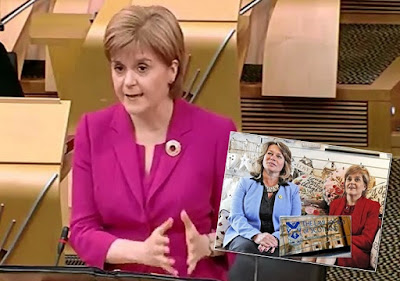
During First Minister’s Questions last Thursday, 1 October,  Nicola Sturgeon said in response to questions that "serious issues" had been raised around the conduct of Michelle Thomson. The First Minister said that a police investigation should be allowed to take its course.

NO HOMELESSNESS FOR POLITICIANS:

The House of Commons Register of Members’ Interests lists 16 SNP MPs as holding property interests from which most receive rental income.

Under the rules, Members of Parliament are required to list a property if (i) its value is over £100,000 and (ii) if they receive rental income of at least £10,000 a year.

Tasmina Ahmed-Sheikh(Ochil and South Perthshire): Three flats in Glasgow and a house in Kingussie, Highlands and Islands (i/ii).

Richard Arkless(Dumfries and Galloway): A house in Broxburn, West Lothian, and a flat in Glasgow (i/ii).

Ian Blackford(Ross, Skye and Lochaber): Croft, including two holiday rental properties on the Isle of Skye (i/ii). A house in Lanark (i),

Deidre Brock(Edinburgh North and Leith): A half share in two Edinburgh flats (i).

Lisa Cameron(East Kilbride, Strathaven and Lesmahagow): A house in South Lanarkshire (i/ii). Five residential and holiday let apartments in Edinburgh and South Lanarkshire (i/ii).

Martyn Day(Linlithgow and East Falkirk): A house in West Lothian (i).

Patricia Gibson(North Ayrshire and Arran): A flat in Edinburgh (i).

Calum Kerr(Berwickshire, Roxburgh and Selkirk): A house in Wester Ross (i/ii).

Chris Law(Dundee West): A flat in Dundee (i) and a flat in Aberdeen (i).

Angus Brendan MacNeil(Na h-Eileanan an Iar): Jointly owns a house in Fort William plus a flat in Glasgow and a flat in London (i/ii).

Stuart McDonald(Cumbernauld, Kilsyth and Kirkintilloch East): A flat in East Dunbartonshire (i).

John McNally(Falkirk): Owns a hair salon, The Barber Shop, from which he receives £600 a month in rent.

John Nicolson(East Dunbartonshire): A terrace house in London’s Tower Hamlets (i/ii). He occasionally receives income for renting it out for photoshoots.

Steven Paterson(Stirling): A half share in a flat in Stirling (i).

Tommy Sheppard(Edinburgh East): Commercial premises and residential property in Edinburgh (i) owned by entertainment company Salt ‘n’ Sauce Promotions of which he is a shareholder.
Share article

Michelle Thomson(Edinburgh West): Two residential properties in Edinburgh, one in Falkirk, one on the Isle of Bute, one in East Calder, one in Stirling, one in Dollar, a half share of a property in Edinburgh and a quarter share of a property in Edinburgh (i/ii). She is a shareholder in the property management firm Your Property Shop.

Friday, October 02, 2015

First Minister says allegations involving struck off solicitor relating to property deals of SNP MP Michelle Thomson are “unacceptable if true”

First Minister at FMQs on claims about MP’s property deals. SCOTLAND’S First Minister told MSPs yesterday that allegations against an SNP MP would represent "completely unacceptable" behaviour if they are proven to be correct.

MP Michelle Thomson (SNP,Edinburgh West ) has been linked with property deals involving a solicitor – Christopher Hales - who has since been struck off by the Scottish Solicitors Discipline Tribunal (SSDT) in connection with 13 transactions in 2010 and 2011.

Speaking at First Minister's Questions, Ms Sturgeon said: "I said yesterday, I have said again today: the SNP had no prior knowledge of these issues.

Scottish Labour leader Kezia Dugdale said the issue was also a "moral matter" which she said had resulted in "vulnerable people being taken advantage of, as their homes are snapped up at knockdown prices".

Ms Sturgeon again insisted that she knew nothing of the allegations until they were reported by the Sunday Times.

She said: "I am in no doubt whatsoever in my mind that if the allegations - and again I stress the word allegations - are proven to be correct, they will represent behaviour that I find completely unacceptable."

The First Minister said it would be "unfair and inappropriate" to judge someone who maintains their innocence while an investigation was still ongoing.

She added: "But when we have all of the facts, when the investigation is concluded, I will take whatever decisions and whatever actions I deem necessary, but those decisions will be driven by facts and not by insinuation and the attempts of opposition parties to stir up political trouble and difficulty."

Ms Sturgeon also said it was "ridiculous" to suggest the SNP would allow a candidate to be put forward for election knowing there were "serious problems" over their integrity.

She added: "Our vetting procedures as a party are robust but we keep them under review, as I would hope every political party does.

"While we make all reasonable checks and ask all reasonable questions, by definition it is not reasonable to expect that matters of which we have no knowledge can be investigated."

First Minister's Questions re Michelle Thomson Scottish Parliament 1st October 2015

But Ms Dugdale accused the SNP leader of "running away" from Ms Thomson, who was the SNP's Westminster spokeswoman for business, innovation and skills and was heavily involved with the pro-independence Business for Scotland group ahead of last year's referendum.

She also said Ms Thomson had for the past two years "been right at the heart of everything the SNP stands for".

Ms Dugdale added: "I am not asking the first minister to comment on the specifics of a live investigation because I accept that criminal matters are for the police.

"But this is also a moral matter, and I would expect her to comment on that. What we have here is vulnerable families losing out for the financial gain of others.

"Vulnerable people being taken advantage of, as their homes are snapped up at knockdown prices. Can I ask the first minister, does she agree with me that profiteering from vulnerable families is just plain wrong?"

Ms Sturgeon responded: "Kezia Dugdale, although she disagrees with me, as she is entitled to do on a whole range of issues, I hope would accept that my commitment to social justice, and helping vulnerable people, like her's, is beyond any question."

Conservative leader Ruth Davidson questioned whether it was "believable" that no one in the SNP knew about the allegations.

She said: "We already know that the Crown Office and Police Scotland were asked whether they would investigate this case in July of last year.

"We know that the Law Society raised with the Crown Office in December.

"We know that journalists have been investigating it all summer and we know that the police were called in nearly three months ago.

"Yet the first minister is asking us to believe that nobody in the SNP, the party of government, from the constituency in Edinburgh West right up to the chief executive to the leader herself, knew anything about this until they read it in the paper almost two weeks ago."

In the decision issued by the Scottish Solicitors Discipline Tribunal (SSDT) which struck off Christopher Hales from the solicitors’ roll, the Tribunal came to a view “the solicitor must have been aware there was a possibility he was facilitating mortgage fraud.”

The decision stated: “The Tribunal had no hesitation in making a finding of professional misconduct. There were numerous breaches of the CML Handbook in respect of 13 different transactions involving an ongoing course of conduct which continued for a period of over one year. The Tribunal has made it clear on numerous occasions that institutional lenders are clients of Respondents in the same way as any other clients and are owed the same duties of care. The CML Handbook has been instituted to help prevent mortgage fraud and emphasise the reporting duties on the part of solicitors. In this case the Respondent had a clear duty to report the back to back transactions, cash backs, increases in prices and deposits being provided by a third party to the lender. These matters would have been very likely to have had a material effect on the lender's decision to lend. The Tribunal consider that the features of these transactions were such that the Respondent must have been aware that there was a possibility that he was facilitating mortgage fraud, whether or not this actually occurred. He generated fees on the basis of allowing this to occur. It must have been glaringly obvious to the Respondent that something was amiss when cash backs of £27,000 or £28,000 from the seller to the purchaser were involved.”

“There were so many breaches of the CML Handbook in these cases that the Respondent would have known that he did not have his client's authority to draw down the funds and accordingly the Tribunal also found it a breach of Rule 6 of the Accounts Rules. The Tribunal considered that not only did the Respondent fail to act in the best interests of his lender clients but he failed to act with the utmost propriety towards these lender clients. This is extremely damaging to the reputation of the legal profession.”

“The Tribunal took account of the Respondent's responses contained in the Executive Summary Report but did not consider that these provided any satisfactory explanation for what had happened. The Tribunal note that the Respondent has ceased practice and took account of the fact that the Respondent had cooperated by admitting the averments of fact, duty and misconduct. The Respondent however did not attend at the Tribunal to provide any mitigation in person.”

“In the whole circumstances, given the ongoing course of conduct, the large number of transactions involved, the Respondent's knowledge of the central role of Mrs A and Company 3, which should have set alarm bells ringing and the fact that this type of conduct is likely to bring the profession into disrepute, the Tribunal considered that it had no option other than to strike the Respondent's name from the Roll of Solicitors in Scotland.”

Prosecutors have instructed police to carry out an investigation into "alleged irregularities" relating to property deals in the year 2010/11 after the case was referred to the Crown Office by the Law Society of Scotland.

The society said concerns over potential criminal matters relating to the tribunal's findings were first raised "informally" with the Crown Office in December 2014, and then "formally" in July this year.

Ms Thomson's solicitor, Aamer Anwar, said in a statement released ahead of FMQs: "Michelle Thomson maintains that she has always acted within the law.

"In the interests of her constituents and her party she thought it best if she voluntarily withdrew from the party whip.

"There was no requirement for her to do so, even though she knew it would automatically lead to her suspension from the party. She did so in order to clear her name and return as quickly as possible to frontline politics.

"To that purpose we have contacted Police Scotland at Mrs Thomson's request advising them of her wish to assist with their investigation if, or when, they wish to speak to her."

Thursday, October 01, 2015

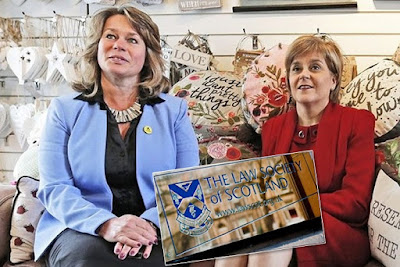
Conflict of Interest accusations hit Law Society of Scotland as employee who sat in on decision to refer SNP MP’s struck off solicitor to Crown Office is linked to pro-indy lawyer group

Sheila Kirkwood, a founding member of Lawyers for Yes. AN EMPLOYEE of the Law Society of Scotland who sat on a committee considering the case of a solicitor linked to SNP MP Michelle Thomson’s property dealings - was also a leading pro-independence activist.

And, papers reporting brief details of the meeting feature no declarations of interest by Kirkwood or any other members of the Committee which then decided to refer the matter to prosecutors.

Sheila Kirkwood, secretary of the same Guarantee Fund Sub-Committee which eventually took the decision to refer the matter of Christopher Hales to the Crown Office in July 2015 – four years after the event – has since been identified as a founding member of Lawyers for Yes – a pro-independence group set up ahead of the Scottish independence referendum held last September 2014.

Kirkwood also endorsed Michelle Thomson on her Facebook page.

Within the minute of the meeting in which Kirkwood was present as secretary of the Guarantee Fund Sub-Committee, there is no mention of any declarations of interests by members of the committee - including Kirkwood.

Facing calls to explain a significant & potential conflict of interest, Lorna Jack, Chief Executive of the Law Society of Scotland, said she was “confident there was no conflict of interest”.

Chief Executive of the Law Society of Scotland, Lorna Jack, issued the following statement at a press conference held at 3.15pm, 1 October 2015:

“The Law Society’s number one regulatory priority is to protect the public from any wrong doing by solicitors. As I have previously commented, following a routine inspection of the accounts of law firm Grigor Hales of Gorgie Road, Edinburgh in July 2011, we believed Christopher Hales had not met the required standards of professional conduct.

“We therefore took action to protect the public by suspending Mr Hale’s practising certificate in September 2011. There is a duty on us as a regulator to report suspicious activity quickly to the appropriate authorities. Such reports and timings or information about the report are confidential by law.

“I want to stress that Law Society employee Sheila Kirkwood has not acted unprofessionally or inappropriately at any time. Sheila is a hard-working, dedicated colleague. She had no involvement in taking papers on the Christopher Hales case to the Law Society Guarantee Fund sub-committee and in no way delayed these papers being taken to the committee. Sheila’s role as secretary to the committee is to write the minute.

“The names of Christopher Hales’s clients were not included in any Law Society papers that Sheila handled.  The first time Sheila realised Michelle Thomson was involved in the Christopher Hales case was from recent media reports.

“Sheila is entitled to her personal political views. The Law Society is a non-partisan organisation. However, we do not stop our staff from holding or expressing their own views in their personal lives.  People in Scotland are legally entitled to express their personal opinions.”

“I am confident there was no conflict of interest in relation to Sheila’s role at the Law Society.”

However – Lorna Jack could not explain why the minute of the meeting released by the Law Society (published below) contains no recusal or declaration of interest of those in attendance.

GUARANTEE FUND SUB COMMITTEE:

Minute of Meeting of the Guarantee Fund Society of Scotland held at 26 2 July 2015 at 9.30am

GRIGOR HALES, EDINBURGH - 20732

Date Considered 2 July 2015

Sub-Committee Members Present 6 solicitors; 5 non-solicitors

Papers considered by Sub-Committee None. This matter was the subject of a verbal report.

Background

The Sub Committee reminded itself that it had previously withdrawn the Practising Certificate of Mr Christopher Hales and that he had subsequently been struck off by the Scottish Solicitors Discipline Tribunal (SSDT). Mr Hales had been the sole partner at the firm which had also ceased. The Sub Committee were asked to consider whether comments made by the SSDT justified a referral of the matter by the Law Society of Scotland to the Crown Office.

Sub Committee's Deliberations

It was noted that the SSDT decision states that "Mr Hales must have been aware that there was a possibility that he was facilitating mortgage fraud" and that "it must have been glaringly obvious to the Respondent that something was amiss when cash backs of £27,000 or £28,000 from the seller to the purchaser were involved".

Sub Committee's Decision

The Sub Committee decided that given the statements made by the SSDT following a complaint arising from a Financial Compliance inspection, that the matter should be referred to the Crown Office for investigation.

Delegated Powers..

To refer the above matter to the Crown Office for investigation

The Guardian newspaper reported: The row over the official handling of the case deepened further after the Law Society confirmed that its head of investigations, Ian Messer, had received a detailed report from the Scottish Solicitors’ Discipline Tribunal (SSDT) naming Thomson, her husband Peter and Thomson’s business partner Frank Gilbride in July 2014.

Messer first informally told the Crown Office in December 2014 that Hales had been struck off by the SSDT for suspected mortgage fraud, during a routine quarterly meeting between the two organisations. Crown Office lawyers asked Messer to provide them with detailed case files but failed to get them.

At the next meeting on 28 April 2015 – a week before Thomson was elected as MP for Edinburgh West – the Crown Office asked again for the Hales case files. They were not submitted to the Crown Office until 3 July 2015; six days later, the Crown Office alerted fraud officers at Police Scotland, who launched a formal investigation.

Those fresh details emerged when the Law Society’s chief executive, Lorna Jack, took the unusual step of arranging a hurried press conference to defend her organisation’s handling of the affair, and the conduct of Sheila Kirkwood, who is secretary to the society guarantee fund sub-committee which handled the Hales case but had delayed handing the papers over to the Crown Office.

It emerged that Kirkwood was, with her husband and fellow solicitor Paul Kirkwood, a founder of the pro-independence campaign Lawyers for Yes, and as an active nationalist had attended dinners for Thomson’s pro-independence campaign Business for Scotland. Kirkwood had also “liked” Thomson on her Facebook page.

Jack insisted that Kirkwood had had no direct say over the Law Society’s handling of the case against Hales, but she admitted that no independent investigation had yet taken place into whether Kirkwood was aware that Thomson was linked to Hales’s property dealings.

Jack said she had taken Kirkwood at her word that she first became aware of that link when Thomson was named in the media earlier in September.

“I want to stress that Law Society employee Sheila Kirkwood has not acted unprofessionally or inappropriately at any time,” Jack said. “Shelia is a hard-working, dedicated colleague. [I] am confident there was no conflict of interest in relation to Sheila’s role at the Law Society.”

Although it took until July 2015 before the Crown Office and police were handed the case files against Hales, Jack confirmed that the Law Society first became alerted to Hales’s mortgage dealings with Thomson in July 2011 during a routine inspection of his firm’s books.

He was suspended in September 2011 “to protect the public”, she said. “The Law Society’s No 1 regulatory priority is to protect the public from any wrongdoing by solicitors,” she added.

Jack implied too that the Law Society would also have alerted the police to any suspicions because of its legal duties under the Proceeds of Crime Act, but she repeatedly refused to elaborate on whether and when that had been done with the Hales case.

“Under the Proceeds of Crime Act, there is a duty on us as a regulator to report suspicious activity quickly to the appropriate authorities. Such reports and timings or information about the report are confidential by law,” she said.

The “Guarantee Fund” of the Law Society of Scotland is possibly one of the murkiest self protection mechanisms operated by the legal profession’s in-house self regulator.

The Guarantee Fund is tasked with paying out compensation to victims of corrupt or rogue solicitors.

However, the Guarantee Fund has racked up numerous accusations of obstructive tactics and deliberate falsification of facts to prevent financially ruined clients securing full compensation for their losses to rogue Scottish solicitors.

Claims against the Guarantee Fund are known to be in the millions of pounds annually.

Shockingly, the percentage of compensation eventually secured as a payment from the fund where some cases can take 5-10 years to be heard - can be as little as 5% to 10% of a client’s total financial losses to rogue solicitors.

The ‘aims’ and functions of the Guarantee Fund sub-Committee as claimed by the Law Society of Scotland, but rarely fulfilled in reality, are:

  • oversee the fulfilment of the statutory obligations of the Law Society of Scotland regarding the Guarantee Fund and financial compliance
  • ensure that risks to the Guarantee Fund are managed to an agreed and acceptable level
  • ensure that Guarantee Fund operations are in accordance with stated Guarantee Fund policy
  • protect the Guarantee Fund, the profession and the public interest by dealing properly and promptly with significant cases of non-compliance with accepted financial compliance standards (eg accounts rules/money laundering regulations)
  • influence strategic developments regarding financial compliance and the Guarantee Fund to ensure that processes remain up to date and fit for purpose
  • enable effective communications with the profession, public and other stakeholders  regarding financial compliance standards and Guarantee Fund claims
  • benefit the Guarantee Find/financial compliance processes by acting as a source of expertise on relevant working practices and issues within the legal profession
  • monitor financial compliance activity (planning, progress, quality & approach)
  • review outputs from financial compliance activity (including the conducting of interviews) and where appropriate (eg as a result of breaches in accounts rules or money laundering regulations), refer matters of professional conduct to the Scottish Legal Complaints Commission and Complaints Investigation Team for investigation or recommend other actions (eg interventions, judicial factories etc) in accordance with the scheme of delegation
  • monitor the consistency and quality of Guarantee Fund claims and intimations processing
  • decide upon Guarantee Fund claims (as detailed in the delegated powers) or refer to the Professional Conduct Committee, as appropriate.
  • consider and approve strategic policy matters related to financial compliance and Guarantee Fund matters
  • consider the continuing adequacy of accounts rules and other guidance to protect the Guarantee Fund, the profession and the public, monitor the development of new or amended rules and recommend these for approval.
  • review financial compliance activity to inform and influence the profession, public and other stakeholders about relevant financial standards, compliance requirements and claims issues
  • monitor Guarantee Fund risk management procedures and approve
  • key policies related to insurance arrangements, financial reserve levels, investment decisions and firms which pose a risk to the fund
  • monitor the financial position of the Guarantee Fund and recommend approval of the annual budget and annual subscriptions to the Council
  • be made aware of operational developments in the workings of the financial compliance and Guarantee Fund functions

Wednesday, September 30, 2015

The struck off solicitor, and the MP who ‘took advantage’ of homeowners - Michelle Thomson - the SNP Member of Parliament with 17 homes

Lawyer involved in property deals with Michelle Thomson - was struck off by tribunal. A SOLICITOR - Christopher Hales, who acted for Edinburgh West MP Michelle Thomson and her husband in multiple property deals, has been struck off for professional misconduct over his part in 13 deals involving Ms Thomson or M&F Property Solutions, of which she was a partner.

Michelle Thomson, the party’s shadow minister for business, innovation and skills, has been accused of taking advantage of vulnerable families by building a property portfolio worth about £1.7 million by buying homes at knockdown prices from families struggling to pay their mortgages.

Hales, who once listed his occupation as “Police Constable” – and is now struck off by the Scottish Solicitors Discipline Tribunal from working as a solicitor - handled numerous property deals for his client – SNP MP Michelle Thomson. Mr Hales acted for Ms Thomson before she was elected as an SNP MP.

According to a ruling by the Scottish Solicitors’ Discipline Tribunal, a full version of which has been published by the Sunday Times, Mr Hales failed to provide key information to mortgage lenders in breach of guidelines designed to prevent fraud in numerous cases.

The decision to strike off Christopher Hales came to a view “the solicitor must have been aware there was a possibility he was facilitating mortgage fraud.”

The decision stated: “The Tribunal had no hesitation in making a finding of professional misconduct. There were numerous breaches of the CML Handbook in respect of 13 different transactions involving an ongoing course of conduct which continued for a period of over one year. The Tribunal has made it clear on numerous occasions that institutional lenders are clients of Respondents in the same way as any other clients and are owed the same duties of care. The CML Handbook has been instituted to help prevent mortgage fraud and emphasise the reporting duties on the part of solicitors. In this case the Respondent had a clear duty to report the back to back transactions, cash backs, increases in prices and deposits being provided by a third party to the lender. These matters would have been very likely to have had a material effect on the lender's decision to lend. The Tribunal consider that the features of these transactions were such that the Respondent must have been aware that there was a possibility that he was facilitating mortgage fraud, whether or not this actually occurred. He generated fees on the basis of allowing this to occur. It must have been glaringly obvious to the Respondent that something was amiss when cash backs of £27,000 or £28,000 from the seller to the purchaser were involved.”

“There were so many breaches of the CML Handbook in these cases that the Respondent would have known that he did not have his client's authority to draw down the funds and accordingly the Tribunal also found it a breach of Rule 6 of the Accounts Rules. The Tribunal considered that not only did the Respondent fail to act in the best interests of his lender clients but he failed to act with the utmost propriety towards these lender clients. This is extremely damaging to the reputation of the legal profession.”

“The Tribunal took account of the Respondent's responses contained in the Executive Summary Report but did not consider that these provided any satisfactory explanation for what had happened. The Tribunal note that the Respondent has ceased practice and took account of the fact that the Respondent had cooperated by admitting the averments of fact, duty and misconduct. The Respondent however did not attend at the Tribunal to provide any mitigation in person.”

“In the whole circumstances, given the ongoing course of conduct, the large number of transactions involved, the Respondent's knowledge of the central role of Mrs A and Company 3, which should have set alarm bells ringing and the fact that this type of conduct is likely to bring the profession into disrepute, the Tribunal considered that it had no option other than to strike the Respondent's name from the Roll of Solicitors in Scotland.”

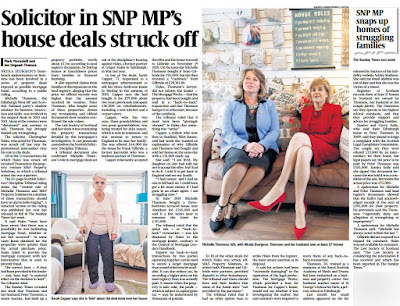
 Solicitor in Thomson's house deals struck off

Sunday Times 27/09/2015

Mark Macaskill ; Jon Ungoed-Thomas

NICOLA STURGEON'S frontbench spokeswoman on business has been involved in a series of property deals exposed as possible mortgage fraud, according to a public ruling.

Michelle Thomson, the Edinburgh West MP and Scottish National party's shadow minister for business, innovation and skills, was involved in the suspect deals in 2010 and 2011. Many of the vendors were "distressed" and anxious to sell. Thomson has strongly denied any wrongdoing.

The solicitor, Christopher Hales, who acted for Thomson, was struck off last year for professional misconduct over his role in the deals.

All of the 13 transactions for which Hales was struck off involved Thomson or the property venture M&F Property Solutions, in which a tribunal stated she was a partner.

The 53-page Scottish Solicitors' Discipline Tribunal ruling states the "central role of Michelle Thomson and M&F Property Solutions in a number of these transactions should have set alarm bells ringing". A redacted version of the ruling was published last year but released in full to The Sunday Times last week.

It said Hales "must have been aware that there was a possibility he was facilitating mortgage fraud, whether or not this occurred". In some cases loans obtained for the properties were greater than the actual purchase price. Hales failed to provide the mortgage company with key information that is used to prevent fraud.

The correct facts — if they had been provided to the lender — may have had "a material effect on the decision to lend", the tribunal ruled.

The Sunday Times revealed last week that Thomson and her husband, Peter Thomson, a music teacher, had built up a property portfolio, worth about £1.7m according to Registers of Scotland documents, by buying homes at knockdown prices from families in financial hardship.

It also reported claims from families of discrepancies on the land registry, alleging that the price on official records was higher than the amount received by vendors. Peter Thomson, who bought some of these properties, denies any wrongdoing and official documents show vendors confirmed the sale values.

The Law Society of Scotland said last week it was examining the property transactions detailed by this newspaper's investigation. It can prosecute cases before the Scottish Solicitors' Discipline Tribunal. A tribunal document also confirmed Michelle Thomson's role in mortgage deals set out at the disciplinary hearing against Hales, a former partner at Grigor Hales in Edinburgh, in May last year.

In one of the deals, Sarah Capper, 77, responded to a newspaper advertisement to sell her three-bedroom home in Stirling in the autumn of 2010. Capper says she had bought it for £79,000 about two years previously and spent £50,000 on refurbishments, including a new kitchen and a conservatory.

Capper, who has two sons, three grandchildren and two great-grandchildren, was being treated for skin cancer, which is now in remission, and was anxious to return to England to be near her family. She was offered £64,000 for the house by Frank Gilbride, a former journalist who was a business partner of Thomson.

Capper reluctantly accepted the offer and the house was sold to Gilbride on November 19 2010. On the same day Michelle Thomson bought it from Gilbride for £95,000, but she then received a "cashback" from Gilbride of £28,181.80.

Hales, Thomson's lawyer, did not inform the lender — The Mortgage Works — that the property had been bought and sold in a "back-to-back" transaction and that Thomson had got it at a discount, because of the cashback.

The tribunal ruled that it must have been "glaringly obvious" to Hales that something was "amiss".

Capper, a widow who now lives in Henfield, West Sussex, said last week she wanted an explanation of why Gilbride and Thomson had bought and sold her house on the same day with a £31,000 mark-up.

She said: "I am livid. My daughter-in-law had told me not to accept the offer, but I had to do it. I sold it to get back to England and see my family.

"I had cancer, and I had no one to fall back on. I could have got a lot more money if I had gone to an estate agent. I am struggling now."

In June 2010 Michelle Thomson bought a three-bedroom terraced house near Aberdeen for £245,000 and sold it a few hours later to someone she knew for £315,000.

The tribunal ruled that the quick sale — or "back-toback" transaction — was not disclosed by Hales to the mortgage lender, contrary to the Council of Mortgage Lenders Handbook.

Experts say back-to-back transactions by two parties operating together can be used to secure a larger mortgage than would otherwise be available. It can also reduce tax, by recording a higher price on the land registry than was actually paid. It means when the property is later sold, the profit — which is subject to capital gains tax — may be understated by thousands of pounds.

In 10 of the other deals for which Hales was struck off, M&F Property Solutions, in which both Thomson and Gilbride were partners, provided deposits to other homebuyers.

The tribunal said Hales should have told their lenders that some of the funds were "not provided by the purchaser".

The tribunal ruled that it had no other option than to strike Hales from the register, the most severe sanction at its disposal.

It said his actions had been "extremely damaging" to the reputation of the legal profession. The Mortgage Works, which provided a loan for Thomson for Capper's home, would not say whether it was investigating the matter, but said solicitors were required to warn them of any back-toback transaction.

Thomson, 50, trained as a musician at the Royal Scottish Academy of Music and Drama but later embarked on a business and property career. Her husband teaches music at St George's School for Girls, a private school in Edinburgh.

Last month her email address appeared on the list released by hackers of the infidelity website Ashley Madison. She said the email address was out of date and that she was the victim of a smear.

Registers of Scotland records show at least 17 homes in Scotland are owned by Thomson, her husband or the couple jointly. The Thomsons say they operate to the highest ethical standards, and that they provide support and advice for struggling families.

Sandra and Garry Kelly, who sold their Edinburgh home to Peter Thomson in 2009, said they intend to lodge a complaint with the Scottish Legal Complaints Commission. The couple say they were offered £73,000 by an intermediary for their home, but legal papers say the price to be paid by Peter Thomson was £105,000.

Sandra Kelly said she signed this document because she was told it was a condition of the sale, but insists the actual price was £73,000.

A spokesman for Michelle and Peter Thomson said land registry documents showed that the Kellys had acknowledged receipt of the sum of £105,000 for their property. The spokesman previously said the Thomsons "vigorously deny any allegation of wrongdoing or impropriety".

A spokesperson for Michelle Thomson said: "Michelle has always acted within the law and will be giving no further comment."
Gilbride did not respond to a request for comment. Hales was not available for comment.

A spokeswoman for the Law Society of Scotland said: "The Law Society is considering the information it has received and which has been reported in The Sunday Times."

Thursday, February 06, 2014

Corroboration to remain for now: Holyrood’s Justice Committee rebel against MacAskill’s ‘mad plan’ to remove Scotland's safeguard against miscarriage of justice

Corroboration to stay for now, says Justice Committee report. CORROBORATION, a long held safeguard against miscarriage of justice in Scots law where evidence in a criminal trial is required from two separate sources for a conviction, is to remain for now. The news comes as the Scottish Parliament’s Justice Committee have suggested Justice Secretary Kenny MacAskill ditch his plans to abolish corroboration in an effort to assist the Crown Office in obtaining higher rates of convictions, even where evidence is dodgy or practically non existent.

News of today’s development came after it was made clear in a report published today by the Scottish Parliament indicated that the majority of members of Holyrood’s Justice Committee, chaired by Christine Grahame MSP (SNP), did not support the much vaunted ‘reform’ put forward by MacAskill, who has served an unprecedented seven years as Scotland’s often accident prone Justice Secretary.

Contrary to much of the lobbying put out by the Crown Office and ‘campaign’ groups with a vested interest in removing Corroboration from Scots Law, the fact is that this long held safeguard against miscarriage of justice cuts across all criminal prosecutions, and not just rape or sexual offence cases, as anyone with an actual understanding of the law and a clear head will know.

Christine Grahame MSP: ‘Justice Committee Not Convinced Over Corroboration’

In response to the Justice Committee's rebellion against Mr MacAskill’s ill advised plan to remove corroboration, the Scottish Government have announced an inquiry to be led by former High Court judge Lord Bonomy, who will look at safeguards needed if corroboration is eventually abolished.

The terms of reference for the group headed by Lord Bonomy include consideration of the following areas:

• Whether a formal statutory test for sufficiency based upon supporting evidence and/or on the overall quality of evidence is necessary

• Whether any proposed prosecutorial test or a requirement for publication of any such test should be prescribed in legislation

• The admissibility and the use of confession evidence

• The circumstances in which evidence ought to be excluded

• The practice of dock identification

• Jury majority and size

• The future basis and operation for a submission that there is no case to answer at the end of the prosecution case

• Whether a judge should be able to remove a case from a jury on the basis that no reasonable jury could be expected to convict on the evidence before it

• Whether any change is needed in the directions that a judge might give a jury, including a requirement for special directions in particular circumstances

• Whether any additional changes are required in summary proceedings.

Appeals are not expected to be considered by the review as they are for wider consideration, not related specifically to corroboration.

The group is expected to take a year in its deliberations. Any necessary legislative and practical change to be taken forward on the back of its recommendations will then be subject to full Parliamentary scrutiny and commenced alongside the provisions in the Criminal Justice Bill, abolishing the corroboration requirement – which as before, is intended to take place in the financial year 2015-16.

Commenting on the plans announced by the Scottish Government, Lord Gill, Scotland’s top judge said: “I am grateful to the Cabinet Secretary for his sensitive response to the widespread discussion of this proposal, and for his usual courtesy in letting me see the terms of reference before they were finalised. The proposed review will enable this issue to be looked at at greater length by a body of experienced professionals. The terms of reference should allow a thorough consideration of the issues. I am pleased that Lord Bonomy has agreed to Chair the Review and I look forward to seeing the results of the Review’s work.”

In October of last year, Scotland’s top judge gave evidence to the Justice Committee, reported HERE, defining corroboration as one of the "finest features" of the country's justice system.

The Lord President’s testimony at Holyrood backing the retention of corroboration came after a terse Lord Advocate Frank Mulholland appeared before MSPs, demanding the lifting of corroboration to enable often incompetent prosecutors to gain higher rates of convictions for cases the Crown Office & Procurator Fiscal Service (COPFS) more often than not fail to take to court for one excuse or another.

And, contrary to intense lobbying by the Lord Advocate, Police Scotland, and campaign groups, it is widely known in the legal system the regular failures by COPFS in cases involving sexual offences are mostly due to the fact evidence and statements in such cases are so badly handled by prosecutors and Police, it is unlikely a prosecution could be presented in a court of law without incurring regular criticism from the benches of COPFS and the Lord Advocate himself.

The Criminal Justice (Scotland) Bill, which includes proposals to abolish the requirement for corroboration, is currently at Stage 1 in the Parliamentary process. Further information on the Bill is available from:HERE

It should be noted Scottish Law Reporter supports the retention of corroboration, and has reported on the issue in previous coverage HERE

BBC News reports further: Ditch corroboration plans, say Justice Committee MSPs

MSPs have suggested ditching controversial plans to abolish the requirement for corroboration from criminal justice legislation. It emerged that the majority of Justice Committee members do not support change.

The government said an inquiry led by former high court judge Lord Bonomy would look at safeguards needed if corroboration was abolished.Opposition leaders called on ministers to wait until after the inquiry. The reform is included in the Scottish government's Criminal Justice Bill.

Justice Secretary Kenny MacAskill said he remained "committed to this essential and long-overdue reform as the corroboration rule can prevent strong cases which could be prosecuted in other jurisdictions from being taken forward".

He added: "Scotland is the only country in the world which has been identified as having the requirement and this is acting as a barrier to justice and denying too many victims their opportunity to have their day in court."

But MSPs on the Justice Committee said they were "concerned that the case for abolition has paid insufficient regard to the importance of this requirement within the Scottish criminal justice system".

Opposition party leaders pressed First Minister Alex Salmond during his weekly question time to delay abolition until Lord Bonomy's inquiry had concluded.

Scottish Conservative leader Ruth Davidson said: "What we as members are being asked to do is to vote through a bill which we know to be deeply flawed on the grounds that Kenny MacAskill says he'll sort it later. "There is an obvious solution here. Leave the scrapping of corroboration out of the bill. "Ask Lord Bonomy to report on the whole issue and then let us look at it again."

Liberal Democrat leader Willie Rennie argued: "Appointing Lord Bonomy doesn't restore justice, it simply papers over the cracks with a veneer of respectability." He urged the first minister to overrule his justice secretary "before he does serious damage".

But Mr Salmond responded: "It's not a quick fix, it's a distinguished judge who's looking to make absolutely certain that as this change is made, appropriate safeguards are there to prevent miscarriages of justice."
'Archaic rule'

The committee has been scrutinising the Scottish government's Criminal Justice (Scotland) Bill, which includes plans to abolish the centuries-old requirement for corroboration - which means that currently evidence against an accused person must come from more than one source.

One of Scotland's top judges, Lord Carloway, called for the change in a review of the criminal justice system, insisting corroboration was "an archaic rule that has no place in a modern legal system".

Supporters include the police, victims' groups and prosecutors. Some have argued that the removal of corroboration could also help widen access to justice for victims, particularly in cases of rape and domestic violence.

Opponents, including many from within the legal profession, have said it could lead to rises in miscarriages of justice. Justice Committee convener Christine Grahame said the proposal had divided opinion among the MSPs.

The SNP MSP said: "The committee could not reach agreement on whether removing such a significant and integral part of the criminal justice system would improve 'access to justice' for victims of sexual offences in a meaningful way or indeed secure more convictions. "Some therefore asked the cabinet secretary to consider removing the relevant sections on corroboration from the bill. "Others felt that the case had been proved."

Ms Grahame also said the Scottish government needed to provide "much more information on its plans to review additional safeguards" before the Scottish Parliament as a whole voted on the general principles of the bill.

Mr MacAskill said he noted the committee's recommendations and hoped its members would "welcome today's announcement on safeguards".

He said: "I have always been clear that we are willing to listen and to work with stakeholders on building further safeguards into our reforms. "I therefore welcome the fact that Lord Bonomy has agreed to chair this reference group. "I am confident that he and his team will carry out a robust and thorough exploration of any additional safeguards which may be required in the light of the corroboration requirement being abolished."

The group is expected to take a year for its deliberations, and will not make any recommendations before the bill is voted on at Holyrood.

Thursday, January 10, 2013

The camera never lies, yet inquiry & SNP spin campaign clears First Minister Salmond of TV lying over ‘legal advice’ for independent Scotland’s chances of remaining in EU

Alex_Salmond

First Minister Alex Salmond claimed legal advice had been sought during tv interview. PROVING the worthlessness and indeed, damage to reality by party political media campaigns & a so called “independent inquiry” undertaken by persons appointed by those accused and under investigation, Scotland’s struggling First Minister Alex Salmond has yet again been cleard of a complaint lodged under the mysterious “Ministerial Code”, this time Mr Salmond being cleared of claiming on television he had legal advice to the effect that an independent Scotland could remain in the European Union, even though Mr Salmond actually said those very words in a BBC television interview with Andrew Neil.

You decide - First Minister Alex Salmond claimed he had legal advice an independent Scotland will remain in the EU

The full report on the ‘investigation’ into Mr Salmond can be viewed online HERE The Scottish Government’s version of the timeline of the events is available HERE

Predictably, the Scottish Government’s media machine has issued a long tirade (reprinted below) with quotes from the First Minister, congratulating himself upon his apparent exoneration from misinforming & misleading the public on the EU legal advice claims.

It is rumoured the entire PR driven incident along with the enquiry has cost the taxpayer around £50,000 to come up with an intense media campaign, supportive political appearances, snide media comments & speeches, supportive online media forum comments and a report to clear Mr Salmond of a a habit which the First Minister and the SNP will be remembered for in 2012, the year Scots finally found out the Nationalists are like all other political parties, and no different from the ones they castigate.

Political observers will also recall 2012 for being the year in which Mr Salmond was accused of being an “instinctive liar” by Scottish Labour, the party who along with the Scottish Conservatives & Liberal Democrats have made instinctive lying in public life a national sport, now joined in earnest by the SNP.

A political insider commented on the fiasco : “Clearly the European Union can do without another nationalistic leader who's Government clears him of lying on television, even when the camera suggests he did exactly that”

Scottish Govt Press Release : FM cleared by ministerial code report

The First Minister acted fully in accordance with the Scottish Ministerial Code in relation to the debate on the existence or content of legal advice on an independent Scotland’s continued membership of the European Union, an independent report has concluded.

The First Minister appointed Sir David Bell KCB – an independent adviser to the Scottish Government on the Ministerial Code – to conduct the investigation following a complaint by Catherine Stihler MEP.

The report, which has been published today, says: “I have not found you, or the Scottish Government, to have breached the Ministerial Code in respect of any complaints made by Ms Stihler. I have though recommended that the Scottish Government considers revising those parts of the code relating to legal advice.”

Sir David examined five separate grounds of complaint from Ms Stihler – and in each case he found that the First Minister and the Scottish Government had acted fully in accordance with the Ministerial Code.

The report also concludes that “the Edinburgh Agreement was the appropriate moment to seek specific legal advice from the Law Officers … it was only when the details of the referendum process became clear that you were in a position to seek such advice.”

Sir David also recommends that the Scottish Government considers whether the part of the Ministerial Code relating to legal advice could be redrafted in a clearer and more accessible form – a recommendation which the Government accepts.

First Minister Alex Salmond said: “I would like to thank Sir David for his very thorough and detailed report, the findings of which clearly demonstrate that there was no breach of the Ministerial Code on this matter.”

“I welcome the report which demonstrates that I and the rest of the Scottish Government acted entirely in accordance with the Scottish Ministerial Code. I also welcome his conclusion that the signing of the Edinburgh Agreement was the appropriate moment at which to seek specific legal advice on an independent Scotland’s continued membership of the European Union.”

“Sir David also recommends that the Scottish Government considers whether the section of its Ministerial Code relating to legal advice provided to Ministers should be redrafted to make it clearer. That is a recommendation I am happy to accept, and work will now be taken forward by Government officials with that aim in mind.

“This has been the sixth complaint to be referred to the independent panel of advisers I introduced in 2008 to rule on these matters.  I am delighted that each complaint has been dismissed and the advisers concluded my ministers and I have acted entirely properly at all times.”

Saturday, December 22, 2012

SNP run Scottish Borders Council demand ‘500% rise’ £15K Common Good Fund admin fee from small town of Selkirk, includes £9K legal bill generated by Council’s own lawyer

sbclogoSNP controlled Council inflate town’s legal bill 500% to £15K for Common Good paper shuffling. A SMALL COMMUNITY in the Borders is facing a staggering FIFTEEN THOUSAND POUND demand from the SNP led Scottish Borders Council for administering the town of Selkirk’s Common Good Fund, reveals local media who also report a whopping NINE THOUSAND POUNDS of the bill is for the work of one single lawyer employed by scandal hit Scottish Borders Council. The in-house council lawyer who the £9K legal fees are being attributed to, has been identified by council figures as Anne Isles, a solicitor who has been at Scottish Borders Council for over ten years.

However, Community leaders in Selkirk are demanding a full breakdown of the staggering FIVE HUNDRED PERCENT INCREASE under the new SNP controlled administration, after it emerged the Council had earlier been charging around £3-£4k a year prior to the Scottish Nationalists taking charge of the south of Scotland local authority, which is mired in a £262 Million pound mountain of debt and is regularly featured in financial scandals.

Reports in the local media also highlight the fact the SNP controlled Council is charging the small Borders town of Selkirk more money than its Common Good Fund actually brings in, while local transparency campaigners have also questioned why Selkirk’s Common Good Fund appears to bring in so little money under Scottish Borders Council’s management, even though the fund owns what appear to be highly prized assets such as salmon fishing rights, shooting rights, a golf course, commercial shops and also three farms.

The in-house whose work has apparently generated the £9K legal fees, Ms Anne Isles, is reportedly ‘well known’ to private law firms and their clients in the Scottish Borders. Ms Isles is also known to have once featured in reports in the Scotsman newspaper after parents of a special needs child living near to Kelso had publicised their concerns about the solicitor’s conduct during a court case in which Ms Isles represented the Council who fought to deny the little girl a public bus trip to her school of attendance. The parents alleged Ms Isles conduct & questioning of the young girl during hearings unnecessarily upset and reduced the infant to tears.

No one from Scottish Borders Council was willing to comment on why the SNP controlled local authority had upped its legal fees a staggering 500% to small towns. No one from the Scottish National Party was willing to comment.

Scottish Borders Council has featured in numerous, almost weekly scandals, notably one involving a controversy over a huge payout of £318,000 to former Chief Executive David Hume, who promptly went on to work for the Scottish Government, earning fees paid by Scottish Ministers via a ‘tax efficient’ Limited Company arrangement for work at Children's Hearings Scotland. The Council was also fined £250,000 by the Information Commissioner after an investigation found the incompetent local authority had abused personal data involving staff pensions.

Local media in the Scottish Borders, the Southern Reporter & Selkirk Advertiser report on the scandal :

Selkirk’s anger over £15K common good bill

Selkirk’s community leaders are demanding to know why charges to the town’s common good fund increased fivefold last year, and have called their treatment by Scottish Borders Council “hypocrisy”.

Selkirk Community Council has been asking Scottish Borders Council (SBC) for a breakdown of costs since March after SBC said its annual charge for administering the fund would be more than £15,000 for the previous year. The usual cost is £3-4,000.

Community councillors finally saw a breakdown of the figures at a meeting last week which showed nearly £9,000 going on the legal fees of one official.

Vice-chairman Dr Lindsay Neil said: “We are paying SBC more money than the common good fund has to distribute: the expenses outweigh the actual fund. I sympathise that the council has to try and scrape money as best it can, but it should not be raiding it out of the common good fund.”

He said the community council was initially told by ex-councillor and chairperson of the common good fund working group, Carolyn Riddell-Carre, that the £15,000 was due to their requests for Freedom of Information (FoI) enquiries.

Dr Neil commented: “You are not allowed to charge for FoI unless you let the person (who’s requested it) know it is going to cost more than a certain amount. None of that was done. We said, ‘This is crazy, if it’s FoI we need to question this’.

“It’s an obligation of the local authority to administer the common good fund, they should get on with it.

“But the council argues, ‘Why should Selkirk be relieved of the costs of its common good fund and all the people in the Borders help pay for it?’

“But SBC has undertaken to meet all the costs of the refurbishment of the Tait Hall in Kelso, which belongs to Kelso’s common good fund. It’s simple hypocrisy. They hold the purse strings, they have access to the funds and there’s nothing we can do about it. We don’t have control,” said Dr Neil.

“If necessary we will go to Audit Scotland (which audits the council’s financial matters),” he added. “We (community councillors at Monday’s meeting) were unanimous in wanting to find out why this money has been charged, and we are dissatisfied it has taken so long, and what was supplied at the end of the day was so woefully inadequate.”

TheSouthern asked Scottish Borders Council if they had charged for Freedom of Information requests.

A spokesperson denied this was the case, saying: “The recharge for council officers’ time is with full council agreement.

“These costs are not for work in response to FoI enquiries, and the community council has been fully advised of this directly through Dr Neil at a meeting of the Selkirk common good fund sub-committee in Selkirk on October 31, 2012, and previously.

“The council does not charge the common good funds in respect of work done in the furtherance of formal FOI requests,” the spokesperson said.

Asked why the charges had jumped so dramatically from £3-4,000 to £15,000, the spokesperson said: “The charges are based on actual work, so will vary year to year.”

She then pointed out: “Scottish Borders Council awards a block grant to the common good to offset a proportion of these costs which are shown in the Budget under Central Support Service Recharge.

“The current 2012/13 Central Support Service Recharges are £15,102, offset by the contribution from the council of £3,952.”

Asked for a breakdown of the £8,886 costs for legal work carried out by Anne Isles, the depute clerk in Galashiels’ council offices, the spokesperson answered: “The (£8,886 legal) costs were in relation to all legal work in that particular year for the common good fund, including drafting and reviewing legal documents – the fund owns three farms, two commercial shops, salmon fishings, shootings and a golf course, along with several other properties which are not occupied by third parties but require to be managed.”

“There was also work done (correspondence, meetings) in relation to the proposed wind farm.

“General correspondence is done in relation to all the grants and donations requests and payments by the funds. The cost also covers attendance at committee meetings, including travel to and from Selkirk as required. All general queries re the common good funds are also responded to whether from the community council itself, or members of the public.

“In total, approximately 157 hours of time were spent.”

SBC charges queried

COMMUNITY leaders are demanding to know why charges to the town’s Common Good Fund increased fivefold last year.

Selkirk Community Council has been asking Scottish Borders Council (SBC) for a breakdown of costs since March after SBC said its annual charge for administering the fund would be more than £15,000 for the previous year. The usual cost is £3-4,000.

Community councillors finally saw a breakdown of the figures at Monday’s meeting which showed nearly £9,000 going on the legal fees of one official.

Community council vice-chairman Lindsay Neil said: “We are paying SBC more money than the common good fund has to distribute: the expenses outweigh the actual fund. I sympathise that the council has to try and scrape money as best it can, but it should not be pinching it out of the Common Good Fund.”

He said the community council was initially told by ex-councillor and chairperson of the Common Good Fund working group, Carolyn Riddell-Carre, that the £15,000 was due to their requests for Freedom of Information (FoI) enquiries.

“It’s an obligation of the local authority to administer the Common Good Fund – they should get on with it. If necessary we will go to Audit Scotland (which audits the council’s financial matters),” he said.

An SBC spokesperson said: “The recharge for council officers’ time is with full council agreement. These costs are not for work in response to FoI enquiries. The (£8,886 legal) costs were in relation to all legal work in that particular year for the Common Good Fund, including drafting and reviewing legal documents.”

Other work included managing the fund’s properties, correspondence, meetings, travel costs and enquiries.

“The charges are based on actual work, so will vary year to year depending on the work carried out,” said the spokesperson, pointing out that SBC awards a block grant to the community council “to offset a proportion of these costs”.

Wednesday, July 04, 2012

Independence referendum vote fears muddle Crown Office claims of ‘ongoing’ criminal investigation into Scottish banking sector

crown officeCrown Office pulls leg, claims it is investigating crooked bankers. SCOTLAND’S Crown Office & Procurator Fiscal Service (COPFS) has been accused of issuing publicity grabbing misleading statements in Press Releases concerning claims it’s prosecutors have been investigating corruption in Scottish banks “for some time”. Yesterday, the Crown Office claimed it’s Serious and Organised Crime Division ‘was leading the little known about investigation into crooked bankers, but officials refused to provide any substantive proof an investigation was actually underway. The claims appear to have provoked hurried meetings within Scottish Government & Police circles. (probably to synchronise their watches – Ed)

It has been reported in Scots Law publication “The Firm” in an article HERE that “former BBC Head of Legal, Alistair Bonnington, has said the “publicity conscious” Crown Office’s claim that it had been investigating Scottish banks for some time was “wholly absurd”. He accused the Crown Office of attempting to deflect criticism of a “disgraceful lack of activity” over the failure to take criminal action against Scottish banks”. A further article in “The Firm” explaining more on the story is HERE

The Crown Office issued a short press release today claiming an investigation into crooked banking practices had been ongoing for some time but the release came only after Mr Bonnington had appeared on BBC criticising the lack of action in Scotland on any investigations into the Scottish banking sector.

The Press Release also warned the media not to publish anything which may ‘prejudice’ any future criminal proceedings, however a legal insider described this warning as “a joke” and alleged “it is an attempt to muzzle the press from digging deeper into the Crown Office’ so-called investigation into banks”

It has also been speculated the Scottish Government had ordered the Crown Office to issue the short Press Release after it became clear several journalists had been enquiring as to the lack of any investigations into banking practices in Scotland and were about to write damning reports alleging political attempts to suppress any criminal financial scandals of the order of those currently doing the rounds in the city of London ahead of ALex Salmond’s much prioritised independence referendum.

A solicitor speaking to Scottish Law Reporter warned the public not to get their hopes up over the Crown Office investigation into the banks.

He said : “More often than not the Crown Office fail to prosecute complex fraud cases as they neither have the experience, intelligence or the will to do so.”

He added : “There will be no appetite at the Crown Office or within the Scottish Government to rock the Scottish Financial establishment with criminal charges, particularly on the run up to an independence referendum where finance and how banks will survive in an independent Scotland are bound to be key factors in swaying the vote.”

Lord Advocate Frank Mulholland Crown confirms investigation into Scottish banking sector

From: Crown Office NEWS RELEASE For Publication 3 July 2012

CROWN OFFICE CONFIRMS INVESTIGATION INTO SCOTTISH BANKING SECTOR

The Crown Office today confirmed that an investigation into the Scottish banking sector is ongoing.

Given the degree of public concern about recently reported issues in the banking sector, the Crown has decided to confirm that an investigation has been underway for some time. Its scope will now be extended as a result of recent developments.

The Serious and Organised Crime Division is leading the investigation.

As the investigation is ongoing, it would not be appropriate to comment further.

Notes to editors:

1. Editors are asked to act responsibly and refrain from publishing or broadcasting material which could be prejudicial to any future criminal proceedings.

2. The Crown Office and Procurator Fiscal Service (COPFS) is Scotland’s sole prosecuting authority. COPFS prosecutes cases in the public interest after the receipt of initial crime investigation reports from police forces in Scotland. COPFS then decide whether to proceed with any action in the case. The Procurator Fiscal will take a proactive role where necessary in directing police enquiries, particularly in the investigation of serious crime. In Scotland, the decision whether to prosecute a case is one for the COPFS alone, not the police.

Sunday, May 13, 2012

Borders Tory MSP attacks SNP-Libdem deal to run scandal tainted Scottish Borders Council, claims nationalists ‘will use platform to tear up UK’

sbclogoSNP led coalition to run the Scottish Borders is attacked by local Tory MSP. WHILE many Borderers and those further afield WELCOME the formation of a new administration at Scottish Borders Council which will now be run via a coalition between the Scottish National Party (SNP), the Scottish Liberal Democrats & Independent Councillors, John Lamont, the Scottish Conservative MSP for Roxburgh & Berwickshire has attacked the coalition deal, alleging the new SNP dominated administration will use their position in the Borders as “a mouthpiece for separation from the UK”. Mr Lamont also blasted the LibDems, Independents & the now dissolved “Borders Party” for “propping up the SNP.”

John Lamont MSP (Scottish Conservative, Roxburgh & Berwickshire) Responding to the announcement of the new administration at Scottish Borders Council, local MSP for the area, John Lamont said in a Press Release issued yesterday : “I’d like to firstly pay tribute to the work achieved by the previous Scottish Conservative led Council administration. Under our councillors’ steady hand we saw finances kept in check, three new high schools built and a fivefold increase in recycling rates. There can be no doubting that this new administration has big shoes to fill.

However, Mr Lamont quickly moved to attack the deal giving power to the SNP, and accused the Conservatives former LibDem coalition partners for giving the Nationalists a platform to break up the union.

Mr Lamont continued : “It is important that they do not undo the great work done by their predecessors, and that they do not use the Council as a mouthpiece for separation from the UK. By falling in behind the SNP, the Lib Dems, Independents and Borders Party have given the Nationalists a platform to promote their agenda to tear the United Kingdom apart.

“The people of the Borders will not accept this, and I am sure a lot of those who voted for the Lib Dems and the Borders Party will be dismayed by the shoddy deal they have struck with the SNP. I know that many supporters of the Borders Party find it incredible that their councillors have disbanded themselves, joined the Independent Group under a new leader and then jumped into bed with the SNP, all within one week!

“The SNP’s sole political aim is to separate us from the rest of the UK. It would be naïve to think that the SNP will not now use the Council as a way to promote their plans to break up Britain.”

John Lamont MSP added: “The upcoming referendum is the biggest decision Scotland has had to make in 300 years. I am determined to keep Scotland in the UK, and like many voters, I will be keeping a close eye on this SNP led administration to make sure that they do not use the Scottish Borders Council to promote their separatist agenda.”

No reaction to Mr Lamont’s accusations has been issued by any of the other parties in the new coalition at Scottish Borders Council, however an openness campaigner in the Borders welcomed the change at Scottish Borders Council, voicing hope the new nationalist led administration would “clean up the endemic corruption at Scottish Borders Council and make sure citizens of the Borders were treated with a bit more respect from Council staff & officials who appear to pursue personal vendettas against members of the public.”

Commenting on the change of administration, an insider agreed it was time for change at SBC and said he hoped there would now be investigations launched by the new administration into the Council’s poor handling of its finances, which include millions of pounds of losses in now bankrupt Icelandic Banks.

He also called for a full inquiry and investigation into recent claims in local newspapers that the current leader of the Council, David Parker, authorised Press Releases containing false information regarding the controversial departure of SBC Chief Executive David Hume and speculation over how much of a taxpayer funded payoff Mr Hume received. The murky incident of Mr Hume’s departure was reported HERE and more recently HERE

SCOTTISH BORDERS COUNCIL : THE TORY LIBDEM YEARS LAID BARE

Since 2002, a multitude of scandals have hit Scottish Borders Council, from poor financial management to massive multi million pound losses in bankrupt Icelandic Banks, allegations of bullying, massive debts reported to be in the hundreds of millions of pounds, individuals councillors charged with criminal offences while other councillors pursued personal vendettas against members of the public, and more recently, scandals involving the sacking of it’s very own Chief Executive, David Hume, all of which can be found HERE

Scottish Borders Council hit the headlines with revelations of huge salaries, expenses & more, here : Reasons your Scottish Borders Council tax is so high : 15 Councillors soak up £1/2 million, Officials & Chief Exec on £100K plus & golden pensions & MONEY TO BURN : Millions lost in Icelandic banks yet 34 Scottish Borders Councillors soak up another million in salaries & expenses claims

More on the Icelandic Bank-SBC scandal can be read here : “Akin to Money Laundering” : Tory-LibDem Scottish Borders Council ‘played Russian Roulette’ with taxpayers £172 million in bankrupt Icelandic Banks

Scottish Law Reporter also reported on the calls for a full investigation of Scottish Borders Council during November 2010 where it was revealed by the former Scotsman journalist Mr Chisholm who carried out his own investigation of SBC’s Icelandic finance deals, that Audit Scotland had been asked to investigate claims Scottish Borders Council acted negligently & recklessly in investing a staggering £10 million pounds of taxpayers money in the now collapsed Icelandic banks. The Council, which is now cutting posts & public services across the Borders is expected to lose more than £3 million pounds on its investment and that the final payment (if indeed any payments are made) of its expected return is not due until October, 2018.