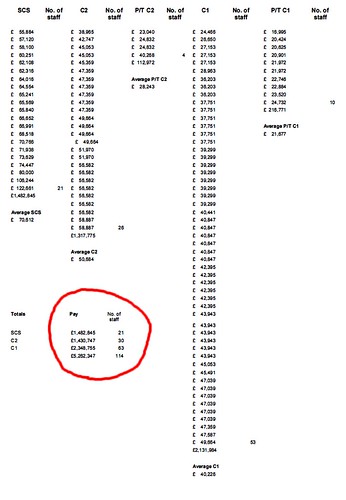
While many are calling for reforms of the legal services market, there is a notable silence over who provides legal services & advice to the Scottish Executive Government and what happens when that advice or those giving it may come into a conflict of interest situation via legislation which may impugn the interests of their professional body - the Law Society of Scotland, of which all who practice law in Scotland must currently be a member of ...
No shortage of lawyers then at the Scottish Executive Government but it does seem the once claimed £5 million pound expenditure under Labour is a bit of a stretch of the imagination ? Perhaps the SNP can come clean on that one, since they shouted about it enough when in opposition ...
The Government Legal Service for Scotland in more detail :
Government Legal Service For Scotland
The Government Legal Service for Scotland ( GLSS) is a professional community of lawyers in government in Scotland.
It exists in order to -
* raise awareness of the roles of public service lawyers and of the GLSS member offices
* promote contacts, share information and develop skills and knowledge among staff in its member offices
* provide shared services to member offices and their staff.
who we are
The member GLSS offices are -
* Office of the Solicitor to the Scottish Executive
* Legal Secretariat to the Lord Advocate
* Office of the Solicitor to the Advocate General
* Legal Secretariat to the Advocate General
* Scottish Parliament's Directorate of Legal Services
* Scottish Law Commission
The GLSS also provides legal staff to (for example) the Crofters' Commission, the Lord President's private office and the Scottish Land Court. It works closely with others, in particular with the Office of the Scottish Parliamentary Counsel ( OSPC), responsible for drafting most Scottish legislation.
uniqueness of GLSS work
Lawyers working with the GLSS and its related offices are engaged on a wide variety of interesting and intellectually challenging work, much of it unique to government. A central theme is the development and implementation of new law. Preparation of legislation for both the Scottish Parliament and Westminster forms a large part of the workload. It also includes handling high profile, sensitive litigation and dealing with novel devolution or other constitutional problems. The work of the GLSS is often newsworthy, and it is always necessary to consider political consequences and potential sensitivities or wider implications. Given the nature of the work, the GLSS lawyer has a very influential role and a real opportunity to make a difference.
GLSS lawyers are involved in almost all aspects of government - whether it be resolving legal problems in policy development, operational delivery of services to the public or the smooth running of corporate services. European Union, human rights and devolution law and practice form a constant background to government legal work.
GLSS lawyers may also be seconded to work in policy posts, particularly in areas which relate to legal policy such as the Scottish Executive's Justice Department or Constitutional Policy Unit. GLSS lawyers also provide support for public inquiries. Lawyers working at the Scottish Law Commission contribute directly to the Commission's aims of improving, simplifying and updating the law of Scotland and lawyers at the Scottish Parliament are central to the Parliament's work as a legislature.
Opportunities also exist for secondment to one of the EU institutions or a placement with an external organisation, whether in the public or private sector. This has, on occasions, involved temporary postings to places as far afield as Indonesia.
One aspect of working practice which differs markedly from many private sector firms is that lawyers in the GLSS tend to move between different areas of work over the course of their careers. They are viewed as specialist government lawyers, rather than specialising in a particular subject area for lengthy periods of time. This approach means that lawyers develop transferable skills and are able to deal with novel subjects which frequently arise.
Office of the Solicitor to the Scottish Executive
OSSE is the largest office in the GLSS, providing legal services to the Scottish Executive and its agencies. This covers a very wide spectrum including litigation and tribunal work, property and commercial law and procurement advice, instructing Bills and drafting subordinate legislation, including implementation of EC Directives. These responsibilities include the provision of legal advice to the Scottish Ministers. A major focus of OSSE's advisory and legislation work is in ensuring that Ministers act always within the powers conferred on them by the devolution settlement and that Executive Bills presented to the Scottish Parliament are within the legislative competence of the Parliament. This aspect of the office's work invariably involves consideration of human rights issues.
OSSE reports to the Lord Advocate and Solicitor General for Scotland who are the principal ministerial advisers to the Scottish Executive on legal matters. It currently has 109 lawyers, plus a range of support staff.
For more information see http://www.scotland.gov.uk
Legal secretariat to the lord advocate
The Lord Advocate and the Solicitor General for Scotland (formally known as the Scottish Law Officers) are the principal legal advisers to the Scottish Executive. One of their roles is to provide legal opinions to Scottish Ministers in cases where advice at the highest level is required. Both are members of the Executive and the Lord Advocate attends Cabinet.
The function of the Legal Secretariat is to support the Scottish Law Officers in this role, for instance by researching and helping to draft opinions and by providing advice on other matters referred to the Law Officers. The work very often involves complex issues of human rights and constitutional law. The Legal Secretariat also has an important role in maintaining close liaison with OSSE which provides most of the legal advice required by the Executive and with their UK counterparts.
The Legal Secretariat currently comprises three lawyers, plus support staff.
office of the solicitor to the Advocate General
The Office of the Solicitor to the Advocate General for Scotland ( OSAG) is part of the Department of Constitutional Affairs, which is a Department of the UK Government. The Advocate General is the Law Officer responsible for advising UK Ministers on Scots law. OSAG is responsible for advising UK Government Departments operating in Scotland on all matters relating to Scots law. It instructs UK legislation applying in Scotland and represents its client Departments in litigation before the Scottish courts. It has special expertise in administrative law and in the division of legal powers between the devolved Scottish institutions and their UK counterparts.
The Office also provides support for the Advocate General in carrying out his statutory functions under the devolution settlement. Devolution issues arising in the Scottish courts are intimated to the Advocate General and OSAG staff co-ordinate their consideration in Whitehall and arrange for any intervention which the Advocate General considers appropriate. Legal staff also consider legislation which comes before the Scottish Parliament so as to identify any issues about competence which may arise. These issues are then considered in co-operation with Cabinet Office and other Whitehall legal advisers.
The Office comprises 18 lawyers, plus support staff.
Legal secretariat to the advocate general
The Advocate General is one of the three UK Law Officers, along with the Attorney General and Solicitor General, and is the principal legal adviser to the UK Government on Scots law. The Legal Secretariat is a small team of three lawyers based in London. They assist the Advocate General in preparation of Law Officers' opinions (many of which are prepared jointly with the Law Officers for England and Wales), and support him in relation to Parliamentary business, Cabinet committee meetings, correspondence, speeches and other general business. The legal staff take part in Cabinet Office committees of officials and other Whitehall co-ordinating meetings on European law, human rights and devolution.
For more about OSAG and the Legal Secretariat see http://www.oag.gov.uk.
Scottish parliament's directorate of legal services
GLSS staff in the Directorate gain experience as parliamentary lawyers. The work is diverse. Much of it is legislative - helping produce non-Executive Bills, advising the Presiding Office on legislative competence, scrutinising Minister-made subordinate legislation. There is also work on procedures and governance such as advising the Scottish Parliamentary Corporate Body which is responsible for providing the Parliament's property, staff and services. Most of the lawyers work not only with colleagues in the Parliament staff group but also with Members across the parliamentary political spectrum, in committees and other forums.
The Directorate has 13 lawyers, and four support staff.
For more information see
http://www.scottish.parliament.uk/corporate/organisation/directorates/ls.htm.
Scottish law commission
The Scottish Law Commission is an independent statutory body which recommends reforms to improve, simplify and update the law. Its recommendations, if accepted, are generally implemented through legislation in the Scottish or Westminster Parliaments. Lawyers seconded from the GLSS play an important role in managing and contributing to the development of legal policy on all of its reform projects.
There are currently five senior GLSS lawyers working at the Commission. The Commission also recruits legal assistants for assignment to particular projects. For more information about the Commission and its work see http://www.scotlawcom.gov.uk.
careers opportunities for lawyers in the GLSS
Throughout some 175 legal posts in the various offices staffed by GLSS lawyers, the GLSS provides excellent opportunities for a varied and stimulating career.
GLSS lawyers are all civil servants and recruitment is by way of open competition. Vacancies are advertised on the Scottish Executive website as well as in the national press ( www.scotland.gov.uk) Assignment to a particular post takes place after recruitment and is determined by the business needs of the different offices, taking into account, so far as practicable, the experience and preferences of successful candidates.
trainee solicitors
The GLSS offers a varied legal trainee programme which is advertised on the Executive's website and in the national press, as well as through its participation in annual law fairs run by the main Scottish Law Schools. The training covers a wide range of government legal work, from core professional areas - such as contract, litigation and commercial law - to specialist advisory work for departments and associated agencies. Trainees have four six-month placements during their traineeship. There may therefore be opportunities to work with the Legal Secretariat to the Lord Advocate, the Office of the Solicitor to the Advocate General, the Scottish Parliament or the Scottish Law Commission as well as a short placement in the Legal Secretariat to the Advocate General in London. There is also an exchange scheme under which some trainees may spend six months with a private sector firm.
pay and conditions
The GLSS offers excellent working conditions and career prospects, supported by a commitment to training and development. Salaries are in the range of £27,153 to £32,583 for Legal Officers and £36,203 to £46,700 for Principal Legal Officers, the main recruitment grades. Appointments are permanent and pensionable. There are part-time and job-share opportunities as well as other flexible working arrangements. The current salary for trainees is £17,000 in the first year, rising to £18,955 in the second year.
summer placement scheme
The GLSS operates a summer placement scheme offering law students one month's paid work experience, normally between June and September. The scheme is open to students in the fourth year of their degree or currently completing their diploma and is advertised each year through the university Law Schools and Faculties.
for further information contact: Ann McKenzie, GLSS Secretariat, G B(N), Victoria Quay, Edinburgh EH6 6QQ Tel no. 0131 244 0815 or email ann.mckenzie@scotland.gsi.gov.uk