Showing posts with label Lord Hamilton. Show all posts

Friday, October 23, 2015

Quango Law: Scottish Sentencing Council established after two top judges condemn Ministers sentencing quango as an 'attempt to undermine independence of the judiciary'

Judges must now give nod to quango on sentencing. SIX YEARS after proposals to create a Scottish Sentencing Council (SSC) were condemned by Scotland's longest serving judge as a "quango" - with constitutional issues, the sentencing body has finally been established by the Scottish Government, with a brief to “raise public awareness and understanding of sentencing practice”.

The ‘arms length’ body – which some fear may begin to interfere with sentencing on a case by case basis, is headed by the Lord Justice Clerk - Lord Carloway.

Carloway previously backed the Scottish Government’s ‘unfinished plan’ to remove the long held safeguard of corroboration – where evidence in a criminal trial is required from two separate sources for a conviction.

Earlier this week, legal insiders told SLR it was revealing the sentencing council has only came into being after the retirement of Lord Gill from the post of Lord President, earlier this year.

Gill, who was opposed to the Scottish Government’s plan to create a quango style sentencing council retired in May 2015.

It is thought Gill remained opposed to the idea of political meddling in sentencing to the end of his term as Lord President.

Welcoming the establishment of the Sentencing Council, Justice Secretary Michael Matheson said: “The creation of the Scottish Sentencing Council is extremely important for the criminal justice system in Scotland and I welcome today’s official launch. We know that sentencing can be an extremely complicated and emotive issue which is why we want to provide greater clarity and openness around why and how sentences are decided.

Matheson also claimed, unconvincingly, the courts would remain independent of ministers desires for sentencing headlines to suit the Scottish Government’s policy of cooking the books on crime statistics & convictions.

The Justice Secretary said: “While the independence of Scotland’s judiciary of course remains a fundamental part of the Scottish legal system, as does judicial discretion in individual sentencing decisions, the Council will help to ensure transparency and consistency in all sentencing decisions made in Scotland, as well as helping the public better understand the sentencing process.”

However, legal insiders say the sentencing quango is little more than thinly veiled political meddling in matters constitutionally reserved to the courts.

Both of Scotland’s previous Lord Presidents have publicly criticised the sentencing council since proposals were first made in 2009 as part of the The Criminal Justice and Licensing (Scotland) Act 2010.

During evidence heard at the Scottish Parliament’s Justice Committee in 2009, Lord Brian Gill – in his role as Lord Justice Clerk criticised the sentencing plan,  branding the Scottish Government’s proposal to create a sentencing council as muddled legislation interfering with the sentencing duties of the courts.

Lord Gill said: I am slightly troubled by the term "inconsistency". Forgive me for going back to a slightly earlier point, but it relates to the point that has just been raised with the Lord Justice General.

If the legislation sets out to achieve what is described as consistency, it seems essential that it should define what it means by consistency and inconsistency. The consultation paper started off by talking about inconsistency and then spoke about a perception of inconsistency, which is rather a different thing. It is not quite clear yet what the legislation seeks to achieve. There is no definition of consistency in the draft, and it seems to me that those who would form a sentencing council would find some difficulty in knowing exactly what they were trying to do unless the legislation gave them a clear definition by which to judge their own views and decisions.

That raises in a clear way the constitutional issue that underlies legislation. It is part of the constitution that it is for the appeal court to determine sentencing, except to the extent that legislation lays down what the sentence should be. To read the bill, one might think that it involved merely the creation of some quango but, in fact, there is a huge constitutional question underlying the bill. That is what troubles me."

The Justice Committee also heard from the then Lord President – Lord Hamilton – who accused the Scottish Government of putting forward proposals to undermine the independence of the judiciary.

The current complement of the Scottish Sentencing Council includes 12 members selected by the Scottish Government are:

Lord Carloway (Lord Justice Clerk, Council Chair), Lord Turnbull (Senator Member), Sheriff Principal Ian R. Abercrombie QC (Sheriff Principal Member), Sheriff Norman McFadyen (Sheriff Member), Allan Findlay (Stipendiary Magistrate Member), Gillian Thomson (Justice of the Peace Member), Catherine Dyer (Crown Agent, Prosecutor Member), Stephen O’Rourke (Advocate Member), John Scott QC (Solicitor Member), Val Thomson (Assistant Chief Constable, Constable Member), Sue Moody (Lay Member with knowledge of victims’ issues), Professor Neil Hutton (Lay Member),

Sentencing quango member, Sue Moody, who has knowledge of victims’ issues, said: “I am delighted to be part of the new Sentencing Council. The Council is good news for the victims of crime in Scotland. It will help to demystify sentencing for the public, and will ensure that the interests and needs of victims are taken into account when sentencing guidelines are prepared. This is an important opportunity for victims to contribute their views.”

Chair of the Scottish Sentencing Council Lord Carloway said: “Sentencing is much more complex than it sometimes appears - there can be many different factors involved. The Council will work to raise awareness and understanding of sentencing practice - not only for our justice partners but for the wider public - helping to build confidence in our justice system. I expect the Council to take Scotland into a new era, in which we pursue a more principled approach to sentencing with improved consistency. This will be at the heart of our programme.”

The Scottish Sentencing Council will also:

help develop sentencing policy
conduct research into sentencing practice
publish information about sentences
provide general advice and guidance on sentencing
publish guideline judgments. (These are court opinions which provide guidance on sentences in similar cases)
The High Court, new Sheriff Appeal Court and Scottish ministers can request the Council to prepare or review sentencing guidelines on any matter.

Every three years the Council must prepare and submit a three year business plan to the Scottish Ministers, after consulting the Ministers, the Lord Advocate, the Lord Justice General, and any other people it considers appropriate.

The Council must also prepare and submit an annual report on its activities to Ministers.  The business plan and annual report are then laid before the Scottish Parliament.

A launch event for the sentencing council will take place on 17 November. Lord Carloway, the Lord Justice Clerk and Chair of the Council, and Mr Michael Matheson, Cabinet Secretary for Justice, will speak at the event.

Members of the judiciary, justice partners and other stakeholders have been invited to attend, and further spaces may become available nearer the time. Those involved in the justice system who would like to be added to the waiting list, should contact sentencingcouncil@scotcourts.gov.uk

Carloway & Corroboration:

Earlier this year, Lord Carloway – who authored Carloway Review Report & Recommendations 2011 -  essentially backing up Ministers plans to remove corroboration - was criticised by lawyers after the judge accused the legal profession of opposing the removal of corroboration on the basis of financial greed.

Lord Carloway said in a speech at a conference of Commonwealth Law Reform Agencies in Edinburgh that his proposals to abolish corroboration has been met with “real hostility” from some lawyers.

He suggested in his speech that some of this ire came from lawyers who had a financial interest in retaining corroboration.

Lord Carloway said: “Reactionary or excessively defensive forces among the legal profession can, and often do, behave in a manner obstructive to progressive law reform, especially where there is transparent perceived financial self-interest.”

However, the remainder of the judiciary demanded corroboration be retained.

In October 2013, Scotland’s top judge Lord Brian Gill – who opposed the removal of corroboration, gave evidence to the Justice Committee, reported HERE, defining corroboration as one of the "finest features" of Scotland’s justice system.

And, Judges of the High Court of Justiciary opposed Carloway on the removal of corroboration, signing a petition against it, available here: Response by the Senators of the College of Justice to SG consultation : Reforming Scots Criminal Law & Practice .

Scottish Law Reporter previously reported on the Scottish Government's plans to remove corroboration from Scots Law, HERE

Friday, April 27, 2012

Lord President’s ‘tap on the shoulder judge routine’ : Solicitor Philip Mann appointed as £128K a year sheriff of Grampian,Highlands & Islands

NOMINATED by Scotland’s First Minister Alex Salmond, who in actuality plays only a bit part in sending the Lord President, Lord Hamilton’s ‘tap on the shoulder job offer to a legal colleague’ onto the Queen for approval, solicitor Philip Mann of Moray based law form Stephen & Robb has now been appointed as sheriff of Grampian, Highlands & Islands, earning a taxpayer funded salary of £128,296 a year plus expenses.

The law firm’s website still lists Mr Mann as “still available to give you the benefit of his considerable experience in many areas of the law but principally in buying and selling properties, Wills and Powers of Attorney and reparation claims”

The Scottish Government Press Release :

Appointment of Mr Philip Mann, solicitor, as sheriff of Grampian, Highlands and Islands based at Kirkwall and Lerwick.

Her Majesty the Queen has appointed Mr Philip Mann, solicitor, as sheriff of Grampian, Highlands and Islands based at Kirkwall and Lerwick.

First Minister Alex Salmond nominated Mr Mann for appointment, which was made on 16 April, on the basis of a report by the independent Judicial Appointments Board.

Mr Mann will take up his role on 2 July.

Philip Mann was educated at Keith Grammar School and Aberdeen University where he gained his degree in Law.  He was admitted as a solicitor in 1975 when he joined Fyfe and Murray, Solicitors, Greenock, having served his apprenticeship with Stephen & Robb, Solicitors and Estate Agents, Keith.  He re-joined Stephen & Robb in 1976 and has remained there throughout his career.  He is now their senior partner.  In 2002 Mr Mann became an honorary sheriff for the sheriff court district of Elgin.  In 2006 he was appointed as a part-time sheriff and in that capacity sits in courts all over Scotland.

The salary of a sheriff is £128,296 per annum.

The Judicial Appointments Board for Scotland was established by Ministers in 2002 and it became an independent advisory non-departmental public body on 1 June 2009. The Board has statutory responsibilities under the Judiciary and Courts (Scotland) Act 2008. The Board’s role is to recommend for appointment to the office of judge, sheriff principal, sheriff and part-time sheriff. The First Minister retains the statutory responsibility for making nominations to Her Majesty the Queen. The First Minister is required by statute to consult the Lord President of the Court of Session before making his nomination to Her Majesty.

Friday, January 20, 2012

Lord President asks Westminster to amend Scotland Bill, closing Criminal Appeals route to UK Supreme Court on Human Rights issues

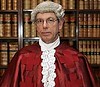
Lord_HamiltonLord President asks for amendment to Scotland Bill allowing Scottish Courts to bury handle Human Rights appeals. IN a move seen by many legal observers as an indication the retiring Lord President, Lord Hamilton may not be so retiring from the legal scene as some may have expected, the Lord President has written to the UK Parliament to ask its MPs to add a restriction on criminal appeals to the UK Supreme Court to the Scotland Bill provisions dealing with devolution issues, thus ensuring the Court of Session can ‘take care of’ any Human Rights infringements, and bury the chance of any appeal from Scotland being heard at the UK’s Supreme Court, a move welcomed (even if it was arranged) by the SNP. The move brings the Lord President into line with the wishes of the Scottish Government, who fell over themselves to castigate the UK’s Supreme Court and even it’s Scottish judges after rulings in the Cadder v HMA case and Nat Fraser appeal.

The Lord President’s representations to Westminster can be read online HERE

Now that the Lord President has ‘rolled over’ to make a judicial request to back up the harsh words from Scottish Ministers, who did not enjoy the impression which was created that Scotland’s justice system and its courts simply couldn't be trusted with appeals, particularly on ECHR issues, the way is now clear for Lord Hamilton to return to a few appointments at the behest of Scottish Ministers as soon as is practicably possible (String pulling comes to mind – Ed)

The Press Release from the Judiciary of Scotland : Lord President Makes Written Representations to Parliament

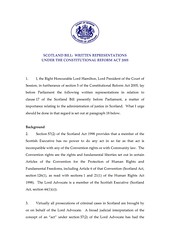
WrittenRepresentationsLPJan12jpg_Page1Click image to read Lord Hamilton’s representation to Westminster. Utilising the powers conferred on him by the Constitutional Reform Act 2005 the Lord President is laying before the United Kingdom Parliament written representations regarding the Scotland Bill presently before it. Section 5 of the Act provides that the Lord President may lay written representations before Parliament on matters relating to the judiciary or the administration of justice in Scotland. Equivalent powers are available to the Lord Chief Justice of England and Wales and the Lord Chief Justice of Northern Ireland.

The Lord President is urging Parliament to do two things:

(1) to extend the jurisdiction of the Supreme Court in Scottish criminal appeals and references to the remedying of infringements by the courts below as well as by the prosecutor; but

(2) to restrict those cases in which leave may be granted to appeal to the Supreme Court from the High Court of Justiciary to cases in which the High Court has certified that a point of law of general public importance is involved in the decision.

As to (2), the Court of Criminal Appeal in England and Wales and the equivalent court in Northern Ireland have long had a certification procedure which has proved to be valuable. The Lord President wishes to secure a similar provision for the High Court in Scotland.

The Lord President seeks, in the Scotland Bill, an amendment to the Scotland Act 1998 to the above effect.

Constitutional Reform Act 2005

Part 2

Section 5 Representations to Parliament.

(1)The chief justice of any part of the United Kingdom may lay before Parliament written representations on matters that appear to him to be matters of importance relating to the judiciary, or otherwise to the administration of justice, in that part of the United Kingdom.

(2)In relation to Scotland those matters do not include matters within the legislative competence of the Scottish Parliament, unless they are matters to which a Bill for an Act of Parliament relates.

(3)In relation to Northern Ireland those matters do not include transferred matters within the legislative competence of the Northern Ireland Assembly, unless they are matters to which a Bill for an Act of Parliament relates.

(4)In subsection (3) the reference to transferred matters has the meaning given by section 4(1) of the Northern Ireland Act 1998 (c. 47).

(5)In this section “chief justice” means—

(a)in relation to England and Wales or Northern Ireland, the Lord Chief Justice of that part of the United Kingdom;

(b)in relation to Scotland, the Lord President of the Court of Session.

Explanatory Notes

Section 5: Representations to Parliament

Section 5 provides that the Lord Chief Justice of England and Wales, the Lord Chief Justice of Northern Ireland and the Lord President of the Court of Session may table written representations to Parliament on matters relating to the judiciary or the administration of justice. In respect of the Lord President of the Court of Session and the Lord Chief Justice of Northern Ireland, this function is qualified by subsections (2) and (3) in order to respect the devolution settlements with Scotland and Northern Ireland respectively.

Constitutional Reform Act 2005

Sunday, January 08, 2012

One expensive ‘Tap on the Shoulder’ as Scottish judiciary chooses its new £214K a year plus expenses Lord President to replace retiring Lord Hamilton

Lord_HamiltonHunt is on to find replacement for Lord Hamilton who retires in June 2012. AS reflected in the current Lord President’s previous explanation of recruitment of members of the judiciary, where a friendly tap on the shoulder appeared to suffice, the Scottish justice system is again to tap someone else on the shoulder to fill the Lord President’s post upon the retirement of Lord Hamilton, the current Lord President in June 2012. An announcement from the Scottish Government reflects the position that bit-part-justice-player, “The First Minister”, has convened a selection panel, to choose the new Lord President, but only after the members of the selection panel were ordered to fill recommended for the post by the legal establishment.

Choosing a new Lord President (and 49 other ways to make potato waffles – Ed)

Following notification of the current Lord President, Lord Hamilton's, intention to retire in June 2012, the First Minister has established a selection panel to make recommendations for a new Lord President. That appointment process has begun today, 4 January 2012, with the office being advertised and applications being invited by 31 January 2012. The selection panel will interview shortlisted candidates and make a report to the First Minister with their recommendations shortly after that.

The selection panel consists of:

Sir Muir Russell (Chair), Chair of the Judicial Appointments Board for Scotland;
Professor Andrew Coyle, Lay member of the Judicial Appointments Board for Scotland;
Rt. Hon Lord Hardie, Senator (Inner House), and
Hon Lady Dorrian, Senator (Outer House)

The office of Lord President is the most senior judicial office in Scotland and the office holder is responsible for leadership of the entire Scottish judiciary, in addition to chairing the Board of the Scottish Court Service. The salary is £214,165.

The procedure for appointing the Lord President is governed by sections 19 and 20 and Schedule 2 of the Judiciary and Courts (Scotland) Act 2008 and section 95 of the Scotland Act 1998. The 2008 Act requires the First Minister to establish a panel to recommend individuals who are suitable for appointment. The First Minister must have regard to the panel's recommendation but is not bound by it. Once the panel makes its recommendation, it is for the First Minister to make his nomination to the Prime Minister, after consultation with both the Lord President and the Lord Justice Clerk. The Prime Minister has responsibility for recommending to Her Majesty the appointment of a person as Lord President, but may not recommend any person who has not been nominated by the First Minister.

Sir Muir Russell was appointed as lay Chairing Member of the Judicial Appointments Board for Scotland in October 2008 for a period of three years and re-appointed in October 2011 for a further three years. He was educated at the High School of Glasgow and Glasgow University, where he took a first class honours degree in Natural Philosophy. He was Permanent Secretary to the Scottish Office and then the Scottish Executive from 1998 to 2003 and Principal of the University of Glasgow from 2003 to 2009.

Professor Andrew Coyle was appointed as a lay Member of the Judicial Appointments Board for Scotland in November 2008 for a period of three years and re-appointed in 2011 for a further three years. He is Emeritus Professor of Prison Studies in the University of London and Visiting Professor in the University of Essex. He was the founding Director of the International Centre for Prison Studies (1997-2005) and a former prison governor. Professor Coyle has a PhD from the University of Edinburgh and is a Fellow of King's College London. He is a member of the Foreign Secretary's Advisory Group on Torture Prevention.

The Rt Hon Lord Hardie was appointed as a Senator of the College of Justice in March 2000 and was promoted to the Inner House of the Court of Session in December 2009. Lord Hardie is a graduate of Edinburgh University (MA, LLB Hons) and qualified as a solicitor in 1971. In 1973 he was admitted to the Faculty of Advocates and he served as an Advocate Depute from 1979 to 1983 and Dean of Faculty from 1994 to 1997. He served as Lord Advocate from 1997-2000.

Hon Lady Dorrian was appointed as a Senator of the College of Justice in 2005, having served as a Temporary Judge since 2002. Lady Dorrian is a graduate of the University of Aberdeen (LLB). She was admitted to the Faculty of Advocates in 1981 and was Standing Junior Counsel to the Health and Safety Executive and Commission between 1987 and 1994. She served as Advocate Depute between 1988 and 1991, and as Standing Junior to the Department of Energy between 1991 and 1994. Lady Dorrian was appointed Queen's Counsel in 1994 and between 1997 and 2001 she was a member of the Criminal Injuries Compensation Board.

Eligibility for appointment as Lord President is open to:

Serving Court of Session Judges
Sheriffs principal and sheriffs who have held continuous office for at least five years
Solicitors who have had rights of audience in both the Court of Session and the High Court of Justiciary for a continuous period for at least five years
Advocates of at least five years standing
Writers of the Signet of 10 years standing who have passed an examination in civil law set by the Faculty of Advocates two years before appointment

Lord Hamilton was first appointed as a Senator of the College of Justice in 1995 and was promoted to the Inner House of the Court of Session in 2002. He was appointed to the offices of Lord President and Lord Justice General in 2005. Lord Hamilton is a graduate of the universities of Oxford (BA, Worcester College) and Edinburgh (LLB). He was admitted to the Faculty of Advocates in 1968 and was Standing Junior Counsel to the Scottish Development Department (1975-78) and the Inland Revenue (1978-82) He served as an Advocate Depute from 1982 to 1985.

Thursday, September 15, 2011

Scotland’s Lord President, Lord Hamilton announces retirement date of 08 June 2012, First Minister goes on-the-hunt for new head of Scotland’s courts

Scotland’s Lord President, Lord Hamilton, has announced he is to retire on June 8 2012. While it is up to the Prime Minister, currently David Cameron to recommend a replacement to the Queen, that person must be recommended by the First Minister, currently Alex Salmond who in turn cannot make a recommendation until the panel constituted to find a replacement for Lord Hamilton makes its own recommendations.

Lord Hamilton was first appointed as a Senator of the College of Justice in 1995 and was promoted to the Inner House of the Court of Session in 2002. He was appointed to the offices of Lord President of the Court of Session and Lord Justice General of Scotland in 2005.

Under the Judiciary and Courts (Scotland) Act 2008 the First Minister will now establish a panel and invite them to make recommendations of individuals who are suitable for appointment to fill the vacancy.

The panel will comprise Sir Muir Russell, the chair of the Judicial Appointments Board for Scotland; one other lay member of that Board nominated by Sir Muir and two judges who will be nominated by the First Minister.

Mr Salmond said: "Lord Hamilton has given outstanding public service both in his role as a judge and as the Lord President and Lord Justice General.

"He has presided during a time of considerable change with the enactment of the Judiciary and Courts (Scotland) Act 2008 - legislation which he played in active part in promoting. It is in his role as both the first Head of the Scottish Judiciary and the chair of the Scottish Court Service that Lord Hamilton has demonstrated his leadership skills and willingness to take on a whole range of new responsibilities which are delivering an improved court system.

"Despite his substantial non-judicial responsibilities, Lord Hamilton has maintained a strong commitment to his judicial work, continuing to preside regularly in the most demanding and complex civil and criminal appeal cases. He will leave behind a substantial contribution to the development of Scotland's distinctive civil and criminal law."

The Rt Hon Lord Hamilton will be retiring after 17 years as a judge. It is for the Prime Minister to make a recommendation to the Queen on who should replace Lord Hamilton, but he may not recommend any person who has not been nominated to him by the First Minister. The First Minister may not nominate any person until the panel has made its recommendation and the First Minister must have regard to the panel's recommendation.

The Judiciary and Courts (Scotland) 2008 Act brought about the creation of the Scottish Court Service as a new statutory entity, governed by a judicially led corporate body as well as giving the Lord President the role of Head of the Scottish Judiciary with important new responsibilities for the disposal of business and the leadership of the Scottish judiciary as a whole.

Lord Hamilton is a graduate of the Universities of Oxford (BA, Worcester College) and Edinburgh (LLB). He was admitted to the Faculty of Advocates in 1968 and was Standing Junior Counsel to the Scottish Development Department (1975-78) and the Inland Revenue (1978-82). He served as an Advocate Depute from 1982 to 1985. From 1988 to 1995 he was a Judge of the Courts of Appeal of Jersey and Guernsey, and from 1992 to 1995 he was President of the Pensions Appeal Tribunals for Scotland. He was appointed as a Senator of the College of Justice in 1995 and as Lord President in 2005. In June 2003 he was elected an Honorary Fellow of Worcester College, Oxford and in January 2006 an Honorary Bencher of the Inner Temple, London.

(A good bloke like Arthur will be missed around the courts – Ed)

Friday, October 15, 2010

Sheriff charged with drink driving, suspended by Lord President, quits post ahead of court appearance.

SHERIFF ROBERT ANTHONY, who was appointed in 2007 after the consequential vacancy arising on the Shrieval bench following the appointment in early 2007 year of Sheriff Hugh Matthews QC to the Court of Session, has quit his job after being suspended by the Lord President, Lord Hamilton when it was revealed Sheriff Anthony had been charged with drink-driving offences (DUI) while driving on the M8 near Harthill. Sheriff Anthony earned around £123,200.

First Minister Alex Salmond nominated Mr Anthony, 45, for appointment on the basis of a report by the independent Judicial Appointments Board. Sheriff Anthony had a commission enabling him to serve where required throughout Scotland's 49 sheriff courts. He sat mostly mostly in the sheriffdom of Glasgow and Strathkelvin.

Admitted as a solicitor in 1984 and to the Faculty of Advocates in 1988, Mr Anthony took silk in 2002. He served as an Advocate Depute, and latterly as a senior Advocate Depute, from 2001 until 2004. In July 2005 Mr Anthony was appointed as a part-time sheriff. He was appointed a Commissioner of the Scottish Criminal Cases Review Commission in March 2007.

The resignation of Sheriff Anthony parallels the case of the former (now deceased) Sheriff Mark Sischy, who similarly resigned from his position as a Sheriff in disgrace after being caught drink-driving, and amazingly returned to the Scottish judicial system as a £74,000-a-year chairman of employment tribunals. Scottish Law Reporter recently reported on events surrounding highly questionable tribunal decisions taken during the late Mr Sischy’s term as the tribunal’s chairman HERE where former St Andrews University lecturer Dr Declan Quigley raised allegations & complaints to Scotland’s Lord President, Lord Hamilton, of ‘buried evidence’ and named Court of Session judge Lady Smith in the complaint, more details of which can be found HERE

News report from “The Sun” follows :

Booze Charge Sheriff Quits

By THOMAS SMITH

Published: 15 Oct 2010
A SHERIFF quit yesterday after appearing in court on a drink-driving charge.

Robert B Anthony, who sits at Glasgow Sheriff Court, resigned from his position after he was suspended by law chiefs. The 48-year-old, from Broxburn, West Lothian, had appeared at Linlithgow Sheriff Court on Wednesday and will appear again next Friday at Livingston Sheriff Court.

Last night a spokesman for the Judicial Office for Scotland said he was "immediately suspended" last month after being charged, pending the outcome of the case. The spokesman added: "Sheriff Anthony has resigned with immediate effect." The sheriff has raised his profile in his five years since being appointed to the bench.

Six months ago, he spared crime boss Eddie Lyons jail for mortgage fraud. The Lyons clan have been involved in a bloody feud with the rival Daniel gang in the north of Glasgow. Sheriff Anthony's claims that Eddie Lyons has "never caused any trouble to society" drew sniggers in court. The notorious gang lord had never been convicted before. He was cleared of attempted murder in 2001 and escaped charges again three years later after police seized £63,000 in alleged drug money from his home.

Fining Lyons, 52, just 300 hours' community service for £259,000 mortgage fraud, Sheriff Anthony told him: "As far as I'm concerned, you are a first offender and a man of mature years who has never caused any trouble to society."

In February this year, Sheriff Anthony jailed two thugs who filmed themselves attacking a stranger then posted the footage on YouTube. Caging the pair for two years, he told them: "This violent and unprovoked attack amounted to nothing more than bullying of a vulnerable member of society."

Last night a spokesman for Lothian and Borders Police said: "We can confirm that a male was charged with drink driving on September 30." He was charged under section five of the Road Traffic Act 1988.

Sheriff Anthony was unavailable for comment last night.

Friday, September 03, 2010

Allegations Court of Session judge ‘buried evidence’ at £200k+ employment tribunal as Lord President puts off complaints investigation into colleague

Lord HamiltonLord President Lord Hamilton in the dock over regulation of judiciary’s conduct. SERIOUS DOUBTS over the ability of Scotland’s top judge to carry out investigations into complaints made against fellow judges & sheriffs have surfaced after Scotland’s Lord President, Lord Hamilton appeared to shy away from carrying out an investigation into serious allegations made by a former lecturer at St Andrews University against currently serving Court of Session Judge Lady Smith & the controversial ex-Sheriff Mark Sischy, (now deceased) who were both involved in an Employment Tribunal case.

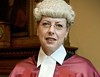
Lady SmithCourt of Session Outer House Judge Lady Smith faces allegations over ‘buried evidence’ at Employment Tribunal. Among the allegations levelled at Lady Smith on the website of Dr Declan Quigley, former lecturer of Anthropology who resigned from St Andrews in 2002 and took the University to an Employment Tribunal, are claims that : Lady Anne Smith, Scottish Supreme Court judge, ensured that evidence buried by the Scottish Employment Tribunals to protect the University of St Andrews remained covered up and that a judgment containing a tissue of misrepresentations went unchallenged.”

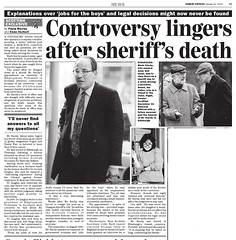
Controversy lingers after Sheriff's Death - Sunday Express January 21 2010The late Mark Sischy who resigned from his position as a Sheriff in disgrace after being caught drink-driving, and amazingly returned to the Scottish judicial system as a £74,000-a-year chairman of employment tribunals, ended up presiding over the former University lecturer’s case against St Andrews University, is, according to Dr Quigley’s website alleged to [have] perverted the course of justice. He signed a judgment containing a tissue of misrepresentations and buried large amounts of evidence to protect the University of St Andrews.”. Mr Sischy’s return to the judicial system in such a prominent role after his drink driving conviction provoked accusations of cronyism, and was questioned at the time by the SNP’s Tricia Marwick MSP. Tricia Marwick said : "The manner in which Mr Sischy was appointed raises concerns of cronyism within the Scottish judicial system.Mr Sischy has been promoted to a full-time chairman while still serving a ban for drink-driving. When you consider that some of the cases brought in front of employment tribunals may involve drink-related incidents during hearings for unfair dismissals, it seems ludicrous to appoint someone with a criminal conviction in this area."

Ms Marwick added : "The posts for part-time employment tribunal chairmen are not advertised while information regarding full-time positions are only circulated to part-time chairmen. This points to cronyism with a strong element of using a 'jobs for the boys' system. The SNP are calling for the procedures of appointments to be more open, transparent and accountable. All positions within the Scottish judicial system should operate best practice where all jobs are advertised and open to the public. These appointments of secrecy are sending out all the wrong messages about employment tribunals.”

Read all about it : Skorupski’s Law – University of St Andrews blew nearly £1/4 million on legal fees. Top judge & Tribunal Chief made ‘questionable decisions’ (click image below to view Dr Quigley’s website)

website image

Among others identified by Dr Quigley’s website are Ian Truscott QC, who represented the University in the Employment Tribunal, and two lecturers at St Andrews University, one alleged to have lied to an Employment Tribunal while the other apparently refused to give evidence.

A Freedom of Information request reported in the Times Higher Education supplement revealed the staggering costs of the hearing, which saw the University of St Andrews spend at least £204,000 to defend the case, far more than Dr Quigley expected to win.

In recent weeks Dr Quigley has been attempting to have his complaints against Lady Smith and the actions of the now deceased Mr Sischy investigated by Scotland’s Lord President, Lord Hamilton, who is responsible for selection and the conduct of the judiciary. However, the Lord President has claimed in correspondence seen by our reporters that he is not responsible for Mr Sischy’s actions and alarmingly, the responses from the Lord President’s office to Dr Quigley’s requests for an investigation apparently ignore all references to complaints made against Lady Smith.

Speaking today to journalists for Scottish Law Reporter, Dr Quigley said : "Lord Hamilton is clearly protecting Lady Smith who corruptly hid from the parties to an employment appeal tribunal (and their barristers) that the Chairman of the original tribunal had been an alcoholic and had been off work for months immediately prior to signing the judgment.”

Dr Quigley continued : “I am examining ways of making Lady Smith legally accountable for her actions and the Lord President and the President of the Employment Tribunals (Mrs Shona Simon) will have to justify why there has been no examination of the circumstances surrounding the case when there have been repeated requests to do so. Obviously, if the claims on my website were not true, I would have been hauled up in front of Lady Smith by now for contempt of court or defamation. In fact, Lady Smith was in contempt of her own court - and of the very basis of the Employment Appeals Tribunals - and she needs to answer for that."

A legal insider this afternoon said it was fundamentally important that any complaint made against a member of the judiciary be thoroughly investigated and go through a formal process which gave a fair hearing to both sides.

However, despite serious allegations being made against a currently serving judge and an ex-sheriff no such investigation has taken place so far by Lord Hamilton, who appears determined to avoid an inquiry into the former University of St Andrews lecturer’s claims, even though there appears ample allegations in the media Mr Sischy gained his Tribunal position through the well known ‘jobs for the boys’ culture in Scotland’s legal establishment, as one report from the Herald newspaper at the time reveals :

Disgraced sheriff's £74,000K comeback Top post despite drink-driving

Iain Wilson Chief Reporter

9 Aug 1999

EXCLUSIVE. A SHERIFF who resigned in disgrace after being caught drink-driving is back in the Scottish judicial system as a £74,000-a-year chairman of employment tribunals.

Mr Mark Sischy's return would not be tolerated under the appointments system which operates in England and Wales. He would not even have been granted an interview because of his criminal conviction. His job was not advertised. The £74,464 salary is met by taxpayers.

Mr Sischy's appointment, via a part-time post in the first instance, will further fuel charges of cronyism and jobs for the boys under the Scottish system, which appears to be less open and transparent than south of the Border. All part-time chairmen's posts in England are advertised under a policy adopted by the Lord Chancellor to draw on ''best available recruitment practices,'' with emphasis placed on open competition.

In Scotland, the posts are not advertised, apparently on grounds it would not produce "a larger field of people with the necessary kind of experience". Instead, aspiring candidates make themselves known either to Mrs Doris Littlejohn, president of Employment Tribunals (Scotland) or to the nation's leading judge, Lord Rodger of Earlsferry, the Lord Justice-General and Lord President of the Court of Session.

Mr Sischy was banned for two-and-a-half years for being almost three times over the drink-drive limit. That timescale does not run out until November. The ban was imposed on May 15, 1997. But by the end of the year, he had re-emerged as a part-time chairman of employment tribunals, whose current pay rates are £332-a-day, plus expenses for travel and subsistence. Promotion has now followed, with Mr Sischy's full-time job, based in Dundee, confirmed last month by Lord Rodger. The vacancy was circulated only among the small pool of part-time chairmen in Scotland. Their caseloads can include drink-related incidents emerging as key factors during evidence at hearings into claims for unfair dismissal.

Mr Sischy, who sat as a sheriff in Glasgow, tendered his resignation from the £79,667-a-year post he had held since 1990 before appearing at Edinburgh Sheriff Court. He was fined £800 and banned from driving for two-and-a-half years. He had been caught with 100mg of alcohol in 100ml of breath by police while driving to a shop near his home. The legal limit is 35mg

Sheriff John Dean told him the fine and period of disqualification had to reflect the level of alcohol in his body. After sentence, Mr Sischy refused to be drawn on what his future plans were. Within months, he was a part-time tribunal chairman.

Now full-time, and with five months of the original drink- driving ban still to go, he is earning almost as much as before his fall from the Bench. Lord Rodger's counterpart in England, the Lord Chancellor, specifically expresses his disgust over drink-driving in a memorandum on conditions of service for tribunal members. His rules and regulations make clear that criminal behaviour, including drink-driving, is unacceptable.

A spokesman for the Lord Chancellor acknowledged that applicants with spent convictions would not necessarily be barred from becoming tribunal chairmen. But he added: "An applicant would not be considered for the period of his disqualification." In other words, anyone still serving a ban would not be interviewed. In his memorandum, the Lord Chancellor warns he would consider removing members if convicted of a grave offence. In particular, he regards "conviction for an offence of driving while under the influence of alcohol or drugs as so grave as to amount prima facie to misbehaviour".

His spokesman said there was no question of a chairman having to resign automatically if convicted after taking up the post. Each case would be considered on the individual circumstances. But the spokesman stressed: "No applicant would be considered for the job while still banned from driving ... he regards drink-driving as a very serious offence." Candidates were specifically warned of the Lord Chancellor's views on drink-driving, both verbally and in writing, during the initial application process, then at interview, and on appointment.

Mr Sischy's ban emerged during an investigation by The Herald into the Scottish appointments system. He offered no explanation for his appointment. When approached, he said: "I think I know what you want to talk to me about. You will understand that I cannot comment." Asked again to discuss issues, he said: "I cannot comment. It is a matter for Doris Littlejohn and the Lord President." Mrs Littlejohn has still to reply to questions lodged by The Herald, and Lord Rodger has refused to comment.

Monday, April 05, 2010

Scottish Court Service now independent from Government although staff remain civil servants under Lord President's leadership

The changes to the Scottish Courts Service, brought about by the Judiciary and Courts (Scotland) Act 2008 are covered by Peter Cherbi’s “Diary of Injustice in Scotland” law blog, in a manner more comprehensively than we can report after just returning from the Easter break …

Scottish Courts Service becomes an ‘arm's length’ independent quango led by Lord President & corporate board

Scottish Courts ServiceThe status of the Scottish Courts Service, the organisation which runs Scotland’s Courts has been changed by the Scottish Government into what some in the legal profession now describe as an ‘arms length’ independent’ body, governed by a Corporate Board chaired by Scotland’s top judge, the Lord President Lord Hamilton. It is claimed, the new arrangements, introduced from 1st April, “will reaffirm the independence of the judiciary and help improve strategic decisions about the operation of the Scotland’s courts.”

The new arrangements, set out in the Judiciary and Courts (Scotland) Act 2008, are intended to improve the justice system by modernising the arrangements for the judiciary and strengthening the relationship between the judiciary and the Scottish Court Service (SCS).

Lord Hamilton judicialLord President Lord Hamilton. Commenting on the changes, the Rt Hon Lord Hamilton, the Lord President and Chair of the SCS Board said: “The changes taking place today - the creation of a Scottish Court Service under the direction of an independent Board and the creation of a unified judiciary - are important constitutional changes. The effect will be to place the Scottish Court Service decision-making process closer to those who are directly involved in the delivery of justice. I believe the new arrangements will provide an opportunity for the creation of a better and closer relationship between judicial office holders and staff, working together to deliver to the public the sound and prompt judgments to which it is entitled.”

“The members of the Board have among them a wide range of knowledge, skills and experience of working within the courts, in government and in the commercial sector. This breadth of understanding will help us develop the direction of the Scottish Court”

“Service and the delivery of services to all those who have need to use them. It will allow us, over the next few months, to consider and develop the strategic direction for the Service. We face, along with the public sector generally, difficult financial conditions. We must not underestimate the challenges this presents.”

In addition to the Lord President, the Scottish Court Service Board includes 12 other members – six members from different tiers of the judiciary and six non-judicial members, including the SCS Chief Executive, an advocate, a solicitor and three members with experience and knowledge from other backgrounds, including business, finance and administration. The ‘new’ members of the Scottish Court Service Board are The Lord President, Lord Justice Clerk, Chief Executive of the Scottish Court Service, The Rt Hon Lord Reed, Sheriff Principal R Alastair Dunlop QC, Sheriff Derek Pyle, Sheriff Iona McDonald, & Mrs Johan Findlay JP (all Judicial Members), Mr Robert Milligan QC (Advocate Member), Mr Mark Higgins (Solicitor Member), Mrs Deborah Crosbie, Mr Anthony McGrath & Mrs Elizabeth Carmichael CBE (Members from ‘outside’ the justice system).

The SCS Board will develop the strategic direction for the Scottish Court Service and deliver an operationally effective SCS, which is responsible for providing the staff, buildings and technology to support Scotland’s courts, the work of the independent judiciary, the courts’ Rules Councils and the Office of the Public Guardian.

The new SCS will work closely with the judiciary, Scottish Government, other justice agencies, professional bodies and consumer and court user organisations to help maintain and strengthen public confidence in the Justice system. SCS Chief Executive Eleanor Emberson has been appointed as Chief Executive to the new organisation. Ms Emberson has been Chief Executive of the Scottish Court Service since 2004. The Scottish Court Service remains part of the Scottish Administration and staff continue to be civil servants.

Those interested in the changes to the Scottish Courts Service status, which have come about from the Judiciary and Courts (Scotland) Act 2008 can view video coverage of the Lord President’s appearance at the Scottish Parliament at LawyerTV where the Lord President was questioned by members of the Justice Committee. While Lord Hamilton, the Lord President was mostly in favour of the bill, former Court of Session judge Lord McCluskey was more critical of many key points, including the amount of Judicial Administration Duties involved in the now passed legislation, along with questions over Judicial Independence.

Lord Hamilton on appointing the Judiciary – An element of trust involved …

Profiles of the members of the ‘new’ Scottish Court Service Board :

The Rt Hon Lord Hamilton, Lord President and Lord Justice General (Arthur Campbell Hamilton).Chair of the Scottish Court Service BoardLord Hamilton was appointed Lord President in December 2005. He was appointed a Judge of the Court of Session in 1995. He is a graduate of the Universities of Oxford (BA, Worcester College) and Edinburgh (LLB). He was admitted to the Faculty of Advocates in 1968.

The Rt Hon Lord Gill, Lord Justice Clerk (Brian Gill) Lord Gill was appointed Lord Justice Clerk in November 2001. He was appointed a Judge of the Court of Session in 1994. He is a graduate of the Universities of Glasgow (MA, LLB) and Edinburgh (PhD). He was admitted to the Faculty of Advocates in 1967, appointed Queen’s Counsel in 1981 and is a member of the English Bar.

Chief Executive of the Scottish Court Service. The Board appointed Eleanor Emberson as Chief Executive of the Scottish Court Service in February 2010. Ms Emerson was Chief Executive of the Scottish Court Service from 2004.The Board will appoint a chief executive in due course, who will also be a member of the Board.

Members of the Board appointed by the Lord President

The Rt Hon Lord Reed (Robert John Reed)
Lord Reed has been a judge of the Court of Session since 1998. He was appointed to the Inner House in 2008, having previously been the principal judge of the Commercial Court. He was admitted to the Faculty of Advocates in 1983.

Sheriff Principal Alastair Dunlop QC
Alastair Dunlop QC has been Sheriff Principal of Tayside, Central and Fife since 2000. He was educated at Trinity College, Glenalmond and the University of Dundee (LLB). He was admitted as a solicitor in 1976 and called to the Faculty of Advocates in 1978. He was appointed Queen’s Counsel in 1990. He is currently a member of the Judicial Studies Committee and chairman of the three local criminal justice boards in his sheriffdom.

Sheriff Derek Pyle
Sheriff Pyle has been a sheriff for ten years. He is based at Dundee and was, prior to that, a sheriff in Inverness. He was formerly a solicitor in private practice in Edinburgh, specialising in commercial litigation. He has a particular interest in the reform of civil law and procedure in commercial disputes and was instrumental in founding the Highland Commercial Court.

Sheriff Iona McDonald
Sheriff McDonald was appointed a part-time Sheriff in 1995 and a full time Floating Sheriff in 2000. She has been Senior Sheriff at Kilmarnock since 2007. She is a graduate of the University of Glasgow (MA, LLB) 1978 and was a solicitor in private practice for almost 20 years.

Mrs Johan Findlay JP
Johan Findlay has been a Justice of the Peace since 1986 in Dumfries and is immediate past Chairman of the Scottish Justices Association. She was a Member of the Parole Board for Scotland from 2000 to 2006 and is an Honorary Sheriff. She is author of ‘All Manner of People, the History of the Justices of the Peace in Scotland’.

Mr Robert Milligan QC
Robert Milligan took silk in 2009. He is a graduate of the universities of Oxford (BA, University College) and Edinburgh (LLB and Dip LP). He was admitted to the Faculty of Advocates in 1995

Mr Mark Higgins
Mark Higgins is a practising solicitor and a member (partner) of the multinational firm Irwin Mitchell LLP. He is a graduate of the University of Glasgow (LLB (Hons) and Dip LP) and is the author of the book Scottish Repossessions (W Green, 2002).

Mrs Deborah Crosbie
Deborah Crosbie graduated from Strathclyde University in 1991 BA (Hon) in Business law and industrial relations. She has had a successful career in the financial services industry and is currently Chief Information Officer for the UK businesses (Clydesdale & Yorkshire Bank) of the National Australia Bank.

Mr Anthony McGrath
Anthony McGrath, graduated from Glasgow University in 1978 BSc (Hon) in Mathematical Statistics. He has had a successful career in marketing and management in the food and drinks industry, including 11 years with Scottish and Newcastle, latterly as a member of its Group and UK management boards. Since 2005 he has been managing director of a chain of public houses.

Mrs Elizabeth Carmichael CBE
Elizabeth Carmichael graduated from Edinburgh University in 1970 MA (hons) History. She has spent most of her working life in the Civil Service, retiring in 2007. From 1999 – 2007 she was Head of the Community Justice Services Division, and since then she has taken on governance roles in the public and voluntary sector, as a Board member of the Scottish Social Services Council and the Deputy Chair of SACRO.

MacAskill tight lippedScotland’s Justice Secretary Kenny MacAskill. Kenny MacAskill Cabinet Secretary for Justice made little comment on the changes, simply saying : “Today marks a milestone in the work being done to modernise and strengthen arrangements for the Scottish judiciary and administration of the courts. It is fundamental to any democracy that the judiciary is independent of the legislative and executive branches of government.”

For my part, I note the appointment of Sheriff Alastair Dunlop QC, who represented me in the case against crooked Scottish Borders lawyer Andrew Penman, and was prepared to take Mr Penman to court and have his negligence & deceit exposed for all to see.

However, the then Alastair Dunlop QC, was speedily appointed to the bench as a Sheriff after just a week had passed after I'd met him, denying my access to my own legal counsel & the court as I couldn’t find another advocate who was allowed to continue the case.

I have the feeling we are looking at the formation of yet another quango to run the justice system in its own interests, rather than the interests of the public who has to pay for it through taxes … and only time will tell if any actual improvements come about through these ‘changes’ …

Wednesday, May 20, 2009

19 years later ‘rights of audience’ sections of 1990 Law Reform legislation become Act of Sederunt in Scotland

We all know the Scots justice system is somewhat slow, but nineteen years is a long time to wait on the implementation of acts of law designed to widen rights of audience in the Scottish Courts.

Yes, some 19 years later, the famous Sections 25-29 of the Law Reform (Miscellaneous Provisions) (Scotland) Act 1990 have become an Act of Sederunt, only it seems because the Justice Secretary and Lord President were running out of excuses to hold back on the approval of rights of audience applications by people from outside the legal establishment.

This all somewhat conflicts with the terms of a leaked letter from Justice Secretary Kenny MacAskill to Cabinet Secretary for Finance John Swinney, dated 25 July 2007 .. where the impression was given that applications were progressing to approval … and now some two years on from that, applicants still have to deal with a barrage of obstructions from both the Government and the Scots legal establishment.

Announcement of Sections 25-29 becoming law (19 years later) :

Act of Sederunt (Sheriff Court Rules Amendment) (Sections 25 to 29 of the Law Reform (Miscellaneous Provisions) (Scotland) Act 1990) 2009 No. 164

Scottish Statutory Instruments

2009 No. 164

SHERIFF COURT

Act of Sederunt (Sheriff Court Rules Amendment) (Sections 25 to 29 of the Law Reform (Miscellaneous Provisions) (Scotland) Act 1990) 2009

Made

24th April 2009

Coming into force

20th May 2009

The Lords of Council and Session, under and by virtue of the powers conferred by section 32 of the Sheriff Courts (Scotland) Act 1971(1) and of all other powers enabling them in that behalf, having approved draft rules submitted to them by the Sheriff Court Rules Council in accordance with section 34 of the said Act of 1971, do hereby enact and declare:

Citation, commencement and interpretation

1.—(1) This Act of Sederunt—

(a) may be cited as the Act of Sederunt (Sheriff Court Rules Amendment) (Sections 25 to 29 of the Law Reform (Miscellaneous Provisions) (Scotland) Act 1990) 2009; and

(b) comes into force on 20th May 2009.

(2) This Act of Sederunt is to be inserted in the Books of Sederunt.

(3) In this Act of Sederunt—

“the Ordinary Cause Rules” means the First Schedule to the Sheriff Courts (Scotland) Act 1907(2);

“the Summary Application Rules” means the Act of Sederunt (Summary Applications, Statutory Applications and Appeals etc. Rules) 1999(3);

“the Summary Cause Rules” means the Summary Cause Rules in Schedule 1 to the Act of Sederunt (Summary Cause Rules) 2002(4);

“the Small Claim Rules” means the Small Claim Rules in Schedule 1 to the Act of Sederunt (Small Claim Rules) 2002(5).

Amendment of rules in consequence of sections 25 to 29 of the 1990 Act

2. In rule 1.2 (interpretation) of the Ordinary Cause Rules, at the end there is added—

“(6) In these Rules, references to a solicitor include a reference to a member of a body which has made a successful application under section 25 of the Law Reform (Miscellaneous Provisions) (Scotland) Act 1990(6) but only to the extent that the member is exercising rights acquired by virtue of section 27 of that Act.”.

3. In rule 1.2 (interpretation) of the Summary Application Rules, at the end there is added—

“(4) In this Act of Sederunt, references to a solicitor include a reference to a member of a body which has made a successful application under section 25 of the Law Reform (Miscellaneous Provisions) (Scotland) Act 1990 but only to the extent that the member is exercising rights acquired by virtue of section 27 of that Act.”.

4.—(1) The Summary Cause Rules are amended in accordance with paragraphs (2) and (3).

(2) In rule 1.1 (citation, interpretation and application), after paragraph (4) there is inserted—

“(4A) In these Rules, references to a solicitor include a reference to a member of a body which has made a successful application under section 25 of the Law Reform (Miscellaneous Provisions) (Scotland) Act 1990 but only to the extent that the member is exercising rights acquired by virtue of section 27 of that Act.”.

(3) In rule 23.3 (expenses), in paragraph (1) for “statutory table of fees of solicitors appropriate to the action” there is substituted “applicable statutory table of fees”.

5.—(1) The Small Claim Rules are amended in accordance with paragraphs (2) and (3).

(2) In rule 1.1 (citation, interpretation and application), after paragraph (4) there is inserted—

“(4A) In these Rules, references to a solicitor include a reference to a member of a body which has made a successful application under section 25 of the Law Reform (Miscellaneous Provisions) (Scotland) Act 1990 but only to the extent that the member is exercising rights acquired by virtue of section 27 of that Act.”.

(3) In rule 21.6 (expenses), in paragraph (2) for “statutory table of fees of solicitors appropriate to a summary cause” there is substituted “applicable statutory table of fees”.

A. C. HAMILTON

Lord President I.P.D.

Edinburgh

24th April 2009

Explanatory Note

(This note is not part of the Act of Sederunt)

By sections 25 to 29 of the Law Reform (Miscellaneous Provisions) (Scotland) Act 1990, any professional or other body may, for the purpose of enabling any of their members who is a natural person to acquire rights to conduct litigation or rights of audience, make an application for that purpose to the Lord President of the Court of Session and the Scottish Ministers. Such an application must include a draft scheme, which the Lord President and the Scottish Ministers may approve. Section 27(1) of the 1990 Act provides that where such an application has been granted any member of the body concerned who is qualified under the scheme and who appears to the body to be a fit and proper person has the rights to conduct litigation or rights of audience to which that qualification entitles him or her. This Act of Sederunt amends the principal sets of sheriff court rules so as to ensure that they properly accommodate the possibility of such a person conducting litigation or exercising a right of audience in the sheriff court.

Sections 25 to 29 of the 1990 Act were brought into force in March 2007.

(1)

1971 c. 58; section 32 was amended by the Law Reform (Miscellaneous Provisions) (Scotland) Act 1985 (c. 73), Schedule 2, paragraph 12, the Civil Evidence (Scotland) Act 1988 (c. 32), section 2(4), the Children (Scotland) Act 1995 (c. 36), Schedule 4, paragraph 18(2), the Adults with Incapacity (Scotland) Act 2000 (asp 4), schedule 5, paragraph 13 and the Debt Arrangement and Attachment (Scotland) Act 2002 (asp 17), section 43, and was extended by the Child Support Act 1991 (c. 48), sections 39(2) and 49, the Vulnerable Witnesses (Scotland) Act 2004 (asp 3), section 14(2) and the Bankruptcy and Diligence (Scotland) Act 2007 (asp 3), section 33. Back [1]

(2)

1907 c. 51. Schedule 1 was substituted by S.I. 1993/1956 and amended by S.I. 1996/2167 and 2445 and S.S.I. 2000/239 and 408, 2001/8 and 144, 2002/7, 128 and 560, 2003/25 and 26, 2004/197 and 350, 2005/20, 189, 638 and 648, 2006/198, 207, 293, 410 and 509, 2007/6, 339, 440 and 463 and 2008/121, 223 and 365 and 2009/107. Back [2]

(3)

S.I. 1999/929, amended by S.S.I. 2000/18 and 387, 2001/142, 2002/7, 129, 130, 146 and 563, 2003/26, 27, 98, 261, 319, 346 and 556, 2004/197, 222, 334 and 455, 2005/61, 473, 504 and 648, 2006/198, 410, 437 and 509, 2007/6, 233, 339, 440 and 463 and 2008/9, 41, 111, 223, 335 and 365 and 2009/107 and 109. Back [3]

(4)

S.S.I. 2002/132, amended by S.S.I. 2003/26, 2004/197, 2005/648, 2006/509, 2007/6, 339, 440 and 463 and 2008/121, 223 and 365 and 2009/107. Back [4]

(5)

S.S.I. 2002/133, amended by S.S.I. 2003/26, 2004/197, 2005/648, 2006/509, 2007/6, 339, 440 and 2008/121, 223 and 365 and 2009/107. Back [5]

(6)

1990 c. 40. Back [6]

Saturday, May 16, 2009

Lord Hamilton & Lord Gill criticise ‘Sentencing Council’ plan – The movie

The Lord President Lord Hamilton & the Lord Justice Clerk, Lord Gill appeared before the Scottish Parliament’s Justice Committee to discuss, and criticise some of the plans contained in Criminal Justice and Licensing Scotland Bill, particularly those plans relating to the ‘Sentencing Council’, an idea from the Scottish Government to give communities and victims a say in the recommended lengths of sentences of those found guilty of offences ..

You can read our earlier report on the debate HERE

Watch the testimony of Lord Hamilton & Lord Gill here (be careful your veins don’t drain of life while watching – Ed)

Part I

Part II


Part III


Part IV


Part V

(I thought the best bit was when Lord Gill called the whole thing a quango – Ed)

Lord Gill sums it all up in one word – phew !

Wednesday, May 13, 2009

Sentencing Council condemned by Lord Hamilton at Holyrood Justice Committee

Justice Secretary Kenny MacAskill’s plans to create a new ‘Sentencing Council’ to recommend the length of sentences to Scotland’s judges have come in for a bit of a bashing from the Lord President, Lord Hamilton, the Lord Justice Clerk, Lord Gill, and a few others.

The Herald reports :

Judges condemn ‘flawed’ new justice bill

ROBBIE DINWOODIE, Chief Scottish Political Correspondent

May 13 2009

The head of Scotland's judicial system, Lord Hamilton, yesterday accused ministers of "putting the cart before the horse" by looking to create a new Sentencing Council before establishing if there was currently a problem with inconsistent disposals by judges and sheriffs.

The Lord President, the country's most senior judge, told the Justice Committee at Holyrood that the Criminal Justice and Licensing (Scotland) Bill was flawed in its attempt to create a Sentencing Commission that would lay down guidelines.

He argued that such a body should comprise a majority of judges, sheriffs and justices; should have only an advisory role to the Court of Criminal Appeal, which should retain the formal power to issue guidelines; and should be primarily a body conducting research into current sentencing practice.

"There is no empirical evidence that there is any inconsistency of sentencing," said Lord Hamilton, who said setting up a £1m body before any such proof had been found was "putting the cart before the horse."

The submission on behalf of all judges argued that the bill undermined judicial independence, stating: "Whatever may be asserted about the residual discretion of individual judicial office holders when passing particular sentences, the bill's proposals strike directly at the independence of the judiciary (and in particular the High Court) as the arm of government essentially responsible for the setting of sentencing policy.

"The proposals (as framed) are fundamentally unacceptable both on domestic constitutional grounds and because mandatory directions to the court by a non-judicial body undermine the judicial independence required of courts by Article 6 of the European Convention on Fundamental Rights and Freedoms."

Sheriffs were no more enthusiastic about the proposals, with the Sheriffs' Association being highly critical of the proposal to make the Bench offer an explanation before handing down any sentence of less than six months.

Its submission said critics who argue that short sentences are ineffective and that prisons can do little for short-term inmates are missing the point.

Committee convener Bill Aitken, who is Tory justice spokesman, said after the meeting: "Kenny MacAskill's proposals have been demolished by those who best know the legal system in scathing terms.

"He is completely out of touch with reality."

Friday, April 03, 2009

Judge who jailed rape case witness criticised by Lord Justice-General

Roger Craik QC, the judge who jailed a witness in a rape case, has been criticised by the Lord Justice General for his disproportionate actions towards a reluctant witness ….

No punishment though, as the Judiciary are of course, self-regulating (big surprise – Ed)

The Scotsman reports :

Judge who locked up witness in rape case escapes punishment

Published Date: 03 April 2009
By JOHN ROBERTSON
Law Correspondent

A JUDGE who locked up a reluctant witness in a rape case was criticised by the Lord Justice-General yesterday for his "unjustified and disproportionate" action.

However, Roger Craik, QC, was told that Lord Hamilton, Scotland's most senior judge, did not intend to take any action against him, allowing him to continue to preside over High Court trials.

Ann Robertson, 43, was held overnight in custody after she stormed out of court and refused to complete her evidence.

She lodged an official complaint about her treatment and said Mr Craik should be sacked.

In yesterday's announcement of the findings of a "thorough investigation", Lord Hamilton said Ms Robertson had put the trial judge in a difficult position and her behaviour could not have been ignored by him.

However, he upheld the complaint and told Ms Robertson: "I have come to the view that his decision that you be detained overnight, which must have been traumatic for you, was, in the circumstances, disproportionate."

George Cummings, 69, from Grangemouth, was jailed for three and a half years for sexually abusing two sisters while they were children.

He had also been accused of raping Ms Robertson as a child, but that charge was dropped.

Before being called to give evidence at the High Court in Edinburgh, arrangements were made to try to put her at ease. The court was cleared of the public and a female supporter was allowed to sit near her. She had been offered screens to separate her from the accused, but declined.

"Ms Robertson appeared to have particular difficulty in testifying … while still being questioned by the prosecutor, she abruptly and without permission left the court," said the statement issued on behalf of Lord Hamilton.

"She was ultimately persuaded to return. Her evidence resumed." But Ms Robertson stormed out a second time, and again had to be persuaded to return.

Mr Craik, a temporary judge, said he recognised she was under pressure and in a difficult situation, but told her she was under an obligation to give evidence.

If she felt she could not continue, he told her, she should intimate that and he would decide whether or not to adjourn.

Ms Robertson refused to answer questions about the effects of the alleged abuse on her adult relationships, and would not continue with her evidence.

The judge adjourned the trial until the next day. He wanted Ms Robertson to be seen by a doctor to determine if she was fit to give evidence and, concerned she might not return, ordered her to be detained. The following day, "with some difficulty", she completed her evidence.

The statement added: "The Lord Justice-General has concluded that the trial judge's decision to order Ms Robertson's detention overnight was dis-proportionate. He has advised him accordingly. No further action is being taken.

"While the conduct of cases involving sexual abuse is a difficult and delicate matter, the court has a duty to ensure that the accused receives a fair and expeditious trial."

Friday, September 26, 2008

Judicial ‘independence’ supported by MSPs as concerns grow over judicial ‘dictatorship’

When is independence independence … when it is transparent, accountable, just, and fair …

However, none of those terms could ever be applied to Scotland’s judiciary going on the experience of most solicitors and much of the Scots public.

Still, in the best interests of keeping things as they are, and ensuring little reform in the public interest, the Scottish Parliament has ‘backed’ the independence of the Scottish Judiciary by supporting the Judiciary & Courts (Scotland) Bill, which leaves the Lord President at the head of the Scottish Courts Service.

As a reminder to whom we are putting in such a powerful and ‘independent’ position, here is a clip of Lord Hamilton’s testimony at the Scottish Parliament …

Lord Hamilton - A measure of trust ?

Judicial independence is backed by MSPs

STEWART PATERSON September 26 2008

A Bill to guarantee the independence of the Scottish judiciary from parliament has been passed by MSPs.

The Judiciary and Courts (Scotland) Bill makes the Lord President, Scotland's most senior judge, the head of the judiciary with responsibility for all court business and for the conduct of judges.

The Scottish Court Service will become a non-ministerial department, run instead by a board, chaired by the Lord President. The bill also changes the eligibility rules on who can be appointed to the Court of Session, to those who have practised as solicitor advocates in either the Court of Session or the High Court, instead of both.

Kenny MacAskill, the Justice Secretary, said: "The bill delivers a strong coherent structure for a modern judiciary and the effective management of our court system."

The bill was also welcomed by senior figures in the legal profession. Lord Hamilton, the Lord President, said: "If the bill receives the Royal Assent, it will in due course bring about significant change in the administration of the Scottish courts and in my own office of Lord President.."

Eleanor Emberson, chief executive of the Scottish Court Service, said: "I believe that having the Lord President as chair of the Scottish Court Service governing body gives this organisation fresh impetus."