Coming straight from the horses mouth, so to speak, the Dean of the Faculty of Advocates, Richard Keen QC, has let it be known that claims to the Master Policy and Guarantee Fund are rocketing over mortgage & buy-to-let frauds, where many Scots legal firms have seemingly faked securities for clients in order to obtain mortgages from banks ..
Some legal firms and solicitors seem to have faked up the paperwork for their own property deals too (we heard that – Ed)
Peter Cherbi’s “A Diary of Injustice in Scotland” reports more on the matter :
 Richard Keen QC. Richard Keen QC, the Dean of the Faculty of Advocates, has admitted there will be a sharp rise in claims against solicitors, with both the Master Policy & Guarantee Fund being heavily affected as many of the dubious buy-to-let schemes, involving solicitors apparently faking up securities for clients, begin to be discovered.
Richard Keen QC said in “The Firm” article which you can read here : Reasons to be cheerful : “Are there any prospects for growth in the present environment? I would predict that over the next 12 months we are almost certainly going to see a substantial increase in the identification of loan fraud related to buy to let projects. I would not be at all surprised if this came to dominate claims on the Master Policy and the Guarantee Fund.”
 Law Society will face many claims against crooked lawyers. Prospects for growth, as the Dean himself indicates, seem to be a huge jump in fraud claims against the legal profession, with the Master Policy & Guarantee Fund both being put to the test as many banks and financial instructions discover that many ‘buy-to-let’ schemes have frankly, been nothing short of bare faced fraud, on the part of many clients and solicitors, hungry for fat profits on highly dubious deals, backed by faked up securities many of the Banks failed to accurately confirm supported the transactions taking place.
You can read more about the buy to let fraud here : Buy-to-let fraud hits thousands
Buy-to-let fraud has hit the property market and the legal profession many times before, and many will remember how some clients of the defunct law firm Scott Moncrieff & Dove Lockhart (known for their jailed solicitor partner John McCabe where £4 million disappeared), were apparently also engaged with some of the solicitors in ‘buy-to-let’ fraud schemes, in which several Scottish banks lost a great deal of money.
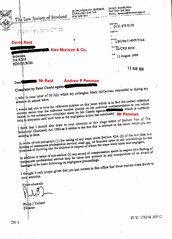
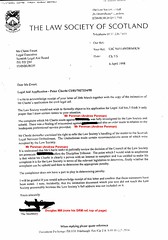
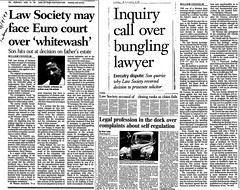 Lessons to be learned – The ‘Penman Levy’ ends up costing Scots lawyers & legal firms dear. The growth in ‘buy to let fraud’ & claims against crooked lawyers is not the only growth area in the legal system these days .. as solicitors in Scotland must also now fork out a huge annual complaints levy, dubbed by some senior lawyers as the "Penman Levy", in reference to the multitude of 'crooked lawyer' scandals reported in the media after my own personal battle with the legal profession, which involved the Law Society's determination to defy prosecution in the case of crooked Borders lawyer Andrew Penman.
You can read more about the Scotsman’s reporting of the Andrew Penman case, here : Andrew Penman of Stormonth Darling Solicitors, Kelso -The Scotsman stories
However, while each Scottish solicitor was forced this year to pay an average of £400 each to fund the “Penman Levy" to run the Scottish Legal Complaints Commission, amounting to a whopping £2.4 million, it seems some solicitors have decided to recoup their ‘Penman Levy’ costs by fiddling their fee demands to clients, as many Scots are about to find out, if they are expecting a bill from their lawyer.
In a recent survey of 20 contacts throughout Scotland who have received demands from their solicitors for payment of fees, every single bill was found to be well far of the 'cost estimate' originally provided by the solicitor to the particular client, and it is also worth noting that in each case, where timescales for a resolution to the client's problem had been given, not one single case out of the 20 clients concerned, had progressed to a solution.
In one case, involving a boundary dispute with a neighbour, the client, of a famous Edinburgh legal firm, was told in 2005, it would cost in the region of £2,000 to study the papers, seek Counsel's opinion, and bring the case to court.
However, last week the client received a demand for an additional second Counsel's opinion, which came to £2,105.55 pounds alone, which the client was not informed had even been given in 2008. When the client asked to see the actual opinion, his request was refused, with a letter arriving two days later demanding full payment of the £2,105.55 otherwise immediate steps would be taken to recover the funds.
After a little checking by the client, directly with the Advocate, it has been discovered the QC who was supposed to have given Counsel's opinion on the boundary dispute, had never actually undertaken the work, nor even given the first Counsel's opinion the solicitor had charged his client £1520, during 2007.
Obviously in this case, a significant fraud has taken place against the client, by one of Edinburgh's 'most respected legal firms', and this particular case will no doubt generate another complaint against a 'crooked lawyer' to add to the thousands of complaints filed each year by clients against their solicitors in Scotland.
 SLCC wont investigate cases before late 2008. However the ‘do-nothing’ Scottish Legal Complaints Commission will not even investigate this complaint or any matter arising from the case, as the SLCC conveniently decided it would not examine any complaints connected with legal work instructed prior to 1st October 2008, when the Commission began operation.
Studying the raft of solicitors bills recently sent out to clients, there does appear to be an increasing trend by Scots legal firms, desperate for any income they can get, to provide false accounts to clients, for cases which partners have taken on but have never seriously pursued as per agreements reached with clients to represent their legal interests.
The only advice I can offer for now is : If you have currently engaged a solicitor in any way whatsoever, you must carefully scrutinise your solicitors fee demands and bills, because the likelihood is, their fee demands are inaccurate and unjustified.
In another case, a family who were due to receive property as part of their deceased father's estate in the Scottish Borders, were forced to wait three years, before being told there was no assets left in the estate and they must put in money to pay a whopping £5,300 bill for legal services, undertaken by a notorious firm of solicitors based in the Scottish Borders.
In yet another instance, a client was recently sent a bill for £3,520 by a Glasgow law firm, despite the fact he actually settled the case with his neighbour over a land dispute in 2007. The recent fee demand was accompanied by a 7 day threat of court action if no payment was received, apparently being sent on the basis "the account had been misfiled and never sent out" - this despite the fact the client retained his fee payments and took his client file from his solicitor's office in 2007 after settling the case, and settling all fees due which totalled £1,477 at the time.
Many of the other cases brought to my attention of inflated accounts & demands from solicitors involve case work such as, land purchases or sales gone wrong, divorces, custody cases, boundary disputes, failures in executry work, false QC's opinions, backdated or allegedly misfiled accounts, fictitious work undertaken on cases which have no hope of reaching a settlement.
A paralegal I know who recently was sacked along with several other staff from her struggling legal firm, described the client billing situation in the Scots legal profession as "fraudulent at best", and went on to claim "at the moment its pandemonium in many legal firms I know of, where friends and paralegals I know personally have been asked to type up bills for clients which they know themselves are fictitious as the work has never been done".
"I remember a few weeks ago there was a client telephoned to speak to the senior partner over the size of his bill and the fact it was nearly £6,000 over the estimate initially provided. The senior partner told me he didn't want to speak to the client under any circumstances, and I was to call the Police if the client made any hint he would not pay or insulted any members of staff on the telephone".
"I know for a fact that client's case is a mess and twice the solicitor took the matter into court just to have the case adjourned so he could get more fees out of the client for doing nothing”
“The case, which involved a neighbour who had built on their land, has left the client with a property they cant sell. Probably the mess will be left for someone else to clean up if they can get another solicitor to look at it which I honestly don't think will happen after the mess my former employers made of their case."
So the lesson for anyone of you who has received or is about to receive a bill from their solicitor, is to check it out thoroughly, because the chances are, there is a lot of false work added to that account, which you either never authorised, or were never told would be required.
I suppose the other lesson, perhaps this time for solicitors is – speak out against the bad apples in the profession, because in the long run it will be a lot cheaper for you, generate much more respect, and probably bring in business & clients who for now, doubt your honesty and ability as a profession to regulate yourselves.
Oh, by the way, (I have to ask) how do solicitors really feel about having to pay out £400 a year to fund the SLCC, simply because the Law Society decided to fiddle the case against Andrew Penman, the Scotsman’s reporting of which brought about many hundreds more scandals involving crooked lawyers reported in the Scottish media to this day ?
Read on for some more examples of sleazy solicitors from Scotland’s legal profession (from the Scotsman) :
Sleazy side of legal profession
""We must ensure those with the highest standards are protected from the dishonest few" - leslie cumming
By GINA DAVIDSON
AS Leslie Cumming lay bleeding outside his Murrayfield home, the victim of a frenzied stabbing, his cool legal brain was probably already clicking into gear.
While his body fought to stem the flow of blood from a dozen wounds, his mind was whirring through the possibilities of who would have wanted to attack him. It wasn't long before the top law official was able, from his hospital bed, to give Lothian and Borders Police a rundown of lawyers he is and has investigated for suspected money laundering.
Now, two lawyers are to be interviewed by detectives in connection with the attack on the 62-year-old, while police also sift through all the Law Society files that are the work of months of painstaking investigation by chief accountant Cumming and his 12-strong team.
Yet while the attack on Cumming saw the reality of violent crime intrude into his highly regulated world of balance sheets and law books, it has also focused the public interest on corrupt lawyers. Ever since he was appointed chief accountant of the Law Society of Scotland back in 1984, Cumming has taken it upon himself to weed out rogue or "bent" lawyers throughout the country.
Back in the early 1990s, he ensured the Law Society took a hard-line stance against crooked lawyers who embezzled clients' money, changing the five-year inspection of firms' books to two years. The move came after lawyer John McCabe, who had worked for Edinburgh firm Scott Moncrieff & Dove Lockhart, was jailed for ten years for defrauding his clients out of more than £4 million.
More than two years ago the Law Society - which represents more than 8000 lawyers - along with the National Criminal Intelligence Service held a series of seminars aimed at raising awareness about the ways criminals might try to exchange stolen for clean money.
That was when the Proceeds of Crime Act became law, making it illegal for professionals to handle criminals' money without asking questions. As a further safety measure, he also oversaw the introduction of regulations which mean every firm must submit a financial certificate every six months to the Law Society, providing financial information about the firm and confirming compliance with accountancy rules.
Such scrutiny was bound to make him some enemies. Yet Cumming has always maintained that solicitors in Scotland are in the majority honest, with just a few spoiling the reputation of the profession. He has said: "Our system relies on the near 100 per cent honesty of the profession which is what we find time after time.
"It is our duty to the profession and their clients to ensure that those who maintain the highest standards and their clients are protected from the actions of the few who act dishonestly."
Sources in the legal profession claim there are currently 19 lawyers on petition charges - which means they've committed an offence which could mean a minimum sentence of more than five years in jail - although a spokesman for the Crown Office says they have no way of confirming the number as they don't list occupations.
Legal sources also suggest that, despite the Proceeds of Crime Act which could see lawyers face up to 14 years in prison for turning a blind eye to money laundering, there are still those who believe the rewards are worth the risk.
"It all depends on how well your practice is doing, that seems to be the excuse when people are struck off," says one Edinburgh lawyer. "That if business isn't going so well, and they have clients who have money to 'invest' in property, then it becomes an option. But lawyers know the risks. If a client comes in with £100,000 in cash and says he wants to buy something, be it property or shares, bells should be ringing.
"If a lawyer doesn't do the necessary checks, ask the necessary questions and then gets found out to be dealing with dirty money, then they go to jail, it's as simple as that. Most would think it isn't worth the risk, but there will always be those who are blinded by the cash."
Another adds: "The change in the law has been onerous for solicitors. It means that when a new client comes through the door we have to ask for passports, driving licences, utility bills . . . it's a bureaucratic nightmare.
"If there's any reason to suspect the client of trying to pass off stolen money you have to report them to NCIS in England. The solicitors are being asked to police clients rather than the police, and if we get it wrong we go to jail."
Another city solicitor says: "Embezzling has been seen as a way out of trouble for some lawyers in the past, but these days firms' books are gone through with a fine-tooth comb every two years. The accountants at the Law Society know exactly what to look for, so there's no hiding any dodgy practices."
However, despite all the checks and balances, one case which slipped Cumming's net for a decade, until just two years ago, was that of former solicitor John Kennedy Forster. A partner at Stranraer-based solicitors Ferguson & Forster, MacFie & Alexander, he admitted 35 charges of embezzling £667,000 from his clients to pay for school fees, his large home with outdoor swimming pool and foreign holidays.
His sentencing was deferred several times at the High Court in Edinburgh, to allow for compensation proceedings to be resolved and for a report to be submitted by forensic accountants. Finally though on March 18, 2004, he was jailed for six and a half years.
According to Cumming, the case took so long because it "involved a uniquely complex system with the evidence well hidden".
He added: "But as with all cases, once the cracks appeared layer after layer of the fraud was exposed and produced the evidence which we needed and which the Crown then used.
"Most successful frauds involve several strands and depend on a position of particular power or influence. The hardest to uncover are those where there's an element of complicity. It's a constant challenge and each time we find a scheme we ensure that all our inspection teams know about the mechanisms and how it worked so that they can recognise the signs in the future."
Police sources here in Edinburgh believe there are few, if any, corrupt lawyers working in the Capital, and that the Law Society's checks are currently adequate for preventing illegal financial activities, although they admit there will be those who don't get caught quickly enough.
One says: "I've seen a few dodgy lawyers in my time, but not on the financial front.
"There's more organised crime in Glasgow than Edinburgh but then the property market here is much more expensive and so that maybe proves the attraction. But I do think that there's only a few corrupt lawyers in Scotland - although they can be damaging to the whole of the profession."
But perhaps the most telling thing about crime among Scotland's lawyers is that claims on the Law Society's Guarantee Fund - a fund which compensates clients who have suffered loss as a result of a solicitor's dishonesty, and which is paid into by partners in law firms - have steadily fallen under Cumming's tenure.
Each partner pays around £200 a year into the fund, which is in excess of £1 million. For the year 2003-2004, the last year for which figures are available, the total paid out was £187,000, whereas when the fund was first established in the early 1990s, the compensation payouts were as high as £1.35m.
LOWERING THE BAR: CROOKS WHO MAKE UP LAW'S LIST OF SHAME
1991: Edinburgh lawyer John McCabe was jailed for ten years after admitting 34 charges of fraud totalling more than £4 million. He conned banks and building societies into handing over loans of up to £500,000 and ploughed the money into disastrous business ventures. He fled to South America, leaving a taped confession, but returned within a few days and was arrested at Heathrow Airport.
1996: A five-year sentence was handed to David Hoey, a lawyer from Leven, after he was found guilty at the High Court in Edinburgh of stealing more than £500,000 from elderly clients. He had already been struck off when the offence came to light.
1996: After a probe into his firm's financial affairs, Donald Pirie was struck off. A police investigation found that the Cowdenbeath-based lawyer, who lived in East Linton, had embezzled £63,000 from clients, including £40,000 from his parents. He was jailed for five and a half years.
1997: Stephen Crilley pocketed £45,000 in fees due to his firm because he believed he was underpaid. He was a partner with Grant & Wyllie until resigning in 1996 and was struck off the following year. He avoided going to prison by repaying the money.
1997: Pat Elliot was jailed for 18 months after she was found guilty of stealing £60,000 that was destined for two charities from a client's will. Elliot, of Crown Terrace, Glasgow, was also struck off.
1998: Alexandra MacRae, a lawyer who underwent a sex-change operation and was previously known as Steven Raw, admitted to embezzling more than £16,000 from a client's account in order to pay her Dundee firm's debts. She was struck off before later being sentenced to 15 months. However, she appeared in court again in 2001 and was sentenced to three years for embezzling almost £100,000 from an elderly client while she had worked as a lawyer.
2000: William Stevens of Saughtonhall Drive was jailed for four years at the High Court in Edinburgh for embezzling cash from elderly clients to pay for school fees. He was also struck off, although had resigned as a partner with firm Bennett and Robertson in 1997.
2001: Alistair Liddle prompted a police hunt in 1997 after vanishing, leaving his family in Forres, just as the Law Society was to investigate his firm. He was struck off in 1999 and traced to Cornwall in 2001, where he admitted embezzling £17,875 from a client's account. He was jailed for a year.
2001: Solictor Bruce Gordon of Piersfield Terrace in Edinburgh was struck off after being found guilty of professional misconduct for embezzling £55,000 from a dead man's estate. He was jailed for a year.
2003: Alastair Hall, a former partner of A&R Robertson and Black in Blairgowrie, was jailed for 11 years after stealing £500,000 from clients. He admitted five charges of embezzlement, two of fraud and a bankruptcy offence.
2004:Edinburgh lawyer Ricky McAnulty was jailed after admitting embezzling almost £20,000 from the accounts of five clients. He was struck off and sentenced to 18 months in Saughton.
2004: Douglas Criggie, who owned Cumberland Street firm Criggie & Co, was charged with embezzling £50,000 from clients. But his firm was sequestrated after it was discovered he had unpaid loans and bills totalling £300,000 and he went bankrupt. He was struck off by the Law Society in May 2004 and the Crown Office is still considering prosecution.
2005: Glasgow lawyer Calum Blyth was jailed for two years after being found guilty of embezzling £108,000 from his clients and obtaining a further £27,000 by fraud while working for Blyth Solicitors between 1996 and 1999