Showing posts with label Scottish Solicitors Discipline Tribunal. Show all posts

Friday, October 09, 2015

TRIAL BALLOON: Lord Advocate deflects calls for inquiry on Crown Office handling of mortgage fraud allegations against solicitor who represented MP Michelle Thomson

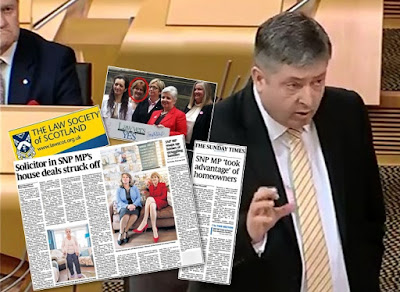
‘Unconvincing’ Lord Advocate raises fears of cover up. DURING one of the worst performances ever by a Lord Advocate before the Scottish Parliament – top prosecutor Frank Mulholland said he did not think there should be an inquiry into the handling of an investigation of a lawyer who was struck off over property deals involving SNP MP Michelle Thomson.

Responding to questions on when the Crown Office & Procurator Fiscal Service (COPFS) was informed of allegations of mortgage fraud involving solicitor Christopher Hales – Frank Mulholland told MSPs that he does not believe there should be an inquiry into when prosecutors knew and how the case has since been handled - after it emerged the Law Society briefly informed the Crown Office of the ‘issue’ in December 2014.

Hales, who once listed his occupation as “Police Constable” – and is now struck off by the Scottish Solicitors Discipline Tribunal from working as a solicitor - handled numerous property deals for his client – SNP MP Michelle Thomson. Mr Hales acted for Ms Thomson before she was elected as an SNP MP.

According to a ruling by the Scottish Solicitors’ Discipline Tribunal, a full version of which has been published by the Sunday Times, Mr Hales failed to provide key information to mortgage lenders in breach of guidelines designed to prevent fraud in numerous cases.

In the Scottish Parliament on Thursday, Labour MSP Jackie Baillie asked Mr Mulholland about the timeline in the case.

During the 10 minute session, Lord Advocate Frank Mulholland presented a timeline of events as the Crown Office saw it:

18 December, 2014 - The issue of solicitor Christopher Hales was raised "informally" by the Law Society of Scotland with the Crown Office. Neither the clients nor properties were named.

28 April, 2015 - The issue was raised again and it was noted that the matter of referral to the Crown Office was still under consideration by the Law Society. Neither the clients nor properties were named.

1 July, 2015 - The Crown was advised by the Law Society that it was required to obtain authorisation from its Guarantee Fund Sub Committee to formally refer the case.

3 July, 2015 - Referral was received by the Crown following the required authorisation. Documents were handed over to the Crown Office and in those documents the names of clients and properties were disclosed.

9 July, 2015 - A formal referral was made to the Crown Office and instructions were issued to Police Scotland.

Frank Mulholland  questioned by MSPs about when the Crown Office was first notified of allegations of mortgage fraud against Christopher Hales.

Mr Mulholland said: "As the Crown has made clear on a number of occasions, the case of Christopher Hales was first brought to its attention by the Law Society of Scotland at a meeting on 18 December, 2014."

Ms Baillie asked if Mr Mulholland believed there should be an investigation into the processing of information between the Law Society and the Crown Office.

She asked if he would order such an inquiry, given that there may have been "additional opportunities for alleged mortgage fraud" due to the delay.

Mr Mulholland responded: "I don't have the power to order an inquiry, and I don't think there should be an inquiry."

He said Police Scotland were instructed to investigate the allegations on 3 July 2015 and formally issued officers to do so on 9 July.

He said the issue was raised at routine quarterly meetings between the Law Society and the Crown Office.

Mr Mullholland said the Crown Office was first made aware on 18 December 2014 that the case was under consideration for referral. The issue was raised again on 28 April.
Image copyright PA Image caption Ms Thomson denies acting illegally

Mr Mulholland added: "The first time the Crown was made aware of the identity of the clients and the properties, was the 3rd of July."

Mulholland was also asked by Jackie Baillie if the Crown Office had begun any Proceeds of Crime actions against those involved.

Embarrassingly for the Lord Advocate, and appearing to have little clue as to the sequence of events, he responded “not yet”.

Police Scotland launched an inquiry only after the Crown Office was finally handed the detailed case files in the Hales case by the Law Society, some seven months from the day it first alerted prosecutors to the case.
Hales was banned from the legal profession in May 2014 over 13 property deals linked to Thomson and her business partners. The transactions involved “back to back” sales, where homes – often owned by vulnerable people – were bought at below full market value and then resold at far higher prices, in some cases on the same day; where large cash sums were transferred between the parties involved; where mortgage loans were sought that were higher than the price paid for the home, and where higher prices than those actually paid were recorded in the Scottish land registry.

Mortgage companies involved in those transactions, including Lloyds, which gave loans through its subsidiary Birmingham Midshires, and Virgin Money, which now owns the mortgage book for Northern Rock, which lent money for one sale, have confirmed they are now in contact with the police.

The Sunday Times disclosed it had submitted new evidence of an unusual property transaction to Police Scotland detectives after a couple who sold a home to Thomson alleged they had £32,000 deducted from the sale proceeds to pay off a loan they had no knowledge of.

The solicitor involved in that transaction, James Craig, had been found guilty of professional misconduct in February 2014 by the Scottish Solicitors Disciplinary Tribunal (SSDT), the body that struck off Hales three months later, and fined £2,500 for breaching money laundering regulations. There was no evidence that Craig acted improperly in the case reported by the Sunday Times.

The Sunday Mail reported that a second lawyer named in the SSDT judgment on Hales called Christopher Tulips, whose firms Strefford Tulips was involved in several deals for Thomson’s firm M&F Property Solutions, had also been censured and fined £2,500 for his role in back-to-back property deals. The published ruling by the SSDT on Tulips is anonymised, so it remains unclear whether his case involved transactions linked to Thomson.

Last week, the Law Society said its director of financial compliance Ian Messer "informally" raised concerns about the case of Mr Hales during two separate meetings with prosecutors in December 2014 and April 2015.

However, the Law Society did not "formally" submit its evidence to the Crown until July 2015, two months after Ms Thomson was elected SNP MP for Edinburgh West.

Law Society chief executive Lorna Jack gave an "absolute and categorical assurance" last week that the election played no part in the timings of the case.

She said Mr Messer would have seen Ms Thomson's name in the unredacted report into Mr Hales but may not have been aware she was a Westminster candidate.

The secretary to the Law Society committee that struck Mr Hales off, Sheila Kirkwood, is said to be a personal acquaintance of Ms Thomson with close links to the SNP.

Lorna Jack has pledged to look more deeply into Ms Kirkwood's links with Ms Thomson, but said she has received an assurance the secretary was unaware of the MP's links to Mr Hales until she read about it in media reports.

Ms Thomson is linked to 13 transactions Mr Hales conducted in 2010-11 where properties were said to have been bought cheaply from clients looking for a quick sale and then sold at a huge mark-up on the same day.

Complicated "cashback" deals were said to have been used to artificially inflate property prices in order to secure bigger loans from lenders.

Ms Thomson has denied acting illegally.Ms Thomson has surrendered the SNP party whip and has also stood down as the party's business spokeswoman at Westminster until the investigation into Mr Hales has concluded.

Previously, First Minister Nicola Sturgeon denied having any prior knowledge of a scandal which led to one of her most prominent MPs stepping down from the party.

During First Minister’s Questions last Thursday, 1 October,  Nicola Sturgeon said in response to questions that "serious issues" had been raised around the conduct of Michelle Thomson. The First Minister said that a police investigation should be allowed to take its course.

NO HOMELESSNESS FOR POLITICIANS:

The House of Commons Register of Members’ Interests lists 16 SNP MPs as holding property interests from which most receive rental income.

Under the rules, Members of Parliament are required to list a property if (i) its value is over £100,000 and (ii) if they receive rental income of at least £10,000 a year.

Tasmina Ahmed-Sheikh(Ochil and South Perthshire): Three flats in Glasgow and a house in Kingussie, Highlands and Islands (i/ii).

Richard Arkless(Dumfries and Galloway): A house in Broxburn, West Lothian, and a flat in Glasgow (i/ii).

Ian Blackford(Ross, Skye and Lochaber): Croft, including two holiday rental properties on the Isle of Skye (i/ii). A house in Lanark (i),

Deidre Brock(Edinburgh North and Leith): A half share in two Edinburgh flats (i).

Lisa Cameron(East Kilbride, Strathaven and Lesmahagow): A house in South Lanarkshire (i/ii). Five residential and holiday let apartments in Edinburgh and South Lanarkshire (i/ii).

Martyn Day(Linlithgow and East Falkirk): A house in West Lothian (i).

Patricia Gibson(North Ayrshire and Arran): A flat in Edinburgh (i).

Calum Kerr(Berwickshire, Roxburgh and Selkirk): A house in Wester Ross (i/ii).

Chris Law(Dundee West): A flat in Dundee (i) and a flat in Aberdeen (i).

Angus Brendan MacNeil(Na h-Eileanan an Iar): Jointly owns a house in Fort William plus a flat in Glasgow and a flat in London (i/ii).

Stuart McDonald(Cumbernauld, Kilsyth and Kirkintilloch East): A flat in East Dunbartonshire (i).

John McNally(Falkirk): Owns a hair salon, The Barber Shop, from which he receives £600 a month in rent.

John Nicolson(East Dunbartonshire): A terrace house in London’s Tower Hamlets (i/ii). He occasionally receives income for renting it out for photoshoots.

Steven Paterson(Stirling): A half share in a flat in Stirling (i).

Tommy Sheppard(Edinburgh East): Commercial premises and residential property in Edinburgh (i) owned by entertainment company Salt ‘n’ Sauce Promotions of which he is a shareholder.
Share article

Michelle Thomson(Edinburgh West): Two residential properties in Edinburgh, one in Falkirk, one on the Isle of Bute, one in East Calder, one in Stirling, one in Dollar, a half share of a property in Edinburgh and a quarter share of a property in Edinburgh (i/ii). She is a shareholder in the property management firm Your Property Shop.

Wednesday, September 30, 2015

The struck off solicitor, and the MP who ‘took advantage’ of homeowners - Michelle Thomson - the SNP Member of Parliament with 17 homes

Lawyer involved in property deals with Michelle Thomson - was struck off by tribunal. A SOLICITOR - Christopher Hales, who acted for Edinburgh West MP Michelle Thomson and her husband in multiple property deals, has been struck off for professional misconduct over his part in 13 deals involving Ms Thomson or M&F Property Solutions, of which she was a partner.

Michelle Thomson, the party’s shadow minister for business, innovation and skills, has been accused of taking advantage of vulnerable families by building a property portfolio worth about £1.7 million by buying homes at knockdown prices from families struggling to pay their mortgages.

Hales, who once listed his occupation as “Police Constable” – and is now struck off by the Scottish Solicitors Discipline Tribunal from working as a solicitor - handled numerous property deals for his client – SNP MP Michelle Thomson. Mr Hales acted for Ms Thomson before she was elected as an SNP MP.

According to a ruling by the Scottish Solicitors’ Discipline Tribunal, a full version of which has been published by the Sunday Times, Mr Hales failed to provide key information to mortgage lenders in breach of guidelines designed to prevent fraud in numerous cases.

The decision to strike off Christopher Hales came to a view “the solicitor must have been aware there was a possibility he was facilitating mortgage fraud.”

The decision stated: “The Tribunal had no hesitation in making a finding of professional misconduct. There were numerous breaches of the CML Handbook in respect of 13 different transactions involving an ongoing course of conduct which continued for a period of over one year. The Tribunal has made it clear on numerous occasions that institutional lenders are clients of Respondents in the same way as any other clients and are owed the same duties of care. The CML Handbook has been instituted to help prevent mortgage fraud and emphasise the reporting duties on the part of solicitors. In this case the Respondent had a clear duty to report the back to back transactions, cash backs, increases in prices and deposits being provided by a third party to the lender. These matters would have been very likely to have had a material effect on the lender's decision to lend. The Tribunal consider that the features of these transactions were such that the Respondent must have been aware that there was a possibility that he was facilitating mortgage fraud, whether or not this actually occurred. He generated fees on the basis of allowing this to occur. It must have been glaringly obvious to the Respondent that something was amiss when cash backs of £27,000 or £28,000 from the seller to the purchaser were involved.”

“There were so many breaches of the CML Handbook in these cases that the Respondent would have known that he did not have his client's authority to draw down the funds and accordingly the Tribunal also found it a breach of Rule 6 of the Accounts Rules. The Tribunal considered that not only did the Respondent fail to act in the best interests of his lender clients but he failed to act with the utmost propriety towards these lender clients. This is extremely damaging to the reputation of the legal profession.”

“The Tribunal took account of the Respondent's responses contained in the Executive Summary Report but did not consider that these provided any satisfactory explanation for what had happened. The Tribunal note that the Respondent has ceased practice and took account of the fact that the Respondent had cooperated by admitting the averments of fact, duty and misconduct. The Respondent however did not attend at the Tribunal to provide any mitigation in person.”

“In the whole circumstances, given the ongoing course of conduct, the large number of transactions involved, the Respondent's knowledge of the central role of Mrs A and Company 3, which should have set alarm bells ringing and the fact that this type of conduct is likely to bring the profession into disrepute, the Tribunal considered that it had no option other than to strike the Respondent's name from the Roll of Solicitors in Scotland.”

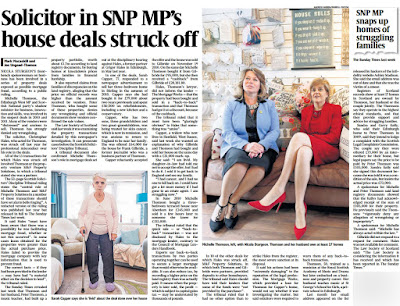
 Solicitor in Thomson's house deals struck off

Sunday Times 27/09/2015

Mark Macaskill ; Jon Ungoed-Thomas

NICOLA STURGEON'S frontbench spokeswoman on business has been involved in a series of property deals exposed as possible mortgage fraud, according to a public ruling.

Michelle Thomson, the Edinburgh West MP and Scottish National party's shadow minister for business, innovation and skills, was involved in the suspect deals in 2010 and 2011. Many of the vendors were "distressed" and anxious to sell. Thomson has strongly denied any wrongdoing.

The solicitor, Christopher Hales, who acted for Thomson, was struck off last year for professional misconduct over his role in the deals.

All of the 13 transactions for which Hales was struck off involved Thomson or the property venture M&F Property Solutions, in which a tribunal stated she was a partner.

The 53-page Scottish Solicitors' Discipline Tribunal ruling states the "central role of Michelle Thomson and M&F Property Solutions in a number of these transactions should have set alarm bells ringing". A redacted version of the ruling was published last year but released in full to The Sunday Times last week.

It said Hales "must have been aware that there was a possibility he was facilitating mortgage fraud, whether or not this occurred". In some cases loans obtained for the properties were greater than the actual purchase price. Hales failed to provide the mortgage company with key information that is used to prevent fraud.

The correct facts — if they had been provided to the lender — may have had "a material effect on the decision to lend", the tribunal ruled.

The Sunday Times revealed last week that Thomson and her husband, Peter Thomson, a music teacher, had built up a property portfolio, worth about £1.7m according to Registers of Scotland documents, by buying homes at knockdown prices from families in financial hardship.

It also reported claims from families of discrepancies on the land registry, alleging that the price on official records was higher than the amount received by vendors. Peter Thomson, who bought some of these properties, denies any wrongdoing and official documents show vendors confirmed the sale values.

The Law Society of Scotland said last week it was examining the property transactions detailed by this newspaper's investigation. It can prosecute cases before the Scottish Solicitors' Discipline Tribunal. A tribunal document also confirmed Michelle Thomson's role in mortgage deals set out at the disciplinary hearing against Hales, a former partner at Grigor Hales in Edinburgh, in May last year.

In one of the deals, Sarah Capper, 77, responded to a newspaper advertisement to sell her three-bedroom home in Stirling in the autumn of 2010. Capper says she had bought it for £79,000 about two years previously and spent £50,000 on refurbishments, including a new kitchen and a conservatory.

Capper, who has two sons, three grandchildren and two great-grandchildren, was being treated for skin cancer, which is now in remission, and was anxious to return to England to be near her family. She was offered £64,000 for the house by Frank Gilbride, a former journalist who was a business partner of Thomson.

Capper reluctantly accepted the offer and the house was sold to Gilbride on November 19 2010. On the same day Michelle Thomson bought it from Gilbride for £95,000, but she then received a "cashback" from Gilbride of £28,181.80.

Hales, Thomson's lawyer, did not inform the lender — The Mortgage Works — that the property had been bought and sold in a "back-to-back" transaction and that Thomson had got it at a discount, because of the cashback.

The tribunal ruled that it must have been "glaringly obvious" to Hales that something was "amiss".

Capper, a widow who now lives in Henfield, West Sussex, said last week she wanted an explanation of why Gilbride and Thomson had bought and sold her house on the same day with a £31,000 mark-up.

She said: "I am livid. My daughter-in-law had told me not to accept the offer, but I had to do it. I sold it to get back to England and see my family.

"I had cancer, and I had no one to fall back on. I could have got a lot more money if I had gone to an estate agent. I am struggling now."

In June 2010 Michelle Thomson bought a three-bedroom terraced house near Aberdeen for £245,000 and sold it a few hours later to someone she knew for £315,000.

The tribunal ruled that the quick sale — or "back-toback" transaction — was not disclosed by Hales to the mortgage lender, contrary to the Council of Mortgage Lenders Handbook.

Experts say back-to-back transactions by two parties operating together can be used to secure a larger mortgage than would otherwise be available. It can also reduce tax, by recording a higher price on the land registry than was actually paid. It means when the property is later sold, the profit — which is subject to capital gains tax — may be understated by thousands of pounds.

In 10 of the other deals for which Hales was struck off, M&F Property Solutions, in which both Thomson and Gilbride were partners, provided deposits to other homebuyers.

The tribunal said Hales should have told their lenders that some of the funds were "not provided by the purchaser".

The tribunal ruled that it had no other option than to strike Hales from the register, the most severe sanction at its disposal.

It said his actions had been "extremely damaging" to the reputation of the legal profession. The Mortgage Works, which provided a loan for Thomson for Capper's home, would not say whether it was investigating the matter, but said solicitors were required to warn them of any back-toback transaction.

Thomson, 50, trained as a musician at the Royal Scottish Academy of Music and Drama but later embarked on a business and property career. Her husband teaches music at St George's School for Girls, a private school in Edinburgh.

Last month her email address appeared on the list released by hackers of the infidelity website Ashley Madison. She said the email address was out of date and that she was the victim of a smear.

Registers of Scotland records show at least 17 homes in Scotland are owned by Thomson, her husband or the couple jointly. The Thomsons say they operate to the highest ethical standards, and that they provide support and advice for struggling families.

Sandra and Garry Kelly, who sold their Edinburgh home to Peter Thomson in 2009, said they intend to lodge a complaint with the Scottish Legal Complaints Commission. The couple say they were offered £73,000 by an intermediary for their home, but legal papers say the price to be paid by Peter Thomson was £105,000.

Sandra Kelly said she signed this document because she was told it was a condition of the sale, but insists the actual price was £73,000.

A spokesman for Michelle and Peter Thomson said land registry documents showed that the Kellys had acknowledged receipt of the sum of £105,000 for their property. The spokesman previously said the Thomsons "vigorously deny any allegation of wrongdoing or impropriety".

A spokesperson for Michelle Thomson said: "Michelle has always acted within the law and will be giving no further comment."
Gilbride did not respond to a request for comment. Hales was not available for comment.

A spokeswoman for the Law Society of Scotland said: "The Law Society is considering the information it has received and which has been reported in The Sunday Times."

Saturday, January 25, 2014

BBC Scotland’s Lawyers Behaving Badly reveals solicitors guilty of misconduct are still benefiting from MacAskill’s £151m a year legal aid pot

Self Regulation by the Law Society of Scotland has failed profession & clients. THE fact is, regulation of the legal profession by the Law Society of Scotland, the Scottish Legal Complaints Commission and the Scottish Solicitors Discipline Tribunal does not serve any purpose of protecting the profession from bad apples or giving the client a fair hearing enabling proper and full closure of complaints.

All self regulation of the legal profession has achieved in Scotland is to centre extraordinary power at the Law Society’s Drumsheugh Gardens HQ in Edinburgh. It is no use pretending the profession is clean, and it is no use trying to blame someone else for a problem of the profession’s own creation. Over then to BBC Scotland for their investigation of Lawyers Behaving Badly.

BBC Scotland investigates Lawyers Behaving Badly Part 1

BBC Scotland investigates Lawyers Behaving Badly Part 2

Lawyers Behaving Badly: Firms employing misconduct solicitors still get legal aid

By Samantha Poling Investigations correspondent, BBC Scotland

The BBC investigated lawyers who had been found guilty of professional misconduct

Law firms with solicitors who have been found guilty of professional misconduct are still receiving millions in legal aid, according to a BBC investigation.

It found that 33 solicitors guilty of misconduct such as dishonesty, are working for firms eligible to claim public funds through legal aid cases.

Four solicitors were found to have deliberately misled their clients.

The Law Society of Scotland, which regulates solicitors' conduct, said it was doing its job properly.

The programme - BBC Scotland Investigates: Lawyers Behaving Badly - found one solicitor was convicted of domestic abuse and assault and another who was on the Criminal Legal Aid register despite a conviction for embezzling court fines.

The investigation revealed that 22 solicitors had findings of professional misconduct but remained on the Criminal Legal Assistance Register.

For civil law cases, a total 22 firms which employed solicitors found guilty of professional misconduct remained on the legal aid register.

The list included the firm Robertson and Ross, which was banned from the Criminal Legal Assistance Register by the Scottish Legal Aid Board, for submitting fake travel claims totalling more than £220,000.

Robertson and Ross issued a statement saying it was an ex-employee who claimed fake travel expenses and the full amount was repaid.

They said "neither the firm or any current member/employee has any formal finding of dishonesty against them", and said the firm should remain on the Civil Legal Aid Register.
'Bad apples'

The BBC also discovered that three firms on the Civil Legal Aid Register employed solicitors who had been disciplined for the way they handled legal aid cases.

Combined, the firms received almost £7.5m last year from the £150m Scottish Legal Aid budget.

Professor Julian Webb, from Warwick School of Law, said: "One can always say, and I think the profession's defence on this one is, what we are dealing with is the bad apples, that the system at root is not necessarily a bad one.

"Most solicitors, certainly, I don't think, go into the profession with the intention of being dishonest or defrauding clients."

He added: "Whether the structures are sufficiently robust to capture or catch those bad apples and catch them early enough, I think certainly in the Scottish examples, is a really moot question."

The Scottish Legal Aid Board said they monitored solicitors and acted decisively where they could, such as when the Legal Aid fund was abused or when their code of practice was breached. But it was not their job, they said, to regulate the legal profession.

A spokesman said the cases that involved solicitors convicted of domestic abuse and of embezzling fines did not result in them being struck off the professional register.

He said the Scottish Legal Aid Board did not have the power at that time to remove the solicitors from the register.

"In the cases where a solicitor was convicted for assault and the clerk of court was convicted for embezzlement, the Scottish Solicitors' Disciplinary Tribunal determined in 2001 and 2004 respectively that neither offence was sufficiently serious for either solicitor to be struck off," the spokesman said.

"At that time, as well as the general regulatory powers and functions in relation to solicitors, the Law Society of Scotland alone exercised the statutory power through Section 31 of the Legal Aid (Scotland) Act to exclude a solicitor from undertaking legal aid and representing legal aid clients. They did not exercise this power."

He added: "Solicitors undertaking criminal legal aid must register with us, and we have powers to de-register a solicitor from criminal legal aid work where we have evidence of abuse of the legal aid fund or breaches in our criminal Code of Practice.

"Where appropriate, a report is sent to the procurator fiscal, who makes a determination on whether to prosecute or not. This is not a matter for the board."

The system of regulating solicitors in Scotland falls between the Scottish Legal Complaints Commission, which deals with service complaints, and the Regulation Committee of the Law Society of Scotland, which deals with complaints about conduct.

The Law Society of Scotland has a dual role of representing solicitors and regulating their conduct, which has led to accusations of a lack of robustness.

Carole Ford, the lay convener of the Law Society's regulation committee, said: "The Law Society looks only at conduct issues.

"It is not looking at any other aspect of complaints and the Law Society's system is overseen. The Scottish Legal Complaints Commission has oversight of what the Law Society does. There is absolutely no doubt that the Law Society is doing its job properly."

Andrew Hopper, who is both a solicitor and Queen's Counsel, has worked mostly on cases involving professional regulation and discipline in relation to solicitors for the past 25 years. He said it was "unsettling" to find cases where findings of dishonesty were made but no strike-off followed.

He said: "It's unsettling for the profession as well as the public. If you have a concept that you can have solicitors who have been found to be dishonest continuing in practice, that affects the reputation of the whole profession.

"It is disturbing, it creates a two-grade profession and it is dreadful to my mind for the reputation of the whole profession that this should have been able to occur."

The Scottish Solicitors Discipline Tribunal, which struck off nine solicitors last year, insisted the system was robust.

They told the BBC they were always concerned if a solicitor was found guilty of dishonesty. But they said they would have to assess the extent to which anyone had suffered as a result of that dishonesty before taking a decision to strike off.

Tuesday, May 14, 2013

Police called in to investigate DWF Biggart Baillie’s Banking & Finance head solicitor Grant Docherty, fined £7.5K by Discipline Tribunal over ‘crazed’ threats made to client

Top Banking specialist lawyer Grant Docherty found guilty of threatening client. SOLICITOR GRANT DOCHERTY, currently the head of Banking & Finance at DWF Biggart Baillie has been found GUILTY of PROFESSIONAL MISCONDUCT and fined £7,500 by the Scottish Solicitors Discipline Tribunal (SSDT) after it emerged Police were called in to investigate threats he made against a client over a cancelled property transaction.

Evidence presented to the SSDT and included in complaints made to the Law Society of Scotland revealed that solicitor Docherty (aged 49), who is currently head of the Banking & Finance team at DWF Biggart Baillie said Robert Rankin would be ripped “to shreds” after failing to come up money for a house purchase. The Discipline Tribunal also heard that Docherty, 49, sent his client a string of abusive texts including one which warned: “I’ll come after you with everything I have.” A further text said: “This is personal. You’re a liar and the worst sort of human being.”

The mountain of threats from Docherty, who is recommended by the Law Society to clients who need legal advice on banking matters, began when a client, a Mr Rankin of Hamilton, revealed he could no longer buy a house in Troon, Ayrshire, from Mr Docherty’s widowed father. Docherty’s colleagues at Biggart Baillie then launched legal action against Rankin. A few days later, Docherty rang the lawyer handling the case.

Acting for the Law Society of Scotland, the Prosecuting Fiscal, Paul Marshall, told a Scottish Solicitor’s Discipline tribunal in Edinburgh: “He said he would rip Robert Rankin to shreds.” Prosecutor Mr Marshall went on to tell the Discipline Tribunal that some of Docherty’s 33 vile messages, which had been sent between December 2010 and January 2011, were seen by the client’s young son. One of the messages said Docherty would “ensure” Robert was “destroyed”.

Docherty only stopped threatening his client, who had been put in a state of fear & alarm by the solicitor’s actions, when Police were called in. Complaints were then made to the Law Society of Scotland who brought the prosecution of Docherty before the Tribunal hearing in April where the solicitor was fined £7,500 after being found guilty of professional misconduct. It was reported the Tribunal chairman Alistair Cockburn said at the hearing : “The expressions used were unfitting of a solicitor.”

However, it has emerged tonight that the Scottish Solicitors Discipline Tribunal have secretly discussed the case with a view to refrain from publishing some of the more threatening texts sent by the solicitor, which a well placed legal insider claims are allegedly of “a violent nature”.

The legal insider said : “The SSDT have a duty to ensure the public be given a true picture of Mr Docherty’s conduct towards his client and this can only be achieved by publishing all the communications from the solicitor to his client in their entirety in the Tribunal’s final report.”

As of this evening, the Scottish Solicitors Discipline Tribunal have suspiciously failed to publish its decision on the prosecution of Docherty which took place nearly a month ago.

No one from the Scottish Solicitors Discipline Tribunal could be contacted for comment, and a spokesperson for the Crown Office & Procurator Fiscal Service told a Scottish Law Reporter journalist they were unable to say whether Mr Docherty was being investigated at this time by themselves or the Police. Neither Docherty or Mr Rankin could be reached for further comment.

Docherty does not mention the incident on his Linkedin page, which states “I am head of the Banking & Finance team at DWF Biggart Baillie. I have built up over 22 years experience in the banking and finance sector working for well known Hong Kong and Scottish commercial law firms during which time I have played a key role in a range of high profile international and cross-border transactions. I trained in Scotland and left the country in 1990 to pursue my career in Hong Kong. Prior to joining Biggart Baillie, I established and led DLA Piper's Banking and Finance team in Hong Kong.”

Docherty, who lists golf, cricket, skiing and travel as his enjoyments, goes on to say : “My practice covers a broad range of banking and finance work, including bilateral and syndicated loans, property finance, asset finance, acquisition finance, project finance, structured finance and securitisation, banking regulation, equipment leasing, banking product development and documentation, bank mergers and acquisitions and debt restructuring. My clients have included banks and financial institutions, leasing companies, corporate borrowers, shipping companies and financial services and banking regulator”

The Scottish Sun newspaper reported on the prosecution of Docherty here : Raging lawyer’s threat over cancelled house deal

Friday, February 01, 2013

Professor Kay Hampton joins SSDT, steps down from Law Society of Scotland’s ‘dictatorial’ ruling Council

THE Scottish Solicitors Discipline Tribunal (SSDT) gets a new member as Professor Kay Hampton steps down from the Law Society of Scotland's Council today, 1 February, following her appointment to the Scottish Solicitors' Discipline Tribunal panel. Professor Hampton was among the first non-solicitors to be appointed as members of the Law Society's Council in 2011. While the Law Society Council had lay member observers for many years, non-solicitor members with full voting rights were appointed following the Legal Services (Scotland) Act 2010.

Professor Hampton’s achievements & appointments are listed by the Law Society of Scotland as : Professor Kay Hampton - Professor in Community and Race Relations; Commissioner to the Scottish Human Rights Commission; Public Appointments Assessor, Commission on Ethical Standards for Public Appointments, Adjudicating Panel Member, General Teaching Council.; Trustee, SAMH Former Member of Children's Panel in Glasgow. Former Commissioner of the Equalities and Human Rights Commission. Former Chair, Deputy Chair and Commissioner, Scotland and UK for the Commission for Racial Equality. Former Chair and UK Board Member for the Community Fund, Lottery Fund.

Recently appointed convener to the Society's audit committee, Liam McCabe, Director of Finance at the University of Stirling, will replace Professor Hampton on Council.

Austin Lafferty, president of the Law Society, said: "Kay deserves many congratulations on her appointment to the SSDT. While we are very sorry to lose such a talented and dedicated member of Council, I am very pleased to welcome Liam as the new convener of the audit committee and to the Society's Council."

Mr Lafferty added: "During the past 18 months Kay has been a wonderful ambassador for the Society and has made an immense contribution to both our regulatory and representative work as a Council member, as a member of our regulatory committee and as convener of the Society's equality and diversity committee. I'm pleased that Kay will continue to make a positive contribution to the development of the legal profession in Scotland through her new role with the SSDT.

"I'm equally pleased to congratulate Liam on his appointment as convener of the Society's audit committee and I look forward to working with him on Council. The calibre of those applying for the role was extremely high and we were struck by the range and depth of applicants' skills. The committee has an important role within the Society's governance structure and oversees the external auditing of the Society's finances and its risk management assessment."

Professor Hampton said: "I feel greatly privileged to have had the opportunity to work with respected colleagues at the Council and regret having to stand down from my activities at the Law Society. My time here has been exceedingly inspiring, empowering and positive.

"During my time at the Society, I experienced a genuine sense of commitment and professionalism on the part of staff and council members alike. I shall remain a positive ambassador for the Council and the Society."

Mr McCabe, who has a BA in accounting with business law, is a chartered public finance accountant and has extensive experience of audit committee work. He has also appeared on a number of occasions as a witness and given evidence to the Scottish Parliament's audit committee. He was appointed as convener of the Law Society's audit committee for a three year period in January 2013.

Liam McCabe said: "I'm delighted to have been appointed convener of the Society's audit committee. It's a very interesting time for the legal profession and the Law Society, as it is for Scotland as a whole, and I'm looking forward to joining Council and to working with the other audit committee members and everyone at the Society."

Tuesday, May 19, 2009

Law & Order : Lawyer William Rennie jailed for 1 year over £90k embezzlement of client funds

The latest solicitor to be jailed for embezzling their clients funds is one William Rennie, of Irvine, Ayrshire, who helped himself to £90,000 from the client accounts over a two year period.

The Scotsman reports :

Pillar of community to prison – downfall of a crooked lawyer

Published Date: 19 May 2009
By Campbell Thomas

A LAWYER who took nearly £90,000 from unsuspecting clients has been jailed for a year.

William Rennie, 56, traded on his image as a respectable family solicitor and upstanding member of the Ayrshire community.

But he secretly siphoned off cash from the proceeds of divorce cases and family wills after his business collapsed.

Jailing Rennie yesterday, Sheriff Alistair Watson told him: "A solicitor has a special place of trust in the lives of people and the abuse of that trust is always extremely serious."

In one case, Rennie banked £30,000 which was intended to pay off a mortgage following a divorce, writing on the cheque stub that it had been used to settle the mortgage.

On another occasion, £15,000 was paid into his account but was disguised on the stub as a bequest to a friend of the deceased person.

One divorcing couple had asked Rennie to keep the money from their house sale, which was to be split between them, until they needed it.

But instead Rennie paid himself £10,000, writing on cheque stubs that the husband and wife had each received £5,000.

The crimes came to light in July 2004 when Rennie used clients' money to pay a VAT bill in a bid to avoid legal action.

He ceased trading in November 2004 after the Law Society became involved. Rennie told police: "I must have been crazy."

He admitted embezzlement from his firm, Rennie and Co, in High Street, Irvine, between June 2002 and September 2004.

He was originally charged with taking nearly £140,000, but the Crown reduced the amount when he agreed to plead guilty.

Rennie, of Kilmaurs, was cleared of failing to obey a court order relating to earlier bankruptcy proceedings after his guilty plea.

Sarah Livingstone, defence advocate, said Rennie got into financial difficulties after his partnership with another solicitor dissolved in the 1990s. He faced rising staff costs and diverted money from clients' accounts to keep the business afloat.

Miss Livingstone told Kilmarnock Sheriff Court: "As serious as this is, and he knows it is, he has lost everything. Nothing was hidden and it was obvious he was going to be caught. He just buried his head in the sand."

Rennie was suffering serious health problems because of the offence, Miss Livingstone said, adding: "He was not living the high life."

In 2006, Rennie was found guilty of professional misconduct after allowing a house to fall into ruin. The Scottish Solicitors' Discipline Tribunal (SSDT) heard he had been asked to handle the estate of a couple who left no wills after dying just weeks apart.

But he took no action for nearly three years, then refused to co-operate with a Law Society of Scotland probe.

After the ruling, Rennie was placed on restriction and banned from practising without supervision. He was struck off as a solicitor in December 2007.

Rennie's victims had been repaid through a fund contributed to by all Scots solicitors, the court heard.

He refunded £70,000 of the money after selling his home and cashing in endowments.

Passing sentence, Sheriff Watson told Rennie he recognised he was a "broken man" who had shown contrition.

Wednesday, April 22, 2009

Discipline Tribunal allows solicitor facing 21 negligence claims to retain practising certificate

The Scottish Solicitors Discipline Tribunal is back in the dock for failing to adequately protect consumers from rogue solicitors, this time, the dishonour falls to solicitor John G O’Donnell from Glasgow, who, facing over 21 negligence claims from clients, has been allowed to retain his practicing certificate by the SSDT and Law Society of Scotland. (No wonder the public think the Law Society and SSDT are both crooked ! – Ed)

Peter Cherbi’s “Diary of Injustice in Scotland” law blog reports on the case :

Law Society ‘puppet’ tribunal allows crooked lawyer to remain in practice as fraud levels soar in Scots legal profession

Law SocietyLaw Society puppet tribunals protect crooked lawyers. Consumers of legal services in Scotland remain as unprotected as ever from the crooked element of the Scottish legal profession, as the media report the latest failure of self regulation by the Law Society of Scotland & the Scottish Solicitors Discipline Tribunal, that of allowing well known solicitor John G O’Donnell, from Glasgow, to remain in practice, despite a trail of client complaints and deception stretching back years.

REVEALED - Top Lawyer at the centre of 12 negligence claimsSunday Mail previous report on claims against John G O’Donnell. Mr O' Donnell, is still facing over 21 client claims for negligence against his work as a solicitor, but while the SSDT and the Law Society have pursued the complaints, and issued one of the weakest punishments available to them, the damages claims for negligence, which are being handled by the Law Society's infamously corrupt Master Insurance Policy remain to be settled, and as one ex-member of staff from the Law Society said this morning "will probably take years to settle".

You can read the full Discipline Tribunal report here : SSDT findings on John G O'Donnell or, alternatively, HERE

The Scottish Solicitors Discipline Tribunal decision : “The Tribunal find John Gerard O’Donnell, 15 Clarkston Road, Glasgow; Find the Respondent guilty of Professional Misconduct in respect of his failure to comply with undertakings given to an individual and that individual’s solicitor, his unreasonable delay in having a lease completed and registered and his misleading the individual and the individual’s solicitor in that regard and his failure to advise the individual and the individual’s solicitor of the true position, his failure to comply with the guidelines on mandates 1998, his misleading the Law Society and his unreasonable delay on a number of occasions in responding to the reasonable enquiries of the Law Society.”

.. and for all that, no fine, and only a restricted practising certificate !

Philip Yelland - Director of Regulation - Law Society of ScotlandPhilip Yelland, in charge of standards at Law Society for years, but still plenty of John G O’Donnells & Andrew Penmans. As you can see from the decision handed down by the puppet Discipline Tribunal, Mr O’Donnell, like many other solicitors who handle their clients affairs so badly, has been allowed to remain in practice, and the only reason this case got to the Tribunal was because the Sunday Mail was keeping tabs on the case. If there had been no media attention, it is highly likely that Mr O’Donnell, just like many other lawyers, some even charged with criminal offences, would have walked free after a complaints whitewash from his legal colleagues at the Law Society of Scotland.

It is of note there is not one shred of concern for the clients or their many claims for negligence, currently being strung out, delayed, meddled with, fiddled with, and generally wiped out by the dirty tricks department of the Law Society, of which many of us have come to know and experience over the years.

You can read more about how the Law Society deals with negligence claims made against Scottish solicitors here : Lawyers negligence insurance branded corrupt, anti-consumer as evidence reveals only one per cent of clients get chance of payout

Scottish Legal Complaints CommissionSLCC of no help to victims of O'Donnell. Asked today if the Scottish Legal Complaints Commission would be of any help to the many victims of Mr O'Donnell, a legal insider said "The Scottish Legal Complaints Commission are about as much use as a dead duck. They have spent most of their time so far doing what is best for themselves, and have passed most complaints back to the Law Society simply because they are too hot to handle."

He went on "I don't see how the SLCC can justify their existence when all they have done is grumble about the size of their salaries, threaten to resign just because they had no Personal Insurance cover, and are trying to avoid taking up most of their responsibilities to protect clients from the likes of O'Donnell, while charging the legal profession and soaking up public money like a sponge."

Sensationally a retired solicitor, sickened by the constant scandals within the legal profession spoke out last night, warning the public they would have to do more against crooked lawyers or face their own legal problems when they needed a solicitor.

He said : "As long as solicitors don't fear regulation, there will always be 'crooked lawyers' out there getting away with whatever they can. Just look at what Mr O'Donnell has been up to, and the time it has taken the Law Society and the SSDT to do something, which at the end of the day amounted to a slap on the wrist."

ScottishGovernmentScottish Government accused of looking the other way on crooked lawyers. He also went on to accuse civil servants within the Scottish Government, and politicians of allowing the legal profession to circumvent the rights of clients whenever they felt like it. He said : "I was a solicitor for 30 years, and its no secret among us the Law Society, civil servants & Ministers within the Scottish Government share a common purpose in preventing fully independent regulation from being a reality and ensuring proper oversight of what you regularly describe, with some justification, as a thoroughly corrupt legal profession."

Strangely enough, I have reported on that subject nearly two years ago : Justice Secretary rejects independent regulation of lawyers and public right of choice in legal services market

An official with a consumer group said : "If you think about it, it's almost as if paedophiles can call up Government Ministers or civil servants and get them to drop charges against them. That is the extent of what happens between the Law Society and Scotland's elected lawmakers. A cosy relationship that neither wish to end because its been so profitable to both in the past, and be warned, they will do anything to protect it."

Here is an example of just how far that relationship between the Law Society and the Scottish Government goes :

Kenny MacAskill defends the O’Donnell’s of his beloved legal profession at all costs, regardless of their victims plight.

John G O Donnell Sunday Mail 19 April 2009Exclusive: Watchdogs force one of country's worst lawyers out of firm

Apr 19 2009 By Russell Findlay

ONE OF Scotland’s worst lawyers has been forced out of business by legal watchdogs. John O’Donnell, 58, was accused of having “contempt” for the Law Society of Scotland by repeatedly snubbing clients and ignoring complaints.

He has been banned from working unsupervised for five years by the Scottish Solicitors’ Discipline Tribunal (SSDT). It means he can no longer run his own law firm but can still work as a lawyer.

Legal reformer Peter Cherbi of Injustice Scotland said: “This lawyer is unfit to practise and should have been struck off. Instead he gets a slap on the wrist. “Again the Law Society and SSDT have failed to protect the public. This shows self-regulation doesn’t work.”

The Sunday Mail first exposed O’Donnell five years ago when cops probing an alleged money laundering gang raided his John G O’Donnell & Co office in Cathcart, Glasgow.

We revealed he faced at least 21 negligence complaints and compensation claims of more than £1million. But it took until last year for the SSDT to find him guilty of six counts of misconduct including breaching money laundering rules. O’Donnell claimed he suffered depression but had a clean bill of health and got off with a £500 fine.

He was finally forced out of business by an SSDT ruling in February, details of which were only released last week at the Sunday Mail’s request.

The SSDT found he lied to clients, their lawyers and the Law Society, and said they were “not convinced” by his explanations. They added: “It is imperative solicitors are honest at all times.”

One legal source said: “He got away with playing the sickness card for years. “This smacks of too little, too late.”

O’Donnell, who did not return our calls for comment, is trying to sell his business before the ban begins on June 1 but can still advertise his services until then.

A legal insider said: “This guy was subject to discipline last year. “Yet he is trusted to wind up the affairs of his clients and none of them are aware of what is happening.”

Saturday, February 07, 2009

Solicitors Discipline Tribunal asked to rehear case of sabotage by GSPC members in Arran property market

Shady goings on in Arran report a battle between solicitors from the Glasgow Solicitors Property Centres and local estate agents …

The Herald reports :

Estate agent wants tribunal to rehear case of ‘sabotage’

ALISON CAMPSIE February 07 2009

There is no shortage of incomers to Arran. So impressed are its visitors that many return to settle on the island after enjoying a happy holiday there, seduced by its picture-perfect setting and its swell of natural beauty.

Houses, until recently, changed hands in just a few weeks with a brisk turnover of impressive Victorian villas and quaint stone cottages, many with glorious views.

For estate agents on Arran, the past decade has been boom time and more of them have started to operate in the area to service the growing numbers who go there to pursue an island idyll.

Elizabeth Blair, 49, was one of those professionals. Her family goes back four generations on Arran and, after training in Glasgow as a solicitor and working in Ayr, she decided to open an estate agency in 2006. At that time, she was the island's only resident solicitor and was already conveyancing for clients. So why not sell the properties too?

"It was a no-brainer. The island was booming, houses were selling very well and I was already doing the conveyancing work for estate agents. I thought I would go in at ground level and do it myself," she said.

It was a small operation, working out of the home she shares with her mother and daughter.

In her first year, she had just two properties on her books, but she was happy with her new direction.

But it was this move which led to her becoming embroiled in a malicious campaign against her professional activities. It was a situation starkly at odds with the pleasantries of island life.

A number of her adverts in locally-circulated copies of the Glasgow Solicitors Property Guide were sabotaged with thick black stickers used to cover the details, effectively deleting Ms Blair's clients from its pages.

As a result, Graeme Miller, who ran Miller Stewart estate agents in Brodick and who also has an office in Glasgow's east end, was brought before a Scottish Solicitors' Discipline Tribunal (SSDT) which this week concluded that he should be censured for failing to supervise his staff.

That conclusion should have, on the face of it least, brought an end to the long-running and increasingly hostile dispute, but Ms Blair is demanding that the tribunal is reheard.

The censure came after Mr Miller admitted to failing to supervise his staff properly and the tribunal heard that he had found evidence on a colleague's computer that stickers had been purchased.

The more serious charge against Mr Miller, which related to the defaced ads, was dropped before the tribunal and never heard by the panel.

This is despite the solicitor admitting responsibility on behalf of his staff to the Law Society of Scotland, at a professional standards committee in 2007.

That committee concluded that his actions were merely "thoughtless" and that no further action would be taken.

The matter was then referred to the SSDT for further action but Ms Blair yesterday described this hearing, and its conclusion, as a "travesty of justice".

No one at the SSDT was available to speak to The Herald yesterday, and the Law Society of Scotland said it could only confirm that it had referred the matter to the tribunal. Neither could answer a specific list of questions about the case.

While Ms Blair, her mother Jan Reid and two of her clients had attended the hearing, none of them were called to offer any evidence to the panel.

A complaint now sits with the Scottish Legal Complaints Commission about the way the hearing was conducted. In the complaint, Ms Blair said that the tribunal was fed "a litany of false statements and an unfounded character assassination on myself"

and that it represented a "chilling disregard" for the Solicitors' Code of Conduct.

The tribunal heard that Ms Blair had been refused entry to the GSPC. However, the GSPC said yesterday that this was not the case.

A spokesman said: "We had no idea that this was to be put to the tribunal.

"It was completely unexpected that he (Mr Miller) was going to make the allegation which had no basis in fact.

"As soon as we heard what had been said, we took action to reassure that it was not the case."

The tribunal was also told that Mr Miller decided to "minimise his presence on the island" because of a "separate and unusual aspect of professional life on Arran" and that he had endured "the sudden onset of personal malice."

He decided to sell up in 2007, the tribunal heard. The Miller Stewart office on Brodick seafront became Arran Property.

A search of company records shows that Mr Miller is the director of the new estate agency and that he owns 90% of its shares.

The Herald tried to contact Mr Miller at both his Glasgow office and at Arran Property, where an employee said he was not on the island and would not want to be interviewed.

One of the two retired couples whose property details were allegedly sabotaged yesterday spoke of their experience. In 2008, they received a letter from the Law Society of Scotland which outlined an offer from Mr Miller of £1000 in compensation and an apology. The offer was declined.

The wife, who asked not to be named, said: "All we were trying to do was sell our property. I got a copy of the guide and saw our ad had a black sticker on it. I picked up two other copies and it was the same. We were totally at a loss to know why.

"It happened the following week too. We were getting concerned, we had a property to sell and people who were coming on to the island at the weekend did not know about it.

"We can't turn the clock back, but of course we would be happier if we hadn't been caught up in the black sticker escapade."

The GSPC spokesman added: "Miller Stewart is no longer operating on Arran and we would not accept them doing so. As soon as we knew what Miller Stewart was doing we made arrangements that it could not happen again.

"At the same time our board of directors wrote a strongly worded letter saying that the action was entirely unacceptable and the consequence was that eventually Mr Miller decided it was no longer sensible for his firm to be a member of the GSPC. Miller Stewart ceased to be a GSPC member on Arran."

Mr Miller is no longer a member of the GSPC on Arran but his Glasgow office is still linked to the organisation.

Wednesday, October 24, 2007

Tennis fan ex lawyer holds up Court of Session with tennis elbow

Lawyers have been known to come up with some rather unbelievable excuses not to attend SSDT disciplinary hearings, or avoid court appearances, but playing tennis does stretch the credulity of ones position a little far.

However, for one fairly well known ex lawyer, Michael G Robson, stretching the credulity of the Court of Session itself has become a sport, playing backhand after backhand in beating off appearances & the inevitable in the case of Michael Robson V SSDT LAW 82/195.

Here are excerpts from the excuses given to m'lordships, who must have definitely been out to lunch allowing this to go on for several years !

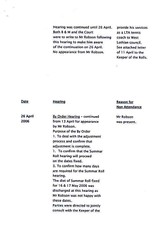
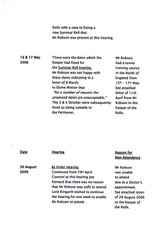
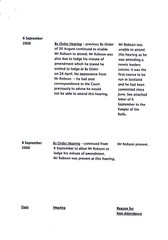
"Mr Robson was unable to attend as his employers were contracted to provide his services as a LTA tennis coach to West Lothian Council."

"Mr Robson had a tennis training course in the North of England from 15th - 17th May."

"Mr Robson was unable to attend this hearing as he was attending a tennis leaders course. It was the first course to be run in Scotland and he had been committed since June."

Bizarrely, the English Legal Services Ombudsman has become involved in the case on behalf of clients dissatisfied with the way the Law Society of Scotland handled the original investigations into Mr Robson's conduct.Apparently the Scottish Legal Services Ombudsman felt it was not able to investigate the complaint properly, some four plus hears ago and nothing has been done since.

PA Reid, 'Solicitor Advocate' of Messrs Fleming & Reid, 180 Hope Street, Glasgow, is known to be the Law Society's 'prosecuting fiscal' in this case .... *ahem*

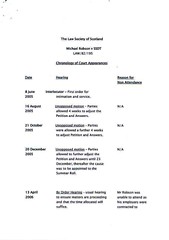
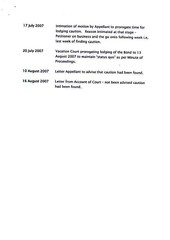
Roll of Court Appearances of Michael G Robson before the Court of Session - not pretty reading, but definitely a lesson in stalling :

Michael Robson v SSDT Page 1Michael Robson v SSDT Page 2Michael Robson v SSDT Page 3

Michael Robson v SSDT Page 4Michael Robson v SSDT Page 5Michael Robson v SSDT Page 6

Michael Robson v SSDT Page 7Michael Robson v SSDT Page 8Michael Robson v SSDT Page 9

More can be read on Mr Robson's downfall as a solicitor HERE

The Sunday Mail reports

Shamed Lawyer in Tennis Racket - Sunday Mail 21 October 2007

Shamed Lawyer In Tennis Racket

Oct 21 2007 By Russell Findlay

Exclusive Brief Accused Of Stringing Along Court With Excuses

A SHAMED lawyer missed a string of dates to defend himself against complaints - because he was too busy playing tennis.

Michael Robson gave the crazy excuse to Scotland's highest court after appealing against a punishment for ignoring clients' wishes.

He was disciplined by legal watchdogs in 2005 but the ruling remained secret because he appealed to the Court of Session.

Robson, 55, missed a court date in April last year as he was working as a Lawn Tennis Association coach.

In May 2006, he went on a two-day tennis training course in England and that September he was at a tennis "leaders course".

Client Peter Cherbi plans to sue Robson for failing to act in a medical negligence claim over the death of his mother in 2000.

Mr Cherbi claims Robson's delays may be a tactic to avoid a court case.

He said: "The deadline for my action against Mr Robson is next year when it will become time barred.

"I suspect he is cynically playing for time. It is extraordinary judges should accept a tennis match is more important than a court appearance." In 2001 the Scottish Solicitors' Discipline Tribunal found Robson had ignored 50 letters from the Law Society, criticised his "cavalier attitude" and ordered that he work under supervision for three years.

In 2002 he was struck off but that was reduced to five-years of supervision on appeal.

He is banned from working as a solicitor as result of the 2005 ruling.

When we called Robson, of Ratho, Edinburgh, he said he would phone back but failed to do so.

Sunday, July 15, 2007

Scottish Solicitors Discipline Tribunal exposed as lacking independence, impartiality

More From A Diary of Injustice in Scotland

Scottish Solicitors Discipline Tribunal attempts to justify existence as independent regulation approaches

If there was a requirement that all members of juries had to be lawyers, judges, policemen, or their colleagues, appointed by the head of Scotland's Judiciary, would anyone think a fair trial could take place ?

How long, for instance, would it take the likes of Donald Findlay QC to point out one of his clients might not get a fair hearing because the jury was composed of Police Officers ? ... 5 minutes ?

However, this is considered the norm at the Scottish Solicitors Discipline Tribunal, when dealing with complaints & prosecutions against solicitors and there are no cries of lack of impartiality and no claims of lack of a fair hearing from the legal profession itself .. because lawyers prefer to be judged by their own, so they escape punishment of course. This has been the way complaints procedures have been rigged handled by the legal profession for decades.

The Scottish Solicitors Discipline Tribunal describes itself on it's web site as :

"The Scottish Solicitors’ Discipline Tribunal (SSDT) is an independent body which mainly deals with serious disciplinary issues that arise from time to time within the Scottish legal profession."

It then goes on to admit that "The Tribunal is governed by a set of rules (Scottish Solicitors Discipline Tribunal Procedure Rules 2005) which must be approved by the the Lord President of the Court of Session. "

Independent, but organised & approved by the Lord President ... a member of the judiciary, a lawyer, member of the Law Society of Scotland ... how's that for independence ?

In another bash at putting forward the impression of independence, the SSDT goes on to say "The Tribunal normally sits with 3 solicitor members and 2 lay members: solicitor members cannot also be members of the Council of the Law Society (governing body in Scotland); lay members are drawn from all backgrounds and walks of life. All members are appointed by the Lord President of the Court of Session – Scotland’s most senior judge."

Pretty thick stuff from the SSDT to give the public the impression they are independent, but reading of their endeavors over the years, or having experience of the complaints process of the legal profession might lead one to think the Scottish legal profession learned their trade on how to write rules for themselves from the Enabling Act of 1933 in Germany written by the Nazis.

"lay members are drawn from all backgrounds & walks of life" .. and " are appointed by the Lord President of the Court of Session" ... almost makes one squirm, doesn't it ?

This is the current solicitor & lay membership of the Scottish Solicitors Discipline Tribunal

If you want to be a "lay member" in anything to do with self regulation, be it the SSDT, the Law Society of Scotland, ICAS, or any of the other rather infamously corrupt self regulators of the professions, it looks like you have to sit on a few other self regulatory, self pat on the back committees too ... in essence, no brickies or plumbers allowed.

Oh yes - the experience argument ... you have to be an experienced lay member of the public to understand these complicated issues of law and how complaints are dealt with, etc ...

Well, that experience has produced cases such as this : Tribunal ‘had no power’ over lawyer who dealt in drugs showing a rather uneven call for increased powers when other more powerful cases before the SSDT in the past have had little attention.

or this : Council of the Law Society of Scotland v Gordon & Maria Thomson - in the case where the legal profession set up Gordon Thomson on false charges so they could take his business away from him (one of the legal firms I was using at the time a willing participant - Alex Morison & Co who 'cornered Mr Thomson's business on instructions from the Law Society) The powers of the SSDT were viciously used against Mr Thomson in that case - used as a lethal weapon against one of it's own who dissented from the line from Law Society HQ in Drumsheugh Gardens.

or this : Lawyer slammed for lying to client - reporting on an item from one of my cases, where even to this day, the lawyer concerned is still battling with the SSDT over the verdict against him, which Robson successfully challenged .. and the SSDT sit back and do nothing of course, because it ultimately involves myself.

Easy to conclude then from the above, that the Scottish Solicitors Discipline Tribunal need replacing with something much more independent, accountable and transparent - because the SSDT of the past and present is nothing of these things.

What of the SSDT when the new Scottish Legal Complaints Commission comes along ?

Well, it will still exist, much as it currently is, biased, prejudiced, and lacking any accountability, transparency or honesty, unless further reforms come forth from the seemingly unwilling halls of the Scottish Executive Justice Department to do much on the injustice front so far.

Oh yes, I know it's early days of the new Executive .. we keep getting told that .. it's early days ... early days .. will they be saying that in 3 years time ? after a few more threatening 'open letters' from ex judges in the newspapers to the Justice Minister ?

Funny how the Justice Minister takes the time to respond by letter and even in personal articles in the newspapers to ex judges who still want to run the legal system, but can't be bothered to reply to victims of injustice seeking reforms in the obvious public interest

Should the public become more vocal or active in pressing home their cases of injustice and calling for & gaining reforms to the legal system ? Yes, I think we should..

Following story from the Herald newspaper on the SSDT calling for more powers, when it should really be abolished and replaced by something not concocted by the legal profession itself.

The story reports on a vindictive diatribe from members of the SSDT who are using the Angela Baillie case as an example for a call for more powers, to give themselves yet another reason to exist of course and fiddle complaints against the leading lights of the legal profession while castigating those who have already been punished by the law or have resigned their registration as a solicitor ....

Surely this 'call' from the Tribunal for more powers, is a good example on it's own, to get rid of it and bring in a replacement to accompany the now dwindling spirit of independent regulation of the legal profession ...

http://www.theherald.co.uk/news/news/display.var.1531703.0.0.php

Tribunal ‘had no power’ over lawyer who dealt in drugs
STEWART PATERSON July 10 2007

A solicitors' watchdog has called for a change in the law after it was unable to impose an effective punishment on a lawyer jailed for drug dealing.

Angela Baillie was sentenced to 32 months for smuggling heroin and valium into Barlinnie Prison in Glasgow.

By the time the Law Society referred her case to the Scottish Solicitors' Discipline Tribunal, Baillie had applied successfully to have her name removed from the roll of solicitors.

The tribunal is concerned that it could only censure the former lawyer instead of the maximum penalty of striking her from the register and has called for a change.

It wants a member with proceedings pending to be unable to remove their name so that it can take action.

Baillie, of Birnam Place, Glasgow, was jailed in April last year for delivering a cigarette packet stuffed with heroin and valium worth almost £1600 to a man in Barlinnie.

The case came before the tribunal in December but her name had been removed from the roll two days after she was convicted.

In a written ruling yesterday, the tribunal expressed concern about lacking the power to impose an appropriate punishment. It said: "The offences to which Baillie pled guilty before the High Court strike at the very heart of the obligations of honesty and integrity which are incumbent on every solicitor.

"It is difficult to imagine conduct more calculated to damage the profession in the eyes of the public."

It stated it was "wholly unsatisfactory" that the tribunal could not show the public and other lawyers the "odium" they felt about Baillie's conduct.

The judgment stated: "The tribunal wishes to place on record its concern that it lacks the power to impose upon the respondent a penalty which it would regard as appropriate in the circumstances of this case, but is placed in the position of doing no more than impose an inadequate and ineffective penalty."

The tribunal called on the Law Society to take urgent steps to change the rules on such matters.

Once a name has been removed from the roll, the tribunal is only able to issue a censure or a fine. However if the person has been sentenced to more than two years in prison it is unable to impose a financial penalty, and as Baillie was jailed for 32 months the only option remaining to the frustrated tribunal was censure.

One possibility recommended is that a solicitor should not be allowed to remove their name from the roll when disciplinary action is possible.

At the trial, Judge Lord Kinclaven told Baillie: "Your case, like many others in this court, clearly illustrates the damage and devastation that can be caused by involvement with drugs and the drug trade."

"The quantities of the drugs made it plain they were not for personal use. They were for supply in the prison system generally."

He added: "You were in a position of trust."

Baillie had used the lawyers' consulting room at Barlinnie for the hand-over on October 23, 2005.

The prisoner she met, who cannot be identified for legal reasons, was strip-searched as he left the meeting and the cigarette packet was found.

Here's an earlier article from the Injustice Scotland website on how decisions by the SSDT have been appealed by Michael Robson, whom I referedd to in the Edinburgh Evening News story earlier in the article :

Strangely enough, we didn't hear any calls for more powers for the SSDT over the successful Robson challenge, but then of course, that would be helping me if they actually did do something in this case, so of course, that couldn't be allowed now, could it ...

The Scottish Law Society can make mistakes

Read on for an interesting article from "The Herald" Newspaper, where a solicitor who was struck off by the Law Society of Scotland has had the decision quashed by the Court of Session.

This is a complicated case, and one quite different from a previous case which saw a stitch up of a famous Edinburgh Solicitor - Gordon Thomson & his wife's legal practice, which was becoming too successful for other members of the legal profession.

The case of Robson, however, shows just how belligerent the Law Society has been in its pursuance of anyone who takes on cases against them. However, it should be borne in mind that when someone does take such a case on, they have the same duty to their client which all other solicitors have, and thus, if a case becomes 'too rich' or is difficult to handle, the client has to be told, and not 'led up the garden path', particularly on matters which may involve long histories of multiple failures by the legal profession and its members, or the death of loved ones at the hands of negligent medical practitioners. ....

Quashing victory for Robson
SIMON BAIN ‘The Herald’ November 29 2004

The Court of Session has quashed a decision by the Scottish Solicitors Disciplinary Tribunal to strike off Michael Robson, a principled solicitor who challenged the legal establishment and took on a slate of victims of legal injustice – only to find himself overwhelmed by the demands on his one-man practice.

The opinion of Lords Kirkwood, Maclean and Osborne, that the tribunal's sentence was "excessive", will be noted by those observers of the profess-ion who claim that solicitors seen as "troublesome" by the Law Society of Scotland are unlikely to prosper.

Robson, 52, was a successful lawyer who set up on his own in 1998, and quickly became a "last resort" for clients whose complaints against solicitors had been turned away by other practices, and rejected by the Law Society of Scotland.
In 1999, he publicly challenged the Law Society's master insurance policy, now under investigation by the Office of Fair Trading, and criticised its complaints procedure.

Robson said the Law Society had "set up an insurance system which protects solicitors at the expense of their clients", while its complaints procedure was "the profession judging its members". Petitioning the Court of Session for a judicial review of one case involving misconduct by lawyers, Robson said then that the review "strikes at the fundamentals of the legal profession".

Less than three years later, his practice was closed down, and Robson struck off and sequestrated, following zealous policing of his business by the Law Society on behalf of demanding clients, some of whose cases the society itself had dismissed.
Robson had been a solicitor for 25 years with an exemplary record when he was reported in 2001 by the Law Society of Scotland to the Scottish Solicitors Disciplinary Tribunal for failing to answer letters.

In January 2002 the tribunal fined him £5000 for profess-ional misconduct and said he could no longer practice alone. The tribunal, a body with legal and lay members, ruled that Robson could work for another firm – but only with the approval of the Law Society. Although two firms immediately offered him an unsolicited position, the Law Society refused to approve his appointment, pushing the father of four into a financial crisis, on top of mounting health problems.

In June 2002 the Law Society reported him a second time to the tribunal, citing his failure to answer further letters dating from the previous year – though by this time Robson had already been forced to shut the firm and make his three staff redundant. Robson pleaded for an 11th-hour adjournment, as on the day he was unable to attend and plead mitigation, but the tribunal refused.

The hearing went ahead on October 8, 2002 and Robson was struck off. The following day, he was sequestrated. He was subsequently diagnosed with a sleeping disorder.

In their judgment, their Lordships state: "We have taken into account the fact that there had been no complaint of profess-ional misconduct when the petitioner had been a partner in two law firms, and that neither of the complaints which had been made involved any element of dishonesty. The professional misconduct of which he was found guilty was undoubtedly serious, but we also have to consider the financial position in which the petitioner found himself as a result of not being able to be employed as a solicitor under supervision after March 2002 because (the Law Society) would not approve the firm which had been prepared to employ him."

The decision to strike Robson off had been excessive, "particularly having regard to the financial consequences of (the Law Society's) decision in May 2002 to defer considerat-ion of the application to employ the petitioner as an assistant".

Robson commented: "These (clients) were people whom the Law Society had failed to look after. Then they put the boot in, when you are trying to deal with a very complex situation. It is a bit rich. They dredged up everything under the sun, for instance they persuaded one person to make a complaint of misconduct against me. I had been a solicitor for 25 years and had avoided complaints like the plague."

In 2001 Robson took on a case brought by two bankrupted developers against the Clydesdale Bank. As an investigation by The Herald revealed, Graeme Duffy and Richard Crocket were only sequestrated as a result of the disastrous employment by the bank of Euan Wallace, a well-known Glasgow surveyor who was shortly to be struck off for life for serious professional misconduct.

Three years later, there is independent evidence that Duffy and Crocket's property assets in March 2000 comfortably outweighed the sum for which they were sequestrated by the bank, which therefore acted wrongly. The developers had at the time just launched a £3m damages action against the Clydesdale over Wallace's conduct. But since the demise of Robsons WS, no law firm has been prepared to take their case to the House of Lords, though Robson subsequently reported the bank and its solicitors for prosecution on the grounds that a false claim for bankruptcy had been lodged.

Such daunting cases, however, took their toll on Robsons WS, and on the health of its founder, who now works as a part-time tennis coach. The judges quashed the decision to strike him off, and have substituted a five-year restriction which allows him to work for "such employer as may be approved by the Council of the Law Society of Scotland".

The petition to the Court of Session also argued that the tribunal was "not independent and impartial within the meaning of Article 6(1) of the European Convention of Human Rights", partly because the Law Society both brought complaints to the tribunal and appointed its members. The petition noted that "the Lord President did not have power to appoint any solicitor member who had not first been recommended" (by the society), and suggested that a tribunal member's "prospects of reappointment would be improved" if he consistently upheld complaints.

It further pointed to the Law Society's own submission to the Scottish Parliament in June 2002 which suggested that the Judicial Appointments Board might nominate tribunal members.

The Law Society's response to the court was that this was simply one of a number of "suggestions as to how the tribunal could be improved". The judges concluded that because "solicitor members must be knowledgeable and experienced and the actual appointments are made by the Lord President", the appointment procedure did not detract from the independence and impartiality of the tribunal.

Their lordships dismissed all other objections to the procedure.

Their decision to amend the sentence on Robson was, moreover, reached "with some hesitation".

In an immediate response to the ruling, the Law Society played down the judges' ruling that Robson should not have been struck off. Reporting on the case, its in-house journal gave priority instead to the fact that the Scottish Solicitors' Discipline Tribunal was found to satisfy the "independent and impartial tribunal" requirement of the European Convention.