Showing posts with label Judiciary and Courts (Scotland) Bill. Show all posts

Friday, September 26, 2008

Judicial ‘independence’ supported by MSPs as concerns grow over judicial ‘dictatorship’

When is independence independence … when it is transparent, accountable, just, and fair …

However, none of those terms could ever be applied to Scotland’s judiciary going on the experience of most solicitors and much of the Scots public.

Still, in the best interests of keeping things as they are, and ensuring little reform in the public interest, the Scottish Parliament has ‘backed’ the independence of the Scottish Judiciary by supporting the Judiciary & Courts (Scotland) Bill, which leaves the Lord President at the head of the Scottish Courts Service.

As a reminder to whom we are putting in such a powerful and ‘independent’ position, here is a clip of Lord Hamilton’s testimony at the Scottish Parliament …

Lord Hamilton - A measure of trust ?

Judicial independence is backed by MSPs

STEWART PATERSON September 26 2008

A Bill to guarantee the independence of the Scottish judiciary from parliament has been passed by MSPs.

The Judiciary and Courts (Scotland) Bill makes the Lord President, Scotland's most senior judge, the head of the judiciary with responsibility for all court business and for the conduct of judges.

The Scottish Court Service will become a non-ministerial department, run instead by a board, chaired by the Lord President. The bill also changes the eligibility rules on who can be appointed to the Court of Session, to those who have practised as solicitor advocates in either the Court of Session or the High Court, instead of both.

Kenny MacAskill, the Justice Secretary, said: "The bill delivers a strong coherent structure for a modern judiciary and the effective management of our court system."

The bill was also welcomed by senior figures in the legal profession. Lord Hamilton, the Lord President, said: "If the bill receives the Royal Assent, it will in due course bring about significant change in the administration of the Scottish courts and in my own office of Lord President.."

Eleanor Emberson, chief executive of the Scottish Court Service, said: "I believe that having the Lord President as chair of the Scottish Court Service governing body gives this organisation fresh impetus."

Friday, April 18, 2008

Scots judiciary allegedly biased against women as figures reveal only one in nine are judges

Could it be the surprise of the century that only one in nine judges in Scotland are women ? We think not ...

Read on for more as the Scotsman reports :

Justice in dock: only one in nine judges is a woman

By MICHAEL HOWIE

THE body in charge of selecting judges and sheriffs is to carry out a major investigation aimed at ending the virtual monopoly that white men have on the bench.

The Judicial Appointments Board for Scotland is to examine the "barriers" it believes are preventing women and people from ethnic minorities from progressing into senior positions.

Equality campaigners fear the lack of women and non-white sheriffs and judges is damaging public confidence in the legal system. They argue that the predominance of white men in the judiciary is off-putting to some victims, for example women who are raped.

Sir Neil MacIntosh, the chairman of the board, insists women who apply to become sheriffs or judges have as much chance as men. But he told The Scotsman too few were putting themselves forward for the most senior positions.

"When women do apply, they are successful," he said. "But there is a gap between the number of potential women candidates and the number who actually come forward."

He believed "a range of factors" was probably preventing women and non-white people from applying to become a sheriff or judge.

He said: "Is it the hours? Is it perhaps that female candidates are still working their way into the more senior ranks – the 'trickle-down' effect? Is it because of the nature of the jobs, as the bulk of appointments are all-Scotland? In other words, you've got to be willing and prepared to travel across the whole of Scotland when called upon to do so. Does that mean that women with family responsibilities still are disadvantaged by that?

"We need to find out whether there are barriers preventing them from coming forward. The process should be equally accessible to anyone.

"I suspect there are a whole range of factors. The important thing is that we address them."

Sir Neil, who retires in June after six years as chairman of the board, which was set up in 2002, went on: "Some people suggest it's just a matter of time, but I'm not convinced. That assumes the trickle-down effect is the only factor. I don't believe that. I think it's an absolute duty (to promote greater diversity]."

But Sir Neil rejected far more radical moves to improve diversity. "We don't operate quotas," he insisted.

Nicky Kandirikiria, executive director of the equality campaign group Engender, is among those who believe the composition of the judiciary is damaging the justice system.

"You have to consider whether having such a male-dominated judiciary is contributing to the fact we have one of the lowest conviction rates for rape in Western Europe," she said. "We know many women who suffer violence don't go to court because it's so male-dominated. More women judges would help."

Under the Judiciary and Courts (Scotland) Bill, the appointments board will have to give people posts "solely on merit". However, there are some in the legal profession who believe a candidate's suitability for the job should be based partly on whether they will help create a more diverse judiciary.

But one senior figure said such action could result in the wrong judges being appointed.

Lord McCluskey, a retired judge, said: "

The nature of justice does not vary in its character depending on whether the person administering it is male, female, black or white.

"If I go into hospital for brain surgery, I want the very best person for the job. I don't want to be told 'it's your turn to be operated on by someone brought in to create diversity for Bangladeshi immigrants'."

Figures show the judiciary's lack of balance in terms of gender and ethnicity. Only four of the 35 serving judges – or 11 per cent – are women. None are from ethnic minorities. Of the 140 full-time sheriffs, 26 – 19 per cent – are female, and only one, Rajni Swanney, who was appointed nine years ago, is from an ethnic minority. She moved to Scotland from India at the age of two and was brought up in Dundee.

While 36 per cent of the legal profession are female, less than a quarter of applications to be sheriffs or judges are from women.

Osama Saeed, the chairman of the Scottish-Islamic Foundation, said:

" The dispensing of justice requires juries to be of your peers, and the judiciary similarly has to be representative of society.

It has an impact in the trust in the system."

The appointments board has set up a working party to examine the composition of Scotland's legal profession. Led by Professor Alan Paterson, from Strathclyde University, it will include representatives from the Law Society of Scotland and the Faculty of Advocates.

The working party plans to survey about 12,000 solicitors, advocates and sheriffs, seeking their attitudes towards becoming a judge or sheriff. Women, people from ethnic minorities and other minority groups will be "tracked" to find out if, and how, their careers are progressing. Steps will then be taken to overcome any hurdles.

Ros Micklem, of the Equality and Human Rights Commission, said the inquiry should go beyond gender and ethnicity.

"We would expect them to ensure they look at all the potential barriers to participation. How many of our judges or sheriffs are disabled? Why is there such a small percentage of women or people from ethnic minorities? Does the environment in which they work encourage them to be honest about sexual orientation, or faith and belief?"

Bill Aitken, MSP, the Scottish Tories' justice spokesman, said judicial appointments should be made on merit, but he would welcome more women and people from ethnic minorities.

'People should have the opportunity to apply if they want and not feel there is little point'

I WOULD love the opportunity to apply to become a judge. As a career move, it would be a fantastic prospect.

But, as I see it, there are too many deterrents for me, both as a woman and someone from an ethnic minority group.

Applying to become a "floating" sheriff – who is required to work across Scotland – is a "no-no". I have two very small children and a husband who has a very successful and high-profile career. The responsibility to look after the children would fall to me at the end of the day.

This project by the appointments board is a good start, but it will take some years to work through, because of the old mentality of how things are done. There will have to be some genuine incentives in the appointments process and job descriptions to encourage not just people like me, but also those from other minority groups to feel confident about applying to become a judge.

People should be given the opportunity to apply if they want and not feel there is little point because of who they are. If I was white I'd think that too, that just being a mum would mean I wouldn't fit in. But being non-white makes me even further away from what I would imagine the panel are looking for.

However, times are changing – and the quicker the better. The old boy network is still there, but I think it's on the way out.

It might be thought that because I am non-white I won't be able to deal with the type of people coming before me in the dock. But I think the judiciary will appear more in touch with the public if the traditional white, male profile is seen in equal numbers with members of minority groups. It's important that the judiciary visibly reflects the society that it serves. I don't actually think it's the case that judges are out of touch. But the perception is that they don't understand the everyday, "streetwise" life. This is bound to have an impact on confidence in the system.

• Farah Adams is a Blairgowrie-based solicitor who is convener of the Law Society of Scotland's equality and diversity committee.

Tuesday, April 01, 2008

Lord McCluskey on why the Judiciary & Courts Bill is not worth the paper its printed on

More From A Diary of Injustice in Scotland which reports on the testimony of current & former senior members of Scotland's judiciary on the planned reforms of the Judiciary & Courts Bill ...

Judiciary & Courts Bill 'not worth the paper it's written on' as Scottish Parliament hears judges ask for 'a measure of trust'

The latest attempt at reforming Scotland's judiciary has been described as 'not worth the paper it's written on', by Lord McCluskey, formerly one of Scotland's senior judges, now a Labour peer in the House of Lords. The former Court of Session judge made the assertions during his testimony last week to the Scottish Parliament.

Lord McCluskey on judicial independence and proposed judicial reforms

As you know, I have criticised Lord McCluskey for his criticisms of proposed reforms to the legal profession and judicial system, but in this case, he is probably correct, and the Judiciary & Courts Bill itself, which is currently being heard by the Scottish Parliament's Justice Committee should be at the very least, cleaned up quite a bit, and quite a dose of accountability & transparency added to it.

For instance, perhaps a more open, transparent appointments system than simply leaving it to the Lord President to appoint judges, may bring a little more in terms of public confidence to Scotland's creaky self serving legal system, which doesn't seem to have any will to change with the times, and certainly not adhere to the public interest, rather, adhere to it's own ..

Lord Hamilton on judicial appointments - apply a measure of trust ...

The office of Lord President seems to enjoy far too many powers, lacking accountability to anyone as Lord Hamilton's comments seem to indicate, but that really sums up the whole of Scotland's legal system - lacking accountability to anyone but itself, which is why the rest of us are almost enslaved to it, even being denied access to justice when it suits the legal establishment to keep people out of the courts or even decide an individual be denied access to legal representation.

The Lord President, Lord Hamilton is involved in many appointments to the legal system, not just those of appointing members of the judiciary, and only recently his role, along with Justice Secretary Kenny MacAskill in refusing all applications made by non members of the Law Society of Scotland to gain rights of audience & representation under Sections 25-29 of the Law Reform (Misc Provisions) (Scotland) Act 1990 brought into question the motives of the current legal establishment for keeping the legal services market closed, as a business monopoly for its own.

Such is the determination of the current legal big wigs to protect their own business markets and money making model, a leaked letter from the Justice Secretary to the Cabinet Secretary for Finance, John Swinney, sought to mislead Mr Swinney on the wellbeing and status of applications made under Sections 25-29, all of which have so far been struck down by both the Lord President and Mr MacAskill, ensuring that no one practices law in Scotland unless they tow the Law Society line and obey those currently in charge. Open legal markets we do not have yet then ...

Justice Secretary Kenny MacAskill misleads Cabinet Colleague John Swinney on access to justice appointments ...
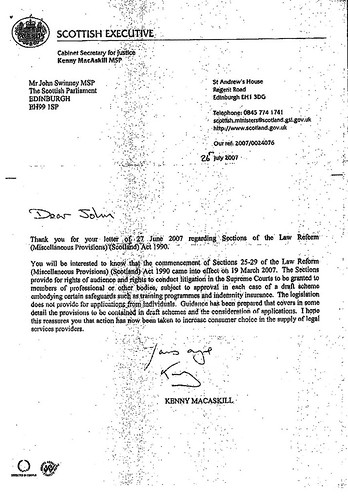
Justice Secretary Kenny MacAskill to Cabinet Secretary for Business John Swinney 26 July 2007

Revisiting Lord McCluskey's comments that the Judiciary & Courts Bill is not worth the paper it's printed on, this does bring back memories of former Scottish Legal Services Ombudsman Linda Costello Baker's comments against the Legal Profession & Legal Aid (Scotland) Act 2007, which she called "a mess", and of course as we now know, she was correct in her claims - the Scottish Legal Complaints Commission which has sprang from the LPLA Act, has been happily and easily co-opted by the Law Society of Scotland, and Ministerial appointments to the Commission itself have seen a bunch of lawyers and ex Law Society Committee members appointed to it, giving the air that it will be injustice as usual for anyone who has problems with a solicitor in Scotland.

You can read more about what former Legal Services Ombudsman Linda Costello Baker said on the half hearted attempt at reforming Scotland's legal profession via the LPLA Bill here : Last words from former Scottish Legal Services Ombudsman condemn the Scottish legal profession

My latest article on the demise of the LPLA Act and the Scottish Legal Complaints Commission before it has even begun its work can be viewed here : Funding argument over Scottish Legal Complaints Commission conceals lawyers interference in 'independent' complaints body

Do we call that reform ? I don't think so .... and no doubt the Judiciary & Courts Bill, if it does make it through the Justice Committee, may well go the same way as the LPLA Bill when it was at the Justice 2 Committee in 2006 ... voted through and passed into law .. then turned on its head to serve those it sought to reform, as any attempt at reforming Scotland's legal system seems to end up in the bucket.

Lord Hamilton on dealing with complaints against the judiciary ...

Maybe we should therefore listen to Lord McCluskey this time, and make sure that if the Judiciary & Courts Bill does go through, it serves a common purpose of transparency & accountability, not simply serving the judiciary itself..

I did notice one thing though ... a small detail I suppose, given the lack of standards within the Scottish Parliament itself ... anyway, Bill Aitken MSP is still the Convener of the Justice Committee and hearing this Judiciary & Courts Bill, but of course he was a JP himself, admittedly a JP isn't that high on the judicial ladder, however, as Annabel Goldie MSP as a solicitor herself and thus a member of the Law Society of Scotland, had to resign from the Justice 2 Committee in 2006 when it heard the LPLA Bill, I wonder what shifting standards policy the Scottish Tories are applying to themselves these days ? Obviously the conflict of interest one must be out of fashion now ...

You can read more about Annabel Goldie's resignation in 2006 here : Annabel Goldie does the right thing and resigns from Justice 2 Committee Convenership but it seems that having a JP in charge of hearings on judicial reform is, amazingly, not a conflict of interest ... those tories must be up to something then .. trying to make the bill fail perhaps ?

Here follows some coverage of the Parliamentary hearings from both the Herald and Scotsman.

Plan for Bill on judiciary ‘not worth paper it’s written on’

ROBBIE DINWOODIE, Chief Scottish Political Correspondent

The plan to enshrine in statute the independence of the judiciary, praised last week by Scotland's most senior judge, was described by a former solicitor-general yesterday as "not worth the paper it's written on".

Lord Hamilton, the Lord President told the Holyrood Justice Committee last week that the proposal in the Judiciary and Courts (Scotland) Bill "sends out the right message" against a day in the future when "conflicts could arise between the judiciary and the executive".

But yesterday retired judge and former law officer Lord McCluskey told the same committee: "The evidence you heard last week was, with respect, naive. The simple answer is it could never be more than symbolic, because if an unpleasant government came to power, then do you imagine it would not behave like the governments in Zimbabwe or Pakistan?

"If a party comes to power which does not respect democratic values then this is not worth the paper it is written on. Just as this Parliament could pass it a week on Monday, it could repeal it a week on Tuesday. This is actually worth nothing at all."

Lord McCluskey added: "Most countries in the world have a written constitution in which the independence of the judiciary is embedded in the constitution. Judicial independence lies in the hearts of men, not in constitutions and statutes of this kind, and I would rather it stayed there."

Calling the proposal "just a kind of gesture politics", he said: "The English needed it and so we slavishly copied the English. We have never had a statutory declaration in Scotland. We don't need to follow slavishly and plagiarise English legislation."

The bill would give the Lord President formal recognition as the head of the Scottish judiciary, making him responsible for matters such as the training, welfare and conduct of the judiciary. There would also be new procedures for appointing and disciplining judges and for dealing with public complaints.

The legislation also sets out proposals for modernising the machinery for sacking judges and sheriffs on the grounds of unfitness for office. They would be investigated by a tribunal chaired by a judge and containing a lay element.

Lord McCluskey said: "In my time there have been judges on the High Court bench who drank too much, who didn't do their homework, who didn't turn up. They were dealt with by the Lord President behind the scenes, and dealt with successfully, and that's the way it has to work."

On attracting a wider cross-section of society to the Bench, Lord McCluskey said: "I can see merit in the government, whether through the (judicial appointments) board or otherwise, taking steps to enable more people to acquire the skills that are needed to be a judge.

"But if I'm going to be operated on by a brain surgeon, I want the brain surgeon to be the best brain surgeon. I don't want him operating because he's black, Jewish, Catholic.

"It's the same with judges. It's the same kind of expertise which is required. I don't think affirmative action has any place in the selection of brain surgeons or High Court judges."

and now for the Scotsman's version, with a piece by Lord McCluskey himself first :

Why an 'English' bill won't fit Scottish justice system

By LORD McCLUSKEY

LORD McCLUSKEY shares his concerns about the judicial reform bill, which he believes is needlessly copying measures introduced south of the Border.

THE Scottish Parliament is about to devote much time and effort considering a Bill that is both unnecessary and misconceived. With the title, The Judiciary and Courts (Scotland) Bill, it is unlikely to generate mass demonstrations around Holyrood.

Bewigged lawyers will not mount barricades proclaiming that "The End is Nigh". MSPs will probably approach the Bill in the belief that there must be some point to it: after all, it has been adopted by an SNP-led administration, having originally been proposed, in February 2006, in a consultation paper endorsed by Cathy Jamieson and Lord Advocate Boyd, as part of "our programme for reforming Scotland's justice system". The word "our" was and remains a serious misdescription: let me explain where the ideas in this Bill really came from.

On 12 June 2003, there occurred one of the most astonishing events in English constitutional history: yes, I do mean "English".

Downing Street issued a press notice announcing the abolition of the office of Lord Chancellor. When, within hours, it was realised that could not be done by Prime Ministerial diktat – because the office of Lord Chancellor had existed for eight centuries, the office holder was the head of the English judiciary with responsibilities under 374 Acts of Parliament, and only he could appoint judges in England and Wales – a second notice hastily appeared saying that it was "intended" to abolish the office. It was too late to save the then Lord Chancellor, Lord Irvine of Lairg: he retired to the backbenches in ominous silence. Lord Falconer of Thoroton took his place on the Woolsack and in Cabinet, with a brand new title, "Secretary of State for Constitutional Affairs".

What had happened? What did it mean for Scotland? What had happened was that David Blunkett, the home secretary, proposed to insert into the new Asylum and Immigration Bill an "ouster" clause, preventing the courts hearing legal challenges to the decisions of tribunals in asylum or immigration applications. The Lord Chancellor, rightly, regarded that as a totally unacceptable departure from the rule of law. Both remained adamant; someone had to lose. It was the Lord Chancellor who lost. But it would have looked bad to announce that the Lord Chancellor had been defenestrated for defending the rule of law, so it was declared that the job itself had been abolished. As Lord Hoffmann said: "His removal had to be dressed in the robes of high constitutional principle."

What did it all mean for Scotland? Not much. For in Scotland the Lord Chancellor had no significant functions. We had our own head of the Scottish judiciary, the Lord President. Judges here were appointed by the First Minister, advised by a Judicial Appointments Board. For Scots, the Lord Chancellor was as relevant as the Captain of the Yeomen of the Guard.

In England, by contrast, eight centuries of tradition and legal structures had to be demolished and replaced in a hurry. So the new secretary of state set about creating a fresh constitutional structure for the English legal system. He entered private negotiations with the Lord Chief Justice of England and Wales. There was no place in these discussions for the Lord President, the First Minister, the Lord Advocate, the Advocate General, or Scottish Law Lords – not altogether surprisingly, because Scotland's legal system was not affected by the loss of the Lord Chancellor. The negotiations produced a "Concordat", providing new ways to carry out the Lord Chancellor's English functions. The new scheme was enacted in the Constitutional Reform Act, 2005.

The Lord Chief Justice was given a new title, "Head of the Judiciary of England and Wales". For appointing judges, England copied the Scottish system, creating a Judicial Appointments Commission. And, most interestingly, because the English regarded the Lord Chancellor as the guardian, within government, of the independence of the judiciary, it was decided that an entirely new guarantee of that independence was needed; so the new Act declared that government ministers had to respect the independence of the judiciary.

Of course, Scotland had no need of such an enactment, because the Lord Chancellor had no comparable role in relation to the independence of Scottish judges. Nor was any such role necessary, because Scottish public servants, both in government and judiciary, knew in their bones that ministers, like everyone else, had to respect, and invariably did respect, the independence of the judiciary. That fundamental tradition of respect had endured without challenge in Scotland for centuries without the need for a Lord Chancellor or a statutory declaration.

So what does the new Bill do? It slavishly copies the English Constitutional Reform Act, 2005. It creates a new title, "Head of the Scottish Judiciary" and confers it on the Lord President, along with numerous administrative functions that he has never had, or needed, and which will make unacceptable inroads on the time and energy he has for carrying out his real function, which is to safeguard and develop the unique character of Scots Law.

Next, it provides a "Guarantee of continued judicial independence". The word "continued" acknowledges that judicial independence already exists. And whose duty is it to provide that "guarantee"? Answer: the First Minister, other ministers including the Lord Advocate, and everyone responsible for the administration of justice.

Surely these public servants, especially the Lord Advocate, would be the first to declare that they already have such a duty at common law and that to neglect it by "seeking to influence particular judicial decisions" would be to pervert the course of justice.

As the "guarantee" imposes the duty only on those named, what about others, spouses, uncles and partners? What about Donald Trump? The simple point is that the duty created in the Bill already exists.

The Bill neither guarantees nor extends it. If anything, it limits it. It does not even create an offence of "influencing judicial decisions".

The Bill abounds in similar nonsenses, especially in relation to the appointment of judges. Let us hope that MSPs recognise its uniquely English features and have the courage to reject them.

Biggest wigs lining up to give evidence

By Jennifer Veitch

A PROCESSION of Scotland's biggest wigs lined up to give evidence at the Scottish Parliament's justice committee last week, convened by Bill Hamilton, including Lord Hamilton, the Lord President and Lord Justice-General, and Lord Osborne, one of our longest-serving judges.

Compared to a day in court, there was not much pomp or ceremony about the proceedings, with the judges looking almost ordinary in their suits and raincoats. But the fact that they were there at all, publicly discussing their role and the implications of the Judiciary and Courts (Scotland) Bill, was extraordinary enough.

There has been much criticism of attempts by the former Scottish Executive and the current Scottish Government to bring forward legislation to reform the judiciary.

There are others who are better placed – including Lord McCluskey on these pages today, to analyse the detail of the proposals in depth.

But, having had the opportunity to listen to sat Tuesday's oral evidence, it became obvious to me that there is much about the way the current system operates that could be improved.

The headline-grabbing issue was of course Lord Osborne's criticism of the procedures used by the Judicial Appointments Board in hiring judges, namely the absence of any formal checks as to the performance or competence of candidates.

For example, he said no-one would bother to contact a sheriff principal to ask whether a sheriff was the subject of any disciplinary proceedings or outstanding complaints.

Lord Osborne also poured scorn on a system that relied too heavily on performance at interview, which he regarded as an unreliable indicator of suitability for the bench.

While interviews are of course a necessary evil for most people seeking less elevated positions, clearly the Judicial Appointments Board should be able to provide much greater reassurance that such jobs are being filled on merit, and only after a robust assessment of a candidate's suitability.

The problem is that it also emerged that judges apparently want to have it both ways. Lord Hamilton said that he still needs to be able to give a "tap on the shoulder" to fill temporary judge positions.

Given the huge workload and degree of responsibility that judges must bear, is this fair on either the candidates stepping up to the plate or the public whose fates may rest on their decisions?

The absence of a formal complaints procedure for those who wish to raise concerns about the conduct of a judge – as opposed to using the appeals process to challenge a judicial decision – was also a concern.

Lord Hamilton was not able to give a figure as to the number of complaints that he receives about judges' conduct. No doubt when he produces the figures, as requested by the justice committee, it will emerge that he does not receive that many at all.

But, however small the number, there should be a far greater degree of openness and transparency about the rules and procedures involved. To leave everything to the discretion of the head of the judiciary, no matter how upstanding a fellow, seems too heavily weighted against the complainer.

The argument that introducing a formal complaints procedure would lead to more complaints simply does not hold water.

Surely there could be discretion to weed out vexatious or frivolous complaints? And, more importantly, there could also be an opportunity for the judiciary to learn from the few complaints that might actually be justified.

The Judiciary and Courts (Scotland) Bill may well be flawed, and the justice committee may well want to suggest amendments before the bill proceeds to the next stage in the parliament.

But the judges have already demonstrated that the issue at stake here is not whether change is necessary or desirable, but whether the Bill as drafted offers the best way of going about it.

Judges want independence from reforms

More From A Diary of Injustice in Scotland, this time reporting on the Scot's judiciary's desire for independence ...

Scots judiciary want 'independence' from legislative reforms, public accountability as judges attack Judiciary & Courts Bill

While to many, independence means a break from whatever foul acts or perceptions of wrongdoing, lack of freedoms, unaccountability or lack of honesty exist in an organisation, public body, or even a country, the Scots legal establishment have taken on the 'independence' word as an argument to retain control over itself and all things relating to the law, from appointments to regulation, to just about anything it feels is within it's sphere of influence.

This is not a new argument to the Scots legal establishment however, who in the form of the Law Society of Scotland, used the same argument in 2006 in an attempt to thwart the progress of the now passed Legal Profession & Legal Aid (Scotland) Act 2007, which brought a measure of independent regulation to the legal profession, attempting to cure the high rate of corrupt complaints investigations carried out by the solicitors own self regulatory body, the Law Society of Scotland.

Douglas Mill, the Law Society's Chief Executive, famously threatened the Scottish Parliament & Executive with legal action, declaring after drafting in an English QC to assist in writing legal opinions, that it was and is a solicitor's "Human Right" to regulate complaints against colleagues .. and thus taking away regulation from the Law Society of Scotland would be a breach of ECHR.

You can read about Douglas Mill's threat of a legal challenge against the LPLA Bill here : Law Society of Scotland threatens Court challenge against Scottish Executive over LPLA legal reform Bill

Unsurprisingly, Douglas Mill's threat of court action to stop the much needed legislation failed, but it did have an effect of galvanising some politicians in the parliament to speak out somewhat more than they had previously, particularly regarding the now Cabinet Secretary for Finance John Swinney's position on matters, where a stinging confrontation between Douglas Mill & John Swinney before the Justice 2 Committee saw revelations of serious corruption and fraud within the Law Society's Master Insurance Policy, run by the equally infamous insurers Marsh UK.

You can read about the bitter public confrontation between Douglas Mill & John Swinney here : Law Society boss Mill lied to Swinney, Parliament as secret memos reveal policy of intervention & obstruction on claims, complaints.

Now, in 2008, the 'independence' argument is being presented again, this time by those higher up the ladder in the Scots legal establishment, to thwart changes proposed in the forthcoming Judiciary & Courts (Scotland) Bill, which is currently under consideration by the sole Justice Committee of the Scottish Parliament, chaired by Bill Aitken MSP, a self confessed fan of Douglas Mill.

For a brief guide to how the Scots judiciary regard the term 'independence', see a previous related article here : Judicial 'independence' in Scotland sees Lord President appointed head of judiciary & 'Law Society' style complaints system against judges

Senior judges appeared earlier this week before the Justice 2 Committee and criticised parts of the proposed judicial reforming legislation, particularly raising points relating to the Judicial Appointments Board, where Lord Osborne, Scotland's longest serving judge claimed the Board was not carrying out its duties properly.

From the Scotsman :

Lord Osborne said: "It's my understanding that the board has set its face against making inquiries about how the individual candidate may have performed his professional or judicial responsibilities before that appointment arises.

"For example, if a sheriff is seeking appointment to a more senior judicial office, the board does not enquire of others how that sheriff has performed."

He added: "This is not a happy approach. You are blinkering yourself to sources of information I would have thought are highly valuable."

There are many of course, who would say that past and even the current system of appointing judges has never really inquired as to how candidates had performed their duties in the past as lawyers, and certainly none of that has ever been made public, leading to feelings that poor regulatory records and bad legal service to clients has been glossed over while candidates for judicial appointments were solicitors themselves ...

I don't ever recall the public getting to read the service & regulatory history of a candidate for a judicial appointment when they were a lawyer, how they performed for their clients, what they did, what kinds of cases they were involved in etc ...

Why shouldn't such information be published ? Don't the rest of us deserve to know who these judges really are and what they have been doing before they were a judge ?

Of course, the problem with obtaining such information about a judicial appointments candidate in the first place is that any regulatory records and other information would originate from that great bastion of honesty, the Law Society of Scotland, whom we know has more than on one occasion, fiddled a few investigations against crooked lawyers, leaving little 'honesty' value being able to be attached to such disclosures of previous service ...

Lord Osborne also went onto criticise plans plans for an ombudsman to oversee the way the Lord President handles complaints against judges, saying :

"If we cannot trust the Lord President of the Court of Session to observe the rules … then it is a sorry day."

No one likes a bit of much needed transparency then, and with the way the Scots legal establishment has effectively ruled itself for centuries, deciding for itself who among us gets access to justice and who gets justice denied, who would ever be able to trust anyone linked to such a body ...

Lord Hamilton the current Lord President who is currently in charge or has a powerful 'say so' in appointing just about everyone to anything in any area of the Scots legal establishment, faired no better, with an insistence that he should be able to "tap someone on the shoulder" for an emergency appointment ... another great vote for 'independence of the judiciary'.

It is quite clear there needs to be significant judicial reform in Scotland, with much needed accountability & transparency brought to admissions, regulation and all matters relating to Scotland's judiciary, and while their lordships will no doubt resist such ideas to the bitter end, perhaps even daring to bring a few legal challenges, quiet threats, or even a few case rulings to 'teach government a lesson or two', at the end of the day, the public interest and the interests of accountability must be served, thus such reforms will win the day, albeit in a slightly watered down version.

Along with reforming admissions to the judiciary of course, the Scottish Parliament could also tackle reforming admissions to the legal services market, where for now, the Lord President and the Justice Secretary Kenny MacAskill, both former lawyers and members of the Law Society of Scotland, decide who can enter the legal profession and who cannot, and the two of them have happily sat down together and canceled all applications by qualified persons so far under Sections 25-29 of the Law Reform (Misc Provisions) (Scotland) Act 1990 to gain rights of audience and representation in the Scottish courts system ...

The Herald reports :

Protect judiciary’s independence, top judge tells MSPs

ROBBIE DINWOODIE, Chief Scottish Political Correspondent

The Lord President, Scotland's most senior judge, appeared for the first time before MSPs yesterday and made a strong plea for the judiciary's independence from government to be enshrined in law.

Welcoming Lord Hamilton to the justice committee, convener Bill Aitken said it was a unique occasion as he could find no precedent for the Lord President addressing a parliamentary committee.

The country's top judge gave evidence on the Judiciary and Courts (Scotland) Bill at a session which included three other judges, as well as sheriffs, advocates, solicitors and representatives of the Judicial Appointments Board.

Lord Hamilton was one of several senior legal figures who gave their views on the Judiciary and Courts Bill.

They included fellow judges Lord Hodge, Lord Osborne, and Lord Reed, and top figures from the Law Society of Scotland and the Faculty of Advocates.

Lord Hamilton backed the intention to place a statement on judicial independence on the face of the Bill, saying: "I see it as a signal, if nothing more, that there should appear in the legislation a provision for the importance of judicial independence."

He stressed he did not envisage this principle being breached but added: "It sends out the right message. We live in pleasant times. Times may not always be pleasant, and conflicts could arise between the judiciary and the executive."

Lord Hamilton would become formal head of the system, responsible not just for the High Court, Court of Session and Court of Appeal, but also for the sheriff and district courts.

To ease the administrative burden he would be given his own separate civil service, the Scottish Courts Service, based on the model established in Dublin. Lord Hamilton stressed that he still intended to spend the majority of his time in court.

He argued that if MSPs wanted to compel anyone in future to appear before him it should be the chief executive of the SCS, not the Lord President, who could be invited to attend but should not be compelled to attend, again as a bulwark for the independence of the post from political control.

Similarly, there was disagreement about the planned composition of the Judicial Appointment Board. He believed that, on another point of principle, those appointed by the Government should be in a minority, with either a majority for the judiciary or a casting vote in the hands of the Lord President. Most witnesses were broadly happy with the Bill, but Lord Hamilton rejected a suggestion that training for judges should be made mandatory in law. He told MSPs that he had responsibility in the Bill for putting in place the arrangements for the training of judges.

"It's a question of finding the right way of securing the ultimate end," he said, adding that his experience indicated that the best way of securing attendance of senior judicial office holders at training events was through encouragement.

"There are dangers if one uses the stick too much rather than the carrot. I would say that a judicial office holder is going to be much better able to receive training if he or she has been encouraged that it is a good thing to go there, rather than by two policemen marching him or her to the appropriate place.

"I would say that the better arrangement is to leave matters to me to put in place appropriate arrangements. If it is necessary then the arrangements could include matters which verge on compulsion, but I would hope it would not come to that."

He also said that, in terms of a complaints system against judges and sheriffs, there were already steps in place through the Judicial Council for Scotland to draw up a Code of Judicial Guidance, a list encouraging good practice rather than a "penal code of misconduct".

He made one other appeal to MSPs regarding judicial appointments. He wanted to encourage a system similar to that of Recorders south of the border, part-time judges bringing expertise to the Bench without seeking to become full-time judges.

It was envisaged that these would have to go through the Judicial Appointments Board but he asked for flexibility on this.

"I need to be able to tap them on the shoulder to invite them onto the bench part-time and get that trend going."

The Scotsman reports :

Top judge attacks 'blinkered' judicial appointments system

By Michael Howie

Home Affairs Correspondent

SCOTLAND'S longest-serving judge has attacked the way his fellow judges and sheriffs are appointed, accusing the body in charge of failing to do enough to weed out bad candidates.

Lord Osborne said the Judicial Appointments Board for Scotland had "set its face against" consulting other members of the legal profession when deciding who should become a judge or sheriff.

Lord Osborne, a senior appeal judge, and Lord Hamilton, the Lord President, yesterday gave evidence to the Scottish Parliament's justice committee, which is examining a bill proposing one of the biggest overhauls of the judiciary and courts in legal history.

Lord Osborne said: "It's my understanding that the board has set its face against making inquiries about how the individual candidate may have performed his professional or judicial responsibilities before that appointment arises.

"For example, if a sheriff is seeking appointment to a more senior judicial office, the board does not enquire of others how that sheriff has performed."

He added: "This is not a happy approach. You are blinkering yourself to sources of information I would have thought are highly valuable."

Lord Osborne suggested inferior candidates could get the job simply because they were better at interviews, adding: "The ability to interview well is not necessarily a guide to the ability to a job under consideration."

He highlighted the situation where a part-time sheriff applies for a full-time role, and pointed out that the sheriff principal would not be consulted to find out if the candidate was subject to any disciplinary proceedings.

"The part-time sheriff could be given a permanent appointment when there are outstanding complaints against them which were never brought to the attention of the appointments board. That doesn't seem to be a satisfactory situation."

He also criticised plans for an ombudsman to oversee the way the Lord President handles complaints against judges, adding: "If we cannot trust the Lord President of the Court of Session to observe the rules … then it is a sorry day."

Sir Neil McIntosh, chairman of the Judicial Appointments Board, said it carried out disclosure checks on candidates, adding: "We also check available information on candidates from the Law Society and Faculty of Advocates."

Meanwhile, Lord Hamilton, the country's most senior judge, yesterday criticised proposed new laws which would require temporary judges to be appointed by the board, insisting he should be able to "tap someone on the shoulder" in emergencies.

At present, the Lord President is in charge of appointing temporary judges, and does not have to consult the Judicial Appointments Board. Lord Hamilton said the proposed system would put people off applying for temporary judge posts.

He told MSPs that he wanted to see experienced advocates routinely becoming part-time judges to gain experience of the bench, adding: "In order to set that trend into place, I think I require to be able to go and tap on the shoulder rather than people filling out application forms."

Lord Hamilton also welcomed the provisions in the new legislation to place a statutory duty on the government to preserve the independence of the judiciary: "I think it's internationally recognised that this guarantee of continued judicial independence should be formally established within the constitutional structure.

"It's important as a symbol if nothing else that there's a recognition of judicial independence."

Monday, February 18, 2008

Retired sheriff takes humorous swipe at regulation as judiciary fights reforms

Nothing like a spot of sour grapes to keep the day afloat for some ...

The Scotsman reports :

Proposed judicial complaints body prompts lighter look at possibilities

By IAN C SIMPSON

Ian C Simpson QC, a retired sheriff, takes a humourous look at what could happen with proposals to reform the complaints procedure against jugdes.

ANNUAL REPORT OF THE JUDICIAL DISAPPOINTMENT BOARD FOR SCOTLAND 2010

CHAIRWOMAN: LADY FRANKIE KNOWEV-HALL

IT HAS been a challenging but stimulating first year for your board, set up to investigate complaints against judges and sheriffs. Our early relocation to Auchenshoogle proved to be a mixed blessing. While Auchenshoogle Castle is a spectacular setting for a workplace environment, the need to install appropriate, fit for purpose, office equipment led to unfortunate tension with Historic Scotland.

Acutely aware of the imperative to fully use our budget by year-end if we wanted the same allocation next year, we went ahead with the changes that were vitally necessary – open-plan space, fluorescent lighting throughout, cables for computers, male and female toilets for staff and the public, disabled facilities, status-appropriate space for board members and senior staff with carpets and furniture to match.

All this seemed more important than retaining inappropriate relics of feudalism, the Great Hall, the hole for pouring boiling oil on intruders, dungeons, and the like. It has, unfortunately, been necessary to set aside a contingency fund to cover the costs involved in our defence as we have been charged with a number of breaches of the planning legislation. We do not comment on this as it is sub judice, and, in the same spirit, we are holding as pending the 67 complaints we have uncovered against the local sheriff, Sheriff McTavish.

The relocation has been only partially successful in bringing employment to this remote area. We have attracted one local employee, and he on condition that he is not required to wear a commissionaire's uniform as he stands at the castle gates.

For the rest of our loyal, re-located employees we are actively addressing the issue of overcharging by local bed and breakfast establishments.

Our publication, A Guide for Girners, has been freely available in every court and we have received 2,609 complaints against judges and sheriffs. The complainers divide by class, gender and age along predictable lines. When number-crunching postcodes, we were surprised to find disproportionate numbers of complaints from the Riddrie area of Glasgow and the Longstone area of Edinburgh. Further consultation with appropriate agencies revealed that a large prison is situated in each location.

One statistic stood out: 2,590 complaints came from those who were case-losers; one came from a case winner.

The lady in question had been awarded a residence order in respect of her five children, described by the local social work department as "hyperactive and irredeemably feral".

The rest of the complaints relate to delays in issuing judgements, but our heavy workload has thus far prevented us from dealing with those.

Most of the complaints could be categorised as "sour grapes". We found some substance in a series of complaints that a High Court judge grinned broadly while sentencing, the longer the sentence, the broader the grin. His Lordship informed us that at moments of stress he suffered from trapped wind and the perceived grin was really a grimace. We dismissed the complaints against him, with a recommendation that he should take a couple of antacid pills before sentencing.

Great challenges lie ahead. Next year we hope to start investigating judges of the past. Lord Braxfield is reputed to have told one accused: "Y'er a very clever chiel, man, but ye wad be nane the waur o' a hanging." A suitable case for us, I feel sure.

Monday, February 04, 2008

Judiciary & Courts (Scotland) Bill : Lord President to be made head of Judiciary & Complaints.

The recent announcement of the Judiciary & Courts (Scotland) Bill has both the judiciary and critics up on arms over what's in and what's out of the legislation, which comes from the reviews of the previous Scottish Executive.

Peter Cherbi reports on the issue from his blog A Diary of Injustice in Scotland :

Judicial 'independence' in Scotland sees Lord President appointed head of judiciary & 'Law Society' style complaints system against judges

The definition of the word "independent" certainly takes a tumble when it comes to matters involving the Scottish legal establishment - as a judge is put in charge of a planned new complaints procedure system against judges & sheriffs, long resisted by the judiciary to the point of threat of legal action.

Certainly while the limited moves to reform Scotland's 'law unto itself' judiciary are welcomed, the lack of reforms to the way members of the judiciary are appointed, and regulated, are disappointing to say the least. In essence, the accountability of the judiciary will still rest with, the judiciary in the proposed Bill.

The Judiciary & Courts (Scotland) Bill, will see the current Lord President, Lord Hamilton, made head of the Scottish Judiciary, along with taking on responsibility for all court business, conduct issues involving complaints made against sheriffs & judges, while also guaranteeing statutory independence for the judiciary.

Read more here on the Judiciary & Courts (Scotland) Bill from the Scottish Government in acrobat pdf format : Proposals for a Judiciary (Scotland) Bill

On the face of it, not too bad a deal for the judiciary then, who have long threatened rebellion, even legal action, against any proposed reforms to the judicial bench, or even any prospect of an investigation into the judicial bench

In fact, the judiciary have long felt strongly over the issue, or even just a 'thought' about judicial reforms, an example of which in 2001, where the Sheriffs Association threatened the Justice 1 Committee of the Scottish Parliament, Chaired by Christine Grahame (SNP) MSP that even if only the Committee investigated the status of Sheriffs, there may be legal action under Article 6 of ECHR - no surprise then that Ms Grahame's Justice 1 Committee held a meeting in private and then extracted the Sheriffs from their "regulation of the legal profession" inquiry, which to all purposes was ran by the Law Society of Scotland anyway, and also saw members of the public embargoed from testifying in public over their difficulties with the legal system.

You can read the Sheriff Lockhart's letter to Christine Grahame's Justice 1 Committee who were carrying out their 2001 "Regulation of the legal profession" cover up inquiry ordering them not to consider investigating members of the judiciary on the Scottish Parliament's own web site here : Secretary of the Sheriffs Association Sheriff Lockhart's letter to the Justice 1 Committee "Regulation of the legal profession" inquiry 2001

Threatening legal action against the Parliament and Government seems to be a hobby for members of the legal establishment, where, when faced with the loss of control over part of the complaints system against solicitors, Law Society Chief Executive Douglas Mill threatened the Parliament & Executive with legal action if the Law Society wasn't allowed to remain supreme regulator of the legal profession.

My coverage of Douglas Mill's threat of legal action over losing complaints regulation : Law Society of Scotland threatens Court challenge against Scottish Executive over LPLA legal reform Bill

Douglas Mill, as you all know, brought in an English QC - Lord Lester of Herne Hill, to author an opinion it was 'against a lawyers human rights under ECHR' for anyone else except a lawyer to investigate a complaint against a lawyer ! - a desperate move which didn't succeed in preventing the relevant legislation contained in the then Legal Profession & Legal Aid (Scotland) Bill from being passed into law in late 2006.

So you see, the legal establishment do have a track record in threatening legal action against any prospect of reforms to the way they regulate or conduct themselves - hardly something one could call acceptable in a democracy ?

Douglas Mill, who can't go quick enough as Chief Executive of the Law Society, according to some lawyers themselves, even lied to Parliament over the Law Society's interference in claims & complaints against crooked lawyers ... so if the legal establishment feel themselves brave or strong enough in their power to lie to Parliament & Government Ministers, on camera - how can they ever be trusted ?

My coverage of Douglas Mill's misleading testimony to the Scottish Parliament & the confrontation with John Swinney : Law Society boss Mill lied to Swinney, Parliament as secret memos reveal policy of intervention & obstruction on claims, complaints.

Given the Scottish taxpayer will be pumping in a few million pounds a year into the new Scottish Legal Complaints Commission, which saw the same Lord President recently help with the appointments of its members, mainly lawyers, ex police and other figures to 'independently' investigate complaints against Scottish solicitors, it might have been more effective to hand over the complaints & investigation process involving complaints made against the judiciary to the new 'independent' commission .. at least taking the judges themselves out of having responsibility for the procedures, which surely are something of a conflict of interest.

However, it appears giving an 'independent' body any oversight or regulatory role in matters involving the judiciary is one step too far for Scotland's judges, who are as intent as Douglas Mill, the current (resigning soon) Chief Executive of the Law Society of Scotland in maintaining control over regulatory matters for themselves .. as well as appointments of their colleagues, and every other matter involving the judiciary.

One of the arguments for the Judiciary & Courts Bill, is to guarantee the independence of the judiciary in statute. That is of course a good and necessary thing. No argument there - but there has to be transparency & accountability, and who is going to guarantee that ? the judges themselves ? ... I think not, as we have all suffered the legal profession's attempt to do that over the decades by way of the Law Society of Scotland investigating complaints against lawyers - a very corrupt arrangement indeed, as many media outlets have reported over the years - and many of us Scots have experienced first hand.

I have covered at length previously how the Law Society have investigated complaints against lawyers, here are some examples :

Lawyers complaints system thought to have caused intimidation of clients for years

Law Society of Scotland covers up history of crooked lawyer as new President indicates little change on pro lawyer anti client policies

Andrew Penman & Norman Howitt : Lawyer & accountant team up to ruin Cherbi executry estate

Quoting today's Scotsman article : "The bill also aims to modernise the machinery for sacking judges and sheriffs, who have long been considered "above the law", on the grounds of unfitness for office. Under the proposals, they would be investigated by a tribunal chaired by a judge and containing a lay element."

Yes indeed, the Law Society of Scotland have lay members on their Complaints Committees - and they have done not one bit of good whatsoever - usually always siding with the lawyer element to get crooked lawyers off the hook, and even bizarrely changing their decisions to prosecute, after secret intervention from senior members of the Law Society itself.

In short, the lay element of regulation does not work, when it comes to professions such as lawyers, accountants and other 'self regulatory' professions which certainly qualifies as a good description of the way the judiciary handles complaints against itself ...

I have reported on matters regarding the 'lay element' of Committees involving the legal and accounting professions before - where these two professions regularly swap individuals and senior members, to ensure complaints against each other's respective members are covered up to the nth degree.

Fears over corrupt self regulation as accountants regulator draft in ex Law Society President and solicitor as Public Interest members

Restrictions required on the interests of lay members in the world of self regulation

Oh, and if you are wondering about how the new Scottish Legal Complaints Commission lay membership qualifies as independent, read the following article, which reveals that 'independence' or 'lay membership' when it comes to all matters legal, is anything but.

Call for MacAskill appointments 'sleaze investigation' as revelations show Legal Complaints Commission member was subject of Police inquiry

Scottish Legal Complaints Commission 'lacks impartiality' despite Ombudsman's appointment as Chairman

Levels of Lay Membership on new Scottish Legal Complaints Commission questioned as lawyers begin attempt to plant allies in positions

While of course, the Lord President and the judiciary should be independent of Ministers, the relationship between Minister & the Lord President seems to come in handy for the legal establishment when for instance, the Lord President and Justice Secretary sit down together to cancel any applications for rights of audience & representation made under Sections 25-29 of the Law Reform (Miscellaneous Provisions) Act 1990, which were implemented only after a long campaign from the legal profession to keep them off the law books, ensuring that only lawyers and the legal profession could grant the public access to justice & legal services.

In fact, so intent was the legal profession on maintaining a closed shop of legal services, a serving Lord Advocate, Lord Hardie recommended repealing of Sections 25-29 to keep the lawyers monopoly on the publics use of legal services, a tradition the current Justice Secretary, Kenny MacAskill, and the Lord President have been continuing, by vetoing all applications for entry into the legal services market since the 2007 implementation of Sections 25-29.

So, the Lord President & Ministers get along fine when it comes to excluding the public from freedom of choice of legal services ... but not when it comes to regulation of the judiciary ...

To quote the Scotsman article once more : "It is likely a code of conduct will have to be drawn up, governing the conduct of Scotland's sheriffs and judges."

If that code of conduct is anything like the one used by the Law Society of Scotland, it will be as much use as no use, and will even contain such things as the ability to make & change rules as they see fit ... a great vote for transparency & accountability ...

Independent regulation of the judiciary and an independent appointments process - a few 'great democracies' seem to get along with it fine ... across the Atlantic for instance ... so how about some 21st Century reforms for the legal establishment in Scotland .. not 17th Century reforms as we seem to be getting ...

Finally, a brief note on something which has been raised in comments to my article on the Douglas Mill resignation.

Yes, its true the Law Society are out for revenge over John Swinney's questioning against Douglas Mill before the Justice 2 Committee over the Law Society's interference & intervention in claims & complaints against crooked lawyers.

Some documents currently in circulation, with an origin from 'legal quarters', seem to be an attempt to discredit individuals who have taken a stand on certain issues. This is nothing new, we have had this before, and we will have it again. This is the legal profession's way of defending itself - resorting to dirty tricks when things don't go its way and mounting highly personalized campaigns against people to 'discredit them'.

Whatever the Law Society tries to do against Mr Swinney, or anyone else who has taken a stand on such issues, will only undermine the legal profession itself and their position, while hopefully at the same time, kicking into touch the Justice Secretary who still seems to be so in love with the Law Society and his legal colleagues. After all, the Justice Secretary can hardly go around praising the very profession which seems to be bent on causing trouble for one of Scotland's most capable politicians as many of you have pointed out in emails to me today.

Good thing its all on video, isn't it ...

The Scotsman reports :

Shake-up to ensure that judges are not a law unto themselves

By Michael Howie

SCOTLAND'S judiciary will undergo one of the biggest overhauls in legal history under new legislation designed to protect judges and sheriffs from ministerial interference.

The Judiciary and Courts (Scotland) Bill, published yesterday, proposes to make the Lord President, currently Lord Hamilton, the head of the Scottish judiciary, with overall responsibility for all court business.

If approved by MSPs, the bill will, for the first time, place a statutory duty on the First Minister to safeguard judicial independence.

However, the radical proposals will also see members of the bench subject to a formal complaints procedure to deal with allegations of misconduct.

For the first time, witnesses and accused who feel they have been mistreated by a sheriff or judge will be able to trigger disciplinary proceedings which, in extreme cases, could result in the official being removed from their post.

The bill proposes to move responsibility for the running of the Scottish Courts Service from ministers to a new board that will include judges and be chaired by the Lord President.

The historic move last night appeared to have eased fears that the Lord President would become increasingly dependent on the support of government-selected civil servants, blurring the lines between two pillars of democracy which have existed in Scotland since the 1500s.

The moves will give judges greater freedom to put forward their own policy ideas to ministers regarding how key areas of the justice system should be run.

The bill also aims to modernise the machinery for sacking judges and sheriffs, who have long been considered "above the law", on the grounds of unfitness for office. Under the proposals, they would be investigated by a tribunal chaired by a judge and containing a lay element.

It is likely a code of conduct will have to be drawn up, governing the conduct of Scotland's sheriffs and judges.

Some sheriffs are thought to be opposed to the move, believing it is an attack on their independence as they will constantly have to watch what they say.

However, ministers have rejected that charge, insisting sheriffs and judges should be subject to the same rules about decent behaviour that govern other office-bearers.

Kenny MacAskill, the justice secretary, said the bill would "strengthen and modernise" the judiciary, adding: "The legislation is of constitutional significance (and] considers the relationship between the judiciary and other branches of government."

Lord Hamilton, who welcomed the bill, said: "I believe the bill presents an opportunity for the Scottish Parliament to make law of considerable constitutional significance, which will place the relationship of the judiciary with the Scottish Government, and with the parliament itself, on a new footing."

He said there had been dialogue over the proposals between judges, ministers and officials for two years, adding: "That dialogue has been constructive and allowed for detailed and productive discussion on the full range of topics in the bill.

"Of course, that does not mean the senior judiciary agree with each and every detail of it. We shall wish to study its provisions carefully over the next few months and listen to the views of others about the bill, all with a view to our making suggestions to the parliament as to how its provisions might be improved."

One leading QC, Paul McBride, said the proposals would help to bring "errant" sheriffs and judges to book. "This is more to do with the conduct, both on and off the bench. It will allow errant people who behave inappropriately to be brought to account.

"But, vitally, they will still be able to take decisions that will be unpopular among our political leaders."

He said the legislation represented the "biggest review there has been of the role of judges and sheriffs in a modern society".

"The hope is that judicial independence will remain and be strengthened – but that if there is judicial incompetence, there is a process by which such a person can be removed from office."

KEY POINTS

• Statutory guarantee of judicial independence

• Make Lord President head of the Scottish judiciary with responsibility for court business, training, welfare, deployment and conduct

• Make Scottish Courts Service a non-ministerial department run by board chaired by Lord President

• Formal complaints procedures for conduct issues involving a sheriff or judge

• Streamline procedure for considering fitness for office of judges and sheriffs