Showing posts with label Transparency. Show all posts

Sunday, May 18, 2014

Scottish Information Commissioner rejects call for honesty in Holyrood petition proposal to amend law on inaccurate & false FOI responses from public bodies

Scots FOI Chief rejects calls for honesty over lack of powers to deal with inaccurate data from public bodies. APPEARING to reject calls for new ‘honesty powers’ to deal with Scots public authorities who provide dishonest or inaccurate data in response to Freedom of Information requests, Scottish Information Commissioner Rosemary Agnew has claimed Scotland’s FOI system is "open, transparent and honest" – even though evidence & case examples suggest public authorities are releasing dodgy data in an attempt to avoid public scrutiny of their activities.

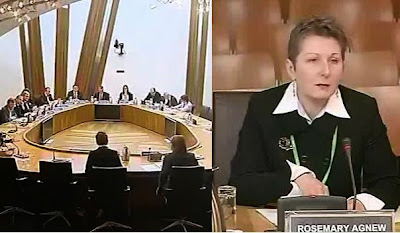
The Scottish Information Commissioner made the claims to MSPs during her appearance on 6 May at the Scottish Parliament’s Public Petitions Committee where msps considered proposals to give the Commissioner new powers to deal with dishonest public bodies, contained in Petition PE1512 Amendments to the Freedom of Information Scotland Act 2002 filed by retired Scotsman journalist Mr William Chisholm.

The petition calls on the Scottish Parliament to urge the Scottish Government to strengthen the Freedom of Information (Scotland) Act 202 by requiring public bodies to provide full and accurate information in all responses to FOI requesters, and to extend the powers of the Scottish Information Commissioner (SIC) to enable the Commissioner to investigate complaints alleging erroneous responses. The petition also seeks powers to impose monetary penalties on any public body which breaches the amended FOISA regulations on accuracy.

Scottish Information Commissioner Evidence to MSPs on Petition PE1512 6th May 2014

Giving evidence to MSPs, Ms Agnew appeared to suggest a variety of reasons could lead to the information being requested not being released, such as public bodies not searching for the information in the correct place, inaccuracies in public records, or the information not being held by the public body.

Throughout the debate Ms Agnew appeared unable to justify her opposition to the petition’s proposals to bring requirements of honesty into the FOI framework, giving at times rambling answers to questions put by msps. The full meeting minutes are available here: Official Report of meeting 6 May 2014 (434KB pdf)

The Commissioner went on to tell the Committee tthe most effective way to deal with FOIs was "getting it right first time"  - although many FOI requesters including some msps who use Freedom of Information to find out what Scottish public authorities are really up to, may find Ms Agnew’s claim on this point hard to swallow.

Commenting on Ms Agnew’s appearance before MSPs, the Petitioner, Mr Chisholm said: “In her evidence to the Committee on May 6th, the Scottish Information Commissioner (SIC) said she saw no need to amend the current legislation. This, despite the fact that 12,000 responders to FOI requests may be breaking the law in any given year, and even though there has not been a single prosecution or conviction under Section 65 of FOISA.”

Mr Chisholm continued: “The SIC also explained that an individual with a complaint about the accuracy of a FOI response had recourse under other Acts as well as FOISA. But it would seem much more logical for all issues relating to Freedom of Information to be monitored and governed by FOISA. How is that individual supposed to negotiate the labyrinth of legislation which seems to have been concocted to protect local authorities, Government agencies, and other organisations covered by FOISA?”

Concerns have also been raised over the Information Commissioner’s policy towards public authorities who provide dodgy information in response to FOI requests after it emerged in responses to the petition that not one single prosecution of a public body breaching FOI laws has taken place – even though the Information  Commissioner and Police Scotland identified 10 cases where there was evidence that suggested a section 65 offence may have been committed.

Concluding the debate. the  Committee agreed to defer consideration of the petition to a future meeting to allow time for the  Scottish  Government  to  respond  and  to  enable  the  petitioner  to comment on evidence received.

Scottish Law Reporter previously reported on the Petition 1512 here : MSPs to question Scottish Information Commissioner over proposal to amend law on inaccurate & false FOI responses from public bodies

REVEALED: BRIEFING TO UNDERMINE PETITION
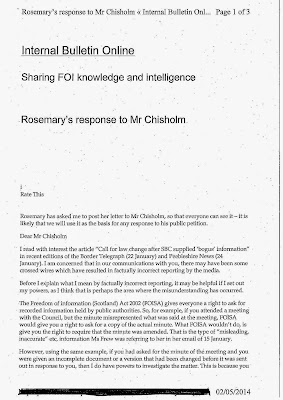
Disclosures obtained under Freedom of Information legislation and forwarded to Scottish Law Reporter have revealed how the Scottish Information Commissioner held discussions on how to respond to queries from the Scottish Parliament’s Petitions Committee on calls to integrate honesty clauses into the FOI Act.

In documents published today, the SIC is seen to discuss with staff as to how to reply to MSPs questions on the petition, and

Apparently concerned of queries over the lack of prosecutions of FOI violations, the SIC staff express concerns as noted : “Rosemary is to give evidence to the committee on Tuesday 6 May. One of the issues we expect will come up is about the number of s65 cases we've had. IT s a bit of a side issue (Mr Chisholm's concern appears to be about whether he was provided all information in scope of his request, though we never did have an application to investigate), but it was raised during Tuesday's committee meeting as one of the tests of whether FOISA is working.”

Commenting on the documents earlier today, transparency campaigners described the SIC’s efforts to wind up Mr Chisholm’s petition as “outrageous”.

A legal insider added “Considering the Information Commissioner has already admitted she does not have powers to investigate cases of dishonest FOI responses, perhaps the SIC may better focus its obvious influence in ensuring an honesty clause is attached to the Freedom of Information Scotland Act rather than expending so much effort to kill off the idea that anyone making an FOI request should expect honesty in responses from public bodies funded by taxpayers.”

Tuesday, August 06, 2013

Openness for all : Decision makers including judges should declare Secret Society membership says new petition filed at Holyrood

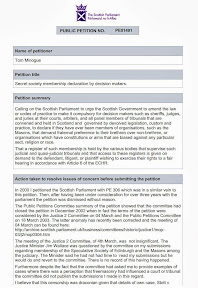
A PETITION calling on decision makers from judges to tribunal members to declare their membership of all organisations including Freemasonry has been filed at the Scottish Parliament for consideration by MSPS. The petition, filed by transparency campaigner Thomas Minogue of Dunfermline, Fife, can be viewed online at the Scottish Parliament’s website HERE.

The Petition “calls on the Scottish Parliament to urge the Scottish Government to amend the law or codes of practice to make it compulsory for decision makers such as sheriffs, judges, and juries at their courts, arbiters, and all panel members of tribunals that are convened and held in Scotland and governed by devolved legislation, custom and practice, to declare if they have ever been members of organisations, such as the Masons, that demand fraternal preference to their brethren over non-brethren, or organisations which have constitutions or aims that are biased against any particular sect, religion or race.”

The petition further states : “That a register of such membership is held by the various bodies that supervise such judicial and quasi-judicial tribunals and that access to these registers is given on demand to the defendant, litigant, or plaintiff wishing to exercise their rights to a fair hearing in accordance with Article 6 of the ECHR.”

Further details given to MSPs by the petitioner, Mr Minogue, state : “In 2000 I petitioned the Scottish Parliament with PE 306 which was in a similar vein to this petition. Then, after having been under consideration for over three years with the parliament the petition was dismissed without reason.”

“The Public Petitions Committee summary of the petition showed that the committee had closed the petition in December 2002 when in fact the terms of the petition were considered by the Justice 2 Committee on 04 March and the Public Petitions Committee on 18 March 2003.”

“The latter anomaly has recently been corrected and the meeting of 04 March can be found here:http://archive.scottish.parliament.uk/business/committees/historic/justice1/mop-03/j2mop0304.htm

“The meeting of the Justice 2 Committee, of 4th March, was  not insignificant. The Justice Minister Jim Wallace was questioned by the committee on my submissions regarding membership of the Speculative Society of Edinburgh and the Masons among the judiciary. The Minister said he had not had time to  read my submissions but he would do and revert to the committee. There is no record of this having happened.”

“Furthermore despite the fact that the committee had asked me to provide examples of cases where there was a perception that freemasonry had influenced a court or tribunal the committee did not publish the submissions I made in this regard. I believe that this censorship was draconian given that details of own case, Stott v Minogue 2000 SLT (Sh Ct) 25, & GWD 36-1386, - which spawned the petition – and the decision by the Social Security Commissioner, Ref: CSI/136/02. are in part matters of public record, or have been reported widely in the press and legal journals and are the two most important Scottish cases that deal with the influence of freemasonry in the justice system.”

“Having sought to determine my rights to challenge the existing law which allows nondisclosure of (secret) membership of fraternal organisations by decision makers by the courts, my elected representatives, and the previous government (which subverted the public petitions process), I am now attempting to resolve this anomaly with a new government, which claims to be open and accountable to the people of Scotland.”

The Closing Date for signatures supporting the aims of the Online Petition is 29 October 2013.

Sunday, June 09, 2013

Transparency scandal as Scotland’s top judge threatens to withdraw judicial cooperation with Scottish Parliament over calls for judges to publish register of hidden interests

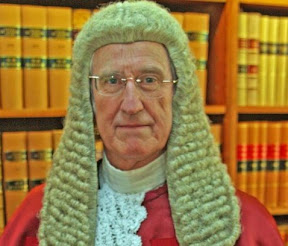
Lord Brian Gill : Too much transparency may end  judges involvement with Holyrood. CALLS FOR TRANSPARENCY in Scotland’s Judiciary have provoked Lord Brian Gill, Scotland’s top judge to issue a veiled threat to block any further cooperation from the judiciary with the Scottish Parliament after MSPs twice asked the Lord President to show up to give evidence on a proposal to create a compulsory register of interests for Scotland’s judiciary.

Responding to MSPs on Holyrood’s Public Petitions Committee who are considering Petition PE1458: Register of Interests for members of Scotland's judiciary, Lord Gill said : “Judicial participation in the work of the committees must however be kept within prudent limits” and went on to state it was up to Lord Gill as the Lord President to decide whether any appearance by a judge in front of MSPs may compromise the independence of the judiciary.

The top judge’s threat to withdraw help or cooperation from the judiciary on legislation including personal appearances by judges at Holyrood comes as a scandal involving multiple failures by the judiciary to declare conflicts of interest, financial deals & wealth, hospitality, paid outside work, links to law firms and even criminal convictions engulfs Scotland’s entire judicial system.

The Scottish Parliament are yet to respond to Lord Gill’s veiled threats to restrict or block all cooperation from the judiciary in future legislation, however critics of Scotland’s closed shop judiciary have urged the Scottish Parliament to move ahead of the obstructive judge and legislate for a compulsory register of judicial interests encompassing financial and other interests of Scotland’s judges.

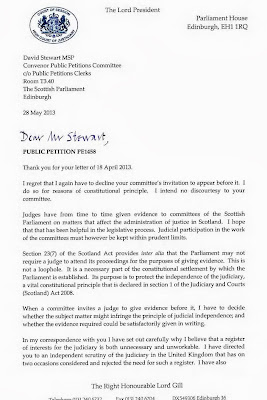
Lord Gill’s letter to the Convener of the Public Petitions Committee :

PUBLIC PETITION PE1458

Thank you for your letter of 18 April 2013. I regret that I again have to decline your committee's invitation to appear before it. I do so for reasons of constitutional principle. I intend no discourtesy to your committee.

Judges have from time to time given evidence to committees of the Scottish Parliament on matters that affect the administration of justice in Scotland. I hope that that has been helpful in the legislative process. Judicial participation in the work of the committees must however be kept within prudent limits.

Section 23(7) of the Scotland Act provides inter alia that the Parliament may not require a judge to attend its proceedings for the purposes of giving evidence. This is not a loophole. It is a necessary part of the constitutional settlement by which the Parliament is established. Its purpose is to protect the independence of the judiciary, a vital constitutional principle that is declared in section 1 of the Judiciary and Courts (Scotland) Act 2008.

When a committee invites a judge to give evidence before it, I have to decide whether the subject matter might infringe the principle of judicial independence; and whether the evidence required could be satisfactorily given in writing.

In my correspondence with you I have set out carefully why I believe that a register of interests for the judiciary is both unnecessary and unworkable. I have directed you to an independent scrutiny of the judiciary in the United Kingdom that has on two occasions considered and rejected the need for such a register. I have also directed you to the decision of the United Kingdom Government to accept that finding, and to the decision of the United Kingdom Supreme Court not to create a register. That I think, is as much useful evidence as I am in a position to give on the subject; but if there is any further information that you feel would be relevant and helpful to the committee, please let me know and I will consider the matter further.

In your letter you have asked whether any central record has been kept of failures by judges to recuse themselves. The Lord President has been responsible for matters concerning the conduct of judicial office holders since April 2010. During that period there has been no case in which a judge has been found guilty of misconduct for a failure to recuse.

If you would find it helpful I would be pleased to meet with you to discuss the constitutional implications of the Committee's invitation.

Scottish Law Reporter has previously reported on a story which revealed several of Scotland’s judges are actually convicted criminals, one of whom was even convicted of cheating the benefits system : ONE OF OUR JUDGES IS A BENEFITS CHEAT– reveals investigation into undeclared criminal habits, tax dodging & secret fiddles of Scottish judiciary