Showing posts with label Lord McCluskey. Show all posts

Saturday, March 16, 2013

KEEP SALM & CENSOR ON ? First Minister’s report on Leveson will censor anyone with an opinion - facebook, twitter & blogs also targeted in ex-judge’s bill

Alex_Salmond

First Minister Alex Salmond wants regulator with power to censor anyone with adverse opinion. THE PROSPECT of Soviet style total media censorship coming to Scotland has taken a significant leap forward with the conclusions of Lord McCluskey’s Expert Group on the Leveson Report in Scotland, prepared for First Minister Alex Salmond who wants to appoint a regulator with powers to sanction anyone who produces news or comment in print form or on the internet.

The now widely criticised report, prepared by the former Solicitor General in consultation with a number of others including lawyers such as Peter Watson of Levy Mcrae (who count among their clients former Lord Advocate now Dame Elish Angiolini DBE QC, née McPhilomy and former Glasgow City Council Boss & Cocaine addict Steven Purcell)  and who also recently represented Mr Salmond personally in a failed complaint against the Daily Mail newspaper, aims to silence anyone in Scotland with an opinion that does not match those who want to keep criticism & scandal out of the limelight.

The Daily Record reports : Leveson: Press freedom under threat as Alex Salmond's draconian Bill threatens to censor anyone with an opinion

16 Mar 2013

SCOTLAND'S First Minister wants to appoint a regulator with powers to sanction anyone who produces news, comment or celebrity gossip – in print or digital.

ALEX SALMOND yesterday stood accused of plotting a draconian law that will have a chilling impact on freedom of speech and cost thousands of jobs.

The First Minister wants to appoint a regulator with powers to sanction ANYONE who produces news, comment or celebrity gossip – in print or digital.

Salmond hired an expert group headed by Lord John McCluskey to work out how Lord Leveson’s plan to regulate the press could be adopted in Scotland. But their report – branded Loch Leveson – said the powers of the regulator in Scotland should be beefed up to cover the web and ­publications other than newspapers.

They also recommended legislation to cover Twitter and Facebook.

Unlike the English system, Loch Leveson will regulate opinion pieces and even what they call scandalous gossip about celebrity.

In theory, bloggers such as ­schoolgirl Martha Payne, who complained about her school dinners, could be hauled before the regulator and fined.Even a local church magazine could fall foul of what Tory leader Ruth Davidson described as “the most draconian press controls in the western world”. The Bill would make it compulsory for every newspaper to fund the new system. Experts say it would cost £1.5million a year – mainly in fees to lawyers. It could signal the death of scores of local newspapers and cost thousands of jobs.

Sink this attack on democracy 

The Leveson inquiry into press ethics was held in the wake of the phone-hacking scandal at Rupert Murdoch’s News of the World. But the Scottish move goes even further than the controversial ­recommendations made last year by Lord Justice Leveson. Scotland would face tighter control of its print media than the rest of the UK, where Leveson recommended a voluntary system of self-regulation.

All written news material in ­Scotland – from the biggest national newspapers and magazines to the smallest church newsletter – would be affected. In a further departure from the Leveson recommendations, the rules would apply to all internet news media.

The report even suggests they could be extended to social networking websites like Twitter. That means anyone commenting on Facebook or posting on a website about celebrities or current affairs could fall foul of the regulator.

McCluskey’s committee said a two-tier system should be created by law. The first level would be a UK regulator set up by the press. The second tier would be a Scottish “recognition body” to ensure the regulator complied with the ­principles laid down by Leveson.

Crucially, the report suggests Government ministers would have the power to appoint the head of the recognition body – opening the door to ­state interference with the press for the first time in centuries.

Salmond was last night accused of attempting to shackle the press. Critics fear they could be used to muzzle newspapers in the run up to next year’s referendum.

Former journalist Davidson said: “With the First Minister now saying he will consider the expert group’s findings, there’s a real danger the threat of legislation will be kept hanging over the heads of editors as the ­referendum approaches.

“Even more astonishing is the proposal for the regulator to be responsible for news comment on the internet and for the newspaper industry to provide all the funds.

“It cannot be right that an industry already in crisis should be expected to pay for the regulation of the very thing that’s killing it off.

“We are, however, pleased that the expert group has recognised there’s no specific need for a Scotland-only regulator and a single regulator can operate across the whole UK as at present.”

McCluskey’s panel included David Sinclair, director of communications at Victim Support Scotland, legal academics Neil Walker and Peter Watson and journalist Ruth Wishart.

Their report was hurriedly published yesterday after the collapse of talks at Westminster to find a common way forward for the UK.

McCluskey said a UK-wide ­regulator could still be set up if a deal can be reached between David Cameron, Ed Miliband and Nick Clegg.

But while Leveson recommended a “carrot-and-sticks” approach to get newspapers to sign up to a voluntary regulator, McCluskey’s panel said they had “little confidence” this would encourage publishers to sign up.

They said: “We have reached the view that there is no practical ­alternative to making it compulsory for all news-related publishers to be subject to the new system of ­regulation,”

Salmond praised the “extremely thorough” report, saying: “It is for the parliaments in London and in ­Scotland to establish a recognition process.

“It is for the press to bring forward a voluntary regulatory body compliant with Leveson principles. I hope this is still possible.”

But Scots Labour leader Johann Lamont said: “We agreed with the First Minister that this group should look solely at the technicalities of implementing Leveson in Scots law.

“We did not agree to the Leveson recommendations being rewritten or built upon.”

The McCluskey report was commissioned by Alex Salmond to look at how the recommendations of the Leveson report could be implemented in Scotland. The findings go further than those of Lord Justice Leveson last year.

McCluskey report at a glance

All newspapers and magazine publishers would be forced to sign up to the regulator. Under the Leveson proposals, this would have been voluntary but came with incentives such as lower damages in the event of libel action.

A recognition body would be set up – appointed by ministers – to ensure the regulator was sticking to the rules. They would have the power to overrule the regulator.

The regulator could have the power to censure newspapers, magazines and websites, including gossip sites. Leveson made no recommendations on policing the internet or ruling on celebrity gossip.

McCluskey’s group said further regulation of  social media may also be required, opening the door to Facebook posts and Twitter being scrutinised.

Major publishers would have to meet the cost for setting up and running the regulator but websites – many of which generate millions of pounds for their owners – are likely to be exempt from paying.

Analysis - by media lawyer Campbell Deane

WHEN Alex Salmond announced an expert group to advise on the most appropriate means of regulating the newspaper industry, the writing was on the wall.

He wasn’t asking the group whether there was a need to implement Leveson’s proposals in Scotland. He was asking them how to achieve it.

That decision was astonishingly short-sighted. We have not had a Millie Dowler or Madeleine McCann in Scotland. We have not even come close.

We have had no phone- hacking scandal. Journalists as a rule in Scotland have behaved. These were London-centric issues for which the Scottish newspaper industry was being punished without guilt.

And yet Salmond’s panel of experts recommend the Scottish Parliament creates a regulator to prevent serious abuses of the kind which don’t occur in Scotland. Not content with implementing Leveson’s recommendations, the panel have chosen to go further by bringing under regulation all publishers of news-related material.

This country prides itself on free speech yet the panel recommended implementing proposals that could mean gossiping about the rich and famous online with your friends would get you into trouble.

By its nature, comment allows people to express their views. That should not be restricted.

At a time when newspapers are struggling for their very existence, they will be asked to fund complaints based on comment and gossip which have nothing to do with them.

They will put a financial burden on the Scottish industry that may push some newspapers over the edge.

How the loss of indigenous Scottish titles will benefit Scotland is beyond me.

Friday, March 15, 2013

Law Society of Scotland President Austin Lafferty backs Alex Salmond’s draconian North Korea style censorship controls on Scots media & internet, claims ‘boundaries must be set’

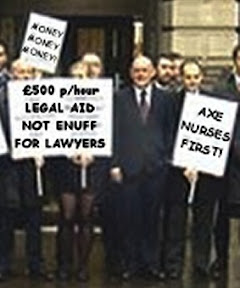
Between the placards, Austin Lafferty strikes a chord for an increase in legal aid fees. AUSTIN LAFFERTY, the current President of the Law Society of Scotland has given his backing to the draconian media & internet censorship proposals put forward by 83 year old retired judge Lord McCluskey. Lafferty, himself no stranger to hanging around the media and the annals of Edinburgh Sheriff Court & Holyrood on wet days to collect taxpayer funds for his colleagues at the expense of everyone else, claimed the now widely condemned attempt by the Scottish Government to censor anyone with an opinion “will hopefully rebuild public confidence in the media”.

The Law Society of Scotland’s media unit published a Press Release stating Society President and Glasgow-based media lawyer Austin Lafferty said: "The report of the expert group headed by Lord McCluskey will hopefully rebuild public confidence in the media.”

Lafferty went on : "As a long-standing media lawyer, I am well aware that developments in technology have brought new methods of potential intrusion. In my experience, journalists generally act with professional responsibility and self-discipline. However, clear boundaries must be set, with robust sanctions imposed where necessary. Equally, free speech must be protected and we already have libel and defamation laws that work effectively.”

Lafferty added : "I look forward to considering the report in more detail but broadly welcome the group's approach and conclusions, which must now be considered by parliament. I hope whatever regulatory regime is adopted will allow a fresh start for all."

Scottish Government ‘to consider’ draconian censorship of all media as proposed in Lord McCluskey’s report on Leveson press regulation

THE SCOTTISH GOVERNMENT have today published the report by their own expert group headed by 86 year old Lord McCluskey on the recommendations made by Lord justice Leveson into press practices and how these could be applied in Scotland. However, the terms of the former Solicitor General’s report go much wider than the original Leveson recommendations, with Lord McCluskey also advocating regulation of twitter, facebook and all forms of media carring ‘news’.

Lord McCluskey’s report can be viewed online here : Expert Group on the Leveson Report in Scotland

The Scottish Government’s Press Release : Scottish Government to consider McCluskey report

First Minister Alex Salmond today thanked the expert group led by former Solicitor General Lord McCluskey considering how the recommendations made by Lord Justice Leveson into press practices could be applied in Scotland as it published its report.

The expert group, which was appointed by the First Minister in December, has made a series of recommendations on how a system of self-regulation of the press could be established and recognised in Scotland in a report distributed to all parties this morning.

Mr Salmond said the thorough report from Lord McCluskey and his colleagues was “an important contribution” to the process of implementing Leveson in Scotland, as he indicated the Scottish Government would now consider the report’s findings carefully while continuing the cross-party efforts to reach a suitable way forward in Scotland.

The Scottish Government is committed to cross-party talks on implementing the Leveson recommendations and will continue to work toward a consensus on the way forward in Scotland.  The First Minister confirmed today that ministers would report to Parliament after the Easter recess on the progress of these talks.

The First Minister said: “Lord McCluskey and his group have reported at an opportune time.While there is a huge amount of uncertainty and division surrounding how Westminster is going to take forward the Leveson recommendations, I am hopeful that in Scotland all parties in the Parliament can continue to work together to find an acceptable way forward.Lord McCluskey’s group has delivered an extremely thorough piece of work looking at how the proposals made by Lord Justice Leveson could be applied in the context of Scots law, including draft legislation. We will now take the time to consider all of their suggestions in full and discuss the proposals with the other political parties and other stakeholders.”

Mr Salmond continued : "The report is admirably clear. It is for the Parliaments in London and in Scotland to establish a recognition process. It is for the press to bring forward a voluntary regulatory body compliant with Leveson principles. I hope that this is still possible.The Scottish Government indicated at the time of Leveson’s report that we wanted to implement his key proposals of a voluntary self-regulatory system set up by the press with statutory underpinning.

“Since Leveson reported, all parties in the Parliament have taken part in a cross-party effort that has seen the leaders hold talks with Hacked Off, the Media Standards Trust and representatives of the press with a commitment to meet with the UK Government after their position becomes clearer.These efforts will continue and the Scottish Government will report back to Parliament after Easter on the progress of these talks. I would like to put on record my sincere thanks to Lord McCluskey, David Sinclair, Professor Neil Walker, Peter Watson and Ruth Wishart for their efforts in producing this diligent report.”

Monday, June 27, 2011

First Minister’s threats & intimidation over alleged Supreme Court ‘interference in Scots Law’ scores ‘call for change’ on Human Rights rulings

After weeks of threats & intimidation, claims, counterclaims & criticisms from Scotland’s First Minister Alex Salmond & Justice Secretary Kenny MacAskill of the UK Supreme Court’s rulings in the Cadder v HMA case and more recently its ruling on Nat Fraser, accused of murdering his wife, the review group headed by Lord McCluskey has published its first report ahead of a debate in the Scottish Parliament later this week. Unsurprisingly, the initial report concludes there should be change in the way cases from Scotland can get to the Supreme Court and  only if the High Court in Scotland granted convicts permission to appeal.

Eager to take the sting out of today's announcement of the untimely death of Lord Rodger, who, along with Lord Hope and the other judges of the Supreme Court the First Minister & Justice Secretary did most thuggishly attack over the past few weeks due to their own perception the Supreme Court had ‘interfered’ in the Scots legal system, First Minister Alex Salmond today selectively welcomed the findings of Lord McCluskey’s review group, saying : “There is now a consensus that the UK Supreme Court plays a much broader role in Scottish criminal law than had been envisaged when the Scotland Act was passed, and that it is more intrusive within Scots Law than is the case for the other jurisdictions within the UK - with serious implications for the certainty and integrity of our distinct legal system.”

However, it should be noted Lord McCluskey’s initial report clearly states : “We do not suggest that the jurisdiction of the Supreme Court should be ended.”

Supreme Court Review

On 05 June 2011, First Minister Alex Salmond announced the creation of an independent review group to consider the law and practice currently governing the respective jurisdictions of the High Court of Justiciary and the Supreme Court in cases involving the application of human rights law, including cases in which 'devolution issues' are raised.

The full terms of reference for the group are: "To consider and assess the mechanisms created under the Scotland Act 1998 and the Human Rights Act 1998, and developed since then, for applying Human Rights law to criminal cases in Scotland, including particularly the regulation, subject matter and scope of appeals from the High Court of Justiciary to the Supreme Court of the United Kingdom; To consider the criticisms of and various suggested amendments to those mechanisms in light of current assessments, including criticisms, of their operation; and to advise on the ways in which they might best be altered, if appropriate, by legislation or otherwise, to ensure Scotland's unique system of Criminal Law and Procedure is fully protected, within the context of the accepted need for that system to comply with the Human Rights Act."

Read the reports here : First Report of the Review Group (pdf) Appendix and Supplement (pdf)

SUMMARY OF ADVICE :

72. We agree with the Expert Group that serious problems have arisen - in relation to the jurisdiction of the Supreme Court in criminal cases involving human rights issues - because the statutory basis in the Scotland Act 1998 for that jurisdiction is unsatisfactory (cf. paragraphs. 42 and 43).  We do not suggest that the jurisdiction of the Supreme Court should be ended.

73. We endorse the general solution proposed by the Expert Group and adopted by the House of Commons on 21 June 2011 to create a different procedure for human rights appeals, but we advise consideration of a new provision governing permission to appeal to the Supreme Court from a determination by the High Court of Justiciary of any question of “compatibility”, as  defined in the new Section 98A (2) (paragraphs 53 to 57).

74. Our proposed new provision (outlined in paragraph 56) would put the High Court of Justiciary on an equal footing with its counterparts elsewhere in the UK by enabling the Supreme Court to grant permission to appeal only if the High Court of Justiciary has  granted a certificate that the case raises a point of general public importance. Other issues about permission are suggested for further discussion (paragraphs 67 to 69).

75. It should be made clear that, in criminal appeals from the High Court of Justiciary on “compatibility” questions, the Supreme Court’s jurisdiction is to be exercised in such a way that it defines and expresses the law applicable and then sends the case back to the High Court of Justiciary to apply that law (paragraphs 60 to 64). In this way the traditional role of the High Court of Justiciary, reflecting the long history of separate development of the Scottish criminal system, would be preserved. The precise method of achieving this clarification should be fully discussed with those who have to deal with such cases in practice.

76. We advise that careful consideration be given to a general rule that normally the Supreme Court should give a ruling on a “compatibility” question only after the case has been completed. However, it might be wise to permit the High Court of Justiciary to ask the Supreme Court for a ruling at an earlier stage (paragraphs 65 and 66). We have not, as yet, fully discussed the provisions that allow References to the Supreme Court by the Advocate General or the Lord Advocate.

77. We are prepared to consult interested parties on the way forward following publication of this Report and the subsequent Parliamentary debate.

BBC News reports :

Supreme Court system for Scottish cases 'flawed'

Experts reviewing the relationship between the High Court of Justiciary and the UK Supreme Court in criminal cases have called for change.

Lord McCluskey's review group claimed Scotland faced more intrusive jurisdiction from the Supreme Court than the rest of the UK.

The report said the system was "flawed" and called for coherence across the UK.

The first minister set up the group over concern about the Supreme Court's involvement in Scottish criminal cases.

Scottish government ministers previously said the Scottish legal system should have direct access to the European court in Strasbourg - ending the jurisdiction of the UK Supreme Court on Scottish criminal cases.

However, the McCluskey Group backed the UK Supreme Court's jurisdiction to rule on human rights in Scottish criminal cases - but only if the High Court in Scotland granted convicts permission to appeal.

Currently in Scotland, an appeal can be made to the UK Supreme Court for criminal cases relating to human rights law.

In the rest of the UK, an appeal to the Supreme Court is only possible with the leave of the Court of Appeal - and only when a point about general public importance is at stake.

The McCluskey report recommended a new provision, with proposed amendments to the Scotland Bill, which would place the High Court of Justiciary "on an equal footing with its counterparts elsewhere in the UK, by enabling the Supreme Court to grant permission to appeal only if the High Court of Justiciary has granted a certificate that the case raises a point of general public importance".

It also said it should be made clear that "the jurisdiction of the Supreme Court should be exercised in such a way that it identifies clearly the law that the criminal courts have to apply, but that the application of the law to the case in which the issue is being litigated should be remitted to the High Court of Justiciary".

It claimed this would help preserve the traditional role of the High Court of Justiciary under current constitutional arrangements by ensuring "the Supreme Court, in dealing with its human rights jurisdiction in criminal cases, would concentrate on identifying and articulating clearly the relevant law contained in the Human Rights Act and would not proceed to decide the case as if it were the High Court of Justiciary".

First Minister Alex Salmond welcomed the review group's first report, which has been published in order to help inform the Scottish Parliament debate taking place on Thursday.

He said: "There is now a consensus that the UK Supreme Court plays a much broader role in Scottish criminal law than had been envisaged when the Scotland Act was passed, and that it is more intrusive within Scots Law than is the case for the other jurisdictions within the UK - with serious implications for the certainty and integrity of our distinct legal system.

"We now have the interim analysis and conclusions of the McCluskey Group, and I particularly welcome its recommendations for amendments to the Scotland Bill to limit the role of the UK Supreme Court by placing referrals from Scotland's highest court of criminal appeal - the High Court of Justiciary - on the same footing as is the case for the justice system south of the border.

"It also makes positive suggestions for the UK Supreme Court to operate clearly and consistently as a court of interpretation of human rights law, and not 'as if it were the High Court of Justiciary'."

He added that the recommendations should be "capable of attracting support and consensus across parliament, and among the wider legal and other important interests involved".

It is expected the group will publish a final report by autumn - before amendments are made to the Scotland Bill.

A spokesman for the Advocate General - the UK government's senior Scottish legal adviser - said any change in the rights of Scots to appeal directly to the Supreme Court in London would require legislation in Westminster.

He said amendments could be made to the Scotland Bill, which has just been sent to the Lords from the House of Commons, but pointed out that Lord McCluskey's full report was not due to be published until later in the year.

The spokesman said: "Ministers will consider the McCluskey Report and debates later in the week in Holyrood.

"They will do this along with consideration of the UK government's expert qroup and consultations on this issue before coming to a final view."

The row about the Supreme Court's role in Scottish criminal cases erupted in May in the case of Nat Fraser.

Five justices in the court in London said Mr Fraser's conviction for the 1998 murder of his wife, Arlene, should be quashed.

Fraser, 52, from Elgin, now faces a retrial.

The court had previously cast doubt on a large number of criminal convictions in Scotland in a ruling which came to be known as the Cadder judgement.

This concerned the rights of a suspect to legal representation during questioning by police.

Monday, June 06, 2011

Less than stellar : Alex Salmond evades support for Justice Secretary’s threat to Supreme Court funding, Lord McCluskey to chair review team

ALEX SALMOND, Scotland’s First Minister has finally issued a Government statement on the crisis in the Scottish legal system caused by his opposition and that of his Justice Secretary to Scottish criminal cases being sent to the UK’s Supreme Court in London. The official statement, published two weeks after the ‘crisis’ began, comes after a less than stellar appearance on national television where the First Minister refused to respond to questions asking if he supported threats issued by Justice Secretary Kenny MacAskill to withhold Scottish funding of the Supreme Court, reported recently in the Herald newspaper.

The Herald newspaper also came in for criticism from Mr Salmond for running the story on Mr MacAskill’s threat to end funding for the Supreme Court as one say of denying Human Rights appeals the chance to be heard.

Less than stellar : In an unusually poor, evasive showing, First Minister Alex Salmond slips on Human Rights & justice issues, evades questions over conduct of Justice Secretary Kenny MacAskill


Menzies Campbell QC & MP (LibDem) talks about the Supreme Court appeals ‘problem’ started by the Scottish Government, not by the legal profession.


The somewhat late and suspiciously rather long media release from the Scottish Government :

UK Supreme Court

05/06/2011

A group of independent specialists in Scots law, with unrivalled experience of court practice, has been appointed to review the law and practice currently governing the respective jurisdictions of the High Court of Justiciary and the Supreme Court in court cases involving the application of human rights law, including cases in which 'devolution issues' are raised.

The group will make such proposals for change as they judge to be appropriate to secure that Scotland's unique system of criminal law and procedure is fully protected, given the need for that system to comply with the Human Rights Act. The group is:

    * Lord McCluskey, former Solicitor General and Senator of the College of Justice (chair)
    * Sir Gerald Gordon, one of the most influential figures in Scottish criminal law and procedure
    * Charles Stoddart, a former sheriff, sheriff principal and director of judicial studies and prominent author on criminal law
    * Professor Neil Walker, expert in constitutional law at the Edinburgh School of Law

The group's remit will be to examine the emerging implications of the 1998 Scotland Act, the 1998 Human Rights Act and the Constitutional Reform Act 2005 on the current roles of the High Court of Justiciary in Edinburgh and the UK Supreme Court in London, and advise on possible options for reform.

The full remit of the group is:

    * To consider and assess the mechanisms created under the Scotland Act 1998 and the Human Rights Act 1998, and developed since then, for applying Human Rights law to criminal cases in Scotland, including particularly the regulation, subject matter and scope of appeals from the High Court of Justiciary to the Supreme Court of the United Kingdom
    * To consider the criticisms of, and various suggested amendments to, those mechanisms in the light of current assessments, including criticisms, of their operation
    * To advise on the ways in which they might best be altered, if appropriate, by legislation or otherwise, to ensure that Scotland's unique systems of Criminal Law and Procedure is fully protected, within the context of the accepted need for that system to comply with the Human Rights Act

An interim reports is expected before the summer Parliamentary recess with a full report following later in the year.

First Minister Alex Salmond said: "This expert group is a stellar cast of some of the leading names in the Scottish legal firmament. We have called upon specialists of the highest calibre and asked them to use all their experience to bring forward proposals for reform. These experts in Scots law and the constitution will conduct a fundamental review of the UK Supreme Court's role in Scottish criminal cases before presenting an interim report in time for a Scottish Parliament debate before the summer recess. Their final report will be published later this year, and will put forward options for reform in time for those proposals to be incorporated into the Scotland Bill. Lord McCluskey, Sir Gerald Gordon, Charles Stoddart and Professor Neil Walker are all highly respected in their fields. They have a wealth of knowledge and experience which they will bring to the table, and they are blessed with some of the most impressive legal minds in the country. They will give detailed and thorough consideration to all of the issues, and I look forward to receiving their recommendations."

Mr Salmond added in the lengthy rambling diatribe on the Supreme Court : "Scotland is renowned for its distinct, independent and entirely separate legal system - so my own view is that we simply cannot ignore a situation where a court in another UK jurisdiction is intervening so aggressively in our judicial system. The fact that courts outside Scotland should have no jurisdiction over Scottish criminal matters is a long-standing and fundamental principle which is enshrined in the Act of Union. Yet we find ourselves in a situation where the unanimous decision of a bench of seven judges in the High Court in Scotland can be overturned by a UK Supreme Court where Scots judges are in a minority. We must protect the independent and unique nature of Scots law and pursue change in the role of the UK Supreme Court to prevent further erosion and interference in Scotland's distinct legal system. The Scottish Government's view is that Scotland should be like every other jurisdiction across Europe and use the Strasbourg Court as the final option for judgement when needed. Unlike the UK Supreme Court in London, the Strasbourg Court can't strike down convictions, it doesn't open cell doors and potentially enable people to walk free, and it certainly doesn't do so without a proper examination of the degree of protections, checks and balances within the Scottish judicial system."

Biographies of the review team :

Lord McCluskey (Chair)

John Herbert McCluskey, Baron McCluskey (born 12 June 1929) was Solicitor General for Scotland from 1974 to 1979. During this period he worked on the then Labour government's proposals for devolution.

Lord McCluskey became a member of the Judiciary in 1984 and presided for 16 years as a High Court judge over some of the country's most famous criminal cases. He retired in 2000.

Sir Gerald Gordon

Sir Gerald Gordon CBE QC KBE FRSE (born 1929) is the editor of Scottish Criminal Case Reports and of Renton and Brown's Criminal Procedure, and author of The Criminal Law of Scotland.

Sir Gerald was a Sheriff from 1976 to 1999 and a Temporary Judge at the High Court until June 2004. He was Professor of Scots law at Edinburgh University from 1972 to 1976 and Head of Department of Criminal law and Criminology there from 1965 to 1972. He practised as an Advocate from 1953 to 1959 and was Procurator Fiscal Depute from 1960 to 1965.

Sir Gerald was a Member of the Scottish Criminal Cases Review Commission (SCCRC) from its inception in 1999 until 2009.

He was referred to by Lord Hope of Craighead, in a book entitled "Essays in Criminal Law in honour of Sir Gerald Gordon", as "one of the complete masters" of Scots criminal law…"up there with Sir George MacKenzie and Baron Hume".

Charles Stoddart

Sheriff Charles N Stoddart is the author and co-author of a number of key publications on the law of Scotland. He was the first director of Judicial Studies for the Judicial Studies Committee for Scotland (which provides training and professional development support for the Scottish judiciary - Court of Session, High Court and Sheriff Courts), a post he took up on a full-time basis in August 1998. He was a well-respected sheriff and recently acted as an interim sheriff principal.

Professor Neil Walker

Neil Walker - LLB, PhD, LLD (Honoris Causa) (Uppsala), FRSE - is Regius Professor of Public Law and the Law of Nature and Nations at the School of Law, University of Edinburgh His main area of expertise is constitutional theory. He has published extensively on the constitutional dimension of legal order at sub-state, state, supranational and international levels.

He has also published at length on the relationship between security, legal order and political community. He maintains a more general interest in broader questions of legal theory as well as in various substantive dimensions of UK and EU public law.

Previously he taught public law at Edinburgh for ten years (1986-96), was Professor of Legal and Constitutional Theory at the University of Aberdeen (1996-2000), and, most recently, was Professor of European Law at the European University Institute in Florence (2000-8), where he was also the first Dean of Studies (2002-5).

In December 2008 Professor Walker was asked by the Scottish Government to conduct an independent review of final appellate jurisdiction in the Scottish legal system.

Tuesday, April 01, 2008

Lord McCluskey on why the Judiciary & Courts Bill is not worth the paper its printed on

More From A Diary of Injustice in Scotland which reports on the testimony of current & former senior members of Scotland's judiciary on the planned reforms of the Judiciary & Courts Bill ...

Judiciary & Courts Bill 'not worth the paper it's written on' as Scottish Parliament hears judges ask for 'a measure of trust'

The latest attempt at reforming Scotland's judiciary has been described as 'not worth the paper it's written on', by Lord McCluskey, formerly one of Scotland's senior judges, now a Labour peer in the House of Lords. The former Court of Session judge made the assertions during his testimony last week to the Scottish Parliament.

Lord McCluskey on judicial independence and proposed judicial reforms

As you know, I have criticised Lord McCluskey for his criticisms of proposed reforms to the legal profession and judicial system, but in this case, he is probably correct, and the Judiciary & Courts Bill itself, which is currently being heard by the Scottish Parliament's Justice Committee should be at the very least, cleaned up quite a bit, and quite a dose of accountability & transparency added to it.

For instance, perhaps a more open, transparent appointments system than simply leaving it to the Lord President to appoint judges, may bring a little more in terms of public confidence to Scotland's creaky self serving legal system, which doesn't seem to have any will to change with the times, and certainly not adhere to the public interest, rather, adhere to it's own ..

Lord Hamilton on judicial appointments - apply a measure of trust ...

The office of Lord President seems to enjoy far too many powers, lacking accountability to anyone as Lord Hamilton's comments seem to indicate, but that really sums up the whole of Scotland's legal system - lacking accountability to anyone but itself, which is why the rest of us are almost enslaved to it, even being denied access to justice when it suits the legal establishment to keep people out of the courts or even decide an individual be denied access to legal representation.

The Lord President, Lord Hamilton is involved in many appointments to the legal system, not just those of appointing members of the judiciary, and only recently his role, along with Justice Secretary Kenny MacAskill in refusing all applications made by non members of the Law Society of Scotland to gain rights of audience & representation under Sections 25-29 of the Law Reform (Misc Provisions) (Scotland) Act 1990 brought into question the motives of the current legal establishment for keeping the legal services market closed, as a business monopoly for its own.

Such is the determination of the current legal big wigs to protect their own business markets and money making model, a leaked letter from the Justice Secretary to the Cabinet Secretary for Finance, John Swinney, sought to mislead Mr Swinney on the wellbeing and status of applications made under Sections 25-29, all of which have so far been struck down by both the Lord President and Mr MacAskill, ensuring that no one practices law in Scotland unless they tow the Law Society line and obey those currently in charge. Open legal markets we do not have yet then ...

Justice Secretary Kenny MacAskill misleads Cabinet Colleague John Swinney on access to justice appointments ...

Justice Secretary Kenny MacAskill to Cabinet Secretary for Business John Swinney 26 July 2007

Revisiting Lord McCluskey's comments that the Judiciary & Courts Bill is not worth the paper it's printed on, this does bring back memories of former Scottish Legal Services Ombudsman Linda Costello Baker's comments against the Legal Profession & Legal Aid (Scotland) Act 2007, which she called "a mess", and of course as we now know, she was correct in her claims - the Scottish Legal Complaints Commission which has sprang from the LPLA Act, has been happily and easily co-opted by the Law Society of Scotland, and Ministerial appointments to the Commission itself have seen a bunch of lawyers and ex Law Society Committee members appointed to it, giving the air that it will be injustice as usual for anyone who has problems with a solicitor in Scotland.

You can read more about what former Legal Services Ombudsman Linda Costello Baker said on the half hearted attempt at reforming Scotland's legal profession via the LPLA Bill here : Last words from former Scottish Legal Services Ombudsman condemn the Scottish legal profession

My latest article on the demise of the LPLA Act and the Scottish Legal Complaints Commission before it has even begun its work can be viewed here : Funding argument over Scottish Legal Complaints Commission conceals lawyers interference in 'independent' complaints body

Do we call that reform ? I don't think so .... and no doubt the Judiciary & Courts Bill, if it does make it through the Justice Committee, may well go the same way as the LPLA Bill when it was at the Justice 2 Committee in 2006 ... voted through and passed into law .. then turned on its head to serve those it sought to reform, as any attempt at reforming Scotland's legal system seems to end up in the bucket.

Lord Hamilton on dealing with complaints against the judiciary ...

Maybe we should therefore listen to Lord McCluskey this time, and make sure that if the Judiciary & Courts Bill does go through, it serves a common purpose of transparency & accountability, not simply serving the judiciary itself..

I did notice one thing though ... a small detail I suppose, given the lack of standards within the Scottish Parliament itself ... anyway, Bill Aitken MSP is still the Convener of the Justice Committee and hearing this Judiciary & Courts Bill, but of course he was a JP himself, admittedly a JP isn't that high on the judicial ladder, however, as Annabel Goldie MSP as a solicitor herself and thus a member of the Law Society of Scotland, had to resign from the Justice 2 Committee in 2006 when it heard the LPLA Bill, I wonder what shifting standards policy the Scottish Tories are applying to themselves these days ? Obviously the conflict of interest one must be out of fashion now ...

You can read more about Annabel Goldie's resignation in 2006 here : Annabel Goldie does the right thing and resigns from Justice 2 Committee Convenership but it seems that having a JP in charge of hearings on judicial reform is, amazingly, not a conflict of interest ... those tories must be up to something then .. trying to make the bill fail perhaps ?

Here follows some coverage of the Parliamentary hearings from both the Herald and Scotsman.

Plan for Bill on judiciary ‘not worth paper it’s written on’

ROBBIE DINWOODIE, Chief Scottish Political Correspondent

The plan to enshrine in statute the independence of the judiciary, praised last week by Scotland's most senior judge, was described by a former solicitor-general yesterday as "not worth the paper it's written on".

Lord Hamilton, the Lord President told the Holyrood Justice Committee last week that the proposal in the Judiciary and Courts (Scotland) Bill "sends out the right message" against a day in the future when "conflicts could arise between the judiciary and the executive".

But yesterday retired judge and former law officer Lord McCluskey told the same committee: "The evidence you heard last week was, with respect, naive. The simple answer is it could never be more than symbolic, because if an unpleasant government came to power, then do you imagine it would not behave like the governments in Zimbabwe or Pakistan?

"If a party comes to power which does not respect democratic values then this is not worth the paper it is written on. Just as this Parliament could pass it a week on Monday, it could repeal it a week on Tuesday. This is actually worth nothing at all."

Lord McCluskey added: "Most countries in the world have a written constitution in which the independence of the judiciary is embedded in the constitution. Judicial independence lies in the hearts of men, not in constitutions and statutes of this kind, and I would rather it stayed there."

Calling the proposal "just a kind of gesture politics", he said: "The English needed it and so we slavishly copied the English. We have never had a statutory declaration in Scotland. We don't need to follow slavishly and plagiarise English legislation."

The bill would give the Lord President formal recognition as the head of the Scottish judiciary, making him responsible for matters such as the training, welfare and conduct of the judiciary. There would also be new procedures for appointing and disciplining judges and for dealing with public complaints.

The legislation also sets out proposals for modernising the machinery for sacking judges and sheriffs on the grounds of unfitness for office. They would be investigated by a tribunal chaired by a judge and containing a lay element.

Lord McCluskey said: "In my time there have been judges on the High Court bench who drank too much, who didn't do their homework, who didn't turn up. They were dealt with by the Lord President behind the scenes, and dealt with successfully, and that's the way it has to work."

On attracting a wider cross-section of society to the Bench, Lord McCluskey said: "I can see merit in the government, whether through the (judicial appointments) board or otherwise, taking steps to enable more people to acquire the skills that are needed to be a judge.

"But if I'm going to be operated on by a brain surgeon, I want the brain surgeon to be the best brain surgeon. I don't want him operating because he's black, Jewish, Catholic.

"It's the same with judges. It's the same kind of expertise which is required. I don't think affirmative action has any place in the selection of brain surgeons or High Court judges."

and now for the Scotsman's version, with a piece by Lord McCluskey himself first :

Why an 'English' bill won't fit Scottish justice system

By LORD McCLUSKEY

LORD McCLUSKEY shares his concerns about the judicial reform bill, which he believes is needlessly copying measures introduced south of the Border.

THE Scottish Parliament is about to devote much time and effort considering a Bill that is both unnecessary and misconceived. With the title, The Judiciary and Courts (Scotland) Bill, it is unlikely to generate mass demonstrations around Holyrood.

Bewigged lawyers will not mount barricades proclaiming that "The End is Nigh". MSPs will probably approach the Bill in the belief that there must be some point to it: after all, it has been adopted by an SNP-led administration, having originally been proposed, in February 2006, in a consultation paper endorsed by Cathy Jamieson and Lord Advocate Boyd, as part of "our programme for reforming Scotland's justice system". The word "our" was and remains a serious misdescription: let me explain where the ideas in this Bill really came from.

On 12 June 2003, there occurred one of the most astonishing events in English constitutional history: yes, I do mean "English".

Downing Street issued a press notice announcing the abolition of the office of Lord Chancellor. When, within hours, it was realised that could not be done by Prime Ministerial diktat – because the office of Lord Chancellor had existed for eight centuries, the office holder was the head of the English judiciary with responsibilities under 374 Acts of Parliament, and only he could appoint judges in England and Wales – a second notice hastily appeared saying that it was "intended" to abolish the office. It was too late to save the then Lord Chancellor, Lord Irvine of Lairg: he retired to the backbenches in ominous silence. Lord Falconer of Thoroton took his place on the Woolsack and in Cabinet, with a brand new title, "Secretary of State for Constitutional Affairs".

What had happened? What did it mean for Scotland? What had happened was that David Blunkett, the home secretary, proposed to insert into the new Asylum and Immigration Bill an "ouster" clause, preventing the courts hearing legal challenges to the decisions of tribunals in asylum or immigration applications. The Lord Chancellor, rightly, regarded that as a totally unacceptable departure from the rule of law. Both remained adamant; someone had to lose. It was the Lord Chancellor who lost. But it would have looked bad to announce that the Lord Chancellor had been defenestrated for defending the rule of law, so it was declared that the job itself had been abolished. As Lord Hoffmann said: "His removal had to be dressed in the robes of high constitutional principle."

What did it all mean for Scotland? Not much. For in Scotland the Lord Chancellor had no significant functions. We had our own head of the Scottish judiciary, the Lord President. Judges here were appointed by the First Minister, advised by a Judicial Appointments Board. For Scots, the Lord Chancellor was as relevant as the Captain of the Yeomen of the Guard.

In England, by contrast, eight centuries of tradition and legal structures had to be demolished and replaced in a hurry. So the new secretary of state set about creating a fresh constitutional structure for the English legal system. He entered private negotiations with the Lord Chief Justice of England and Wales. There was no place in these discussions for the Lord President, the First Minister, the Lord Advocate, the Advocate General, or Scottish Law Lords – not altogether surprisingly, because Scotland's legal system was not affected by the loss of the Lord Chancellor. The negotiations produced a "Concordat", providing new ways to carry out the Lord Chancellor's English functions. The new scheme was enacted in the Constitutional Reform Act, 2005.

The Lord Chief Justice was given a new title, "Head of the Judiciary of England and Wales". For appointing judges, England copied the Scottish system, creating a Judicial Appointments Commission. And, most interestingly, because the English regarded the Lord Chancellor as the guardian, within government, of the independence of the judiciary, it was decided that an entirely new guarantee of that independence was needed; so the new Act declared that government ministers had to respect the independence of the judiciary.

Of course, Scotland had no need of such an enactment, because the Lord Chancellor had no comparable role in relation to the independence of Scottish judges. Nor was any such role necessary, because Scottish public servants, both in government and judiciary, knew in their bones that ministers, like everyone else, had to respect, and invariably did respect, the independence of the judiciary. That fundamental tradition of respect had endured without challenge in Scotland for centuries without the need for a Lord Chancellor or a statutory declaration.

So what does the new Bill do? It slavishly copies the English Constitutional Reform Act, 2005. It creates a new title, "Head of the Scottish Judiciary" and confers it on the Lord President, along with numerous administrative functions that he has never had, or needed, and which will make unacceptable inroads on the time and energy he has for carrying out his real function, which is to safeguard and develop the unique character of Scots Law.

Next, it provides a "Guarantee of continued judicial independence". The word "continued" acknowledges that judicial independence already exists. And whose duty is it to provide that "guarantee"? Answer: the First Minister, other ministers including the Lord Advocate, and everyone responsible for the administration of justice.

Surely these public servants, especially the Lord Advocate, would be the first to declare that they already have such a duty at common law and that to neglect it by "seeking to influence particular judicial decisions" would be to pervert the course of justice.

As the "guarantee" imposes the duty only on those named, what about others, spouses, uncles and partners? What about Donald Trump? The simple point is that the duty created in the Bill already exists.

The Bill neither guarantees nor extends it. If anything, it limits it. It does not even create an offence of "influencing judicial decisions".

The Bill abounds in similar nonsenses, especially in relation to the appointment of judges. Let us hope that MSPs recognise its uniquely English features and have the courage to reject them.

Biggest wigs lining up to give evidence

By Jennifer Veitch

A PROCESSION of Scotland's biggest wigs lined up to give evidence at the Scottish Parliament's justice committee last week, convened by Bill Hamilton, including Lord Hamilton, the Lord President and Lord Justice-General, and Lord Osborne, one of our longest-serving judges.

Compared to a day in court, there was not much pomp or ceremony about the proceedings, with the judges looking almost ordinary in their suits and raincoats. But the fact that they were there at all, publicly discussing their role and the implications of the Judiciary and Courts (Scotland) Bill, was extraordinary enough.

There has been much criticism of attempts by the former Scottish Executive and the current Scottish Government to bring forward legislation to reform the judiciary.

There are others who are better placed – including Lord McCluskey on these pages today, to analyse the detail of the proposals in depth.

But, having had the opportunity to listen to sat Tuesday's oral evidence, it became obvious to me that there is much about the way the current system operates that could be improved.

The headline-grabbing issue was of course Lord Osborne's criticism of the procedures used by the Judicial Appointments Board in hiring judges, namely the absence of any formal checks as to the performance or competence of candidates.

For example, he said no-one would bother to contact a sheriff principal to ask whether a sheriff was the subject of any disciplinary proceedings or outstanding complaints.

Lord Osborne also poured scorn on a system that relied too heavily on performance at interview, which he regarded as an unreliable indicator of suitability for the bench.

While interviews are of course a necessary evil for most people seeking less elevated positions, clearly the Judicial Appointments Board should be able to provide much greater reassurance that such jobs are being filled on merit, and only after a robust assessment of a candidate's suitability.

The problem is that it also emerged that judges apparently want to have it both ways. Lord Hamilton said that he still needs to be able to give a "tap on the shoulder" to fill temporary judge positions.

Given the huge workload and degree of responsibility that judges must bear, is this fair on either the candidates stepping up to the plate or the public whose fates may rest on their decisions?

The absence of a formal complaints procedure for those who wish to raise concerns about the conduct of a judge – as opposed to using the appeals process to challenge a judicial decision – was also a concern.

Lord Hamilton was not able to give a figure as to the number of complaints that he receives about judges' conduct. No doubt when he produces the figures, as requested by the justice committee, it will emerge that he does not receive that many at all.

But, however small the number, there should be a far greater degree of openness and transparency about the rules and procedures involved. To leave everything to the discretion of the head of the judiciary, no matter how upstanding a fellow, seems too heavily weighted against the complainer.

The argument that introducing a formal complaints procedure would lead to more complaints simply does not hold water.

Surely there could be discretion to weed out vexatious or frivolous complaints? And, more importantly, there could also be an opportunity for the judiciary to learn from the few complaints that might actually be justified.

The Judiciary and Courts (Scotland) Bill may well be flawed, and the justice committee may well want to suggest amendments before the bill proceeds to the next stage in the parliament.

But the judges have already demonstrated that the issue at stake here is not whether change is necessary or desirable, but whether the Bill as drafted offers the best way of going about it.

Tuesday, February 05, 2008

Ex-Judge Lord McCluskey warns against judicial reforms in Scotland

Again, the legal establishment warns against reforming the judiciary.

Over to Lord McCluskey in the Scotsman, where history is everything if you have a legal establishment operating by dictatorship ...

The Scotsman reports :

History shows it's all for nothing if you don't have freedom

By LORD McCLUSKEY

THE downside of being heavily engaged in any demanding job – lawyer, doctor, surveyor, plumber, manager – is that you become immersed in your clients' problems.

You lose sight of the larger picture. The same is true for teachers, civil servants, judges, politicians. Eyes are firmly fixed on the ground, brains calculating the next step; you seldom look to see what lies on the horizon, or what is happening on either side; there's no time to look back. You fail to see the wood because you are preoccupied with the roots of the trees.

We take notice of the wider world only when it comes up and bites us on the leg. Your dentist retires and you suddenly discover that there is a nationwide shortage of NHS dentists. You go to the airport and terrorist alert delays your flight, all because of some sectarian dispute in an unknown faraway country whose name you can't even pronounce. You go to buy haddock only to discover that the fishing grounds have been closed because the species is threatened with extinction. You hear about Britney's self-inflicted wounds but turn a deaf ear to news of man-made famine in Burundi.

But it is salutary, indeed essential, occasionally to turn aside from the daily grind, the trivia of celebrity, the aridity of routine, and accept the challenge of trying to understand something of the great intellectual and historical forces that have shaped our world and continue to do so.

It is not enough just to worry about the present or to fret about the future: it is essential to reflect on the past. Our lives are shaped by the history, not just of events but, more importantly, of ideas. If we don't understand that – if we imagine that kings, battles and empires alone are what fashioned our civilisation – then we simply fail to understand the society in which we live.

For lawyers especially, it is essential to appreciate that the laws that govern our lives derive from the ideas, the sacrifices and the struggles of those who employed their reason to challenge the myths that supported tyrannies, whether of the mind or of governance.

It is not difficult to rediscover where we came from: just switch off the TV, bin the colour supplements, the "Style" and "Escape" sections of the Sunday paper, and settle down to read a book – one that illuminates how Western civilisation was made, a book that reminds us how we won the right to freedom of conscience and thought, and the power to fashion our social, intellectual and political environment.

So let me recommend an outstanding account of where our liberties really came from. It explains: why we are no longer burned at the stake or beheaded for rejecting the doctrines of the religious establishment; how we won the right to reject the faith-based orthodoxies that the Earth was the centre of the universe and that women were fashioned from Adam's spare rib some five millennia ago.

It is a story of the bravery and sacrifices of those who – often at the cost of their lives – challenged the myths and superstitions of their times, cruelly and stubbornly promulgated by tyrants of the mind: the last judicial execution for blasphemy in Scotland was in 1697. It is a challenging affirmation of the maxim "The price of liberty is eternal vigilance". It could, frighteningly, be easier to lose our intellectual and spiritual freedom than it was to win it.

This story is narrated in A C Grayling's outstanding book, Towards the Light. It is not a history of events but it reminds us of familiar happenings. They include the murderous persecutions by the Spanish Inquisition, the Reformation, the French and American Revolutions and the campaigns for the abolition of slavery.

It charts the reasoned and evidence-based analyses that underlay the intellectual struggles for freedom of thought in Western society that reached their apogee in the Enlightenment, in which Scots played an outstanding role. It tells how religious reformers, scientists, political philosophers and even lawyers won for us all the right to think for ourselves, to accept or reject religious beliefs, and to discard political systems that exerted tyranny over the many to benefit a privileged few.

The fruits of their endeavours were not only books and political tracts but also the prolonged – and unfinished – battles to overcome the prejudices, cultural practices and beliefs that, for thousands of years, have helped to make the lives of women, slaves, the industrial and agricultural underclasses, and the mentally ill and dissidents or eccentrics of all kinds inexcusably miserable. Lawyers can take pride in the lawyer-heroes, Lincoln, Gandhi and Mandela.

If the results are to be celebrated, as they should be, then equally the sustained, numbing obstinacy of those who blocked the paths to liberty of mind and conscience must leave us puzzled and dismayed at the lack of openness of mind of so many who wielded power for centuries in medieval Europe.

If we are to be worthy of the achievements of those who previously lit the way out of intellectual darkness, then it is for us to remember their achievements, to salute and safeguard them. Those intellectual achievements are significantly more important constituents of our heritage than the castles, the stately homes, the ceremonials – even the literature – that we rightly preserve as proclaiming our identity.

So it is for us all, not least lawyers and politicians, to rediscover whose shoulders we stand upon when – usually without conscious acknowledgement – we affirm and seek to vindicate the rights of clients, of citizens. Let us remember where rights came from and what they cost. We have a solemn responsibility to treasure and preserve them. As always in troubled times, they are under threat.

Sunday, December 02, 2007

Lord McCluskey - Double jeopardy needs to be looked at again

Lord McCluskey's piece on looking again at double jeopardy ... and this from the man who was resisting any reform of law, the judiciary, the legal profession, and access to justice

The Scotsman reports :

It's time to look again at double jeopardy rule

LORD McCLUSKEY

'HARD cases make bad law," so they say. But the World's End case could make the law better. The justice minister has announced a review by the Scottish Law Commission of aspects of Scots Law that were thrown into relief by the sudden and unexpected collapse of the World's End murder trial, following Lord Clarke's decision that the accused had "no case to answer" because the evidence led by the Crown was deemed "insufficient".

The commission will study, among other practices, the double jeopardy rule, the admissibility of evidence about the accused's previous convictions and the question as to whether the Crown should be able to appeal against a judge's ruling of "no case to answer" (it has also been decided to ask the commission to examine what lawyers call the Moorov doctrine, though it is not clear what it has to do with what happened in the World's End case).

The so-called double jeopardy rule (Scots Law has a different name for it) means that, once a person has been brought to trial for a crime and acquitted, he cannot be tried a second time for the same offence. Just like the rule that prevents the jury from being told - except in very special and carefully defined circumstances - about an accused's previous convictions, the double jeopardy rule is very old: and it is regarded by many as an irremovable cornerstone of justice. Is that a good reason for not changing such rules? I think not. It's time to put a few sacred cows out to grass.

You don't have to go far back to find that numerous rules of law, including rules about procedure and evidence, as well as basic substantive laws, have been dramatically changed. The legal landscape has, in a few decades, changed as much as the frontage of Princes Street - often for the better but sometimes, like Princes Street, for the worse.

Procedurally, for example, it is only recently that a judge was given the power to decide that there was "no case to answer" once the Crown had led all its evidence. And it was only recently that the law was changed to permit the Crown to bring a second prosecution, if the court allowed it, when a conviction was quashed on appeal for what are sometimes called "technical reasons", such as a mistake by the trial judge.

As to the substantive law itself, adultery used to be a crime. So was homosexual intercourse between consenting adult males until some 40 years ago - though it was known to be practised in some quarters of society (hence the story of the new young English judge seeking guidance on sentencing by asking a senior colleague: "What do you usually give for sodomy?" and getting the reply: "Five guineas and a bunch of roses"). How times have changed!

In short, one essential feature of a democratic society is that we allow parliament to change the law as circumstances and social attitudes change. The Scottish Law Commission is an excellent instrument for scrutinising suggested changes away from the screaming headlines that try to turn hard cases into bad law.

Should parliament reconsider the double jeopardy rule? We have already made substantial inroads into it by giving the court power, when quashing a conviction, to authorise the Crown to bring a fresh prosecution. And, since the Criminal Appeal Court was set up 80 years ago, we have created greatly expanded grounds of appeal for those convicted by a jury. Appeals can now proceed on the basis of new evidence or because the defence botched the job of defending the accused. Since 1998, the Scottish Criminal Cases Review Commission has been able to open up grounds of appeal even after the first - and traditionally final - appeal has been rejected.

Given such changes, mostly in favour of the accused, there is something to be said for balancing the justice system by giving the Crown the right to go to the court and ask for permission to serve a new indictment on an accused whom a jury has previously acquitted.

If the court considers that the new basis for prosecuting is valid (for example, that new forensic techniques have enabled old evidence to be better understood), and if the court is satisfied that the prosecution is not being vindictive or oppressive, then why not?

Should we allow the Crown to appeal against a single judge's decision that there was "no case to answer" - so as to enable the case to go to the jury? That's what people nowadays call a "no-brainer". Of course, the Crown should be able to appeal: and the court should regulate its timetable so that the appeal can be dealt with within 48 hours. People don't understand why a judge's ruling, preventing the jury from hearing the whole evidence, should be sacrosanct and unappealable. My own view goes further: I believe that we should abolish altogether the "no case to answer" procedure, which we imported from England in 1980.

Placing an accused's previous convictions before the jury is a difficult one. In principle, a person should be convicted only on the basis of the direct evidence. When a child is molested and assaulted, the police naturally consult their files to see who has "form" in this field. If the person they decide is the culprit comes to court, and the jury learn of his record, then they are halfway to accepting he committed the crime with which he is now charged. The recent case of Stefan Kiszko, pressured to confess to a crime that he did not commit, for which he served 16 years in prison, because the police thought he fitted their picture of the culprit, must make us pause for thought. In Scotland, we recall the notorious case of Paddy Meehan, who was wrongly charged and convicted because he had analogous criminal form. If we start hanging dogs just because they have a bad name, we undermine justice itself.

Wednesday, November 28, 2007

Labour Party brings in Lord McCluskey to advise on donations

As the turmoil continues in the Labour party over donation anomalies, it has been revealed that Lord McCluskey has been brought in to give advise on the changes that Labour needs to make in handling donations ...

The Herald reports :

Lord McCluskey to advise on donations

MICHAEL SETTLE

Lord McCluskey, the Scottish peer and former judge, will join Lord Harries, the ex- Bishop of Oxford, in giving advice on the changes Labour needs to make in handling donations, Gordon Brown announced yesterday.

Educated at Holy Cross Academy in Edinburgh and at the city's university, John McCluskey, 78, is one of Scotland's most respected legal figures. He graduated in the early 1950s and shortly thereafter served in the RAF.

In 1955, he was admitted to the Faculty of Advocates, becoming a QC in 1967. In the mid-1970s, the father-of-three became Sheriff Principal of Dumfries and Galloway and in 1976 became Baron McCluskey of Churchhill in Edinburgh.

Also in the mid to late 1970s, the crossbench peer became Scotland's Solicitor General during the time of the Wilson and Callaghan governments. Later, he became the Labour opposition's spokes-man for Scottish legal affairs up to 1984.

His extra-parliamentary positions have included being the chairman of the Scottish Association for Mental Health and chairman of the John Smith Memorial Trust. His recreational activities include swimming and tennis.

Lords McCluskey and Harries will receive a report from Labour's former General Secretary Lord Whitty into all aspects of the secret donor controversy.

Tuesday, October 30, 2007

Lord McCluskey - time to clean up our Human Rights

Lord McCluskey pontificates on the rights & wrongs of slopping out, and the woes or not of Human Rights - just as long as it doesn't interfere in the judiciary & its mode of operation of course ...

The Scotsman reports :

The time has come to 'clean up' our Human Rights Act

LORD McCLUSKEY

I N FEBRUARY, The Scotsman published an article in which I highlighted some of the anomalies resulting from the ways in which the Courts and the Scottish Executive were applying the Human Rights Act and the European Convention on Human Rights. I wrote: "In Scotland, we have the revolting spectacle of criminals being compensated to the tune of millions of taxpayers' money, because they had to use chamber pots in their cells overnight. Just think about it: when the European Convention on Human Rights was written in 1950, half the people of Europe were still using chamber pots overnight, or holes in the ground! Did anyone imagine that, 50 years later, convicted murderers and rapists would be entitled to financial compensation because they didn't have en suite facilities?"

The same scandal has now been thrown into dramatic focus by a decision of the highest court, the House of Lords, as reported in The Scotsman last Thursday. The issue before the court was: "Can a claim for damages based on an alleged breach, by the Scottish Executive, of a prisoner's right under the European Convention become time-barred by a section of the Human Rights Act

If that sounds a bit technical, then don't read the judgements: they are fiendishly complicated. The implications, however, are clear. Prisoners in Scottish jails during the last eight years or so who had to slop out are now free to sue for damages as compensation for the indignities of having to do so. Most will get Legal Aid. The Scottish Executive believed that claims older than one year were "time-barred", so the sums involved were not unacceptably great. The Lords have decided that the Executive was wrong. The consequence is that some £70m of taxpayers' money (plus legal expenses) will have to be paid over to countless convicted criminals. So if you try to persuade your MSP that a few hundred thousand pounds spent in your district would save lives, reduce accidents or improve public services, you are likely to be met with the reply: "Sorry: all our spare funds have had to be allocated to alleviate the suffering of convicts caused by their having had to slop out."

It is more than a pity that some politicians have decided to use this ludicrous situation to make political points about the decision of the newly-elected Scottish government in 1999 not to celebrate its birth by spending millions on installing en suite facilities in every prison cell in Scotland. What a wonderful start to devolution that would have been! It is not difficult to imagine the scorn of opposition politicians if Donald Dewar's opening statement to the new parliament was that the government's first priority was to build a thousand loos for crooks.

What the newly-elected ministers actually did when they inherited the age-old problem of no en suite facilities in some prisons was to decide that the financial resources available were severely limited. So, before spending millions on ending slopping out, they decided to tackle first the increasing - and also inherited - problems of drugs, and overcrowding, in Scottish prisons. As Lord Bonomy recorded in the original slopping out case (Napier), "the increasing prison population, the huge increase in the number of prisoners with drug problems requiring special attention in prison, and unforeseen problems, such as occasional prison riots and a significant increase in suicide in the mid to late 1990s, all combined to put pressure on limited resources." The new government also had to find money to build two new prisons to accommodate the rising prison population: en suite facilities had to wait. Remember also that the Human Rights Act 1998 was not yet in force and its consequences were then barely understood.

Lord Bonomy, looking at the special facts of Napier's case - Napier was an untried prisoner with special health problems - posed the issue before him in this way: "The question... is whether Napier was subjected to conditions of detention which reached a level of severity amounting to 'serious ill-treatment' in light of a consideration of all the circumstances of his detention... including his own personal circumstances." On the basis of medical evidence that applied mostly to Napier himself, he decided that this untried prisoner had been subjected to "inhuman and degrading treatment" and that his right to a private life had been violated.

For myself, I fail to understand why these conclusions were not fully challenged on appeal. But, even if Lord Bonomy was right about Napier, it does not follow that his findings apply to all prisoners, including those convicted and sentenced. The idea that convicted murderers, rapists and drug dealers sentenced to imprisonment should enjoy the same sort of right to a "private life" as ordinary citizens is undiluted nonsense. If the Human Rights Act or Convention really create such rights, it is time they were changed. But even before legislators take steps to amend that act, or to have the statement of rights in the European Convention rewritten, the Scottish Executive should refuse to pay anything to slopping-out claimants, forcing them to go to court to have the underlying principles considered in cases not affected by the circumstances uniquely relevant to Napier. If the Executive loses in our courts, an appeal should be taken to the European Court of Human Rights to have the basic issues reconsidered.

Many judges in that court come from countries where prison conditions are so primitive that our jails look like rest and recreation camps. I know that from personal experience. I take lawyers and others from countries in Europe and beyond to visit our prisons. They marvel at the modern conditions there, contrasting the much inferior conditions in their prisons. I find it difficult to believe that a court comprising judges from such backgrounds would take a tender-hearted view when applying the "inhuman and degrading" test to the sensibilities of convicted criminals. If the alternative to paying out £70m to convicts is an appeal to Strasbourg, it surely must be worth a try.

Friday, September 28, 2007

Lord McCluskey supports Lord Advocate in World's End murder case collapse

Oh no, not again ... Lord McCluskey turns up so much these days in the press, he should really be appearing in Hitchhikers Guide to the Galaxy, or would that be Hitchhikers Guide to Scotland's Injustice system ...

Lord McCluskey decides to support the Lord Advocate against some of his colleagues in the Judiciary ... party politics before legal friends these days ? or just another entertainment show recalling the days of "Spitting Image" ?

The Herald reports :

Former solicitor general backs prosecutors

DAVID LEASK

The Lord Advocate last night won the backing of one of Scotland's most distinguished retired judges.

Former solicitor general Lord McCluskey said he believed Lord Hamilton had no grounds to accuse Elish Angiolini of threatening the independence of the judiciary.

"He's quite wrong," Lord McCluskey said. "What he fails to see is that it is sometimes essential for a minister to comment upon a case. It happens all the time in parliament. He may be asked a question. He may be required by circumstances to make a statement.

"I don't have any objection to people from outside the executive and parliament criticising judges."

Ministers, Lord McCluskey said, were entitled to debate the merits of any decision, just not to comment on the merits of any judge. "He can't say the judge is foolish or the judge doesn't know his rear from his elbow.

"There is everything wrong with a minister saying a judge is a fool or biased, in implying prejudice.

"But if you are to criticise a judgment, there is nothing to stop you doing that, not least in learned articles."

Like most judges, Lord McCluskey is no stranger to criticism of his decisions - either from the public or fellow lawyers. And like most judges, he didn't always like it. "I sometimes felt aggrieved," he said, "that someone had differed from my own point of view, that's a natural human response." Public criticism of judgments is an everyday occurrence, he said. "It is quite common, for example, for people to complain that a judge is too lenient in sentencing."

Lord McCluskey would welcome a public debate on one element of the World's End trial. Charges against Angus Sinclair were dismissed because Lord Clarke felt there was "no case to answer" - not enough evidence to put before a jury. He could not have done so before 1980. That was when the provision was brought into Scots law, an "alien import," said Lord McCluskey, from England.

Lord McCluskey believes the rule of corroboration in Scots law means there is no need for the English-style notion of insufficient evidence.

Tuesday, September 25, 2007

Lord McCluskey on World's End trial collapse : Judges can make mistakes

Never one to be silent when it suits (as many of you who have appeared in front of him will remember), Lord McCluskey cannot resist comment on the collapse of the World's End trial.

Quick fixes to Scots Law suit some but not the country ... so why not make a good job of it this time, instead of having to protect the usual suspects from any significant reform ...

Good thing the issue at hand isn't judicial reforms, because we all know where his lordship stands on those !

The Scotsman reports :

There clearly is a case to answer for Lord Clarke

LORD McCLUSKEY

THE World's End murder trial collapsed on 10 September, following Lord Clarke's decision that there was "no case to answer" because the evidence was "insufficient in law". The unexpected ruling produced a shocked public response - hardly surprising, considering the circumstantial evidence put before the court, the evidence that the accused had sex with the murder victims after they left the pub and within hours of the finding of their naked, murdered bodies, and the realisation that other forensic evidence judged important by the police was not led by the prosecution. Matters were made worse when the analogous criminal record of Angus Sinclair was revealed.

There were criticisms of the judge, the Crown Office and the prosecutor. There were calls for new laws to prevent repetition of what the public thought blatant injustice.

Confidence in the justice system is of the greatest importance. When it is shaken so dramatically, everyone involved needs to think carefully about what needs to be done. Should a judge have the power to deny the jury the right to draw the inference of guilt from such powerful circumstantial evidence? Was the judge right to refer to the test of "reasonable doubt", a test which most lawyers believe does not apply to a "no case to answer" submission? Should it be left to a single judge to take such a momentous decision? Should the court be told of the accused's history of sexual, violent crime? Should the Crown have a right to appeal the judge's ruling if they conclude that he got it wrong? Behind all other questions lies the basic one: did the judge err in denying the jury the chance to decide the case?

Before 1980, "no case to answer" did not exist: a judge could not take a case from the jury on the ground of "insufficient evidence" until all evidence had been heard. When this new procedure was introduced by Parliament in 1980, Lord Justice General Emslie said it was "entirely novel to our accustomed and well-tried procedure", pointing out that it was borrowed from England. Debating the Bill in the House of Lords, I expressed my disquiet. It even created an extra hurdle that did not exist in England because, unlike England, Scotland has a rule requiring corroboration in all criminal cases - so "insufficiency" of evidence means something different.

One unseen result is that prosecutors have to drop cases because they fear they may not be able to jump this hurdle. So this procedure, allied with an accused's right to silence, enables guilty men to escape justice every day of the week. I believe we should revert to our "well-tried" procedure, at least until we reconsider the rule, dating from the days when suspects were tortured, giving an accused the right to remain silent, however powerful the evidence against him.

In most cases, a judge has little difficulty in deciding the "sufficiency" test. But in a narrow, difficult case he has the right to call in two colleagues. This is seldom done unless the question is a purely legal one, and it is less appropriate when the issue requires a grasp of the whole evidence, but that is not an insuperable problem, given the instantaneous recording of all the evidence.

In a case such as this, where the evidence clearly places the accused with a victim in the hours before her murder, having taken her in his car and had sex with her shortly before she was strangled with her own tights, where there is no evidence of any stranger being involved, no-one could have criticised the judge if he had openly consulted other judges to test his own reading of the situation. The issue as to what inferences a jury might legitimately draw from a mix of direct and circumstantial evidence is never easy.

Judges make mistakes: that is why we have vigorous and busy appeal courts. A judge's ruling against the Crown on the "no case to answer" plea ought to be appealable.The accused can appeal against it: and either side can appeal in minor cases prosecuted in the lower courts. There is no time problem: I know of cases where a judge's procedural decision against the Crown in a High Court jury trial has been appealed, and overturned, within 48 hours.

Did this trial judge get it wrong? The reasoning that he gave in open court is careful, thorough and coherent. The Lord Advocate, in a comprehensive, powerful and convincing statement to Parliament, has nevertheless argued strongly that he was mistaken. The issue between them should not be left in such an inconclusive state, especially as the judge has no right of reply. The Lord Advocate can still refer this case to the Appeal Court for a conclusive ruling on the issue, using a "Lord Advocate's Reference". Though the acquittal would stand even if the Crown won the argument, a Reference ought to be made. That would settle the well-publicised differences between the Lord Advocate and the judge, and enable the Appeal Court to give guidance on the extremely important interplay between direct and circumstantial evidence in a case where the victim is dead, the accused is silent, and the rule requiring corroboration before the end of the case can so readily wreak injustice.

I disagree with those who suggest that, in her parliamentary statement, the Lord Advocate should not have said the judge was wrong. Public outrage in this case demanded the Lord Advocate explain the Crown's position publicly, even if the explanation disclosed disagreement with the judge's legal ruling. If it had to be done, it had to be done fully and honestly. It was. Nor is it unusual: every time the Crown announces an appeal against a judge's ruling (for example, regarding unduly lenient sentences) it amounts to a public assertion that the judge erred.

Judges should not be criticised unfairly. But fair and reasoned criticism is perfectly justified, indeed necessary, in a democracy. The best, indeed the only, way to evaluate the criticism that the judge took too narrow a view of the evidence is for the Lord Advocate to take a Reference to the Appeal Court now. That would enable senior judges to deliver a judgment potentially of immense value to those who have to address possible reforms of the criminal trial system. The victims of these appalling crimes surely deserve no less.