Showing posts with label Faculty of Advocates. Show all posts

Friday, March 13, 2015

Digitally recorded statements could lead to miscarriage of justice as Evidence and Procedure Review calls for recordings of witness testimony to be admitted as evidence at trials

Courts proposal on taped witness statements could skew justice A REPORT published today by the Scottish Court Service claims digital technology should be used to “transform our criminal justice system” and ‘capture’ evidence from witnesses in advance of a criminal trial.

The review, chaired by a senior judge concludes witness accounts recorded at or soon after the scene of a crime should be admissible at trial, and criminal trial procedure should be re-thought to permit such developments.

In response, solicitors say the latest round of politically rooted meddling in the justice system contains little in the way of safeguards for accused and protections for the right to a fair trial.

The Evidence and Procedure Review  – chaired by Lord Carloway - calls for Scotland to harness the opportunities that new technologies bring to improve the quality and accessibility of justice – by recording statements from witnesses in advance of criminal proceedings. The Evidence and Procedure Review was an internal Scottish Court Service research project led by the Lord Justice Clerk, Lord Carloway, supported by a small reference group and a full-time Project Director.

However, legal insiders say the proposals are of serious concern to how the justice system deals with witnesses and the rights of all accused persons – who have the right to test evidence put forward by the prosecution in court.

The move – which some see as a plan to substitute dodgy witnesses for a video recording - may also increase a growing trend in criminal trials where it has become obvious witnesses have been ‘coached’ by prosecutors in their delivery of evidence while under oath.

The growing trend of dodgy evidence presented in court by the crown - an issue familiar to many experienced criminal defence solicitors and counsel -  has now reached a point in Scotland where trials attract regular criticism from the bench of crown agents conduct and the incredulity of witness testimony – among them – statements given by serving Police Officers.

Published here: the Evidence and Procedure Review consists of five Chapters:

Chapter 1 introduces the Review, its remit and details the considerations that led to the Review taking place.

Chapter 2 considers how children and vulnerable witnesses are treated in Scotland, Australia, England and Wales and Norway, and concludes that Scotland there is more that we could to improve the way in which such witnesses are required to give evidence. 

Chapter 3 looks at the legal issues raised if witness statements recorded prior to trial are to be generally admissible.   It reviews the law on hearsay, under which such statements are currently generally excluded, and considers the implications of a rule that would provide for their general admissibility. 

Chapter 4 considers how criminal procedures would have to change to accommodate and take full advantage of the availability of such evidence; it also covers how the infrastructure of the justice system, both in terms of the technology available and the nature of facilities in the courts, police offices and elsewhere will have to be rendered fit to undertake the tasks of recording, editing, storing and presentation of such testimony.

Chapter 5 provides some concluding remarks.

A statement released by the Scottish Court Service said: “We need to rethink what constitutes the best evidence at trial – and this may mean a transformation in the way the evidence of witnesses in general is captured and presented.  It is highly likely that a witness account taken at the scene of a crime or shortly after will be more reliable, full and accurate than their attempt to recall what happened many months later in court. The Report explores what legal and other changes need to be made to allow pre-recorded witness statements to be admitted as direct evidence, and what safeguards need to be in place. There are, potentially, great benefits – these include greater accuracy and reliability of the evidence; the ability to manage cases more effectively; and less reliance on witnesses turning up at court on the trial day.

Scotland needs to move to the forefront of law and practice in relation to children and vulnerable witnesses.There’s extensive evidence that giving testimony at court is especially distressing and potentially damaging for young and vulnerable witnesses; and it is a poor way to get good evidence from them. Although Scotland does have a range of protections available, experience elsewhere, such as in England and Wales, Australia and Norway, suggests we can go further to protect such witnesses and ensure their evidence is taken in the most appropriate way in advance of the trial.

The Report is a starting point for developing ideas and proposals – it aims to be a catalyst for developing reforms that will bring a better experience for those called to give evidence in criminal proceedings, a system of justice that deals with cases speedily, effectively and fairly, and one which remains relevant, trusted and respected by the Scottish people.  The Scottish Court Service will now work with the Scottish Government, other justice agencies, the legal professions and victims groups to explore the implications of the report’s propositions and develop proposals for change.”

Chief Executive of the Scottish Courts Service - Eric McQueen said: “This Report aims to stimulate discussion about the very nature of criminal trials - how do we ensure the testimony of witnesses is as reliable, accurate and complete as it could be; how do we eliminate unnecessary delays and preserve a fair, transparent and just system; how do we make sure that  young and vulnerable witnesses  are safeguarded against further trauma?

"The propositions in this Report could transform our criminal justice system.  We now need work through their implications with everyone with an interest, so that the proposals that emerge are ambitious, workable and will help create a modern, fair and efficient criminal justice system for the digital age.”

Speaking to Scottish Law Reporter earlier today, a criminal defence solicitor said “The proposals presented by the SCS are just another politically motivated ‘think-of-the-PR project’ with little real regard for the interests of justice or the right to a fair hearing”.

James Wolffe QC, Dean of the Faculty of Advocates, promised to consider the report's conclusions in detail but in an initial response said: "It is fundamental to the rule of law that an accused person should be able to challenge and test the evidence led by the prosecution. That is the mechanism by which we, in Scotland, seek to ensure that only the guilty are convicted. All of us have an interest in securing the sound administration of justice in Scotland – and, used appropriately, technology may provide opportunities for improving that system."

Lord Carloway – who chaired the report – previously called for the removal of CORROBORATION – a long held safeguard against miscarriage of justice in Scots law where evidence in a criminal trial is required from two separate sources for a conviction.

The plot to remove corroboration was instituted by the now sacked Justice Secretary Kenny MacAskill. The bitter debate on removal of corroboration reached a point where Crown Office insiders – angry over adverse media coverage – lashed out at members of the judiciary after a number of High Court judges signed a petition against the planned removal of corroboration.

Prosecutors at Scotland’s Crown Office & Procurator Fiscal Service (COPFS) appeared before MSPs at the Scottish Parliament to back the removal of corroboration in an effort to assist the Crown Office in obtaining higher rates of convictions.

The proposal to remove the right of corroboration was effectively shelved after Scotland’s top judge warned the Scottish Parliament’s Justice Committee against meddling with legal safeguards which cut across almost any criminal offence in law – ensuring the right to a fair trial.

Friday, March 25, 2011

Investigation reveals Maurice O’Carroll appointment to Scottish Legal Complaints Commission filled board member role no one else wanted

Maurice O'Carroll

Hobson’s Choice ? Scottish Govt’s Maurice O’Carroll QC fills unwanted SLCC board position. The recent recruitment round at the Scottish Legal Complaints Commission appears to have fell well short of its aim to recruit a willing advocate from Scotland’s Faculty of Advocates, as the law affairs journalist Peter Cherbi’s “Diary of Injustice” law blog reveals the truth behind Justice Secretary Kenny MacAskill’s announcement of the appointment of Maurice O’Carroll QC to a newly created ‘lawyer only’ board member position on the SLCC. The truth being, no one else applied for the job on the contaminated law complaints quango, giving rise to speculation Mr O’Carroll is a very reluctant or perhaps even ‘unfortunate’ volunteer.

The Scottish Legal Complaints Commission’s Press Release on Mr O’Carroll’s appointment which seems a bit short on detail, can be viewed HERE as the Scottish Government’s version, located HERE and which we reported earlier HERE, has now been pulled (yes, pulled after the appointment was exposed as lacking any competition, or willingness of advocates to come forward ? – Ed)

The investigation into the appointment of Mr O'Carroll, carried out by independent law journalist Peter Cherbi's “Diary of Injustice” law blog follows :

Poisoned Chalice : MacAskill forced to parachute Government’s own lawyer onto Scottish Legal Complaints Commission after Advocates shun job offer

MacAskill tight lippedHumiliation for Justice Secretary MacAskill in latest SLCC appointments round as no one applies for lawyer position. KENNY MACASKILL, Scotland’s Justice Secretary and the controversial anti-consumer Scottish Legal Complaints Commission (SLCC) were both left in a humiliating position of being forced to beg Richard Keen QC, the Dean of the Faculty of Advocates for help in finding a suitable recruit to fill a ‘lawyer-only’ position at the ‘independent’ law complaints regulator, the SLCC, after documents published today reveal not one single member of the entire Scottish legal profession applied for one of four newly created & lavishly paid positions on the SLCC’s board.

The lack of any candidates subsequently forced the Scottish Government to appoint its own standing Junior Counsel to the advertised position at the SLCC, in what some say amounted to a face saving exercise for the Justice Secretary.

The humiliating lack of interest from Scotland’s 460 or so Advocates in the latest recruitment drive for the Scottish Legal Complaints Commission’s already lawyer-heavy board was revealed in documents obtained through Freedom of Information legislation which show only one Advocate ‘was identified’ by the Scottish Government’s own recruitment team for the ‘lawyer-only’ position, after no one else from the Faculty of Advocates applied to join the infamously anti-client, anti-consumer SLCC.

The sole ‘identified’ Advocate whose name was entered into the recruitment process was later named by the Justice Secretary as the well known Maurice O’Carroll, who happens to be the Scottish Government’s own standing Junior Counsel.

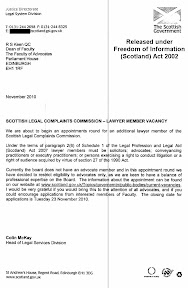
Scottish Government officials were forced to write to Faculty of Advocates after no one came forward to join the SLCC’s board. According to papers released in response to a Freedom of Information request to the Office of the Commissioner for Public Appointments for Scotland (OCPAS), a recruitment panel chaired by Colin McKay, the Scottish Government’s Head of Legal Services Division, encountered difficulties in its stated mission to “identify specific advocates that they could approach” to fill the lawyer-only board appointment, forcing Mr McKay to write directly to the Dean of the Faculty of Advocates himself, Richard Keen QC “for his help in encouraging applications” to join the SLCC. However, it appears the Scottish Government’s plea to the Faculty fell on deaf ears, and not one Advocate came forward to join the frequent flyers from the legal profession who are already rooted on the SLCC’s board.

The lack of interest from advocates in joining the SLCC became such a humiliation, the Scottish Government were forced to ask for an exception to the code of public appointments. An email from the Scottish Government to OCPAS, obtained as a result of a Freedom of Information request read : “The panel interviewed the candidate and considered them suitable for appointment. The Lord President has now confirmed that he is content to accept the Panel’s assessment that the candidate is appointed.“We confirm that the current SLCC lawyer round resulted in there being a lack of choice to fill the lawyer member position on the Board. A low response was not unexpected as the applicants for this appointment must be a advocate practising in Scotland and therefore the pool of candidates is very small. The appointing Minister [Kenny MacAskill] was informed of the situation and gave his approval for the appointment round to continue. I therefore request an exception to the Code to allow us to proceed with the round on that basis.”

Humiliation for MacAskill as “no Ministerial choice being achieved” in SLCC’s lawyer-only board member recruitment process. The OCPAS assessor who sat in on the Scottish Government’s recruitment process reported to her superiors, stating : “This appointment was for a lawyer member with the person specification requiring applicants to be an Advocate practicing in Scotland. This appointment was part of an appointment round also appointing non lawyer members but it was able to proceed on a separate timetable resulting in a much shorter timescale being achieved. This was achieved primarily because of the limited field of potential applicants and the targeted advertising and short application form used.”

“Historically it has been difficult for the Commission to attract Advocates to these appointments. The targeted advertising and short application form may have contributed to the outcome of an appointable candidate being recommended albeit with no Ministerial choice being achieved.”

The Justice Secretary chose to omit any reference to the lack of interest in joining the SLCC, and simply, announced Mr O’Carroll’s appointment in a quietly issued press release, stating : “Mr O'Carroll has extensive and varied advocacy experience. His breadth of experience and professional standing will complement and strengthen the current Board. This appointment will run for five years from a date which has still to be confirmed but likely to be sometime around March. This post is part-time and attracts a remuneration of £212 per day for a time commitment of up to six days per month.”

A senior source within the Scottish Government’s Justice Department speaking earlier this week to Diary of Injustice said : “This has been a face saving exercise for the Justice Secretary. If Mr O’Carroll had not been parachuted into the appointments process, there would have been no takers for the poisoned chalice of a position on the board of the SLCC.”

SLCC jobsThe SLCC announced in November it was looking for four ‘Frequent Flyers” to join its board : High Salaries & little work as a sweetener. The latest recruitment round for adding four additional “frequent flyers” to the Scottish Legal Complaints Commission’s board, where expenses claims are lavish, and work is minimal, were split into three positions earmarked for ‘non-lawyers’ with “consumer backgrounds” and one lawyer member’ who was “required to be a practising advocate”. I reported on the recruitment announcement in an earlier article of November 2010, here : Quangocrats wanted : Scottish Legal Complaints Commission seek ‘non-lawyer’ board members with legal & ‘consumer’ backgrounds at £209+ a day

Solicitors were apparently excluded from the latest ‘lawyer-only’ board member position because the SLCC felt it looked like there were too many solicitors, former solicitors & even non-practicing solicitors on its board already, namely Professor Alan Paterson OBE, FRSE, David Smith, Margaret Scanlan OBE & David Chaplin.

It is also noteworthy that much of the SLCC’s current staff who actually handle the complaints work, migrated over from the Law Society of Scotland’s Client Relations Office, itself which has been the focus of well founded accusations of corrupt self-regulation of solicitors and regular cover ups to protect ‘crooked lawyers’ from complaints lodged by financially ruined clients.

It will be interesting to see exactly who qualifies for the SLCC’s three new ‘non-lawyer’ positions, as the current crop of ‘non-lawyer’ board members comprises two ex-senior Police Officers, a member of the Scottish Criminal Cases Review Commission and a Doctor with several other quango positions including one at the Accounts Commission for Scotland. More details on the SLCC’s board members and their numerous positions can be found in an earlier article, here : More ‘jobs for the boys’ than action on ‘crooked lawyers’ : What it takes to be a Board Member at the Scottish Legal Complaints Commission

A legal insider speaking to Diary of Injustice this morning indicated observers of the SLCC may not be in for too much of a surprise in who will be appointed by the Justice Secretary to the three ‘non-lawyer’ positions currently on offer at £209+ per day along with additional expenses, for as little as six days work per month and lasting five years.

It is also worth bearing in mind that work is not a problem at the SLCC, as there isn’t much to do, which I revealed last month, here : ‘One complaint upheld’, 928 more sent back to Law Society & £1.8million spare cash : Scottish Legal Complaints Commission's 2010 annual report

Margaret Scanlan - Called to the Bars - Sunday Mail  15 March 2009 emailThe new quangocrats will have a chance to work with existing SLCC Board members already featured in newspapers for being ‘on the razzle’. The recruitment advertisement from the Scottish Government stated : “The Scottish Legal Complaints Commission (SLCC) requires 3 non lawyer members to become part of their Board with effect from February 2011. The successful candidates will be appointed by Scottish Ministers in consultation with the Lord President of the Court of Session.As a non lawyer member you will have the ability to apply objective and impartial judgement to the resolution of disputes, have the ability to offer guidance on one or more of the following Commission activities: regulation, consumer rights, consumer advocacy, consumer needs and have the ability to contribute to an effective team.”

The Scottish Government issued a statement in response to queries from Diary of Injustice about the latest failed SLCC appointments round. Their spokesperson said : "Mr O'Carroll was appointed following an open and transparent recruitment process regulated by the Scottish Commissioner for Public Appointments."

The Scottish Legal Complaints Commission issued a brief statement, saying : “All Members of the SLCC Board are Ministerial public appointments and are made in accordance with the Office of the Commissioner for Public Appointments in Scotland’s Code of Practice.”

Neither the SLCC nor the Scottish Government commented on allegations Mr O’Carroll ‘was volunteered for the appointment’, or revelations not one Advocate applied for the position other than one of the Government’s own lawyers.

Given the Scottish Legal Complaints Commission has only upheld one single complaint against an unknown solicitor or law firm in the past three years, I doubt the level of work will be much of a problem for any of the new recruits to the SLCC’s Board. Readers can find out just how effective the SLCC has been since it came into being, in my coverage of its 2010 annual report, revealed last month, here : ‘One complaint upheld’, 928 more sent back to Law Society & £1.8million spare cash : Scottish Legal Complaints Commission's 2010 annual report

My earlier coverage of the Scottish Legal Complaints Commission and its much less than expected performance as a regulator of complaints against Scotland’s legal profession, can be read here : The Scottish Legal Complaints Commission – The story so far

Background to new ‘lawyer board member’ of the Scottish Legal Complaints Commission :

Maurice O'CarrollMaurice O’Carroll, appointed to the Scottish Legal Complaints Commission. Mr O'Carroll is a graduate of the University of Edinburgh who was admitted to the Faculty of Advocates in 1995. Prior to being called to the Bar Mr O'Carroll worked in Brussels for three years, initially with the European Commission and then with a commercial law firm specialising in international trade. Since 2002 he has been ad hoc Advocate Depute for the Crown Office and Standing Junior Counsel to the Scottish Government since 2003. He has a range of experience which includes planning inquiry work, public and administrative law, conducting employment tribunals and employment appeals tribunals, Inner House experience and providing opinions in relation to each of these areas.

Friday, March 20, 2009

McBride calls slopping out deal ‘legally dubious’ for prisoner’s human rights

Despite a deal being announced between Edinburgh & Westminster to close the time bar on prisoner’s ‘slopping out’ claims to one year, members of the legal profession are warning the deal could breach prisoner’s human rights, and may end up costing a few million pounds more to put right … (and so say a few lawyers miffed at not getting their hands on more taxpayers money – Ed)

The Scotsman reports :

Slopping-out: Bid to stop payouts 'will cost taxpayer even more'

Published Date: 20 March 2009
By David Maddox
Scottish Political Correspondent

ONE of Scotland's top QCs has warned that moves to prevent prisoners suing for having their human rights breached could end up costing taxpayers millions more.

The Scottish and UK governments yesterday announced they had reached an agreement to close a loophole in the Scotland Act to stop prisoners from claiming compensation for slopping out.

But Paul McBride, the vice-chairman of the Faculty of Advocates and a member of the Legal Aid Board, said the proposal to put in a one-year bar was "legally dubious".

The one-year bar, which exists south of the Border through the Human Rights Act, stops claims being made more than 12 months after the alleged human rights breach.

Scotland does not have this protection because it was left out of the Scotland Act 1998.

The proposal agreed by the administrations in Holyrood and Westminster would allow MSPs to amend the Scotland Act.

But Mr McBride said: "I think that is legally very dubious. You cannot just turn off somebody's human rights.

"We are talking here about four people being forced to share a cell designed for one and having no privacy to defecate.

"In my view, there will be challenges to this change, and this will cost the public purse even more in legal fees and legal aid.

They could have put in gold-plated toilets already for the money they have paid out."

A spokesman for the Scottish Government said there would be no proposed changes to the law unless the administration was confident about the legality.

Mr McBride also joined criticism of Alex Salmond after he stated during First Minister's Questions that his government would try to reclaim board and lodgings from compensated prisoners. It costs an estimated £40,000 a year to keep each prisoner locked up and compensation on slopping out has averaged £2,000.

"Again this is legally highly dubious," said Mr McBride. "Even if the Scottish Government succeeded in this claim, the tiny amount recovered would be dwarfed by the cost to the taxpayer for legal aid and the Scottish Government's own costs."

Another leading Scottish advocate, John Scott, chairman of the Howard League for Penal Reform in Scotland, said Mr Salmond "was failing to show sufficient leadership" on the issue and should explain why a prisoner would be singled out for board and lodgings because he had received compensation.

He said claims for board and lodgings only successfully applied to people who had been victims of miscarriages of justice, who had it deducted from their compensation.

He also raised concerns about the one-year bar, saying: "If it succeeds, it could block cases (that] are more deserving."

Saturday, March 14, 2009

Faculty of Advocates & Law Society fall out over poor regulation of solicitor advocates

The Dean of the Faculty of Advocates, Richard Keen QC, has called on the Law Society to better regulate solicitor advocates … but given the fact the Law Society couldn’t regulate a dead horse, or even the bones of a dead horse .. that's going to be an impossible task …

The Law Society's reply was to ask for a review by the Justice Secretary Kenny MacAskill ..

The Herald reports :

Law Society attacked over review request

Law Society attacked over review request
BRIAN DONNELLY March 13 2009

Scotland's legal elite have clashed publicly over plans to review the regulation of solicitor advocates after concerns about the system were raised by the country's second most senior judge.

The Dean of the Faculty of Advocates has called on the Law Society of Scotland to face up to its responsibility for regulating solicitor advocates.

The society this week wrote to the Scottish Government requesting an independent review of the system. The faculty believes the society should carry out its own overhaul.

Solicitor advocates are lawyers qualified to represent clients as an advocate in higher courts in England, Wales and in Scotland, the Supreme Court and High Court.

The Lord Justice Clerk, Lord Gill, expressed concern during a recent murder case about the regulation of the group of solicitors.

He found that some solicitors were failing to advise their clients, contrary to Law Society rules, that they have the right to be represented by an advocate, which may be in their best interests.

He added that some solicitor advocates were doing advocacy work beyond their competence and they had a lack of awareness of their professional duties.

He revealed some of the senior solicitors had accepted instructions from their own law firms without advising clients of the availability of counsel, and were "self-certifying" themselves as the lead solicitor in serious criminal cases.

Lord Justice Clerk said: "From the standpoint of the administration of justice the idea that any solicitor advocate can accept instructions, perhaps from his own employee, as leader in a serious trial regardless of his experience and skill, is matter for concern.

"The concept of seniority is in my view conducive to the interests of justice. It does not apply in the case of solicitor advocates ... in practice there is no concept of seniority other than for the purpose of charging fees."

The society asked Justice Secretary Kenny MacAskill to report back next year on an independent review of all aspects of the rights of audience in the Supreme Courts.

Richard Keen, QC, the Dean of the Faculty, said the society had abdicated its responsibility for regulation after Lord Gill "highlighted failures".

He said: "The Faculty had hoped for a constructive response from the Law Society of Scotland, which is the regulatory authority for solicitor advocates.

"It is not appropriate for the Law Society to kick this into the long grass by asking for an independent inquiry or investigation. If the Law Society is to prove itself the regulator it claims to be it should demonstrate that by regulating.

"There is no call and none certainly from the Lord Justice Clerk, for an investigation into rights of audience in general.

"What there obviously has been is a failure of regulation in respect of solicitor advocates, and the faculty hopes that this will be dealt with sooner rather than later.

"If the Law Society feels that as regulator it is not able to investigate and deal with that matter, no doubt another way can be found to do this on their behalf - although why the public purse should have to incur expense on something which the Law Society is already paid to do is not immediately obvious."

Lorna Jack, chief executive of the Law Society of Scotland, said: "We believe that after almost 20 years it is time for an independent, comprehensive review of rights of audience in the higher courts."

She added that the society has a "rigorous" regulatory system to ensure the public interest is protected and standards maintained.

Friday, March 13, 2009

Law Society calls MacAskill for review of rights of audience in Scotland

The Law Society of Scotland as we all know, doesn’t do anything which is not in its own benefit … and

The governing body of the legal profession which doesn’t even allow members a vote in what goes on at its Edinburgh headquarters, has now decided after the recent argument between the Society & the Faculty of Advocates over the regulation of solicitor advocates, that the best way forward is to call for a review of rights of audience, with the intention the Society carries out the review itself …

The Law Society release :

LAW SOCIETY COMMENTS ON CALL FOR REVIEW OF RIGHTS OF AUDIENCE IN SCOTLAND’S HIGH COURTS

Lorna Jack, chief executive of the Law Society, said:

“Following on from Lord Justice Clerk, Lord Gill’s call for a review, the Lord President Lord Hamilton had written to Kenny MacAskill, Cabinet Secretary for Justice, to add his support for a review and we are in favour of this. We believe that after almost 20 years it is time for an independent, comprehensive review of rights of audience in the higher courts.

“Qualified solicitor advocates were given rights of audience in the High Courts and Court of Session in 1990, with the first appearing in the higher courts in 1993, giving clients an extended choice of well trained, experienced and regulated legal professionals to represent them.

“The Society is the regulatory body for all solicitors. This includes solicitor advocates. All of our members are expected to adhere to the professional standards set out in law and the Society’s rules. The Society has a rigorous regulatory system in place to ensure that the public interest is protected and high standards are maintained.

“Solicitor advocates must also comply with Supreme Court Rules. These rules were first approved by the Lord President Lord Hope in 1992 and then in 2002 by Lord Roger when they were reissued.

“To date the Society has never had to prosecute a member for professional misconduct arising from them acting as a solicitor advocate.

“Any complaints about solicitor advocates should be made to the Scottish Legal Complaints Commission (SLCC). The SLCC would deal with any service complaints while issues of conduct would be passed by them to the Society.

Lorna Jack added: “We would welcome a wide ranging review and the opportunity for ongoing discussion of the various issues with the government and the Faculty. We are currently in a time of significant change and this is an important issue for the future of the legal profession.”

ENDS

FOR FURTHER INFORMATION: Please contact Val McEwan or Suzy Powell at the Society on 0131 226 8884 or 0131 476 8115. valeriemcewan@lawscot.org.uk / suzypowell@lawscot.org.uk

Saturday, February 07, 2009

Fraud claims against lawyers soar as Dean of Faculty spills the beans on mortgage fiddles in Scotland

Coming straight from the horses mouth, so to speak, the Dean of the Faculty of Advocates, Richard Keen QC, has let it be known that claims to the Master Policy and Guarantee Fund are rocketing over mortgage & buy-to-let frauds, where many Scots legal firms have seemingly faked securities for clients in order to obtain mortgages from banks ..

Some legal firms and solicitors seem to have faked up the paperwork for their own property deals too (we heard that – Ed)

Peter Cherbi’s “A Diary of Injustice in Scotland” reports more on the matter :

Dean of faculty hints at rising fraud claims against solicitors as 'Penman Levy' bites hard into Scots law firms


richard keen qcRichard Keen QC. Richard Keen QC, the Dean of the Faculty of Advocates, has admitted there will be a sharp rise in claims against solicitors, with both the Master Policy & Guarantee Fund being heavily affected as many of the dubious buy-to-let schemes, involving solicitors apparently faking up securities for clients, begin to be discovered.

Richard Keen QC said in “The Firm” article which you can read here : Reasons to be cheerful : “Are there any prospects for growth in the present environment? I would predict that over the next 12 months we are almost certainly going to see a substantial increase in the identification of loan fraud related to buy to let projects. I would not be at all surprised if this came to dominate claims on the Master Policy and the Guarantee Fund.”

Law Society of ScotlandLaw Society will face many claims against crooked lawyers. Prospects for growth, as the Dean himself indicates, seem to be a huge jump in fraud claims against the legal profession, with the Master Policy & Guarantee Fund both being put to the test as many banks and financial instructions discover that many ‘buy-to-let’ schemes have frankly, been nothing short of bare faced fraud, on the part of many clients and solicitors, hungry for fat profits on highly dubious deals, backed by faked up securities many of the Banks failed to accurately confirm supported the transactions taking place.

You can read more about the buy to let fraud here : Buy-to-let fraud hits thousands

Buy-to-let fraud has hit the property market and the legal profession many times before, and many will remember how some clients of the defunct law firm Scott Moncrieff & Dove Lockhart (known for their jailed solicitor partner John McCabe where £4 million disappeared), were apparently also engaged with some of the solicitors in ‘buy-to-let’ fraud schemes, in which several Scottish banks lost a great deal of money.

Scotsman coverage of some of the stories relating to Andrew PenmanLessons to be learned – The ‘Penman Levy’ ends up costing Scots lawyers & legal firms dear. The growth in ‘buy to let fraud’ & claims against crooked lawyers is not the only growth area in the legal system these days .. as solicitors in Scotland must also now fork out a huge annual complaints levy, dubbed by some senior lawyers as the "Penman Levy", in reference to the multitude of 'crooked lawyer' scandals reported in the media after my own personal battle with the legal profession, which involved the Law Society's determination to defy prosecution in the case of crooked Borders lawyer Andrew Penman.

You can read more about the Scotsman’s reporting of the Andrew Penman case, here : Andrew Penman of Stormonth Darling Solicitors, Kelso -The Scotsman stories

However, while each Scottish solicitor was forced this year to pay an average of £400 each to fund the “Penman Levy" to run the Scottish Legal Complaints Commission, amounting to a whopping £2.4 million, it seems some solicitors have decided to recoup their ‘Penman Levy’ costs by fiddling their fee demands to clients, as many Scots are about to find out, if they are expecting a bill from their lawyer.

In a recent survey of 20 contacts throughout Scotland who have received demands from their solicitors for payment of fees, every single bill was found to be well far of the 'cost estimate' originally provided by the solicitor to the particular client, and it is also worth noting that in each case, where timescales for a resolution to the client's problem had been given, not one single case out of the 20 clients concerned, had progressed to a solution.

In one case, involving a boundary dispute with a neighbour, the client, of a famous Edinburgh legal firm, was told in 2005, it would cost in the region of £2,000 to study the papers, seek Counsel's opinion, and bring the case to court.

However, last week the client received a demand for an additional second Counsel's opinion, which came to £2,105.55 pounds alone, which the client was not informed had even been given in 2008. When the client asked to see the actual opinion, his request was refused, with a letter arriving two days later demanding full payment of the £2,105.55 otherwise immediate steps would be taken to recover the funds.

After a little checking by the client, directly with the Advocate, it has been discovered the QC who was supposed to have given Counsel's opinion on the boundary dispute, had never actually undertaken the work, nor even given the first Counsel's opinion the solicitor had charged his client £1520, during 2007.

Obviously in this case, a significant fraud has taken place against the client, by one of Edinburgh's 'most respected legal firms', and this particular case will no doubt generate another complaint against a 'crooked lawyer' to add to the thousands of complaints filed each year by clients against their solicitors in Scotland.

SLCC squareSLCC wont investigate cases before late 2008. However the ‘do-nothing’ Scottish Legal Complaints Commission will not even investigate this complaint or any matter arising from the case, as the SLCC conveniently decided it would not examine any complaints connected with legal work instructed prior to 1st October 2008, when the Commission began operation.

Studying the raft of solicitors bills recently sent out to clients, there does appear to be an increasing trend by Scots legal firms, desperate for any income they can get, to provide false accounts to clients, for cases which partners have taken on but have never seriously pursued as per agreements reached with clients to represent their legal interests.

The only advice I can offer for now is : If you have currently engaged a solicitor in any way whatsoever, you must carefully scrutinise your solicitors fee demands and bills, because the likelihood is, their fee demands are inaccurate and unjustified.

In another case, a family who were due to receive property as part of their deceased father's estate in the Scottish Borders, were forced to wait three years, before being told there was no assets left in the estate and they must put in money to pay a whopping £5,300 bill for legal services, undertaken by a notorious firm of solicitors based in the Scottish Borders.

In yet another instance, a client was recently sent a bill for £3,520 by a Glasgow law firm, despite the fact he actually settled the case with his neighbour over a land dispute in 2007. The recent fee demand was accompanied by a 7 day threat of court action if no payment was received, apparently being sent on the basis "the account had been misfiled and never sent out" - this despite the fact the client retained his fee payments and took his client file from his solicitor's office in 2007 after settling the case, and settling all fees due which totalled £1,477 at the time.

Many of the other cases brought to my attention of inflated accounts & demands from solicitors involve case work such as, land purchases or sales gone wrong, divorces, custody cases, boundary disputes, failures in executry work, false QC's opinions, backdated or allegedly misfiled accounts, fictitious work undertaken on cases which have no hope of reaching a settlement.

A paralegal I know who recently was sacked along with several other staff from her struggling legal firm, described the client billing situation in the Scots legal profession as "fraudulent at best", and went on to claim "at the moment its pandemonium in many legal firms I know of, where friends and paralegals I know personally have been asked to type up bills for clients which they know themselves are fictitious as the work has never been done".

"I remember a few weeks ago there was a client telephoned to speak to the senior partner over the size of his bill and the fact it was nearly £6,000 over the estimate initially provided. The senior partner told me he didn't want to speak to the client under any circumstances, and I was to call the Police if the client made any hint he would not pay or insulted any members of staff on the telephone".

"I know for a fact that client's case is a mess and twice the solicitor took the matter into court just to have the case adjourned so he could get more fees out of the client for doing nothing”

“The case, which involved a neighbour who had built on their land, has left the client with a property they cant sell. Probably the mess will be left for someone else to clean up if they can get another solicitor to look at it which I honestly don't think will happen after the mess my former employers made of their case."

So the lesson for anyone of you who has received or is about to receive a bill from their solicitor, is to check it out thoroughly, because the chances are, there is a lot of false work added to that account, which you either never authorised, or were never told would be required.

I suppose the other lesson, perhaps this time for solicitors is – speak out against the bad apples in the profession, because in the long run it will be a lot cheaper for you, generate much more respect, and probably bring in business & clients who for now, doubt your honesty and ability as a profession to regulate yourselves.

Oh, by the way, (I have to ask) how do solicitors really feel about having to pay out £400 a year to fund the SLCC, simply because the Law Society decided to fiddle the case against Andrew Penman, the Scotsman’s reporting of which brought about many hundreds more scandals involving crooked lawyers reported in the Scottish media to this day ?

Read on for some more examples of sleazy solicitors from Scotland’s legal profession (from the Scotsman) :

Sleazy side of legal profession

""We must ensure those with the highest standards are protected from the dishonest few" - leslie cumming

By GINA DAVIDSON

AS Leslie Cumming lay bleeding outside his Murrayfield home, the victim of a frenzied stabbing, his cool legal brain was probably already clicking into gear.

While his body fought to stem the flow of blood from a dozen wounds, his mind was whirring through the possibilities of who would have wanted to attack him. It wasn't long before the top law official was able, from his hospital bed, to give Lothian and Borders Police a rundown of lawyers he is and has investigated for suspected money laundering.

Now, two lawyers are to be interviewed by detectives in connection with the attack on the 62-year-old, while police also sift through all the Law Society files that are the work of months of painstaking investigation by chief accountant Cumming and his 12-strong team.

Yet while the attack on Cumming saw the reality of violent crime intrude into his highly regulated world of balance sheets and law books, it has also focused the public interest on corrupt lawyers. Ever since he was appointed chief accountant of the Law Society of Scotland back in 1984, Cumming has taken it upon himself to weed out rogue or "bent" lawyers throughout the country.

Back in the early 1990s, he ensured the Law Society took a hard-line stance against crooked lawyers who embezzled clients' money, changing the five-year inspection of firms' books to two years. The move came after lawyer John McCabe, who had worked for Edinburgh firm Scott Moncrieff & Dove Lockhart, was jailed for ten years for defrauding his clients out of more than £4 million.

More than two years ago the Law Society - which represents more than 8000 lawyers - along with the National Criminal Intelligence Service held a series of seminars aimed at raising awareness about the ways criminals might try to exchange stolen for clean money.

That was when the Proceeds of Crime Act became law, making it illegal for professionals to handle criminals' money without asking questions. As a further safety measure, he also oversaw the introduction of regulations which mean every firm must submit a financial certificate every six months to the Law Society, providing financial information about the firm and confirming compliance with accountancy rules.

Such scrutiny was bound to make him some enemies. Yet Cumming has always maintained that solicitors in Scotland are in the majority honest, with just a few spoiling the reputation of the profession. He has said: "Our system relies on the near 100 per cent honesty of the profession which is what we find time after time.

"It is our duty to the profession and their clients to ensure that those who maintain the highest standards and their clients are protected from the actions of the few who act dishonestly."

Sources in the legal profession claim there are currently 19 lawyers on petition charges - which means they've committed an offence which could mean a minimum sentence of more than five years in jail - although a spokesman for the Crown Office says they have no way of confirming the number as they don't list occupations.

Legal sources also suggest that, despite the Proceeds of Crime Act which could see lawyers face up to 14 years in prison for turning a blind eye to money laundering, there are still those who believe the rewards are worth the risk.

"It all depends on how well your practice is doing, that seems to be the excuse when people are struck off," says one Edinburgh lawyer. "That if business isn't going so well, and they have clients who have money to 'invest' in property, then it becomes an option. But lawyers know the risks. If a client comes in with £100,000 in cash and says he wants to buy something, be it property or shares, bells should be ringing.

"If a lawyer doesn't do the necessary checks, ask the necessary questions and then gets found out to be dealing with dirty money, then they go to jail, it's as simple as that. Most would think it isn't worth the risk, but there will always be those who are blinded by the cash."

Another adds: "The change in the law has been onerous for solicitors. It means that when a new client comes through the door we have to ask for passports, driving licences, utility bills . . . it's a bureaucratic nightmare.

"If there's any reason to suspect the client of trying to pass off stolen money you have to report them to NCIS in England. The solicitors are being asked to police clients rather than the police, and if we get it wrong we go to jail."

Another city solicitor says: "Embezzling has been seen as a way out of trouble for some lawyers in the past, but these days firms' books are gone through with a fine-tooth comb every two years. The accountants at the Law Society know exactly what to look for, so there's no hiding any dodgy practices."

However, despite all the checks and balances, one case which slipped Cumming's net for a decade, until just two years ago, was that of former solicitor John Kennedy Forster. A partner at Stranraer-based solicitors Ferguson & Forster, MacFie & Alexander, he admitted 35 charges of embezzling £667,000 from his clients to pay for school fees, his large home with outdoor swimming pool and foreign holidays.

His sentencing was deferred several times at the High Court in Edinburgh, to allow for compensation proceedings to be resolved and for a report to be submitted by forensic accountants. Finally though on March 18, 2004, he was jailed for six and a half years.

According to Cumming, the case took so long because it "involved a uniquely complex system with the evidence well hidden".

He added: "But as with all cases, once the cracks appeared layer after layer of the fraud was exposed and produced the evidence which we needed and which the Crown then used.

"Most successful frauds involve several strands and depend on a position of particular power or influence. The hardest to uncover are those where there's an element of complicity. It's a constant challenge and each time we find a scheme we ensure that all our inspection teams know about the mechanisms and how it worked so that they can recognise the signs in the future."

Police sources here in Edinburgh believe there are few, if any, corrupt lawyers working in the Capital, and that the Law Society's checks are currently adequate for preventing illegal financial activities, although they admit there will be those who don't get caught quickly enough.

One says: "I've seen a few dodgy lawyers in my time, but not on the financial front.

"There's more organised crime in Glasgow than Edinburgh but then the property market here is much more expensive and so that maybe proves the attraction. But I do think that there's only a few corrupt lawyers in Scotland - although they can be damaging to the whole of the profession."

But perhaps the most telling thing about crime among Scotland's lawyers is that claims on the Law Society's Guarantee Fund - a fund which compensates clients who have suffered loss as a result of a solicitor's dishonesty, and which is paid into by partners in law firms - have steadily fallen under Cumming's tenure.

Each partner pays around £200 a year into the fund, which is in excess of £1 million. For the year 2003-2004, the last year for which figures are available, the total paid out was £187,000, whereas when the fund was first established in the early 1990s, the compensation payouts were as high as £1.35m.

LOWERING THE BAR: CROOKS WHO MAKE UP LAW'S LIST OF SHAME

1991: Edinburgh lawyer John McCabe was jailed for ten years after admitting 34 charges of fraud totalling more than £4 million. He conned banks and building societies into handing over loans of up to £500,000 and ploughed the money into disastrous business ventures. He fled to South America, leaving a taped confession, but returned within a few days and was arrested at Heathrow Airport.

1996: A five-year sentence was handed to David Hoey, a lawyer from Leven, after he was found guilty at the High Court in Edinburgh of stealing more than £500,000 from elderly clients. He had already been struck off when the offence came to light.

1996: After a probe into his firm's financial affairs, Donald Pirie was struck off. A police investigation found that the Cowdenbeath-based lawyer, who lived in East Linton, had embezzled £63,000 from clients, including £40,000 from his parents. He was jailed for five and a half years.

1997: Stephen Crilley pocketed £45,000 in fees due to his firm because he believed he was underpaid. He was a partner with Grant & Wyllie until resigning in 1996 and was struck off the following year. He avoided going to prison by repaying the money.

1997: Pat Elliot was jailed for 18 months after she was found guilty of stealing £60,000 that was destined for two charities from a client's will. Elliot, of Crown Terrace, Glasgow, was also struck off.

1998: Alexandra MacRae, a lawyer who underwent a sex-change operation and was previously known as Steven Raw, admitted to embezzling more than £16,000 from a client's account in order to pay her Dundee firm's debts. She was struck off before later being sentenced to 15 months. However, she appeared in court again in 2001 and was sentenced to three years for embezzling almost £100,000 from an elderly client while she had worked as a lawyer.

2000: William Stevens of Saughtonhall Drive was jailed for four years at the High Court in Edinburgh for embezzling cash from elderly clients to pay for school fees. He was also struck off, although had resigned as a partner with firm Bennett and Robertson in 1997.

2001: Alistair Liddle prompted a police hunt in 1997 after vanishing, leaving his family in Forres, just as the Law Society was to investigate his firm. He was struck off in 1999 and traced to Cornwall in 2001, where he admitted embezzling £17,875 from a client's account. He was jailed for a year.

2001: Solictor Bruce Gordon of Piersfield Terrace in Edinburgh was struck off after being found guilty of professional misconduct for embezzling £55,000 from a dead man's estate. He was jailed for a year.

2003: Alastair Hall, a former partner of A&R Robertson and Black in Blairgowrie, was jailed for 11 years after stealing £500,000 from clients. He admitted five charges of embezzlement, two of fraud and a bankruptcy offence.

2004:Edinburgh lawyer Ricky McAnulty was jailed after admitting embezzling almost £20,000 from the accounts of five clients. He was struck off and sentenced to 18 months in Saughton.

2004: Douglas Criggie, who owned Cumberland Street firm Criggie & Co, was charged with embezzling £50,000 from clients. But his firm was sequestrated after it was discovered he had unpaid loans and bills totalling £300,000 and he went bankrupt. He was struck off by the Law Society in May 2004 and the Crown Office is still considering prosecution.

2005: Glasgow lawyer Calum Blyth was jailed for two years after being found guilty of embezzling £108,000 from his clients and obtaining a further £27,000 by fraud while working for Blyth Solicitors between 1996 and 1999
Sunday, February 01, 2009

Dean of Faculty wants Scotland’s class action restrictions removed to sue Banks

Richard Keen QC, the current Dean of the Faculty of Advocates, has come out in favour of scrapping Scotland’s infamous restrictions on Class Action lawsuits.

The Dean, however, only seems to feel Class Actions should be allowed against Banks & financial institutions … which seems to indicate the cosy relationship between the legal profession and the Banking sector has hit the rocks … no more cheap finance lads ? – Ed

We noticed an interesting version of the Class Actions story over on Peter Cherbi’s “A Diary of Injustice in Scotland” here : Dean of Faculty calls for class actions against banks as Scots legal profession turns against financial sector

The Scotsman reports :

QC: Allow class actions against banks

Published Date: 26 January 2009
By Jane Bradley and John Forsyth

ONE of Scotland's most senior lawyers is calling for ministers to scrap the restriction banning class actions in Scots law, a move that could see a wave of claims against banks.

The suggestion by Richard Keen, QC, the dean of the Faculty of Advocates, would open up the prospect of challenges by groups of shareholders against financial institutions over a lack of information about the state of their business.

It is understood that Scotland's legal profession believes there could be a raft of actions against Royal Bank of Scotland and other financial institutions on the basis that the information given out at the time of rights issues had been inadequate.

Mr Keen said: "The absence of class action certification inhibits pursuit of remedy. It is difficult to fund major litigation of that kind unless you can put together a class action."

Mr Keen's comments follow a string of calls from politicians demanding legal and political action to tackle the crisis – with RBS most in the firing line. Alex Salmond, the First Minister, said yesterday that he believed a parliamentary inquiry should be carried out into the banking crisis in Scotland.

He said any investigation should cover the Financial Services Authority and the role of politicians in overseeing the administration of the financial sector "to ask them why they were asleep on the job".

He said: "I'd rather favour a parliamentary investigation, not just into the Royal Bank of Scotland – that would be daft, as the Royal Bank of Scotland is only one of hundreds of banks worldwide which has got into serious trouble – but into the financial sector."

It emerged at the weekend that Christine Grahame, an SNP MSP, has written to Lothian and Borders Police, demanding that an investigation be carried out into RBS's conduct over its two rights issues last year, while Tavish Scott, MSP, the leader of the Scottish Liberal Democrats, has called for an investigation by the Serious Fraud Office.

Under the leadership of Sir Fred Goodwin, RBS carried out its first £12 billion rights issue in April last year, when thousands of investors forked out £2 a share for a tranche of new stock in the firm. A second rights issue, in November, was shunned by investors and the government had to underwrite the £15 billion issue. RBS's fortunes have nosedived in recent months, with investors watching shares plummet, to close at 12.1p on Friday.

Mrs Grahame's letter told police she believed RBS "appeared to have committed a fraud".

RBS revealed last week it was on course for the biggest loss in UK corporate history, as it expected to write down as much as £20 billion on the falling value of its assets.

Mr Scott said: "I think the banks across the UK must have known what their financial position was much earlier than they were letting on, and that particularly applies to RBS.

"At the time they were asking investors for more money to help their financial position, as RBS giving a full picture of how strong or weak they were as a financial institution? I genuinely don't know, but I believe that the Serious Fraud Office should have a look at it."

He warned that a political inquiry could turn the crisis into a partisan issue and could detract from solving the question of whether investors were misled.

Just last week, the veteran lawyer Ian Hamilton lodged a small-claims action against RBS, saying he had been persuaded to buy 640 shares at the £2 offer price in its 2008 rights issue.

A spokeswoman for RBS refused to comment.

Monday, June 30, 2008

Claim for anything, as long as its not against a lawyer !

Reminding us all we can lodge claims for just about anything, as long as its not a claim of negligence against a member of the legal profession - or any other friendly profession to lawyers who happen to be insured by the same insurers !

The Scotsman reports :

Don't forget that the repeat players have a massive advantage

By Brian Fitzpatrick

IN THE early 1970s, US legal theorist Marc Galanter published Why the "Haves" Come Out Ahead.

Nowadays, his central thesis might seem obvious and his characterisations a bit simplistic. He says the world of litigation is made up of "one-shotters" and "repeat players". One shotters are the majority of ordinary citizens who rarely find themselves in a court case – perhaps a divorce or custody battle or suing after an accident.

Repeat players are those involved "in many similar litigations over time". Examples would be the prosecution service, insurance companies, commercial lenders and landlords.

One-shotters are generally individuals, have few resources and are litigating for immediate one-off outcomes. Repeat players tend to be relatively wealthy in scale and resources, and often "pursue long-run interests".

As seasoned litigators with deep wallets, repeat players enjoy what Galanter calls "advance intelligence" from going through similar litigations.

Professionals rather than enthusiastic amateurs, they can "structure the next transaction and build a record. It is the repeat player who writes the form contract, requires the security deposit, and the like".

As we look on at the behaviour of banks and finance houses who created the credit crisis and yet devolve its results on to more onerous and expensive obligations for individual customers Galanter's observations take on a current-day significance.

Northern Rock, amid all its problems, has little difficulty in repossessing homes at a rate outstripping its competitors and with much more chance of success than the debtor in financial straits, trying to keep a roof over his family's head.

The war-chest of experience built up by repeat players finds arms in expertise aided by an ability to access specialist lawyers and paid experts who service litigation.

The small-firm lawyer seeking to secure a report from a medico-legal expert might have to wait a while – the insurer who pays by return or instructs reports by the hundreds can secure a report in days.

The repeat player makes sure to secure the services of the highly expert major law firms. In turn those firms can access even more expert practitioners at the Bar while increasingly acting as vocal lobbyists for the interests of their clients, even if losing the odd individual case. The repeat player can bear the cost of losing cases far better than any individual. So, when negotiating, it can apply pressure the one-shotter might find irresistible.

If you are a spinally injured car accident victim with a claim of £2.5 million, a "final offer"of £2 million will make you think long and hard. The UK insurance industry, through huge investment in its case management system, knows better than any judge and most claimant lawyers just how much money is needed to see off a troubling claim.

It is not all one-sided. Here in Scotland expert claimant lawyers have, to some considerable extent, evened up the field. Asbestosis, deafness, white finger and other mass litigations would never have secured the sums achieved for thousands had there not been trade union-backed law firms trading blows with insurers.

Legal aid has also provided some measure of antidote, though, nowadays, with a legal aid certificate being somewhat more rare than the proverbial unicorn it represents more a case of providing some bandaging rather than proper even-handed access to justice.

The various equalities bodies have taken up cases and advanced the rights of women and ethnic minorities but with very straitened resources. Making sure that ordinary citizens can secure access, not just to the courts but to expert lawyers has to be at the heart of any debate on the future of our legal system.

Speaking recently in Edinburgh, Lord Rodger reminded lawyers that achieving justice between the parties "not just a result" was what our civil justice system should be about. As we discuss the next phase of Lord Gill's review of the courts we might bear in mind Lord Rodger's concerns that, when considering proposals to divert personal injury cases to the Sheriff Courts, account has to be taken of the potential of diverting work from a globally recognised centre of expertise. Gallanter would have smiled.

• Brian Fitzpatrick is an advocate in the Ampersand stable

Saturday, April 26, 2008

Advocates bolt from the stables to claim better service as clients cite worst legal service in living memory

Never too late for a quick advertisement to promote legal services in Scotland these days ... oh you need a lawyer for that fall in the supermarket so you better get one quickly .. but despite recent 'improvements' in legal services offerings - as claimed by the legal profession itself, clients are coming to terms with the worst level of legal services in Scotland ever ...

A solicitor who recently contacted us at SLR with a file on how poorly an advocate represented his client claimed the Faculty's spin on new services and competence from Scotland's advocates masks the dire performance many have given clients in Court proceedings ...

Come to Scotland and don't advance your legal business ? Surely not a good advertisement for justice ...

The Scotsman reports :

New model army of advocates is making advances

By JENNIFER VEITCH

THE so-called 'devolution' of stables was the biggest shake-up at the Faculty of Advocates for a generation. But a year on, are these new chambers-style groups offering clients a better service – and will they help advocates compete with the oncoming march of the alternative business structure?

Axiom Advocates, one of the first and most high profile stables to 'devolve' from Faculty Services Limited, reports that its new approach, focusing on specialist areas of the law and selecting members on merit, has been a success so far.

David Johnston QC – one of 10 'silks' who have enabled Axiom to boast such heavyweight expertise in commercial and public law – says the group has been so busy it has had to turn some cases away.

He adds that it is too early to say whether the new model is more efficient or cost-effective, but he argues that the ability to specialise and to choose members has obvious advantages for clients.

"If you look back a year, we had all these stables, as some of them are still calling themselves, with members there as a matter of chance," he says. "In the old days, you routinely followed your devil master into the stable he or she was in. That ceased to be practical, and the stables didn't have any focus on particular subject areas.

"It's true that not all the stables specialise, and not all select their members in the way we do. But those are the two things that have made a real difference."

Johnston says the new model has allowed advocates to work more closely, for example by exchanging information on developments in the law and working together to deliver the Third Thursday series of monthly lectures. "The most obvious thing we had done is to set up these monthly events where we provide training for ourselves and others," he says. "On a more internal level, we do have practice groups with members who try to keep up to date in particular areas. These things would have been possible in the past, but never happened."

The faculty shake-up has enabled advocates to work together as closely as possible while remaining within the rules that prevent members from entering into partnership, he adds.

"I do see our function as being more as members of a team," he says. "In the old days, the notion was that the Bar was a bunch of individuals competing against each other.

"Of course, that has not disappeared. But what we have been trying to do is create more of a team mentality, and some of our members do work together on cases for particular clients."

Axiom has also taken on board feedback from clients about giving clearer information about levels of service and fees, he adds, and members are well aware of the competition from other stables, solicitor advocates and even the English Bar.

"We set off at the outset asking, 'how can we improve the quality of service?' We homed in on the fact that often clients would like much more information," he says. "Routinely, our clients enter into fee arrangements so there are no unpleasant surprises.

"We need to constantly be aware that it is a very competitive marketplace, and we need to make sure that the services we offer are excellent."

While Johnston says Axiom has had a busy first year, there seems little room for complacency as an already competitive marketplace looks set to become even more challenging.

A few days ago, the Law Society confirmed it would support the introduction of alternative business structures – subject to the approval of members at its AGM next month, and provided there is appropriate regulation.

However, Johnston is not keen to see the faculty relax its rules on partnership at the Bar, and he wants advocates to remain independent practitioners.

"It does seem to me that there will always be room for an independent referral bar – clearly the moment we end up with partnership of advocates we are faced with conflicts of interest. So it seems to me pretty clear, in a small jurisdiction like this, that it would lead to more restriction on access to legal representation if we were split into a few partnerships.

"We recognise that there are these pressures – the only way that we can reasonably expect people to refer is because we have shown we have the experience to do that business."

There are other advantages to working independently, he adds, as the fact that Axiom's members are not partners means that opposing parties are still free to instruct counsel from the same group of advocates.

"We very often appear against one another – it's just one of those aspects of life at the Bar," he says. "I don't think it has become any more difficult for us."

The advocates' business model also means they are better suited than solicitors to allow counsel to act for and against the same party in different cases, he says.

"In a way, that is one of the curiosities of the bar. Unlike solicitors, who may have a working relationship with a client, it's recognised that we may sometimes act for one client and then another."

But, in the light of increased competition from solicitor advocates and the very real prospect of alternative business structures, Johnston says advocates should be shouting louder about the benefits of using their services. And he sees direct access as their best chance of countering the competition.

"The faculty rules on direct access were relaxed last year and it might be fair to say that there is scope to try to develop that," he says.

"Unless one goes out and explains to the professionals involved that they are able to instruct us, then it has probably passed them by. We need to make it clear that we are there to provide a service and that they can do that without necessarily involving a solicitor. There is a huge potential in the direct access market."

And Johnston adds that increasing specialisation will be needed if advocates are to remain competitive.

"Solicitors are not generalists to any extent, so it does not seem to make much sense to be able to claim to do everything either," he says. "We need not just an understanding of legal reasoning, but there is a lot of law as well.

"I think that's what makes us different from what went before. That's why we are able to make the claims for quality that we do make, and that is also what equips us to compete in a competitive environment."

Monday, February 25, 2008

Law should serve society - why doesn't it with all these lawyers ?

For those of you who wish to believe the law serves society, here is a piece from the Scotsman.

For most, the reality is that the law serves itself, and not the society it is written to serve ...

The Scotsman reports :

Public law must serve our society

Public law must serve our society

By GERRY MOYNIHAN QC

SCOTLAND has a vibrant public law, which is undergoing rapid change through a number of influences unique to our country – change to which practitioners can contribute if they recognise the full scope for innovation that these influences present.

The first stimulus was the introduction of the procedure of Judicial Review, but that was a case of the tail wagging the dog – a change in procedure influencing the development of substantive law.

Nonetheless, it has opened the courts to participation in the principled development of public law that arrived with the New Labour agenda of constitutional reform in the shape of the Scotland Act 1998, the Human Rights Act 1998 and the Freedom of Information (Scotland) Act 2002. Their interaction has given potential for a peculiarly Scots dimension to public law.

The essence of the constitutional change effected by the Scotland Act is that it brings more of a legal content to the control of legislative and executive power in Scotland.

Subject to the exception of EU Law, English law remains grounded in the principle of parliamentary (that is, Westminster) sovereignty. Scotland is different because the Scottish Parliament is not sovereign and it is expressly provided by the Scotland Act that an Act of the Scottish Parliament "is not law so far as any provision of the Act is outside the legislative competence of the parliament", which embraces any incompatibility with the European Convention on Human Rights (ECHR).

Courts can accordingly go beyond the political act of issuing an advisory opinion that legislation is incompatible with the convention (which is all that English courts can do relative to Westminster legislation), right up to the ultimate legal remedy of quashing legislation enacted by the Scottish Parliament.

In Scotland, this fundamental shift from the supremacy of legislation goes further and affects even the implementation of Westminster legislation. The Scottish Government does not have the power to infringe human rights, irrespective of whether the infringement is based on Holyrood or Westminster legislation.

These arrangements are not, however, undemocratic, because the rule of law does not mean rule by lawyers. In the litigation concerning the validity of the ban on fox-hunting, the courts did not ask whether the ban was a good or a bad idea.

Rather, the courts scrutinised whether, in enacting the ban, the Scottish Parliament took proper account of the human rights involved and struck a fair balance between the rights of the individuals who participate in hunting and the interests of the community. To date the ban has been upheld by the courts on the view that a fair balance was struck by the democratically elected legislature whose task it is to resolve controversial questions.

The need for a fair balance between the rights of the individual and the needs of the community runs through the ECHR and now lies at the heart of Scots public law.

There has been a suspicion in some quarters that Scottish judges went too far in deciding that a person charged with a criminal offence should be automatically acquitted in the event of an unreasonable delay in being brought to trial. That result seemed to give undue precedence to the rights of accused persons over the rights of victims of crime and the general public, who under the convention are entitled to the protection of an effective criminal justice system.

That imbalance has now been corrected by the Privy Council, which recently decided that an unreasonable delay does not necessarily require an acquittal.

The objective of an efficient public law is that public authorities should be regulated in their conduct of public affairs. Freedom of information makes a valuable contribution to the attainment of this objective because unless there is openness in decision-making it is all but impossible to scrutinise whether any public body has proper reasons for the decisions taken.

Freedom of information gives the public access to background papers shedding light on the factors that have in fact been taken into account and the weight attached to them, facilitating challenge to unlawful, arbitrary decisions.

We are at the start of a dynamic process that could lead to a distinctive public law built on a fusion of the new constitutional arrangements for Scotland, human rights and freedom of information.

The task we have is to formulate a constructive public law that is responsive to the key objective of producing a tolerant and broad-minded society which is respectful of the rights of the individual while attending to the needs of society as a whole.

• Gerry Moynihan QC is a member of Axiom Advocates. He gave last week's Third Thursday Lecture on public law.

Tuesday, February 05, 2008

Richard Keen QC, new Dean of Faculty of Advocates outlines policy to protect monopoly on legal services

Richard Keen QC, the new Dean of the Faculty of Advocates, outlines his views on what policies he would like to dictate implement, and how the Faculty will tackle such issues as access to legal services - which the new Dean definitely wants to retain as a monopoly rather than allowing anyone else in.

Peter Cherbi reports on the issue from his blog A Diary of Injustice in Scotland and reminds us of some of Mr Keen's other achievements regarding access to legal services ...

QC who fought to prevent FOI revelations on access to justice reveals 'little change' plans as Dean of Faculty

No change is good for the legal profession as many within it's senior ranks would agree.

Keeping complaints in-house, preventing independent scrutiny of solicitors activities, keeping 'meddling' politicians & critics out of the debate on legal issues have long been and still are some of the top priorities of the Scottish legal profession - so change at the top usually means little.

Little it certainly is, as the new Dean of Faculty, Richard Keen QC, discusses his plans for the Faculty of Advocates in the Scotsman this week, which literally amount to window dressing, with the odd repair of a broken window thrown in for good measure.

Mr Keen, who is widely known for a costly battle at the taxpayer's expense to prevent the release of a Freedom of Information request on why Sections 25-29 of the Law Reform (Miscellaneous Provisions) (Scotland) Act 1990 were kept off the legislative books for some seventeen years, brings little change of benefit to the public in his new role as Dean of Faculty, but that is to be expected, as the position of Dean of the Faculty of Advocates has little responsibility or regard for the masses of Scots denied access to justice on a daily basis - more, his thoughts wander back to maintaining a closed shop of legal services, preferring the position of the legal profession dictating who among us has access to legal services, and who gets to take the more usual 'justice denied' route, after throwing as much money at their legal agents of course ...

You can read more about my earlier coverage of the FOI court battle between the previous Scottish Executive, here :

Scottish Executive fails to block FOI disclosure on records of restricted access to Courts

Scottish Executive drops FOI disclosure battle over restrictive access to Courts while thousands go without representation

In a quote from the Scotsman article, which typifies the "Douglas Mill" doctrine of 'lets keep control over access to justice for lawyers so we make the money and control legal services as a monopoly', Mr Keen puts forward the tried & tested ideas of protection of monopoly :

"Proposals for reform that may seem attractive for a very large jurisdiction may, if unthinkingly applied in Scotland, be extremely destructive," he says. "I think we are entitled to contemplate solutions that are tailor-made to our jurisdiction and are not simply a pass-on, for example, from England. This is where I have to say I have some reservations about the OFT's approach, which has a slight hint of 'one size fits all' about it."

Simply, the Scottish legal profession does not want to lose its monopoly on the legal services market - after all, that's what the seventeen year campaign to keep Sections 25-29 of the 1990 Law Reform Act off the books was all about, where plans to allow anyone attaining a certain level of standards & qualifications to enter the legal services market frightened the Scottish legal profession so much, they ensured the relevant parts of law never became legislation until March 2007.

Further revelations in the bitterly fought court battle to keep the public from knowing why those laws were never enacted saw an exchange of letters between the then Lord Advocate Lord Hardie and civil servants where Lord Hardie's ideas to repeal the 1990 laws to reform access to legal services were discussed, with intent to keep anyone who needed to use legal services in the firm grip of the legal profession itself.

Another sad fact of the current changes in the legal profession is the Justice Secretary simply does not give a damn about the public interest, preferring blatantly, to support the legal profession directly against the public at each turn as policy after policy comes & goes, leaving the Scots public out in the cold while the legal profession and a few at the top of the Law Society get to fatten their wallets even more at your expense.

Again, from the Scotsman article :

"From only a few meetings with the minister and his officials, I have come away with the clear impression they want to see change within the legal profession in Scotland, but not regulation for the sake of it," he says.

"What they want to see is innovation and they want it to come from the legal profession itself – they don't want to impose it. They want to see a distinct legal profession that supports a distinct legal system and that is capable of making Scotland an attractive place to come and do business, in the sense of a place where people will want to employ legal services for dispute resolution, commercial litigation, judicial
review."


Amazing stuff, but who would want to use legal services in Scotland in the dangerous unreliable, untrustworthy state they are in ?

Why on earth would anyone consider Scotland an attractive place to come and do legal business with the same legal services which have ripped off the public and corporations alike to the tune of tens of millions of pounds a year, and get away with it ? Why would an international company wish to employ firms of Scots lawyers only to be let down in badly worded contracts, failed & costly litigation which never had a chance of success in the first place, and a general attitude within Scots legal firms to pass over the intentions of a few corporate clients to other companies for a slice of the action to the legal firm itself - yes it does happen ...

So, no change at the Faculty then which benefits the public in any way whatsoever, and little regard at the Justice Department for anything which does not support the demands of the legal profession to do as it pleases ...

Oh, how Scotland needs a more impartial Justice Secretary, and soon ...

The Scotsman reports :

New Dean, new dawn

By JENNIFER VEITCH

AS ONE of the counsel at the inquest into the death of Diana, Princess of Wales, Richard Keen QC is undoubtedly embroiled in one of the highest-profile cases currently running in the courts. But, despite of spending four days a week in London representing the parents of Henri Paul, Dodi Al-Fayed's driver, Keen is still finding time to run affairs at the Scottish bar. And it seems members of the Faculty of Advocates should expect a new dawn under their new dean.

Keen is wasting little time in setting out his stall for some significant, and potentially controversial, changes at the bar. Top of his list is putting an end to the Faculty's rule against counsel teaming up with solicitor advocates to create so-called "mixed doubles".

Direct access to advocates will be also up for review and, in the wake of Mike Jones QC's recent move to become a solicitor, Keen also wants to make it easier for lawyers to move between the two branches of the profession, with a choice of business models. Keen is clear the Faculty must rely on promoting the expertise of its members and sweep away restrictions that critics complain give it an unfair advantage in the marketplace.

"I would like to see a situation in which there is effectively freedom of movement between the two branches of the legal profession, so that there is no insurmountable obstacle to a person moving from membership of the Faculty to membership of the solicitor branch of the profession and vice versa," he says. "For example, it will mean a QC can choose to be an independent self-employed practitioner within the Faculty business model, or he may choose to become a partner in a firm of solicitors, in which case he simply moves over to that business model without any real difficulty or any real barrier."

Keen says he has no problem with Jones's decision to leave the Bar to join solicitors' firm Simpson and Marwick.

"The simple fact is he is an extremely good example – here is a QC who was practising in the Faculty on Friday and is a QC practising as a partner with Simpson and Marwick on Monday. I don't have a problem with that.

"But why would you want him to be a QC as a member of Faculty and a QC as a partner with Simpson and Marwick? All that does is create conflicts of interest and raise issues about him having two sets of overheads and regulatory problems."

Such debates are set against a backdrop of likely reform of legal services in Scotland, with justice secretary Kenny MacAskill having challenged the profession to come up with its own solutions to the issues raised by the Office of Fair Trading (OFT) in its report on last year's Which? super-complaint. The biggest question surrounds the possible introduction of alternative business structures, such as multidisciplinary partnerships. Keen is concerned that importing Clementi-style reforms to a small jurisdiction would not be appropriate, but he does not see that Scotland's size should prevent it competing on an international level.

"Proposals for reform that may seem attractive for a very large jurisdiction may, if unthinkingly applied in Scotland, be extremely destructive," he says. "I think we are entitled to contemplate solutions that are tailor-made to our jurisdiction and are not simply a pass-on, for example, from England. This is where I have to say I have some reservations about the OFT's approach, which has a slight hint of 'one size fits all' about it.

"But we are a nation, not a parish, and we ought to be capable of competing at an international level. And if we are not, we will see a steady drain of the most innovative and intelligent lawyers south of the Border."

The Faculty has commissioned an independent review of its business model, which Keen has pledged to publish, whatever its findings. Meanwhile Keen says he has been impressed by the attitude of the Scottish Government towards the future development of legal services in Scotland.

"From only a few meetings with the minister and his officials, I have come away with the clear impression they want to see change within the legal profession in Scotland, but not regulation for the sake of it," he says.

"What they want to see is innovation and they want it to come from the legal profession itself – they don't want to impose it. They want to see a distinct legal profession that supports a distinct legal system and that is capable of making Scotland an attractive place to come and do business, in the sense of a place where people will want to employ legal services for dispute resolution, commercial litigation, judicial review."

This is a realistic ambition, he adds, so long as the limitations are recognised, and Scotland innovates to compete with other jurisdictions, perhaps by moving to award full costs to parties who win their cases in commercial disputes.

"I do think we have moved away from the rather negative attitude of looking on the legal profession as being there to service criminal work, family law and these areas," he adds. "All these areas are important, of course they are, but there is so much more that can be done."

Whatever future direction is taken by the Scottish Government, Keen intends to address some of the concerns raised by the OFT, including the issue of mixed doubles.

"We must introduce an effective and level playing field between members of Faculty and solicitors," he says. "I don't myself see a future for the prohibition on what's termed mixed doubles. We need to address that sooner rather than later."


Keen insists he considers this "a matter of substance" and not merely one of trying to change perceptions that the bar is protectionist. He adds it will be unpopular with some counsel.

"It is not going to be a welcome development for certain parts of the bar. Regrettably it will be open to abuse, although I hope it won't be abused, by certain sections of the legal profession. We have to remember solicitors tend to be the gatekeepers for provision of work, and there is a reluctance to see a situation in which they as the gatekeepers instruct counsel to appear with them only where they see a problem or an issue they don't want to have to resolve themselves."

He adds: "We must resolve the potential conflicts that may arise. But I see no reason why they should not be addressed and dealt with within the foreseeable future. I mean to see it disappear in 2008."