Showing posts with label Criminal Justice (Scotland) Bill. Show all posts

Friday, October 23, 2015

Quango Law: Scottish Sentencing Council established after two top judges condemn Ministers sentencing quango as an 'attempt to undermine independence of the judiciary'

Judges must now give nod to quango on sentencing. SIX YEARS after proposals to create a Scottish Sentencing Council (SSC) were condemned by Scotland's longest serving judge as a "quango" - with constitutional issues, the sentencing body has finally been established by the Scottish Government, with a brief to “raise public awareness and understanding of sentencing practice”.

The ‘arms length’ body – which some fear may begin to interfere with sentencing on a case by case basis, is headed by the Lord Justice Clerk - Lord Carloway.

Carloway previously backed the Scottish Government’s ‘unfinished plan’ to remove the long held safeguard of corroboration – where evidence in a criminal trial is required from two separate sources for a conviction.

Earlier this week, legal insiders told SLR it was revealing the sentencing council has only came into being after the retirement of Lord Gill from the post of Lord President, earlier this year.

Gill, who was opposed to the Scottish Government’s plan to create a quango style sentencing council retired in May 2015.

It is thought Gill remained opposed to the idea of political meddling in sentencing to the end of his term as Lord President.

Welcoming the establishment of the Sentencing Council, Justice Secretary Michael Matheson said: “The creation of the Scottish Sentencing Council is extremely important for the criminal justice system in Scotland and I welcome today’s official launch. We know that sentencing can be an extremely complicated and emotive issue which is why we want to provide greater clarity and openness around why and how sentences are decided.

Matheson also claimed, unconvincingly, the courts would remain independent of ministers desires for sentencing headlines to suit the Scottish Government’s policy of cooking the books on crime statistics & convictions.

The Justice Secretary said: “While the independence of Scotland’s judiciary of course remains a fundamental part of the Scottish legal system, as does judicial discretion in individual sentencing decisions, the Council will help to ensure transparency and consistency in all sentencing decisions made in Scotland, as well as helping the public better understand the sentencing process.”

However, legal insiders say the sentencing quango is little more than thinly veiled political meddling in matters constitutionally reserved to the courts.

Both of Scotland’s previous Lord Presidents have publicly criticised the sentencing council since proposals were first made in 2009 as part of the The Criminal Justice and Licensing (Scotland) Act 2010.

During evidence heard at the Scottish Parliament’s Justice Committee in 2009, Lord Brian Gill – in his role as Lord Justice Clerk criticised the sentencing plan,  branding the Scottish Government’s proposal to create a sentencing council as muddled legislation interfering with the sentencing duties of the courts.

Lord Gill said: I am slightly troubled by the term "inconsistency". Forgive me for going back to a slightly earlier point, but it relates to the point that has just been raised with the Lord Justice General.

If the legislation sets out to achieve what is described as consistency, it seems essential that it should define what it means by consistency and inconsistency. The consultation paper started off by talking about inconsistency and then spoke about a perception of inconsistency, which is rather a different thing. It is not quite clear yet what the legislation seeks to achieve. There is no definition of consistency in the draft, and it seems to me that those who would form a sentencing council would find some difficulty in knowing exactly what they were trying to do unless the legislation gave them a clear definition by which to judge their own views and decisions.

That raises in a clear way the constitutional issue that underlies legislation. It is part of the constitution that it is for the appeal court to determine sentencing, except to the extent that legislation lays down what the sentence should be. To read the bill, one might think that it involved merely the creation of some quango but, in fact, there is a huge constitutional question underlying the bill. That is what troubles me."

The Justice Committee also heard from the then Lord President – Lord Hamilton – who accused the Scottish Government of putting forward proposals to undermine the independence of the judiciary.

The current complement of the Scottish Sentencing Council includes 12 members selected by the Scottish Government are:

Lord Carloway (Lord Justice Clerk, Council Chair), Lord Turnbull (Senator Member), Sheriff Principal Ian R. Abercrombie QC (Sheriff Principal Member), Sheriff Norman McFadyen (Sheriff Member), Allan Findlay (Stipendiary Magistrate Member), Gillian Thomson (Justice of the Peace Member), Catherine Dyer (Crown Agent, Prosecutor Member), Stephen O’Rourke (Advocate Member), John Scott QC (Solicitor Member), Val Thomson (Assistant Chief Constable, Constable Member), Sue Moody (Lay Member with knowledge of victims’ issues), Professor Neil Hutton (Lay Member),

Sentencing quango member, Sue Moody, who has knowledge of victims’ issues, said: “I am delighted to be part of the new Sentencing Council. The Council is good news for the victims of crime in Scotland. It will help to demystify sentencing for the public, and will ensure that the interests and needs of victims are taken into account when sentencing guidelines are prepared. This is an important opportunity for victims to contribute their views.”

Chair of the Scottish Sentencing Council Lord Carloway said: “Sentencing is much more complex than it sometimes appears - there can be many different factors involved. The Council will work to raise awareness and understanding of sentencing practice - not only for our justice partners but for the wider public - helping to build confidence in our justice system. I expect the Council to take Scotland into a new era, in which we pursue a more principled approach to sentencing with improved consistency. This will be at the heart of our programme.”

The Scottish Sentencing Council will also:

help develop sentencing policy
conduct research into sentencing practice
publish information about sentences
provide general advice and guidance on sentencing
publish guideline judgments. (These are court opinions which provide guidance on sentences in similar cases)
The High Court, new Sheriff Appeal Court and Scottish ministers can request the Council to prepare or review sentencing guidelines on any matter.

Every three years the Council must prepare and submit a three year business plan to the Scottish Ministers, after consulting the Ministers, the Lord Advocate, the Lord Justice General, and any other people it considers appropriate.

The Council must also prepare and submit an annual report on its activities to Ministers.  The business plan and annual report are then laid before the Scottish Parliament.

A launch event for the sentencing council will take place on 17 November. Lord Carloway, the Lord Justice Clerk and Chair of the Council, and Mr Michael Matheson, Cabinet Secretary for Justice, will speak at the event.

Members of the judiciary, justice partners and other stakeholders have been invited to attend, and further spaces may become available nearer the time. Those involved in the justice system who would like to be added to the waiting list, should contact sentencingcouncil@scotcourts.gov.uk

Carloway & Corroboration:

Earlier this year, Lord Carloway – who authored Carloway Review Report & Recommendations 2011 -  essentially backing up Ministers plans to remove corroboration - was criticised by lawyers after the judge accused the legal profession of opposing the removal of corroboration on the basis of financial greed.

Lord Carloway said in a speech at a conference of Commonwealth Law Reform Agencies in Edinburgh that his proposals to abolish corroboration has been met with “real hostility” from some lawyers.

He suggested in his speech that some of this ire came from lawyers who had a financial interest in retaining corroboration.

Lord Carloway said: “Reactionary or excessively defensive forces among the legal profession can, and often do, behave in a manner obstructive to progressive law reform, especially where there is transparent perceived financial self-interest.”

However, the remainder of the judiciary demanded corroboration be retained.

In October 2013, Scotland’s top judge Lord Brian Gill – who opposed the removal of corroboration, gave evidence to the Justice Committee, reported HERE, defining corroboration as one of the "finest features" of Scotland’s justice system.

And, Judges of the High Court of Justiciary opposed Carloway on the removal of corroboration, signing a petition against it, available here: Response by the Senators of the College of Justice to SG consultation : Reforming Scots Criminal Law & Practice .

Scottish Law Reporter previously reported on the Scottish Government's plans to remove corroboration from Scots Law, HERE

Thursday, February 06, 2014

Corroboration to remain for now: Holyrood’s Justice Committee rebel against MacAskill’s ‘mad plan’ to remove Scotland's safeguard against miscarriage of justice

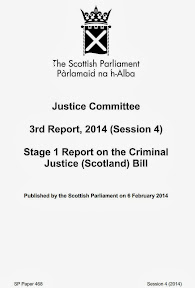
Corroboration to stay for now, says Justice Committee report. CORROBORATION, a long held safeguard against miscarriage of justice in Scots law where evidence in a criminal trial is required from two separate sources for a conviction, is to remain for now. The news comes as the Scottish Parliament’s Justice Committee have suggested Justice Secretary Kenny MacAskill ditch his plans to abolish corroboration in an effort to assist the Crown Office in obtaining higher rates of convictions, even where evidence is dodgy or practically non existent.

News of today’s development came after it was made clear in a report published today by the Scottish Parliament indicated that the majority of members of Holyrood’s Justice Committee, chaired by Christine Grahame MSP (SNP), did not support the much vaunted ‘reform’ put forward by MacAskill, who has served an unprecedented seven years as Scotland’s often accident prone Justice Secretary.

Contrary to much of the lobbying put out by the Crown Office and ‘campaign’ groups with a vested interest in removing Corroboration from Scots Law, the fact is that this long held safeguard against miscarriage of justice cuts across all criminal prosecutions, and not just rape or sexual offence cases, as anyone with an actual understanding of the law and a clear head will know.

Christine Grahame MSP: ‘Justice Committee Not Convinced Over Corroboration’

In response to the Justice Committee's rebellion against Mr MacAskill’s ill advised plan to remove corroboration, the Scottish Government have announced an inquiry to be led by former High Court judge Lord Bonomy, who will look at safeguards needed if corroboration is eventually abolished.

The terms of reference for the group headed by Lord Bonomy include consideration of the following areas:

• Whether a formal statutory test for sufficiency based upon supporting evidence and/or on the overall quality of evidence is necessary

• Whether any proposed prosecutorial test or a requirement for publication of any such test should be prescribed in legislation

• The admissibility and the use of confession evidence

• The circumstances in which evidence ought to be excluded

• The practice of dock identification

• Jury majority and size

• The future basis and operation for a submission that there is no case to answer at the end of the prosecution case

• Whether a judge should be able to remove a case from a jury on the basis that no reasonable jury could be expected to convict on the evidence before it

• Whether any change is needed in the directions that a judge might give a jury, including a requirement for special directions in particular circumstances

• Whether any additional changes are required in summary proceedings.

Appeals are not expected to be considered by the review as they are for wider consideration, not related specifically to corroboration.

The group is expected to take a year in its deliberations. Any necessary legislative and practical change to be taken forward on the back of its recommendations will then be subject to full Parliamentary scrutiny and commenced alongside the provisions in the Criminal Justice Bill, abolishing the corroboration requirement – which as before, is intended to take place in the financial year 2015-16.

Commenting on the plans announced by the Scottish Government, Lord Gill, Scotland’s top judge said: “I am grateful to the Cabinet Secretary for his sensitive response to the widespread discussion of this proposal, and for his usual courtesy in letting me see the terms of reference before they were finalised. The proposed review will enable this issue to be looked at at greater length by a body of experienced professionals. The terms of reference should allow a thorough consideration of the issues. I am pleased that Lord Bonomy has agreed to Chair the Review and I look forward to seeing the results of the Review’s work.”

In October of last year, Scotland’s top judge gave evidence to the Justice Committee, reported HERE, defining corroboration as one of the "finest features" of the country's justice system.

The Lord President’s testimony at Holyrood backing the retention of corroboration came after a terse Lord Advocate Frank Mulholland appeared before MSPs, demanding the lifting of corroboration to enable often incompetent prosecutors to gain higher rates of convictions for cases the Crown Office & Procurator Fiscal Service (COPFS) more often than not fail to take to court for one excuse or another.

And, contrary to intense lobbying by the Lord Advocate, Police Scotland, and campaign groups, it is widely known in the legal system the regular failures by COPFS in cases involving sexual offences are mostly due to the fact evidence and statements in such cases are so badly handled by prosecutors and Police, it is unlikely a prosecution could be presented in a court of law without incurring regular criticism from the benches of COPFS and the Lord Advocate himself.

The Criminal Justice (Scotland) Bill, which includes proposals to abolish the requirement for corroboration, is currently at Stage 1 in the Parliamentary process. Further information on the Bill is available from:HERE

It should be noted Scottish Law Reporter supports the retention of corroboration, and has reported on the issue in previous coverage HERE

BBC News reports further: Ditch corroboration plans, say Justice Committee MSPs

MSPs have suggested ditching controversial plans to abolish the requirement for corroboration from criminal justice legislation. It emerged that the majority of Justice Committee members do not support change.

The government said an inquiry led by former high court judge Lord Bonomy would look at safeguards needed if corroboration was abolished.Opposition leaders called on ministers to wait until after the inquiry. The reform is included in the Scottish government's Criminal Justice Bill.

Justice Secretary Kenny MacAskill said he remained "committed to this essential and long-overdue reform as the corroboration rule can prevent strong cases which could be prosecuted in other jurisdictions from being taken forward".

He added: "Scotland is the only country in the world which has been identified as having the requirement and this is acting as a barrier to justice and denying too many victims their opportunity to have their day in court."

But MSPs on the Justice Committee said they were "concerned that the case for abolition has paid insufficient regard to the importance of this requirement within the Scottish criminal justice system".

Opposition party leaders pressed First Minister Alex Salmond during his weekly question time to delay abolition until Lord Bonomy's inquiry had concluded.

Scottish Conservative leader Ruth Davidson said: "What we as members are being asked to do is to vote through a bill which we know to be deeply flawed on the grounds that Kenny MacAskill says he'll sort it later. "There is an obvious solution here. Leave the scrapping of corroboration out of the bill. "Ask Lord Bonomy to report on the whole issue and then let us look at it again."

Liberal Democrat leader Willie Rennie argued: "Appointing Lord Bonomy doesn't restore justice, it simply papers over the cracks with a veneer of respectability." He urged the first minister to overrule his justice secretary "before he does serious damage".

But Mr Salmond responded: "It's not a quick fix, it's a distinguished judge who's looking to make absolutely certain that as this change is made, appropriate safeguards are there to prevent miscarriages of justice."
'Archaic rule'

The committee has been scrutinising the Scottish government's Criminal Justice (Scotland) Bill, which includes plans to abolish the centuries-old requirement for corroboration - which means that currently evidence against an accused person must come from more than one source.

One of Scotland's top judges, Lord Carloway, called for the change in a review of the criminal justice system, insisting corroboration was "an archaic rule that has no place in a modern legal system".

Supporters include the police, victims' groups and prosecutors. Some have argued that the removal of corroboration could also help widen access to justice for victims, particularly in cases of rape and domestic violence.

Opponents, including many from within the legal profession, have said it could lead to rises in miscarriages of justice. Justice Committee convener Christine Grahame said the proposal had divided opinion among the MSPs.

The SNP MSP said: "The committee could not reach agreement on whether removing such a significant and integral part of the criminal justice system would improve 'access to justice' for victims of sexual offences in a meaningful way or indeed secure more convictions. "Some therefore asked the cabinet secretary to consider removing the relevant sections on corroboration from the bill. "Others felt that the case had been proved."

Ms Grahame also said the Scottish government needed to provide "much more information on its plans to review additional safeguards" before the Scottish Parliament as a whole voted on the general principles of the bill.

Mr MacAskill said he noted the committee's recommendations and hoped its members would "welcome today's announcement on safeguards".

He said: "I have always been clear that we are willing to listen and to work with stakeholders on building further safeguards into our reforms. "I therefore welcome the fact that Lord Bonomy has agreed to chair this reference group. "I am confident that he and his team will carry out a robust and thorough exploration of any additional safeguards which may be required in the light of the corroboration requirement being abolished."

The group is expected to take a year for its deliberations, and will not make any recommendations before the bill is voted on at Holyrood.