Showing posts with label declarations. Show all posts

Monday, September 09, 2013

Holyrood Petition seeking declaration of judges membership of secret societies to include McBride proposals for scrutiny of jurors interests

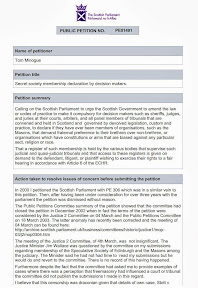
A PETITION to the Scottish Parliament calling on decision makers including judges & tribunal members to declare their membership of all organisations including Freemasonry has today reached over 800 public signatures from Scotland and around the globe including key support from Scots & international legal academics.

Petition PE01491 filed by transparency campaigner Thomas Minogue of Dunfermline, Fife “calls on the Scottish Parliament to urge the Scottish Government to amend the law or codes of practice to make it compulsory for decision makers such as sheriffs, judges, and juries at their courts, arbiters, and all panel members of tribunals that are convened and held in Scotland and governed by devolved legislation, custom and practice, to declare if they have ever been members of organisations, such as the Masons, that demand fraternal preference to their brethren over non-brethren, or organisations which have constitutions or aims that are biased against any particular sect, religion or race.”

However, in a move sure to gather support and ignite further debate, Mr Minogue now plans to include in his petition the proposals put forward by the late Paul McBride QC to require full and substantive declarations by jurors, more details of which can be viewed in an earlier report along with an interview with Paul McBride on the subject, HERE

Speaking to Scottish Law Reporter today, Mr Minogue said : “I am returning to unfinished business and have extended the terms of the petition to include jurors as this group came under scrutiny when Paul McBride QC, criticised the jury in the Neil Lennon assault trial. If that jury was composed predominately of members of the Orange Order they couldn’t have come up with a more bizarre verdict.”

Mr Minogue has campaigned on similar issues in the past, and notably was responsible for bringing “the Spec” (Speculative Society) into the arena of public debate after researching allegations of the group’s influence in the judiciary (over two-thirds of Scots Law Lords were members at that time).

Mr Minogue added in the light of changing attitudes on transparency and a greater need for openness in public life, he believes his current petition carries significant weight and should be considered afresh after an earlier petition on a similar theme was suspiciously dismissed by a previous Scottish Executive even before responses from the then Justice Minister Jim Wallace on judges membership of freemasonry and the Speculative Society of Edinburgh were considered in public by msps.

In relation to the dismissal of the earlier petition, Mr Minogue stated Jim Wallace “said my petition was unique and I was the only person he knew of with concerns in this regard”.

Responding to the ex Justice Minister’s claims some years ago, Mr Minogue commented : “He obviously didn’t know Dr Samuel Johnson said this on the subject: “Where secrecy or mystery begins, vice or roguery is not far off”. Mr Minogue added “This time the numbers supporting the petition show statements such as Mr Wallace’s to be nonsense”

The petition further proposes the publication of declarations by decision makers : “That a register of such membership is held by the various bodies that supervise such judicial and quasi-judicial tribunals and that access to these registers is given on demand to the defendant, litigant, or plaintiff wishing to exercise their rights to a fair hearing in accordance with Article 6 of the ECHR.”

As of today, there are 51 days left for the public to sign the petition on the Scottish Parliament’s website here : Petition PE01491

Friday, October 28, 2011

Top QC Paul McBride calls for jury reform, declarations of jurors interests after Neil Lennon assault trial fiasco

paul mcbride

Jurors must face interviews, declarations of interest says QC Paul McBride  PROPOSALS put forward by top QC Paul McBride in the wake of the not proven verdict in the case of a Hearts fan who was cleared of assaulting Celtic manager Neil Lennon would see jurors being required to declare their interests, face interviews and sit tests before being selected for jury service.

The ideas put forward by the well respected QC have been broadly welcomed by legal insiders who view the proposals as a significant improvement on the current jury system which has little in the way of transparency and has been accused by some of being stacked by prosecutors who prefer desirable outcomes for Crown Office statistics spin

Paul McBride QC interviewed on jury declarations & outcome of Lennon assault case

The Herald reports :

Top QC calls for jury reform

Caroline Wilson
Monday 24 October 2011

JURORS should be made to sit tests before being selected for trials in order to improve the judicial system and bring Scotland into line with other countries, according to a leading QC.

Paul McBride said potential jurors should be interviewed to establish they can “read, write and speak English” and are not “riven with prejudice”.

The only requirement to serve on a jury in Scotland is that a person should be over the age of 18, be registered to vote and have lived in the UK for five years.

Mr McBride believes potential jurors should be forced to disclose their occupation and whether they have been a victim of crime. He said Scotland’s jury system, in which 15 people can reach a decision on a majority of 8-7, made reform even more important.

His intervention follows a jury’s not proven verdict in the case of Hearts fan John Wilson, who was cleared of assaulting Celtic manager Neil Lennon during a match earlier this year. Wilson was accused of a sectarian attack on Lennon, but he was acquitted.

The verdict came despite Wilson admitting in court he had lunged at the Celtic manager and struck him.

Mr McBride said: “The question is, ‘can we improve our jury system?’ and the answer is undoubtedly yes.

“This is an area that lawyers have been discussing for some time. Judges and lawyers undergo a high standard of training. The only area where there is no scrutiny at all on the people who actually make the decision, which is baffling.

“You don’t have to be able to read or write or speak English.

“We have got 15 people deciding whether a person is guilty and we know nothing about them.

“In Scotland, unlike any other country on the planet, a person can be convicted by one vote. Following the Lennon verdict a lot of people, and newspapers were asking about the selection process for juries.

“In every other country there is some kind of jury selection process to determine whether they have got the basic skills and whether they have committed a crime. A lot of trials are conducted by police statements. If a member of the jury can’t read or speak English that’s a bit of a disadvantage.”

During the Tommy Sheridan perjury trial a female juror was threatened with legal action after revealing confidential details of the case on Facebook.

The woman posted information about how jurors voted. It is a criminal offence to reveal a jury’s deliberations.

Mr McBride said: “In America they follow the voir dire system where jurors can be questioned by a judge to determine if they might struggle to be impartial.They might not tell the truth but we should ask the question.

“It is supposed to be a jury of peers but you tend to find that most are unemployed or retired because employed people often get out of jury duty. It is not a jury of peers.

“We were told after the Lennon case, that you must respect the jury’s verdict. Why do we have to respect the verdict by the jury? If a judge makes a controversial decision he is open to criticism on the front pages of a newspaper.”

Mr McBride said both Scottish Labour and the Conservatives had voiced their support for a shake-up of the justice system.

Earlier this year, Elish Angiolini, the former Lord Advocate, called for opening and closing speeches to be introduced to help guide jurors through cases.

She raised concerns over the ability of people who were more used to communication through Facebook to sit through hours of detailed evidence.