Showing posts with label Lord Gill. Show all posts

Wednesday, November 11, 2015

Tenant farmers face few rights after 2012 Landowners Human Rights ruling by Lord Gill & Court of Session - which resulted in suicide of farmer Andrew Riddell

Farmer shot himself in 2012 after Lord Gill ruled landowners Human Rights breached. TENANT farmers continue to fight eviction from their farms after Lord Brian Gill ruled in 2012 that landowners human rights were breached by legislation aimed at protecting tenant farmers passed by the Scottish Parliament.

This week, another eviction of a tenant farmer has been reported where a petition attracted over 19,000 signatures backing Andrew Stoddart, of Colstoun Mains Farm, Haddington, who is fighting eviction by his landlord -  the Colstoun Trust

Mr Stoddart and his young family have been told they have to leave by November 28, with the trust claiming it wants to have “greater involvement in the running of the farm”.

The Stoddarts, along with the two workers they employ on the 900-acre arable and sheep farm, will have to leave their homes and livelihoods behind. This would also be without compensation for the investment they have made.

The eviction follows a 
ten-year dispute over a rent review requested by Mr Stoddart.

It is worth remembering how these evictions have come about.

The quest by Landowners to eject tenants from land was made all the more easy by Scotland’s own landed gentry at the Court of Session after another ten year legal battle - which saw Lord Brian Gill rule in favour of landowners ‘Human Rights’ in 2012.

In the upheld appeal, senior judge Lord Gill ruled that measures put in place to protect tenants in such areas were not compatible with the European Convention on Human Rights.

Lord Gill’s ruling in Salvesen v Riddell [2012] CSIH 26, 2012 SLT 633 allowed billionaire landlord Alistair Salvesen to evict tenant farmer Andrew Riddell (52) from land his family had farmed for 100 years.

After the ruling from the Court of Session, it was widely reported in the media Mr Riddell committed suicide. He was found dead after he had harvested his final crop.

The father of four killed himself just weeks before he was due to leave Peaston Farm, near Ormiston, East Lothian.

Andrew had been involved in a 10-year court battle with his landlord, Scotland’s third richest man Alastair Salvesen.

Mr Riddell's battle began in 2003 when he was given notice to quit by landowner Alastair Salvesen, who bought the farm in 1998.

The problem stemmed from an outdated law that left the family few rights despite being on the land since 1902.

Salvesen served notice to the farmer after a ruling from Lord Gill and the judiciary enforced a notice for the farmer to quit.

The ruling overturned Mr Riddell’s previous security of tenure award in 2010 that meant he could stay living on the land.

Speaking in 2012 after the suicide of Mr Riddell, his neighbour and close friend George Mudie, 60, said: “The farm was Andrew’s life. He was affected very badly by the court’s decision.”

Lord Gill: The Landowner

Records now show at the time of Lord Justice Clerk Lord Gill’s ruling against tenant farmer Andrew Riddell, Lord Gill owned or had an interest in several properties, among them - a large Victorian mansion in one of the richest parts of Edinburgh.

The mansion – owned by the top judge was put on the market last year for £1.7m just before the independence referendum in 2014.

Gill also declared in his now publicly available register of Scottish Court Service Board interests he owns or holds property interests in London identified by an entry in the SCS Board register as “Vestry Court Ltd” –which leads to a multi million pound property listing in London.

Documents at Companies house list Lord Gill and his wife as holding interests in “Vestry Court Ltd” dating back to the mid 1990’s.

Friday, January 30, 2015

FRACKS AWAY: Scottish Government fracking ban hits problem as top judge promotes shale gas retrieval, says “resources should be served by the court system”

Slant drilling coming to a house near you – courtesy of courts. SCOTLAND’S top judge Lord Brian Gill has given his own view of fracking for shale gas on the same day the Scottish Government announced a moratorium on new fracking licenses. In what many view as an opposite opinion to the ban on fracking in Scotland, Lord Gill gave an optimistic appraisal of the retrieval of shale gas in his words, saying “if that should  be allowed” on the same day Energy Minister Fergus Ewing sought to quell protests by announcing a temporary ban on fracking – with the promise of a ‘public consultation’.

Ominously, Gill also indicated the courts should be there to serve opportunities presented by natural resources, and went on to chide the legal profession for not taking enough notice of the North Sea oil boom.

Speaking on the issue of fracking, Gill said: “Our resources of energy may be increased by the retrieval of shale gas, if that should be allowed. It seems to me therefore that the opportunity that our natural resources present should be served by the court system.”

However, Gill’s own views on the nation’s energy policy and how the legal sector should exploit it for their own ends was delivered the very same day the Scottish Government grudgingly announced a ban on new shale gas fracking schemes.

Making a statement announcing the ban on fracking for shale gas after it emerged Energy Minister Fergus Ewing had criticised MSP Joan McAlpine for assisting constituents against plans by the Duke of Buccleuch to mine coalbed methane at Canonbie in Dumfries and Galloway, Mr Ewing told the Parliament: "I want to ensure that the voices of the communities likely to be most affected are heard, and are heard in a more formal and structured way.I am therefore announcing today that in addition to the technical work I've referred to on planning, environmental regulation and upon assessing the impact on public health, Scottish ministers will also launch a full public consultation on unconventional oil and gas extraction."

Speech by Lord Gill on Digital Justice, Fracking & Big Oil. During the speech, Lord Gill also chastised his own judicial colleagues & lawyers for missing out on exploitation of Scotland’s oil boom.

Lord Gill said: “In the 1960s and 1970s the economy of Scotland was transformed by the discovery of North Sea oil. The judges and lawyers of that time were not alert to the opportunity that Scotland could be an international forum for resolving disputes in the oil and gas industry. We paid a price for our complacency when the international oil and gas industry passed us by.”

Gill continued: “Half a century on we should look at Scotland's economic opportunities and see how the courts can best serve them. In recent years a commitment to renewable energy has brought wind power to the fore as an energy source. Other forms of renewable energy may follow.”

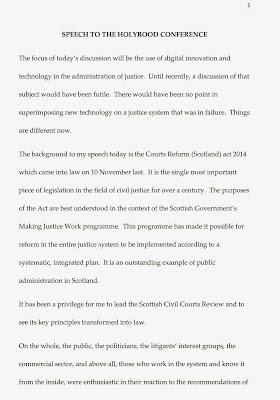
The full text of Lord Gill’s speech follows: The focus of today's discussion will be the use of digital innovation and technology in the administration of justice. Until recently, a discussion of that subject would have been futile. There would have been no point in superimposing new technology on a justice system that was in failure. Things are different now.

The background to my speech today is the Courts Reform (Scotland) act 2014 which came into law on 10 November last. It is the single most important piece of legislation in the field of civil justice for over a century. The purposes of the Act are best understood in the context of the Scottish Government's Making Justice Work programme. This programme has made it possible for reform in the entire justice system to be implemented according to a systematic, integrated plan. It is an outstanding example of public administration in Scotland.

It has been a privilege for me to lead the Scottish Civil Courts Review and to see its key principles transformed into law.

On the whole, the public, the politicians, the litigants' interest groups, the commercial sector, and above all, those who work in the system and know it from the inside, were enthusiastic in their reaction to the recommendations of

the Review and to the Courts Reform Bill through which the prospect of a modern civil justice system became a reality.

Future generations will be surprised to learn that in the early years of the 21st century there were sections of the legal profession who thought it right to conduct civil litigations of a value of £5000 in the highest civil court in the land; or that we tolerated a system in which the legal costs of the first day of an action could exceed the value of the claim.

It is my impression that those lawyers who opposed change assumed that the profession was living in a static legal world. Events have disproved that assumption. In the Scottish legal world change is all around. Solicitor firms of high repute have gone to the wall. Famous legal names have disappeared as a result of the entry of international law firms into Scotland.

Even without the civil justice reforms the profession would have faced the prospect of radical change. Consider the changes that have occurred in the profession since we reported in 2009. Would anyone now contend that, for example, the structure of the solicitor profession or the system of legal aid will be the same in ten years' time as it is now?

All of the controversy over civil justice reform must now be put behind us. The Scottish Parliament has passed the Act. What was the subject of debate is now the law of the land.

So, now that the tumult and the shouting has died, as Kipling put it, it is time to look ahead in a positive way. I am pleased to announce that the timetable for commencement of the provisions of the Act has now been finalised.

By July next the lengthy process of appointment of the first summary sheriffs will be put in hand. In time, those summary sheriffs will deal with the new simple procedure, which will come into force in the Spring of 2016.

In September, at the start of the new legal year, a number of the key reforms will take effect, namely:

• the establishment in Edinburgh of a sheriff court with a Scotland-wide jurisdiction for personal injury cases;

• the extension of the exclusive jurisdiction of the sheriff court to actions with a value of up to £100,000;

• the establishment of the Sheriff Appeal Court, at first with jurisdiction for criminal cases and after January 2016 with jurisdiction also in civil cases;

• and finally, the introduction of the permission stage to judicial review proceedings.

The reforms present opportunities to litigants, to the profession and to judicial office holders at every level. In the Court of Session our administration will no longer bear the burden of low-value litigations.

At sheriff court level solicitors will have the opportunity to deal with claims of significant value and to exercise skilled advocacy in cases that in former days would have been litigated in the higher courts. But litigants should have a choice of representation; and therefore should have also access to the services of the Bar. There will be many important and complex sheriff court litigations where the services of counsel should be available to either side. Whether at first instance or in the Sheriff Appeal Court, section 108 of the 2014 Act imposes a positive duty on the court to sanction the employment of counsel if it considers that in all the circumstances it is reasonable to do so. In making that judgment the court must have particular regard to the difficulty or complexity, or the likely difficulty or complexity, of the proceedings; the importance or value of any claim in the proceedings; and the desirability of ensuring that no party gains an unfair advantage by virtue of the employment of counsel. The court may also have regard to such other matters as it considers appropriate. This provision reflects the expectation underlying the Report of the Civil Courts Review that counsel would have a real and meaningful role in the work of the sheriff court in its expanded jurisdiction.

In consequence of the reforms, the shrieval bench will be relieved of the burden of minor criminal work. The sheriffs will have the opportunity to pursue specialisms in the field of civil law, such as family law and commercial law, and to specialise in the criminal field in cases of serious crime under solemn procedure. This will present the sheriffs with the demanding task of improving their judicial skills and in accepting a high degree of responsibility; but that is a challenge that any sheriff should be glad to accept.

At the third tier level the new office of summary sheriff will lead to the recruitment of a group of sheriffs, who will be specialists in their own way, dealing with lower value cases that presently occupy much of a sheriff's time - small claims, small debts, housing repossessions, family disputes, child- related matters, children's hearing referrals and the bulk of summary prosecutions throughout Scotland.

Finally, the sheriff appeal court will achieve efficiencies at the appellate level by removing business from the Inner House and the Appeal Court respectively; by expediting cases through the first tier of the appeal process and by preventing unmeritorious claims from being pursued in the higher courts.

When the relevant provision comes into force, I intend to appoint Sheriff Principal Mhairi Stephen QC to be President of the Sheriff Appeal Court. She will be the first woman to be appointed as president of an appellate court in Scotland. I am confident of the court's success under her expert leadership.

The reforms seek to remedy one of the besetting problems in our courts in modern times - that of maximising the productive use of available court time. The three keys to the successful implementation of the reforms will be judicial specialisation; judicial case management and flexibility of shrieval deployment.

Under the new system sheriffs will be expected to be flexible in response to the needs of the courts. Efficiency will no longer be impeded by the traditional boundaries between sheriffdoms or by rigid procedural rules whose justification has long been forgotten.

The summary sheriffs will be expected to sit in different courts and in different sheriffdoms - on the same day, if need be.

The whole purpose of these reforms is to maximise the efficiency and the output of the courts. We can no longer allow the progress of an action to be dictated by the convenience of the parties or their lawyers. The court has interests and responsibilities of its own.

The new regime is logical and rational. It is long overdue. I am confident that the legal profession will adapt to it and contribute to its success.

Today's theme is how we bring the court system into the modern world and, perhaps more importantly, how we bring the modern world into the court system. It was recognised in the Scottish Civil Courts Review that improvements in information and communication technology were fundamental to the success of the court reforms. My prediction is that we will move quickly towards the paperless court, towards the filing of writs from the lawyer's desk; towards the virtual court with remote access by judges, lawyers, clerks and witnesses and towards hearings that are no longer based on oral evidence.

In July last year, I had the pleasure of opening the new Civil Justice Centre and Commercial Court in Aberdeen. It is an example of the installation of new technology in a new justice centre. It has been using much of the technology that is being introduced throughout the Scottish court system, including improved video link technology. With it, we are edging nearer to the prospect of a 'virtual court'. Eric McQueen will explain the technology in more detail.

These processes may seem to be innovative and state-of-the-art, but the individuals and businesses who deal with our court system are already well

practised in utilising such technology. Digital innovation is essential if we are to improve access to justice, reduce time and expense for the litigant and ease the administrative burden on our court staff.

But access to justice should not operate solely in favour of those already using the system. Access to justice encompasses a broader aim - to open our courts to public scrutiny and to public understanding and, in that way, to de-mystify our law and its procedures.

In recent years there has been considerable pressure from the media for the televising of proceedings in the courts. On one or two occasions my predecessors have allowed there to be cameras in court.

When I became Lord President it was clear to me that there was no overall policy in the matter. We simply could not go on making ad hoc decisions on individual applications to film or to televise. I therefore appointed a committee under the leadership of my colleague Lady Dorrian to consider the matter in depth, to carry out a public consultation and to report to me with findings and proposals.

I have now received the report of Lady Dorrian's committee. I thank her for having conducted this study so skilfully and thoroughly and I thank her Committee for their good judgment and their openness to change. This morning, Lady Dorrian's Report has been made public. The conclusions of

her Committee represent the consensus view of my colleagues in the Court of Session. They are as follows:

- Filming of civil and criminal appeals and legal debates in civil first instance proceedings, such as judicial review or hearings on the Procedure Roll should be allowed for live transmission. Subsequent news broadcasting and documentary film-making should be allowed subject to clear and comprehensive guidelines.

- In certain circumstances and subject to certain safeguards, criminal trials may be filmed for documentary purposes, but not in cases involving children, sexual offences and vulnerable witnesses.

However, no live transmission should be allowed for any criminal first instance business, or for first instance civil proceedings involving witnesses.

- For subsequent news broadcasts, the delivery of the sentencing remarks of the judge should be permissible, with filming focused only on the judge.

- Similarly, in first instance civil business filming for documentary purposes may be allowed, but should exclude certain cases such as those involving family and immigration matters.

- Filming should be subject to robust, clear and comprehensive guidelines.

- Journalists who register with the Scottish Court Service to gain access to the electronic portal-based system, should also be required to undertake compliance with the Contempt of Court Act. Journalists so registered should be permitted to use live text-based communication. Any person who is not on the register should require the permission of the presiding judge.

I am happy to announce that I accept all of Lady Dorrian's recommendations.

Lady Dorrian's recommendations deal with matters of principle. Our task now will be to translate these principles into practice. I therefore intend to issue guidance to the media to indicate the approach that will be taken in relation to the televising of court proceedings. This may involve further consultation with the media on practical points.

Scotland prides itself on the independence of its legal system. That independence is worth defending. We have a system to be proud of. But we are inevitably subject to the influences of a much larger legal system that is our neighbour. Much of our statutory law nowadays is common throughout the United Kingdom.

If the continued independence of the Scottish legal system is a cause worth fighting for, our courts must meet the needs of the litigant. Unless the courts can provide a justice system that is expeditious, economical and excellent, Scots law faces atrophy and our independent legal profession faces an uncertain future.

A legal system develops through its case law. If Scots law is to be a vigorous system it has to provide a forum that attracts important litigations on important points of law.

But in addition to serving the litigant, the legal system should serve the wider community and its needs.

Our legal system should be a driver for economic progress in Scotland. Our courts and our judges can and should contribute to the prosperity of our country. We can do that if, by the excellence of our judges, and our legal profession and the efficiency of our courts, we make Scotland a forum of litigation that not only retains litigations that at present go elsewhere but also becomes a forum of choice for litigations from abroad.

In the 1960s and 1970s the economy of Scotland was transformed by the discovery of North Sea oil. The judges and lawyers of that time were not alert to the opportunity that Scotland could be an international forum for resolving
disputes in the oil and gas industry. We paid a price for our complacency when the international oil and gas industry passed us by.

Half a century on we should look at Scotland's economic opportunities and see how the courts can best serve them. In recent years a commitment to renewable energy has brought wind power to the fore as an energy source. Other forms of renewable energy may follow. Our resources of energy may be increased by the retrieval of shale gas, if that should be allowed. It seems to me therefore that the opportunity that our natural resources present should be served by the court system.

Twenty years ago my distinguished colleague Lord Penrose single-handedly created within the Court of Session a specialist commercial court. Today it is a prestigious and efficient court that enjoys the confidence of the profession and of the commercial world. I wish to build on that.

It is therefore my intention to launch a feasibility study into the creation of an Energy and Natural Resources Court in the Court of Session to provide a specialist forum for litigations in these fields. I shall look to the advice and assistance of the Scottish Civil Justice Council in that study. In keeping with my view that the courts must serve the litigant, I propose that if such a court should be established, it should sit in other centres, Glasgow or Aberdeen for example, if the need should arise.

We have the courts. We have the manpower. We have the skills of our judges and of our lawyers. My ambition is that we should create a court of international renown that will make its own contribution to Scotland's prosperity.

For the last 40 years, to my own knowledge, the Court of Session and the Appeal Court have suffered from the chronic problem of backlogs and lengthy waiting times for diets. Part of the problem was that the court did not actively manage cases or curtail the length of oral advocacy. The theory was that the judges knew nothing about the case until counsel read the pleadings and other documents and explained what the issues were. There followed a detailed reading of the statutory materials and the case law. Only then did counsel make their submissions.

In less than a year and a half we solved the backlog problem. That has been achieved through careful judicial case management, judicial preparation in advance of the hearing and by the requirement of written submissions: - in short, by judicial efficiency. I am grateful to my judicial and administrative colleagues for what has been achieved.

We have an opportunity now to improve upon these efficiencies and to avoid a relapse into the bad old ways. More importantly, we have a responsibility to litigants, to the public, and to the profession to ensure that our judiciary

has control of the business of our courts. That responsibility is great. It will be achieved only through a concerted effort by all judicial office holders. In the public's eyes, we are one, whether we are summary sheriffs, sheriffs or senators of the College of Justice. We take the same oath. We serve the same society. And we, like the lawyers and the public, are now on the road to the new digital world. It is the pathway to a modern justice system of which we can be proud.

Monday, June 23, 2014

The Lord President’s £60Million stained glass window - Parliament House & Court of Session display their “Hidden Gem” in Edinburgh fringe exhibition

Axe Nurses First: No austerity for £60m spend on Scotland’s main court & judiciary IN the midst of huge cuts to public services including hospitals, the Judiciary of Scotland & Scottish Court Service have announced a celebratory exhibition on their spending of £60 million pounds of taxpayers money on their Parliament House building based in Edinburgh, which houses Scotland’s highest & most inaccessible court – the Court of Session.

The exhibition runs from 28 July to 29 August as venue 402 for the Edinburgh Fringe. Be there, or be aware!

Among the reasons for the multi million pound taxpayer spend on a court no one in Scotland can actually get to without paying tens of thousands of pounds to Edinburgh based QCs, Eric McQueen - the Chief Executive of the Scottish Court Service told staggered msps on the Scottish Parliament’s Justice Committee that “there was no fire certificate in place for the building”.

McQueen also revealed the judges had actually wanted to spend well over £120 Million on the project but this budget was “was brought to a stop to allow us to reassess things and to consider the best strategy”.

McQueen notably did not elaborate to msps on why the £120million plus budget was brought to a halt, probably because no explanation had been dreamed up beforehand which was plausible enough to cover it.

Court Boss & top judge tell MSPs they wanted to spend £120million on top court

Anyone going along to the exhibition please feel free to ask some searching questions on why Scotland’s judiciary are so secretive about their interests and why Scotland’s top court is so inaccessible to the public (– Ed)

Celebrating Parliament House redevelopment

An exhibition was opened today commemorating the completion of the five year, £58 million redevelopment of Parliament House, home of the Supreme Courts of Scotland.

The Lord President, the Rt. Hon. Lord Gill, Chairman of the Scottish Court Service, unveiled a plaque marking the project which was completed last year on time and on budget.

Lord Gill said: “Behind the façade of Parliament House is a collection of buildings ranging over seven floors and containing more than 700 rooms. The oldest building, Parliament Hall, is nearly 400 years old, and it is vitally important that this building is properly maintained for future generations.

“I wish to thank the many individuals and teams who were involved in the project. This work was carried out while the business of the courts continued, and its success has been achieved by effective planning and co-operation.”

Speeches were also delivered by the Cabinet Secretary for Justice, Kenny MacAskill, MSP, Lord Advocate Frank Mulholland, QC, and the Dean of the Faculty of Advocates, James Wolffe, QC.

SCS Chief Executive Eric McQueen said: “The SCS is responsible for preserving this 17th century building which is in a world heritage site and the work involved was a significant challenge. The success of the project has resulted in the improvement of facilities and access for all court users, including victims and witnesses.

“The traditional courtrooms have been fully preserved while at the same time adapted to enable the presentation of evidence, productions and documents, electronically and remotely, from any part of the world. This is part of our ambition to put digital innovation at the heart of our Service.”

The project involved the renewal of all mechanical, electrical and information technology installations, fire safety measures, the introduction of energy efficiency schemes and the improvement of environmental controls in Parliament House, home to the Court of Session and the High Court of Judiciary.

The exhibition - 'Parliament House, The Hidden Gem' - will feature from 28 July to 29 August as venue 402 for the Edinburgh Fringe. It provides a glimpse into the history, traditions and purpose of the Supreme Courts building and will be open Monday to Friday, 10:30-1600. The exhibition was sponsored by Currie and Brown, Asset Management and Construction Consultancy (project managers) and Interserve Construction (principal contractors).

Thursday, February 06, 2014

Corroboration to remain for now: Holyrood’s Justice Committee rebel against MacAskill’s ‘mad plan’ to remove Scotland's safeguard against miscarriage of justice

Corroboration to stay for now, says Justice Committee report. CORROBORATION, a long held safeguard against miscarriage of justice in Scots law where evidence in a criminal trial is required from two separate sources for a conviction, is to remain for now. The news comes as the Scottish Parliament’s Justice Committee have suggested Justice Secretary Kenny MacAskill ditch his plans to abolish corroboration in an effort to assist the Crown Office in obtaining higher rates of convictions, even where evidence is dodgy or practically non existent.

News of today’s development came after it was made clear in a report published today by the Scottish Parliament indicated that the majority of members of Holyrood’s Justice Committee, chaired by Christine Grahame MSP (SNP), did not support the much vaunted ‘reform’ put forward by MacAskill, who has served an unprecedented seven years as Scotland’s often accident prone Justice Secretary.

Contrary to much of the lobbying put out by the Crown Office and ‘campaign’ groups with a vested interest in removing Corroboration from Scots Law, the fact is that this long held safeguard against miscarriage of justice cuts across all criminal prosecutions, and not just rape or sexual offence cases, as anyone with an actual understanding of the law and a clear head will know.

Christine Grahame MSP: ‘Justice Committee Not Convinced Over Corroboration’

In response to the Justice Committee's rebellion against Mr MacAskill’s ill advised plan to remove corroboration, the Scottish Government have announced an inquiry to be led by former High Court judge Lord Bonomy, who will look at safeguards needed if corroboration is eventually abolished.

The terms of reference for the group headed by Lord Bonomy include consideration of the following areas:

• Whether a formal statutory test for sufficiency based upon supporting evidence and/or on the overall quality of evidence is necessary

• Whether any proposed prosecutorial test or a requirement for publication of any such test should be prescribed in legislation

• The admissibility and the use of confession evidence

• The circumstances in which evidence ought to be excluded

• The practice of dock identification

• Jury majority and size

• The future basis and operation for a submission that there is no case to answer at the end of the prosecution case

• Whether a judge should be able to remove a case from a jury on the basis that no reasonable jury could be expected to convict on the evidence before it

• Whether any change is needed in the directions that a judge might give a jury, including a requirement for special directions in particular circumstances

• Whether any additional changes are required in summary proceedings.

Appeals are not expected to be considered by the review as they are for wider consideration, not related specifically to corroboration.

The group is expected to take a year in its deliberations. Any necessary legislative and practical change to be taken forward on the back of its recommendations will then be subject to full Parliamentary scrutiny and commenced alongside the provisions in the Criminal Justice Bill, abolishing the corroboration requirement – which as before, is intended to take place in the financial year 2015-16.

Commenting on the plans announced by the Scottish Government, Lord Gill, Scotland’s top judge said: “I am grateful to the Cabinet Secretary for his sensitive response to the widespread discussion of this proposal, and for his usual courtesy in letting me see the terms of reference before they were finalised. The proposed review will enable this issue to be looked at at greater length by a body of experienced professionals. The terms of reference should allow a thorough consideration of the issues. I am pleased that Lord Bonomy has agreed to Chair the Review and I look forward to seeing the results of the Review’s work.”

In October of last year, Scotland’s top judge gave evidence to the Justice Committee, reported HERE, defining corroboration as one of the "finest features" of the country's justice system.

The Lord President’s testimony at Holyrood backing the retention of corroboration came after a terse Lord Advocate Frank Mulholland appeared before MSPs, demanding the lifting of corroboration to enable often incompetent prosecutors to gain higher rates of convictions for cases the Crown Office & Procurator Fiscal Service (COPFS) more often than not fail to take to court for one excuse or another.

And, contrary to intense lobbying by the Lord Advocate, Police Scotland, and campaign groups, it is widely known in the legal system the regular failures by COPFS in cases involving sexual offences are mostly due to the fact evidence and statements in such cases are so badly handled by prosecutors and Police, it is unlikely a prosecution could be presented in a court of law without incurring regular criticism from the benches of COPFS and the Lord Advocate himself.

The Criminal Justice (Scotland) Bill, which includes proposals to abolish the requirement for corroboration, is currently at Stage 1 in the Parliamentary process. Further information on the Bill is available from:HERE

It should be noted Scottish Law Reporter supports the retention of corroboration, and has reported on the issue in previous coverage HERE

BBC News reports further: Ditch corroboration plans, say Justice Committee MSPs

MSPs have suggested ditching controversial plans to abolish the requirement for corroboration from criminal justice legislation. It emerged that the majority of Justice Committee members do not support change.

The government said an inquiry led by former high court judge Lord Bonomy would look at safeguards needed if corroboration was abolished.Opposition leaders called on ministers to wait until after the inquiry. The reform is included in the Scottish government's Criminal Justice Bill.

Justice Secretary Kenny MacAskill said he remained "committed to this essential and long-overdue reform as the corroboration rule can prevent strong cases which could be prosecuted in other jurisdictions from being taken forward".

He added: "Scotland is the only country in the world which has been identified as having the requirement and this is acting as a barrier to justice and denying too many victims their opportunity to have their day in court."

But MSPs on the Justice Committee said they were "concerned that the case for abolition has paid insufficient regard to the importance of this requirement within the Scottish criminal justice system".

Opposition party leaders pressed First Minister Alex Salmond during his weekly question time to delay abolition until Lord Bonomy's inquiry had concluded.

Scottish Conservative leader Ruth Davidson said: "What we as members are being asked to do is to vote through a bill which we know to be deeply flawed on the grounds that Kenny MacAskill says he'll sort it later. "There is an obvious solution here. Leave the scrapping of corroboration out of the bill. "Ask Lord Bonomy to report on the whole issue and then let us look at it again."

Liberal Democrat leader Willie Rennie argued: "Appointing Lord Bonomy doesn't restore justice, it simply papers over the cracks with a veneer of respectability." He urged the first minister to overrule his justice secretary "before he does serious damage".

But Mr Salmond responded: "It's not a quick fix, it's a distinguished judge who's looking to make absolutely certain that as this change is made, appropriate safeguards are there to prevent miscarriages of justice."
'Archaic rule'

The committee has been scrutinising the Scottish government's Criminal Justice (Scotland) Bill, which includes plans to abolish the centuries-old requirement for corroboration - which means that currently evidence against an accused person must come from more than one source.

One of Scotland's top judges, Lord Carloway, called for the change in a review of the criminal justice system, insisting corroboration was "an archaic rule that has no place in a modern legal system".

Supporters include the police, victims' groups and prosecutors. Some have argued that the removal of corroboration could also help widen access to justice for victims, particularly in cases of rape and domestic violence.

Opponents, including many from within the legal profession, have said it could lead to rises in miscarriages of justice. Justice Committee convener Christine Grahame said the proposal had divided opinion among the MSPs.

The SNP MSP said: "The committee could not reach agreement on whether removing such a significant and integral part of the criminal justice system would improve 'access to justice' for victims of sexual offences in a meaningful way or indeed secure more convictions. "Some therefore asked the cabinet secretary to consider removing the relevant sections on corroboration from the bill. "Others felt that the case had been proved."

Ms Grahame also said the Scottish government needed to provide "much more information on its plans to review additional safeguards" before the Scottish Parliament as a whole voted on the general principles of the bill.

Mr MacAskill said he noted the committee's recommendations and hoped its members would "welcome today's announcement on safeguards".

He said: "I have always been clear that we are willing to listen and to work with stakeholders on building further safeguards into our reforms. "I therefore welcome the fact that Lord Bonomy has agreed to chair this reference group. "I am confident that he and his team will carry out a robust and thorough exploration of any additional safeguards which may be required in the light of the corroboration requirement being abolished."

The group is expected to take a year for its deliberations, and will not make any recommendations before the bill is voted on at Holyrood.

Monday, February 03, 2014

MSPs gained little from Lord Gill in private meeting as Scotland’s top judge battles Holyrood call for judicial transparency & register of interests

Click to watch: little gains from Lord Gill at private meeting with MSPs. IT HAS EMERGED Scotland’s top judge, Lord Brian Gill held a private meeting with two MSPs from the Scottish Parliament’s Public Petitions Committee who are currently investigating calls to create a register of judicial interests in Scotland. The meeting, of which there is now a debate about exactly what was recorded, what was left out and whether or not the Lord President objected to notes being taken at all, was discussed at last week’s Public Petitions Committee hearing on Tuesday the 28th January.

AND, contrary to claims of progress, discussions on what gains had emerged from the  private meeting between Gill, Petitions Committee Convener David Stewart and Deputy Convener Chic Brodie, now appear to show the Lord President led the two msps into believing a small change in how the lumbering Scottish Court IT database reports information on recusals might suffice as an improvement enabling data to be made more public even though in many cases where counsel have dared to raise the issue of a recusal, no note of what was said, or any reference has in fact been placed on the official record or within the IT database referred to during the committee’s discussions.

The situation on a further point, relating to declarations by judges Gill, Carloway, Sheriff Principal Alistair Dunlop and judicial colleagues who serve on the board of the Scottish Court Service also became murkier when it was claimed that information of this nature had come as a revelation to the msps who privately met the Lord President and would be part of an expected letter from Gill to the Petitions Committee.

However, clerks to the committee have since confirmed the information on Gill’s SCS Board disclosures, which are of a narrow focus and limited declaration, was already on the Scottish Parliament’s website and was referred to in briefing notes for the Petitions Committee months before the private meeting with Gill took place.

Sunday Herald reports:

Scotland's top judge offers tiny concession as calls grow for judicial transparency

Paul Hutcheon
Sunday 2 February 2014

SCOTLAND'S top judge, who refuses to back a register of interest for members of the judiciary, has conceded a minor reform to boost transparency.

The Lord President, currently Lord Gill, is looking at pulling together information about judges declining to rule on cases due to a perceived conflict of interest.

MSPs who have criticised the lack of openness in the judiciary welcomed the shift in direction.

Holyrood's Public Petitions Committee is considering a proposal that would require judges and sheriffs to file a register of financial interests, which could include shareholdings and directorships.

Unlike other public servants such as MPs, MSPs and quango board members, judicial office-holders do not have to give details of their outside interests.

Gill, head of the Judicial Office for Scotland, told MSPs last year there were "sufficient safeguards" in place to ensure judicial impartiality.

He added that a register could infringe a judge's "freedom from harassment" from "aggressive media or hostile individuals".

The row deepened after Gill refused to give oral evidence to the committee: MSPs cannot legally compel a judge to attend.

As a compromise, committee convener Dave Stewart MSP and his deputy Chic Brodie held a private meeting with Gill at Holyrood.

At last week's Public Petitions Committee, Stewart revealed progress had been made with Gill.

He said the senior judge, while maintaining his opposition to a register of financial interests, had promised to "check whether the IT systems can be adapted to provide aggregate information about recusals".

A recusal is when a judge takes himself off a case due to a perceived conflict of interest. No list of them exists, but Gill is looking at pulling together the information.

Stewart added that such an outcome would mean "ordinary individuals with an interest here could find out how many recusals there were across Scotland".

He said that Gill would write to MSPs with further details.

Jackson Carlaw, a Tory member of the committee, said at the meeting: "But for the belligerence of this committee in pursuing the issue, there would be no letter forthcoming, and there would be no investigation. I think it rather vindicates the tenacity with which we pursued the matter."

However, SNP MSP John Wilson, who also sits on the committee, had concerns about the private meeting.

He told the committee it "should not be in a position to hold private discussions with individuals who we ask evidence from".

Wilson also asked for the note of the meeting to be made public.

A spokeswoman for the Judicial Office for Scotland said: "The Lord President is examining whether it is possible to capture the information on formal recusal to enable it to be made public.

"The Lord President will write to the convener [Stewart] in due course and no further comment can be made at this time."

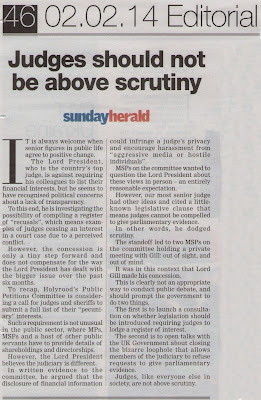
EDITORIAL: JUDGES SHOULD NOT BE ABOVE SCRUTINY

It is always welcome when senior figures in public life agree to positive change.

The Lord President, who is the country's top judge, is against requiring his colleagues to list their financial interests, but he seems to have recognised political concerns about a lack of transparency.

To this end, he is investigating the possibility of compiling a register of "recusals", which means examples of judges ceasing an interest in a court case due to a perceived conflict.

However, the concession is only a tiny step forward and does not compensate for the way the Lord President has dealt with the bigger issue over the past six months.

To recap, Holyrood’s Public Petitions Committee is considering a call for judges and sheriffs to submit a full list of their "pecuniary" interests.

Such a requirement is not unusual in the public sector, where MPs, MSPs and a host of other public servants have to provide details of shareholdings and directorships.

However, the Lord President believes the judiciary is different.

In written evidence to the committee, he argued that the disclosure of financial information could infringe a judge's privacy and encourage harassment from "aggressive media or hostile individuals".

MSPs on the committee wanted to question the Lord President about these views in person - an entirely reasonable expectation.

However, our most senior judge had other ideas and cited a little known legislative clause that means judges cannot be compelled to give parliamentary evidence.

In other words, he dodged scrutiny.

The standoff led to two MSPs on the committee holding a private meeting with Gill: out of sight, and out of mind.

It was in this context that Lord Gill made his concession.

This is clearly not an appropriate way to conduct public debate, and should prompt the government to do two things.

The first is to launch a consultation on whether legislation should be introduced requiring judges to lodge a register of interest.

The second is to open talks with the UK Government about closing the bizarre loophole that allows members of the judiciary to refuse requests to give parliamentary evidence.

Judges, like everyone else in society, are not above scrutiny.

Sunday, June 09, 2013

Transparency scandal as Scotland’s top judge threatens to withdraw judicial cooperation with Scottish Parliament over calls for judges to publish register of hidden interests

Lord Brian Gill : Too much transparency may end  judges involvement with Holyrood. CALLS FOR TRANSPARENCY in Scotland’s Judiciary have provoked Lord Brian Gill, Scotland’s top judge to issue a veiled threat to block any further cooperation from the judiciary with the Scottish Parliament after MSPs twice asked the Lord President to show up to give evidence on a proposal to create a compulsory register of interests for Scotland’s judiciary.

Responding to MSPs on Holyrood’s Public Petitions Committee who are considering Petition PE1458: Register of Interests for members of Scotland's judiciary, Lord Gill said : “Judicial participation in the work of the committees must however be kept within prudent limits” and went on to state it was up to Lord Gill as the Lord President to decide whether any appearance by a judge in front of MSPs may compromise the independence of the judiciary.

The top judge’s threat to withdraw help or cooperation from the judiciary on legislation including personal appearances by judges at Holyrood comes as a scandal involving multiple failures by the judiciary to declare conflicts of interest, financial deals & wealth, hospitality, paid outside work, links to law firms and even criminal convictions engulfs Scotland’s entire judicial system.

The Scottish Parliament are yet to respond to Lord Gill’s veiled threats to restrict or block all cooperation from the judiciary in future legislation, however critics of Scotland’s closed shop judiciary have urged the Scottish Parliament to move ahead of the obstructive judge and legislate for a compulsory register of judicial interests encompassing financial and other interests of Scotland’s judges.

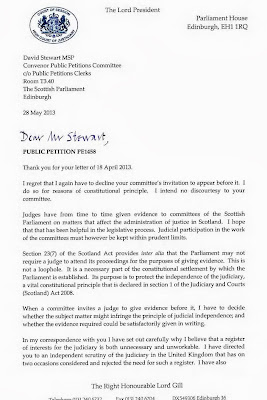
Lord Gill’s letter to the Convener of the Public Petitions Committee :

PUBLIC PETITION PE1458

Thank you for your letter of 18 April 2013. I regret that I again have to decline your committee's invitation to appear before it. I do so for reasons of constitutional principle. I intend no discourtesy to your committee.

Judges have from time to time given evidence to committees of the Scottish Parliament on matters that affect the administration of justice in Scotland. I hope that that has been helpful in the legislative process. Judicial participation in the work of the committees must however be kept within prudent limits.

Section 23(7) of the Scotland Act provides inter alia that the Parliament may not require a judge to attend its proceedings for the purposes of giving evidence. This is not a loophole. It is a necessary part of the constitutional settlement by which the Parliament is established. Its purpose is to protect the independence of the judiciary, a vital constitutional principle that is declared in section 1 of the Judiciary and Courts (Scotland) Act 2008.

When a committee invites a judge to give evidence before it, I have to decide whether the subject matter might infringe the principle of judicial independence; and whether the evidence required could be satisfactorily given in writing.

In my correspondence with you I have set out carefully why I believe that a register of interests for the judiciary is both unnecessary and unworkable. I have directed you to an independent scrutiny of the judiciary in the United Kingdom that has on two occasions considered and rejected the need for such a register. I have also directed you to the decision of the United Kingdom Government to accept that finding, and to the decision of the United Kingdom Supreme Court not to create a register. That I think, is as much useful evidence as I am in a position to give on the subject; but if there is any further information that you feel would be relevant and helpful to the committee, please let me know and I will consider the matter further.

In your letter you have asked whether any central record has been kept of failures by judges to recuse themselves. The Lord President has been responsible for matters concerning the conduct of judicial office holders since April 2010. During that period there has been no case in which a judge has been found guilty of misconduct for a failure to recuse.

If you would find it helpful I would be pleased to meet with you to discuss the constitutional implications of the Committee's invitation.

Scottish Law Reporter has previously reported on a story which revealed several of Scotland’s judges are actually convicted criminals, one of whom was even convicted of cheating the benefits system : ONE OF OUR JUDGES IS A BENEFITS CHEAT– reveals investigation into undeclared criminal habits, tax dodging & secret fiddles of Scottish judiciary

Saturday, June 02, 2012

Lord Justice Clerk Lord Gill confirmed as new Lord President, controversial Lockerbie Lord Advocate Colin Boyd made a Court of Session judge

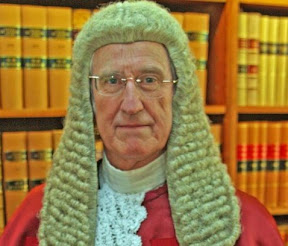
Lord GillLord President to be, Lord Gill LORD BRIAN GILL, Scotland’s current Lord Justice Clerk has been confirmed today as the new Lord President, replacing Lord Arthur Hamilton who retires later this month. The appointment of Lord Gill has been welcomed by many in the legal & political world, and also campaigners for law reform & the media. Lord Gill’s appointment is covered in the popular Scots law blog “A Diary of Injustice in Scotland” HERE and readers may be interested to view Lord Gill’s appearance before Holyrood’s Justice Committee, covered by Scottish Law Reporter in 2009, HERE

However, while many welcome Lord Gill’s appointment as Lord President, the hopes of reform to the justice system and courts have been set back with the First Minister’s nomination of Lord Colin Boyd, who has now been appointed to a post of judge at the Court of Session.

Lord Boyd was the Lord Advocate in the fit up trial of Abdelbasset al Megrahi for the bombing of Pan Am Flight 103 over Lockerbie, Scotland in December 1988. There had been speculation earlier in April that Lord Boyd was to be made a judge, reported on Professor Robert Black’s Lockerbie Case blog, HERE

The announcement from the Scottish Government :

Appointment of Lord President and Senators

First Minister Alex Salmond today welcomed the appointment by Her Majesty the Queen of The Rt Hon Lord Gill as Scotland’s new Lord President. Lord Gill replaces the Rt Hon Lord Hamilton who retires on 8 June. Mr Salmond said that Lord Gill was an outstanding individual who would lead Scotland’s judiciary with independence and integrity and had a clear vision for the continued modernisation of the Scottish courts. Lord Gill was nominated by the First Minister taking account of recommendations made by a selection panel constituted under the Judiciary and Courts (Scotland) Act 2008.

Mr Salmond said: "I warmly welcome the appointment of The Rt Hon Lord Gill as Scotland’s new Lord President. His commitment to reform and modernisation is clear and under his leadership I am confident there will be substantial improvements to the justice system. He is an individual of great stature and integrity and in leading Scotland’s judiciary will enjoy the respect and confidence of those around him."

"I would also like to take the opportunity to thank Lord Hamilton for his leadership over the last few years in establishing the new role of the Lord President and the new governance arrangements for the Scottish Court Service. The changes introduced by the Judiciary and Courts (Scotland) Act were of considerable constitutional significance, and their successful introduction will stand as a testament to his period in office."

Her Majesty the Queen, on the recommendation of the First Minister, has also appointed Lord Boyd QC, Michael Jones QC, and David Burns QC as Senators of the College of Justice.

First Minister Alex Salmond nominated Lord Boyd, Michael Jones and David Burns for appointment on the basis of a report by the independent Judicial Appointments Board for Scotland.

Lord Boyd, Michael Jones and David Burns will take up their appointments later in 2012.

Lord Gill is Scotland's longest serving judge. He is a graduate of the Universities of Glasgow and Edinburgh and lectured in the Faculty of Law of Edinburgh University before being admitted to the Faculty of Advocates in 1967. He was appointed Queen’s Counsel in 1981. He is a member of the English Bar (Lincoln’s Inn, 1991; Bencher 2002); an advocate depute 1977-1979; Standing Junior Counsel to the Foreign and Commonwealth Office (1974-1977), the Home Office (1979-1981) and the Scottish Education Department (1979-1981); and Deputy Chairman of the Copyright Tribunal (1989-1994).

He was appointed a Judge in 1994 and Lord Justice Clerk in 2001. Lord Gill is Chairman of the Lands Valuation Appeal Court and was Chairman of the Scottish Law Commission from 1996 to 2001. In 2008, he was appointed by the UK and Scottish Governments to Chair the Public Inquiry into the fatal explosion in 2004 at the ICL factory in Glasgow. Lord Gill was also Chairman of the Scottish Civil Courts Review (2007-2009). He is Chairman of the Council of the Royal School of Church Music and a Fellow of the Royal Society of Edinburgh and a Fellow of the Royal Scottish Academy of Music and Drama. In 2011, Lord Gill was awarded a Papal Knighthood of the Order of St Gregory the Great.

Lord Boyd qualified as a solicitor in 1978 and was called to the Bar in 1983. He was appointed QC in 1995. He practised at Caesar & Howie from 1978 to 1982 and as an Advocate from 1983 to 1997 building up a practice in civil and particularly planning law. He acted as Advocate Depute from 1993 to 1995 and was appointed Solicitor General for Scotland (for the UK Government) in 1997 and for the Scottish Executive in 1999. Lord Boyd was Lord Advocate from 2000 to 2006. His time in office saw the devolution of legislative responsibility to the new Scottish Parliament and the introduction of the European Convention on Human Rights into domestic law. He brought in significant reforms to the Crown Office and Procurator Fiscal Service. He was also responsible for the prosecution of the Lockerbie trial. He returned to practice as a solicitor advocate in 2007 joining Dundas & Wilson, Solicitors as a Consultant and Head of Public Law. He was appointed a Privy Councillor in 2000. He became a Life Peer in 2006 and is an Honorary Professor of Law at the University of Glasgow.

Mr Jones was called to the Scottish Bar in 1977 and to the Bar of England and Wales in 1987; he was appointed QC in 1989. He has acted as standing counsel to the Department of Trade in Scotland and has been an Advocate Depute. Apart from his practice, he has covered several roles within the Faculty of Advocates and has taught advocacy skills both in the United Kingdom and overseas. Since 2008 he has been Senior Partner with Simpson & Marwick, and Head of its Dispute Resolution Department and its Advocacy Unit. Mr Jones has been Part-time Chairman of the Police Appeals Tribunal since 1997 and Ordinary Judge of Appeal in Jersey and in Guernsey since 2005.

Mr Burns was admitted to the Faculty of Advocates in 1977 and took silk in 1991. Prior to his admission he worked as a legal assistant in Rochester, New York and San Francisco. From 1977 to 1989 he was a Junior Counsel involved in family law, personal injury and planning. From 1989 to 1991 he was an Advocate Depute and on return to private practice he resumed his involvement in planning, personal injury and criminal law. Mr Burns acted as Defence Counsel in the Lockerbie case from 2000 until 2002. In 1998 he was appointed Deputy Commissioner of Social Security and served as a temporary judge from 2002 to 2005. He became a part-time Sheriff in 2007.

The salary of the Lord President is £214,165 per annum and the salary of a Senator is £172,753 per annum.

The Judicial Appointments Board for Scotland was established by Ministers in 2002 and it became an independent advisory non-departmental public body on June 1, 2009. The Board has statutory responsibilities under the Judiciary and Courts (Scotland) Act 2008. The Board's role is to recommend for appointment to the office of judge, sheriff principal, sheriff and part-time sheriff. The First Minister retains the statutory responsibility for making nominations to Her Majesty the Queen. The First Minister is required by statute to consult the Lord President of the Court of Session before making his nomination to Her Majesty.

The process of selection for the Lord President is set out in the Judiciary and Courts (Scotland) Act 2008 ("the 2008 Act"). In line with those provisions the First Minister established a panel of 4 people and invited them to recommend individuals suitable for appointment. The panel was chaired by Sir Muir Russell (Chair of the Judicial Appointments Board for Scotland) and also comprised the Rt Hon Lord Hardie and the Hon Lady Dorrian (senators of the Court of Session) and Professor Coyle (a lay member of the Judicial Appointments Board for Scotland).

A recent report in the Herald newspaper regarding criticism of Lord Boyd’s role in the Lockerbie case :

Lockerbie trial QC criticised

Lucy Adams
Chief Reporter

The commission investigating whether there was a miscarriage of justice at the Lockerbie trial has criticised the former Lord Advocate who led the landmark prosecution.

Colin Boyd, QC, now Lord Boyd, was head of the team which has been accused of failing to disclose crucial information to the defence working on behalf of Abdelbaset Ali Mohmed al Megrahi, who was convicted of the bombing of Pan Am Flight 103.

In its 821-page report, the Scottish Criminal Cases Review Commission (SCCRC) criticises Lord Boyd for his handling of CIA cables, referring to Abdul Majid Giaka, an alleged double agent who was a Crown witness. Giaka identified Megrahi as a member of Libyan intelligence, but his subsequent evidence was rejected following revelations in the US intelligence agency's much-redacted cables that he had demanded and received reward money.

Lord Boyd originally told the trial there was no need for disclosure.

However, the SCCRC said it was "difficult to understand" his assurances on August 22, 2000, that there was "nothing" within the documents relating to Lockerbie or the bombing which could "in any way impinge" on Giaka's credibility. It added: "The matter is all the more serious given that part of the reason for viewing the cables on 1 June, 2000, was precisely in order to assess whether information behind the redacted sections reflected upon Majid's credibility."

The Crown subsequently shared some of the redacted cables after demands from the defence.

Lord Boyd last night rejected the commission's claim. He said: "I reject the suggestion that I or anyone else in the prosecution team failed to disclose material evidence to the defence. All of the relevant CIA cables were disclosed subject to some exceptions, principally to ensure that the lives of named individuals were not put at risk. They were disclosed as a result of a request from the court directed to me.

"I am satisfied that the Crown acted with propriety throughout the trial and endeavoured in this case, as with any other conducted in my name as Lord Advocate, to secure the accused's right to a fair trial." He added he was "satisfied" the verdict was proper and correct.

The SCCRC report refers to a number of occasions when it was not granted full access to security documents from the CIA. It was not allowed to disclose certain documents about the case – including one relating to timers found in Senegal which were similar to those thought to have caused the tragedy, and claims by former CIA staff.

The UK Security Services complied with all requests to share information with the SCCRC but said a number of documents could not be disclosed because of national security.

Yesterday, The Herald reported that the SCCRC dossier uncovers serious discrepancies in the Crown Office's reasons for not disclosing vital information. The commission, which reviews cases post-appeal and investigates possible miscarriages of justice, told the Crown it would take legal action if the prosecution did not hand over important documents and speed up information sharing.

Legal experts have now called for a public inquiry into who was responsible for the 1988 atrocity, full disclosure of the SCCRC report and an inquiry into Crown Office practice not to disclose key evidence to the defence during the trial.

Last night Justice Secretary Kenny MacAskill wrote again to his UK Government counterpart, Kenneth Clarke, to ask for an exemption under data protection laws to allow the document to be published.

A Scottish Government spokeswoman said: "With virtually every passing day, more and more of the content of the SCCRC's Statement of Reasons in the Megrahi case comes into the public domain. Ministers firmly believe this selective reporting of the information only emphasises the importance of the SCCRC being able to decide to disclose information in the Megrahi case."

A spokesman for the Crown Office said: "This highly selective reporting of the commission's consideration of the CIA cables and Majid gives a misleading account of this evidence and the role of Lord Boyd.

"In particular, it fails to acknowledge that the commission concluded that there was no miscarriage of justice on this point and it also ignores the trial court's thanks to Lord Boyd for his efforts to bring this complex and sensitive information before the court.

Thursday, November 11, 2010

Scottish Government announces plans for implementing Lord Gill’s Civil Courts Review on Scots ‘Victorian’ civil justice system

The Scottish Government have finally announced their intentions with regards to implanting ‘some’ of the recommendations of the Civil Courts Review, the damning critique of Scotland’s ‘Victorian’ civil justice system carried out by the Lord Justice Clerk, Lord Gill. The Scottish Government say the proposals will take ‘some years’ to implement …

Readers can download the Civil Courts Review report in pdf format, from the Scottish Courts Website at the following links :

A more critical & in-depth analysis of the Scottish Government’s proposals can be viewed HERE

The Scottish Government’s full response to Lord Gill’s Civil Courts Review can be viewed online here : Scottish Government Response to the Report and Recommendations of the Scottish Civil Courts Review or can be downloaded directly, here : Scottish Government Civil Courts Review response (pdf)

The Scottish Government release on their intentions to implement the Gill reforms :

Proposals for civil justice reform

Justice Secretary Kenny MacAskill today announced the Scottish Government's response to the Report of the Scottish Civil Courts Review, a wide-ranging review led by Lord Gill.

In the report, Lord Gill presented 206 recommendations for change, representing a comprehensive programme of reform - recommendations that are today broadly endorsed by the Scottish Government as necessary for ensuring Scotland has an efficient and effective civil justice system for the 21st century.

The Scottish Government agrees with Lord Gill's analysis of the problems currently facing Scotland's civil courts and believes radical reforms are justified.

Subject to public debate on the details of Lord Gill's proposals, and current constraints on public spending, the following recommendations, in particular, are accepted:

* Civil court business should be reallocated to more appropriate levels, with a far greater proportion of civil court business to be heard by the sheriff courts

* A specialised personal injury court should be established as part of Edinburgh Sheriff Court

* The creation of a new Sheriff Appeal Court

* The introduction of a new role of District Judge

* Adoption of an improved and more active approach to case management

* The introduction of designated specialist judges

Work is already underway on several of Lord Gill's recommendations, and the Scottish Government will continue to work with key stakeholders, including the Scottish Court Service, to take forward proposals for the legislation required to reform and ensure Scotland's civil justice system continues to provide an effective and efficient service for any individuals, families, communities and businesses.

Justice Secretary Kenny MacAskill said: "I thank Lord Gill and the members of his project board, Lord McEwan, Sheriff Principal James Taylor and Sheriff Mhairi Stephen, together with all the members of the broader policy group and others who also participated in the review, either as individuals or as representatives of organisations. Their collective contributions have provided a landmark in the development of Scottish civil justice."

"I am pleased to announce the Scottish Government's commitment to taking forward the majority of Lord Gill's recommendations, which have been broadly welcomed by Scotland's legal community and by the Parliament.

“I am keen to maintain a broad consensus as we set about implementing the required changes. This will enable progress to be sustained across different sessions of the Parliament, as will be necessary with the timescales involved in fundamental change. The Government is establishing a major change programme entitled Making Justice Work which will co-ordinate and oversee reforms across the system."

Wednesday, November 10, 2010

Law Society ‘urges’ Scottish Government to implement civil justice reforms after year long MacAskill 'no-show' on proposals

The Law Society of Scotland has today urged the Scottish Government to take action on the now over-a-year-old recommendations of the Civil Courts Review, carried out by the Lord Justice Clerk, Lord Gill. To-date, the Scottish Govenrment have published little by way of their intentions to implment Lord Gill's recommendations, and notably Justice Secretary Kenny MacAskill appears to have missed most of the Parliamentary debates on the subject, instead being lead by Communities Safety Minister, Fergus Ewing MSP.

While it has been noted Lord Gill made clear his recommendations were not to be “cherry-picked”, the Law Society appears to have done exactly that. A further in-depth investigation of the ‘cherry picking’ (along with a few apples – Ed) can be found HERE

The full release from the Law Society :

Society urges Scottish Government to implement civil justice reforms

The separation of civil and criminal cases, an increase in the threshold for the Court of Session and introduction of specialist sheriffs are just three of the recommendations made to reform the civil justice system by the Law Society of Scotland.

The Society's Civil Justice Committee submission to the Scottish Government today has backed many of Lord Gill's 2009 Civil Courts Review recommendations and believes the suggested reforms could potentially bring the greatest changes to Scotland's civil courts in over a century.

Kim Leslie, convener of the Society's Civil Justice Committee, said: "Lord Gill's report identifies a number of structural and other weaknesses currently affecting Scotland's civil courts, and makes recommendations designed to make radical improvements which, if implemented, will dramatically alter the delivery of civil justice in Scotland.

"We made submissions to the initial consultation as part of Lord Gill's review and welcomed publication of the report in September 2009. We are now keen to see implementation of some of the key recommendations to improve civil justice in Scotland.

"The scope of the review was huge, and the Society's Civil Justice Committee has not commented on every recommendation in the review, however one of our own key recommendations would be to separate civil and criminal business within the Sheriff Court because many of the current problems arise from the huge amount of judicial time which is spent dealing with summary cases.

"We also support the view that there should be specialisation within the judiciary, in particular in administrative, environmental and planning law as well as family, commercial and personal injury cases.

"Such specialisation could be introduced without the need for primary legislation and at no great cost to the public purse - there has already been a successful pilot in Glasgow Sheriff Court of such a system and think this would be beneficial if rolled out across Scotland. The committee is also keen that there should be the option of using a commercial court in each Sheriffdom."

The Society's Civil Justice Committee has also backed increasing the threshold for civil cases in the Court of Session, Scotland's highest civil court. Currently the threshold for cases to be heard in a Sheriff Court is £5,000 and the committee believes this should be raised to at least between £20,000 and £50,000 to allow business to be directed to the appropriate level competent to deal with it.

Ms Leslie said: "Any increase in the threshold for cases to go before the Sheriff Court must coincide with the introduction of specialist sheriffs. We would also endorse the creation of a third tier, dealing with appropriate cases to alleviate pressure on the civil justice system.

"We are in broad agreement with many of the recommendations made in the Civil Justice Review, although we have also taken the opportunity to outline reservations on some of Lord Gill's recommendations, such as a national Sheriff Appeal Court for civil appeals. We would now urge the Scottish Government to implement some of the recommended reforms including the establishment of a Civil Justice Council for Scotland, which would bring in the cost and funding of litigation as part of its remit.

"We are keen to see the introduction of workable improvements to Scotland's civil justice system for all those who use it and work within it and look forward to working with government in bringing forward reform."

The full Law Society of Scotland Civil Justice Committee report can be read at: Law Society Civil Courts response or directly downloaded HERE

Saturday, February 27, 2010

EU rules Court of Session failed to give hearing within a reasonable time as Article 6 puts Scots Law back in the dock

A judgment in from the European Court of Human Rights from February 9 on Richard Anderson v U.K, ruled that the absence of effective court case management in Court of Session proceedings failed to meet the right to a fair trial within the terms of Article 6 of the European Convention on Human Rights.

It should be borne in mind that while Mr Anderson acted in a party litigant capacity, he is actually a member of the Faculty of Advocates, so one could say he had many advantages over a legally unqualified individual who may try to get a similar ruling against the notoriously slow Court of Session civil law case practices.

The issue of poor, or even a lack of case management at the Court of Session extends back many years, although has to some degree been addressed after Lord Penrose’s review of the Court of Session’s Inner House, where he identified numerous shortcomings and made recommendations which are referred to in Lord Gill’s Civil Courts Review :

. a single Inner House judge should deal with procedural business;

. cases should not be allocated until they are ready for a hearing;

. there should be a degree of judicial continuity in managing appeals, and particularly those involving party litigants;

. control over the progress of an appeal should be vested in the court rather than parties;

. the court should fix a timetable to which parties would be required to adhere;

. late amendments and late lodgings of documents should be penalised toencourage frontloading of preparationon.

The Scots Law News and Jonathan Mitchell QC have already covered the issue at length, both links well worth a visit.

In the meanwhile, here follows the ruling from the European Court of Human Rights … and lets hope in the light of Lord Penrose’ review of Court of Session business, which resulted in the recently enacted Act of Sederunt (Rules of the Court of Session Amendment No. 2) (Causes in the Inner House) 2010, SSI 2010/30 (pdf) may clear some of these inequalities up, if not, then yet more trips to Europe may be necessary …

CASE OF RICHARD ANDERSON v. THE UNITED KINGDOM (Application no. 19859/04)

STRASBOURG

9 February 2010

This judgment will become final in the circumstances set out in Article 44 § 2 of the Convention. It may be subject to editorial revision.

In the case of Richard Anderson v. the United Kingdom,

The European Court of Human Rights (Fourth Section), sitting as a Chamber composed of:

Lech Garlicki, President,
Nicolas Bratza,
Giovanni Bonello,
Ljiljana Mijovic,
Päivi Hirvelä,
Ledi Bianku,
Nebojša Vucinic, judges,
and Lawrence Early, Section Registrar,

Having deliberated in private on 19 January 2010,

Delivers the following judgment, which was adopted on that date:

PROCEDURE

# The case originated in an application (no. 19859/04) against the United Kingdom of Great Britain and Northern Ireland lodged with the Court under Article 34 of the Convention for the Protection of Human Rights and Fundamental Freedoms (“the Convention”) by a British national, Mr Richard Anderson (“the applicant”), on 27 May 2004.

# The United Kingdom Government (“the Government”) were represented by their Agent, Ms E. Willmott of the Foreign and Commonwealth Office.

# On 15 January 2008 the Acting President of the Fourth Section to which the case had been allocated decided to give notice of the application to the Government. It was also decided to rule on the admissibility and merits of the application at the same time (Article 29 § 3).

THE FACTS

THE CIRCUMSTANCES OF THE CASE

1. The background to the applicant's civil proceedings

# The applicant was born in 1952 and lives in Glasgow. He is an advocate by profession. He owned a flat in a tenement building in Edinburgh. A number of the flats in the building were also owned by a commercial property company. In August 1988, when the proprietors of the building failed to carry out repairs mandated by the city council under statutory notices, the city council itself instructed works to be carried out (provided for by section 99 of the Civic Government (Scotland) Act 1982). It sought advice from a private architect, awarded the contract for the repairs to a private preservation company and apportioned the cost of the repairs among the various proprietors of the building. In October 1988, a fire occurred in the building which damaged part of the applicant's flat and part of the flat below belonging to the commercial property company. Whilst the applicant was living elsewhere, the commercial property company instructed repair work. The applicant claimed that both sets of repairs constituted trespass to his property, that in each case the repairs were in fact inadequate and unsatisfactory, and that he was entitled to damages in the sum of GBP 100,000.

2. Proceedings in the Sheriff Court

# When the applicant refused to pay the council for his share of the repair costs, the council brought proceedings in the Sheriff Court (the civil court of general jurisdiction). The applicant filed a counter-claim alleging that the council had instructed further repairs that had damaged his property. The applicant further sought referral of the whole case to the Court of Session (the highest civil court in Scotland).

On 14 November 1994 the Sheriff Court upheld the council's claim, rejected the applicant's counter-claim and found that the case did not meet the criterion for referral to the Court of Session. On 11 May 1995, the applicant's appeal to the Sheriff Principal was rejected.

In 1998, the applicant then brought proceedings against the architect and chief executive of the preservation company for contempt of court in relation to an alleged failure to produce documents in the initial action. By judgments of 17 February 1999, the Sheriff Court rejected the applicant's claims.

3. Proceedings in the Court of Session

# On 26 March 1997, the applicant obtained a summons to bring proceedings against the commercial property company (“the first defenders”) and the city council (“the second defenders”) in the Outer House of the Court of Session, alleging that the statutory notices were invalid on grounds of fraud and illegal conspiracy. The second defenders were served on 15 April 1997. The first defenders were served on 14 May 1997. Defences were lodged by both defenders on 12 June 1997. Between that date and 7 January 1998 the record in the case (the parties' written pleadings) was open and closed on a number of occasions at the request of the parties and with the leave of the court to allow for adjustment of their pleadings.

# The applicant was then informed by the court that, since part of his claim challenged one of the orders made in the Sheriff Court proceedings, he was required to intimate a copy of the closed record to the relevant sheriff clerk. On 26 February 1998, the court gave him leave to do so. There was then further correspondence between the parties as to the future procedure in the case, which led the applicant to apply to the court first, for an order for disclosure of certain documents and second, for a warrant to direct the relevant sheriff clerk to transmit the record of the Sheriff Court proceedings to the Court of Session. On 15 July 1998, the applicant's motion to this effect was adjourned to 22 September 1998. On the latter date, the motion was granted by way of interlocutor. This was done when the first defenders, despite their opposition to the motion, failed to appear. On 2 October 1998, the Lord Ordinary granted the first defenders leave to reclaim (appeal) to the Inner House against the interlocutor of 22 September 1998 in so far as it related to the disclosure of documents.

# On 8 October 1998, the Inner House directed the parties to lodge their grounds of appeal within 28 days. On 4 November 1998, the first defenders lodged their grounds of appeal. It appears that, by oversight, the first defenders failed to apply for a hearing.

# On 5 November 1999, the Inner House allowed the applicant to amend his pleadings and allowed the other parties to lodge answers within 21 days. On 7 December 1999, on the first defenders' unopposed motion, the Inner Court appointed the case to the Summar Roll (the list of appeals and other business before it). On 3 February 2000, the Inner House allowed the second defenders' answer to be received late. The interlocutory appeal was then to be heard in one day, 26 May 2000, but this date was vacated when, on 20 April 2000, the applicant explained to the court that he believed a two day hearing would be necessary. On 9 June 2000, the hearing was then fixed for 15 and 16 March 2001. On 7 February 2001, the applicant advised the court that a one-day hearing would be sufficient. The interlocutory appeal was duly heard on 15 March 2001 and, in a judgment given the same day, the Inner House allowed the first defenders' reclaiming motion and remitted the case back to the Lord Ordinary in the Outer House.

# On 20 March 2001, upon remittal to the Outer House, further directions were given for disclosure. On 14 September 2001, on the motion of the first defenders, the court appointed the case to the procedure roll for a debate (hearing) on pleas-in-law. After two dates for that debate were vacated, a two-day hearing was fixed for 20 and 21 June 2002. On 15 May 2002, the court allowed the applicant to lodge further supplementary arguments alleging a lack of candour in the defenders' pleading but refused his motion for further disclosure. The case was heard on 21 June 2002. As a result of that hearing, the applicant's action was dismissed on 4 September 2002 by the Outer House. In a written judgment, the Lord Ordinary found the applicant's claims to be unfounded and unspecified.

# The applicant appealed to the Inner House. The appeal was listed for 18 and 19 November 2003. On 4 November 2003, the Inner House refused the applicant's motion for leave to amend his appeal. However, on 13 November, it allowed him to abandon his appeal against the second defenders and proceed only against the first defenders. The appeal was heard on 18 and 19 November 2003. The appeal was unanimously dismissed on 11 December 2003, the court finding that the applicant's pleadings lacked specification. The applicant was found liable for the first defenders' costs on 18 December 2003.

# In June 2002 the applicant also sought to bring proceedings in the Court of Session against the solicitors acting for the council in the Sheriff Court proceedings. Unable to obtain a solicitor who would provide the necessary signature on the summons, the applicant petitioned the Court of Session for leave to proceed without the signature. Leave was refused on the papers on 25 July 2002. Complaints made in relation to the solicitors and advocates representing the council were dismissed by their respective professional bodies and then by the Scottish Legal Services Ombudsman on 13 November 2001 and 4 July 2003, respectively.

THE LAW

I. ALLEGED VIOLATIONS OF ARTICLES 6 § 1 AND 13 OF THE CONVENTION ARISING FROM THE LENGTH OF THE COURT OF SESSION PROCEEDINGS

# The applicant principally complained that the length of the proceedings before the Court of Session challenging the statutory notices was incompatible with the “reasonable time” requirement of Article 6 § 1 of the Convention. He also referred to Article 13 of the Convention in this connection.

Article 6 § 1 of the Convention, in so far as relevant, reads as follows:

“In the determination of his civil rights and obligations ..., everyone is entitled to a ... hearing within a reasonable time by [a] ... tribunal...”

# The Government contested that argument.

A. Admissibility

1. The parties' submissions

# The Government contended that the applicant had failed to exhaust domestic remedies as he did not complain about the alleged unreasonable length of the proceedings before the Outer and Inner Houses of the Court of Session. First, before the Outer House, when the parties could not agree to the future procedure in the case, the applicant could have enrolled a motion for the court to decide on future procedure. Second, in October 1998, he had failed to seek early disposal of the first defenders' reclaiming motion or to have it heard as a single bill (a motion which can be heard in a short period of time) rather than on the Summar Roll. The brief and interlocutory nature of the appeal meant it would have been well-suited to being heard promptly in this way. Third, when the first defenders failed to apply for a hearing before the Inner House, the applicant failed to apply for the reclaiming motion to be refused for want of insistence. He could also have requested that the first defenders be asked to explain to the court whether they intended to insist upon their appeal. Fourth, in December 1999, when the case was on the Summar Roll, he again failed to seek early disposal of the appeal or to have the case heard as a single bill. Fifth, in October 2001, when the case was on the procedure roll, the applicant failed to agree to allowing the case to be put on the “warning list” (a list of cases that could be heard at short notice). Sixth, in October 2002, the applicant failed to seek early disposal of his own reclaiming motion. Apart from the failure to make use of these procedures, at no point did the applicant enrol a motion, making reference to Article 6 § 1 of the Convention, to have the case expedited. He also had not sought any redress under the Human Rights Act 1998. Finally, the Government argued that the absence of a formal case management system for some ordinary actions in the Court of Session did not prevent litigants from using the above procedures to expedite cases.

# The applicant argued that the Government's submissions were without foundation. For the first alleged remedy, a motion on future procedure, the delay at that stage was minimal. For the remaining delays and the possibility of an early disposal of the appeal, such a procedure existed but it was for urgent matters, such as an appeal against an order removing someone from the matrimonial house, and there was nothing in the present case that met that test. Instead, the applicant's concern throughout the proceedings was that the defenders had been less than candid in their pleadings and he had sought to address that in his own pleadings and in his motion to that effect, which had been refused on 15 May 2002.

2. The Court's assessment

# The Court reiterates that Article 35 § 1 of the Convention requires that the complaints intended to be brought subsequently before the Court should have been made to the appropriate domestic body, at least in substance and in compliance with the formal requirements laid down in domestic law, but that no recourse need be had to remedies which are inadequate or ineffective. The existence of the remedy must be sufficiently certain, failing which it will lack the requisite accessibility and effectiveness. Article 35 of the Convention also provides for a distribution of the burden of proof. It is incumbent on the Government claiming non exhaustion to satisfy the Court that the remedy was an effective one available in theory and in practice at the relevant time, that is to say, that it was accessible, was one which was capable of providing redress in respect of the applicant's complaints and offered reasonable prospects of success (see Bullen and Soneji v. the United Kingdom, no. 3383/06, § 43, 8 January 2009, with further references).

# In determining whether the present applicant has exhausted domestic remedies, the Court also recalls its findings in the cases of Price and Lowe v. the United Kingdom (nos. 43185/98 and 43186/98, § 23, 29 July 2003) and Crowther v. the United Kingdom (no. 53741/00, § 29, 1 February 2005) where it held:

“a principle of domestic law or practice that the parties to civil proceedings are required to take the initiative with regard to the progress of the proceedings, does not dispense the State from complying with the requirement to deal with cases in a reasonable time...The manner in which a State provides for mechanisms to comply with this requirement, whether by way of increasing the numbers of judges, or by automatic time-limits and directions, or by some other method, is for the State to decide. If a State lets proceedings continue beyond the 'reasonable time' prescribed by Article 6 of the Convention without doing anything to advance them, it will be responsible for the resultant delay.”

# The Court finds that, in the present case, the Government's submissions have essentially identified periods in the proceedings where the delay was caused by the applicant's conduct and, in particular, his failure to take “the initiative with regard to the process of the proceedings”. As such, and consistent with its approach in the cases of Price and Lowe, Crowther and Bullen and Soneji, all cited above, it finds that these submissions in reality go to the merits of the application and in particular to the applicant's conduct and contribution, if any, to the length of the proceedings. It follows that the Government's objection to non-exhaustion of domestic remedies must therefore be dismissed.

# The Court notes that these complaints are not manifestly ill-founded within the meaning of Article 35 § 3 of the Convention. It further notes that they are not inadmissible on any other grounds. The complaints must therefore be declared admissible.

B. Merits

(a) Article 6 § 1

1. The parties' submissions

# The Government considered that, because in Scots law proceedings commence when a summons is served on the defender, the relevant period began on 15 April 1997. It ended on 18 December 2003 when the Inner House found the applicant to be liable for the first defenders costs. The total period was therefore some six years and eight months.

# In the Government's submission, the proceedings were of some complexity as evidenced by the applicant's own attempts to amend his written pleadings by means of lengthy minutes of amendment. Responsibility for the progress of proceedings rested with the parties, in particular the applicant as pursuer in the case. In considering what steps he should have taken, it was to be noted that the applicant was represented by a firm of solicitors who regularly acted for litigants in the Court of Session and the applicant himself was an advocate who had practised in the Court of Session for many years. He had failed to show diligence in carrying out the procedural steps required of him, he had used delaying tactics and he had failed to avail himself of the available means for shortening the proceedings. In addition to the failure to take the steps set out by the Government in their submissions on non-exhaustion (see paragraph 15 above), he was also culpable for the delay in the following ways. He had failed to complete service until 14 May 1997; he did not oppose the defenders' motions for adjustment made in 1997; he continued to develop his pleadings from September 1997 – January 1998; he failed promptly to obtain the necessary warrant for intimation to the clerk of the Sheriff Court and, having done so, he had failed to enrol a motion for further procedure to be determined. Before the Inner House, he had persuaded that court that a two-day hearing was necessary (causing the hearing to be postponed) when in fact it was heard in one hour on 15 March 2001. After that hearing he had failed to respond to the defenders' calls to agree upon further procedure. When the case was remitted to the Outer House he had also caused another hearing date to be vacated by insisting that a two-day hearing was required, when in fact the hearing only took one day.

For the period from late 1998 to autumn 1999, the Government understood that the parties were involved in other proceedings in the Sheriff Court (see paragraph 5 above), in settlement discussions and the complaint proceedings brought by the applicant. The Inner House could have held a hearing in this period but the Government submitted that, during this period, it was clear that the parties were content to leave the proceedings in abeyance. When the parties had agreed on future procedure, all hearings dates had been set with reasonable promptness; judgments then had been issued promptly by both the Outer House and the Inner House. The dispute was about repairs to property and was not of a nature to require special efforts of expedition.

# The applicant submitted that the initial delay in service was by no means out of the ordinary. Thereafter the case began to depart from the procedure ordinarily followed in the Court of Session, principally because the defenders had not properly outlined their defences and had not adjusted their pleadings in the time when they could do so without needing to obtain the leave of the court. The applicant was not to blame for his failure to oppose the defenders' motion for adjustment: there was nothing to be gained from such an objection and it was better for the procedure to obtain as full a set of written pleadings as possible. When those adjustments were finally filed, he had no choice but to apply for an extension of time to adjust his own pleadings. He accepted that there was a short delay on his part in giving notice of the proceedings to the clerk of the Sheriff Court but, at the same time, there was nothing more he could have done when his motion for specification for documents (which the defenders had opposed) was before the court.

When the defenders appealed to the Inner House, the applicant was not at fault for failing to seek early disposal of the appeal. As he had submitted at paragraph 16 above, the case was not of the type that would be expedited by the Inner House. He was also not to blame for seeking a two-day hearing before the Inner House, believing this was necessary given the lack of specification in the defenders' written pleadings. He submitted that almost the whole of the proceedings were taken up by his attempts to force the defenders to make candid and proper disclosure of their case and, moreover, that the majority of the delay was due to the inability of the Outer and Inner House to control the proceedings. There was no proper system of case management by the courts; the Scottish courts had only introduced such a principle after his case had been concluded.

2. The Court's assessment

# The Court reiterates that the reasonableness of the length of proceedings must be assessed in the light of the circumstances of the case and with reference to the following criteria: the complexity of the case, the conduct of the applicant and the relevant authorities and what was at stake for the applicant in the dispute (see, among many other authorities, Frydlender v. France [GC], no. 30979/96, § 43, ECHR 2000-VII).

# As to the first of these criteria, the complexity of the case, the Court cannot accept the Government's argument that this was a complex civil dispute. The case turned entirely on the veracity of the applicant's allegations of fraud and illegal conspiracy and there had already been previous litigation between the applicant and the city council in the Sheriff Court. There were no novel points of law at stake and the Outer House was ultimately able to reject the applicant's allegations as unfounded and unspecified. The Inner House was also able to dismiss the applicant's appeal from the Outer House's decision for substantially the same reasons. The relative lack of complexity of the case is also demonstrated by the fact that, once various procedural issues had been resolved, the Inner House was able to dismiss each appeal to it shortly after hearing oral argument.

# As to the third criterion, what was at stake for the applicant, the Court does not accept that the proceedings were of exceptional significance. The repairs to the property may have had some financial consequences for the applicant but this matter had already been litigated before the Sheriff Court and, in the Court's view, the Court of Session proceedings were secondary to that litigation.

# The Court finds that whether there was a breach of Article 6 § 1 essentially turns on the second criterion, that is, the extent to which any delay was attributed to the conduct of the applicant or the relevant authorities. Having reviewed the record of the proceedings submitted by the parties, the Court finds that the applicant bears some responsibility for the delay in the initial stage of proceedings, notably his attempts to have the written pleadings amended on several occasions and his failure promptly to obtain a warrant for intimation to the clerk of the Sheriff Court. However, it accepts that, in respect of the former, the applicant was motivated by a desire to have the written record as fully developed as possible and there was nothing to be gained from objecting to attempts by the defenders to amend their pleadings. The Court also rejects the Government's submission that the applicant contributed to the length of the proceedings by insisting on a two-day hearing for an interlocutory appeal before the Inner House and for the debate on pleas-in-law once the case had been remitted to the Outer House. It sees no reason why this would have required the one-day hearing dates to be vacated since, in the Court's view, it would not have been necessary for a two-day hearing to have taken place on two successive days; each hearing could have gone ahead and, if a second day proved necessary, arrangements been made for the hearing to be continued on the next available date.

# Moreover, the Court finds that there were periods of inactivity for which no satisfactory explanation has been given by the Government. The Court is particularly struck by the fact that the first appeal was before the Inner House from 22 September 1998 until 15 March 2001 and there was little or no activity between late 1998 and autumn 1999. It may well have been that, as the Government submitted, the parties were involved in other proceedings and settlement discussions. However, the Court finds that these considerations were not sufficient to absolve the Inner House of its own obligation to take an active role in the management of proceedings and to make enquiries of the parties to ascertain their position in respect of the appeal. As the Court has frequently stated, the State remains responsible for the efficiency of its system; the manner in which it provides for mechanisms to comply with the reasonable time requirement – whether by automatic time-limits and directions or some other method – is for it to decide. If a State allows proceedings to continue beyond the “reasonable time” prescribed by Article 6 of the Convention without doing anything to advance them, it will be responsible for the resultant delay (Bhandari v. the United Kingdom, no. 42341/04, § 22, 2 October 2007, together with further references therein). Additionally, for the time the interlocutory appeal was pending before the Inner House, the Court does not find that any significant period of delay can be attributed to the applicant or that the expedition of the proceedings was his responsibility at this stage; the interlocutory appeal had been taken by the first defenders when the applicant's motion for disclosure – which they opposed but for which they failed to appear in person – had been granted by the Outer House.

# In all the circumstances, the Court does not consider that the proceedings were pursued with the diligence required by Article 6 § 1. There has accordingly been a violation of that provision, in that the applicant's “civil rights and obligations” were not determined within “a reasonable time”.

(b) Article 13

# To the extent that the applicant also appears to rely on Article 13 in respect of the length of the proceedings before the Court of Session, the Court, having regard to the particular circumstances of the case and its analysis of the Article 6 complaint, finds that it is not necessary to examine the complaint under Article 13.

II. OTHER ALLEGED VIOLATIONS OF THE CONVENTION

# The applicant made the following additional complaints. First, under Article 6 § 1 of the Convention, he complained that the refusal of the Court of Session to grant leave for him to proceed without the necessary signatures on his summons violated his right of access to court. Secondly, under Article 6 § 1 he alleged that there was a lack of a fair hearing in three aspects: (i) that the Sheriff Court and Sheriff Principal refused to hold oral hearings on preliminary matters before them; (ii) that the Court of Session while it heard oral argument, essentially based its ruling on preliminary, written pleadings; and (iii) that the Court of Session failed in its duty to make a proper examination of the submissions, arguments and evidence adduced by the parties. Thirdly, under Article 6, the applicant complained that the courts hearing his case, while themselves independent and impartial, were not in fact independent and impartial by virtue of the corruption and contempt of court of the legal representatives before them. Fourthly, invoking Article 13 of the Convention, the applicant complained that there was no effective remedy in respect of these alleged violations of Article 6 § 1. Finally, he complained under Article 8 of the Convention that the council, by entering his property to carry out the repairs, failed to respect his right to respect for his home.

# For the first complaint, the Court observes that the leave to proceed was refused on 25 July 2002. The present application was lodged on 27 May 2004 therefore this complaint has been introduced out of time and must be rejected pursuant to Article 35 §§ 1 and 4 of the Convention.

# For the second complaint, the Court does not find that the refusal of the Sheriff Court and the Sheriff Principal to hold oral hearings amounted to a breach of Article 6: the obligation to hold an oral hearing in civil proceedings in not absolute and the nature of the issues to be decided by the Sheriff Court and the Sheriff Principal justified their decision to dispense with oral hearings at the preliminary stage of proceedings before them (Jussila v. Finland [GC], no. 73053/01, §§ 41–42, ECHR 2006 XIII). It further finds the applicant's complaint that the Court of Session based its ruling on written pleadings to be unsubstantiated and his complaint that it failed to make a proper examination of the papers before it to be fourth instance in nature. It follows that this second complaint must be rejected as being manifestly ill-founded, pursuant to Article 35 §§ 3 and 4 of the Convention.

# For the third complaint, the Court finds these allegations to be wholly unsubstantiated and thus also to be rejected as manifestly ill-founded. For the fourth complaint, brought under Article 13 taken in conjunction with Article 6 § 1 of the Convention, the applicant's substantive complaints have been rejected pursuant to Article 35 of the Convention. The Court is not persuaded that any of these complaints were “arguable” (Hatton and Others v. the United Kingdom [GC], no. 36022/97, § 137, ECHR 2003 VIII) and thus Article 13 has no application to these complaints. The Court therefore rejects this part of the complaint as manifestly ill-founded.

# For the final complaint, which has been made under Article 8, the Court finds that the applicant has failed to rely on that Article in any of the domestic proceedings which he has brought against the council or the private parties he alleged to be responsible. Hence, this complaint must be rejected under Article 35 §§ 1 and 4 of the Convention for non-exhaustion of domestic remedies.

III. APPLICATION OF ARTICLE 41 OF THE CONVENTION

# Article 41 of the Convention provides:

“If the Court finds that there has been a violation of the Convention or the Protocols thereto, and if the internal law of the High Contracting Party concerned allows only partial reparation to be made, the Court shall, if necessary, afford just satisfaction to the injured party.”

A. Damage

# The applicant claimed GBP 85,603.14 (approximately EUR 97,030) in respect of pecuniary damage. This included the costs he was ordered to pay to the first and second defenders by the Inner House (GBP 33,000 – approximately EUR 37,406) and the money he owed to the city council for the repair work (GBP 30,403.14 – approximately EUR 34,463). He was required to sell his home to pay these costs and was forced to pay rental on another house for 2005–2008; the rental costs were GBP 22,200 (approximately EUR 25,172). The applicant further claimed GBP 10,000 in respect of non-pecuniary damage arising from the emotional distress caused by the alleged breaches of the Convention and by the loss of his home.

# The Government contested these claims. In respect of the claim for pecuniary damage, they submitted there was no causal connection between the damage claimed and any of the breaches of the Convention alleged by the applicant. In respect of the claim for non-pecuniary damage, they submitted that the applicant had failed to explain how any emotional distress was caused by any particular delay in the Court of Session proceedings. Furthermore, any delay was not the cause of the loss of the applicant's home.

# The Court notes that it has only found a violation of Article 6 § 1 in respect of the length of the Court of Session proceedings. Moreover, it does not discern any causal link between that violation and the pecuniary damage alleged; it therefore rejects the applicant's claim for pecuniary damage. It also does not discern any causal link between this violation and any distress that the loss of the applicant's home would have caused him. On the other hand, it accepts the unreasonable delay in the Court of Session proceedings must have caused the applicant some distress and frustration. As a result he has certainly suffered non-pecuniary damage which is not sufficiently made good by the finding of a violation of the Convention. Ruling on an equitable basis, it awards him EUR 1,500.

B. Costs and expenses

# In his claim for just satisfaction the applicant stated that he had retained lawyers to represent him before the Court and sought recovery of his legal costs and expenses. The Court recalls that in order for costs and expenses to be recoverable under Article 41 of the Convention, it must be established that they were actually and necessarily incurred, and reasonable as to quantum (see, among other authorities, D.G. v. Ireland, no. 39474/98, § 128, ECHR 2002 III). The Court notes that no itemised statements were provided in relation to the costs and expenses. Consequently, it makes no award under these heads.

C. Default interest

# The Court considers it appropriate that the default interest should be based on the marginal lending rate of the European Central Bank, to which should be added three percentage points.

FOR THESE REASONS, THE COURT UNANIMOUSLY

# Declares the complaints concerning the excessive length of the proceedings and the absence of an effective remedy in that connection admissible and the remainder of the application inadmissible;

# Holds that there has been a violation of Article 6 § 1 of the Convention;

# Holds that it is not necessary to examine the applicant's complaint under Article 13 of the Convention in the particular circumstances of the instant case;

# Holds

(a) that the respondent State is to pay the applicant, within three months from the date on which the judgment becomes final in accordance with Article 44 § 2 of the Convention, EUR 1,500 (one thousand five hundred euros) in respect of non-pecuniary damage to be converted into pounds sterling at the rate applicable at the date of settlement;

(b) that from the expiry of the above-mentioned three months until settlement simple interest shall be payable on the above amount at a rate equal to the marginal lending rate of the European Central Bank during the default period plus three percentage points;

# Dismisses the remainder of the applicant's claim for just satisfaction.

Done in English, and notified in writing on 9 February 2010, pursuant to Rule 77 §§ 2 and 3 of the Rules of Court.