Showing posts with label Scottish Courts Service. Show all posts

Thursday, July 10, 2014

EXPOSED: The Court of Session Clerk who downloaded child porn & whispered in the ears of Scotland’s top judges

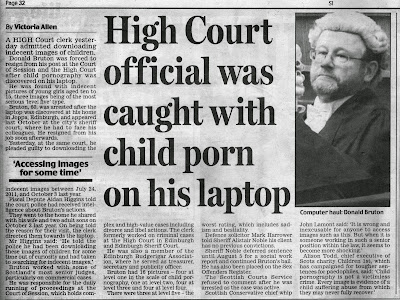
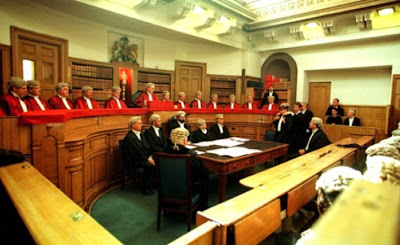
Court of Session was workplace of clerk who admitted downloading child porn. A HIGH COURT clerk & close confidante of Scotland’s top judges in the Court of Session has admitted downloading child porn images while he was employed by the Scottish Court Service. Donald Bruton, who resigned from the Scottish Court Service after child pornography was discovered on his computer pleaded guilty to downloading the indecent images between July 24, 2011, and October 3 last year.

This latest case involving a figure close to Scotland’s judges on charges of child porn is one of many instances were staff working at the Scottish Court Service (SCS) and even prosecutors at the Crown Office & Procurator Fiscal Service (COPFS) have been linked to the downloading of, and in some cases distributing child porn images. However, not all cases have resulted in prosecutions …

The Daily Mail reports:

HIGH COURT OFFICIAL WAS CAUGHT WITH CHILD PORN ON HIS LAPTOP

By Victoria Allen Daily Mail

A HIGH Court clerk yesterday admitted downloading indecent images of children.

Donald Bruton was forced to resign from his post at the Court of Session and the High Court after child pornography was discovered on his laptop.

He was found with indecent pictures of young girls aged ten to 15, three images being of the most serious 'level five' type.

Bruton, 60, was arrested after the laptop was discovered at his home in Joppa, Edinburgh, and appeared last October at the city's sheriff court, where he had to face his colleagues. He resigned from his job soon afterwards.

Yesterday, at the same court, he pleaded guilty to downloading the indecent images between July 24, 2011, and October 3 last year.

Fiscal Depute Aidan Higgins told the court police had received intelligence about Bruton's actions.

They went to the home he shared with his wife and two adult sons on October 3 last year. On being told the reason for their visit, the clerk directed them towards the laptop.

Mr Higgins said: 'He told the police he had been downloading these images of children for some time out of curiosity and had taken to searching for indecent images.'

Bruton worked with some of Scotland's most senior judges, particularly on commercial cases.

He was responsible for the daily running of proceedings at the Court of Session, which holds complex and high-value cases including divorce and libel actions.

The clerk formerly worked on criminal cases at the High Court in Edinburgh and Edinburgh Sheriff Court. He was also a member of the Edinburgh Budgerigar Association, where he served as treasurer, secretary and publicity officer.

Bruton had 16 pictures - four at level one in the scale of child pornography, one at level two, four at level three and four at level four. There were three at level five - the worst rating, which includes sadism and bestiality.

Defence solicitor Mark Harrower told Sheriff Alistair Noble his client has no previous convictions.

Sheriff Noble deferred sentence until August 5 for a social work report and continued Bruton's bail. He has also been placed on the Sex Offenders Register.

The Scottish Courts Service refused to comment after he was arrested as the case was active.

Scottish Conservative chief whip John Lamont said: 'It is wrong and inexcusable for anyone to access images such as this. But when it is someone working in such a senior position within the law, it seems to become more shocking.'

Alison Todd, chief executive of Scots charity Children 1st, which has campaigned for tougher sentences for paedophiles, said: 'Child pornography is not a victimless crime. Every image is evidence of achild suffering abuse from which they may never fully recover.'

Wednesday, June 04, 2014

All rise for 18th Century as Scottish Court Service announce cull of local courts in new delivery of justice services for Scotland

Delivery of justice in Scotland set back 300 years say critics. THE Scottish Court Service (SCS) has announced it is creating a new court structure “for the future” in the restructuring of court services in Scotland which will result in the closure of most local courts across the country under the guise of reform. The sweeping proposals to cull many of Scotland’s local courts were  set out in Shaping Scotland's Court Services, published following a ‘public consultation’ organised by the court service & Scottish Government.

However, critics of the plans which include both legal professionals and court users say the move is little more than a move by the Scottish Government to centralise justice in a handful of justice hubs where cases and their outcomes can be more easily controlled or influenced by vested interests.

Commenting on the planned changes a solicitor said: “We are turning the clock back three hundred years on the delivery of justice in Scotland.”

Court users & consumer groups have also pointed out it will be even more difficult than present for members of the public to obtain access to justice once local courts have closed.

Delivering court services for the 21st century

The Scottish Court Service (SCS) is creating a new court structure for the future and Phase II gets underway on May 31, 2014.

From that date, court business previously held in Stonehaven, Cupar and Arbroath Sheriff and Justice of the Peace Courts will transfer to Aberdeen, Dundee and Forfar Sheriff and Justice of the Peace Courts respectively.

The court restructure is part of some of the most visionary changes to Scotland's justice system in well over a century and supports legislative reform, improves services and facilities for court users, including victims and witnesses, and is affordable in the long term.

The volume of business transacted in the courts which will close over a two year period, is around 5% of the overall court business across Scotland. Court capacity in all receiving courts will be supported by the transfer of staff and members of the judiciary from closing courts to deal with the business.

SCS Chief Executive Eric McQueen said: "Our vision is to have court structures in place that are cost effective, proportionate, accessible and efficient. Cases and appeals will be heard by the right court in both civil and criminal cases, with the highest courts reserved for the most serious and complex cases. Court procedures will be as easy as possible to understand and access and cases dealt with as efficiently as possible once they come to court.

"To achieve this we are targeting our investment to create a modern court structure throughout Scotland. Our Corporate Plan for 2014-17 sets out our programme for the next three years to transform our services and put digital innovation at their heart.

"Investing in fewer courts enables us to make these improvements to facilities and technology, which will provide better services for all court users, and in particular victims and witnesses. Where sheriff courts are closing we have installed facilities to allow victims and witnesses to use video technology to give evidence or make contact with the court, where this is allowed by the current legislation. Future legislative changes will extend the circumstances where video links are possible in criminal and civil procedures."

Arbroath Sheriff and Justice of the Peace Court business will transfer to Forfar Sheriff and Justice of the Peace Court where the SCS has been able to target savings to invest in improved court facilities. Improvements are being made for vulnerable witnesses; new accommodation is provided for the Witness Service and better custody facilities as required by HMIP (Her Majesty's Inspectorate of Prisons for Scotland).

Similarly in Dundee Sheriff and Justice of the Peace Court, which will take the business from Cupar Sheriff and Justice of the Peace Court, the SCS has improved accommodation for witnesses and jurors, providing new non-custodial interview rooms and created catering facilities to serve all court users. With the High Court no longer sitting in Dundee the court will have ample capacity to deal with future business levels and will be fully fit for purpose.

In Aberdeen, where court business will be taken from Stonehaven, construction is already underway of a modern and fully equipped civil centre and commercial court with state of the art technology. The separation of criminal and civil proceedings at this location will provide a greatly improved court environment allowing, for example, children's hearings to take place in a more appropriate courtroom setting.

There will be no compulsory redundancies in delivering this programme.

Restructuring relating to the closure of courts required approval by the Scottish Parliament.

In November 2013 the following courts closed in Phase I of the programme:
Annan JP Court, Cumbernauld JP Court, Irvine JP Court, Motherwell JP Court, Dornoch Sheriff & JP Court, Kirkcudbright Sheriff & JP Court, Rothesay Sheriff Court.

May 2014 phase II:

Arbroath Sheriff & JP Court, Cupar Sheriff & JP Court, Stonehaven Sheriff & JP Court.

January 2015 phase III:

Dingwall Sheriff & JP Court, Duns Sheriff & JP Court, Haddington Sheriff & JP Court, Peebles Sheriff & JP Court.

Other changes will see High Court trials concentrated mainly in the Edinburgh, Glasgow and Aberdeen centres and over a ten year period, sheriff and jury trials will become focussed in 16 mainland courts. The four island courts will continue to hear all business within the jurisdiction of the sheriff. These courts will also deal with specialist civil business, with the remaining courts dealing principally with the jurisdiction of the new summary sheriffs proposed by the Courts Reform (Scotland) Bill.

More information on Shaping Scotland's Court Services:

Scottish Court Service – Corporate Plan 2014-17

Scottish Government - Making Justice Work

Monday, April 05, 2010

Scottish Court Service now independent from Government although staff remain civil servants under Lord President's leadership

The changes to the Scottish Courts Service, brought about by the Judiciary and Courts (Scotland) Act 2008 are covered by Peter Cherbi’s “Diary of Injustice in Scotland” law blog, in a manner more comprehensively than we can report after just returning from the Easter break …

Scottish Courts Service becomes an ‘arm's length’ independent quango led by Lord President & corporate board

Scottish Courts ServiceThe status of the Scottish Courts Service, the organisation which runs Scotland’s Courts has been changed by the Scottish Government into what some in the legal profession now describe as an ‘arms length’ independent’ body, governed by a Corporate Board chaired by Scotland’s top judge, the Lord President Lord Hamilton. It is claimed, the new arrangements, introduced from 1st April, “will reaffirm the independence of the judiciary and help improve strategic decisions about the operation of the Scotland’s courts.”

The new arrangements, set out in the Judiciary and Courts (Scotland) Act 2008, are intended to improve the justice system by modernising the arrangements for the judiciary and strengthening the relationship between the judiciary and the Scottish Court Service (SCS).

Lord Hamilton judicialLord President Lord Hamilton. Commenting on the changes, the Rt Hon Lord Hamilton, the Lord President and Chair of the SCS Board said: “The changes taking place today - the creation of a Scottish Court Service under the direction of an independent Board and the creation of a unified judiciary - are important constitutional changes. The effect will be to place the Scottish Court Service decision-making process closer to those who are directly involved in the delivery of justice. I believe the new arrangements will provide an opportunity for the creation of a better and closer relationship between judicial office holders and staff, working together to deliver to the public the sound and prompt judgments to which it is entitled.”

“The members of the Board have among them a wide range of knowledge, skills and experience of working within the courts, in government and in the commercial sector. This breadth of understanding will help us develop the direction of the Scottish Court”

“Service and the delivery of services to all those who have need to use them. It will allow us, over the next few months, to consider and develop the strategic direction for the Service. We face, along with the public sector generally, difficult financial conditions. We must not underestimate the challenges this presents.”

In addition to the Lord President, the Scottish Court Service Board includes 12 other members – six members from different tiers of the judiciary and six non-judicial members, including the SCS Chief Executive, an advocate, a solicitor and three members with experience and knowledge from other backgrounds, including business, finance and administration. The ‘new’ members of the Scottish Court Service Board are The Lord President, Lord Justice Clerk, Chief Executive of the Scottish Court Service, The Rt Hon Lord Reed, Sheriff Principal R Alastair Dunlop QC, Sheriff Derek Pyle, Sheriff Iona McDonald, & Mrs Johan Findlay JP (all Judicial Members), Mr Robert Milligan QC (Advocate Member), Mr Mark Higgins (Solicitor Member), Mrs Deborah Crosbie, Mr Anthony McGrath & Mrs Elizabeth Carmichael CBE (Members from ‘outside’ the justice system).

The SCS Board will develop the strategic direction for the Scottish Court Service and deliver an operationally effective SCS, which is responsible for providing the staff, buildings and technology to support Scotland’s courts, the work of the independent judiciary, the courts’ Rules Councils and the Office of the Public Guardian.

The new SCS will work closely with the judiciary, Scottish Government, other justice agencies, professional bodies and consumer and court user organisations to help maintain and strengthen public confidence in the Justice system. SCS Chief Executive Eleanor Emberson has been appointed as Chief Executive to the new organisation. Ms Emberson has been Chief Executive of the Scottish Court Service since 2004. The Scottish Court Service remains part of the Scottish Administration and staff continue to be civil servants.

Those interested in the changes to the Scottish Courts Service status, which have come about from the Judiciary and Courts (Scotland) Act 2008 can view video coverage of the Lord President’s appearance at the Scottish Parliament at LawyerTV where the Lord President was questioned by members of the Justice Committee. While Lord Hamilton, the Lord President was mostly in favour of the bill, former Court of Session judge Lord McCluskey was more critical of many key points, including the amount of Judicial Administration Duties involved in the now passed legislation, along with questions over Judicial Independence.

Lord Hamilton on appointing the Judiciary – An element of trust involved …

Profiles of the members of the ‘new’ Scottish Court Service Board :

The Rt Hon Lord Hamilton, Lord President and Lord Justice General (Arthur Campbell Hamilton).Chair of the Scottish Court Service BoardLord Hamilton was appointed Lord President in December 2005. He was appointed a Judge of the Court of Session in 1995. He is a graduate of the Universities of Oxford (BA, Worcester College) and Edinburgh (LLB). He was admitted to the Faculty of Advocates in 1968.

The Rt Hon Lord Gill, Lord Justice Clerk (Brian Gill) Lord Gill was appointed Lord Justice Clerk in November 2001. He was appointed a Judge of the Court of Session in 1994. He is a graduate of the Universities of Glasgow (MA, LLB) and Edinburgh (PhD). He was admitted to the Faculty of Advocates in 1967, appointed Queen’s Counsel in 1981 and is a member of the English Bar.

Chief Executive of the Scottish Court Service. The Board appointed Eleanor Emberson as Chief Executive of the Scottish Court Service in February 2010. Ms Emerson was Chief Executive of the Scottish Court Service from 2004.The Board will appoint a chief executive in due course, who will also be a member of the Board.

Members of the Board appointed by the Lord President

The Rt Hon Lord Reed (Robert John Reed)
Lord Reed has been a judge of the Court of Session since 1998. He was appointed to the Inner House in 2008, having previously been the principal judge of the Commercial Court. He was admitted to the Faculty of Advocates in 1983.

Sheriff Principal Alastair Dunlop QC
Alastair Dunlop QC has been Sheriff Principal of Tayside, Central and Fife since 2000. He was educated at Trinity College, Glenalmond and the University of Dundee (LLB). He was admitted as a solicitor in 1976 and called to the Faculty of Advocates in 1978. He was appointed Queen’s Counsel in 1990. He is currently a member of the Judicial Studies Committee and chairman of the three local criminal justice boards in his sheriffdom.

Sheriff Derek Pyle
Sheriff Pyle has been a sheriff for ten years. He is based at Dundee and was, prior to that, a sheriff in Inverness. He was formerly a solicitor in private practice in Edinburgh, specialising in commercial litigation. He has a particular interest in the reform of civil law and procedure in commercial disputes and was instrumental in founding the Highland Commercial Court.

Sheriff Iona McDonald
Sheriff McDonald was appointed a part-time Sheriff in 1995 and a full time Floating Sheriff in 2000. She has been Senior Sheriff at Kilmarnock since 2007. She is a graduate of the University of Glasgow (MA, LLB) 1978 and was a solicitor in private practice for almost 20 years.

Mrs Johan Findlay JP
Johan Findlay has been a Justice of the Peace since 1986 in Dumfries and is immediate past Chairman of the Scottish Justices Association. She was a Member of the Parole Board for Scotland from 2000 to 2006 and is an Honorary Sheriff. She is author of ‘All Manner of People, the History of the Justices of the Peace in Scotland’.

Mr Robert Milligan QC
Robert Milligan took silk in 2009. He is a graduate of the universities of Oxford (BA, University College) and Edinburgh (LLB and Dip LP). He was admitted to the Faculty of Advocates in 1995

Mr Mark Higgins
Mark Higgins is a practising solicitor and a member (partner) of the multinational firm Irwin Mitchell LLP. He is a graduate of the University of Glasgow (LLB (Hons) and Dip LP) and is the author of the book Scottish Repossessions (W Green, 2002).

Mrs Deborah Crosbie
Deborah Crosbie graduated from Strathclyde University in 1991 BA (Hon) in Business law and industrial relations. She has had a successful career in the financial services industry and is currently Chief Information Officer for the UK businesses (Clydesdale & Yorkshire Bank) of the National Australia Bank.

Mr Anthony McGrath
Anthony McGrath, graduated from Glasgow University in 1978 BSc (Hon) in Mathematical Statistics. He has had a successful career in marketing and management in the food and drinks industry, including 11 years with Scottish and Newcastle, latterly as a member of its Group and UK management boards. Since 2005 he has been managing director of a chain of public houses.

Mrs Elizabeth Carmichael CBE
Elizabeth Carmichael graduated from Edinburgh University in 1970 MA (hons) History. She has spent most of her working life in the Civil Service, retiring in 2007. From 1999 – 2007 she was Head of the Community Justice Services Division, and since then she has taken on governance roles in the public and voluntary sector, as a Board member of the Scottish Social Services Council and the Deputy Chair of SACRO.

MacAskill tight lippedScotland’s Justice Secretary Kenny MacAskill. Kenny MacAskill Cabinet Secretary for Justice made little comment on the changes, simply saying : “Today marks a milestone in the work being done to modernise and strengthen arrangements for the Scottish judiciary and administration of the courts. It is fundamental to any democracy that the judiciary is independent of the legislative and executive branches of government.”

For my part, I note the appointment of Sheriff Alastair Dunlop QC, who represented me in the case against crooked Scottish Borders lawyer Andrew Penman, and was prepared to take Mr Penman to court and have his negligence & deceit exposed for all to see.

However, the then Alastair Dunlop QC, was speedily appointed to the bench as a Sheriff after just a week had passed after I'd met him, denying my access to my own legal counsel & the court as I couldn’t find another advocate who was allowed to continue the case.

I have the feeling we are looking at the formation of yet another quango to run the justice system in its own interests, rather than the interests of the public who has to pay for it through taxes … and only time will tell if any actual improvements come about through these ‘changes’ …

Wednesday, October 21, 2009

Scotland's 'rent boy’ justice system under investigation as revelations speak of ‘impropriety’ among leading figures in legal establishment

Lord Dervaird Quits - Daily Record Dec 23 1989Magic Circle affair brought down Lord Dervaird. While reports leaking out from a divorce case this evening suggest that at least one senior member of Scotland's legal establishment, and several leading lawyers are currently 'under investigation' for ‘impropriety’ with teenage male prostitutes in Edinburgh and across Scotland, we take a look back at the 'Magic Circle scandal, which was unsurprisingly put to bed in the early 1990's in the traditional Scottish way as “nothing happened here, move along please” (oops, looks like they were errm .. wrong ?- Ed)

Ah those were the days (now upon us again ! – Ed)

Gay threat to justiceCases for ConcernRent Boy & SheriffAmnesty for Fettes Raider & Every word is trueLord Dervaird Quits - Daily Record Dec 23 1989Law Chief held with rent boy - Sunday Mail 3 May 2009 eLawyer accused of flashing at boy, 13 -  Daily Record April 13 2006

Magic Circle Affair

Saturday, May 16, 2009

Law & Order : MacAskill ‘declares war’ on fine dodgers unpaid £10 million

Justice Secretary Kenny MacAskill has apparently declared war on thousands of fine dodgers who have yet to pay nearly £10 million in fines much needed to fill the Government’s coffers. (or expenses accounts – Ed)

The Scotsman reports :

Fine dodgers owe £10m but the blitz to collect starts now

Published Date: 16 May 2009
By Michael Howie

JUSTICE secretary Kenny MacAskill yesterday declared war on fine defaulters who are escaping penalties worth a total of nearly £10 million.

He said fine dodgers were "running out of chances" as a campaign to boost fine collection, including a summer blitz by sheriffs' officers, was announced.

Court officials will also attempt to overcome the red tape that is hampering efforts to take benefits away from persistent defaulters.

The Scottish Court Service (SCS) is to be granted access to a database of every benefits recipient in Scotland to establish which fine defaulters are receiving state hand-outs.

And online tracing services will be used for the first time to track down fine dodgers who change address without telling the court.

Of nearly £100m worth of fines imposed in sheriff courts in the past four years, £75.8m has been paid in full.

Some £5.8m is due in future instalments, with £10m worth of fines discharged and arrears of £7.2m.

Arrears for Justice of the Peace fines, fiscal fines and other fixed penalties total about £2m.

Mr MacAskill, who yesterday visited the service's Glasgow fine enforcement team, said: "Non-payment is unacceptable and the SCS is right to target those who have ignored warnings to date.

"Fine dodgers should be clear that they're running out of chances and now face a range of sanctions to ensure they pay their debt to society."

Fine enforcement officers were brought in just over a year ago to collect fines in a bid to reduce the burden on police and courts.

The officers can help and advise those who are genuinely struggling to make payments, but when people deliberately refuse to pay they have powers to dock wages, freeze bank accounts or request that a court orders deductions from benefits. They can also seize vehicles that may, by the order of court, be sold, or send the case to court if none of these options works.

Mr MacAskill said such officers were a "key part of the summary justice reforms that are freeing up more police to keep our streets safe and enabling the courts to focus proceedings on serious criminal cases".

And he added: "As the new measures take effect, I expect to see payment rates improve still further over the next year."

Eric McQueen, director of field services at the SCS, said that "overall, fine collection rates are higher than ever".

But he added: "We can continue to improve collection rates and the new tracing facilities we are introducing will identify addresses, employment and benefits details, making fines easier to collect.

"Our message is clear: fines must be paid."

Tuesday, May 12, 2009

MacAskill fails to shine at Holyrood on McKenzie Friend questions

Justice Secretary Kenny MacAskill came up with anything but a straight answer to questions posed by Margo MacDonald MSP at the Scottish Parliament on the subject of enacting McKenzie Friends in the Scottish courts.

While England & Wales has had McKenzie Friends for some 39 years, Scotland’s Justice Secretary can only manage further delays, however, we might be saved by Lord Gill in his forthcoming review of the Civil justice system, where it is rumoured he supports the introduction of McKenzie Friends to Scotland. (Not if the Law Society have their way – Ed)

Kenny MacAskill faces questions over the 39 year lack of McKenzie Friends in Scottish Courts.

McKenzie Friends

5. Margo MacDonald (Lothians) (Ind): To ask the Scottish Executive whether it will introduce the practice of allowing a McKenzie's friend into law courts. (S3O-6781)

The Cabinet Secretary for Justice (Kenny MacAskill): The term "McKenzie friend" refers to the practice in English and Welsh courts in which parties are given assistance from someone other than a lawyer in presenting their case in court. At present, a party may be represented by a friend, relative or lay representative, such as a citizens advice bureau representative, in the small claims and summary cause sheriff courts. That covers actions up to a value of £5,000.

The right hon Lord Gill's civil courts review is considering the issue of McKenzie friends. I look forward to receiving his report, which is expected in June, and I will carefully consider all his recommendations about McKenzie friends and about wider issues concerning those who represent themselves in court. Those wider issues include the funding of court actions, improved court procedure and other methods of dispute resolution.

Margo MacDonald: I thank the cabinet secretary for his reply and for his attention to Lord Gill's upcoming report. Before its publication, he will see the petition on the matter that was discussed in committee just two days ago.

I draw to the cabinet secretary's attention that the McKenzie friend system, which we advocate, does not allow anyone to advocate on behalf of someone in court; the McKenzie friend is simply there to advise or support a person who might be without legal representation. The cabinet secretary must agree with me that that would only enhance the procedure in Scottish courts.

Kenny MacAskill: Anything that makes people more comfortable in a court environment is to be welcomed. There must be majesty of the court and the experience of court can be traumatic for whatever reason, so people's ability to have support is important.

The question of who has formal representation rights is of greater complexity and must be considered in the round. We have addressed the issue at small claims and summary levels, and there can be representation in some debt cases in ordinary actions. We have broadened the approach to give the Association of Commercial Attorneys various powers, which have been signed off by the Lord President. One thing that differentiates Scotland from England is that there is wider access to legal aid in Scotland than there is south of the border, which means that there is greater opportunity for representation.

Lord Gill must consider the matter because it is not simply about comfort and people's ability to be assisted in court, whether by a lay or legal representative, but about whether court is the appropriate forum in which to deal with a matter. That is why the issue should be considered in its totality. I look forward to Lord Gill's review, and I will be more than happy to discuss the matter thereafter.

Tuesday, May 05, 2009

Law & Order : Holyrood Justice Committee blocks MacAskill’s court closure plans

Justice Secretary Kenny MacAskill’s plans to close three small courts were blocked at Holyrood by MSPs as Holyrood’s Justice Committee criticised plans to close the district courts at Annan in Dumfriesshire and Girvan and Cumnock in Ayrshire.

The Scotsman reports :

Move to shut local courts blocked by MSPs

Published Date: 05 May 2009

SCOTTISH Government moves to close three small local courts were today blocked by MSPs.

The rebuff for ministers came from Holyrood's Justice Committee where MSPs criticised plans to close the district courts at Annan in Dumfriesshire and Girvan and Cumnock in Ayrshire.

Under the plan, their workload would be moved to Dumfries and Ayr respectively.

But Labour and Liberal Democrats argued against it and a motion by Labour MSP Dr Elaine Murray to block the move was passed by a 5-3 majority.

The issue is now likely to go before the full Parliament next Wednesday for a debate and vote.

Justice Secretary Kenny MacAskill later accused his opponents of "political games," a charge angrily denied by Dr Murray, MSP for Dumfries, and Cathy Jamieson, Labour MSP for Carrick, Cumnock and Doon Valley.

Speaking after the committee's move, Mr MacAskill told reporters: "We will need to consider – clearly we are disappointed."

He said the plans was part of reforms launched by the previous administration and similar rural court changes had already taken place in the Highlands, Grampian and elsewhere.

"But it seems some political games are being played, rather than the best interests of justice", he said.

But Ms Jamieson called that comment "outrageous" and said it was not a party issue.

"I was at the committee representing the views of my local constituents, which include the leader of the SNP-controlled council in East Ayrshire, and the local justices' committee," she said.

And Dr Murray said: "There was cross-party support for retaining Annan district court.

"It's not about political games – we believe access to justice is not best served by centralising courts in Dumfries.

Plans to close the courts form part of a wider shake-up of Scotland's summary justice system.

The shake-up involved replacing district courts with justice of the peace courts, which are administer by the Scottish courts service – and in some cases the courts are being relocated.

At today's meeting Mr MacAskill and officials of the court service and Crown Office defended the changes planned for the sheriffdom of South Strathclyde, which covers the three closure-listed courts.

But the plans were criticised by Labour as unnecessary centralisation, and Liberal Democrat Robert Brown said the critics had a "reasonable" case.

Mr MacAskill and official argued that the change would lead to better court accommodation, and that the inconvenience caused to some by the relocation was countered by the gains for others.

And in the case of Annan, it was argued, the vast majority of court business did not involve local people but motorists booked for traffic offences on the M74 motorway.

Mr MacAskill told the committee: "Some towns have both a sheriff and district court, neither of which is fully employed.

"In those situations we would take the opportunity to realise sensible efficiencies through rationalisation and upgrade of the estate."

He said other changes to the summary justice system would result in fewer people having to attend court.

There would also be improvements by putting district courts under the wing of the Scottish courts service rather than 32 different local authorities.

"Local access to justice has not been significantly compromised," he said.

"We are satisfied that the recommendation has been carefully considered with regard to all interests, and represents the best arrangement for the provision of summary criminal courts in the sheriffdom."

But Dr Murray argued that the planned closure of Annan district court was based on wrong assumptions.

For residents of Langholm, the Annan closure would make Dumfries their nearest court, but with no train or direct bus service there.

Dumfries and Galloway Council would be prepared to make a contribution of at least £20,000 to upgrading health and safety requirements at the Annan court.

And in a written submission, Dr Murray said: "People from Langholm will require to travel 40 miles to pay their fine at Dumfries Sheriff Court.

"People situated to the east of Annan will therefore find themselves in the ridiculous position that it would be more convenient for them to have fines etc transferred to Carlisle magistrates court in England which they could at least reach by way of public transport services".

Cathy Jamieson told of local opposition to the Ayrshire changes and said: "My concern is not simply about the buildings, but also about the wider message this sends to local communities.

"We are moving away from a system based on community involvement in justice to something which is literally more remote."

Law & Order : MacAskill’s Fiscal fines scheme a spectacular failure as 15,000 remain unpaid

Justice Secretary Kenny MacAskill’s amazing yet ineffective scheme for handing out ‘Fiscal fines’ to those convicted of minor criminal offences, as an alternative to prison, has been pronounced a spectacular failure by the legal profession, and opposition political parties, as revelations so some 15,000 fines have gone unpaid so far.(Everyone told you so, Kenny – Ed)

The Scotsman reports :

Fast fines scheme 'a failure' as 15,000 go unpaid

Published Date: 05 May 2009
By Michael Howie

NOT a penny has been paid of nearly 15,000 fiscal fines issued to offenders in Scotland last year, prompting widespread condemnation of the system and demands for an inquiry.

Leading QC Paul McBride last night led calls for the scrapping of the controversial fines, which are offered to minor criminals as an alternative to prosecution and were intended to ease pressure on the courts.

Procurators fiscal can offer fines of up to £300 to people accused of offences that would previously have been dealt with in sheriff courts, up from £100 last March. The system aimed to deliver swift justice to offenders while allowing courts to concentrate on serious criminals.

But figures published yesterday appeared to undermine a key argument behind the measure, with more than half of fines imposed last year not being paid in full – and nothing paid back in 41 per cent of cases. This was despite the recruitment of dozens of enforcement officers.

Mr McBride said: "There now has to be a complete rethink about fiscal fines and their effectiveness, because it is plain from today's figures they're no longer working in the way the government suggested they would."

Conservative MSP Margaret Mitchell branded the figures an "absolute disgrace" and said they showed a criminal justice system in "meltdown".

Statistics given to Ms Mitchell by Justice Secretary Kenny MacAskill showed penalties worth £3.7 million were imposed by prosecutors last year as an alternative to court action. Of this total, £1.3m had been collected, £1.2m was being paid in agreed instalments and the other £1.2m was in arrears.

No payments at all had been made in 14,741 fines, or 41 per cent of the total, while a further 4,769, or 13 per cent, were in arrears. More than 57,000 warning letters had been sent out. Ms Mitchell said: "These figures are an absolute disgrace. It is surely bad enough that 54 per cent of fiscal fines, or 19,510, remain either unpaid or only partly paid, but the real revelation is the shambolic administration of these fines."

Describing the number of warning letters as "astonishing", she said: "How much have these letters cost in time and resources? In addition to the letters, there have been 4,485 court citations (notices to attend court) and over 14,000 enforcement orders applied."

Fiscal fines are usually issued to non-violent "low-level" offenders.

The option of the fine is offered to an accused via a letter from the procurator fiscal, after the alleged offender has been arrested and details of the offence reported by the police. Fiscal fines do not result in a criminal record, but they can be referred to in court for up to two years. If the accused refuses to accept the fiscal fine, they go to court.

A recent report by the Inspectorate of Prosecution gave fiscal fines a clean bill of health, stating the great majority of those examined were appropriate and proportionate.

But the scale of unpaid fines – an issue the inspection report did not cover – also came under fire last night from Labour and the Liberal Democrats.

Richard Baker, Scottish Labour's justice spokesman, said: "The fact that nothing has been paid back on 41 per cent of the fines issued last year does make a mockery of the system," he said.

"The public will only have confidence in the summary justice system if fines are paid and they are an effective penalty."

He said unpaid fines meant less money was available to invest in police and other services that could cut crime. "This is an unacceptable situation that the Scottish Government must address as a matter of urgency."

Lib Dem justice spokesman Robert Brown called on Bill Aitken, the convener of the Scottish Parliament's justice committee, to instigate a review.

"Given that the Tories are clearly also concerned, perhaps the justice committee should now examine this in more detail, with a view to developing suggestions to improve the system of fiscal fines," he said.

Lord Advocate Elish Angiolini has backed the use of fiscal fines and other so-called "direct measures" – including fiscal warning letters and compensation orders – claiming they have helped reduce the time it takes more serious cases to get to court.

The news about fiscal fines also comes hard on the heels of revelations that one in five court fines imposed is unpaid. Statistics obtained under Freedom of Information legislation showed collection rates running at just over 80 per cent for fines imposed by sheriffs and only 70 per cent for those handed out by justices of the peace.

Criminals and minor offenders owe at least £9.2m in overdue court fines – enough to hire more than 300 extra police constables a year.

A Scottish Government spokesman said a new enforcement regime had been introduced last year. "The regime, approved by the previous parliament, includes new fines enforcement officers whose work has freed up more police to keep our streets safe and enabled the courts to focus on serious criminal cases," he said.

"Following their recent information campaign, the Scottish Court Service is rightly taking several steps to target those who have ignored warnings over the first year and we hope to see further progress over the next year."

The court service said sheriffs had imposed £98.8m in fines in 2005-8. It said £75.8m had been paid and a further £5.8m was expected to be paid in instalments, meaning an overall collection rate of just over 80 per cent.

Sheriffs discharged another £10m in fines, often because offenders, including some defaulters, had been given alternative sentences, such as jail. Some £7.2m in sheriff court fines remained officially in arrears, with those who owe the money effectively going unpunished.

The court service said new justice of the peace courts issued £2.9m worth of fines between 10 March and 31 December last year, and £700,000 of that was already in arrears.

Yet another shambles in soft-touch Scotland

FISCAL fines were once billed as the great solution to dealing with petty offences and offenders – intended to free up the courts from trivial cases, prevent people from having unnecessary criminal records and streamline an over-crowded court system.

These are fines sent to people who otherwise would expect to be prosecuted but have the option of paying the penalty instead of appearing in court.

The policy was introduced by the government and the responsibility for the manifest failure of fiscal fines lies exclusively with it.

The procurator fiscal service has done its level best and has acted with total propriety in the way it has gone about its business, but the figures speak for themselves: out of £3.7 million in penalties imposed last year as an alternative to court action, only £1.3m has been collected.

In 15,000 cases, no payments have been made at all – 41 per cent of the total – and in another 15 per cent of cases the fines were in arrears.

Further expense has been imposed on an over-stretched criminal justice system by employing fines enforcement officers. And while more than 3,000 enforcement orders were applied, in only 750 cases were fines deducted from benefits.

No amount of spin can reveal anything other than that the policy has been an unmitigated disaster and one wonders about the expense and levels of bureaucracy which have resulted. The effect of all of this is that many people who have committed offences have escaped any form of punishment.

We know court sentences bear no relation to what people actually serve, we know that the government intends to abolish imprisonment under six months, we know that it has abandoned US-style courts that it had planned to introduce, and we further know that there has been a complete U-turn on controlling the sale of knives.

This week Scotland was described by the United Nations as being the most violent nation in Europe and we know that violent crime has risen by 12 per cent.

We also know that every 45 minutes someone breaches an order of bail imposed by the courts.

This latest shambles demonstrates that Scottish law and order policy has become an embarrassment and criminals no longer fear either the police or the courts: welcome to soft-touch Scotland thanks to the policies of the SNP and its Labour predecessor.

Wednesday, April 29, 2009

McKenzie Friends could come to Scottish courts as Holyrood considers 'access to justice' petition

The ability to have a McKenzie Friend by your side in an English courtroom should be extended to Scotland after a 39 year unwarranted exclusion, say access to justice campaigners, and the petitioner, Mr Stewart MacKenzie.

Peter Cherbi’s “Diary of Injustice” law blog reveals more on the merits of the McKenzie Friend petition and why having a McKenzie Friend at your side (if you can’t obtain the services of a solicitor) may very well be a good thing for justice and the courts. (Yes, high time McKenzie Friends were recognised and allowed in Scotland’s courts – Ed)

Diary of Injustice reports :

'McKenzie Friend' proposal to Parliament seeks to end 39 years of lawyers monopoly over Scots access to justice

Law Society of ScotlandLaw Society 'monopolises' Scots access to court. THIRTY NINE YEARS after laws allowing a 'McKenzie Friend' in the English courts system were introduced to facilitate the public's access to justice by allowing a not necessarily qualified legal individual to assist a person in court, a McKenzie Friend Petition (Petition 1247) has been put to the Scottish Parliament at Holyrood, asking for the implementation of the same privileges of a ‘McKenzie Friend’ to be granted in Scotland, to help many who find it difficult through the current system of legal representation, controlled by the Law Society of Scotland, to secure access to the Scottish Courts.

McKenzie's friend Petition PE1247 Page 1McKenzie Friend petition will end 39 years of prejudice against Scots ‘justice rights’ in Court. The petition, brought to the Scottish Parliament by Mr Stewart MacKenzie, calls on the Scottish Parliament to urge the Scottish Government to introduce a McKenzie Friend facility in Scottish courts as a matter of urgency. Mr MacKenzie’s case involving the legal profession became famous, when revelations of secret internal memos documenting a claims fixing policy at the Law Society of Scotland, resulted in a televised confrontation between Mr Swinney & former Law Society Chief Douglas Mill during the Justice 2 Committee's investigation of the now passed into law Legal Profession & Legal Aid (Scotland) Act 2007. The memo-gate scandal eventually toppled Douglas Mill as Law Society Chief Executive in January 2008.

Mr MacKenzie speaking today to Diary of Injustice said : "I am hopeful the petition will get a good hearing at the Scottish Parliament, and begin the work of ending what is a glaringly prejudicial omission from the public's legal rights & entitlements in Scotland, while people in the rest of the UK have enjoyed and heavily used the right of having a McKenzie Friend accompany them in court hearings for nearly four decades."

John SwinneyCabinet Secretary Swinney will be asked to speak to Holyrood committee on the merits of McKenzie Friends. It emerged today, the Scottish Parliament's Petitions Committee has set a 5th of May hearing for the petition, but has not granted Mr MacKenzie the right to give oral evidence, to which the petitioner replied : "Since I am not being allowed to speak on the merits of my own petition, I have asked my MSP, Cabinet Secretary for Finance, John Swinney, to attend the Petition Committee hearing and speak on my behalf, as he has done so with considerable care and attentiveness on previous occasions."

In England & Wales, the concept of a McKenzie Friend has existed for some 39 years, assisting people in court, who find it difficult to obtain legal representation either through cost or other reasons.

The guidance from the President of the Family Division of the courts in England & Wales states : Where proceedings are held in open court, it is clear from the principles set out in Court of Appeal decisions that a litigant who is not legally represented has the right to have reasonable assistance from a layperson, sometimes called a McKenzie Friend (“MF”).”

A litigant in person wishing to have the help of a MF should be allowed to do so unless the judge is satisfied that fairness and the interests of justice do not so require. The presumption in favour of permitting a MF is a strong one.”

A McKenzie Friend May : • Provide moral support for the litigant • Take notes • Help with case papers • Quietly give advice on: points of law or procedure, issues that the litigant may wish to raise in court, questions the litigant may wish to ask witnesses.

Mr Stewart MacKenzie's 'McKenzie Friend' Petition reads as follows : “39 years after a McKenzie Friend was introduced in the English Courts, we still do not have an equivalent in Scots law. For those who are unable, for whatever reasons, to be represented in court by a solicitor, be it cost or principle, it is unjust, immoral and a breach of their fundamental human right to have a fair hearing with reasonable “equality of arms” as required by Article 6 of the European Convention on Human Rights, to force them to appear in court as a party litigant without the facility of having someone to offer them support and guidance.

As people in Scotland are having their lives ripped apart by having their homes repossessed without the opportunity, as they do in England, to at least have their day in court, it is barbaric and inhuman that this obstinate refusal to ensure that the people of Scotland are not treated in an inferior manner compared with the rest of the United Kingdom when it comes to access to Justice. This is not an attempt to get the Parliament to consider any individual case.”

MacAskill tight lippedJustice Secretary MacAskill criticised over his own failure to reform access to justice. While many of the failures to implement the 1990 access to justice legislation can obviously be pinned on previous Scottish administrations who stood by while the Law Society in effect dictated policies on restricting the individual’s right of access to legal representation and the courts, the current Justice Secretary, Kenny MacAskill, and the Scottish Government have done very little, if anything to improve the lot of members of the public who simply cannot get into court because the legal profession feel it is not in their best interests to allow such cases to go forward.

Justice Secretary Kenny MacAskill to Cabinet Secretary for Business John Swinney 26 July 2007 Justice Secretary’s leaked letter promised cabinet colleague John Swinney that access to justice was happening two years ago. The road to reforming access to justice in Scotland has been a rocky one so far, as almost all attempts to-date of implementing changes allowing the Scots public increased access to justice and the Scottish Courts, have either been thwarted by the legal establishment, or held in political limbo by an exceedingly uncooperative Justice Secretary Kenny MacAskill, who despite promises to Cabinet colleague John Swinney, two years ago in 2007 that change 'was on the way', has in reality made things very difficult for anyone other than solicitors to enter the Scots legal services market to this date and no doubt beyond.

Lord Hardie - Repeal Sections 25-29 24th June 1997High Court Judge Lord Hardie while serving as Lord Advocate, wanted to repeal Scots access to justice legislation. However, while the prickly thorn of reforming access to justice falls to the current Scottish Government to act upon, the legal establishment’s attitude to counter any reforms to increased access to the Scottish Courts go back years, as I revealed in an earlier report where in 1997, the serving Lord Advocate at the time, Lord Hardie, himself advocated repealing the laws which allowed increased competition in the Scots legal services market, which had actually been kept from the public by an intense campaign ran by the Law Society of Scotland for over seventeen years, seeing Sections 25-29 of the Law Reform (Miscellaneous Provisions) (Scotland) Act 1990 only implemented in March 2007 after public queries and the release of documents through Freedom of Information laws which revealed the secret campaign by senior law figures and civil servants within the Scottish Executive to withhold or repeal the access to justice legislation.

A member of the public whose legal case could have significantly benefited from the use of a McKenzie’s friend said today : “"It is a matter of record that Lord Hardie has consistently denied the Scottish Public any meaningful or proper access to the law by his stubborn obstruction of articles 25-29 [of the Law Reform & Miscellaneous Provisions (Scotland) Act 1990], allowing members of the public to be represented by a third party of their choice.“

He went on : “The deafening silence by every major political party which has accompanied this wicked betrayal of trust indicates their tacit approval of it. Disturbingly, the Scottish Courts have also consistently refused to allow recordings of hearings to be made - a proposal also rejected by the Scottish Parliament.”

Given the lack of willingness on the part of the current Scottish Government to speedily reform the Scots legal services market, leaving many clients out in the cold in terms of legal representation, many Scots caught up in legal difficulties feel with some justification, their rights are being impugned by both the legal profession and the Government simply to protect solicitors long held monopoly over access to justice.

Clearly the Scots public could benefit from the McKenzie Friend facility being applied to Scots Law, and as with other legal reforms long overdue, the Scottish Government should act without delay and reverse the 39 year prejudice against ordinary Scots obtaining access to courts, while our English counterparts have enjoyed the use and privilege of a McKenzie Friend at their side.

I therefore look forward to reporting on and watching how the McKenzie Friend petition progresses through the Scottish Parliament .. as surely the public interest of access to justice comes first over protecting solicitors business markets & profits.

Friday, April 24, 2009

Law & Order : Edinburgh Sheriff Court clerk charged with £90k fraud

A former clerk employed by the Scottish Courts Service, at Edinburgh Sheriff Court has, apparently been charged with fraud to the tune of £90k. (I thought the SCS said their staff never got up to this kind of stuff ? – Ed)

BBC News reports :

Former clerk charged with fraud

A former clerk at Edinburgh Sheriff Court has appeared on petition in his former workplace charged with fraud.

Graeme Wilson, 28, of Kirkcaldy, made a brief appearance in private before Sheriff James Farrell on Thursday.

He was charged with obtaining £90,107 by fraud from the Scottish Courts Service between 7 October 2007 and 6 March 2009.

No plea or declaration was made and the case was continued for further inquiry. He was released on bail.

Sunday, August 31, 2008

Historic crimes prosecutions ‘on the back burner’ after Crown Office failures in ‘World’s End’ trial collapse

The notable and spectacular failure of the Crown Office in what has come to be known as the ‘World’s End’ murder trial collapse, where the Crown Office’s chief prosecutor actually absconded from court, has caused a few rethinks on other cases where the prosecution of offenders for crimes which were committed many years ago may never see the light of a courtroom.

The Sunday Herald reports :

Collapse of World's End murder case puts pressure on prosecution of 'historic' crimes

By John Bynorth, Home Affairs Editor

WHEN THOMAS Ross Young appeared in court charged with the murder of 17-year-old Patricia McAdam her family believed a 40-year wait for justice might finally be over.

Today, almost a year later, the prospects of a prosecution are fading and there are fears that other long-standing crimes may never be taken to court.

Legal experts believe that a review published by the Crown Office last month into the failed prosecution of the "World's End murders" will make it more difficult to take action on historic unsolved cases.

Now though, speculation is mounting that the prosecution of a man accused of one of Scotland's longest-running murder cases will be dropped.

McAdam's body was never found when she disappeared after hitching a lift with a friend in a lorry from Glasgow to Dumfries on February 19, 1967.

Her case predated the murders of Helen Scott and Christine Eadie, who were last seen at the World's End public house in Edinburgh, in 1977.

Less than a year ago Lord Clarke threw out the case against convicted killer and sex attacker Angus Sinclair at the High Court in Edinburgh for the murders of Scott and Eadie.

This month the Crown Office produced an internal review of the handling of the World's End case which made a number of recommendations for improvements, which have not been made public.

Two weeks ago, Devon and Cornwall Police decided not to charge the convicted child killer Robert Black with the murder of Genette Tate, a 13-year-old girl who vanished during her paper round in Devon in 1978, after the Crown Prosecution Service cited "insufficient evidence", Black is serving 10 life sentences in a high-security prison for the abduction and murders of schoolgirls Susan Maxwell, Caroline Hogg and Sarah Harper.

And three months after the collapse of the World's End case taxi driver Vincent Simpson was cleared of the murder of Dundee trainee nurse Elizabeth McCabe, 20, in 1980 after the credibility of DNA evidence linking him to the crime came under fire.

The Crown Office and Procurator Fiscal Service (COPFS) has now informed McAdam's relatives that no indictment is to be served "meantime" on Young, although the procedings will remain active against him.

Robert Black, professor emeritus in Scottish law at Edinburgh University, told the Sunday Herald that difficulties in preserving DNA evidence and the ability of an accused's defence to highlight flaws in witness recall could make it increasingly difficult to bring so-called historical cases to trial.

He said: "World's End was an example of how historical cases can pose difficult decisions for the Crown. After decades, people's memories fade and the Crown Office must ask whether the evidence is now strong enough for there to be any reasonable likelihood of a conviction.

"It's no use putting prosecution witnesses through the ordeal of a trial if they are going to be crucified by the defence about what they saw and knew, but may have forgotten.

"If there are clear DNA profiles - and there are not the difficulties with DNA evidence that existed in the World's End case - it's easier. But if such a case is dependent on eyewitness testimony, the more difficult it is for the jury to be satisfied beyond reasonable doubt that it would be safe to convict."

The disappearance of Patricia McAdam in 1967 led to the largest search ever undertaken by Dumfries and Galloway Police until the 1988 Lockerbie disaster with hundreds of officers, supported by teams from forces in Glasgow and England and Wales and unprecedented coverage in newspapers and on TV.

Detectives dug up moorland near where she was last seen and drafted in a Dutch clairyovant, Gerard Croiset, who told police the factory worker's body was dumped in a river. Despite Croiset's claims, McAdam's remains were never traced and the force re-investigated the case as a murder inquiry following a cold case review in 2004.

Retired Detective Superintendent Bill Gillis, Dumfries and Galloway Police's former head of CID, who won the support of his then superiors to reopen the case and lead the Pat McAdam reinvestigation, said: "There was a thorough investigation at the time and it was a significant challenge to reinvestigate the case for my officers. We used the knowledge of the officers at the time to piece together information.

"The case had a big impact on Dumfries and we had an astonishing amount of assistance from the public after we launched a fresh appeal. Everybody remembered where they were when Pat McAdam disappeared.

"But the whole point was to bring some closure to Pat's family. I feel sorry for them. They have been looking for somewhere to grieve, but have not been able to do it."

The COPFS said in a statement: "A report on the re-investigation has been submitted to Crown counsel, who have instructed that no indictment is to be served meantime on Thomas Ross Young. No final decision has been taken in the case, and it therefore remains live. Any additional evidence will be reported for consideration by Crown counsel."

It added that McAdam's next of kin had been advised of the Crown counsel's decision.

David Dunlop, the husband of Pat McAdam's sister, Wendy, said: "The whole case has been going on far too long now. She will not comment." The victim's other siblings Eleanor and Neil also declined to comment.

Young's lawyer John McLeod also refused to discuss the case.

Monday, June 09, 2008

Failure of MacAskill's 'Bring your litigation to Scotland' campaign results in soaring costs of access to civil justice

Well well well .. we told you so !

It seems that Justice Secretary Kenny MacAskill's campaign to get companies and individuals to bring their legal business or litigation to Scotland has failed so much, the only way to bring in more money is to ramp up the fees for accessing civil courts instead !.

Nothing like pricing ordinary folks out of access to justice Mr MacAskill .. another failure ? let's hope the First Minister steps in with some ideas of his own ...

The Scotsman reports :

Cost of going to civil court is set to soar

Cost of going to civil court is set to soar

By Michael Howie

THE price of justice in Scotland's courts is set to soar under controversial government plans.

The Scottish Courts Service has announced that fees for accessing civil courts will increase by as much as 100 per cent.

Civil servants want to end subsidies for the use of courts by thousands of people and firms who every year turn to the law to resolve disputes.

Consumer groups and lawyers say the fee increases are unfair and will disproportionately hit the most vulnerable people in society, such as women who require protection from violent partners.

Scotland's civil courts cost about £30 million a year to run, approximately half of which is paid for by fees and the remainder from the public purse.

The Scottish Government wants to end the subsidy for the vast majority of people who use the civil courts to settle grievances, including personal injury claims, child custody battles and divorce.

The changes, which will have to be approved by MSPs, will increase sheriff court costs by 31 per cent and Court of Session costs by 49 per cent.

Only people who receive civil legal aid – those on benefits and very low incomes – will be exempt from the charges.

The fees are used to pay for the administration of courts, including providing sheriffs and judges.

But the increased charges have been met with a wave of criticism, amid accusations that the government is shirking its responsibility to provide a courts system to settle disputes.

Richard Keen, QC, dean of the Faculty of Advocates, said making criminals pay for the cost of running Scotland's courts would be a fairer system. He said: "We don't expect people to have to pay for their own operation. And we don't expect them to pay the cost of sitting exams. That's because we recognise that the wider society benefits from having a funded national health service and education system.

"One can apply the same argument to accessing the courts. This is going to hit hardest some of the most vulnerable in society, such as people who suffer family breakdowns and women who need protection from violent partners."

Elizabeth Welsh, the vice-president of the Family Law Association, said the move would make it even harder for vulnerable people to get justice.

"Increasingly, people trying to access courts are unavoidable cases like protection orders for domestic abuse victims, or care arrangements for children.

"With civil legal aid being so hard to access, these court fee increases are just another barrier to accessing justice. People are already struggling to be able to afford to go to court."

She added: "There is a principle at stake here. Saying the court users should pay for the costs of running the courts fails to recognise that access to justice is a broader social issue.

"It's in the interest of everyone in society that people who, for instance, suffer domestic abuse, are not barred from going to court because of prohibitively high fees."

Eleanor Emberson, chief executive of the Scottish Courts Service, said: "We are committed to ensuring that Scotland has a cost-efficient civil justice system and we are working on changes to our procedures that make better use of technology and that will give better service to our users. Where we are able to reduce our costs, we will, and those using court services will benefit."

FACT BOX

THE cost of a "proof" hearing in court to settle a personal injury claim is currently £230. Under the proposals, that will increase to £500.

Applying for a "simplified" divorce will rise from £70 to £90.

At the moment, it costs £57 to issue a writ in the sheriff court. The courts service wants to raise that to £75.

Small claims actions up to the value of £50 will jump from £8 to £15, although the same charge will also now apply to claims between £50 and £200, which currently attract a £44 charge. Claims for sums between £200 and £3,000 will rise in cost from £44 to £65.

The cost of a petition to appoint an executor will rise from £12 to £15.

Thursday, June 05, 2008

Sheriff tells two who shot boy in head to watch more cowboy films

Not the best advice one could offer perhaps ?

The Daily Record reports :

Watch more cowboy films, judge tells airgun yobs

Jun 5 2008 By Kurt Bayer

TWO drunken idiots who shot a boy of 14 in the head with an air rifle were told by a sheriff yesterday to watch cowboy films.

Instead of jailing Simon Anderson, 20, and Michael Brankine, 22, sheriff Richard Davidson told them: "The problem is that there are not enough western films on television, where you can see the consequences of ricochets."

Anderson and Brankine fired the rifle from a flat window into a street after aboozing session.

The victim was hit by a stray pellet and called police, who went to the flat.

Anderson and Brankine denied everything at first but Anderson then showed the cops the gun.

The pair said they had planned to go to a park to shoot at cans but then decided to fire at lamp-posts, chimneys and a phone box from Anderson's flat instead.

The boy was heading for the call box when he was shot.

He wasn't badly hurt. But Sheriff Davidson reminded Anderson and Brankine that a two-year-old boy had been killed in Glasgow by a man firing an airgun from a window.

Mark Bonini, 27, got life for murdering little Andrew Morton in 2005.

Sheriff Davidson told the two accused: "You cannot fire into a street and be aware of how it's going to behave once it's been fired.

"It was very good fortune, for you and your victim, that the injury was superficial."

Sheriff Davidson noted that both men were first offenders and were in steady education and employment.

He said: "After conversations with colleagues, and with some reluctance, I've come to the conclusion that it would be inappropriate to send you to prison."

At Dundee Sheriff Court, student Anderson was sentenced to 240 hours' community service after admitting culpably and recklessly firing the air rifle in the city's Park Avenue on January 12.

Brankine, of Langlands Street, Dundee, admitted firing the shot that hit the boy. He also got 240 hours' community service and was told to pay £500 compensation.

Kevin Hampton, for Brankine, said his client was sorry for his "very stupid mistake" and would "never touch a weapon again".

Friday, May 30, 2008

History made as three female judges sit at Court of Session.

History made or business as usual .. whatever it is, its a first in Scots Law as three female judges take the bench on a case centering on a name dispute between two firms.

The Scotsman reports :

Fair ladies: first ever all-female bench

By JOHN ROBERTSON and EMILY GOSDEN

AS THE three judges took their places on the bench in the austere setting of the Court of Session in Edinburgh yesterday, their presence caused an unusual flurry of interest.

Roy Martin, QC, paused before proceedings commenced and said: "I hope my Ladies will not mind if I say what a privilege it is to open submissions in these historic circumstances."

The case of Wise Property Care Ltd (trading as White Preservation) against White Thomson Preservation Ltd and a dispute over the right to use the name would not normally have attracted such attention, except for it being the first time three female judges had sat together on the bench in Scotland.

But last night, legal bodies said the presence of Ladies Paton, Smith and Dorrian on the appeal court bench should not obscure the fact that Scotland's legal establishment is monopolised by men.

Scotland has 34 judges, with one place vacant. Of that number, only four are women, Lady Clark having joined Ladies Paton, Smith and Dorrian in 2006. The first appointment of a female judge, Lady Cosgrove, only came in 1996.

Two QCs, Sheriff Rita Rae and Morag Wise, serve as temporary judges. Of the 450 advocates practising, just 106 are female compared with 344 males.

Last month, the Judicial Appointments Board for Scotland announced it was to carry out an investigation aimed at ending the male monopoly, and examining the barriers against women and people of ethnic minorities progressing into senior positions. Neil Stevenson, head of strategic change at the Law Society, gave yesterday's historic moment a cautious welcome.

"It's great to see a success story, but we have to be realistic: there are still some issues about women becoming partners and taking up judicial appointments. We at the Law Society need to keep campaigning," Mr Stevenson said. But he added: "There are more men than women retiring from the profession … we predict that by 2011 there will be more female than male lawyers."

Latest figures show that while women may not have reached the higher echelons in the legal professions, they are beginning to outnumber men in the early stages of the profession and are in the majority studying law at university. Law Society of Scotland figures for 2006 reveal that of the 10,152 practising solicitors, 4,490 were women compared with 5,662 men.

But the numbers of women qualifying as solicitors in Scotland between November 2006 and October 2007 reached 353 compared with only 199 men.

Amanda Jones, a partner at Maclay, Murray & Spens, said: "The simple fact of having an all-female court doesn't indicate that the balance of judges is neutral in its entirety.

"It's serendipitous that this should happen. It's not indicative of a bench that's gender- balanced. It's disappointing that in 2008 it's the first time for an all-female bench; there have been all-male benches for years and no-one's commented."

PROFILE

THE woman who paved the way as the first female judge in Scotland, Lady Cosgrove, was among the first to offer her congratulations on yesterday's events.

She said: "When I was first appointed, I always hoped and dreamed that women would be truly represented on the bench, and I am very happy to hear about the three-woman appeal court, because that is a step in the right direction."

It was as recently as 1996 that Hazel Aronson, QC, broke almost 500 years of male dominance with her elevation to the supreme courts bench.

Lady Cosgrove retired two years ago, and recalled in an interview with The Scotsman at the time: "I have just been in the right place at the right time, part of a generation of women for whom there have been no barriers and ... have been able to reach the heights in their chosen profession."

Sunday, May 25, 2008

Unqualified interpreters used by Courts & Fiscals causing miscarriage of justice

In further rumblings over the use of unqualified and unskilled translation services, it appears to be the case that Scotland may be seeing widespread miscarriages of justice because interpreters for migrant defendants & witnesses are not up to scratch.

It seems the Scottish Court Service and Crown Office are both knowingly using employees who are unqualified to perform their work ... something which perhaps might keep up the quotas for successful prosecutions .. perish the thought ... and what about checking up on other 'employees' of the Fiscals & Sheriff Clerks .. all got their qualifications up to scratch too ? hmmm indeed ...

The Sunday Herald reports :

Justice system compromised by unqualified interpreters

Fears of miscarriages in cases involving migrants
By John Bynorth Home Affairs Editor

SCOTLAND COULD be seeing miscarriages of justice because sheriff clerks and procurators fiscal are using unqualified linguists as interpreters for migrant defendants and witnesses in the courts, the Sunday Herald can reveal.

The Scottish Court Service and Crown Office are allowing foreign students without the industry benchmark Diploma in Public Service Interpreting (DPSI) to work, through approved agencies, as interpreters in cases ranging from custody disputes to serious assaults, including an alleged rape.

The rising number of migrants appearing before the court has led to a greater need for foreign-language speakers. Interpreters working without the qualification - described by the Chartered Institute of Linguists as "indispensable" - are being used to plug the shortfall.

The Sunday Herald has evidence that fiscals and sheriff clerks are routinely using unqualified freelance linguists provided by Scotland's largest interpreting agency, Alpha Translating and Interpreting. Solicitors, court officials and qualified interpreters have raised fears that mistakes are being made that could lead to wrongful convictions or acquittals.

Edinburgh-based Alpha promises high-quality trained staff and "24-hour coverage, 365 days a year". It provides staff to 50 courts, as well as the Scottish government, the NHS, police forces, local authorities and football clubs.

Two years ago, an assault trial at Wick sheriff court involving a Polish accused and a number of Polish prosecution witnesses collapsed because of mistakes made by an inexperienced interpreter. She did not have the DPSI and had not even started the one-year training course that leads to the diploma.

Aberdeen-based defence lawyer Taco Nolf is so concerned about the quality of some interpreters supplied by Alpha, which is approved by the Scottish Court Service and Crown Office Procurator Fiscal, that he has hired his own interpreter to ensure that evidence is being accurately translated.

Nolf, who represented the defendant, Wojciech Wszolek, in the Wick case, has objected to Alpha's interpreters in court, claiming they didn't possess the proper qualifications, did not hold relevant UK degrees or had questionable English.

He said: "An uncommonly large number of court interpreters come from Alpha. They are often unqualified and incompetent. The girl who sank the Wick trial was still working for them six months later.

"It is not good enough for an agency to say that the interpreter is a native speaker of Polish and that he is fluent in English. It does not make him or her a competent interpreter."

Wszolek said he is still angry about the linguist's errors that led to the case collapsing, as he believes the proceedings left him with a stain on his character.

He was cleared in June 2006 after the Alpha interpreter missed out words in translating a witness statement. Sheriff Gordon Fleetwood halted proceedings and deserted the case after being told by Nolf that the interpreter was "entirely unqualified as a translator" as she did not have the diploma, although she had a master's degree in English.

Nolf said he sympathised with the difficulties the courts face in hiring translators for the growing number of cases involving migrants who can speak only their native language, but that he was shocked that many of those hired lack the necessary skills.

Anna Kocela, 29, the interpreter in the aborted Wick case, is working for Alpha while studying for the DPSI, which she expects to pass next year.

She insists there is no question about her English-speaking ability, but says she is often "embarrassed" by the behaviour of some colleagues at Edinburgh sheriff court, who, she claimed, don't understand the Scottish legal system.

Kocela, a former English teacher in her native Poland, said: "Loads of Polish people come here and say they can speak English, but interpreting and speaking English are totally different.

"There's loads of people who are simply taken from the streets, without any qualifications, that haven't been checked on properly."

She said some colleagues were unprofessional in touting themselves around three or more agencies every day to profit from court work, where rates are typically £11 an hour after the agency's fee has been taken off.

Another interpreter had been working for Alpha recently in Edinburgh District Court with only a degree in English from a Polish university. The 30-year-old told the Sunday Herald she was able to gain the work because of her previous experience as an interpreter with the city council.

However, she appeared confused about whether she had worked in the sheriff or district courts when questioned by the Sunday Herald and incorrectly described the system as being "just like the Polish courts".

Another Pole, who is studying business at university and doesn't hold the DPSI, boasted that he covers anything up to 150 sheriff court cases and could potentially earn £1000 a month.

The 24-year-old worked for Alpha after passing a course in English for business run by an accredited private language specialist, and graduated in business studies from a UK university as part of a student exchange programme.

He revealed that he earned £50 for a two-hour interview at Perth police station on behalf of a Polish alleged rape victim on one of his very first assignments last year after Alpha could find no suitable female interpreters.

The man, who spoke broken English, said: "I wasn't quite sure I could manage the rape case, and knew it would be difficult, but she was fine with me.

"Alpha asked for the DPSI, but my English is good enough and I was about to graduate so they gave me work."

Tayside Police said the rape interview would have been re-arranged if the alleged victim had requested a female interpreter to be present.

Cetty Zambrano of the Chartered Institute of Linguists, which set up a national register of public service interpreters in an attempt to improve the quality of linguists, said the DPSI is an indispensable qualification if people want to work as an interpreter in the public service. But the Institute revealed that in three years, only 150 people have sat the diploma's Scottish legal option exam, which is preferred by the courts and Crown Office.

Zambrano added: "The law courts don't demand the diploma because the national agreement isn't even law. Things need tightening up."

A Crown Office spokesperson said: "The Crown Office and Procurator Fiscal Service interpreting contract states that interpreters should have the Diploma in Public Service Interpreting (Scottish Legal Option) and recent experience of both consecutive and simultaneous interpreting in the court context.

"Where an interpreter does not have the DPSI qualification, it may still be possible and appropriate to use them if, for example, they have other relevant qualifications or the agency can provide us with evidence of the interpreter's recent relevant experience."

Alpha, which refused to say how many of its interpreters are unqualified, said in a statement that while the introduction of tendering contracts had improved standards of court interpreting, the "very nature" of freelance work is "a barrier in its own right" to improving the quality of linguists it uses.

"Without a career path, and the potential for viable income generation, there is no incentive to study," it said.