Showing posts with label John Swinney. Show all posts

Thursday, July 12, 2012

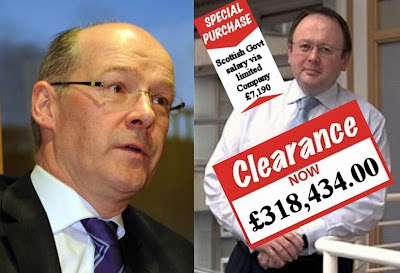
Finance Secretary’s claims over tax avoidance deals challenged as foi reveals Ex Council Chief David Hume paid by Scottish Govt via limited company

Finance Secretary Swinney challenged as FOI reveals Ex Council Chief paid tax efficient salary by Scottish Govt quango. CLAIMS made by Finance Secretary John Swinney in written answers to MSPs “the Scottish Government does not pay salaries with reasons of tax efficiency in mind” have been called into question after freedom of information enquiries revealed David Hume, the former Chief Executive of Scottish Borders Council who left the local authority under less then clear circumstances, has recently been paid a salary by a Scottish Government quango via a limited company, leading to allegations of TAX AVOIDANCE deals being played out in Scotland’s public sector.

The payments made to Mr Hume via a limited company are for contracts with Children's Hearings Scotland (CHS), a Scottish Government backed quango set up to deal with children who commit offences or who have welfare and protection needs require particular help and care.

Freedom of Information enquiries made by campaigners in the Borders to Children's Hearings Scotland revealed David Hume received £7,190 for three months work, an amount paid by the Scottish Government through what staff at CHS described as “an organisation called Enlighten”.

However, further enquiries made by journalists who were passed the foi responses have revealed “Enlighten” is actually a limited company identified as ENLIGHTEN : DAVID HUME CONSULTING LTD, based at"Glen Orchy” 15 Glenorchy Road, North Berwick, East Lothian.

David Hume is currently listed as the sole Director of Enlighten, according to a search on the CompanyCheck website which also revealed “Enlighten” had been registered on 15/12/2011, just over a week after Children's Hearings Scotland admitted Mr Hume had begin providing services to them. The full FOI response from CHS is available online : HERE

An expert on freedom of information who viewed the disclosures by Children's Hearings Scotland said he was of the opinion an effort had been made to withhold any references to Mr Hume being paid via a limited company.

He said : “In the current climate of sharp debate over the payment of publicly funded salaries for employees & consultants via limited companies, Children's Hearings Scotland appear to have taken it upon themselves to avoid revealing the organisation called Enlighten was actually a limited company formed by Mr Hume himself. This is not a very honest application of freedom of information.”
From riches to consultant : David Hume recently took home £318K exit package from former top post at Scottish Borders Council. The row over payments of publicly funded salaries to consultants like Mr Hume, via limited companies comes on top of recent reports Mr Hume, who took an extended period of sick leave from his Council post received a staggering THREE HUNDRED & EIGHTEEN THOUSAND POUNDS in a pay-off linked to his application for voluntary from the scandal hit south of Scotland authority which has been criticised for its massive debt mountain of TWO HUNDRED & SIXTY TWO MILLION POUNDS, equivalent to a debt of £2,403 plus for every person currently living in the Scottish Borders.

Speaking further on Mr Hume’s work for Children's Hearings Scotland, Sara Brodie, Performance Officer for CH,S said in the freedom of information response : “Mr Hume’s role is to support the National Convener in negotiations with local authorities to agree Area Support Team structures, roles and responsibilities and to draft and negotiate partnership agreements.”

“Mr Hume is engaged as and when required by the National Convener. Mr Hume has provided this support since December 2011.  As a recently retired local authority Chief Executive, Mr Hume has specialist knowledge of the current local authority landscape, which is required to support the National Convener in her negotiations with local authorities.”

Apparently mindful of the controversy over consultants receiving their salaries & fees via limited companies, a scheme now generally accepted as that of tax avoidance, CHS officials refused to reveal the daily rate paid to Mr Hume.

CHS further admitted : “Mr Hume works on a consultancy basis in a competitive environment and as such we are satisfied that Mr Hume has commercial interests in relation to the disclosure of this information.  We believe that releasing the daily rate paid to Mr Hume would prejudice his ability to compete effectively in tendering exercises against competitors whose charges are not widely known.”

“As this exemption is conditional we have applied the ‘public interest test’.  This means we have, in all the circumstances of this case, considered if the public interest in disclosing the information outweighs the public interest in applying the exemption.  We have found that, on balance, the public interest lies in favour of upholding the exemption.  We recognise that there is a general public interest in ensuring that there is effective oversight of expenditure of public funds and to ensure that the public is obtaining value for money.  However, we believe that this interest has been met by disclosure of the total fees paid to Mr Hume. “

A “purchase order” for services obtained from Mr Hume was also released by CHS staff, only after campaigners demanded a review of the initial decision to refuse the release of any further information on Mr Hume’s activities at Children's Hearings Scotland. The “purchase order” released by CHS staff and available to view online HERE lists the amount paid to Mr Hume as £7,190 but curiously omits any references to the funds being paid to Hume’s private limited company. Terms & Conditions of CHS contracts were also released, available to view HERE

Commenting on the refusal of Children's Hearings Scotland to disclose further information relating to Mr Hume, a legal insider today said it was ludicrous that any details of payments of public funds and especially payments of a tax efficient nature via limited companies should be withheld from taxpayers.

In the wake of the revelations of tax efficient payments to Mr Hume, attention has now turned to denials of such payments from the Scottish Government, where recently, Scotland’s Finance Secretary John Swinney was asked by Drew Smith MSP (Glasgow) (Scottish Labour): “To ask the Scottish Executive whether it has paid a salary to any (a) civil servant, (b) official, (c) consultant or (d) contractor via a (i) private company or (b) other arrangement for reasons of tax efficiency.”

Mr Swinney said in a written response published by the Scottish Parliament : “The Scottish Government does not pay salaries with reasons of tax efficiency in mind.”

In a further response to a question put by Hugh Henry, Mr Swinney went onto claim: “In all instances, the Scottish Government expects those who work on public sector business to do so within the tax system, whether that is through the Scottish Government payroll or the payroll of a parent company that the Scottish Government has a contractual arrangement with.”

However, campaigners investigating tax avoidance schemes in Scotland have today indicated they believe there is a significant network of consultants working for Scottish Government entities who are being paid salaries, fees & expenses via limited companies.

Further investigations by journalists have today revealed Mr Hume as at least one other directorship, with a company called: SCOTREGEN LIMITED, Fairfield House, Ibrox Business Park, Broomloan Place, Glasgow. Mr Hume, who is listed on the Scotregen website as a “public policy specialist” was appointed director on 24/5/2012. The list of directors of Scotregen contain the names of individuals, some of whom have multiple directorships in additional companies. One director appears to have up to FORTY TWO different directorships.

Scotregen Ltd claims its overall objective is to improve the health and wellbeing of residents in Scotland’s disadvantaged communities. The company has sponsors such as the Scottish Government, Highlands & Islands Enterprise and Edinburgh City Council.

Mr Hume could not be reached for comment, and no one from the Scottish Government was available to issue any explanation about the revelations of payouts to Mr Hume or others in similar circumstances..

Sunday, February 06, 2011

Budget to go NatConDem ? First Minister Alex Salmond claims supermarkets are ‘barons of politics’ after SNP’s ‘Tesco Tax’ is voted down

Scotland’s First Minister Alex Salmond is reported to be somewhat ‘in the huff’ with supermarkets after his SNP minority Government’s proposals to slap a tax on the major supermarkets in an attempt to bring in an extra £30 million pound hole in his election sweetening budget was voted down. The First Minister, still firmly ‘in the huff’ now alleges the major supermarkets are the “barons of politics” after opposition msps voted against Mr Swinney’s plans to thrash major retailers with an extra tax.

The vote against the tax will put more pressure on Mr Swinney & force the SNP to trade with the Scottish Conservatives & Liberal Democrats to get their budget through the Parliament, raising the prospect of a NatConDem budget full of cuts & sweeteners to those who may not deserve it (Sounds like we are being condem’ned by the Nats ? – Ed)

BBC News reports :

Supermarkets are 'the barons of politics', says Salmond

Major supermarkets are now the "barons of politics", according to First Minister Alex Salmond, who was speaking after MSPs voted down plans to introduce a so-called "Tesco tax".

The levy would have brought in an extra £30m a year - with £23m of that from the largest supermarket chains.

But Labour, the Lib Dems and the Tories branded the plan "anti-competitive".

The retailer Sainsbury's would have paid £2.5m more a year, the equivalent of its hourly profit, Mr Salmond said.

"And yet they moaned about having to pay the additional sum to help everyone in difficult circumstances," he told BBC Five Live.

When asked why opposition parties - other than the Greens - did not support the proposal, Mr Salmond said: "The supermarkets have the most enormous lobbying power.

"I think they are the barons of politics."

The plan - which Mr Salmond said was about rebalancing the relationship between out-of-town shopping centres and small, independent town centre retailers - was voted down on Wednesday, by 68 votes to 46.

'Broadest shoulders'

But the first minister hinted it would be included in the SNP's manifesto ahead of the Scottish elections in May.

"We can't get it through this parliament, but I think it'd be a fair assumption to say it's something that we'll take to the people," he said.

"Like the referendum on independence, we'll see if there's popular support for the idea that those with the broadest shoulders bear a little more of the burden when times are tough."

Fiona Moriarty, the director of the Scottish Retail Consortium, which represents the big four supermarkets, last month told a committee of MSPs that small businesses needed larger ones to survive.

She added: "It's not our job as a sector to come up with solutions for budgetary shortfalls."

The proposal was however supported by the Federation of Small Businesses.

Sunday, May 17, 2009

An extra £2m for MSPs at Holyrood while Westminster’s reputation withers in expenses scandal

Lately with all the scandal over MPs at Westminster raiding the public purse for everything from umbrellas to swimming pool boilers, the Scottish Parliament has been trying to hold itself up as a model of responsibility on politicians expenses. We in Scotland know otherwise. (Yes we certainly do ! – Ed).

The Sunday Herald reports :

MSPs set to pocket £2m by using your money (and they won't say if they will pay it all back)

by Tom Gordon and Paul Hutcheon

SENIOR MSPS were last night desperately trying to cling on to almost £2 million of profits tied up in their publicly-funded second homes. After priding themselves on a model expenses system, some of Holyrood's leading politicians were trying to gag debate over the last big perk for MSPs - the ability to sell their second home and keep any profit.

The Sunday Herald has learned SNP chief whip Brian Adam and minister for parliamentary business Bruce Crawford advised MSPs against talking to the media about the issue, in what one senior SNP worker called an atmosphere of "blind panic".

Of the 28 MSPs currently charging taxpayers for the cost of mortgage interest on a second home in Edinburgh, 12 are Nationalists, half of whom are cabinet secretaries or ministers. They include finance secretary John Swinney and housing minister Alex Neil, who would make profits of £95,000 each if they sold up.

Following a critical review of the practice last year, all mortgage interest claims will stop in 2011. The end of the perk is expected to trigger a wave of house sales as MSPs switch to renting and staying in hotels instead of using a second home.

Five MSPs would turn profits of more than £100,000 if they sold their homes tomorrow because of a long-term rise in values, according to valuations that the Sunday Herald asked a leading Edinburgh estate agent to place on the properties in the capital.

Former Liberal Democrat leader Nicol Stephen would make a profit of £200,000, or almost four times his salary, while presiding officer Alex Fergusson would make £125,000.

Brian Adam, the whip who is advising Nationalist MSPs to stay silent, would make £120,000. Alex Salmond last night said Holyrood "has shown Westminster the way forward in the row over MPs' expenses".

However, the first minister's spokesman refused to give his view on profits from house sales, dismissing the subject as "a legacy issue". Between them, the 28 MSPs are currently sitting on a £1.7m nest egg built up using parliament's Edinburgh Accommodation Allowance, with around £800,000 of it in homes owned by SNP MSPs. In light of the crisis over expenses at Westminster, MSPs now face calls to repay part or all of any profit made to the taxpayer.

Last week Nick Clegg, the UK leader of the LibDems, said his MPs would hand back any profit made by selling second homes in London.

However, Tavish Scott, the Scottish LibDem leader, who stands to make £120,000 on his second home in Edinburgh, said MSPs would not follow suit, pointing out last year's review of expenses decided it was too complicated to work. But Clegg's call has put Liberal Democrat MSPs on the spot, and alarmed other parties as well.

According to SNP sources, Crawford and Adam contacted Nationalist MSPs to tell them not to be drawn on the subject. "It's a blind panic. It's Crawford and Adam doing the phone round. They're saying, We have people involved'. It's a case of battening down the hatches," said one source.

The Sunday Herald has also obtained an internal memo sent by the SNP press office to MSPs on Thursday about second home profits. "I advise that you don't get into that issue," wrote head of communications Liz Lloyd. It is understood the five LibDem MSPs involved held an emergency meeting at Holyrood on Thursday to agree a line on defending non-repayment.

However, one LibDem MSP told the Sunday Herald: "Personally, I don't know how they can sleep at night. They're having a panic attack and hiding behind the independent review.

"Given the scale of the profits, I doubt if any of them could lay their hands on that kind of money in any other way. It's not beyond the wit of man or woman to work out a method of compensating the public purse for some of it."

MSPs currently earn £55,381 a year in salary. Ministers receive an extra £26,069 and cabinet secretaries an extra £41,618. The Scottish parliament is expected to publish the latest quarterly expense claims this week.

Wednesday, April 29, 2009

McKenzie Friends could come to Scottish courts as Holyrood considers 'access to justice' petition

The ability to have a McKenzie Friend by your side in an English courtroom should be extended to Scotland after a 39 year unwarranted exclusion, say access to justice campaigners, and the petitioner, Mr Stewart MacKenzie.

Peter Cherbi’s “Diary of Injustice” law blog reveals more on the merits of the McKenzie Friend petition and why having a McKenzie Friend at your side (if you can’t obtain the services of a solicitor) may very well be a good thing for justice and the courts. (Yes, high time McKenzie Friends were recognised and allowed in Scotland’s courts – Ed)

Diary of Injustice reports :

'McKenzie Friend' proposal to Parliament seeks to end 39 years of lawyers monopoly over Scots access to justice

Law Society of ScotlandLaw Society 'monopolises' Scots access to court. THIRTY NINE YEARS after laws allowing a 'McKenzie Friend' in the English courts system were introduced to facilitate the public's access to justice by allowing a not necessarily qualified legal individual to assist a person in court, a McKenzie Friend Petition (Petition 1247) has been put to the Scottish Parliament at Holyrood, asking for the implementation of the same privileges of a ‘McKenzie Friend’ to be granted in Scotland, to help many who find it difficult through the current system of legal representation, controlled by the Law Society of Scotland, to secure access to the Scottish Courts.

McKenzie's friend Petition PE1247 Page 1McKenzie Friend petition will end 39 years of prejudice against Scots ‘justice rights’ in Court. The petition, brought to the Scottish Parliament by Mr Stewart MacKenzie, calls on the Scottish Parliament to urge the Scottish Government to introduce a McKenzie Friend facility in Scottish courts as a matter of urgency. Mr MacKenzie’s case involving the legal profession became famous, when revelations of secret internal memos documenting a claims fixing policy at the Law Society of Scotland, resulted in a televised confrontation between Mr Swinney & former Law Society Chief Douglas Mill during the Justice 2 Committee's investigation of the now passed into law Legal Profession & Legal Aid (Scotland) Act 2007. The memo-gate scandal eventually toppled Douglas Mill as Law Society Chief Executive in January 2008.

Mr MacKenzie speaking today to Diary of Injustice said : "I am hopeful the petition will get a good hearing at the Scottish Parliament, and begin the work of ending what is a glaringly prejudicial omission from the public's legal rights & entitlements in Scotland, while people in the rest of the UK have enjoyed and heavily used the right of having a McKenzie Friend accompany them in court hearings for nearly four decades."

John SwinneyCabinet Secretary Swinney will be asked to speak to Holyrood committee on the merits of McKenzie Friends. It emerged today, the Scottish Parliament's Petitions Committee has set a 5th of May hearing for the petition, but has not granted Mr MacKenzie the right to give oral evidence, to which the petitioner replied : "Since I am not being allowed to speak on the merits of my own petition, I have asked my MSP, Cabinet Secretary for Finance, John Swinney, to attend the Petition Committee hearing and speak on my behalf, as he has done so with considerable care and attentiveness on previous occasions."

In England & Wales, the concept of a McKenzie Friend has existed for some 39 years, assisting people in court, who find it difficult to obtain legal representation either through cost or other reasons.

The guidance from the President of the Family Division of the courts in England & Wales states : “Where proceedings are held in open court, it is clear from the principles set out in Court of Appeal decisions that a litigant who is not legally represented has the right to have reasonable assistance from a layperson, sometimes called a McKenzie Friend (“MF”).”

A litigant in person wishing to have the help of a MF should be allowed to do so unless the judge is satisfied that fairness and the interests of justice do not so require. The presumption in favour of permitting a MF is a strong one.”

A McKenzie Friend May : • Provide moral support for the litigant • Take notes • Help with case papers • Quietly give advice on: points of law or procedure, issues that the litigant may wish to raise in court, questions the litigant may wish to ask witnesses.

Mr Stewart MacKenzie's 'McKenzie Friend' Petition reads as follows : “39 years after a McKenzie Friend was introduced in the English Courts, we still do not have an equivalent in Scots law. For those who are unable, for whatever reasons, to be represented in court by a solicitor, be it cost or principle, it is unjust, immoral and a breach of their fundamental human right to have a fair hearing with reasonable “equality of arms” as required by Article 6 of the European Convention on Human Rights, to force them to appear in court as a party litigant without the facility of having someone to offer them support and guidance.

As people in Scotland are having their lives ripped apart by having their homes repossessed without the opportunity, as they do in England, to at least have their day in court, it is barbaric and inhuman that this obstinate refusal to ensure that the people of Scotland are not treated in an inferior manner compared with the rest of the United Kingdom when it comes to access to Justice. This is not an attempt to get the Parliament to consider any individual case.”

MacAskill tight lippedJustice Secretary MacAskill criticised over his own failure to reform access to justice. While many of the failures to implement the 1990 access to justice legislation can obviously be pinned on previous Scottish administrations who stood by while the Law Society in effect dictated policies on restricting the individual’s right of access to legal representation and the courts, the current Justice Secretary, Kenny MacAskill, and the Scottish Government have done very little, if anything to improve the lot of members of the public who simply cannot get into court because the legal profession feel it is not in their best interests to allow such cases to go forward.

Justice Secretary Kenny MacAskill to Cabinet Secretary for Business John Swinney 26 July 2007 Justice Secretary’s leaked letter promised cabinet colleague John Swinney that access to justice was happening two years ago. The road to reforming access to justice in Scotland has been a rocky one so far, as almost all attempts to-date of implementing changes allowing the Scots public increased access to justice and the Scottish Courts, have either been thwarted by the legal establishment, or held in political limbo by an exceedingly uncooperative Justice Secretary Kenny MacAskill, who despite promises to Cabinet colleague John Swinney, two years ago in 2007 that change 'was on the way', has in reality made things very difficult for anyone other than solicitors to enter the Scots legal services market to this date and no doubt beyond.

Lord Hardie - Repeal Sections 25-29 24th June 1997High Court Judge Lord Hardie while serving as Lord Advocate, wanted to repeal Scots access to justice legislation. However, while the prickly thorn of reforming access to justice falls to the current Scottish Government to act upon, the legal establishment’s attitude to counter any reforms to increased access to the Scottish Courts go back years, as I revealed in an earlier report where in 1997, the serving Lord Advocate at the time, Lord Hardie, himself advocated repealing the laws which allowed increased competition in the Scots legal services market, which had actually been kept from the public by an intense campaign ran by the Law Society of Scotland for over seventeen years, seeing Sections 25-29 of the Law Reform (Miscellaneous Provisions) (Scotland) Act 1990 only implemented in March 2007 after public queries and the release of documents through Freedom of Information laws which revealed the secret campaign by senior law figures and civil servants within the Scottish Executive to withhold or repeal the access to justice legislation.

A member of the public whose legal case could have significantly benefited from the use of a McKenzie’s friend said today : “"It is a matter of record that Lord Hardie has consistently denied the Scottish Public any meaningful or proper access to the law by his stubborn obstruction of articles 25-29 [of the Law Reform & Miscellaneous Provisions (Scotland) Act 1990], allowing members of the public to be represented by a third party of their choice.“

He went on : “The deafening silence by every major political party which has accompanied this wicked betrayal of trust indicates their tacit approval of it. Disturbingly, the Scottish Courts have also consistently refused to allow recordings of hearings to be made - a proposal also rejected by the Scottish Parliament.”

Given the lack of willingness on the part of the current Scottish Government to speedily reform the Scots legal services market, leaving many clients out in the cold in terms of legal representation, many Scots caught up in legal difficulties feel with some justification, their rights are being impugned by both the legal profession and the Government simply to protect solicitors long held monopoly over access to justice.

Clearly the Scots public could benefit from the McKenzie Friend facility being applied to Scots Law, and as with other legal reforms long overdue, the Scottish Government should act without delay and reverse the 39 year prejudice against ordinary Scots obtaining access to courts, while our English counterparts have enjoyed the use and privilege of a McKenzie Friend at their side.

I therefore look forward to reporting on and watching how the McKenzie Friend petition progresses through the Scottish Parliament .. as surely the public interest of access to justice comes first over protecting solicitors business markets & profits.

Wednesday, March 04, 2009

Law Society of Scotland is ‘World’s Worst Regulator’

The Law Society of Scotland, as we all know, isn’t the world’s best regulator .. hence all the trouble over the years it has caused those among the profession who keep their nose clean, by also keeping the bad apples in the bunch.

Peter Cherbi’s “A Diary of Injustice in Scotland” law blog goes a little further into the Law Society’s performance, and finds its actually one of the world’s worst regulators, with the same faces still at the Law Society despite all the scandals over the years ... (which would be like keeping Sir Fred Goodwin on at the RBS after its collapse, wouldn't it ? - Ed) …

Toxic levels of complaints, poor standards of service & soaring fraud by solicitors makes Law Society of Scotland 'World's worst regulator'

The 4m Crooked Lawyer (John McCabe) - Daily Record 1991Crooked lawyers give Scotland a bad name. While the attention of most remains focussed on the crisis in the banking system, the problems which have caused the collapse of our great financial institutions are nothing new to Scotland's legal sector. Year in year out, clients have been losing millions of pounds of their money to , ambitions, greedy, and downright crooked lawyers over the past couple of decades, and the regulator responsible, the Law Society of Scotland, has done little or nothing about it.

Tangled Web of deceit that ensared 4million - Scotlsman 28 November 1991A crooked lawyer’s tangled web of deceit. During 1991, one of the most famous cases of fraud by the Scots legal profession occurred with revelations that John McCabe, a solicitor working at the now defunct Edinburgh firm of Scott Moncrieff & Dove Lockhart, operated a multi million pound fraud scam against clients & banks, which ultimately was discovered after he became careless and so entrenched in deceit & debt, there was simply no place left to run (although he did try running to Uruguay). While clients stood ruined, and banks took huge losses, the Law Society of Scotland could only watch on as the press of the day mauled both the legal profession and the poor standards of regulation which allowed McCabe to get away with what he did, and ultimately, McCabe was jailed for 10 years for his crimes.

Just imagine for a minute, if every one of the 10,000 lawyers in Scotland stole £4million from their clients. What would be done about it ? .. well nothing much, as long as the Law Society has anything to do with regulating lawyers …

Lawyers left to make good the cost of colleague's dishonesty - Scotsman 1991Law Society Chief Kenneth Pritchard failed on reforms. Amid the recriminations of the McCabe case, and the costs of compensating his victims, the Law Society's Kenneth Pritchard (now a Sheriff), promised reforms to ensure no repetition, and that standards would rise in Scotland's legal profession to ensure public confidence remained in solicitors.

Kenneth Pritchard : “The aim of the new rules … is not to help the legal profession shrug off an obligation to meet losses, but to reduce the amount the Guarantee Fund might have to repay. "It should become much more difficult for solicitors to defraud clients. “There is not a reluctance among solicitors to pay this money. there is an acceptance that we must do so to maintain the good name and standing of the profession.". What good name ?

Policy is to protect both says Law SocietyLaw Society Chief Pritchard performs a u-turn & orders legal firm to drop 'crooked lawyers' case. However, three years on in 1994, the same Law Society Chief, Kenneth Pritchard who had promised reforms to prevent crooked lawyers hurting their clients, was revealed to have personally intervened in a case of litigation against a firm of crooked lawyers, ordering the clients solicitors to withdraw from acting, letting the crooked lawyers off the hook in a policy of protection for crooked lawyers.

Extract of Court PleadingsCourt documents revealed Law Chief's duplicity. Kenneth Pritchard wrote to legal firm Skene Edwards advising them to withdraw from acting in the case, and that letter was subsequently discussed in the Scottish Parliament debate chamber by Cabinet Secretary for Business John Swinney.

You can read more about how the Law Society of Scotland and Kenneth Pritchard did nothing to stem the rising tide of crooked lawyers, and actually closed ranks with crooked lawyers to protect them from punishment while denying clients access to justice, here : Law Society intervention in claims 'commonplace' as ex Chief admits Master Policy protects solicitors against clients

After the exploits of McCabe, the Law Society of Scotland professed to have 'cleaned up Scotland's legal profession, but much worse was to come as the following demonstrates.

Scotsman coverage of some of the stories relating to Andrew PenmanBorders lawyer Andrew Penman became Scotland's most famous crooked lawyer. From 1994 to the present day, my own battle with the Law Society of Scotland ended up in the press, showing yet again the Law Society of Scotland would simply close ranks with crooked lawyers to protect them from client complaints & financial claims for dishonesty & fraud. Indeed, the Law Society went out of its way in a determined effort to prevent me from obtaining legal representation and access to the courts to pursue Penman and his legal firm Stormonth Darling solicitors, for the untold damage it did to my family. Nothing then had changed - there were still plenty of crooked lawyers in business, and the Law Society of Scotland still covered up for crooked lawyers no matter what.

Scotsman 8 January 1999 Independent watchdog for lawyers proposedProposals since 1999 to bring independent regulation to lawyers were blocked by Law Society. The legacy of Andrew Penman, and the cover up by the Law Society of his actions was felt by all solicitors just as in the McCabe case, and assisted with the drive to bring about independent regulation of lawyers and end the closed shop operated by the Law Society of Scotland that allowed thousands of complaints to be binned while investigations were whitewashed.

REVEALED - Top Lawyer at the centre of 12 negligence claims2006, and still plenty crooked lawyers in Scotland. Things are now so bad in Scotland that many solicitors & legal firms have 'toxic levels of client complaints & claims' for poor legal service, rendering the use of Scots solicitors a dangerous game of Russian roulette for consumers, where selecting the worst of a bad bunch can see you end up financially ruined and your lives destroyed by a greedy lawyer out to take as much as possible, safe in the knowledge his regulator, the Law Society of Scotland, will do nothing to help members of the public.

Cash Link to Law Chief StabbingLawyers staged mafia hit on one of their own. Indeed the corruption of Scotland's legal profession became so entrenched, the Law Society's own Chief Accountant, Leslie Cumming, was subject to a mafia hit, staged by crooked lawyers in an attempt it has since been claimed to put off investigations into crooked lawyers .. and while the then Law Society Chief Douglas Mill was busy blaming clients for the attack on Cumming, it became clear to all the motives for the attack came from within the ranks of Scotland's solicitors, who had become so evil they would consider and use murder hits to escape justice for their vast network of corruption against clients.

EXCLUSIVE Lawyer sued for 1million 2007, and even more crooked lawyers. The media coverage of countless scandals within the Scots legal establishment, and the Law Society’s seeming ability to whitewash any crooked lawyer, no matter the crimes they had committed, ultimately brought about the creation of legislation passed in 2007 to 'improve' regulation of the legal profession, however the 'independent' Scottish legal Complaints Commission which was created as a result of the LPLA (Scotland) Act 2007 has since been co-opted by the Law Society, and is mired in many scandals itself, as the legal profession fights back to retain its crooked regulatory powers over crooked lawyers.

Let us finally take a look at some of the people who have perpetuated this disgraceful state of affairs the Scots legal services market finds itself in :

Douglas Mill at the Scottish ParliamentDouglas Mill, ex-Chief Exec. of the Law Society. Douglas Mill, recently famed on television for supporting Sir Fred Goodwin who brought RBS to its knees, made no bones about it, he had no time for clients who complained against crooked lawyers, and saw it as his mission to interfere in complaints & financial claims against crooked lawyers. Mill horrendously hounded clients who dared make a complaint against a solicitor, and personally saw to it that attempts at legal action against solicitors failed at every turn, even demanding legal aid be refused to anyone seeking to take a lawyer to court.

Philip Yelland - Director of Regulation - Law Society of ScotlandPhilip Yelland, Head of Client Relations. During all this time, and all these scandals, one man has been the key to ‘Client Relations’ at the Law Society of Scotland, Mr Philip Yelland, who has presided over scandal after scandal, where curiously many of the crooked lawyers got off the hook, or investigations were simply whitewashed, while the Law Society saw to it members of the public were denied access to justice and a solicitor to try and pursue the thousands of McCabes and Penmans for the damage they did to many clients.

Michael Clancy - Director of Law Reform - Law Society of ScotlandMichael Clancy, Director of Law Reform. Despite the hundreds of ‘crooked lawyer’ scandals in the last two decades, and all the promises of reform from the Law Society itself, nothing has been done to help thousands of people with outstanding cases against crooked lawyers, and some at the Law Society such as Michael Clancy, have come down hard against any proposals to bring in Parliament or new legislation to help clean up the legal profession’s sins of the past.

You can read my own proposals, in effect. a “Truth & Reconciliation” proposal for the Law Society’s sins of the past here : The polluter pays - Why cleaning up lawyers sins of the past would be good for the public & legal profession alike

We are now at a point where no matter the scale of corruption in Scotland’s legal services market, nothing will bring the reforms and consumer protection that all Scots and consumers of legal services in this country should have. The feeling now by many is that when someone goes to a lawyer, the odds are they are going to get ripped off, and with lawyers experiencing a marked downturn in legal business, levels of fraud against clients through faked up legal fees and menacing demands for expenses on work not carried out are sharply rising.

If we are to have good regulation of legal services in Scotland, the Law Society of Scotland and those associated with it, presently or formerly, cannot be allowed anywhere near such a body, as the crop of scandals at the Scottish Legal Complaints Commission show very clearly.

As long as we have a Justice Secretary who says he will protect lawyers from much needed reforms, the Scots public will always take second place to the criminal element of society that walks around with a Law Society of Scotland membership badge, professing to offer the best in legal services when in reality they offer levels of toxicity to consumers that Chemistry could never hope to define.

Friday, August 08, 2008

MacAskill claims ignorance as he appoints ex Law Society President McAllister named in claims fixing memos to Judicial Appointments Board

More From A Diary of Injustice in Scotland as Kenny MacAskill pleads ignorance over those oh-so-famous claims fixing memos from dearly departed and happily-not-missed Chief Executive Douglas Mill.

The kink in the story is that Martin MacAllister, who was whisked to the Judicial Appointments Board quietly by the Justice Secretary, is of course identified on those fiddly, shady memos which targeted members of the public who were trying to complain against their solicitors ..... very shady indeed ..

Justice Secretary MacAskill denies knowledge of ‘claims fixing’ memos identifying former law chief sent to Judicial Appointments

When questioned today over why former Law Society President Martin McAllister was appointed to the Judicial Appointments Board, despite being identified by Cabinet Secretary John Swinney MSP in memos detailing a claims & complaints fixing scandal operted by the Law Society of Scotland, Justice Secretary Kenny MacAskill denied through his spokesman, any knowledge of the offending memos, which have been available at the Scottish Parliament, in the media, and even on the internet for some time now, and which continue to rock Scotland's legal establishment.

Kenny MacAskill denies existence of memosKenny MacAskill denies existence itself ? : “Mr McAllister was appointed through fair and open competition by an independent panel. We are not aware of any formal complaint about Mr McAllister’s role in relation to claims and complaints during his time as President of the Law Society of Scotland, and no evidence has been presented to us which would raise any questions over the decision of the selection panel.”

The now well known memos to everyone except the Justice Secretary himself, were revealed by the Cabinet Secretary for Finance John Swinney MSP, who identified a particular memo from Law Society Chief Executive Douglas Mill to the then Law Society President Martin McAllister as being the key to a claims & complaints fixing scandal which saw clients claims against crooked lawyers ruined by a well practiced policy of delay & destruction of claims & complaints against multiple firms of crooked lawyers.

John Swinney, a trustworthy manJohn Swinney reveals a memo : "I am interested in what the witnesses have just said about the Law Society having nothing to do with the arrangements for handling negligence claims. I have in front of me a memorandum in connection with the case of one of my constituents. It was issued by Mr Mill on 5 July 2001.”

"Mr Mill's memo was written to the then president of the Law Society, Mr McAllister. It refers to the broker of the master policy. Mr Mill suggests that it would be good if he and the others involved all got together and had a "summit meeting" to discuss how to dispose of my constituent's "several valid claims". Mr Mill and I have discussed the matter at length over the years, but I find that a rather strange memo if it is to sit comfortably with the statement that the president has just made.

The memo of 5 July encourages "a summit meeting on the up-to-date position"to be held to look at "both the complaints and the claims aspects." That rather suggests that the Law Society has been involved. The claim remains unresolved to date and yet the memo is dated 5 July 2001."

Cabinet Secretary for Finance John Swinney identifies Martin McAllister in memos which revealed the Law Society's claims & complaints fixing scandal to protect crooked lawyers

The claims fixing scandal, which involved senior members of staff at the Law Society of Scotland, apparently headed in an operation by Law Society Chief Executive Douglas Mill, saw a policy implemented by the Law Society and some of the UK's largest insurers, Royal Sun Alliance PLC, and Marsh UK to delay and destroy client claims and complaints against notorious Scots legal firms with poor regulatory records.

Law Society Chief Exec Douglas Mill's memo to Martin McAllister - ‘We have to stop the MacKenzie's claims dead and prevent their testimony to a Parliamentary investigation’

Douglas Mill Memo to Martin MacAllister 5 July 2001

The Law Society of Scotland
INTERNAL MEMORANDUM

To: Martin McAllister
CC: David Preston, Philip Yelland
FROM : Douglas Mill
DATE : 5 July 2001

Could you sign this letter ? I have discussed with Alistair Sim and I think a holding letter is ideal. Alistair confirms that there is never any question of the Mackenzies sending out hard copy letters. There is a saga here and you will recall I intimated this to you and David by copying Alistair Sim's email of 8 June. David has asked for a one page summary on the Mackenzie's position, which is quite frankly an impossibility !.

The Mackenzies I would say are different from some of the other complainers in as much as they have several valid claims, they have been let down by a series of solicitors but they are unreasonably in their expectations of quantum etc. Rather than trivialise matters I would recommend that the four of us i.e. you, me, David Preston and Alistair Sim all get an hour or so together some time in July to have a summit meeting on the up-to-date position looking at both the complaints and claims aspects. there is no doubt that Mr Mackenzie is intelligent and well organised individual who would unlike some of the other thorns in our flesh, come over very well at a JHAC investigation.

DRM

Clearly the memos do indeed, identify the then Law Society President Martin McAllister as being part of the fray which prevented the MacKenzies claims & complaints against a number of solicitors from progressing to any reasonable conclusion.

Indeed, since the date of the memo (2001), none of the claims identified within the memo, or by John Swinney in his confrontation with Douglas Mill before the Scottish Parliament's Justice 2 Committee during 2006 have been settled. Not one. In fact, not one claim or complaint by those who submitted their cases to the Justice 2 Committee during 2006 have been settled. Not one.

So in conclusion, Douglas Mill’s memo to Martin McAllister has resulted in a very successful policy by the Law Society of Scotland of protection for several firms of corrupt solicitors while significant and long lasting financial harm has been caused to the damaged lives of clients.

Mr McAllister has now been appointed to the Judicial Appointments Board, where he will be in part responsible for the appointment of lawyers to the positions of Sheriffs and Judges.

Inevitably some of those lawyers who come before the Judicial Appointments Board will have not the best of regulatory records, where complaints have been poorly handled by the Law Society of Scotland, possibly to the point those complaints have been dealt with by the ‘Douglas Mill doctrine’ contained in the memo to Mr McAllister, which is clearly ‘destroy the client’s access to justice at all costs’.

Is it fair to have lawyers appointing lawyers to positions of Judges ?

During the 2001 Justice 1 Committee “regulation of the legal profession inquiry’ which was heavily restricted in content & remit by the then Convener, Christine Grahame MSP (SNP), Martin McAllister, the then President of the Law Society of Scotland made the following comments :

Martin McAllister : “We are open to change and want to make improvements. It is proper that Parliament is reviewing the checks and balances that operate, but it is a fundamental right of citizens in a democracy that the legal profession is independent. Such a profession is a guarantor of the rights of citizens—and in Scotland we deserve no less.”

Well, eight years on from the date of Douglas Mill’s memo to Mr McAllister, there have been no improvements in regulating the legal profession, and still, the Law Society of Scotland impedes and prevents clients access to justice when it sees fit.

Martin McAllister went onto say during the 2001 J1 inquiry : “The point is that the organisation is changing. We have made a number of changes in how we deal with complaints over the past 10 years. I do not think that the committee would find it useful to go through a list of those, but some key things are important in improving public perception, one of which is greater lay involvement. A second is the improvement in literature, so that the public have a much better idea of how we deal with complaints. We have brought with us our current, revised leaflets.”

What change ? The Law Society of Scotland hasn’t changed one bit over the past ten years, or the past twenty years for that. There is still a claims and complaints fixing policy to see that no claim or complaint goes to a fair & proper conclusion and clients who choose to complain are victimised almost to the point of death.

Christine Grahame’s Justice 1 Committee of 2001 forbade members of the public to appear before it to testify as to their experiences with the Law Society of Scotland, while lawyers, more Law Society officials, and just about anyone who could be dragged out to support the idea of self regulation (lawyers looking after complaints against lawyers) were allowed almost free reign to appear before the then Justice 1 Committee at the cost of excluding the Scots public.

It took a further five years until 2006 when members of the public, ordinary Scots like you and I, were able to appear at Holyrood during the 2006 LPLA Bill inquiry by the Justice 2 Committee and tell of how scandalous the Law Society of Scotland had treated them.

However, there are more memos which identify the then serving Law Society President (Martin McAllister) in the Law Society’s claims & complaints fixing scandal which eventually saw the resignation of Douglas Mill earlier this year, which I covered here : Breaking News : Law Society Chief Executive Douglas Mill who lied to Parliament, pursued 'personal vendetta' against critics - to resign

Marsh UK Director Alistair Sim to Law Society Chief Executive Douglas Mill - Collating information on the MacKenzies and throwing some red herrings at the Justice Committee ..

Alistair Sim  to Douglas Mill secret memo intervention in MacKenzie case

Email to Douglas Mill from Alistair J Sim

From: Alistair J Sim
Sent 03 July 2001 09:30
To: douglasmill; davidcullen
Subject JAHAC

Douglas / David

I have a couple of faxes from the MacKenzies intimating the sort of comments they say they will be conveying to the Justice Committee on 31 July. These do not call for any response from me.

Reference is made to evidence already given by the President and to a letter/fax the MacKenzies have sent to the President regarding their claims.

Could we discuss -

-whether any information is required from us/the insurers to enable the President to respond to the MacKenzies

-whether it will be appropriate to collate any information on the MacKenzies claims

-whether I or any of my colleagues or any of the claims team at RSA may be called to give evidence to the Committee.

Regards

Alistair.

Clearly Mr McAllister was privy to a great deal of information as Law Society President, information which could have ended the suffering of many clients who had been trying to pursue claims or complaints against their solicitors, but as the facts show, no action was taken by Mr McAllister to alleviate clients problems at the hands of his colleagues Douglas Mill, Philip Yelland & others at the Law Society of Scotland.

To a certain extent of course, Martin McAllister was but a tool of Douglas Mill, as the President of the Law Society of Scotland is more of an honorary position, the real power lying with the slightly dictatorial position of Chief Executive.

Clearly Mr McAllister could have done more, said more, and helped clients who were caught in the Douglas Mill doctrine much more than has happened, because as we hear from Mr Swinney himself, no client, no claim has been settled, not one.

Perhaps the memos identifying Mr McAllister in the claims & complaints fixing operation run by the Law Society of Scotland should have surfaced as a possible barrier to being appointed to the Judicial Appointments Board, which is a position itself responsible for the appointment of lawyers to positions on the judiciary.

Before I quote the Justice Secretary’s Press Release on the McAllister appointment, I feel a footnote is required on the second appointment contained in the Press Release, that of Lady Smith.

Lady Smith, appointed along with Martin McAllister, is the wife of David Smith, who was of course, appointed by Kenny MacAskill to the Scottish Legal Complaints Commission – to examine complaints against other lawyers.

You can read more about Mr MacAskill’s appointments to the Scottish Legal Complaints Commission in the following report I wrote earlier in the year :

Call for MacAskill appointments 'sleaze investigation' as revelations show Legal Complaints Commission member was subject of Police inquiry

You don’t have much imagination in public appointments, Mr MacAskill, do you ? and why did you try to use the Office of Public Appointments in Scotland to justify your selections because the OCPAS assessor apparently didn’t have sight of any of the information or memos your own Cabinet colleague Mr Swinney has within his files …

Judicial Appointments Board

21/07/2008

The Cabinet Secretary for Justice today announced the appointment of new legal members to the Judicial Appointments Board for Scotland.

Lady Smith has been appointed as the Senator member to replace Lord Wheatley whose term of office came to and end in June. Lady Smith's appointment is for three years from July 1, 2008.

Lady Smith is a graduate of the University of Edinburgh. She was admitted to the Faculty of Advocates in 1980, and appointed Queen's Counsel in 1993. She was appointed a judge of the Court of Session and High Court in 2001

Martin McAllister has been appointed as the solicitor member of the Board to replace Michael Scanlan whose term comes to an end later this year. Mr McAllister has been a solicitor since 1980. He was President of the Law Society of Scotland from 2001 to 2002 and is a partner of Taylor and Henderson, Solicitors in Saltcoats.

Mr McAllister has been appointed to the Board for a period of three years. He will take up his appointment in October.

These new appointees replace members who are retiring this year. The composition of the Board i.e. five legal and five lay persons remains unchanged.

Both appointments are part-time and carry a commitment of around 20 - 30 days a year. Mr McAllister will be entitled to a daily fee of £290. Lady Smith, being a serving judge, receives no fee for her attendance.

The appointments of the new solicitor member followed recommendations to Scottish Ministers by an independent selection panel chaired by the Rt Hon Lady Cosgrove, recently retired judge of the Court of Session.

The Judicial Appointments Board for Scotland was set up in 2002 with a remit to advise Ministers on the appointment of Judges, Sheriffs Principal and Sheriffs (both full-time and part-time). There are ten members, five legal members (a Judge, Sheriff Principal, Sheriff, an Advocate and a Solicitor) and five lay members including Sir Neil McIntosh as the lay Chairman.

The Judicial Appointments Board currently operates on an administrative basis and is therefore not subject to OCPAS regulations. However, the selection panel included an OCPAS assessor and followed good recruitment practice in making the recommendations for appointment.

Sunday, August 03, 2008

Law Society 'Client Care' conferences are no place for clients !

More From A Diary of Injustice in Scotland as revelations show Law Society conferences on "Client Care" are the joke we all know them to be ... and a bloody good opportunity to have a free meal on the firm !

Law Society conference on client care falls short as lawyers told to 'dump & ruin clients’ to save themselves

Despite the promise of 'a new era' in dealing with complaints against crooked lawyers and attempts to improve the appallingly poor quality of Scotland's overpriced legal services market, the Law Society of Scotland are still choosing to undermine the very foundations of client care, with more of the usual policies, sanctioning lawyers disgraceful treatment of clients to the point of ruin.

One of a number of comments on my earlier article on legal fees here : Solicitors target clients with ‘sky high’ legal fees as Scotland's billion pound legal industry slows down went onto show how poor client care is regarded in the Scots legal profession :

“When confronted by a large legal bill of approximately £10,000 from the defenders in a personal injury case I instructed the solicitors then representing me to lodge a motion to the Court of Session on basis you outline, that is, the clear potential for a serious conflict of interest arising given the Auditor of the Court of Session would be ruling on matters relating to a fellow professional's expenses.

My solicitors refused to submit the motion, claiming it was incompetent. When I suggested it was for the Court to decide this and I should at least be allowed the opportunity to present the motion and receive the Court's decision my solicitors threatened to withdraw if I insisted on submitting the motion.”

Not much in the way of client care there … is there ? Could there be some kind of accounting fiddle going on too while one lawyer is tasked to investigate another colleague’s expenses ? Maybe you too are getting a fiddled bill in from your lawyer in a now common fraud by solicitors against unsuspecting clients …

So, while preaching an emphasis on caring for the client, and attending to good service with one hand, the Law Society’s ‘other hand’ is being used again to undermine what it publicly preaches, in favour of a more sinister policy of protecting its members once again from negligence claims and complaints against poor work …

Recently there has been an upswing in 'profession orders' from the Law Society to solicitors to dump clients who are either complaining against another solicitor, or are trying to lodge court cases for negligence or financial recovery of damages from lawyers who have ruined clients.

A very recent example letter follows below, from the Law Society of Scotland to a solicitor, which was 'inadvertently' sent to the client by a member of that solicitor's staff, and then forwarded to me, goes to show there is no let up even now in how low the Law Society feels it can treat members of the public and get away with it :

Dear ****

I am writing to you with reference to your client Mr ****'s negligence claim against Messrs **** & **** . I would emphasise this is private correspondence between us which is under no circumstances to be disclosed to your client.

I note your client is seeking to have the various papers he is in possession of relating to the investigation of the complaint against Mr **** submitted in evidence for his negligence claim.

I also note from the terms of your letter your client apparently is insisting on calling witnesses from the Law Society of Scotland who took part in the investigation of the complaint made against Mr ****.

In consideration of the above information you have furnished us, I recommend you withdraw from acting from your client immediately and make it as difficult as possible for any potentially dangerous material to be returned to your client in the file.

Yours sincerely,

Mr ****

* I have been asked to remove names & identities of those concerned for now, on the instructions of the client who sent me the letter.

I, of course, am not surprised in the slightest at the above letter, as this is a well trodden path for the legal profession when dealing with clients who have been ruined by one of their colleagues. It just goes to reinforce what has already been reported by myself and attested to by others over the years, the Law Society of Scotland is, a corrupt institution, and must be denied any future regulatory role in complaints or client claims made against solicitors.

I am not surprised ... why ? Well, just look at a few similar letters I have reported on in the past .. together with input from Cabinet Secretary for Finance Mr John Swinney (SNP) who bravely exposed another such letter in the Scottish Parliament itself.

John Swinney MSP exposes Law Society Chiefs who ordered lawyers to dump clients who were ruined by crooked lawyers

On my own case too, I received similar treatment from none other than Law Society Chief Executive Douglas Mill and Director of Client Relations Philip Yelland, who personally intervened in both my legal aid claims, and ordered my solicitor not to take instructions from me which like the above letter quoted, sought to prevent my inclusion of evidence gathered by the Law Society against well known crooked Borders lawyer Andrew Penman of Stormonth Darling Solicitors, Kelso, whom you can read more about from the Scotsman stories on that case here :

Andrew Penman of Stormonth Darling Solicitors, Kelso -The Scotsman reports on Scotland's most crooked lawyer

Here are copies of the actual letters from Philip Yelland ordering my solicitor not to take my instructions on the claim against Andrew Penman, and Law Society Chief Executive Douglas Mill ordering my legal aid be refused here :

Philip Yelland - Director of Regulation - Law Society of ScotlandClient Relations Director Philip Yelland :

'I order you not to help your client Mr Cherbi or take his instructions on submitting evidence in his negligence claim against Andrew Penman'


Philip Yelland letter to David Reid ordering him not to take my instructionsDear Mr Reid

Complaint by Peter Cherbi against Andrew Penman

I refer to your letter of 30 July which my colleague Mary McGowan responded to during my absence on annual leave.

I would ask you to note the reference number on this letter which is in fact the correct reference number rather than the reference number quoted on the previous correspondence to you which relates to the subsequent complaint made by Mr Cherbi against Andrew Penman which is currently held in abeyance until such time as the negligence action has concluded.

I think that I should also draw to your attention at this stage terms of Section 56A of The Solicitors (Scotland) Act 1980 as it seems to me that this is relevant to the issues which you are seeking to raise.

In terms of sub-paragraph (1) the taking of any steps under Section 42A (2) of the Act (that is a finding of inadequate professional service) shall not be founded upon in any proceedings for the purposes of showing that the solicitor in respect of whom the steps were taken was negligent.

In addition in terms of sub-section (2) any award of compensation made in respect of a finding of inadequate professional service may be taken into account in any computation of an award of damages to be made following on negligence proceedings.

I thought it only proper given that you had written to this office that these matters were drawn to your attention.

Yours sincerely

Philip J Yelland
Director

So, what was Mr Yelland doing writing to my lawyer telling him not to take my instructions on submitting the evidence of the complaints investigation against Andrew Penman which I wanted heard out in the Court of Session ?

Were the Law Society so desperate they didn’t want all the dirty details of what happened at the Complaints Committee coming out in public, where Senior Law Society member James Ness had inserted false evidence and personal attacks to save Mr Penman in a routine which until then had been kept secret from most clients who lodged complaints against their solicitors …

Now the turn of Douglas Mill, who was determined to prevent my access to the court at any cost, even ensuring I wasn’t able to ask for a Judicial Review against how the Law Society Complaints Committee and a few of its top staff saved crooked lawyer Andrew Penman. Telling a few lies and half truths was certainly not beneath a rather desperate Douglas Mill as his letter to the Legal Aid Board demonstrates :

Douglas Mill - Law Society of Scotland Chief ExecutiveLaw Society Chief Executive Douglas Mill :

Cancel Peter Cherbi's legal aid claim and any access to justice on my orders or else …


Douglas Mill letter to Scottish Legal Aid Board demanding my legal aid be refusedDear Ms Ewart

Legal Aid Application - Peter Cherbi

I write to acknowledge receipt of your letter of 20 March together with the copy of the intimation of Mr Cherbi's application for civil legal aid.

The Law Society would not wish to formally object to his application for Legal Aid but, I think it is only proper that I draw certain issues to your attention.

The complaint which Mr Cherbi made against Mr Penman was fully investigated by the Law Society and upheld. there was a finding of misconduct made against Mr Penman and also an order made in relation to the inadequate professional service provided.

Mr Cherbi thereafter exercised his right to refer the Law Society's handling of the matter ot the Scottish Legal Services Ombudsman. the Ombudsman made certain recommendations some of which were accepted by the Law Society.

It is understood that Mr Cherbi seeks to judicially review the decision of the Council of the Law Society not prosecute Mr Penman before the Discipline Tribunal. the point which I would wish to emphasises is that whilst Mr Cherbi is clearly a person with an interest to complain and was entitled to make his complaint, it is for the Law Society in terms of the relevant legislation to determine, firstly whether the complaint can be upheld and then to determine the appropriate penalty.

The complainer does not have a part to play in determining penalty.

I will be grateful if you would acknowledge receipt of this letter and confirm that these commends have been noted. I note, incidentally, that the intimation document which you sent did not reach the Law Society presumably because the Law Society's full address was not included on it.

Yours sincerely,

Douglas Mill
The Secretary

These letters on my own case are quite a common occurrence when clients of crooked lawyers find they can no longer gain access to justice or legal representation, the reasons for that being clear in the 'professional orders' handed down to solicitors from the Law Society, however, it is very difficult for a client to get hold of such material, believe me.

In one now famous case where there was a 'leak' from the Law Society of Scotland on the personal memos of Douglas Mill & others, did the true extent of the Law Society's ability and determination to prevent members of the public from obtaining access to justice in claims against crooked lawyers.

You can read more about that case involving a client who was able to testify before the Scottish Parliament in the following articles :

Law Society boss Mill lied to Swinney, Parliament as secret memos reveal policy of intervention & obstruction on claims, complaints.

The Corrupt Link Revealed - How the Law Society of Scotland manages client complaints & settlements.

Law Society boss Mill lied to Swinney, Parliament as secret memos reveal policy of intervention & obstruction on claims, complaints.

The determination of the Law Society to keep such a deniable policy afloat even led to it's Chief Executive and senior staff appearing before the Scottish Parliament and simply telling lies to deny what has become obvious to all - a policy to protect crooked lawyers at any cost whatsoever.

Law Society Chief Exec Douglas Mill – despite what my own memos say, I never fiddled complaints against crooked lawyers !

So, there we have it folks, for "Client Care", read "Client Control", and for "access to justice" read "control of access to justice".

What right if any does the Law Society of Scotland have to preach "Client Relations" when all it does is ensure that clients have no access to justice or legal services if it turns out like an increasing number of people, they have been defrauded by their solicitors ...

However, the Law Society with its seemingly vast army of paid political allies (some of whom seem to be in receipt of free legal services), continues on in its unchecked ways, reminding everyone, who is actually in control of the legal services and to this end, an impending, if imaginatively titled conference "Client Care and avoiding client dissatisfaction" hosted by the Law Society of Scotland, is listed as having the following aims :

(1) Identify areas which can give rise to client concerns and complaints
(2) Suggest ways of avoiding these issues
(3) Put forward ways of how they can be dealt with if and when they arise

Well, identifying areas which give rise to client concerns and complaints shouldn’t be too difficult … lying to clients, cheating clients, embezzling clients finds, ripping off the estates & wills of dead clients, stealing clients land & property … all areas which could give rise to client concerns & complaints, yes ?

Suggesting ways of avoiding the above … well .. that would be teaching and ensuring much higher standards of legal service, by keeping a watchful eye on the profession (which the Law Society has obviously not been doing) and ensuring that lawyers don’t continue with their present attitude of ‘lets rip off clients because we know we can get away with it’.

Putting forward ways of dealing with the above … well well well … I have a few things to say about that, as I’m sure many of you do too ! but put simply, an effective, independent regulatory body, fully accountable and transparent, with strong powers of enforcement, would just about do the trick, and of course, not forgetting opening up the legal services market fully to competition, to ensure that when lawyers feel they have to boycott an individual’s right of access to justice, that individual can still go somewhere else.

After reading all of the above, have a look here at the Law Society’s idea of a Client Care conference :

Client Care and avoiding client dissatisfaction

CPD: 2 hours (Other)

26 November 2008, The Law Society of Scotland

Client Care and avoiding client dissatisfaction has always been important in trying to avoid complaints. The creation of the Scottish Legal Complaints Commission dealing with service complaints alone will see a change in the regulatory structure in 2008.

The aim of this event is to:
Identify areas which can give rise to client concerns and complaints;
Suggest ways of avoiding these issues; and
Put forward ways of how they can be dealt with if and when they arise

The aim of the event is to try to ensure that practitioners are aware of these issues and to give an indication in general terms about how the Commission is at this stage developing.

Convener:
Philip Yelland from The Law Society

Speakers:
Philip Yelland from The Law Society
Russell Lang from Marsh
Jane Irvine, Chair of the Scottish Legal Complaints Commission

Registration: 5.30pm Seminar: 6pm - 8pm

£55.00 + £9.62 VAT = £64.62

If the legal profession want to hear from clients themselves (which they obviously don't), why not let in clients for free ?

Could it be that Philip Yelland would rather order solicitors to drop their clients, not take their instructions or see to it they never get access to legal services again, rather than teach how clients should be respected and not ripped off or have their access to justice limited ?

Perhaps a good idea now would be for Jane Irvine, the Chairman of the 'new' and supposedly independent Scottish Legal Complaints Commission to hold some client care conferences at the SLCC and get the public perspective on how client care should develop, not the wishes orders from the legal profession itself.

Saturday, January 26, 2008

You Tube video forces resignation of Law Chief who misled Justice Committee, Cabinet Secretary over 'negligence claims' memos

Law Society Chief Executive Douglas Mill has been forced to resign after widespread distribution of video clips showing the Law Chief contradicting the content of his own case memos to the Justice 2 Committee of the Scottish Parliament and the now Cabinet Secretary for Finance John Swinney MSP.

Law Society Chief Executive Douglas Mill misleads Scottish Parliament & John Swinney - Q: When is a lie a big lie ? A: When it comes from a Law Chief ...

Mill, who has served as dictator Chief Executive of the Law Society of Scotland for the past 11 years, leaves the profession badly damaged after many failed policies and a disastrous anti client witch hunt which some say has even led to suicides.

Leading members of the legal profession and law critics today suggested there should now be term limits on the post of Chief Executive, as the last 11 years under Douglas Mill's rule has seen record scandals involving solicitors embezzling clients funds, record numbers of complaints many of which went unresolved, record negligence actions which were halted in their tracks by Law Society officials - some of them by Mill himself, and bitter public witch hunts against clients & law critics in the media and in their personal lives - all supported and sanctioned by the Chief Executive's office.

Law campaigner Peter Cherbi said : "Its high time the solicitor membership of the Law Society got themselves a vote in what goes on in their own institution. People in positions such as Douglas Mill cannot be left in office for years to pursue their own policies out of self interest & self preservation at the expense of the rest of society"

A solicitor who did not wish to be identified said : "I am relieved a sad chapter in the history of our profession is coming to an end. Here's hoping a streamlined Law Society might actually speak for the rest of us instead of telling us what to do"

While Mill may be best remembered for telling extensive porkies to John Swinney & the Scottish Parliament, he also smuggled an English QC north of the border to threaten the Parliament with legal action over the LPLA (Scotland) Act 2007, which saw the Law Society lose control of service complaints, and he even had a pop at the FSA, inferring they would come to blows with the Parliament over the same complaints-busting legislation which Mill feared so much.

Lets also not forget the access to legal services debate where Douglas Mill definitely does not want any public choice in an opened up legal services market .. preferring the closed shop monopoly the Law Society has presided over for decades.

Peter Cherbi sums up Mill's departure very well, in what can only be described as a blow by blow account of Mill's blatant and very public hunt against the well known law critic - read that here : Breaking News : Law Society Chief Executive Douglas Mill who lied to Parliament, pursued 'personal vendetta' against critics - to resign

Business Journalist Ian Fraser, who writes for the Herald, has a very good story on Douglas Mill's departure which can be seen here : Douglas Mill takes a hike

Douglas Mill to go in October - a lingering departure of failure .... oh and just a couple of days before the new Scottish Legal Complaints Commission begins its work .. coincidence perhaps ?

The Herald reports :

Law Chief leaves post

BRIAN DONNELLY
January 26 2008

The chief executive of the Law Society of Scotland is to leave the post after 11 years, it was announced yesterday.

Douglas Mill, 57, will continue as chief executive until he leaves in October. Mr Mill said: "It has been a time of much change and there is a great deal more to come. I wish the society all the very best for the future and look forward to seeing it continue to thrive."

Richard Henderson, president of the society, said: "I would like to put on record the considerable debt the soc-iety owes to Douglas for his work over the past 11 years."

The Law Society Press Release ... forgive the spin !v:

Chief Executive of Law Society of Scotland to leave in October 2008

Douglas Mill, has decided to leave his position as Chief Executive of the Law Society of Scotland in October 2008.

Until that time Douglas, who joined the Society in 1996, will continue to undertake some of his duties and commitments as Chief Executive and will also undertake some project work for the Society.

In addition Douglas will continue to act as an ambassador for the Scottish Solicitors profession in undertaking his duties as President of ILACE (International Institute of Law Association of Chief Executives).

Richard Henderson, President of the Society said: "I would like to put on record the considerable debt which the Society owes to Douglas for his work over the past eleven years.

"The Society is a more business like and modern organisation than the one Douglas joined as Chief Executive and under his leadership the organisation has met many significant challenges.

"It is indicative of Douglas' professionalism that he is ensuring that the transition can be as smooth as possible."

Douglas Mill said: "It has been an honour to be the Chief Executive of the Law Society of Scotland for the past 11 years. It has been a time of much change and there is a great deal more to come. I wish the Society all the very best for the future and look forward to seeing it continue to thrive."